
Captain Billy's Whiz Bang, May 1922 · page 50 of 68
Captain Billy's Whiz Bang #33 — page 50: what you’re looking at
What you’re looking at
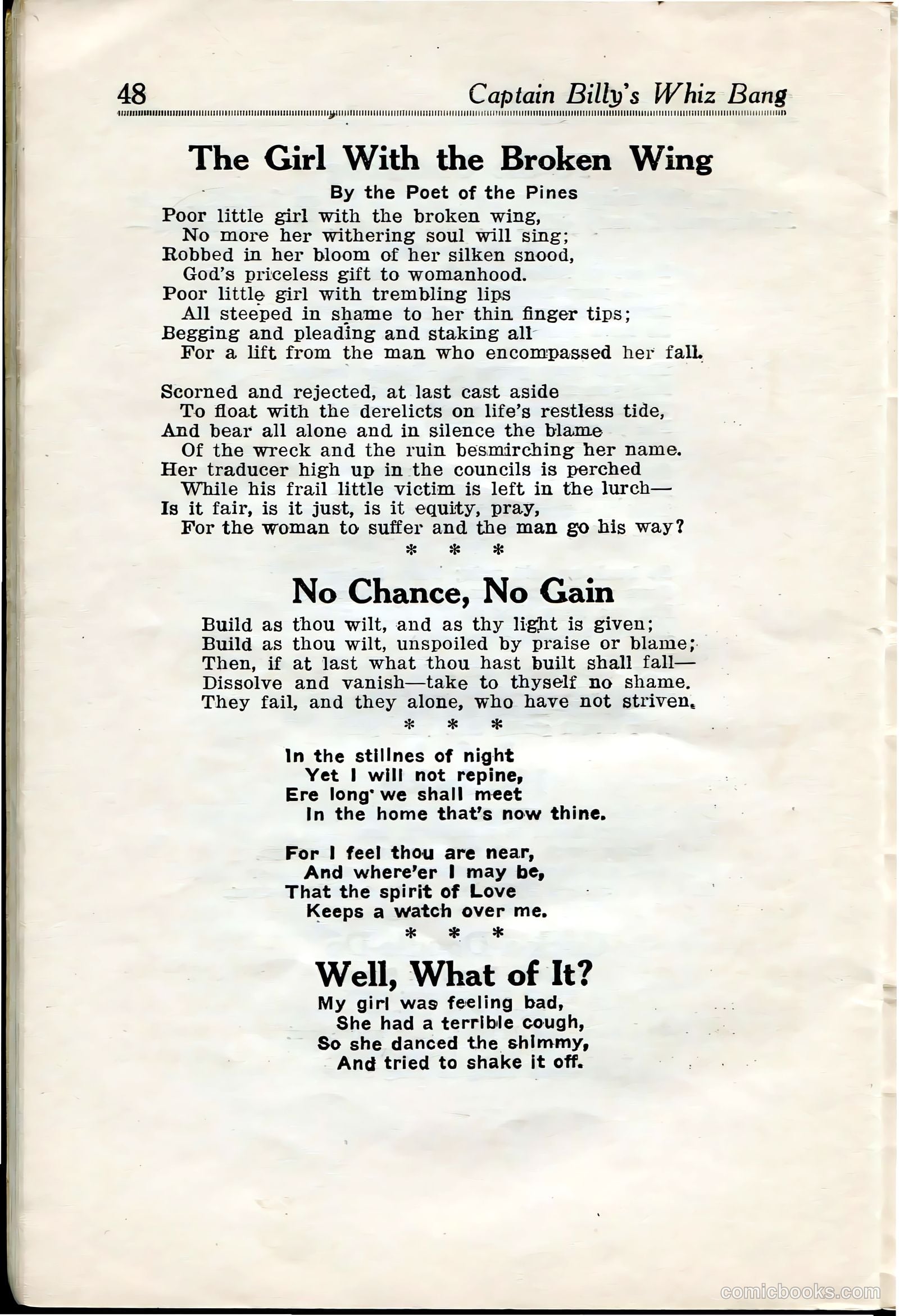
This page contains four poems with contrasting tones. The dominant piece, "The Girl With the Broken Wing," is a serious social critique addressing sexual double standards. It describes a young woman seduced and abandoned by a man of higher social standing who faces no consequences ("high up in the councils"), while she bears all shame and social ruin alone. The poem poses a rhetorical question about the unfairness of this disparity. The other three poems—"No Chance, No Gain," an untitled romantic piece, and "Well, What of It?"—appear unrelated. The last is comedic, describing a girl dancing the "shimmy" (a popular 1920s dance) to cure a cough, likely satirizing both the dance's popularity and folk remedies. The juxtaposition suggests *Whiz Bang* mixed serious social commentary with light humor, reflecting Jazz Age attitudes toward morality and gender.
📄 Transcribed text from this page (OCR, searchable)
Machine-transcribed from the original scan — historical spelling and the odd misread are preserved.
48 Captain Billy's Whiz Bang The Girl With the Broken Wing By the Poet of the Pines Poor little girl with the broken wing, No more her withering soul will sing; Robbed in her bloom of her silken snood, God's priceless gift to womanhood. Poor little girl with trembling lips All steeped in shame to her thin finger tips; Begging and pleading and staking all For a lift from the man who encompassed her fall. Scorned and rejected, at last cast aside To float with the derelicts on life's restless tide, And bear all alone and in silence the blame Of the wreck and the ruin besmirching her name. Her traducer high up in the councils is perched While his frail little victim is left in the lurch— Is it fair, is it just, is it equity, pray, For the woman to suffer and the man go his way? * * * No Chance, No Gain Build as thou wilt, and as thy light is given; Build as thou wilt, unspoiled by praise or blame; Then, if at last what thou hast built shall fall— Dissolve and vanish—take to thyself no shame. They fail, and they alone, who have not striven. * * * In the stillness of night Yet I will not repine, Ere long' we shall meet In the home that's now thine. For I feel thou are near, And where'er I may be, That the spirit of Love Keeps a watch over me. * * * Well, What of It? My girl was feeling bad, She had a terrible cough, So she danced the shimmy, And tried to shake it off.