
Captain Billy's Whiz Bang, May 1922 · page 16 of 68
Captain Billy's Whiz Bang #33 — page 16: what you’re looking at
What you’re looking at
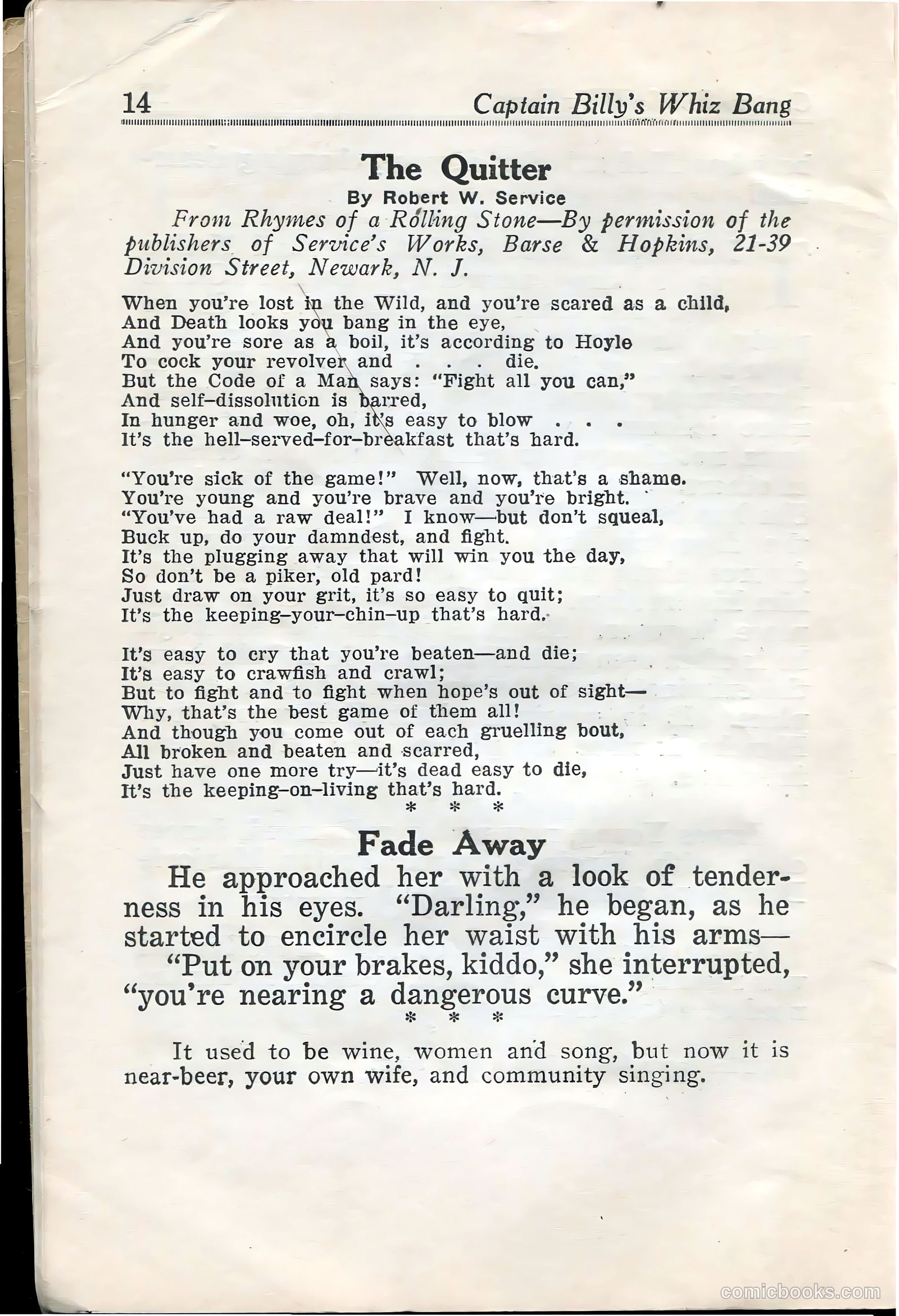
This page contains two pieces of humor typical of 1920s American satire: **"The Quitter"** is a serious poem by Robert W. Service about perseverance and not giving up during hardship. It encourages enduring struggle rather than surrendering to despair or death, with the central message that "it's the keeping-your-chin-up that's hard"—implying survival requires mental fortitude more than physical action. **"Fade Away"** is a brief comedic sketch mocking romantic advances. A man attempts seduction, but the woman deflects with a car-driving metaphor ("brakes," "dangerous curve"), suggesting he's moving too fast. The humor relies on automobile culture references—likely contemporary given the 1920s dating. **The closing joke** satirizes Prohibition-era social decline: pre-Prohibition life featured "wine, women and song" (classical indulgences), but now offers only "near-beer" (weak substitute alcohol), "your own wife" (domestic duty), and "community singing" (wholesome but dull). This reflects widespread frustration with Prohibition's restrictions on entertainment and personal freedom.
📄 Transcribed text from this page (OCR, searchable)
Machine-transcribed from the original scan — historical spelling and the odd misread are preserved.
14 Captain Billy's Whiz Bang The Quitter By Robert W. Service From Rhymes of a Rolling Stone—By permission of the publishers of Service's Works, Barse & Hopkins, 21-39 Division Street, Newark, N. J. When you're lost in the Wild, and you're scared as a child, And Death looks you bang in the eye, And you're sore as a boil, it's according to Hoyle To cock your revolver and . . . die. But the Code of a Man says: “Fight all you can,” And self-dissolution is barred, In hunger and woe, oh, it's easy to blow . . . It's the hell-served-for-breakfast that's hard. “You're sick of the game!” Well, now, that's a shame. You're young and you're brave and you're bright. “You've had a raw deal!” I know—but don't squeal, Buck up, do your damndest, and fight. It's the plugging away that will win you the day, So don't be a piker, old pard! Just draw on your grit, it's so easy to quit; It's the keeping-your-chin-up that's hard. It's easy to cry that you're beaten—and die; It's easy to crawfish and crawl; But to fight and to fight when hope's out of sight— Why, that's the best game of them all! And though you come out of each gruelling bout, All broken and beaten and scarred, Just have one more try—it's dead easy to die, It's the keeping-on-living that's hard. * * * Fade Away He approached her with a look of tender- ness in his eyes. “Darling,” he began, as he started to encircle her waist with his arms— “Put on your brakes, kiddo,” she interrupted, “you're nearing a dangerous curve.” * * * It used to be wine, women and song, but now it is near-beer, your own wife, and community singing.