
Captain Billy's Whiz Bang, May 1922 · page 45 of 68
Captain Billy's Whiz Bang #33 — page 45: what you’re looking at
What you’re looking at
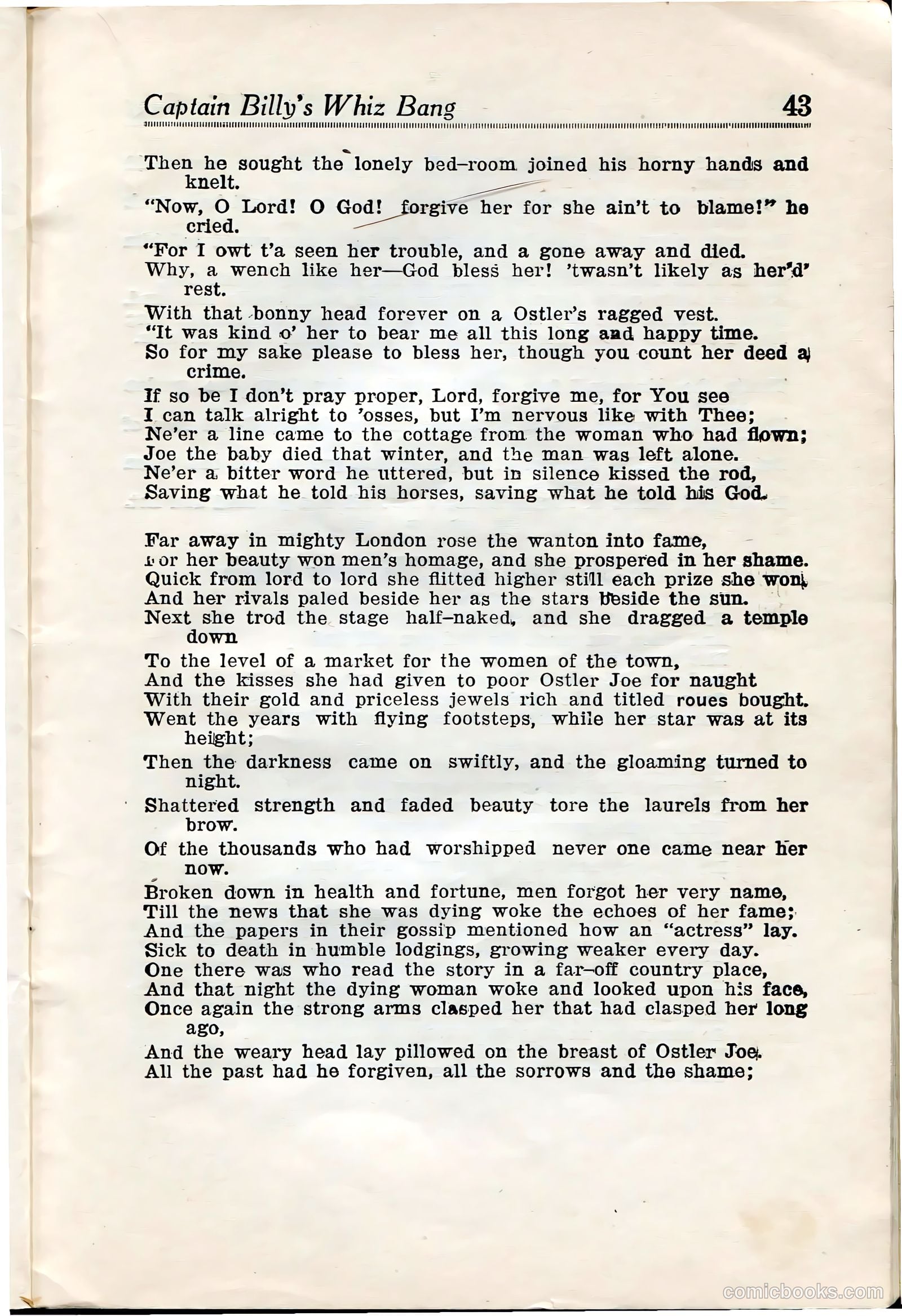
This page contains no cartoon but rather a narrative poem—a morality tale popular in early 20th-century satirical magazines. The story contrasts two characters: "Ostler Joe," a humble, virtuous stable worker, and an unnamed woman who abandons him. The narrative follows a classic Victorian morality framework: the woman leaves Joe (pregnant, implied), he loses their baby to winter, yet forgives her completely. Meanwhile, she becomes a London actress/courtesan, achieving fame through beauty and "shame," performing nearly nude and corrupting public morals. Her wealthy suitors literally purchase the affection she once gave Joe freely. Eventually, poverty and disease claim her. A dying woman in "humble lodgings" turns out to be her—and Joe, reading the news in his "far-off country place," still harbors only forgiveness. The satire targets urban vice, theatrical immorality, and aristocratic decadence while celebrating rural virtue and Christian forgiveness. It reflects period anxieties about actresses, female sexuality, and urbanization.
📄 Transcribed text from this page (OCR, searchable)
Machine-transcribed from the original scan — historical spelling and the odd misread are preserved.
Captain Billy's Whiz Bang 43 Then he sought the lonely bed-room joined his horny hands and knelt. "Now, O Lord! O God! forgive her for she ain't to blame!" he cried. "For I owt t'a seen her trouble, and a gone away and died. Why, a wench like her—God bless her! 'twasn't likely as her'd rest. With that bonny head forever on a Ostler's ragged vest. "It was kind o' her to bear me all this long and happy time. So for my sake please to bless her, though you count her deed a crime. If so be I don't pray proper, Lord, forgive me, for You see I can talk alright to 'osses, but I'm nervous like with Thee; Ne'er a line came to the cottage from the woman who had flown; Joe the baby died that winter, and the man was left alone. Ne'er a bitter word he uttered, but in silence kissed the rod, Saving what he told his horses, saving what he told his God. Far away in mighty London rose the wanton into fame, For her beauty won men's homage, and she prospered in her shame. Quick from lord to lord she flitted higher still each prize she won, And her rivals paled beside her as the stars beside the sun. Next she trod the stage half-naked, and she dragged a temple down To the level of a market for the women of the town. And the kisses she had given to poor Ostler Joe for naught With their gold and priceless jewels rich and titled roues bought. Went the years with flying footsteps, while her star was at its height; Then the darkness came on swiftly, and the gloaming turned to night. Shattered strength and faded beauty tore the laurels from her brow. Of the thousands who had worshipped never one came near her now. Broken down in health and fortune, men forgot her very name, Till the news that she was dying woke the echoes of her fame; And the papers in their gossip mentioned how an "actress" lay. Sick to death in humble lodgings, growing weaker every day. One there was who read the story in a far-off country place, And