
A complete issue · 68 pages · 1922
Captain Billy's Whiz Bang #30
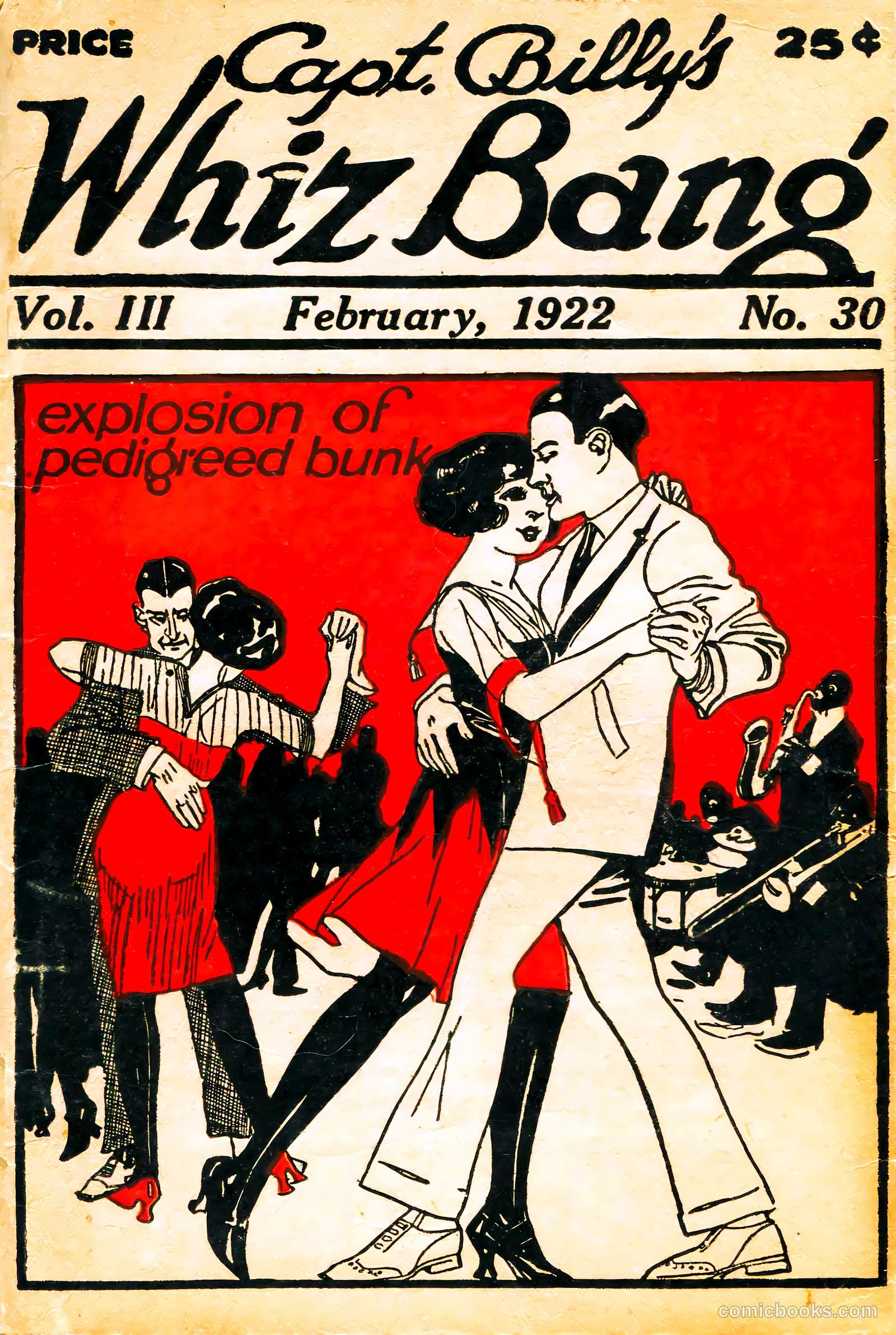
This cover satirizes Jazz Age excess and moral panic. The central couple dances energetically while musicians perform—likely referencing the "jazz craze" that shocked conservative Americans in the early 1920s. The phrase "pedigreed bunk" suggests pretentious or high-class nonsense. The "explosion" imagery conveys the satirical point: established social conventions are literally bursting apart through modern dancing and youth culture. The well-dressed figures (suggesting wealthy respectability) are the ones engaging in this "bunk," mocking the era's anxiety that refined society was abandoning propriety. *Whiz Bang* was a humor magazine known for irreverent social commentary. This cover likely ridicules both the moral outrage over jazz and the hypocrisy of the upper classes who publicly condemned it while privately enjoying it.
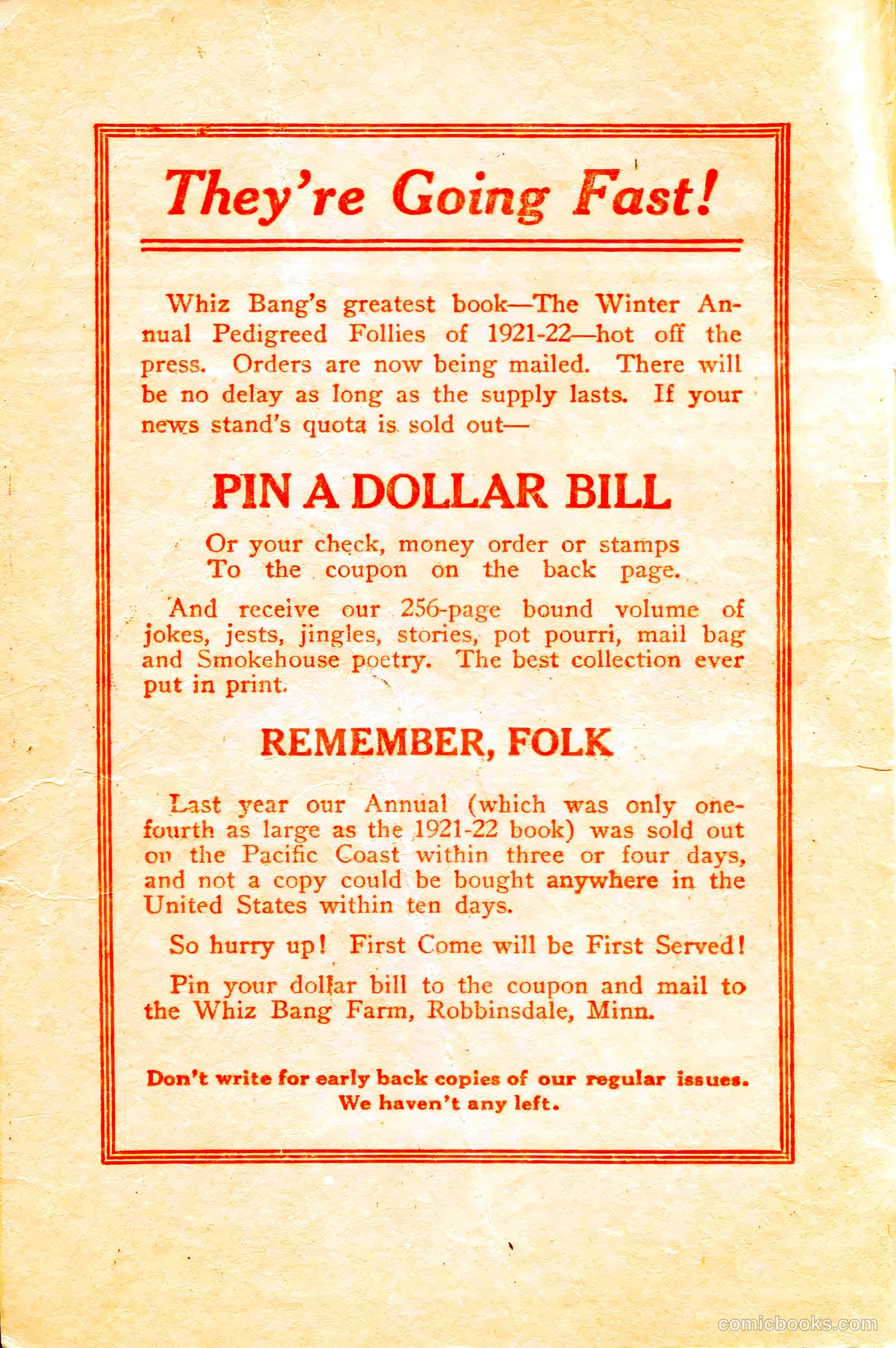
This is primarily a **direct-mail advertisement**, not a political cartoon. It promotes *Whiz Bang's Winter Annual: Pedigreed Follies of 1921-22*, a 256-page humor collection containing jokes, stories, and poetry. The pitch uses urgency marketing typical of early 1920s mail-order campaigns: claiming rapid sellouts, emphasizing scarcity ("First Come will be First Served"), and referencing last year's edition selling out nationwide within days. Readers could order by mailing a dollar bill to the Whiz Bang Farm in Robbinsdale, Minnesota. The language reflects period sensibilities—"Smokehouse poetry" suggests rustic/rural humor; "pot pourri" (miscellany) was standard magazine jargon. The tone is colloquial ("Remember, Folk"), targeting working-class readers accustomed to purchasing humor magazines. There's no identifiable political satire here—this is straightforward commercial promotion using scarcity-based sales psychology.
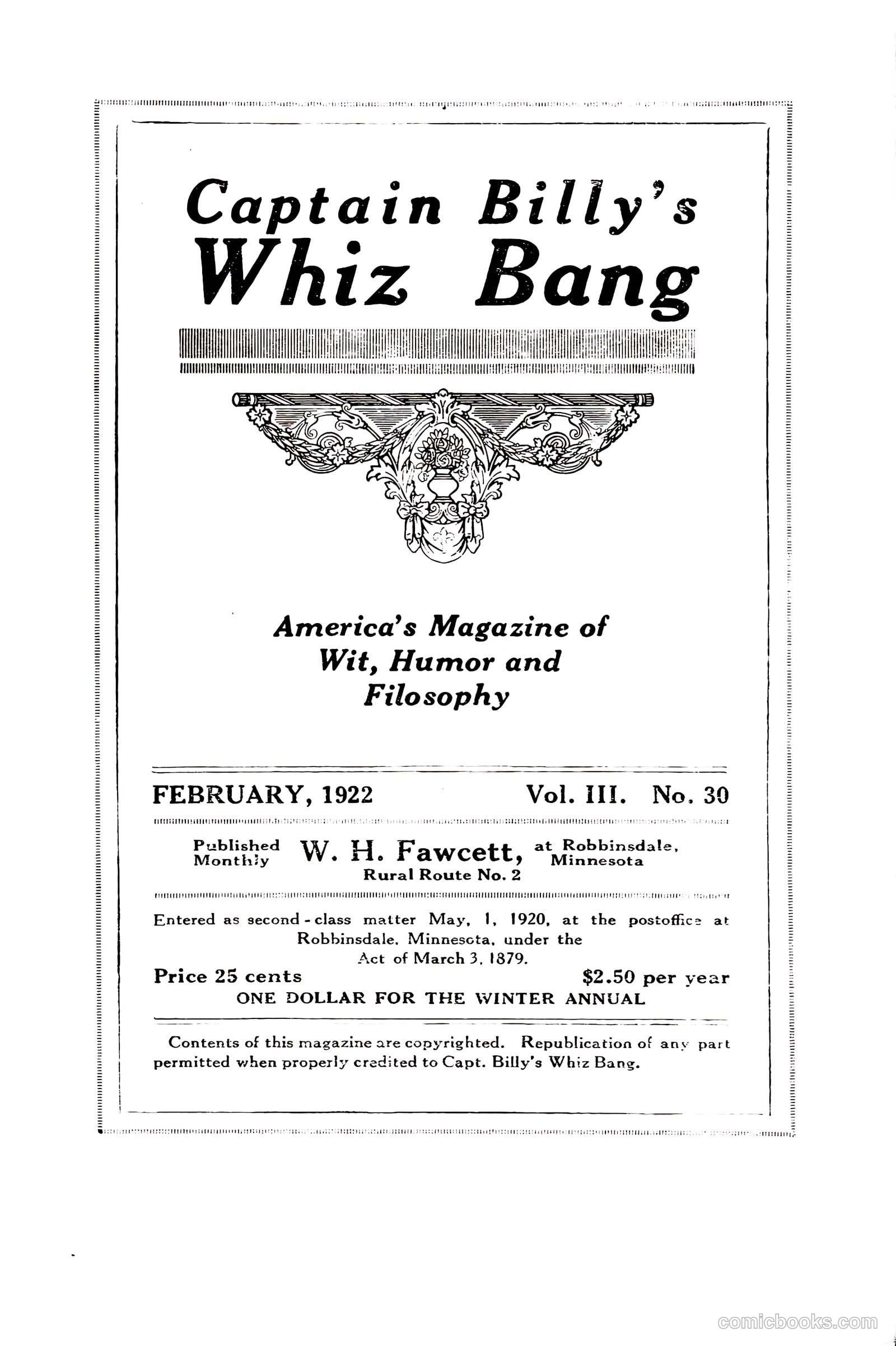
This is a title page for *Captain Billy's Whiz Bang*, a monthly humor magazine published from Robbinsdale, Minnesota. The publication describes itself as "America's Magazine of Wit, Humor and Philosophy," costing 25 cents per issue or $2.50 yearly. The page contains no political cartoons or satirical content—it's purely a cover/masthead identifying the publication's details: publisher W.H. Fawcett, volume III, issue 30, from February 1922. The ornate decorative illustration is generic period design, not a specific cartoon. This appears to be a general-interest American humor magazine typical of the early 1920s, aimed at popular, mass-market audiences.
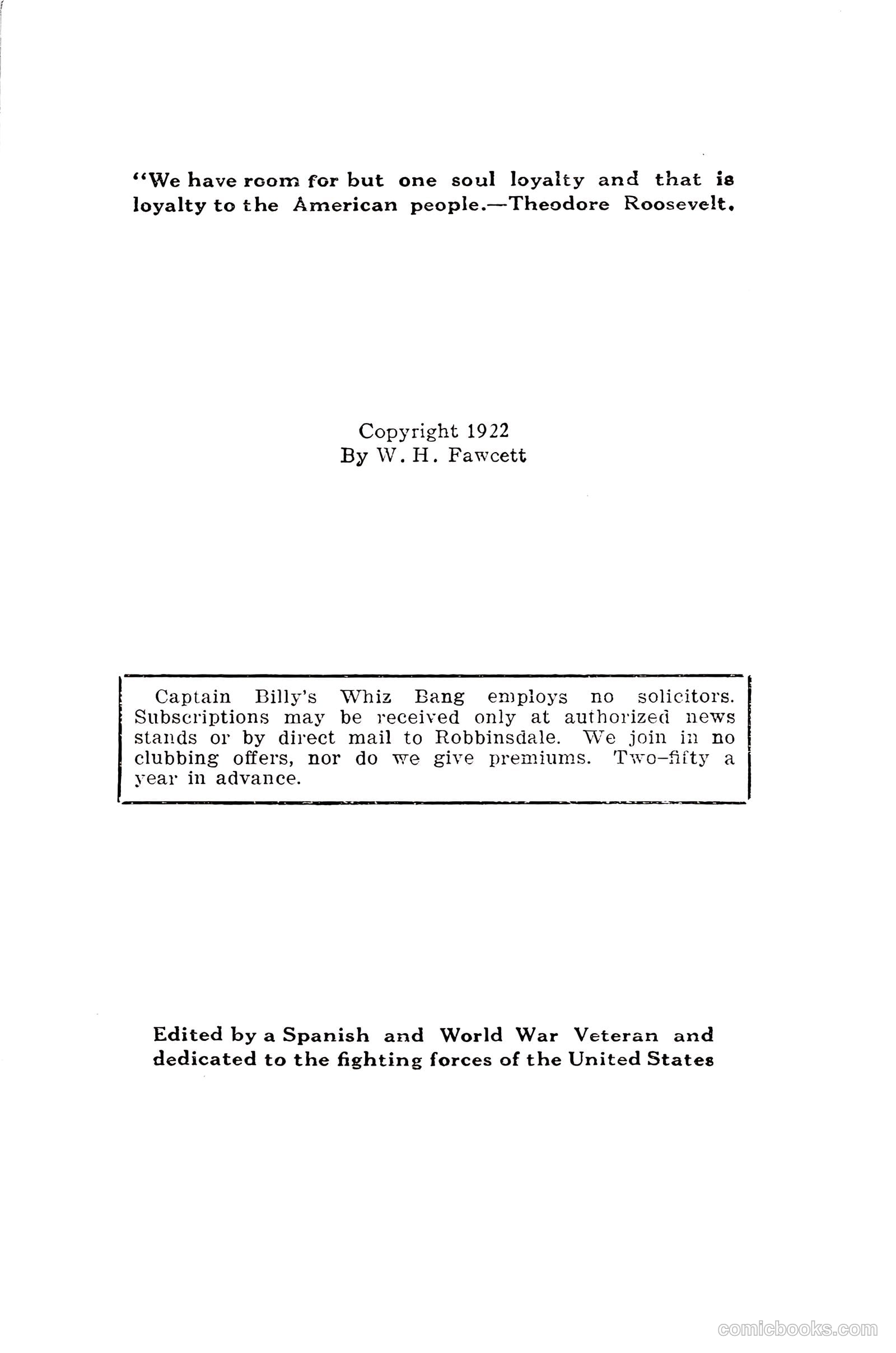
This is a **title/copyright page** from *Captain Billy's Whiz Bang*, a 1922 satirical magazine edited by a Spanish-American and World War I veteran and dedicated to U.S. fighting forces. The page features: - A **Theodore Roosevelt quote** about singular loyalty to America (likely referencing post-WWI concerns about divided allegiances among immigrant communities) - **Copyright and publication information** for W.H. Fawcett - A **subscription notice** explaining the magazine's distribution method and cost (two-fifty yearly, paid in advance) The Roosevelt epigraph reflects early 1920s anxieties about American patriotism and immigration—a common theme in the post-WWI Red Scare period. The page itself contains no cartoon or visual satire, just administrative publication details.
This is a humorous travel narrative by "Bilious Billy," the persona of Captain Billy's Whiz Bang magazine. The piece satirizes the wandering American traveler, mixing complaints about domestic hardships (expensive coal in Minnesota) with frivolous vacation plans (Cuba, Miami Beach, Montreal). The humor relies on exaggeration and non-sequiturs: Billy can't decide where he's going, complains about high heating costs while fantasizing about tropical leisure, and makes absurd comparisons ("sun was hot tamale"). The reference to being "like a wandering Jew" reflects period casual stereotyping. The tone mocks both the restless American urge to travel and the class privilege enabling it. Mentions of "fast horses and saintly senoritas" in Cuba suggest both adventure-seeking and patronizing stereotypes about Caribbean destinations common to 1920s American humor. This is primarily satirical commentary on American leisure culture and travel anxiety rather than political commentary.
This is satirical commentary on **William Jennings Bryan**, the famous politician and three-time presidential candidate who had recently moved to Miami. The author mocks Bryan's association with keeping Florida "bone-dry"—enforcing Prohibition—while ironically noting there are plenty of "damp rascals" (illegal drinkers) around anyway. The joke centers on Bryan's religious activism: he's too busy addressing Baptist conventions and giving Bible talks to socialize, yet the narrator sarcastically credits him with Florida's dry laws while simultaneously contradicting this by finding alcohol readily available. The subsequent Atlanta section satirizes women's fashion choices conflicting with the **Eighteenth Amendment** (Prohibition, ratified 1919). The implication is that Atlanta women's revealing hats/clothing violate the moral standards supposedly upheld by Prohibition advocates—highlighting the hypocrisy of selective moral enforcement. The satire criticizes both Prohibition's ineffectiveness and the religious hypocrisy of its champions.
This page from *Captain Billy's Whiz Bang* contains satirical commentary on Atlanta and Southern society, without illustrations visible here. The humor targets regional stereotypes and prominent figures. **Clayt Robson**, a Georgia lobbyist and political boss, is mocked for not understanding that "damned Yankee" was two words—a joke about Southern provincial ignorance of Northern terminology. The author recounts a conversation with **Cole S. Blease**, former South Carolina governor, who harshly condemns Atlanta as "a hell-hole of perdition" unfit for virtuous women or honest men. The author disagrees, claiming he found Atlanta girls "of true Southern stock—very shy and rather demure." The satire critiques both anti-Atlanta sentiment and romanticized notions of Southern femininity. References to "birds of paradise plume" and cocktails suggest Atlanta's emerging cosmopolitanism clashed with traditional Southern morality—a common *Whiz Bang* theme mocking prudish attitudes and regional pretension.
This page from **Captain Billy's Whiz Bang** (a humor magazine popular in the 1920s-30s) contains satirical anecdotes rather than political cartoons. The first piece references **"Pitchfork" Ben Tillman**, a real South Carolina politician known for inflammatory rhetoric, using his quip about Atlanta's character as a humorous springboard. The author then mocks automobile culture by describing a car crash in Jacksonville, sardonically linking it to mortality—a contemporary anxiety about the dangers of new automotive technology. The second anecdote is self-deprecating hunting humor: the author, claiming to be both a "good farmer" and deer hunter, admits spending ten days unsuccessfully hunting near "Breezy Point Lodge" before finally killing a "spike buck" on the last day. The joke emphasizes his incompetence and the animal's near-human resistance ("almost shook hands with me"). The guide "Panther Pete" (Arthur Foote) appears to be a local character known for trapping—suggesting regional frontier authenticity lending credibility to the tall tale. The humor targets urban/amateur outdoorsmen and emerging car culture.
This page contains three separate humorous anecdotes from *Captain Billy's Whiz Bang*, a 1920s satirical magazine known for ribald humor and social commentary. The second story mocks a suspicious character in San Francisco's red-light district. A young man in a red necktie claims to be a "businessman," but the police officer notes his peculiar walk—suggesting he's engaged in illegal activity (likely prostitution or drug dealing). The joke's punchline—"you don't know what kind of business I'm in!"—is a veiled reference to vice work. He receives thirty days jail time. The third anecdote contrasts Prohibition-era America with Canada and Mexico. In Montreal, the narrator legally purchased champagne (Canada hadn't enacted Prohibition), while in Tiajuana, Mexico, alcohol was also freely available. The implication: American laws were absurdly restrictive compared to neighboring countries, making the U.S. appear foolishly puritanical. Both stories satirize early 1920s law enforcement and Prohibition's unpopularity among satirists.
This is a satirical piece from *Captain Billy's Whiz Bang*, a post-WWI humor magazine. The main political reference is **Andrew J. Volstead**, the Minnesota congressman who authored the Volstead Act (1919), which enforced Prohibition. The satire mocks Prohibition's failure: the author claims to have found abundant illegal "mountain dew" (whiskey) in rural Minnesota—paradoxically more alcohol than during pre-Prohibition times. This highlights the law's ineffectiveness and the irony that banning alcohol increased bootlegging. The humorous poem listing strange animals (jack-asses, wild boars) encountered while deer hunting is comedic filler typical of the magazine's style. The anecdote about hogs acting strangely around trees is setup for what appears to be a continuation on another page—likely leading to a punchline about the hogs' actual behavior. The overall tone criticizes Volstead and Prohibition as counterproductive federal overreach.
This page contains humorous anecdotes and folk verses typical of early 20th-century American comic magazines. The content includes: 1. **Old Man Foss's woodpecker story**: A practical joke setup where Foss trained chickens to respond to rapping (not calling) after losing his voice. The humor lies in the unintended consequence—woodpeckers now compulsively peck, mimicking the sound. 2. **The old gray mare song**: A nostalgic childhood ditty about a horse sitting on wooden harness parts (single tree, whipple tree). The joke is the repetitive, absurd lyrics. 3. **Minnesota hunting camp song**: A crude folk ditty about sticking a finger in a woodpecker's hole, with the bird's exasperated response ("Take it out"). This is ribald humor typical of the era's working-class culture. 4. **Street car anecdote**: Begins an incomplete story about a woman with a poodle, seemingly setting up another humorous observation. The page showcases rural American humor, folk traditions, and working-class comedy of the 1920s-30s era.
This page from the satirical magazine contains several short humorous anecdotes mocking social conventions and everyday frustrations: **The opening joke** satirizes matrimonial pressure—a man suggesting an unmarried woman would look better holding a baby, which she dismissively rebuffs. **The "Chief Bloberger" section** mocks the "hobo problem" of Depression-era America: vagrants traveling rail lines, described as unemployable, dangerous, and burdensome to rural communities who must feed them or face property destruction. **The "Extra! Extra!" announcement** is absurdist humor announcing an impossible stunt (diving into concrete while playing ukulele), satirizing both sensational news and the absurdity of fundraising gimmicks. The charity for "starving plumbers of Chicago" appears to be a nonsensical punchline. **The final anecdote** (text cuts off) appears to be setting up a pun about the salesman trying a "sailor" (hat style) on the wife—likely implying the narrator misunderstood "sailor" as a person rather than a hat type. The overall tone is crude, slapstick humor typical of 1920s men's magazines.
This page from *Captain Billy's Whiz Bang* (a satirical magazine) presents anecdotal humor rather than a political cartoon. The text explains the origin story of H.A. D'Arcy's famous poem "The Face Upon the Floor" (also known as "The Face Upon the Barroom Floor"). The narrative describes an 1887 incident in a New York saloon where a derelict beggar interrupted a table of theater managers, requesting a drink. After someone offered him whisky, the bartender Joe Schmidt ejected him forcibly. The piece treats this as a touching human moment that inspired Darchy's sentimental poem. For modern readers: this reflects late-19th-century attitudes toward poverty and charity—simultaneously pitying the homeless while depicting their removal as comedic. The "satire" is genteel, focused on theater-world anecdotes rather than sharp social critique. The magazine balanced crude humor with nostalgic storytelling about New York's theatrical past.
This page from **Captain Billy's Whiz Bang** (a popular early-20th-century humor magazine) contains a first-person narrative rather than a cartoon. The author recounts a saloon incident where a destitute man—described as a fallen artist—is attacked by a terrier named "Toby" that chases poorly dressed people. The story satirizes **working-class charity and respectability**: after the man is knocked down, patrons secretly place coins in his coat so he won't feel humiliated by receiving charity. This touches on the author's broader point about distinguishing between "professional beggars" and talented individuals fallen on hard times. The piece becomes sentimental when the author writes a poem about the incident, published in the *New York Dispatch*. Joe Schmidt (the saloon keeper) is so moved he buys 100 copies and sends 25 to Buffalo Bill's company—suggesting the story achieved notable commercial success. The satire targets both **sentimental magazine culture** and **American attitudes toward poverty and dignity**.
This page from the satirical magazine contains three separate humor items: 1. **Editorial note** on poet D'Arcy's work, discussing his famous poem "The Face Upon the Floor" (a sentimental narrative poem from the 1890s about a derelict). The editor denies the poem caused Prohibition, emphasizing it's moral commentary, not temperance advocacy. 2. **"Gus" anecdote**: A crude joke about a hired hand interrupting an affair. The "intruder" (the husband) casually exits with a flippant remark, treating the situation as routine. The humor relies on unexpected nonchalance about infidelity. 3. **"Ikey" anecdote**: A joke about an absent-minded city worker hired as a farmhand. The setup suggests the punchline will reveal foolish behavior with a horse, though the text cuts off mid-sentence. These items reflect typical *Whiz Bang* content: rural/urban character humor, sexual innuendo, and slapstick scenarios targeting working-class audiences.
This page from the satirical magazine contains several brief humorous sketches typical of early 20th-century American comic writing: **"The Wa-hoo-wa Bird"** presents a tall tale about an exotic, fictional bird from Borneo that mates only once per century, then celebrates atop a rubber tree. The joke appears to mock both tall-tale storytelling and romantic sentimentality—the bird's ecstatic cry "My Gawsch, Mamma, ain't love grand!" uses exaggerated dialect humor common to the era. **"Deciding the Race"** relies on a simple con-artist setup: Pat proposes a race where he'll mark the tree if he wins, but Mike must erase the mark if he wins first—creating an impossible situation for Mike. **"The Old Boy's Chatter"** contains crude physical humor about marrying a bow-legged woman (making her physical defect visible) and a mild joke about men prioritizing appearance on weekends. These sketches exemplify Whiz Bang's bawdy, vaudeville-influenced humor style popular with working-class audiences.
This page from the satirical magazine contains several crude jokes typical of 1920s humor: **"This Bends in the Middle"** mocks bow-legged girls, making double-entendre jokes about their physical appearance and what Santa put in their stockings (implying leg braces or medical devices). **"The Charity Bazaar"** plays on a youth's confusion when told he'd "get the girl" with a pie purchase at an auction—the joke implying the pie itself *is* a euphemism for the girl. **"Shed Tears, Brothers"** appears to reference a criminal quitting the "holdup game," with the final line's "garter stretched out on the floor" suggesting either a woman departing or a double meaning about abandoned criminal life. **"Our Monthly Maxim"** is a simple pun about bells sounding the same regardless of context. The humor relies heavily on physical appearance jokes, sexual innuendo, and crude wordplay—typical of this era's "men's humor" magazines that mixed lowbrow comedy with mild irreverence toward authority.
This page contains three short humorous anecdotes typical of 1920s American magazines: **"Parlor Story"** mocks dialectal speech through a misunderstanding: a waiter mishears "eliminate" as "liminate," and a Black chef (referred to with period slurs) comically refuses to perform a nonsensical task. The joke relies on stereotypical dialect humor. **"Speaking About Atrocities"** is a train-robbery joke where a female passenger, annoyed at being excluded from robbery, demands equal treatment from the bandits—inverting expected chivalry for comedic effect. **"Pat's Practical Piety"** presents Irish ethnic humor: "Pat" crosses thin ice while alternating between praising God and the devil with each step, then dismisses both upon reaching safety. This satirizes superficial religiosity and pragmatism. All three reflect early-20th-century American humor conventions built on ethnic/racial stereotypes and dialect comedy now considered offensive.
This page contains three unrelated joke segments typical of early 20th-century American humor magazines: 1. **"Useless Effort"**: Mocks Irish tourists through the "Paddy Ryan" character (a common ethnic stereotype of the era). The joke plays on illogical reasoning—the guide brings him up a mountain to view a valley, defeating the purpose. 2. **"And He Got It"**: A burglar joke where a policeman sarcastically tells a safecracker he's "working too hard" and needs "arrest"—a pun on overexertion versus legal consequences. 3. **"It Rained Keys, Bo!"**: A risqué joke implying the narrator received multiple offers from other women when waiting at the apartment, rather than from the original girl. The final line is self-aware commentary about joke magazines' limitations. These are simple, pun-based humor pieces targeting working-class readers, with light mockery of Irish immigrants and criminal types—standard fare for period humor publications.
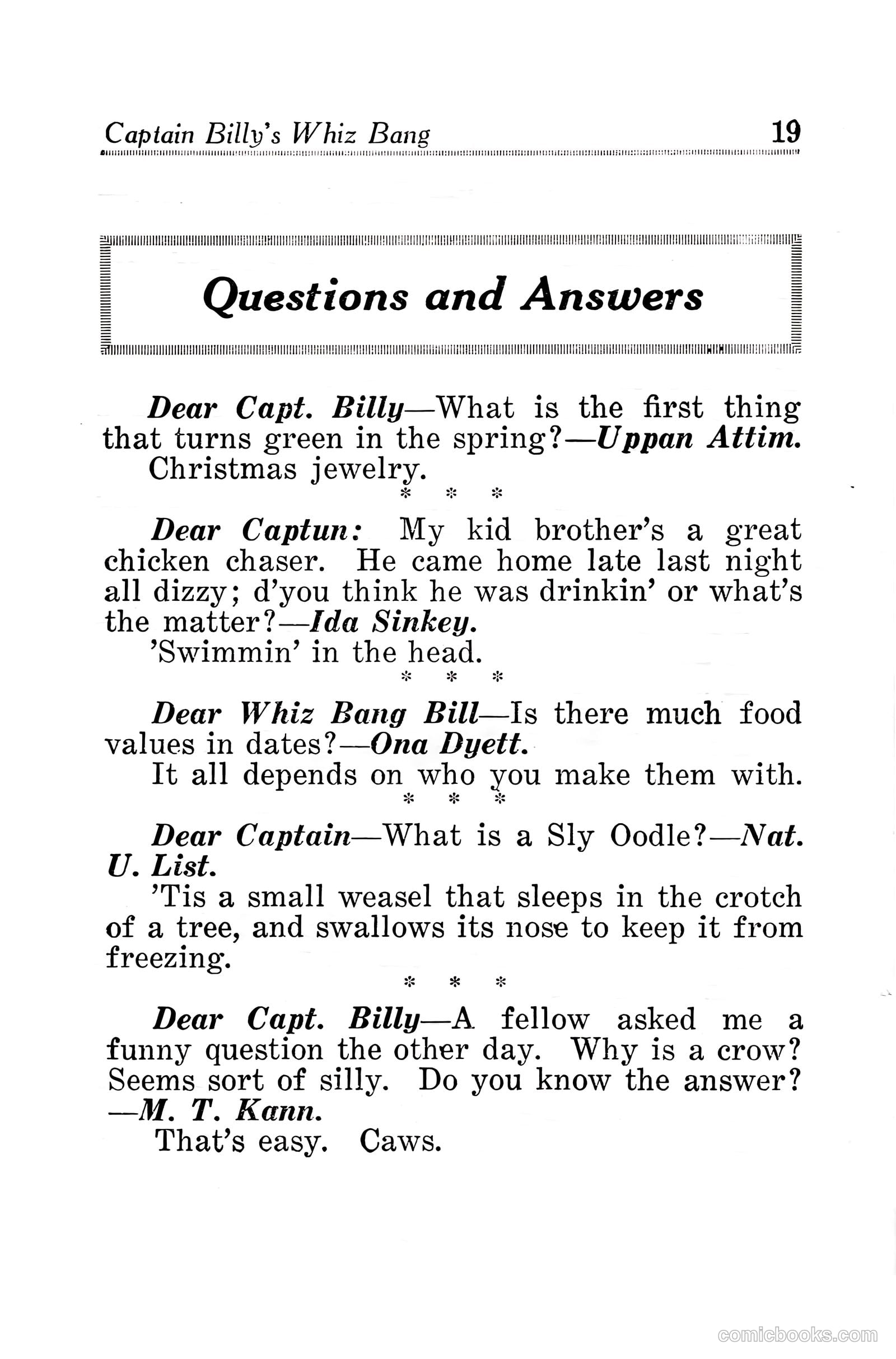
This is a humor page from *Captain Billy's Whiz Bang*, a popular American satirical magazine (1919-1932). It's a "Questions and Answers" advice column featuring intentionally absurd or risqué jokes rather than genuine advice. The humor relies on double meanings and wordplay: "Christmas jewelry" turns green (implying cheap costume jewelry), a dizzy chicken-chaser has "swimmin' in the head" (lightheaded), food values in "dates" depend on the dating partner (sexual innuendo), and "Why is a crow?" is answered with "Caws" (a pun: a crow's sound). The fake definition of "Sly Oodle" is pure nonsense. The bylines use pun names ("Uppan Attim," "Ona Dyett," "Nat. U. List") reinforcing the joke format. This was mainstream humor of the 1920s: risqué but not explicit, relying on readers catching double meanings and appreciating irreverent irrelevance.
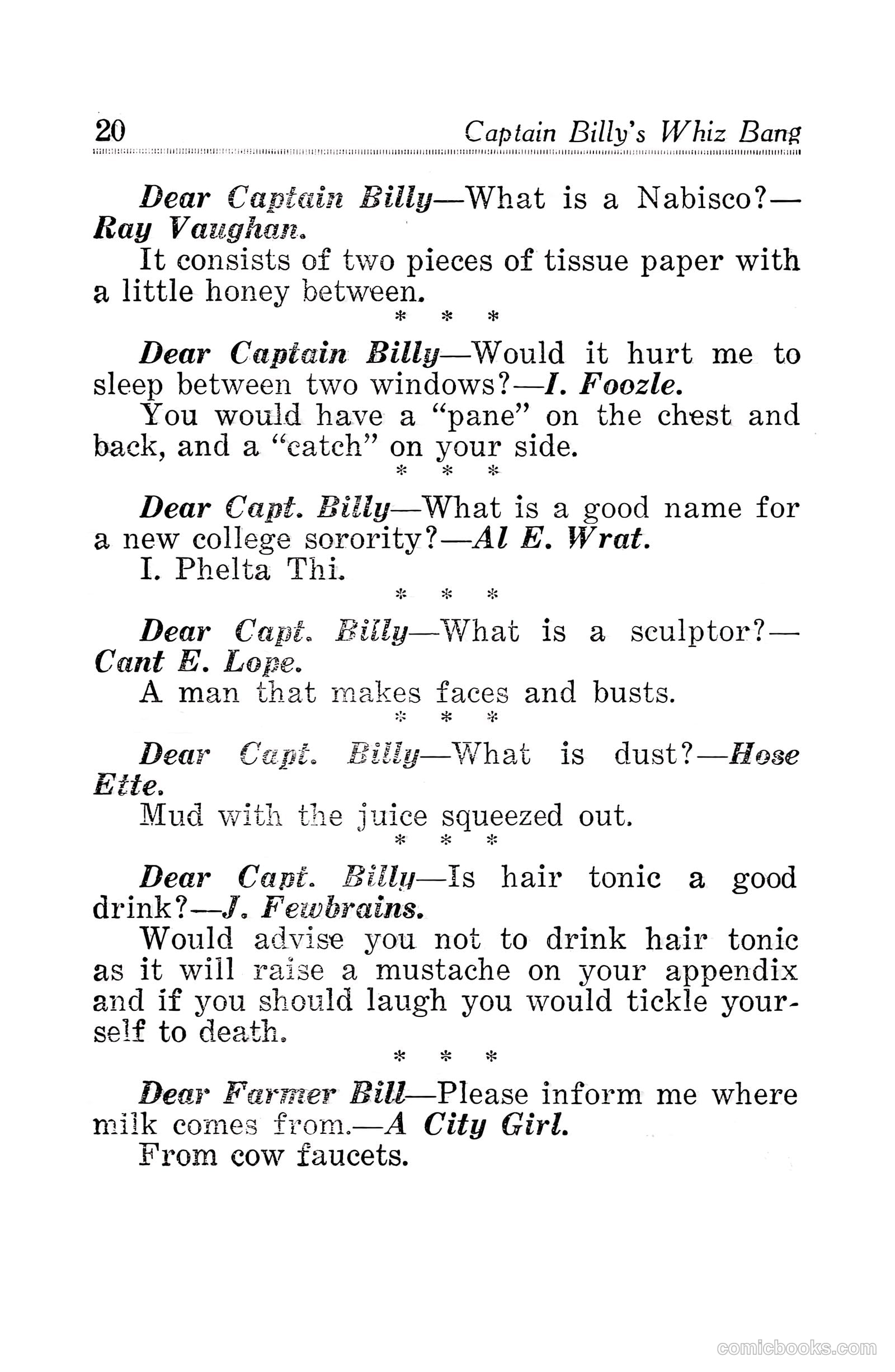
This is a humor advice column featuring pun-based jokes typical of 1920s American satirical magazines. The format mimics genuine advice columns, but each answer is a deliberate wordplay joke rather than sincere guidance. Examples of the humor: - **Nabisco joke**: Plays on the cookie brand name, substituting a nonsensical definition using "tissue paper" and "honey" - **Windows pun**: "Pane" (window glass) vs. "pain" (physical hurt); "catch" references catching cold - **Sorority name**: "I. Phelta Thi" sounds like "I felt a thigh"—suggestive humor - **Dust definition**: Absurdist wordplay ("mud with juice squeezed out") - **Hair tonic**: Ridiculous medical scenario for laughs - **Cow faucets**: Mocks urban ignorance about farm/food origins The recurring "Dear Captain Billy" framing and fake reader names (Ray Vaughan, Al E. Wrat, Hose Ette—all puns) signal this is intentional comedy. The column targets readers seeking witty, crude humor rather than actual advice.
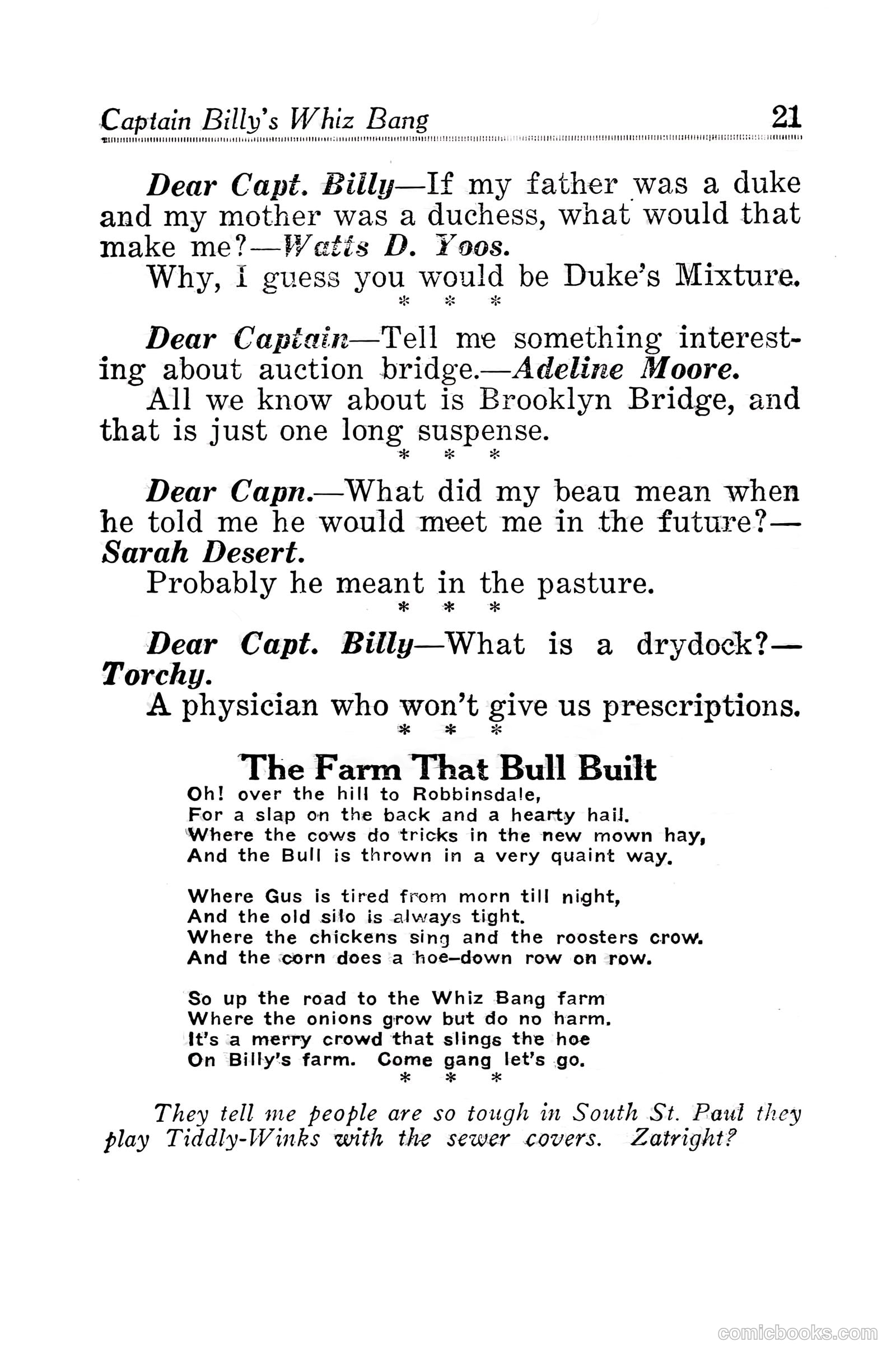
This page from *Captain Billy's Whiz Bang* (a 1920s humor magazine) consists of a "Dear Captain" advice column with humorous Q&A exchanges and a poem celebrating the magazine's namesake farm. The jokes rely on wordplay and double meanings: "Duke's Mixture" puns on a cigarette brand; the Brooklyn Bridge joke mocks its famous complexity; "pasture" plays on "future"; and the drydock joke conflates a dry-dock (ship repair facility) with a doctor refusing prescriptions. The poem advertises the Whiz Bang farm near Robbinsdale, Minnesota with folksy rural imagery. The final joke about South St. Paul residents being so "tough" they use heavy sewer covers as game pieces reflects period American humor about regional toughness and working-class culture. The satire is gentle and domestic rather than political—typical of magazine humor targeting mainstream readers with puns, rural nostalgia, and gentle mockery of contemporary life and slang.
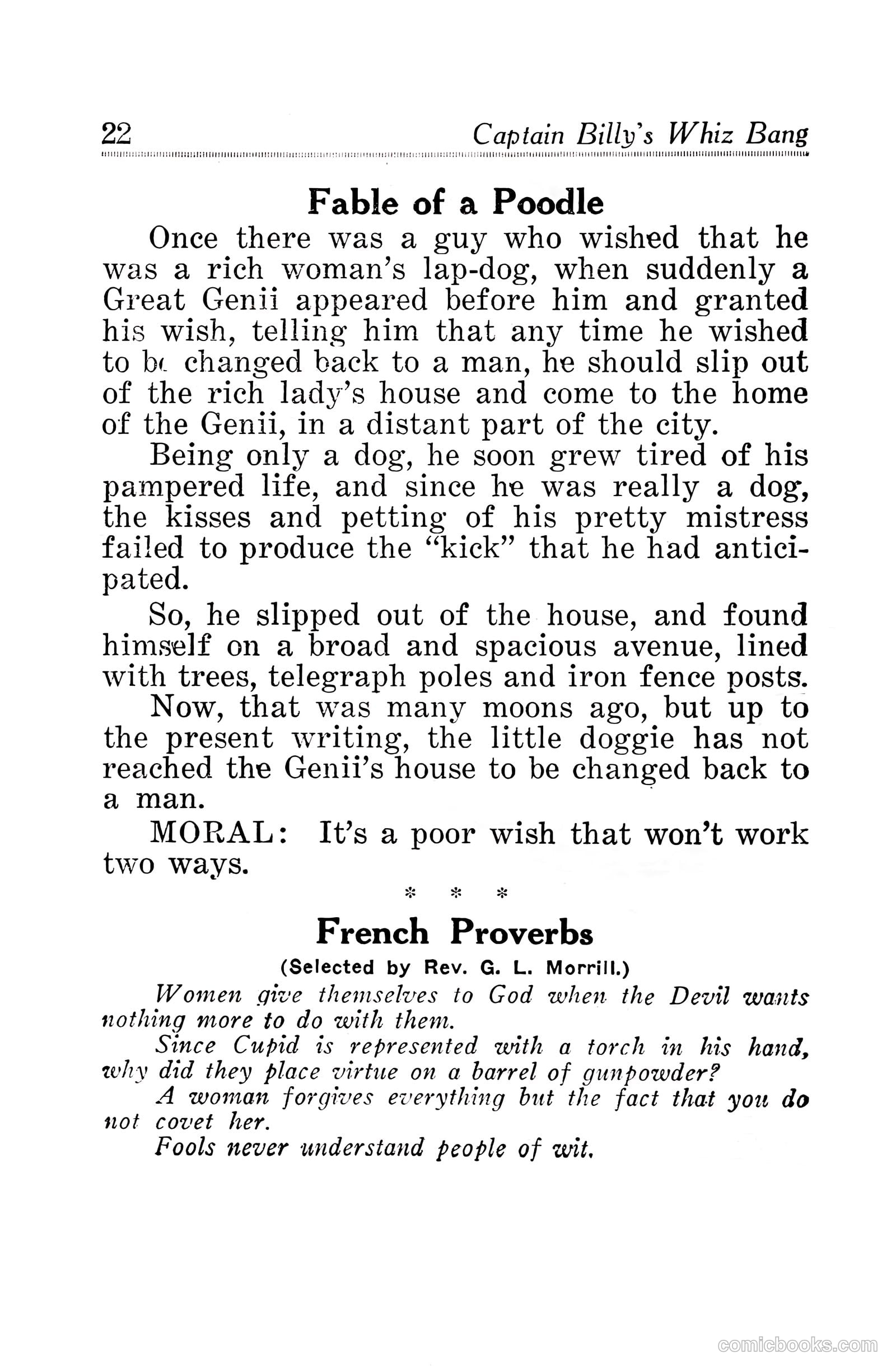
This page contains two satirical pieces with cynical takes on human nature and desire. **The Poodle Fable** is a morality tale about a man who wishes to become a rich woman's lap-dog but grows bored with pampering—he craves excitement ("the kick") that affection cannot provide. When he leaves to reverse the wish, he never returns, suggesting he's become lost or simply prefers his dog existence. The moral—"It's a poor wish that won't work two ways"—means desires often have unforeseen consequences or reveal our true nature. **The French Proverbs** section offers misogynistic and cynical observations: women are discardable to the Devil; virtue is dangerously fragile; women are unforgiving of indifference rather than infidelity; and fools cannot comprehend intelligent people. Both sections reflect *Whiz Bang*'s tone: irreverent, skeptical of human motives, and dismissive particularly of women's character. This represents 1920s men's magazine humor—crude, cynical, and designed to amuse readers through shared contempt for pretense and romantic idealism.
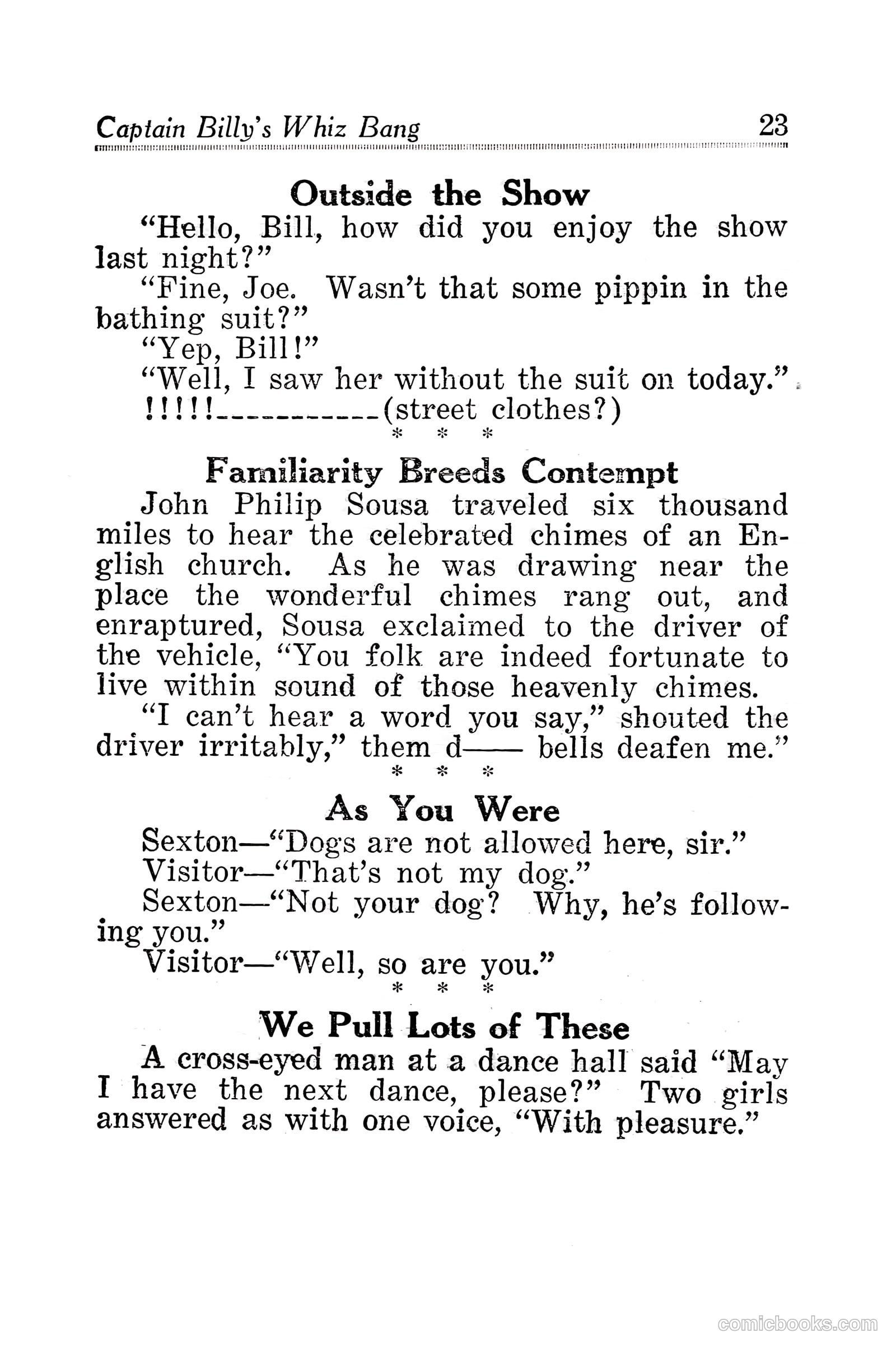
This page from the satirical magazine contains four brief joke anecdotes targeting social hypocrisy and human nature: **"Outside the Show"** jokes about male perspective—a man claims to have seen an attractive woman in street clothes after seeing her in a bathing suit, implying ordinary clothing is somehow disappointing. **"Familiarity Breeds Contempt"** features composer John Philip Sousa, who traveled to hear famous English church bells, only to learn the locals resent them as noise. The joke: what's extraordinary to outsiders becomes annoying to those accustomed to it. **"As You Were"** plays on a church sexton's hypocrisy—he objects to a dog following someone but doesn't notice he himself is following them. **"We Pull Lots of These"** jokes about a cross-eyed man's misfortune: two girls accept his dance invitation "with pleasure," but the implication is they're mocking his appearance rather than genuinely interested. The humor relies on irony, social awkwardness, and human inconsistency typical of early 20th-century American humor magazines.
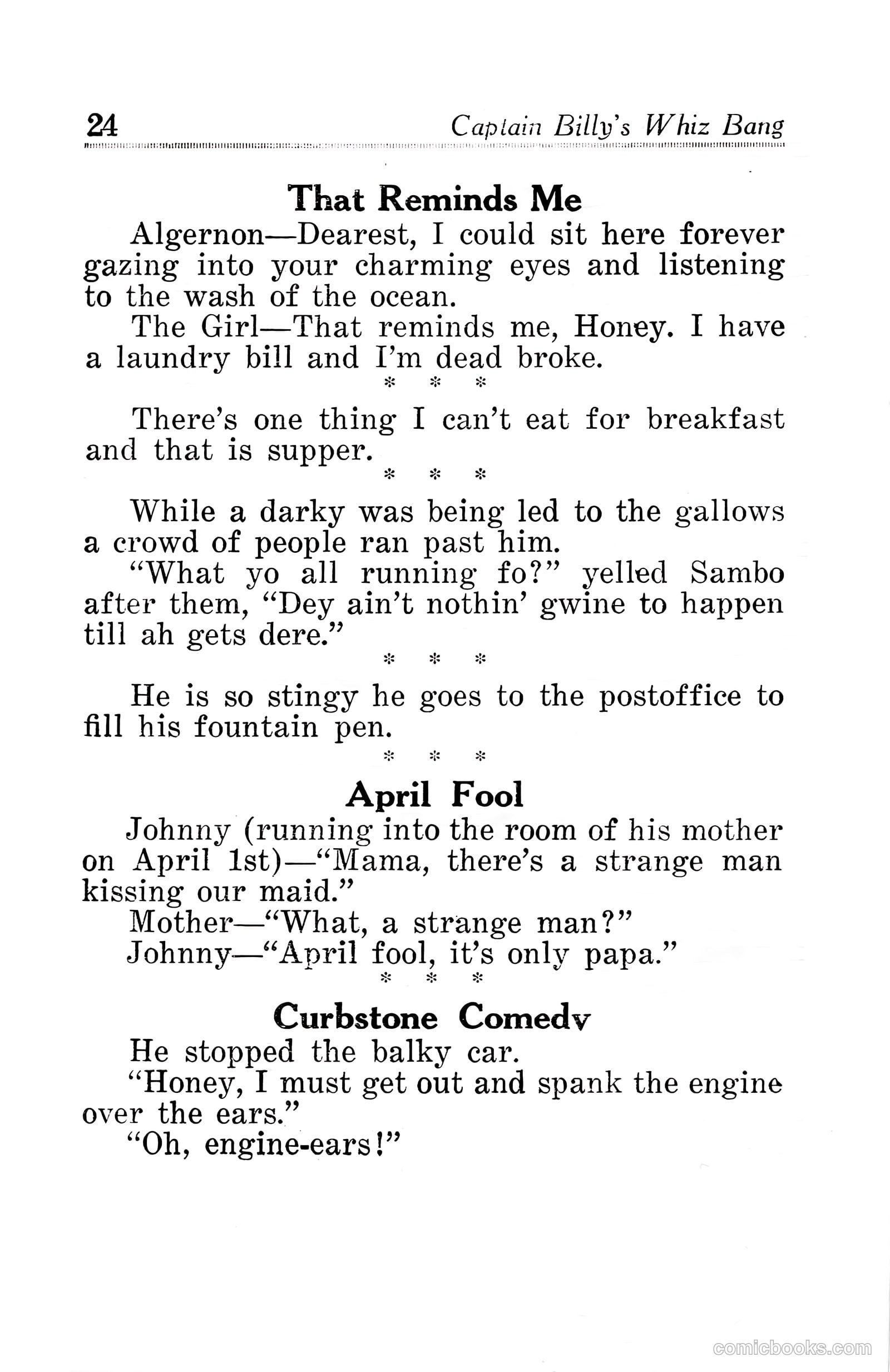
This page contains six brief jokes typical of 1920s American humor magazines. The content reflects period attitudes and conventions: **"That Reminds Me"** uses romantic sentiment undercut by practical money concerns—a common joke format about marriage. **The gallows joke** employs racial dialect and minstrelsy stereotypes common in early 20th-century American humor, featuring a caricatured Black man ("darky," "Sambo") in a dark scenario played for laughs. **"April Fool"** trades on marital infidelity as humor—the punchline relies on the unexpected revelation that the "strange man" is the unfaithful husband. **"Curbstone Comedy"** uses a pun: "engine-ears" sounds like "engineer," playing on the wife's literal interpretation of "spank the engine over the ears." These jokes reflect *Whiz Bang*'s lowbrow, rapid-fire comedic style. The racial material is particularly jarring to modern readers—it represents accepted entertainment conventions of that era that are now recognized as offensive and dehumanizing.
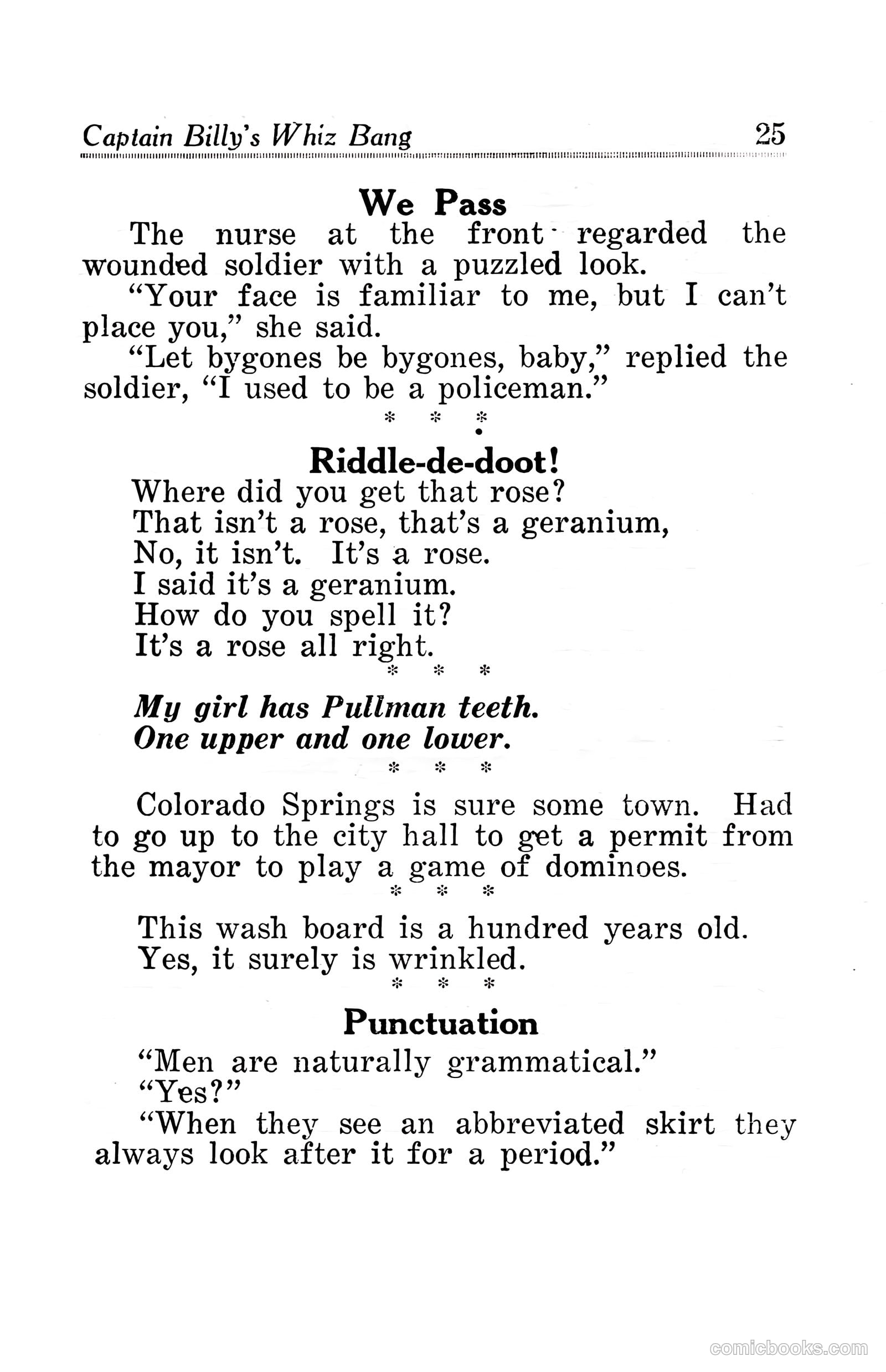
This page from the satirical magazine contains several short humorous sketches typical of the 1920s-era publication. The opening "We Pass" joke plays on post-WWI awkwardness: a nurse encounters a wounded soldier she recognizes but can't place—he's a former policeman, suggesting wartime role changes or the difficulty of reintegrating veterans into civilian life. The remaining pieces are absurdist humor: a circular riddle about mistaking a geranium for a rose, a pun about "Pullman teeth" (likely referencing Pullman train cars and missing teeth), and bureaucratic satire about needing mayoral permits for dominoes in Colorado Springs. The final "Punctuation" joke is a visual pun: "abbreviated skirt" (a short skirt revealing legs) causes men to look for a "period"—playing on grammar terminology and contemporary anxiety about women's shorter hemlines, which were considered scandalous in the 1920s.
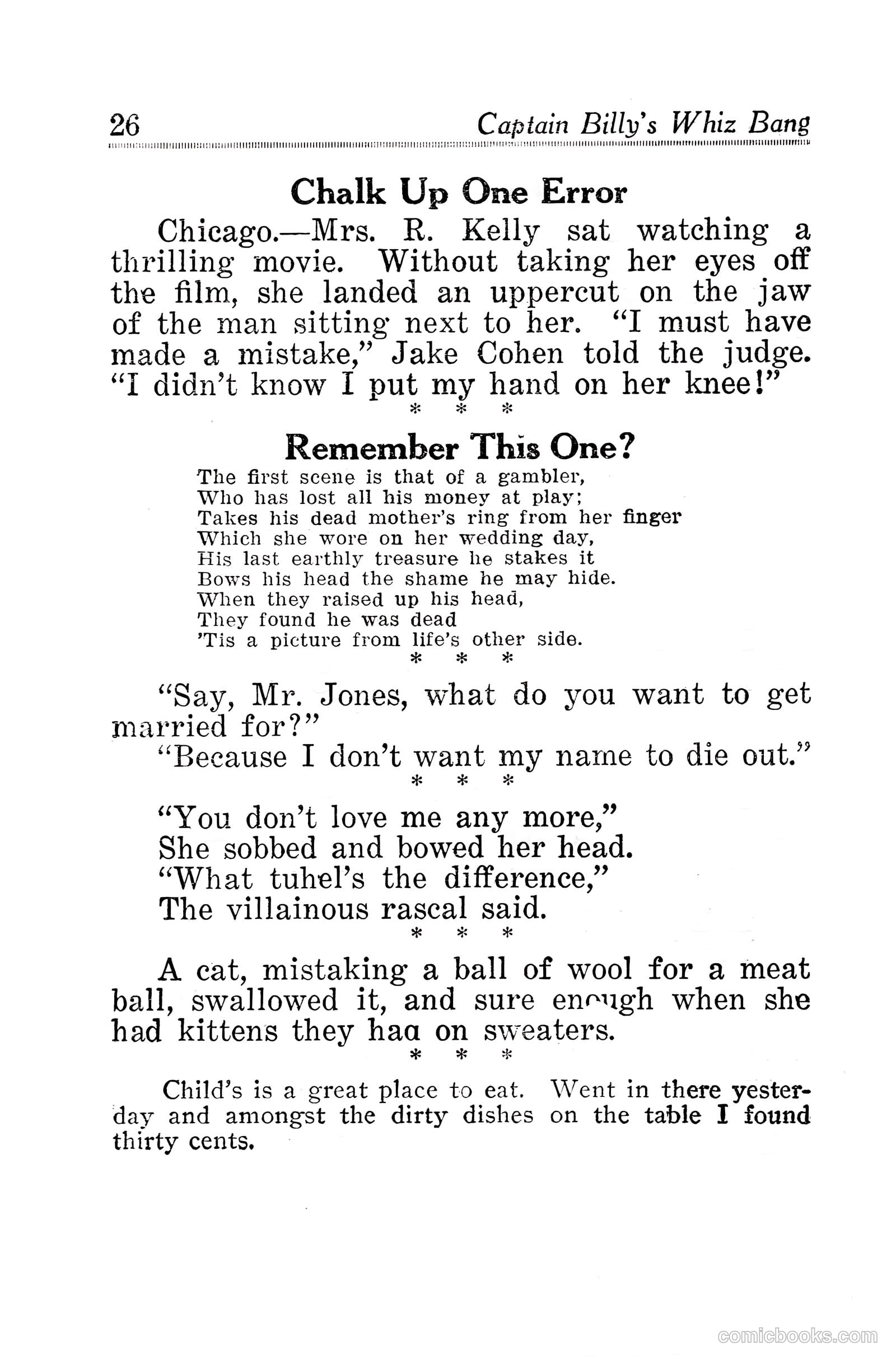
This page from the satirical magazine contains several brief humorous anecdotes and jokes typical of early 20th-century American humor: **"Chalk Up One Error"** presents a domestic misunderstanding joke where a woman accidentally strikes a man at a movie theater, and he claims ignorance about touching her knee—a common setup for period humor about public conduct and physical boundaries. **"Remember This One?"** includes a melodramatic poem about a desperate gambler staking his dead mother's ring and dying—representing the "morality tale" genre popular in entertainment of the era. The remaining items are short gags about marriage, relationships, and a restaurant's cleanliness standards—standard vaudeville-style humor. The overall tone is lighthearted, relying on slapstick, wordplay, and observational humor. There appear to be no political cartoons on this page; it's primarily joke content reflecting working-class urban American life and period attitudes toward courtship, gambling, and dining establishments.
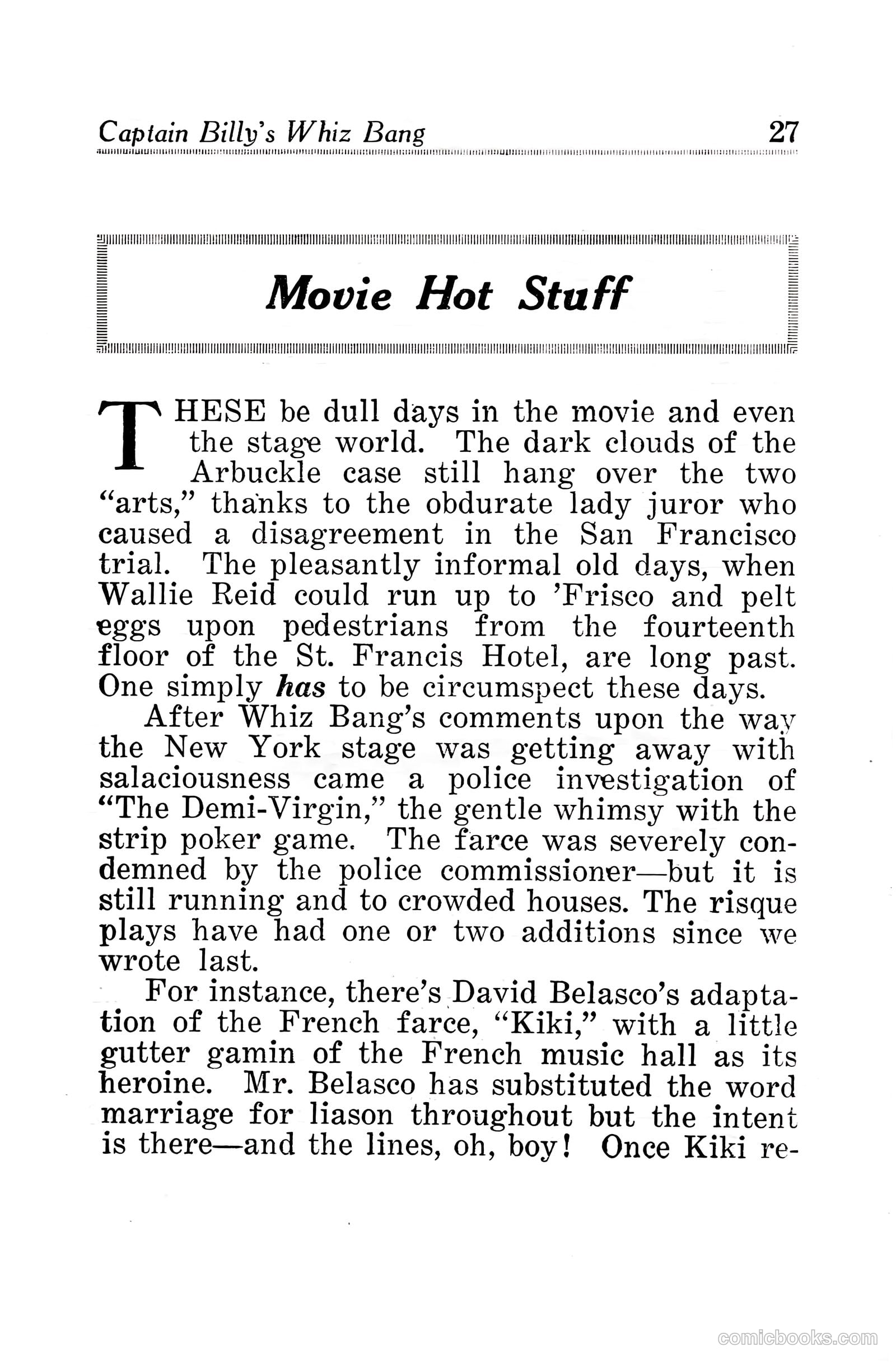
This column discusses scandals affecting 1920s entertainment. The **Arbuckle case** references comedian Roscoe "Fatty" Arbuckle, accused of rape in San Francisco—a trial ending in mistrial due to jury disagreement, damaging Hollywood's reputation. **Wallie Reid** was a popular actor whose public misbehavior (the egg-throwing anecdote illustrates his former recklessness) contrasted with post-scandal industry self-consciousness. The piece criticizes how authorities selectively police entertainment: "The Demi-Virgin" (a Broadway play featuring strip poker) faced police investigation and condemnation yet remained popular. David Belasco's adaptation of French farce "Kiki" uses linguistic camouflage—substituting "marriage" for "liaison"—to evade censorship while maintaining sexually suggestive content. The satire mocks both the entertainment industry's hypocrisy and moral guardians' ineffectual censorship, suggesting audiences still flock to risqué shows regardless of official disapproval.
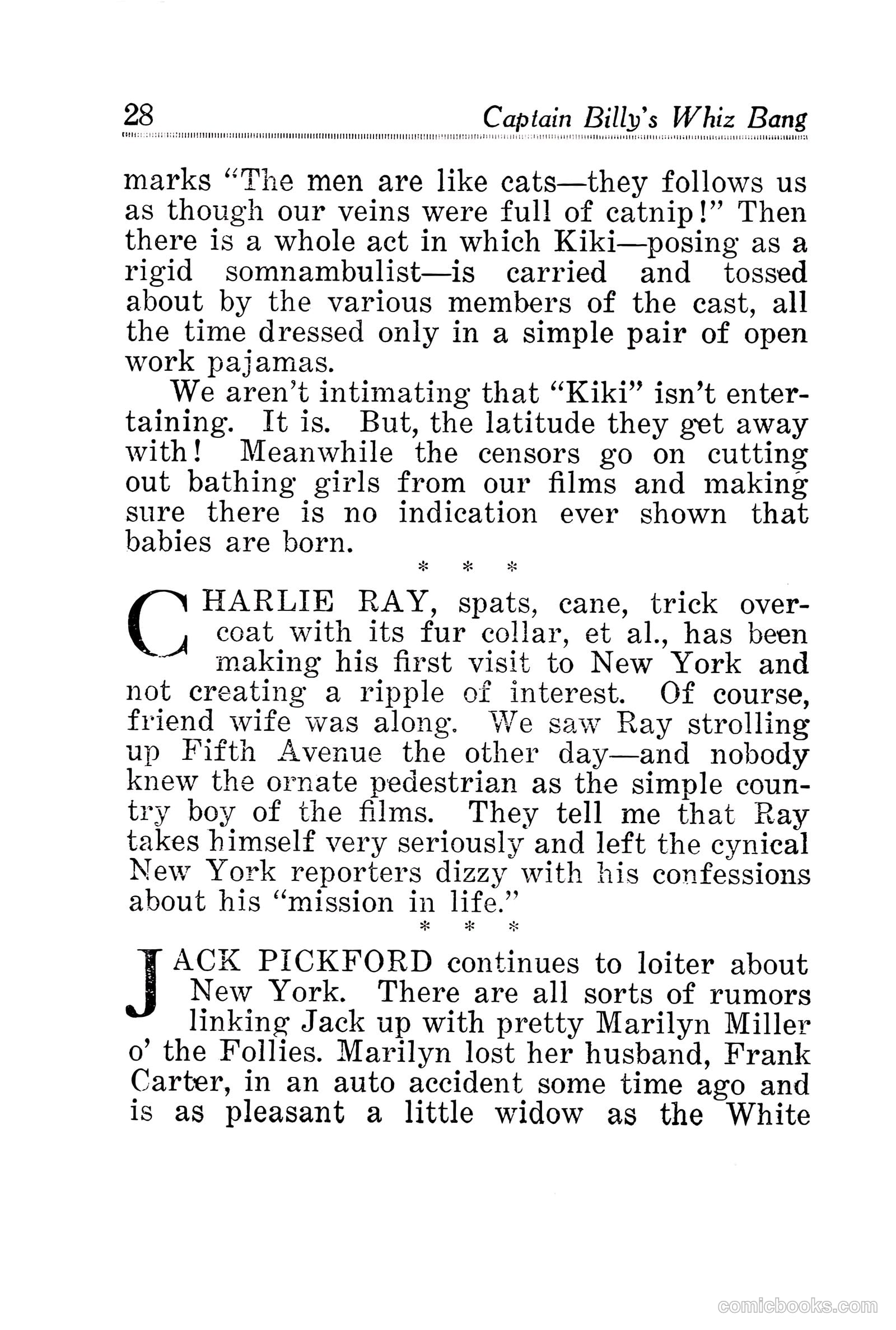
This is a gossip/satirical column from *Captain Billy's Whiz Bang*, a 1920s humor magazine. It critiques Hollywood censorship and celebrity culture through three items: **"Kiki"** — The writer mocks film censors' hypocrisy: they cut bathing scenes and avoid depicting childbirth, yet allow the actress Kiki to be tossed around in semi-transparent pajamas in a "somnambulist" act. The satire highlights arbitrary moral standards. **Charlie Ray** — A silent film actor famous for playing a simple "country boy" character. The joke is that in real life, the ornately dressed, pretentious Ray is unrecognizable on Fifth Avenue—his public persona contrasts sharply with his actual personality and his self-serious "mission in life" philosophy. **Jack Pickford** — Gossip linking the actor to Marilyn Miller of the Follies (a Broadway revue), a recent widow. The column treats celebrity romance rumors as entertainment fodder. The overall tone mocks both Hollywood's artificial morality and celebrities' self-importance.
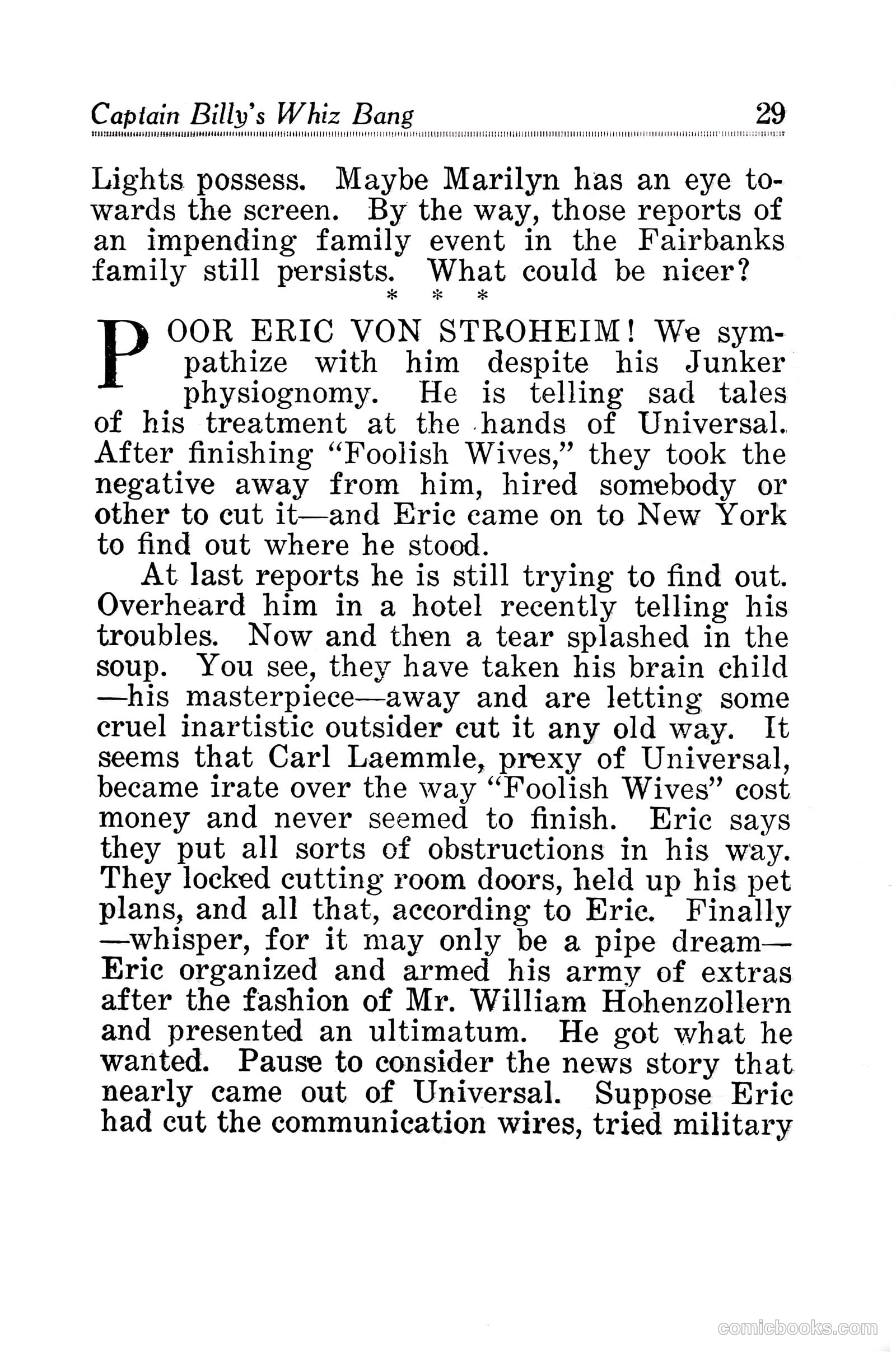
This gossip column mocks director **Erich von Stroheim's** well-publicized conflict with **Universal Studios** over his film "Foolish Wives." The satire centers on von Stroheim's loss of creative control: studio head **Carl Laemmle** removed him from editing his own film, assigning another editor instead. The piece ridicules von Stroheim's emotional complaints (tears in soup) while sympathizing with his artistic frustration. The satire peaks with a speculative joke: it suggests von Stroheim allegedly threatened—or fantasized about—organizing his extras "after the fashion of Mr. William Hohenzollern" (the German Kaiser) into a military-style ultimatum to regain control. The humor lies in the absurdity of a film director staging a quasi-military rebellion, and in the barely-concealed suggestion this nearly caused a real scandal at Universal. This reflects 1920s Hollywood power struggles between auteur directors and studio monopolies.
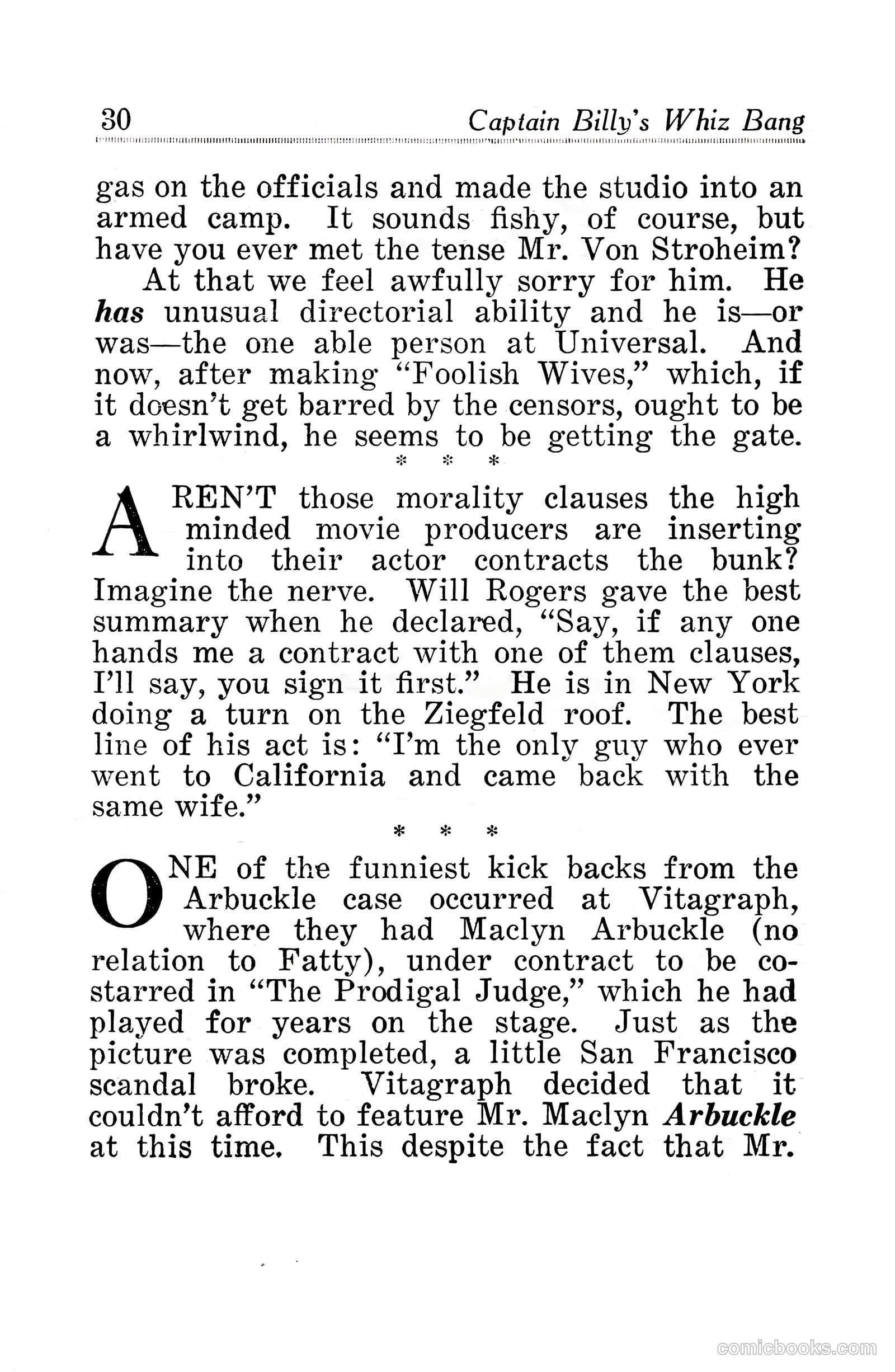
This page from the satirical magazine contains three Hollywood gossip items from the early 1920s: 1. **Erich von Stroheim**: The text criticizes the director's temperamental behavior at Universal Studios during filming of "Foolish Wives," suggesting he's being fired despite his talent. 2. **Morality Clauses**: The piece mocks studios' attempts to enforce moral behavior clauses in actor contracts. Will Rogers's quip—that he'd demand the producer sign first—satirizes the hypocrisy of studios imposing strict moral standards on performers while allowing questionable behavior behind closed doors. 3. **The Arbuckle Scandal Fallout**: The item describes Vitagraph's decision to drop Maclyn Arbuckle (unrelated to the notorious Roscoe "Fatty" Arbuckle) from "The Prodigal Judge" due to association with a San Francisco scandal—illustrating studios' panic-driven overreactions to moral controversy. The satire targets studio hypocrisy and the chilling effect of moral policing on the film industry.
This page contains three separate jokes typical of 1920s American humor magazines: **"Very Well"** is a risqué poem about seduction where a man successfully flirts with a woman—until the punchline reveals she steals from him while he embraces her. The joke plays on gender stereotypes and petty theft. **"A Tough Steak"** is a cannibal joke (a common format in period humor) with self-referential satire: the punchline suggests the Whiz Bang editor is so unpalatable/unpleasant that even cannibals wouldn't want to eat him. This was likely an inside joke among the magazine's staff. **"Nah, Nah!"** is a conductor-passenger joke. The passenger uses "forward" ambiguously (asking if his wife is aboard), and the conductor deliberately misinterprets it as a character question, implying the wife wasn't flirtatious *with him*—a cheeky insult. The opening anecdote about "Maclyn" and "Fatty" references silent film personalities, likely comparing early star Maclyn Arbuckle to rising star Fatty Arbuckle, though details are unclear.
This editorial celebrates Rev. D. H. Jones, a Baptist minister who resigned rather than enforce his congregation's demands for strict Sunday closing laws (blue laws—statutes prohibiting commercial activity on Sundays). The satire targets religious hypocrisy and coercive moralism. Jones argues that forced piety corrupts Christianity; the church should attract through moral example, not punishment or legal coercion. He criticizes "professional reformers" and "Christian lobbyists" in Washington—likely referring to temperance and Sabbatarian advocacy movements—as self-righteous busybodies using religion as a weapon rather than inspiration. The phrase "I would rather be a man than a minister" emphasizes that personal integrity matters more than institutional authority. The editorial mocks the presumption that legal restrictions on others' behavior reflect God's will, comparing it to expecting roses to smell of polecat. The headline, "The Bull is Mightier Than the Bullet," suggests moral strength surpasses force—a dig at legislated morality.
This page contains satirical quotes attacking religious censorship and Sunday "blue laws" (proposed legislation restricting activities on Sundays). The speaker—identity unclear from the image alone—argues that opposition to Sunday movie theaters is religious bigotry disguised as morality. The quotes mock those who see sin in entertainment while ignoring hypocrisy in organized religion itself. The second section shifts to a poignant narrative about an infant's funeral, describing the mother's grief and the clergyman's consolation that the child's "immortal existence" justifies the death. This appears designed to contrast with the satirical section above—possibly suggesting that genuine spiritual comfort comes from compassion rather than restrictive moral policing. The juxtaposition critiques religious institutions that prioritize controlling public behavior over addressing human suffering.
This page from *Captain Billy's Whiz Bang* contains two distinct pieces: **The first section** is a sentimental narrative about a child's funeral, emphasizing grief and religious consolation—likely typical of the magazine's mixed content. **The second section** is satirical commentary on a proposed federal "Snooper's Brigade." A prohibition commissioner had announced plans for a society requiring citizens to spy on neighbors and report their conduct. The *Detroit Free-Press* mockingly termed it the "Snoopers' Brigade." The satire targets an Orwellian surveillance scheme that would turn Americans into informants against each other. The author notes, with apparent approval, that Americans rejected this idea—they weren't willing to become neighborhood investigators. This reflects resistance to authoritarian government overreach and invasive social control during the Prohibition era. The piece celebrates American resistance to state-sponsored domestic spying, positioning such surveillance as fundamentally un-American.
This page contains **no cartoon or illustration**—it's entirely text: a serious editorial essay about entrapment and police misconduct. The piece criticizes law enforcement practices where officers deliberately induce citizens to commit crimes, then arrest them. It cites a Mississippi case where a peace officer bought liquor (illegal during Prohibition), convinced someone to purchase it for him, then arrested that person. The court discharged the accused and convicted the officer instead. The essay argues courts properly exclude such "entrapment" testimony and warns against the "Snooper's League" (likely referencing overzealous Prohibition enforcement agents). It condemns officials who "literally hire men to commit a crime" under the guise of law enforcement. The final snippet is an unrelated joke about corporal punishment as education. **Context for moderns**: This reflects 1920s Prohibition-era debates over government overreach, police entrapment tactics, and civil liberties—issues that remain relevant today.
This page from *Captain Billy's Whiz Bang* (a satirical magazine) contains political commentary and humorous notes: **Main Article**: The Chicago Tribune is praised for attacking "Mr. Crafts" and his movement, described as bigoted and savage, motivated by a desire to jail fellow citizens and destabilize the republic. (Likely refers to Anthony Comstock or a similar moral reform crusader of the early 20th century, though the specific figure isn't named here.) **"Farmyard Notes"**: A series of rustic one-liners and puns (chickens toughening up, cauliflower superiority, bird/berry reversals). One joke about cross-eyed men ogling women in short skirts reflects the era's anxiety about changing women's fashion and sexual morality. **"Cellar Ancestry"**: A whimsical poem personifying vegetables mourning vinegar's "mother's" death—pure nonsense humor typical of the magazine's style. The page mixes genuine political critique with lowbrow humor, characteristic of *Whiz Bang's* irreverent tone.
This page contains two satirical pieces mocking New York City life and social pretension. **"As It Is In New York"** (first section): A humorous sketch by columnist O.O. McIntyre describing an out-of-town man on a date in Manhattan's Italian immigrant neighborhood (East Houston Street). The satire targets his transparent social climbing—his monogrammed accessories, fake sophistication (calling the waiter in French), and his absurd attempts to impress a woman from a factory ("jobber plant") while ultimately just wanting to write home about his loneliness. **"New York" poem** (second section): A scathing attack on the city itself, attributed to a former port official. It's explicitly antisemitic (references "Ruled by Jew and prostitute") and portrays New York as morally corrupt, chaotic, and dominated by greed and vice. The final line names the city "Delirium." Both pieces reflect 1920s urban anxiety and cynicism—mocking both pretentious outsiders and the city's perceived moral decay. The antisemitic rhetoric reflects unfortunate period attitudes found in American satirical publications.
This page contains three unrelated short comedic sketches typical of 1920s satirical magazines. **"Farm Life"** mocks both labor relations and changing social expectations. The joke is that a farmer's hired man has become so demanding and entitled—insisting on short hours, car privileges, and even influencing the farmer to shave his whiskers—that he's essentially domesticated his employer. The punchline relies on the implication of an inappropriate relationship ("kissed him good-night"), playing on period anxiety about masculine propriety. **"Wah, Wah!"** uses dialect humor (common but offensive by modern standards) featuring a character choosing a chocolate-covered watermelon—a reference to racial stereotypes prevalent in early-20th-century American entertainment. **"Sic 'em, Tige!"** is a simple doctor-patient joke where a sword swallower's occupation explains his appetite problems—an absurdist punchline. The "Little Joe" quote offers casual dice-game commentary. These sketches reflect the magazine's mix of ribald humor, ethnic caricature, and nonsense comedy aimed at male readers.
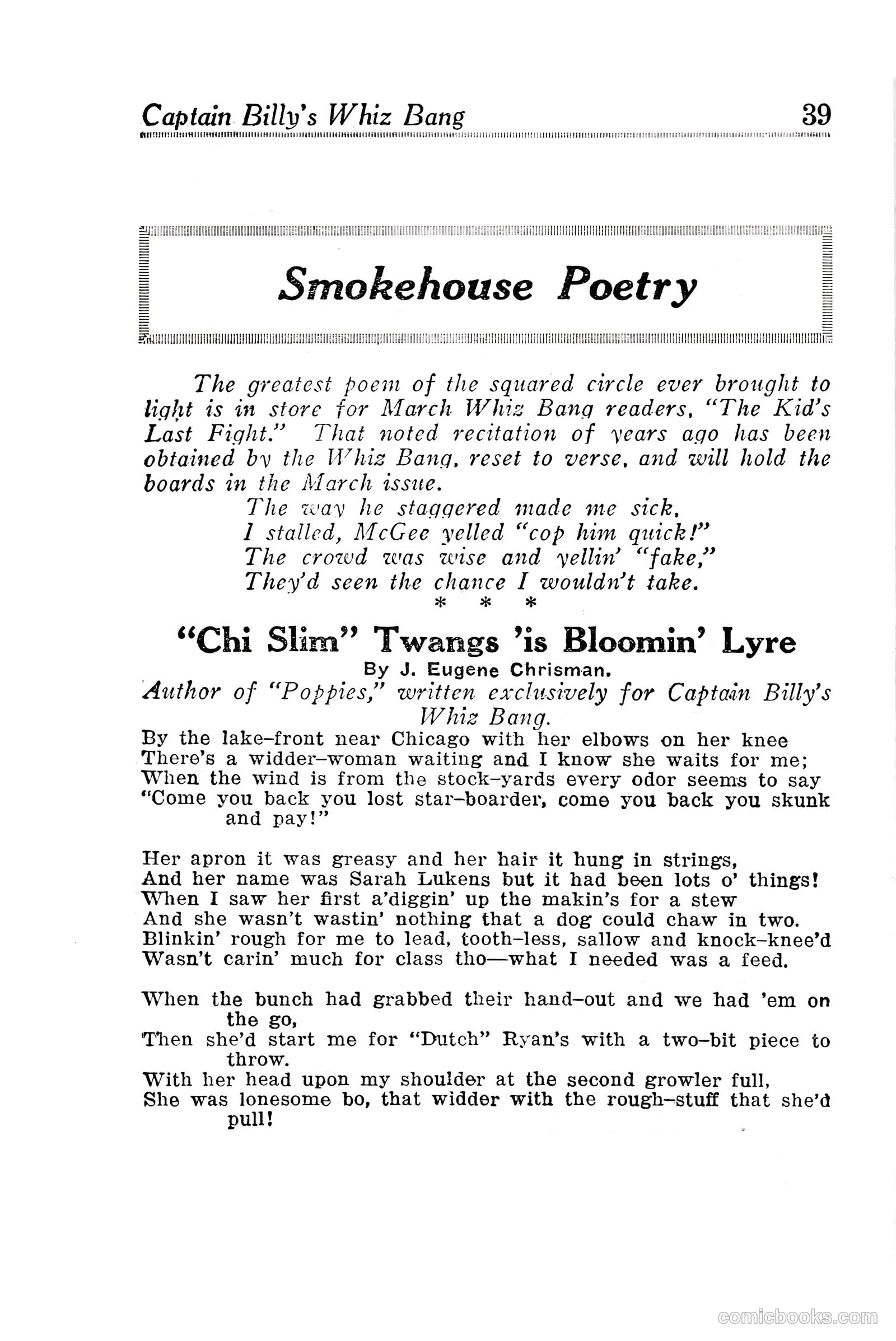
This page from *Captain Billy's Whiz Bang* (a humor magazine) contains two pieces about working-class urban life. **Top section** announces an upcoming boxing poem, "The Kid's Last Fight," with sample verses depicting a fixed fight where the boxer throws a match despite crowd pressure—referencing the era's widespread boxing corruption concerns. **Main poem** by J. Eugene Chrisman depicts a hobos' perspective on a destitute widow, "Chi Slim," living near Chicago's stockyards. The crude vernacular verse romanticizes poverty and transience: the speaker describes Sarah Lukens as unattractive, toothless, and destitute, yet affectionately recalls her loyalty and companionship during hard times. The poem celebrates working-class camaraderie and rough survival, with references to "hand-outs," cheap beer ("growler"), and petty crime associates like "Dutch" Ryan. The satire targets sentimental nostalgia for vagrant life while depicting Depression-era desperation as almost quaintly romantic—typical of *Whiz Bang's* irreverent working-class humor.
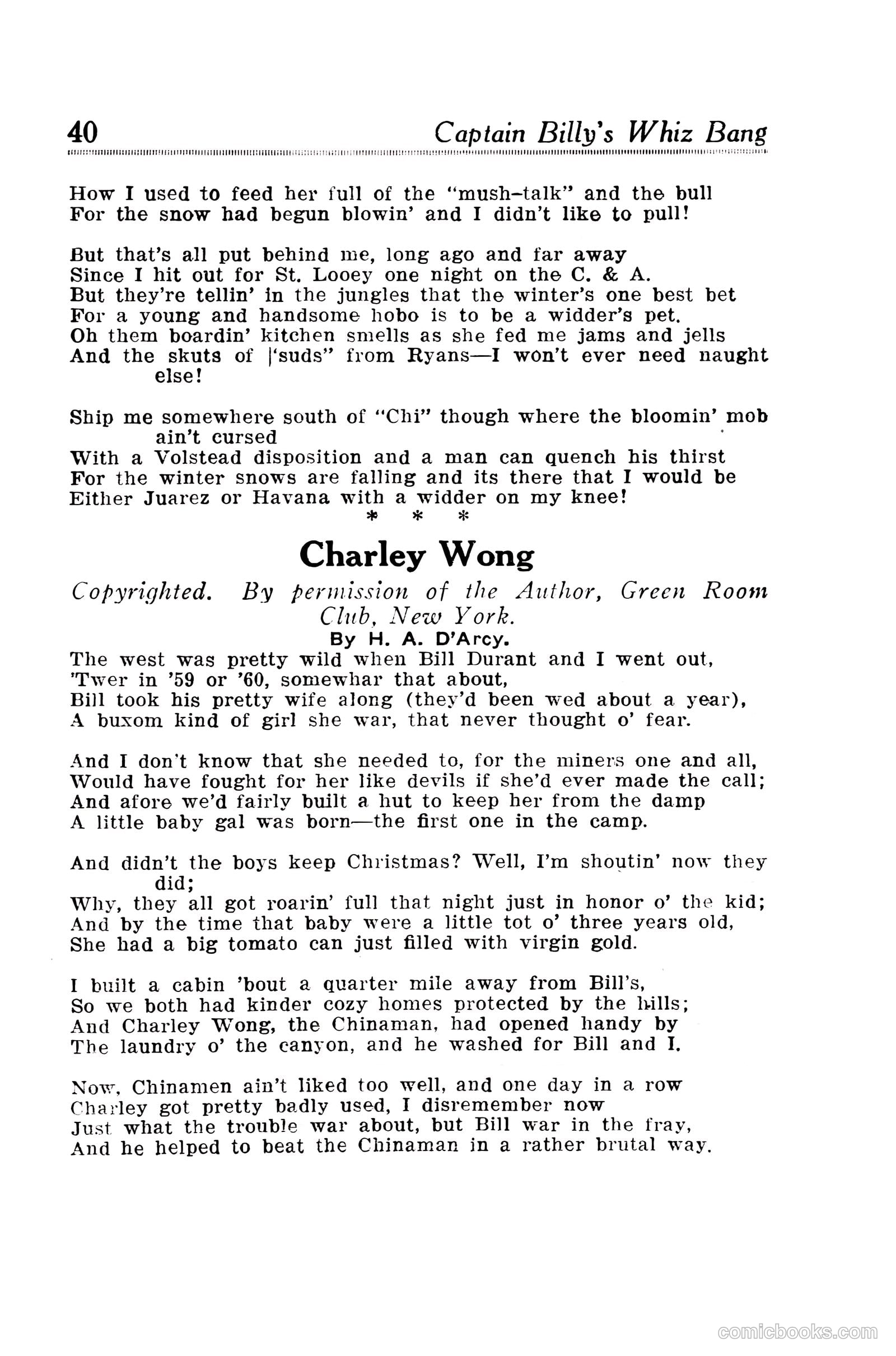
This page contains two separate poems from an early 20th-century American humor magazine. **"Captain Billy's Whiz Bang" poem**: A hobo's nostalgic monologue about life on the rails. He recalls romantic manipulation ("mush-talk"), leaving for St. Louis, and the hobo lifestyle. The poem references the **Volstead Act** (Prohibition, 1920-1933), mentioning a desire to escape to Mexico or Cuba where drinking remains legal. The "widder" (widow) references suggest hobos exploited older women for food and shelter. **"Charley Wong" poem**: A frontier tale by H.A. D'Arcy about Bill Durant's wife during the Gold Rush era (circa 1859-60). It describes mining camp life, celebrating the birth of the "first one in the camp" and miners' protective devotion to her. The narrative later mentions conflict with a Chinaman, reflecting the racial tensions common in frontier literature of this era. Both poems romanticize marginalized figures—hobos and frontier settlers—in vernacular verse typical of this satirical magazine.
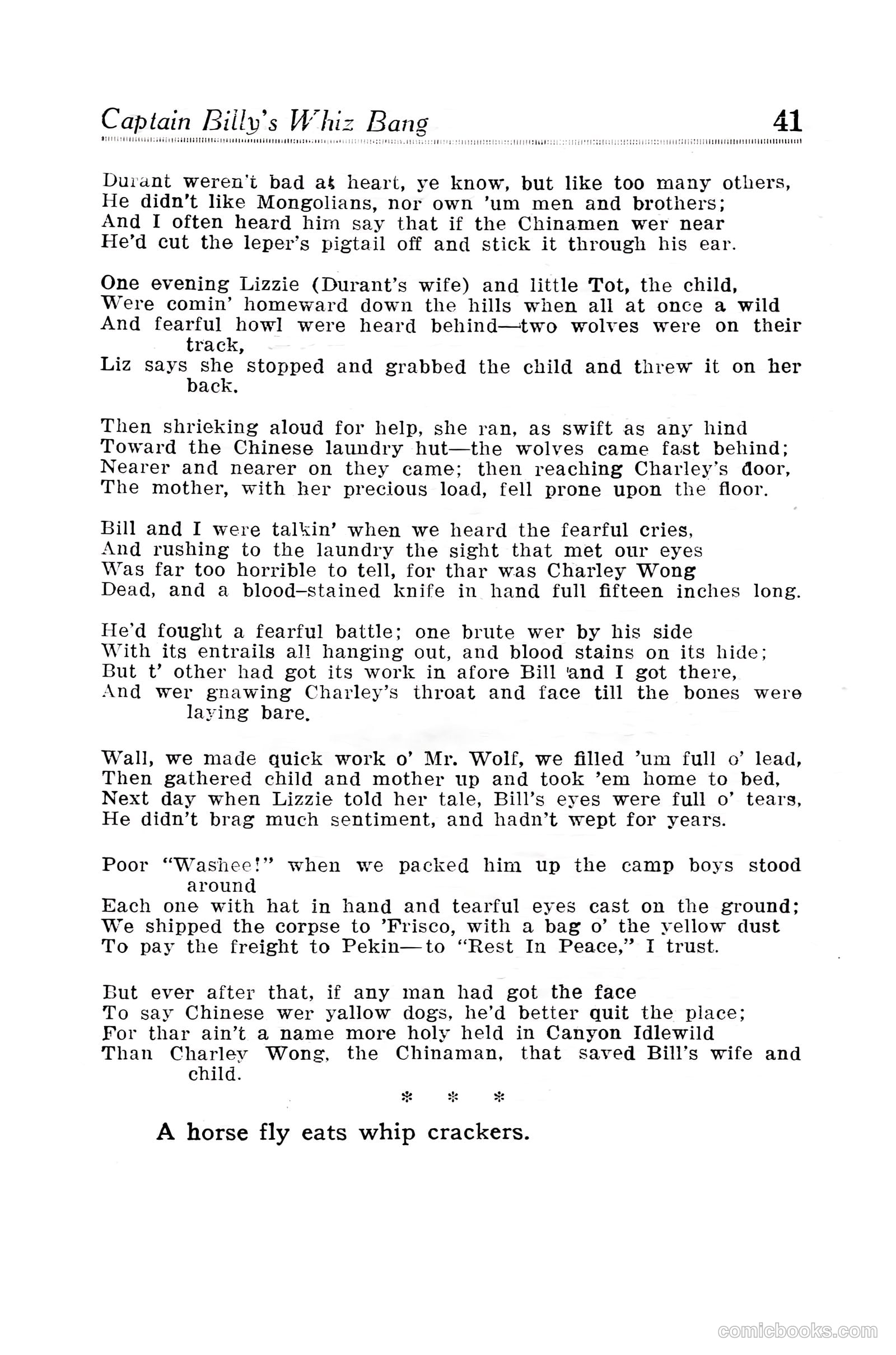
This page contains a narrative poem about racial prejudice and redemption set in the American West (Canyon Idlewild). The story features Durant, a character explicitly prejudiced against Chinese people and Mongolians, whose wife and child are attacked by wolves while traveling. They flee to a Chinese laundry run by Charley Wong, a Chinese immigrant worker. Wong heroically fights the wolves to protect the family, mortally wounding himself in the process. The narrator and Bill witness his death and are profoundly moved. The poem's moral message—delivered in its final stanza—reverses Durant's racism: the community now honors Wong as a hero who "saved Bill's wife and child," arguing that no name is "more holy" in their canyon. This appears to be anti-racist satire, using a frontier narrative to critique anti-Chinese sentiment prevalent in early 20th-century America. The humor works through ironic contrast: prejudiced characters are forced to recognize Chinese dignity through an act of self-sacrifice. The closing line about the horse fly is an unrelated joke.
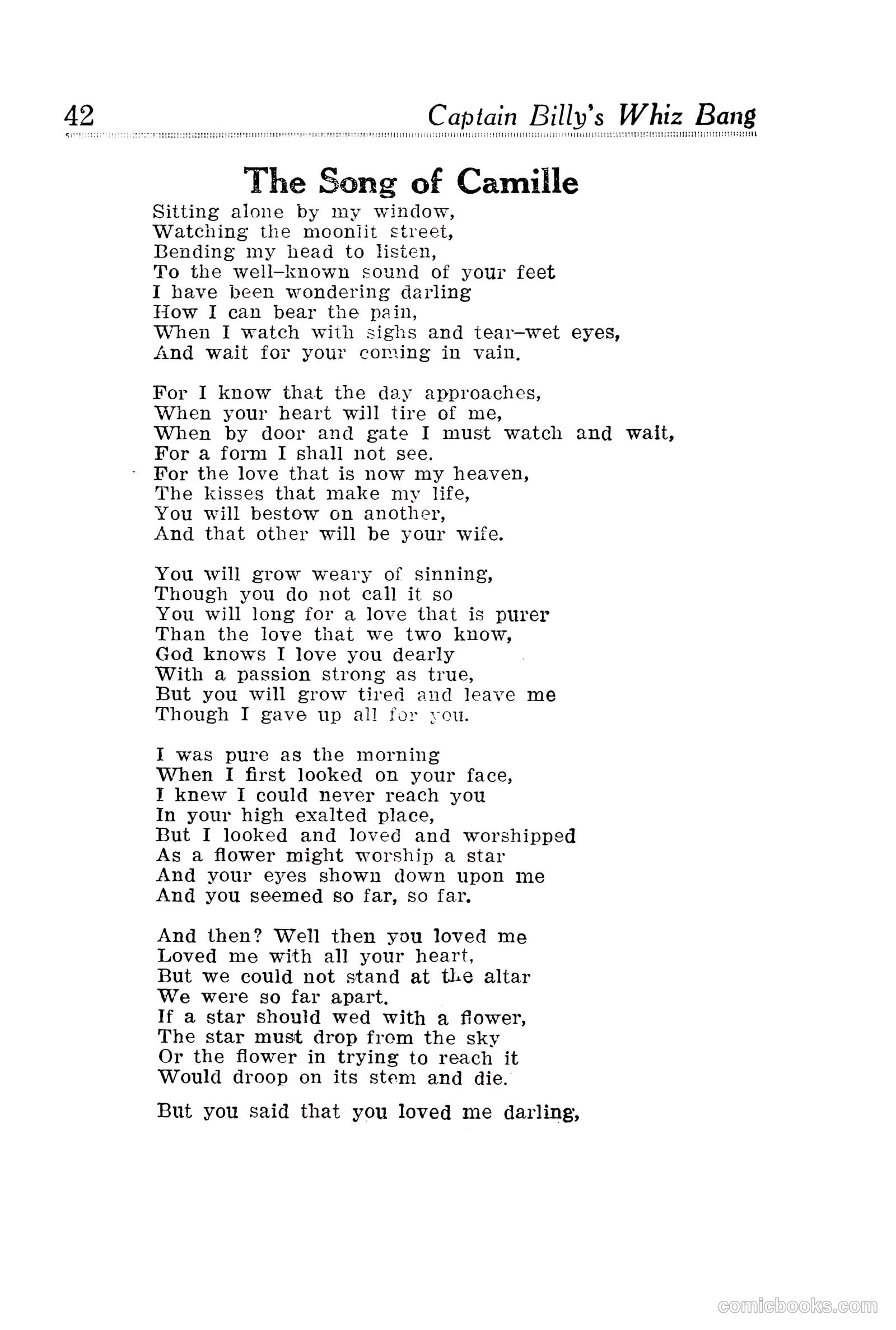
This page contains a sentimental poem, not a political cartoon. It's a melodramatic monologue by a female speaker (Camille) addressing her lover, expressing her doomed romance. The poem deals with class difference and social inequality—she describes herself as a "flower" unable to reach his "high exalted place" like a star. Their love is illicit and impossible: he will eventually marry someone of his own social standing ("your wife"), leaving her abandoned. She's sacrificed her virtue ("I gave up all for you") with no prospect of legitimate marriage due to their class divide. The romantic tragedy and moral fallen-woman theme reflect early 20th-century sentimental literature. Published in *Captain Billy's Whiz Bang*, a humor magazine known for mixing satire with lighter content, this appears to be melodramatic verse for entertainment rather than satirical commentary.
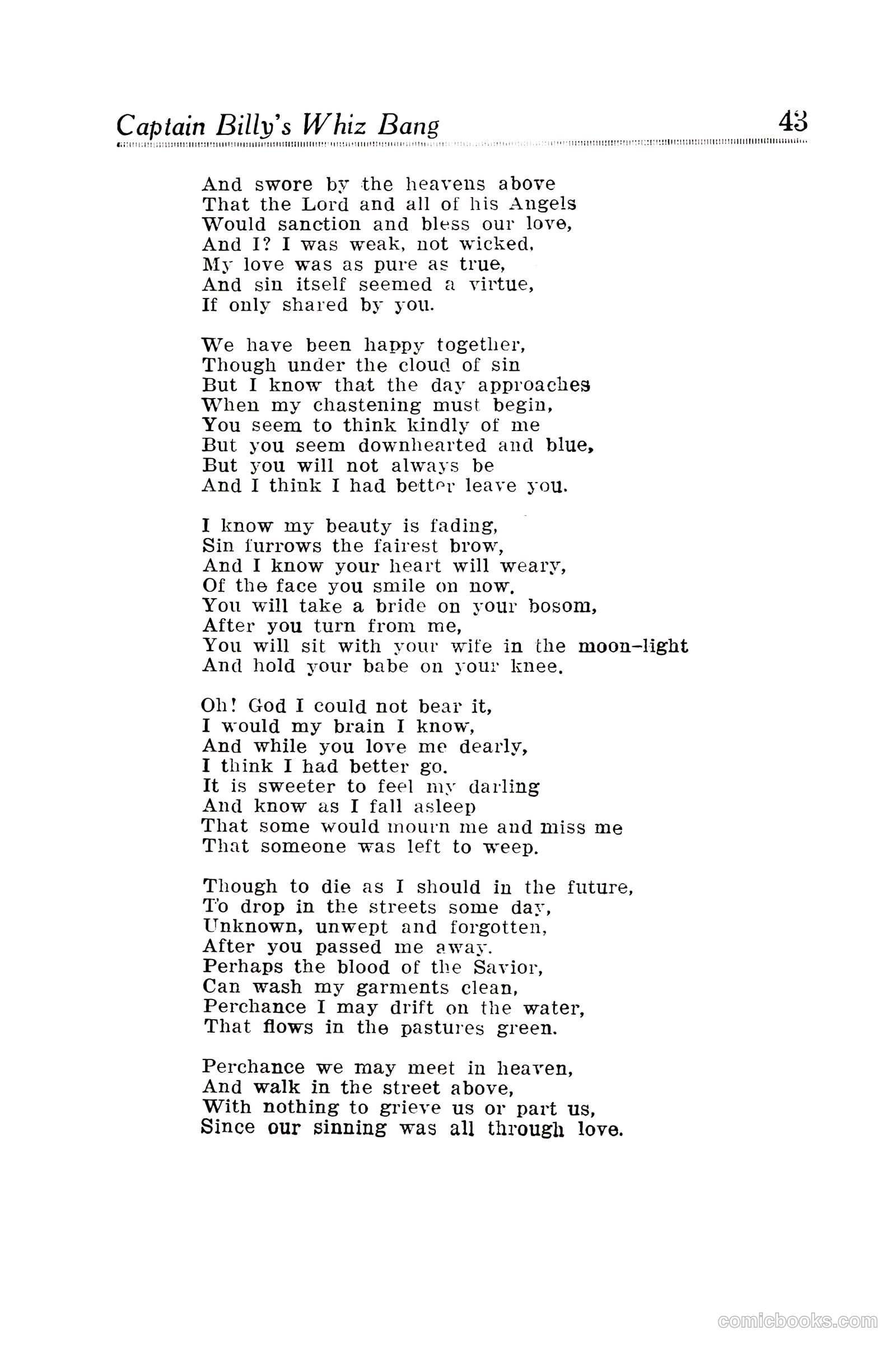
This page contains a sentimental poem—not a cartoon—titled "Captain Billy's Whiz Bang," a popular American humor magazine from the 1920s-30s. The poem dramatizes an illicit affair from the woman's perspective. She justifies their "sinning" as rooted in pure love, but recognizes their relationship must end. Her reasoning combines self-sacrifice (she'll leave before he tires of her fading beauty) with melodramatic fatalism (she imagines dying forgotten in the streets, hoping divine salvation through Christ's blood). The final stanza offers romantic reconciliation: they'll reunite in heaven, absolved because their sin stemmed from love rather than wickedness. The piece typifies Whiz Bang's mix of bawdy humor and sentimental moralizing—simultaneously acknowledging sexual transgression while providing religious redemption, appealing to readers' emotions rather than their sense of propriety.
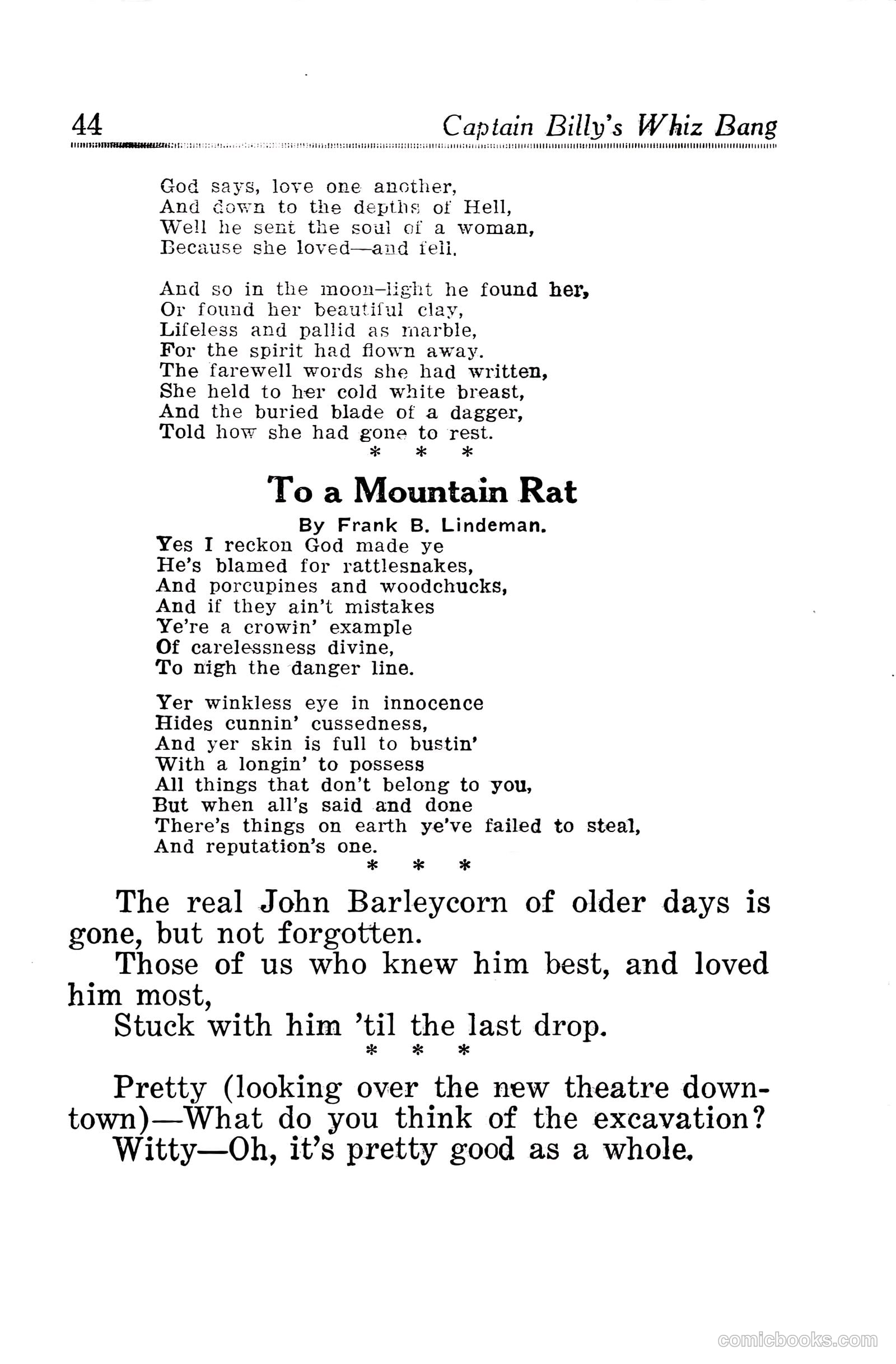
This page contains three literary pieces and a brief joke: **"Captain Billy's Whiz Bang"** (title): A tragic poem about a woman's suicide—she dies by dagger, having "loved—and fell" (suggesting seduction/lost virtue), a melodramatic Victorian moral tale. **"To a Mountain Rat"** by Frank B. Lindeman: A dialect poem personifying a rat as an example of God's imperfection, depicting it as naturally thievish and cunning. The humor lies in mock-serious theological complaint about a minor pest. **John Barleycorn reference**: An obituary-style tribute to alcohol (Barleycorn being a traditional personification of liquor), likely written during Prohibition (1920-1933), nostalgically mourning whiskey with dark humor about loyalty "til the last drop." **Final joke**: A pun on "excavation"—Pretty asks Witty's opinion of digging work for a new theater downtown; Witty replies it's "pretty good as a whole" (sounds like "as a hole"), treating excavation literally as a hole rather than construction work.
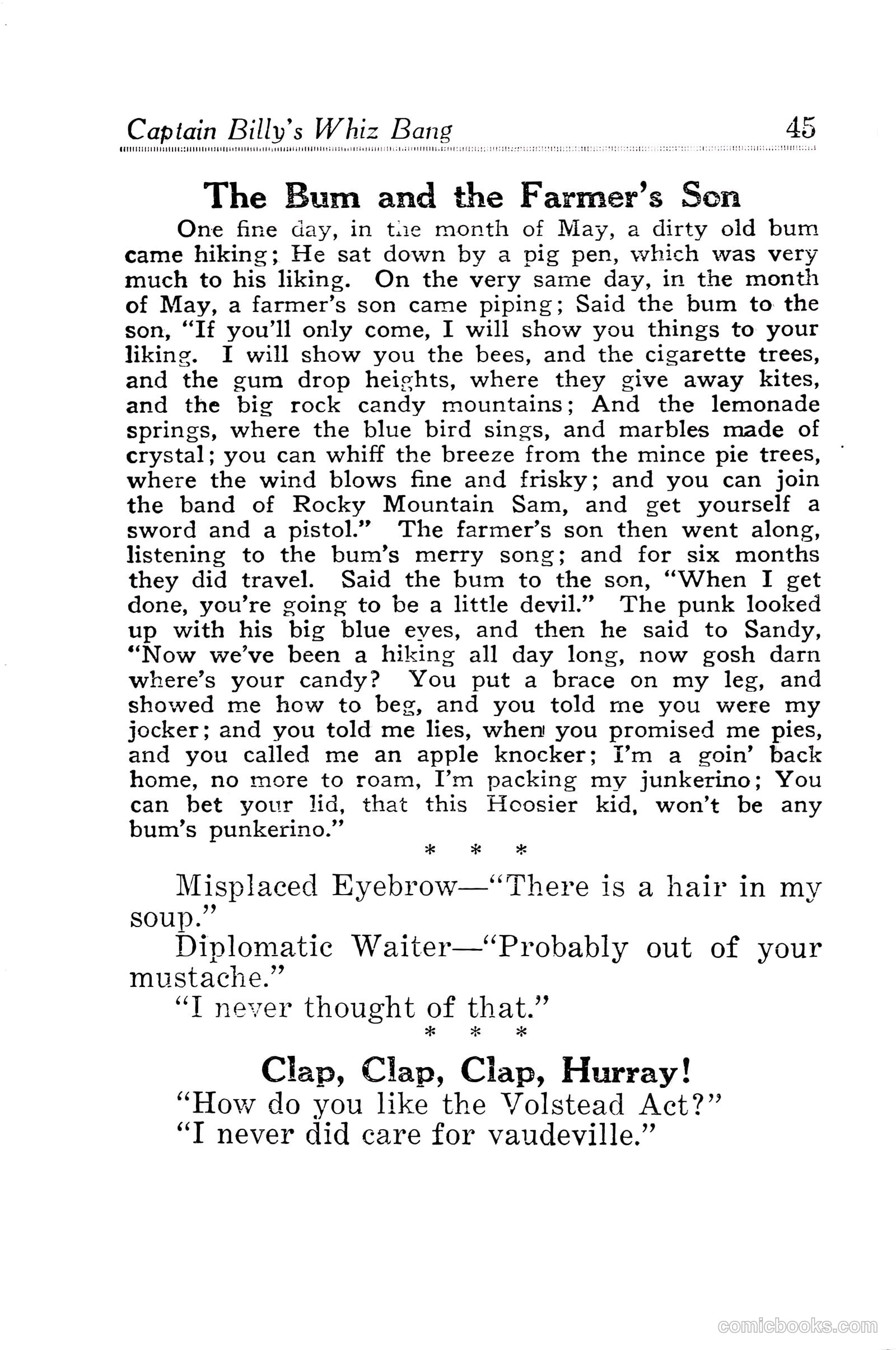
This page contains humorous short pieces typical of 1920s American satirical magazines. **"The Bum and the Farmer's Son"** is a cautionary narrative poem about a vagrant who lures a naive farm boy with fantasies of magical places (candy mountains, lemonade springs) and promises of adventure with outlaw "Rocky Mountain Sam." After six months of traveling, the boy realizes he's been deceived—the bum taught him to beg and con others—and returns home, rejecting the vagrant lifestyle. The brief jokes below mock everyday situations: a diner customer complains about hair in soup; a waiter makes a quick-witted retort about the man's mustache. The final joke is a pun playing on "Volstead Act" (the 1920 Prohibition law) and "vaudeville" (theatrical entertainment)—suggesting the questioner pretends to mishear "Prohibition" as stage comedy to make a political joke about Prohibition's unpopularity. These pieces reflect 1920s attitudes about vagrancy, con artists, and anti-Prohibition sentiment.
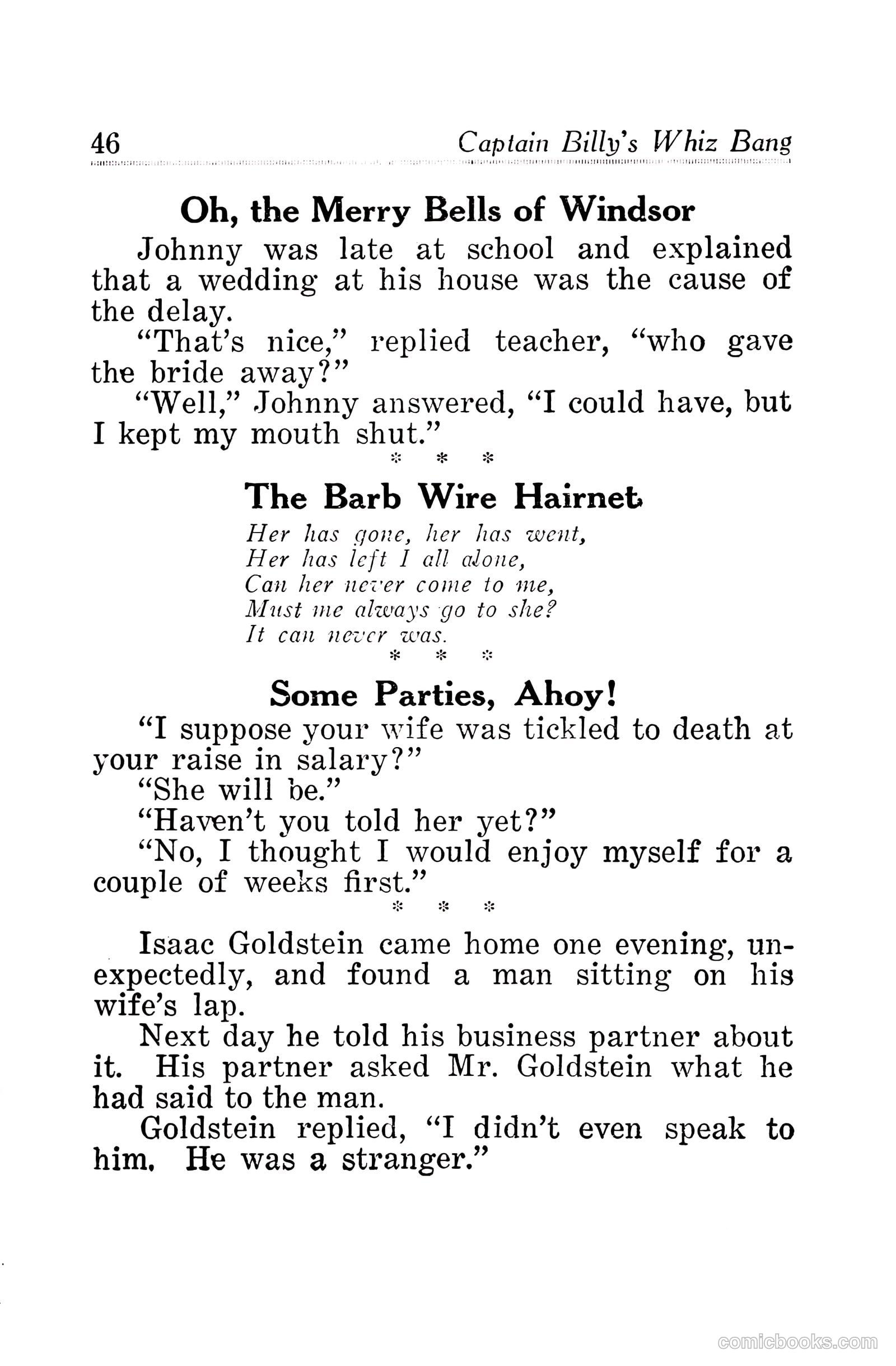
This page contains four short joke pieces typical of 1920s American humor magazines: 1. **"Oh, the Merry Bells of Windsor"** — A schoolboy joke about a wedding where Johnny could have "given away" the bride but stayed silent, implying he knows embarrassing secrets about her. 2. **"The Barb Wire Hairnet"** — A humorous poem mocking poor grammar ("Her has gone," "It can never was"), likely satirizing uneducated or immigrant speech patterns. 3. **"Some Parties, Ahoy!"** — A joke about a man keeping a salary raise secret from his wife to enjoy personal freedom first—satirizing marital dynamics and domestic control. 4. **Isaac Goldstein story** — A Jewish-named character finds a stranger on his wife's lap but says nothing. The humor appears to rely on ethnic stereotyping and implications of marital infidelity, typical of the era's crude comedic conventions. These jokes reflect 1920s American attitudes toward class, education, marriage, and ethnicity.
This page from the satirical magazine contains short humorous quips and light jokes typical of early 20th-century American comedy: **"Finishing Touches"** is a pun on "snow use" (no use), about canceling plans due to snow. **"Jewish Bees"** appears to be a crude ethnic stereotype joke, using "business" (spelled out phonetically as "biz-z-ness") as a punchline playing on antisemitic tropes associating Jewish people with commerce. **"Tar Baby"** is a mathematical pun where a modest girl won't do "improper fractions"—a double entendre on the word "improper." **"Down in Dreamy Honohula"** uses Hawaiian references ("Honohula") and deliberately vague sexual double entendres with made-up words like "thingamabob" and "thingamajig." The page demonstrates the magazine's humor style: wordplay, ethnic stereotypes, and risqué innuendo presented as lighthearted jokes—reflecting attitudes and comedy conventions of that era that would be considered offensive today.
This page from *Captain Billy's Whiz Bang* (a WWI-era American humor magazine) contains a collection of brief jokes and witticisms rather than illustrated cartoons. The humor relies on wordplay and double meanings typical of the period: - **"Strike Three!"** jokes about loose-lipped romantics ending up married - **"She crept up to the scales"** puns on "weigh/way" - **"Motto for Poets"** uses sexual innuendo ("sucking") - **"Mr. Martin's Ferry" complaint** appears self-referential—the magazine joking about writing jokes on thin paper so readers could see through them - **"Mary's Lamb"** plays on the nursery rhyme while making suggestive comments about "calves" - The final exchange is straightforward advice The publication's humor is crude, risqué by period standards, and relies heavily on puns and double entendres. There are no identified political figures or caricatures—just generic social commentary presented as joke collections.
This page collects brief humorous anecdotes and jokes typical of *Whiz Bang*, a 1920s-era satirical magazine known for ribald humor and social commentary. **"Vengeance at Last"** mocks literary pretension—specifically poets writing derivative "Apologies to Poe" (imitations of Edgar Allan Poe's famous poem "The Raven"). The joke imagines someone literally beating such poets. The remaining items are standalone gags: "A Tough Break" jokes about a horse named "cigarette" and gambling losses; "Da, Da, Daddy" is a novelty song lyric about attraction; jokes about Turkish baths, marital complaint, and the final double entendre about women's undergarments (a "combination" was a one-piece undergarment). **The satire targets:** literary pretension, urban leisure activities (gambling, bathhouses), and marriage friction—all common working-class anxieties. The humor is crude and lowbrow, reflecting the magazine's appeal to soldiers and working men post-WWI.
This is a collection of brief humorous one-liners and short jokes typical of 1920s American comic magazines. The page contains no political content or caricatures—rather, it's a compilation of everyday absurdist humor targeting rural and working-class life. The jokes mock simple people through exaggeration: a farm boy gets punished for *not* working, a drunk man confuses who needs help getting to bed, a job listing absurdly requires tools unrelated to driving. The "Oregon Gal" poem uses homespun verse to tease an awkward girl dressed up. A pun about fish having "minnows" appears alongside observations that musicians "just play" at work and towns that don't bury their dead. These represent typical lowbrow humor of the era—folksy, punny, and relying on mild social embarrassment rather than sharp satire. The appeal was to rural and working-class readers who recognized these everyday scenarios.
This page from the satirical magazine contains brief jokes and puns typical of early 20th-century American humor. The content includes: **Puns and wordplay**: "Would Gillette me?" (Gillette razor brand), "I'm the King of Siam/Yesiam" (pun on "yes I am"). **Sexual innuendo**: References to "Teddy's Teachings" about multiplication likely allude to Theodore Roosevelt's views on large families. A section about kissing implies promiscuity. **Absurdist humor**: A chiropodist becoming a throat specialist, leaving lights on to sleep, mixing beans with honey to hold them on a knife—nonsensical scenarios for comedic effect. **Social commentary**: A joke about wearing carpet holes from standing at a pulpit suggests clergy repetition or wasted effort. The page reflects Whiz Bang's style: rapid-fire gags mixing mild sexual humor, advertising tie-ins (Gillette), and observations of everyday absurdity—aimed at post-WWI American audiences seeking lighthearted, irreverent entertainment.
This page from *Captain Billy's Whiz Bang* (a 1920s humor magazine) contains short jokes and quips reflecting post-WWI American culture during Prohibition (1920-1933). **Key references:** - **"Near-beer"** jokes mock the alcohol ban—near-beer was legal but weak, making the prohibition's enforcement absurd - **"The 1922 Girl"** satirizes modern women's attitudes toward marriage and independence, seen as shocking at the time - **"Oil by Myself"** likely references John D. Rockefeller and oil monopolies - **Mrs. Murphy/beer bottle** is a crude domestic joke playing on beer bottle shapes - **The prohibition agent joke** suggests widespread illegal alcohol consumption despite federal law The humor relies on topical references to Prohibition's unpopularity, changing gender roles, and industrial titans. The crude physical humor (cross-eyed woman, hump-backed man) was acceptable in period comedy but reflects attitudes we'd now consider offensive.
This page from *Captain Billy's Whiz Bang* (a popular WWI-era satirical magazine) contains brief jokes and quips typical of the era: **"Wriggle Through This One"** sarcastically thanks Prohibition (enacted 1920) for taking alcohol, predicting tobacco will follow—leaving only chewing gum, a joking commentary on increasingly restrictive laws. **"How Do You Get That Way?"** uses ethnic stereotyping (Jewish sergeant with exaggerated dialect) for humor about military drill instruction—common in period comedy but offensive by modern standards. **Other jokes** employ crude puns and stereotypes: a man hitting his thumb, Swedes pursuing lutefisk in Ireland, a boy washing his face, and a "change of wives" joke. The final "Consolation" uses comparison humor about ugly women. The overall tone reflects 1920s popular humor: topical references to Prohibition, casual ethnic caricaturing, and simple wordplay—reflecting attitudes and sensibilities quite distant from modern standards.
This page contains three brief humorous pieces typical of 1920s satirical magazines: **"Dope This One"**: A joke where the punchline is censored (marked with *). A city man asks a farmer why he locks up his donkey so carefully. The farmer's reply—"Because it is too good an *"—appears to be an off-color or risqué joke, with the offensive word redacted, likely referring to the donkey's sexual prowess or desirability. Readers were expected to fill in the blank themselves. **"Hiawatha Skinned a Squirrel"**: A tongue-twister poem mocking the literary style of Longfellow's "Song of Hiawatha" through absurdist repetition about making mittens with paradoxical inside-outside positioning. It's nonsense designed for comedic effect and difficulty in recitation. **"They don't look natural"**: A brief joke about rolling dice—a man rolls two threes (sixes would be "snake eyes," considered lucky or suspicious), and complains they look unnatural, implying the dice are loaded. All three pieces target audience participation or contain double meanings meant for adult readers.
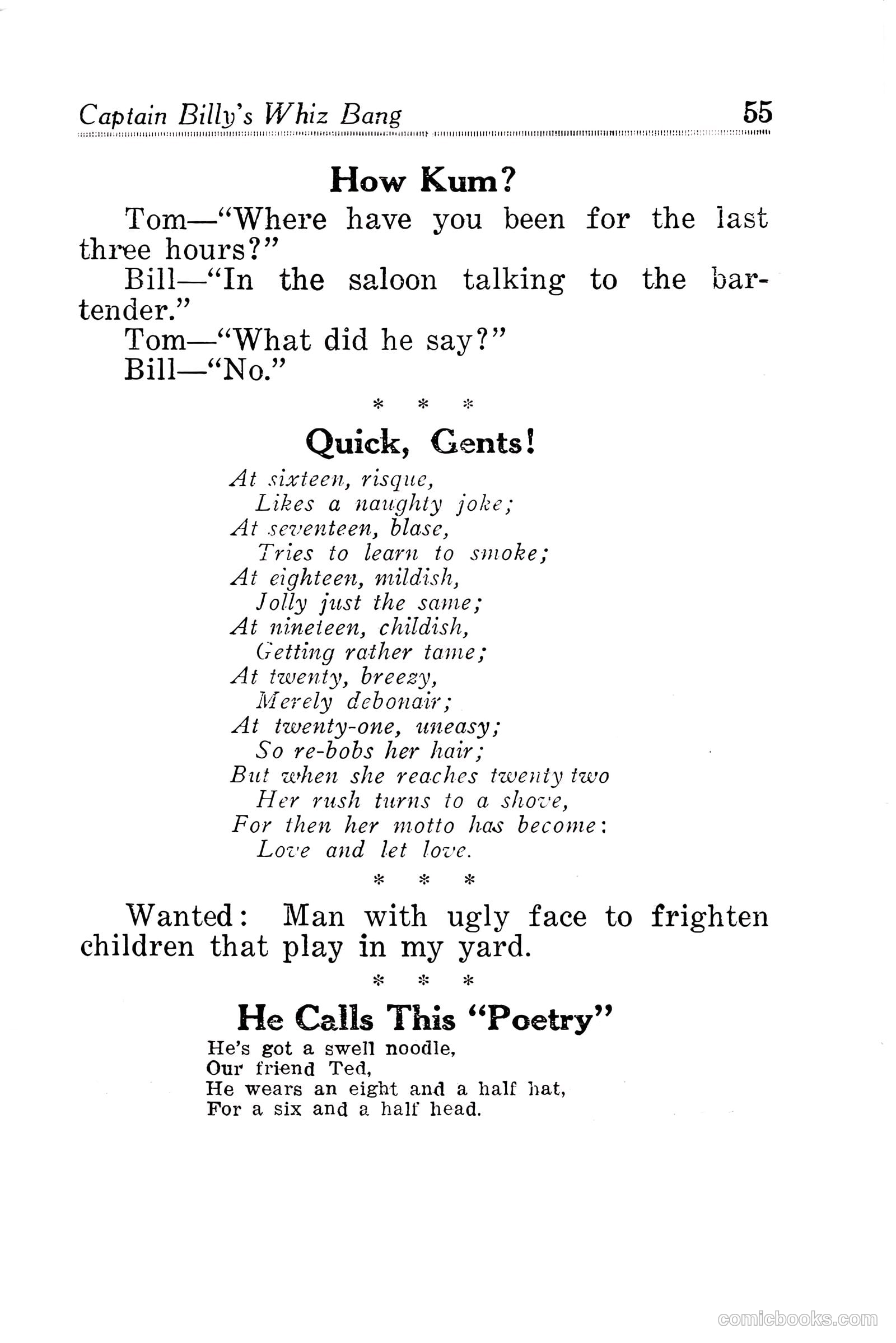
This page from the satirical magazine contains several brief jokes typical of 1920s humor: **"How Kum?"** is a play on words—Bill goes to a saloon to ask the bartender something, and the answer is simply "No," implying he was rejected or refused. **"Quick, Gents!"** satirizes changing female behavior and morality across ages 16-22. It suggests women progressively become more worldly and flirtatious, culminating at twenty-two with an explicit motto about romantic freedom ("Love and let love")—humor about evolving sexual attitudes. **The "Wanted" ad** is absurdist humor offering payment for an ugly man to scare neighborhood children. **"He Calls This 'Poetry'"** mocks someone named Ted for wearing a hat too large for his head (eight-and-a-half size for a six-and-a-half head), with "noodle" being slang for head/brain. The joke implies his "poetry" is as mismatched and ridiculous as his oversized hat. The content reflects early-20th-century masculine, risqué humor typical of the era's men's magazines.
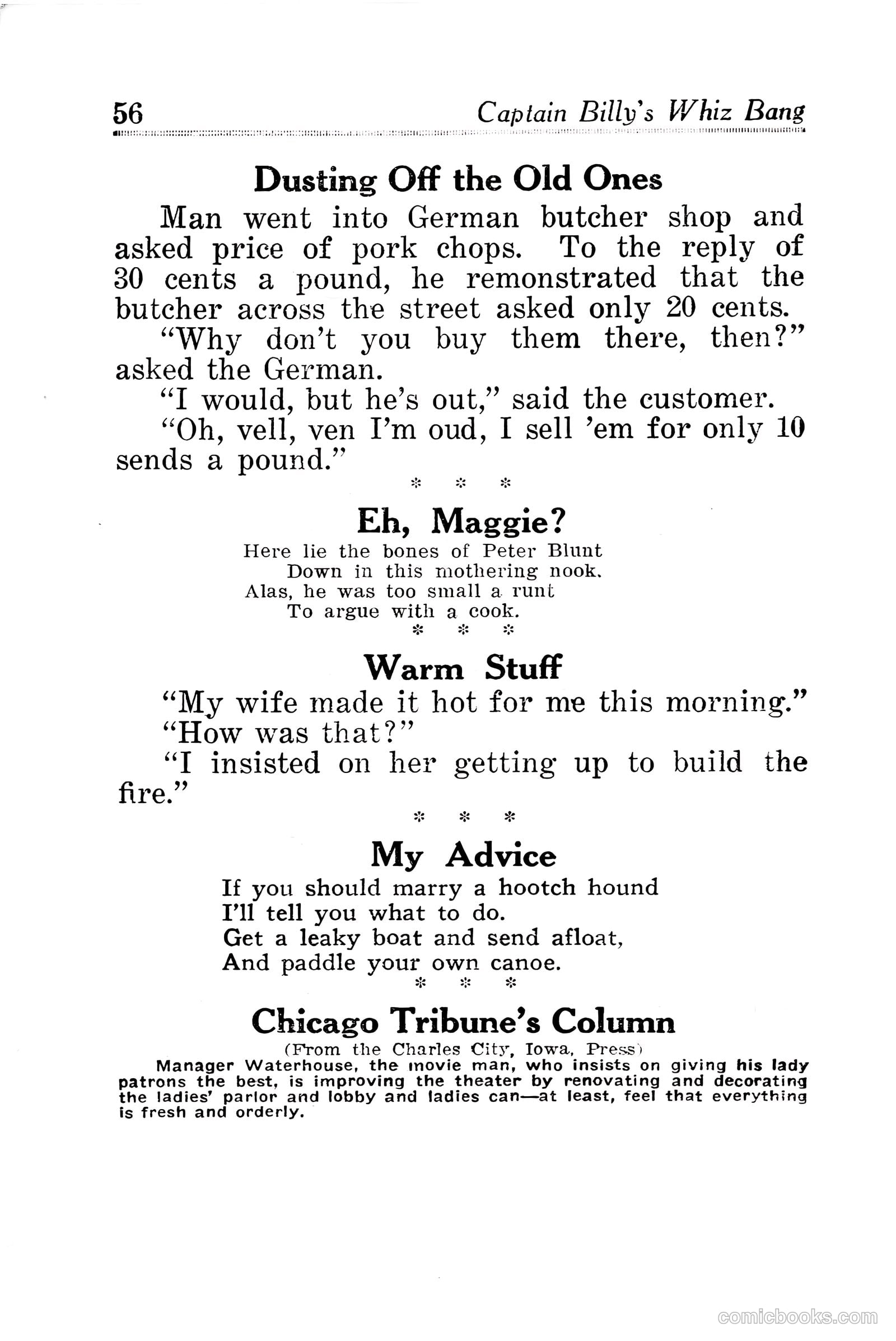
This page collects brief humorous anecdotes typical of early 20th-century American comic magazines. The first joke uses a German butcher's accent and logic to mock undercutting competitors—when asked why his prices are higher, he implies he'd sell cheaper when unavailable, absurdist humor. "Eh, Maggie?" is a mock epitaph mocking a small man who couldn't stand up to a cook—domestic humor playing on kitchen hierarchy. "Warm Stuff" is a marital joke: the wife made things "hot" (angry) by making her husband build the fire himself rather than serve him. "My Advice" warns against marrying a "hootch hound" (alcohol drinker) via darkly comedic suggestions to abandon him. The final item praises a movie theater manager for improving ladies' facilities—likely genuine local praise rather than satire, reflecting period concerns about women's comfort in public spaces.
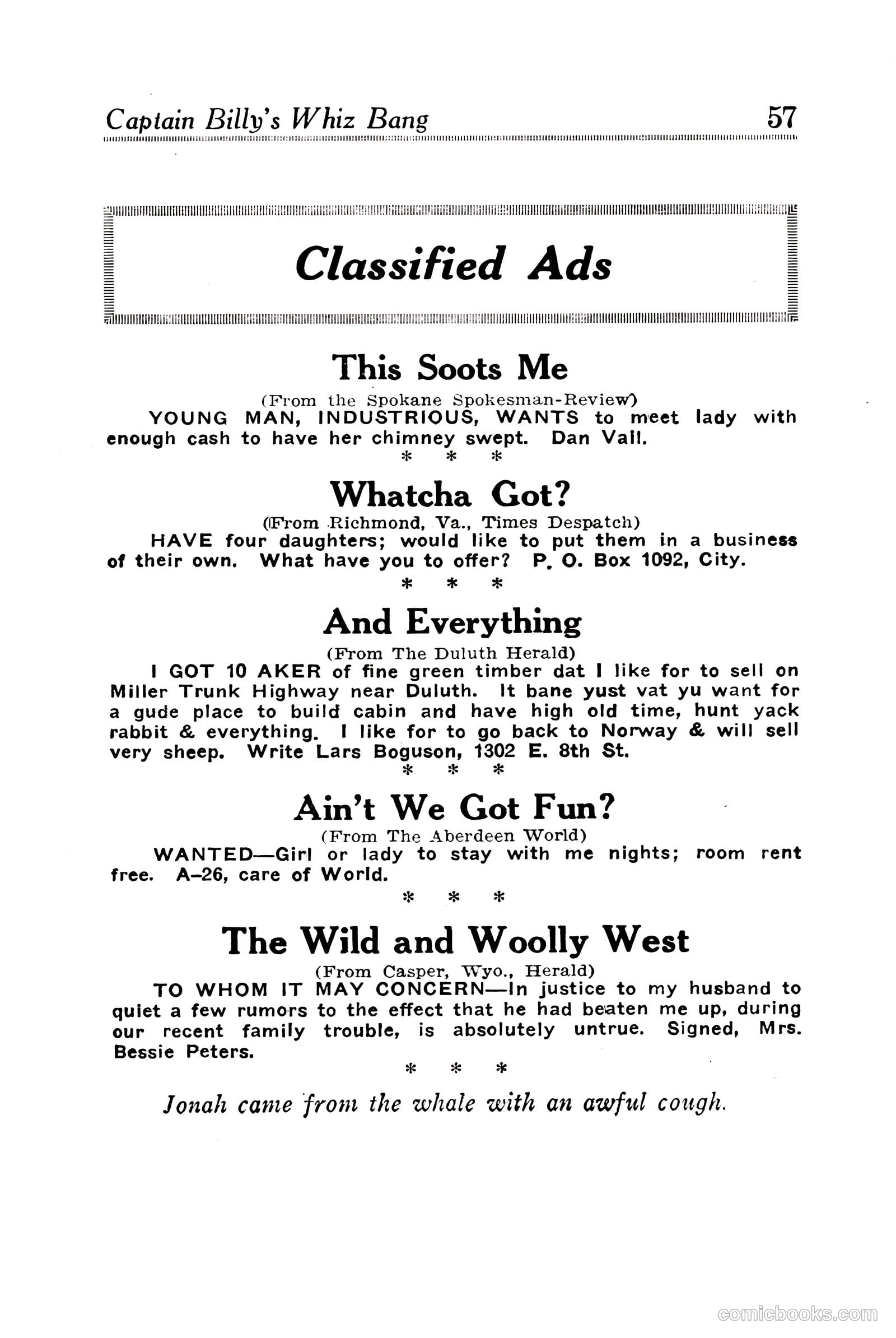
This page from *Captain Billy's Whiz Bang* reprints humorous classified ads from newspapers across America, satirizing the absurdity and desperation evident in real classified sections. The humor relies on the gap between what advertisers claim to offer and what they actually mean. The jokes exploit double meanings and innuendo: a man wants a lady with "cash to have her chimney swept" (sexual); a father seeks to put four daughters "in a business of their own" (implying they'd become sex workers); a man wants a girl to "stay with me nights" with "room rent free" (soliciting a prostitute). Other ads mock broken English ("bane yust vat yu want," "very sheep" for "very cheap") and present absurd situations, like a woman publicly denying she was beaten by her husband—which actually suggests she was. The bottom line about Jonah is a non-sequitur joke unrelated to the ads above it. The satire targets both the desperation of ordinary Americans and contemporary moral anxieties about vice and exploitation.
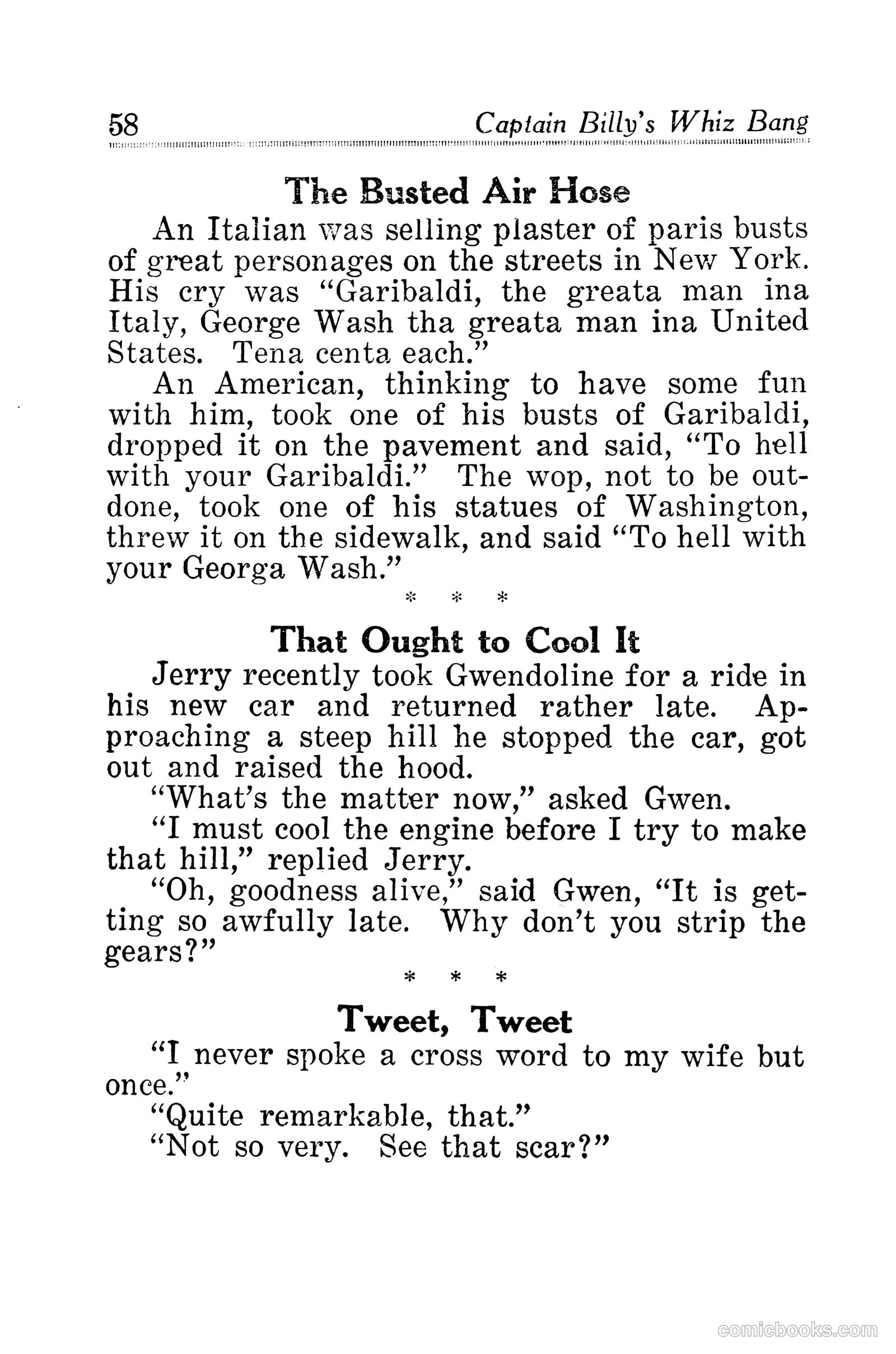
This page contains three separate joke items from *Captain Billy's Whiz Bang*, a humor magazine popular in the early 20th century. **"The Busted Air Hose"** depicts ethnic stereotyping typical of the era—an Italian street vendor speaking in exaggerated dialect sells busts of Garibaldi and George Washington. An American deliberately breaks the Garibaldi bust as a prank; the vendor retaliates by destroying the Washington statue. The "joke" relies on crude ethnic caricature (the vendor is called "the wop") and presents immigrant-American conflict as comedic. **"That Ought to Cool It"** is a double-entendre joke: Jerry claims he needs to cool his car's engine before climbing a hill, but Gwendoline's suggestion to "strip the gears" is presented as an innocent (if mechanically nonsensical) alternative—the humor derives from sexual innuendo the reader supplies. **"Tweet, Tweet"** is a domestic violence joke: a man claims he never argued with his wife except once, then reveals a scar, implying she attacked him violently. The "humor" comes from presenting spousal violence as amusing.
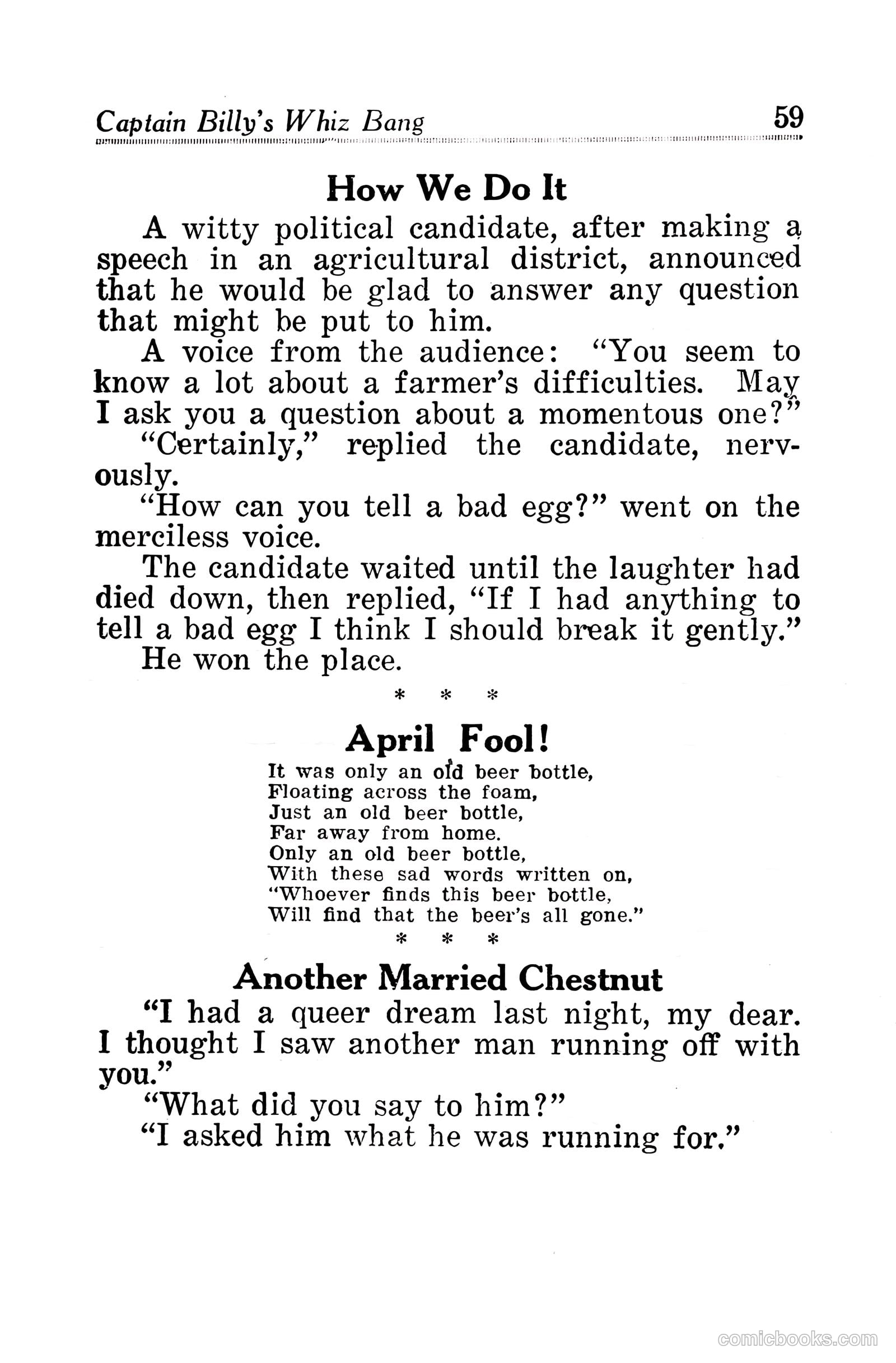
This page contains three separate jokes typical of 1920s American humor magazines: **"How We Do It"** satirizes politicians' prepared responses to tough questions. A candidate, cornered by a farmer about identifying "bad eggs," cleverly deflects with a double entendre ("break it gently")—implying both egg-handling and delivering bad news. The joke celebrates quick wit as political currency. **"April Fool!"** is a Prohibition-era joke: a message in a bottle warns finders the beer is gone—mocking the absurdity of alcohol being unavailable (Prohibition lasted 1920-1933). **"Another Married Chestnut"** is a tired marital joke where a husband, having dreamed of his wife running away with another man, asks what the man wanted—implying his wife is so undesirable no one would actually want her. The "chestnut" label acknowledges it's an old, recycled joke. All three rely on wordplay and expected social scenarios of the era.
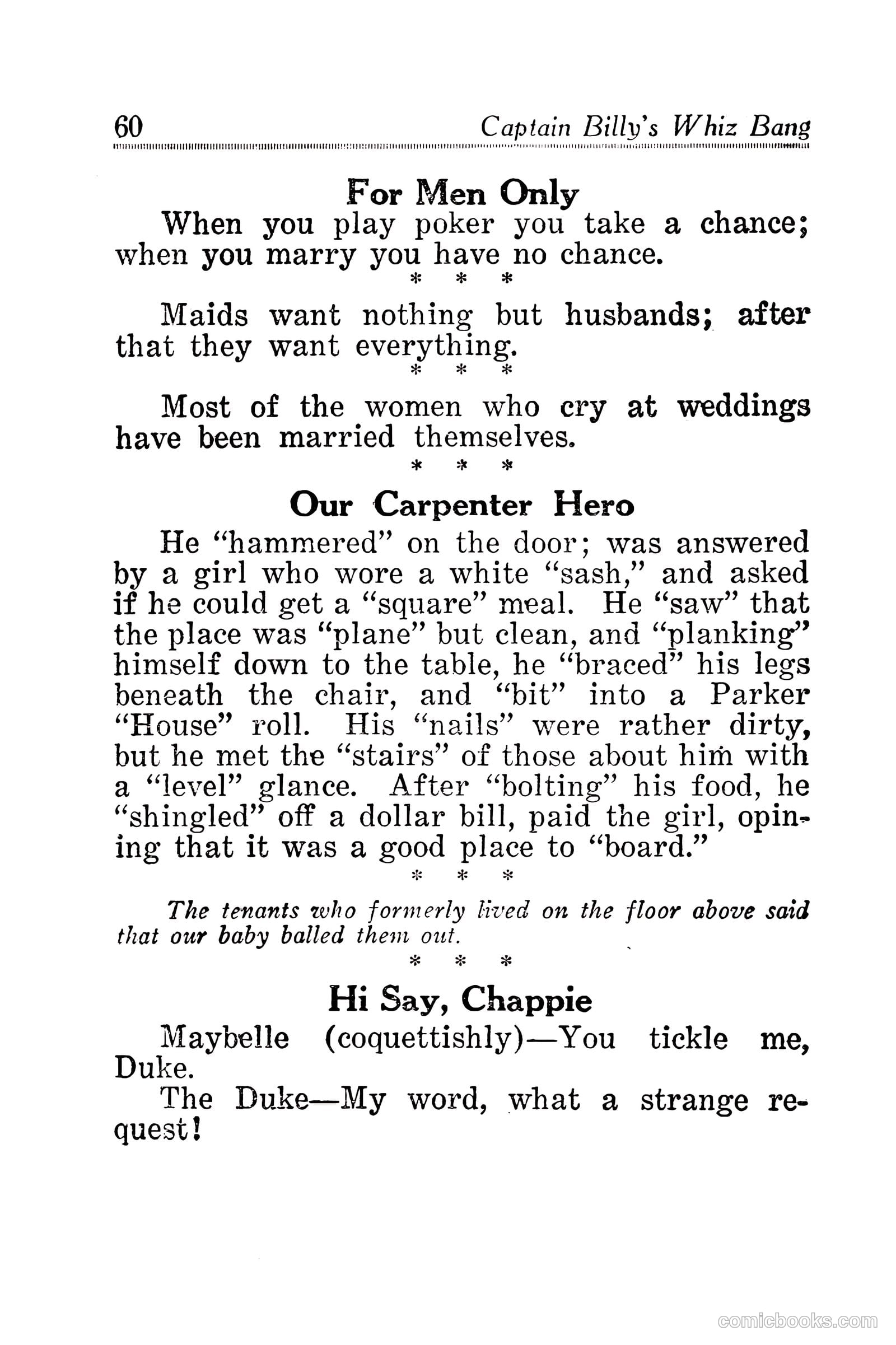
This page from *Whiz Bang*, a 1920s-era men's humor magazine, contains several short jokes reflecting contemporary attitudes toward marriage and gender relations. The opening section ("For Men Only") presents cynical aphorisms about marriage as a trap—contrasting poker's chance-based nature with marriage's certainty of loss. Women are stereotyped as materialistic, wanting husbands for financial support then endless consumption. "Our Carpenter Hero" is an extended pun featuring carpentry/building terminology applied to a man's restaurant visit: he "hammered," the girl wore a "sash," he sought a "square meal," the place was "plane," he "planked" himself down, "braced" his legs, "bit" into a Parker House roll, had dirty "nails," faced the "stairs" of others, spoke with a "level" glance, "bolted" food, and "shingled" off a dollar. The remaining brief jokes are slapstick-style humor about babies causing noise complaints and a misunderstanding about "tickling" (likely implying flirtation). The tone throughout is dismissive of women and family life—standard for this era's male-oriented humor magazines.
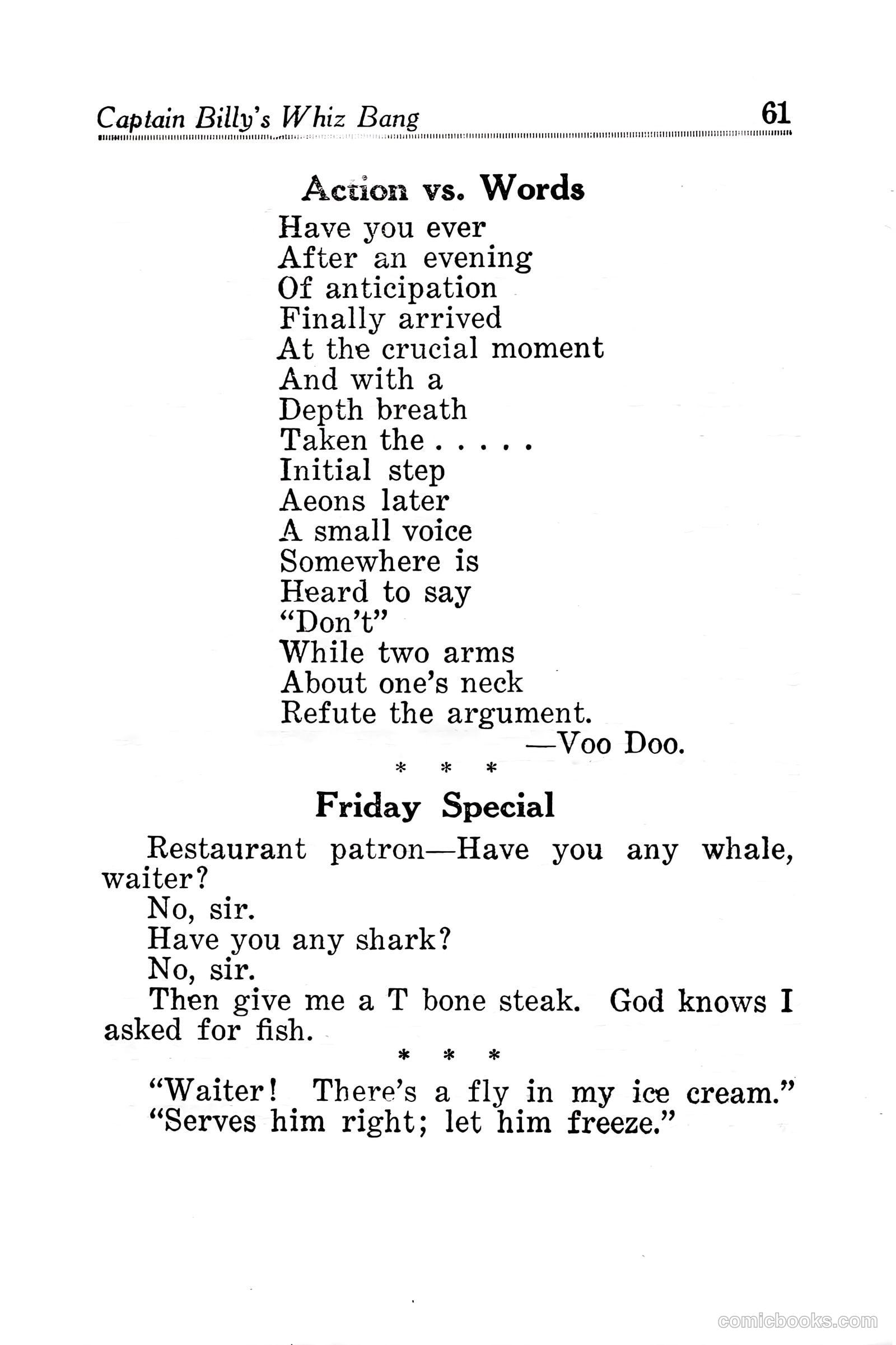
This page from **Captain Billy's Whiz Bang** (a 1920s satirical magazine) contains three separate humor pieces: 1. **"Action vs. Words"** (credited to Voo Doo): A poem about romantic tension—a man takes a crucial first move after anticipation, but a woman's voice says "Don't," while her arms around his neck contradict her words. The joke: actions speak louder than words. 2. **"Friday Special"**: A restaurant joke playing on miscommunication. A diner asks for whale, then shark (unavailable), then settles for T-bone steak while sarcastically noting he "asked for fish." The humor derives from the absurdity of requesting exotic seafood and the waiter's inability to fulfill even basic requests. 3. **Waiter/Fly joke**: A classic setup-punchline about a fly in ice cream, with a darkly humorous response suggesting the fly deserves to freeze. These are straightforward jokes about romance, dining frustration, and wordplay—typical of 1920s magazine humor aimed at young male readers.
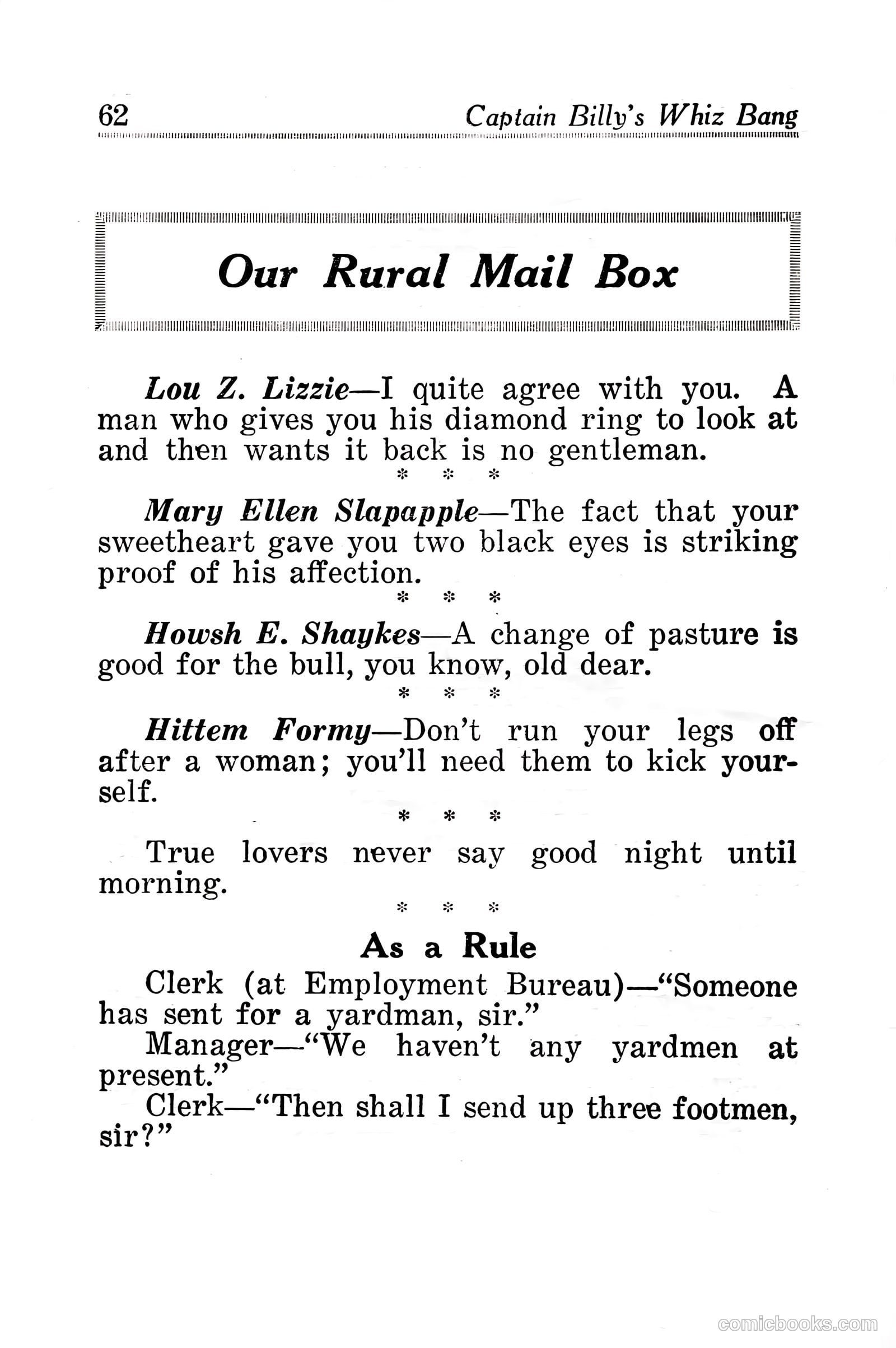
This page contains humorous advice columns and jokes typical of 1920s satirical magazines. The "Rural Mail Box" section features tongue-in-cheek responses to supposed reader letters, offering cynical relationship advice: a man demanding his ring back is dishonorable; black eyes prove affection; advice against chasing women; and that true lovers stay together all night. The bottom joke, "As a Rule," plays on employment terminology. A clerk suggests sending "three footmen" as substitutes for a yardman—a pun exploiting the measurement "yard" (three feet equals one yard). It's simple wordplay humor typical of the era's popular comedic style, relying on literalism and double meanings rather than sophisticated satire.
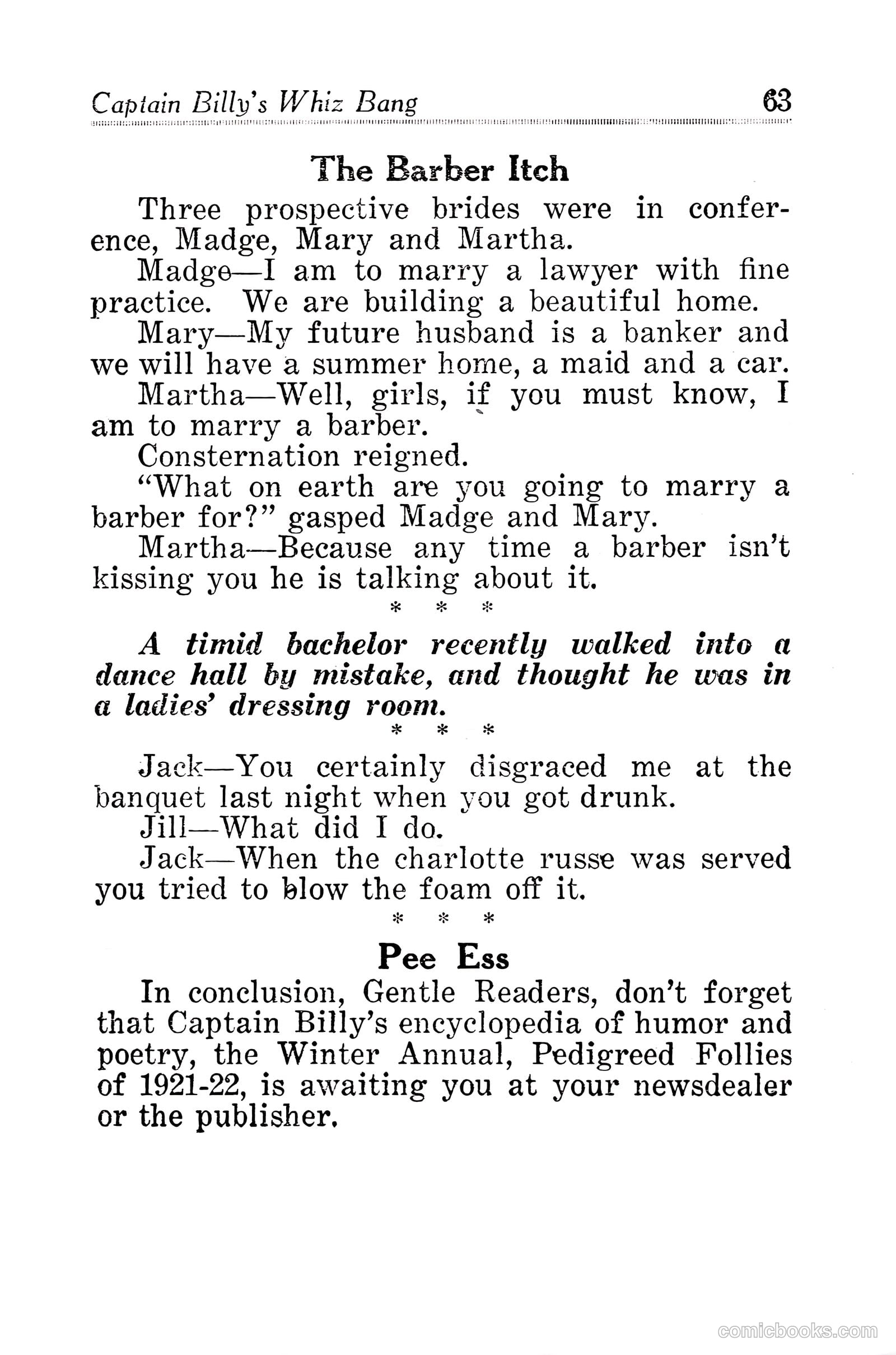
This page from *Captain Billy's Whiz Bang* (a 1920s humor magazine) contains four brief jokes typical of the era's risqué comedy. **"The Barber Itch"** jokes about barber stereotypes—suggesting barbers are overly affectionate/flirtatious with clients, spending as much time kissing women as talking about kissing them. **The bachelor anecdote** plays on innocence: a shy man accidentally enters a ladies' dressing room, mistaking it for a dance hall. **The Jack and Jill exchange** mocks a drunk woman's social incompetence at a banquet—she attempts to blow foam off a charlotte russe (a molded dessert), confusing it with beer or another foamy drink. The final "Pee Ess" section is an advertisement for the magazine's winter annual edition. These jokes reflect 1920s attitudes toward gender roles, drinking culture (post-Prohibition repeal era), and working-class stereotypes, presented in the punchy, mildly bawdy style that defined the publication.
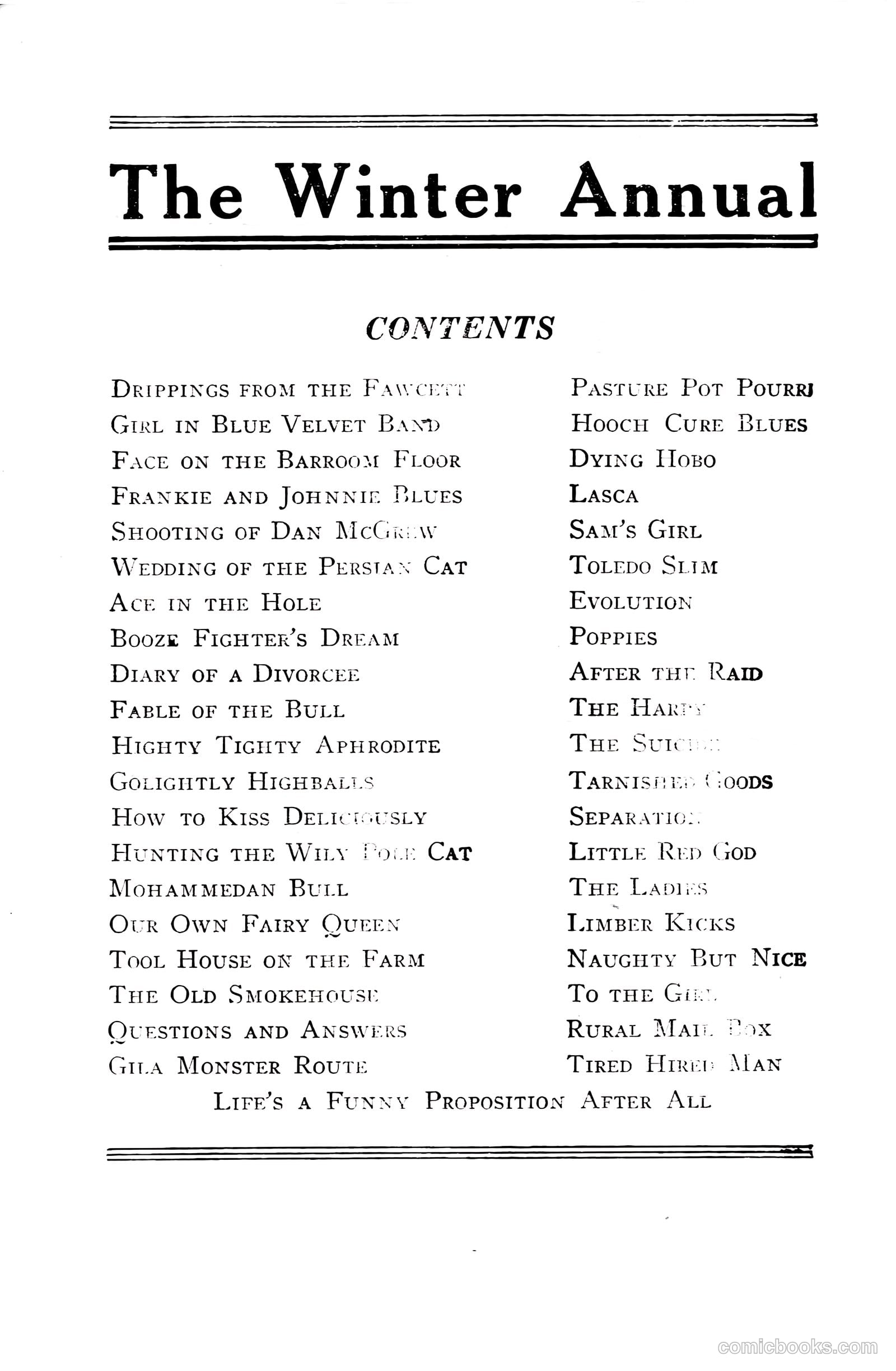
This is a **contents page** from "The Winter Annual," a collection of humorous pieces from Fawcett Publications' satirical magazine. The page lists story titles rather than displaying actual cartoons or illustrations. The titles suggest parodies and humorous takes on popular culture and folk material of the era—including references to well-known ballads ("Frankie and Johnnie," "The Shooting of Dan McGrew") and classical art ("Face on the Barroom Floor"). Pieces like "Highty Tighty Aphrodite" and "How to Kiss Deliciously" indicate risqué humor typical of early 20th-century American satire magazines. Without seeing the actual illustrated content, we cannot identify specific caricatures or political references, but the collection appears aimed at adult readers seeking irreverent parodies of familiar cultural touchstones.
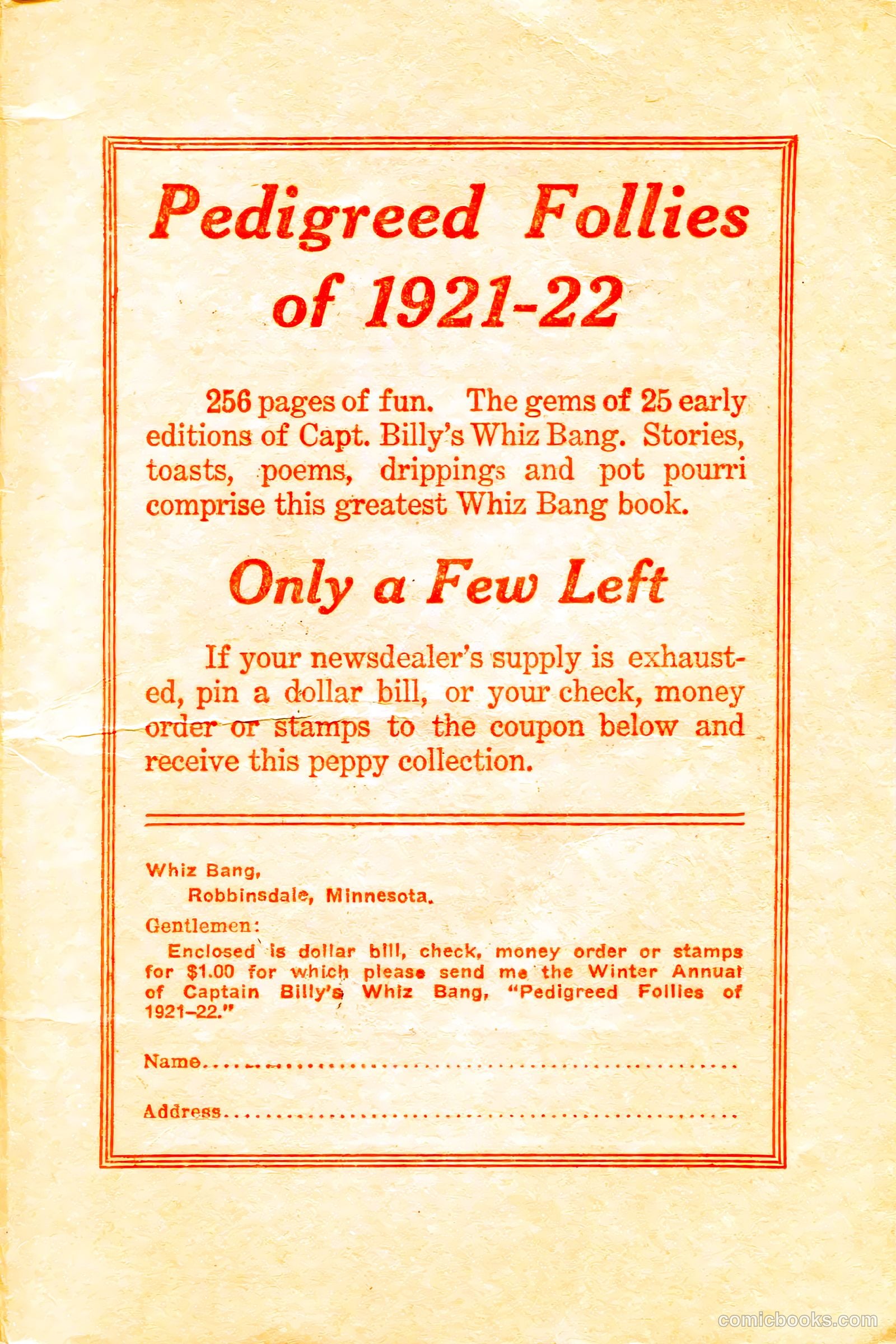
This is a **title page and advertisement**, not a political cartoon. It promotes "Pedigreed Follies of 1921-22," a collection compiled from *Captain Billy's Whiz Bang*, an American satirical magazine popular in the early 1920s. The page advertises a $1.00 book containing 256 pages of humor—stories, poems, toasts, and jokes—drawn from 25 earlier magazine editions. The marketing emphasizes scarcity ("Only a Few Left") to encourage mail orders. **Context for modern readers:** *Whiz Bang* was known for bawdy, irreverent humor aimed at soldiers and working-class men. The term "drippings and pot pourri" suggests miscellaneous, often crude comic material typical of the era. This advertisement reflects 1920s direct-mail marketing and the popularity of affordable, mass-produced humor collections in post-WWI America.
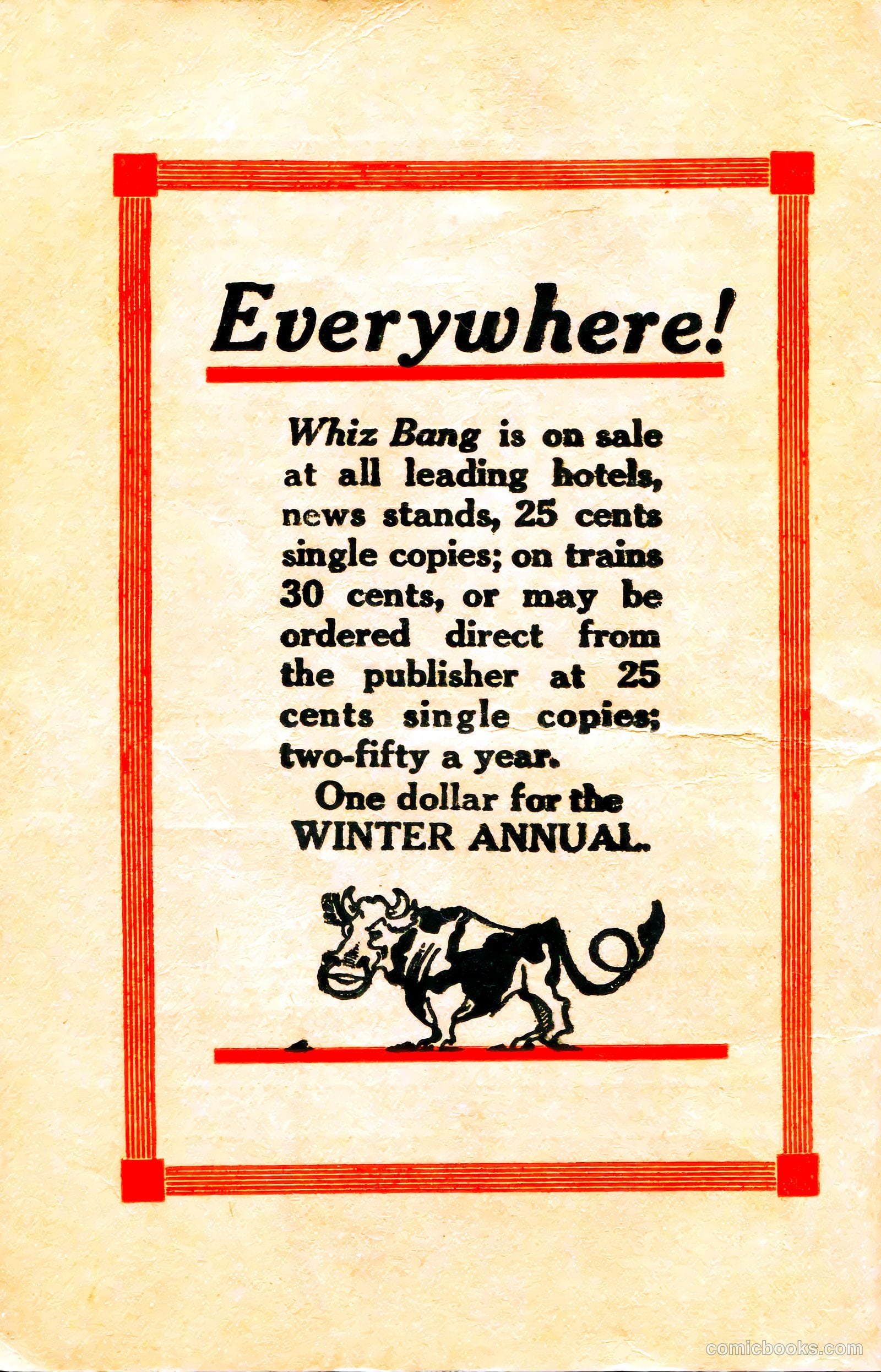
This is a **title/advertisement page**, not a cartoon. It announces the distribution and pricing of *Whiz Bang*, a satirical magazine. The page promotes where readers can purchase copies (hotels, newsstands, trains) at 25-30 cents per issue, or subscribe for $2.50 annually. A special Winter Annual edition costs one dollar. The mascot—a cartoon bull with an exaggerated expression—appears to be the publication's iconic symbol, likely chosen for the aggressive, provocative tone typical of *Whiz Bang*, which was known for bawdy humor and social satire during the 1920s-1930s. The red decorative border and bold typography emphasize the magazine's eye-catching, sensationalist marketing approach aimed at working-class and traveling readers.