
Captain Billy's Whiz Bang, February 1922 · page 54 of 68
Captain Billy's Whiz Bang #30 — page 54: what you’re looking at
What you’re looking at
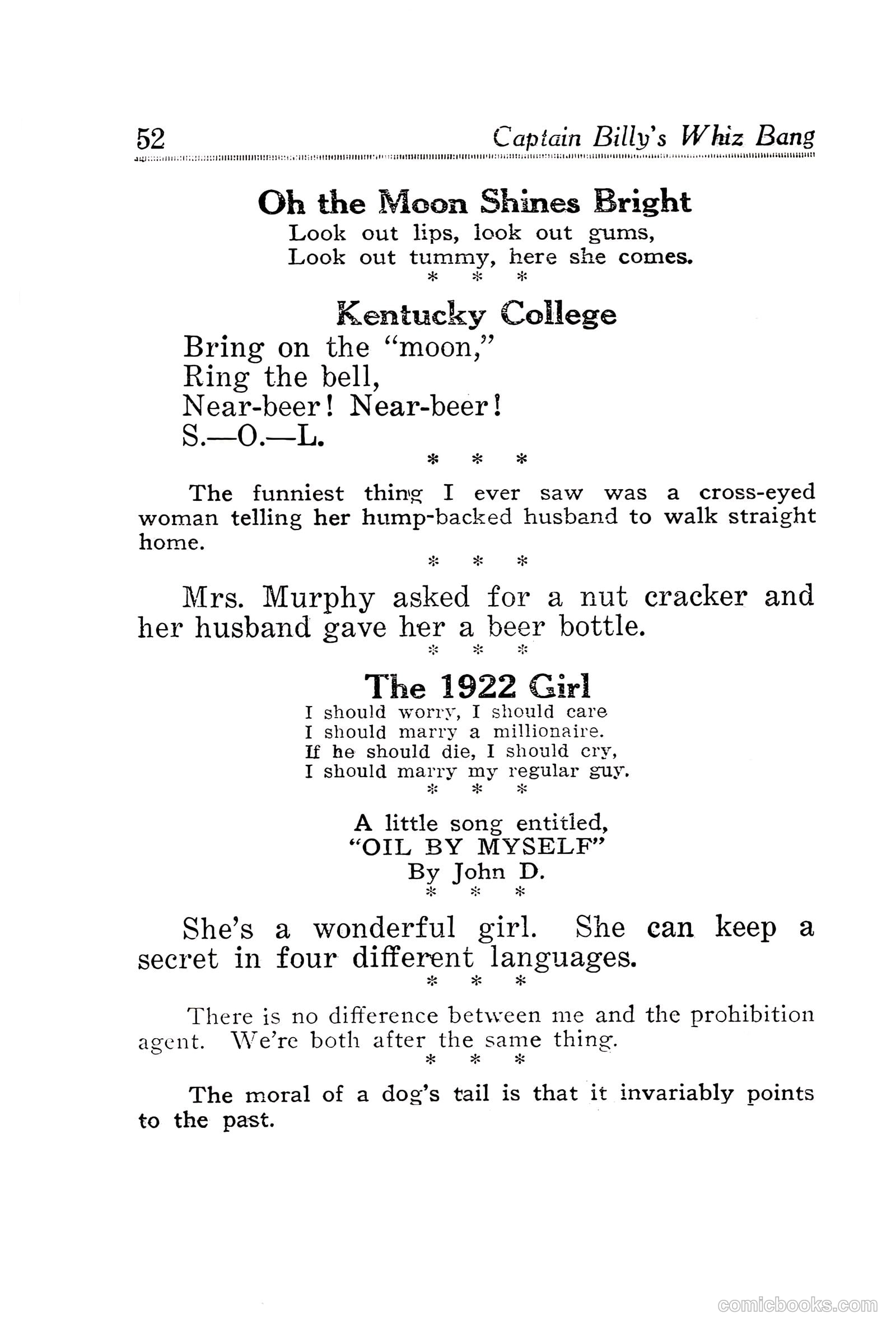
This page from *Captain Billy's Whiz Bang* (a 1920s humor magazine) contains short jokes and quips reflecting post-WWI American culture during Prohibition (1920-1933). **Key references:** - **"Near-beer"** jokes mock the alcohol ban—near-beer was legal but weak, making the prohibition's enforcement absurd - **"The 1922 Girl"** satirizes modern women's attitudes toward marriage and independence, seen as shocking at the time - **"Oil by Myself"** likely references John D. Rockefeller and oil monopolies - **Mrs. Murphy/beer bottle** is a crude domestic joke playing on beer bottle shapes - **The prohibition agent joke** suggests widespread illegal alcohol consumption despite federal law The humor relies on topical references to Prohibition's unpopularity, changing gender roles, and industrial titans. The crude physical humor (cross-eyed woman, hump-backed man) was acceptable in period comedy but reflects attitudes we'd now consider offensive.
📄 Transcribed text from this page (OCR, searchable)
Machine-transcribed from the original scan — historical spelling and the odd misread are preserved.
52 Captain Billy's Whiz Bang Oh the Moon Shines Bright Look out lips, look out gums, Look out tummy, here she comes. * * * Kentucky College Bring on the “moon,” Ring the bell, Near-beer! Near-beer! S.—O.—L. * * * The funniest thing I ever saw was a cross-eyed woman telling her hump-backed husband to walk straight home. * * * Mrs. Murphy asked for a nut cracker and her husband gave her a beer bottle. * * * The 1922 Girl I should worry, I should care I should marry a millionaire. If he should die, I should cry, I should marry my regular guy. * * * A little song entitled, “OIL BY MYSELF” By John D. * * * She’s a wonderful girl. She can keep a secret in four different languages. * * * There is no difference between me and the prohibition agent. We’re both after the same thing. * * * The moral of a dog’s tail is that it invariably points to the past.