
Captain Billy's Whiz Bang, February 1922 · page 29 of 68
Captain Billy's Whiz Bang #30 — page 29: what you’re looking at
What you’re looking at
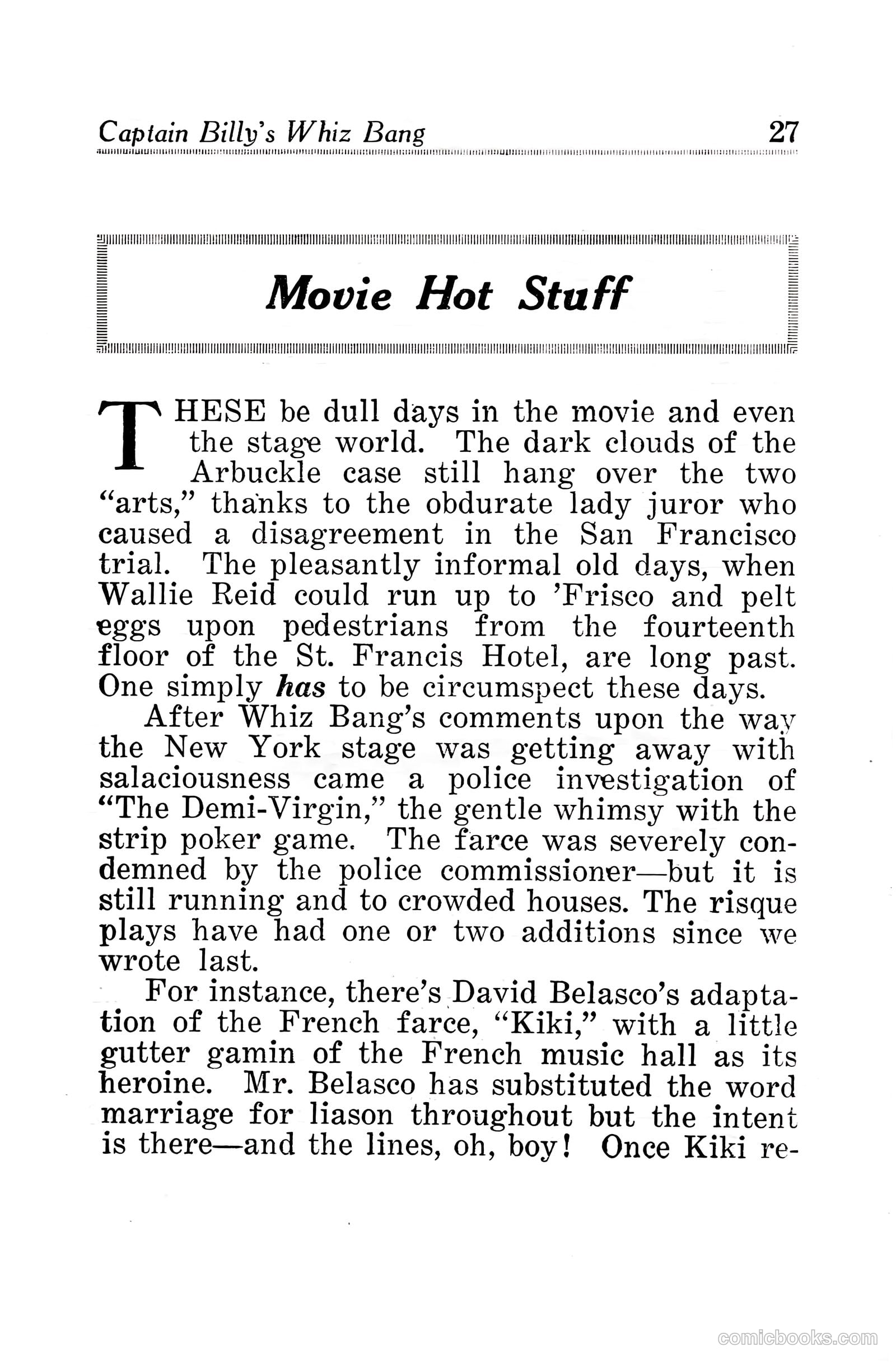
This column discusses scandals affecting 1920s entertainment. The **Arbuckle case** references comedian Roscoe "Fatty" Arbuckle, accused of rape in San Francisco—a trial ending in mistrial due to jury disagreement, damaging Hollywood's reputation. **Wallie Reid** was a popular actor whose public misbehavior (the egg-throwing anecdote illustrates his former recklessness) contrasted with post-scandal industry self-consciousness. The piece criticizes how authorities selectively police entertainment: "The Demi-Virgin" (a Broadway play featuring strip poker) faced police investigation and condemnation yet remained popular. David Belasco's adaptation of French farce "Kiki" uses linguistic camouflage—substituting "marriage" for "liaison"—to evade censorship while maintaining sexually suggestive content. The satire mocks both the entertainment industry's hypocrisy and moral guardians' ineffectual censorship, suggesting audiences still flock to risqué shows regardless of official disapproval.
📄 Transcribed text from this page (OCR, searchable)
Machine-transcribed from the original scan — historical spelling and the odd misread are preserved.
Captain Billy's Whiz Bang 27 Movie Hot Stuff THESE be dull days in the movie and even the stage world. The dark clouds of the Arbuckle case still hang over the two “arts,” thanks to the obdurate lady juror who caused a disagreement in the San Francisco trial. The pleasantly informal old days, when Wallie Reid could run up to ‘Frisco and pelt eggs upon pedestrians from the fourteenth floor of the St. Francis Hotel, are long past. One simply has to be circumspect these days. After Whiz Bang’s comments upon the way the New York stage was getting away with salaciousness came a police investigation of “The Demi-Virgin,” the gentle whimsy with the strip poker game. The farce was severely condemned by the police commissioner—but it is still running and to crowded houses. The risque plays have had one or two additions since we wrote last. For instance, there’s David Belasco’s adaptation of the French farce, “Kiki,” with a little gutter gamin of the French music hall as its heroine. Mr. Belasco has substituted the word marriage for liason throughout but the intent is there—and the lines, oh, boy! Once Kiki re-