
Captain Billy's Whiz Bang, February 1922 · page 14 of 68
Captain Billy's Whiz Bang #30 — page 14: what you’re looking at
What you’re looking at
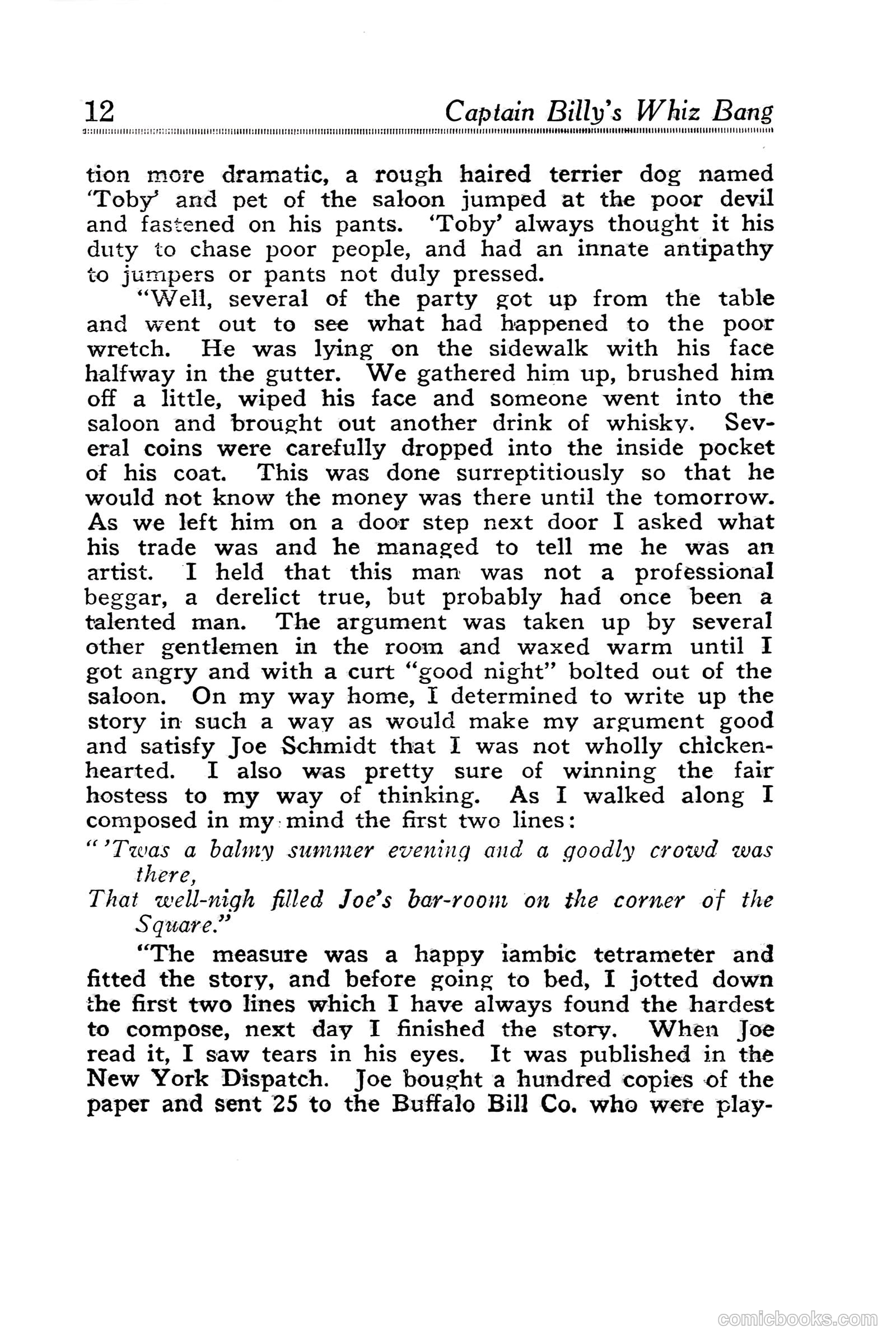
This page from **Captain Billy's Whiz Bang** (a popular early-20th-century humor magazine) contains a first-person narrative rather than a cartoon. The author recounts a saloon incident where a destitute man—described as a fallen artist—is attacked by a terrier named "Toby" that chases poorly dressed people. The story satirizes **working-class charity and respectability**: after the man is knocked down, patrons secretly place coins in his coat so he won't feel humiliated by receiving charity. This touches on the author's broader point about distinguishing between "professional beggars" and talented individuals fallen on hard times. The piece becomes sentimental when the author writes a poem about the incident, published in the *New York Dispatch*. Joe Schmidt (the saloon keeper) is so moved he buys 100 copies and sends 25 to Buffalo Bill's company—suggesting the story achieved notable commercial success. The satire targets both **sentimental magazine culture** and **American attitudes toward poverty and dignity**.
📄 Transcribed text from this page (OCR, searchable)
Machine-transcribed from the original scan — historical spelling and the odd misread are preserved.
12 Captain Billy's Whiz Bang tion more dramatic, a rough haired terri 'Toby' and pet of the saloon jumped at the poor devil and fastened on his pants. 'Toby' always thought it his duty to chase poor people, and had an innate antipathy to jumpers or pants not duly pressed. "Well, several of the party got up from the table and went out to see what had happened to the poor wretch. He was lying on the sidewalk with his face halfway in the gutter. We gathered him up, brushed him off a little, wiped his face and someone went into the saloon and brought out another drink of whisky. Several coins were carefully dropped into the inside pocket of his coat. This was done surreptitiously so that he would not know the money was there until the tomorrow. As we left him on a door step next door I asked what his trade was and he managed to tell me he was an artist. I held that this man was not a professional beggar, a derelict true, but probably had once been a talented man. The argument was taken up by several other gentlemen in the room and waxed warm until I got angry and with a curt "good night" bolted out of the saloon. On my way home, I determined to write up the story in such a way as would make my argument good and satisfy Joe Schmidt that I was not wholly chicken-hearted. I also was pretty sure of winning the fair hostess to my way of thinking. As I walked along I composed in my mind the first two lines: "''Twas a balmy summer evening and a goodly crowd was there, That well-nigh filled Joe's bar-room on the corner of the Square.'" "The measure was a happy iambic tetrameter and fitted the story, and before going to bed, I jotted down the first two lines which I have always found the hardest to compose, next day I finished the story. When Joe read it, I saw tears in his eyes. It was published in the New York Dispatch. Joe bought a hundred copies of the paper and sent 25 to the Buffalo Bill Co. who were play-