
Captain Billy's Whiz Bang, February 1922 · page 35 of 68
Captain Billy's Whiz Bang #30 — page 35: what you’re looking at
What you’re looking at
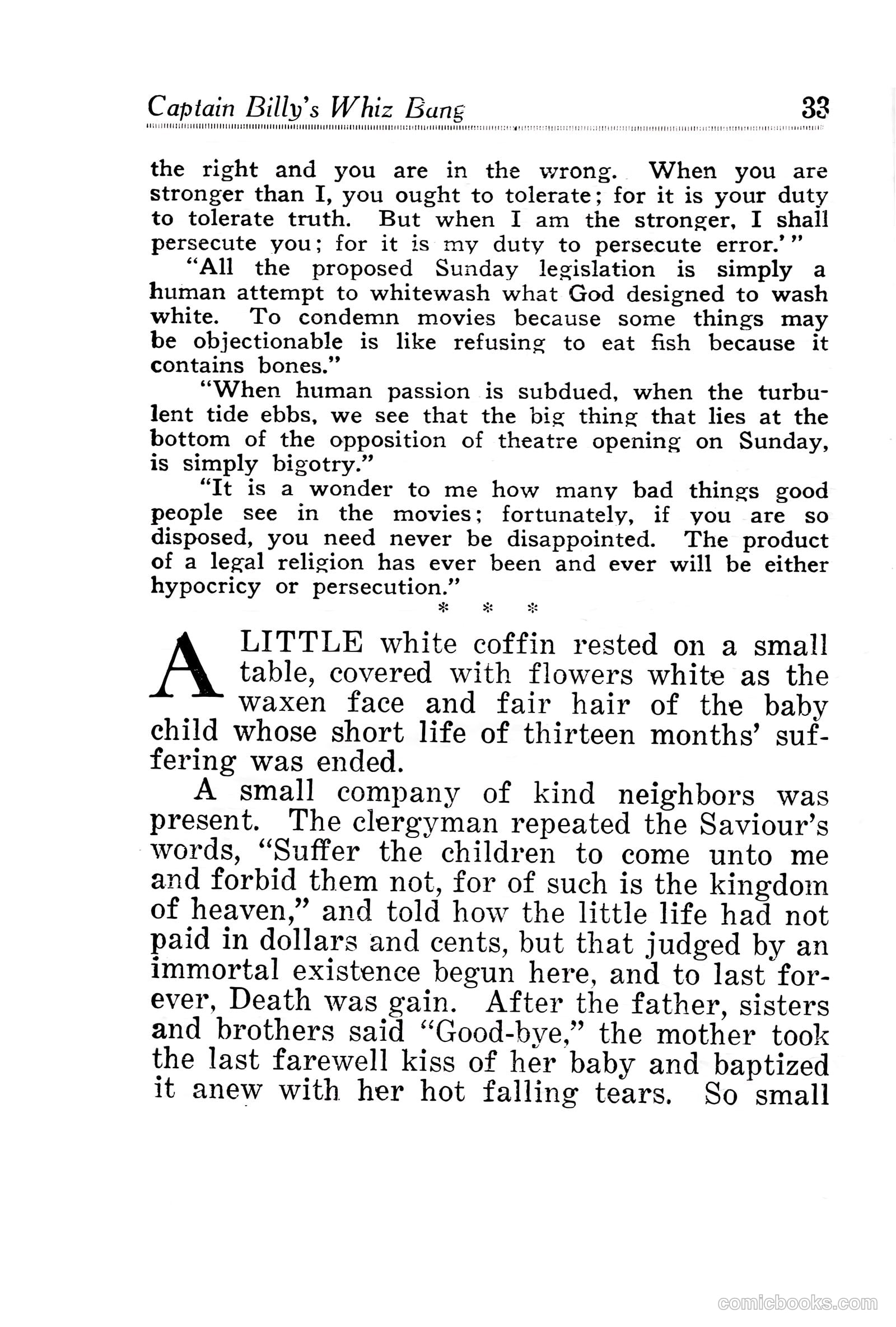
This page contains satirical quotes attacking religious censorship and Sunday "blue laws" (proposed legislation restricting activities on Sundays). The speaker—identity unclear from the image alone—argues that opposition to Sunday movie theaters is religious bigotry disguised as morality. The quotes mock those who see sin in entertainment while ignoring hypocrisy in organized religion itself. The second section shifts to a poignant narrative about an infant's funeral, describing the mother's grief and the clergyman's consolation that the child's "immortal existence" justifies the death. This appears designed to contrast with the satirical section above—possibly suggesting that genuine spiritual comfort comes from compassion rather than restrictive moral policing. The juxtaposition critiques religious institutions that prioritize controlling public behavior over addressing human suffering.
📄 Transcribed text from this page (OCR, searchable)
Machine-transcribed from the original scan — historical spelling and the odd misread are preserved.
Captain Billy’s Whiz Bang 33 the right and you are in the wrong. When you are stronger than I, you ought to tolerate; for it is your duty to tolerate truth. But when I am the stronger, I shall persecute you; for it is my duty to persecute error.’ ” “All the proposed Sunday legislation is simply a human attempt to whitewash what God designed to wash white. To condemn movies because some things may be objectionable is like refusing to eat fish because it contains bones.” “When human passion is subdued, when the turbu- lent tide ebbs, we see that the big thing that lies at the bottom of the opposition of theatre opening on Sunday, is simply bigotry.” “It is a wonder to me how many bad things good people see in the movies; fortunately, if you are so disposed, you need never be disappointed. The product of a legal religion has ever been and ever will be either hypocrisy or persecution.” * * * A LITTLE white coffin rested on a small table, covered with flowers white as the waxen face and fair hair of the baby child whose short life of thirteen months’ suf- fering was ended. A small company of kind neighbors was present. The clergyman repeated the Saviour’s words, “Suffer the children to come unto me and forbid them not, for of such is the kingdom of heaven,” and told how the little life had not paid in dollars and cents, but that judged by an immortal existence begun here, and to last for- ever, Death was gain. After the father, sisters and brothers said “Good-bye,” the mother took the last farewell kiss of her baby and baptized it anew with her hot falling tears. So small