
Captain Billy's Whiz Bang, February 1922 · page 19 of 68
Captain Billy's Whiz Bang #30 — page 19: what you’re looking at
What you’re looking at
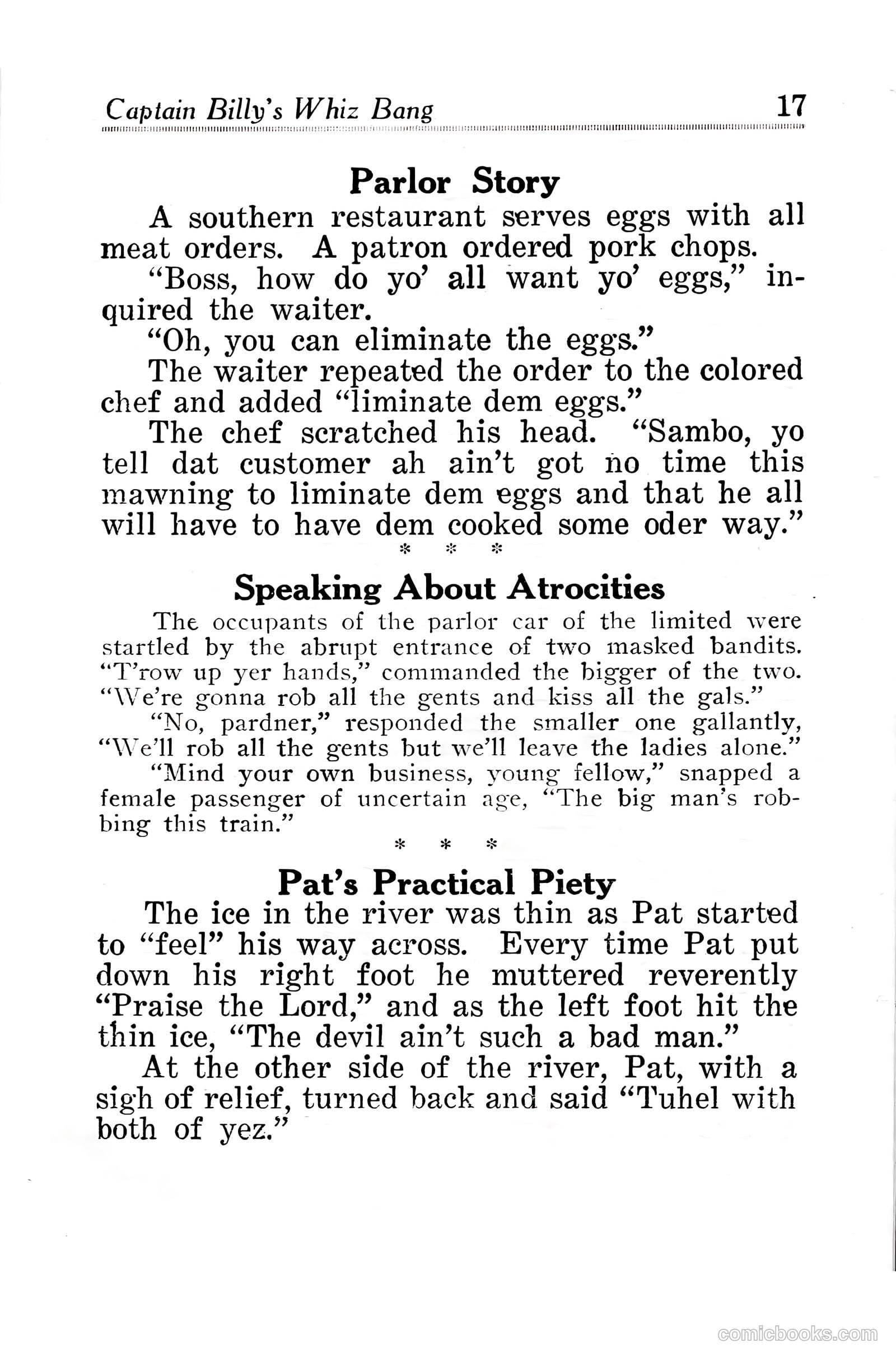
This page contains three short humorous anecdotes typical of 1920s American magazines: **"Parlor Story"** mocks dialectal speech through a misunderstanding: a waiter mishears "eliminate" as "liminate," and a Black chef (referred to with period slurs) comically refuses to perform a nonsensical task. The joke relies on stereotypical dialect humor. **"Speaking About Atrocities"** is a train-robbery joke where a female passenger, annoyed at being excluded from robbery, demands equal treatment from the bandits—inverting expected chivalry for comedic effect. **"Pat's Practical Piety"** presents Irish ethnic humor: "Pat" crosses thin ice while alternating between praising God and the devil with each step, then dismisses both upon reaching safety. This satirizes superficial religiosity and pragmatism. All three reflect early-20th-century American humor conventions built on ethnic/racial stereotypes and dialect comedy now considered offensive.
📄 Transcribed text from this page (OCR, searchable)
Machine-transcribed from the original scan — historical spelling and the odd misread are preserved.
Captain Billy's Whiz Bang 17 Parlor Story A southern restaurant serves eggs with all meat orders. A patron ordered pork chops. “Boss, how do yo’ all want yo’ eggs,” inquired the waiter. “Oh, you can eliminate the eggs.” The waiter repeated the order to the colored chef and added “liminate dem eggs.” The chef scratched his head. “Sambo, yo tell dat customer ah ain’t got no time this mawning to liminate dem eggs and that he all will have to have dem cooked some oder way.” * * * Speaking About Atrocities The occupants of the parlor car of the limited were startled by the abrupt entrance of two masked bandits. “T’row up yer hands,” commanded the bigger of the two. “We’re gonna rob all the gents and kiss all the gals.” “No, pardner,” responded the smaller one gallantly, “We’ll rob all the gents but we’ll leave the ladies alone.” “Mind your own business, young fellow,” snapped a female passenger of uncertain age, “The big man’s robbing this train.” * * * Pat’s Practical Piety The ice in the river was thin as Pat started to “feel” his way across. Every time Pat put down his right foot he muttered reverently “Praise the Lord,” and as the left foot hit the thin ice, “The devil ain’t such a bad man.” At the other side of the river, Pat, with a sigh of relief, turned back and said “Tuhel with both of yez.”