
Captain Billy's Whiz Bang, February 1922 · page 13 of 68
Captain Billy's Whiz Bang #30 — page 13: what you’re looking at
What you’re looking at
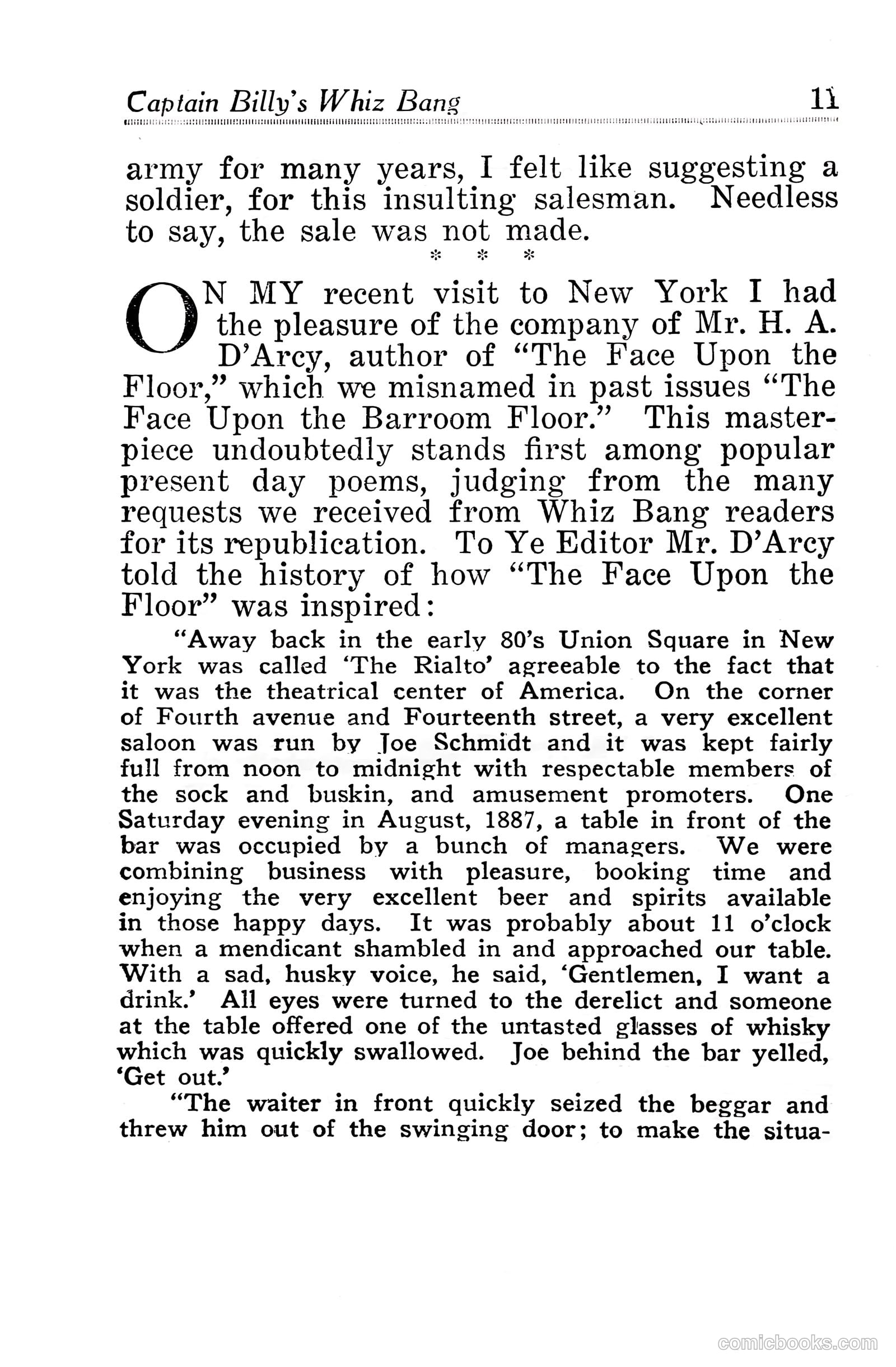
This page from *Captain Billy's Whiz Bang* (a satirical magazine) presents anecdotal humor rather than a political cartoon. The text explains the origin story of H.A. D'Arcy's famous poem "The Face Upon the Floor" (also known as "The Face Upon the Barroom Floor"). The narrative describes an 1887 incident in a New York saloon where a derelict beggar interrupted a table of theater managers, requesting a drink. After someone offered him whisky, the bartender Joe Schmidt ejected him forcibly. The piece treats this as a touching human moment that inspired Darchy's sentimental poem. For modern readers: this reflects late-19th-century attitudes toward poverty and charity—simultaneously pitying the homeless while depicting their removal as comedic. The "satire" is genteel, focused on theater-world anecdotes rather than sharp social critique. The magazine balanced crude humor with nostalgic storytelling about New York's theatrical past.
📄 Transcribed text from this page (OCR, searchable)
Machine-transcribed from the original scan — historical spelling and the odd misread are preserved.
Captain Billy's Whiz Bang 11 army for many years, I felt like suggesting a soldier, for this insulting salesman. Needless to say, the sale was not made. * * * ON MY recent visit to New York I had the pleasure of the company of Mr. H. A. D'Arcy, author of “The Face Upon the Floor,” which we misnamed in past issues “The Face Upon the Barroom Floor.” This master- piece undoubtedly stands first among popular present day poems, judging from the many requests we received from Whiz Bang readers for its republication. To Ye Editor Mr. D'Arcy told the history of how “The Face Upon the Floor” was inspired: “Away back in the early 80's Union Square in New York was called ‘The Rialto’ agreeable to the fact that it was the theatrical center of America. On the corner of Fourth avenue and Fourteenth street, a very excellent saloon was run by Joe Schmidt and it was kept fairly full from noon to midnight with respectable members of the sock and buskin, and amusement promoters. One Saturday evening in August, 1887, a table in front of the bar was occupied by a bunch of managers. We were combining business with pleasure, booking time and enjoying the very excellent beer and spirits available in those happy days. It was probably about 11 o'clock when a mendicant shambled in and approached our table. With a sad, husky voice, he said, ‘Gentlemen, I want a drink.’ All eyes were turned to the derelict and someone at the table offered one of the untasted glasses of whisky which was quickly swallowed. Joe behind the bar yelled, ‘Get out.’ “The waiter in front quickly seized the beggar and threw him out of the swinging door; to make the situa-