
Captain Billy's Whiz Bang, February 1922 · page 37 of 68
Captain Billy's Whiz Bang #30 — page 37: what you’re looking at
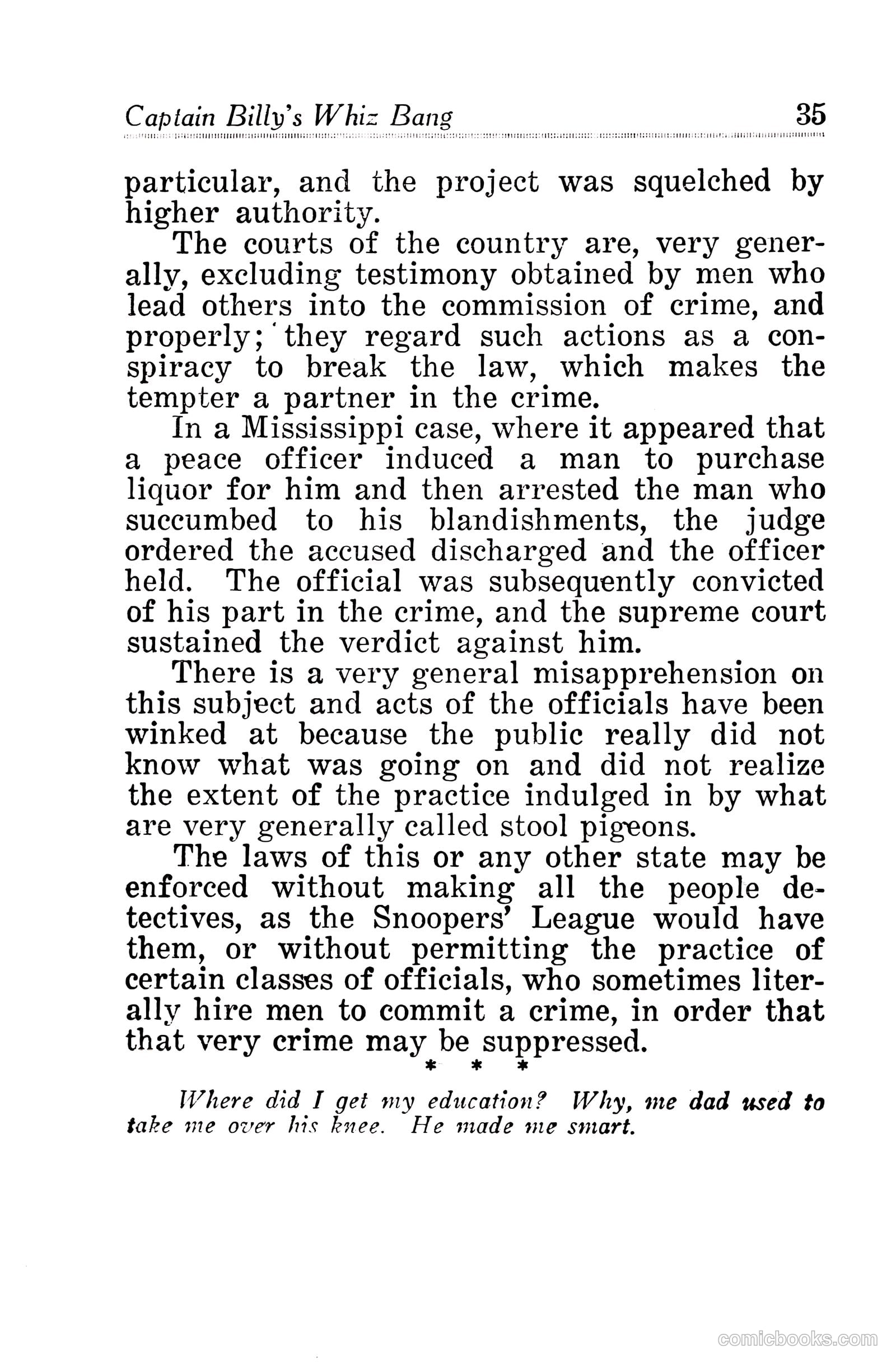
What you’re looking at
This page contains **no cartoon or illustration**—it's entirely text: a serious editorial essay about entrapment and police misconduct. The piece criticizes law enforcement practices where officers deliberately induce citizens to commit crimes, then arrest them. It cites a Mississippi case where a peace officer bought liquor (illegal during Prohibition), convinced someone to purchase it for him, then arrested that person. The court discharged the accused and convicted the officer instead. The essay argues courts properly exclude such "entrapment" testimony and warns against the "Snooper's League" (likely referencing overzealous Prohibition enforcement agents). It condemns officials who "literally hire men to commit a crime" under the guise of law enforcement. The final snippet is an unrelated joke about corporal punishment as education. **Context for moderns**: This reflects 1920s Prohibition-era debates over government overreach, police entrapment tactics, and civil liberties—issues that remain relevant today.
📄 Transcribed text from this page (OCR, searchable)
Machine-transcribed from the original scan — historical spelling and the odd misread are preserved.
Captain Billy's Whiz Bang 35 particular, and the project was squelched by higher authority. The courts of the country are, very gener-ally, excluding testimony obtained by men who lead others into the commission of crime, and properly; they regard such actions as a con-spiracy to break the law, which makes the tempter a partner in the crime. In a Mississippi case, where it appeared that a peace officer induced a man to purchase liquor for him and then arrested the man who succumbed to his blandishments, the judge ordered the accused discharged and the officer held. The official was subsequently convicted of his part in the crime, and the supreme court sustained the verdict against him. There is a very general misapprehension on this subject and acts of the officials have been winked at because the public really did not know what was going on and did not realize the extent of the practice indulged in by what are very generally called stool pigeons. The laws of this or any other state may be enforced without making all the people de-tectives, as the Snoopers’ League would have them, or without permitting the practice of certain classes of officials, who sometimes liter-ally hire men to commit a crime, in order that that very crime may be suppressed. * * * Where did I get my education? Why, me dad used to take me over his knee. He made me smart.