
A complete issue · 68 pages · 1921
Captain Billy's Whiz Bang #18
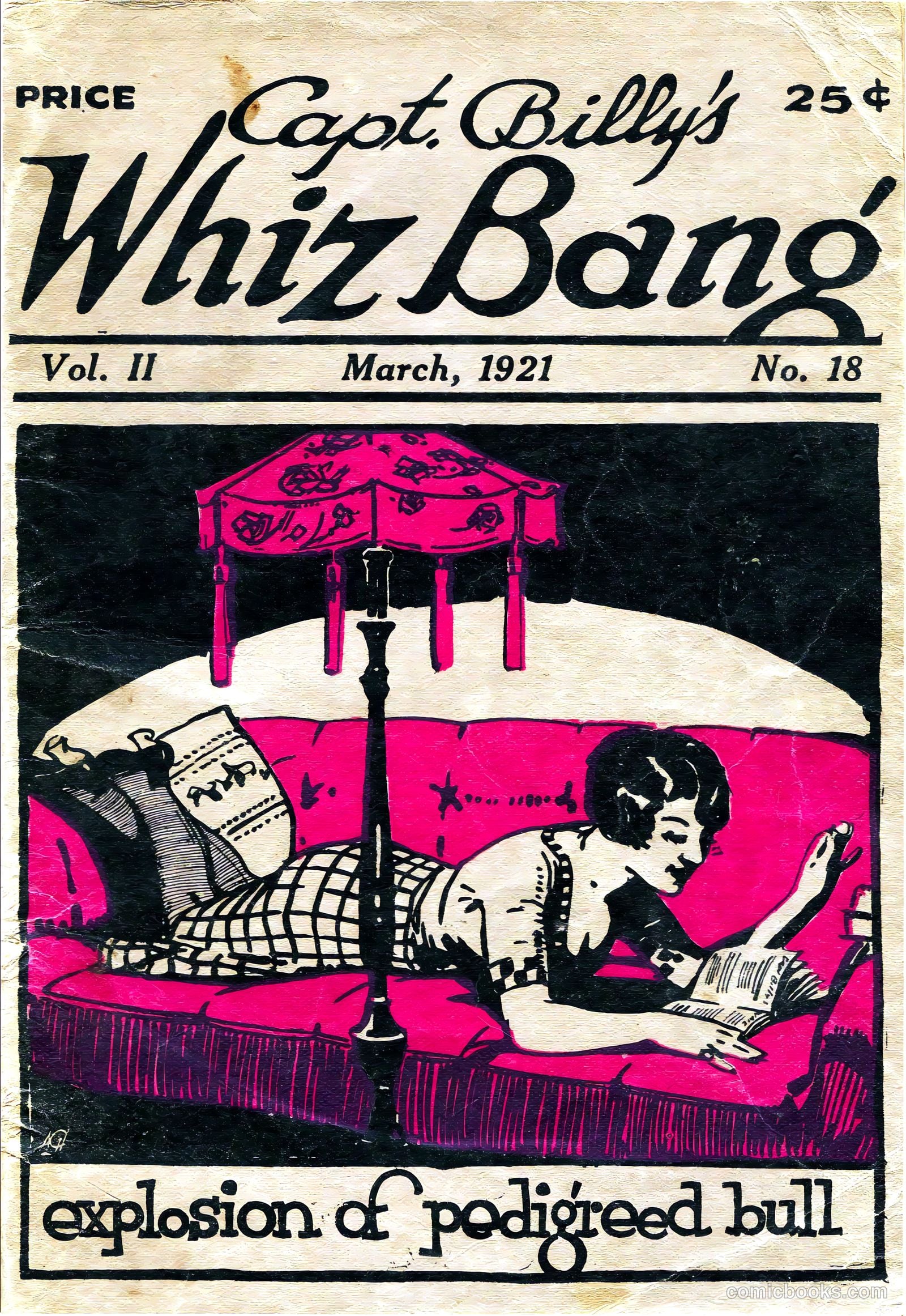
This March 1921 satirical illustration depicts a woman reclining on a pink couch under an umbrella, reading while a gramophone plays. The caption's phrase "explosion of pedigreed bull" appears to be crude slang—likely mocking either pretentious talk or dubious claims. The woman's relaxed, indifferent posture while supposedly enduring this "explosion" suggests the satire targets absurd overreactions or the dismissal of pompous nonsense. The gramophone may emphasize that such talk is mere noise. The illustration's Art Deco style and the magazine's "Whiz Bang" branding (known for risqué humor) indicate this was humor aimed at post-WWI audiences skeptical of high-minded pretension. The specific target remains unclear without broader context.
This is primarily **advertising copy**, not a political cartoon. The page promotes *Whiz Bang* magazine itself through verse that promises readers stress relief and entertainment after work. The poem suggests the magazine's content—humor and "Farmyard Philosophy and Foolishness"—will dispel everyday worries. Below is a subscription coupon addressed to "Capt. Billy's Whiz Bang" in Minnesota, costing $2.50 yearly. This appears to be **house advertising**: the magazine promoting its own subscription within its pages. The tone is lighthearted and self-promotional, positioning *Whiz Bang* as affordable escapism for working people seeking home entertainment. There is no identifiable political satire or caricature on this page—it's straightforward (if humorous) commercial promotion.
This is the title page of **Captain Billy's Whiz Bang**, a satirical humor magazine published in rural Minnesota in March 1921. Edited by W.H. Fawcett, it was billed as "America's Magazine of Wit, Humor and Philosophy" and cost 25 cents per issue. The publication was entering its second year of circulation. The decorative floral ornament and formal framing reflect typical magazine design of the 1920s. This appears to be a working-class humor publication, likely containing jokes, cartoons, and satirical commentary typical of the post-WWI era. The page itself contains no cartoons or specific political content—it's a masthead/contents page.
This is a title page from *Whiz-Bang*, a 1921 satirical magazine edited by a Spanish-American War and World War I veteran. The page features a Theodore Roosevelt quote emphasizing sole loyalty to "the American People," likely a reference to post-WWI concerns about foreign influence and hyphenated identities (German-Americans, Italian-Americans, etc.). The magazine appears dedicated to supporting U.S. military forces, and the union printing label indicates working-class patriotic sentiment. The quote's placement suggests *Whiz-Bang* positioned itself as championing nationalist American values against perceived divided loyalties—a common theme in 1920s publications responding to immigration anxieties and wartime social tensions.
This is a humorous anecdote from *Captain Billy's Whiz Bang*, a post-WWI satirical magazine. The joke hinges on a double entendre about the word "naval." **The Setup:** A narrator, recently returned from war, brings an old sea captain friend (Jim Edmunds) to a formal party. They struggle to get Jim into proper formal wear—specifically, the tailor wants a low-cut vest with one button, but Jim insists on a two-button vest. **The Punchline:** When the hostess notices Jim's naval medal and says "I see you're naval," Jim thinks she's making an innuendo about his exposed chest/body. His retort—"if that danged tailor had his way, you could see a whole lot more"—suggests the tailor wanted to reveal even more of his body. **The Satire:** The humor mocks working-class masculinity and social pretension. Jim, uncomfortable in formal dress, misreads a polite remark as flirtation, revealing both his social awkwardness and his preoccupation with the tailor's unwanted alterations.
This page contains two humorous anecdotes from an early 20th-century satirical magazine. **First Story**: Bob Jaeger visits a "National Dutch room" cabaret featuring jazz dancers doing the "shimmy" (a popular 1920s dance). Bob's response—suggesting they play a wedding march "quick"—is a joke about the dancers' vigorous, sexually suggestive movements; he's implying they need to get married rather than dance so provocatively. **Second Story**: Gus, an employee sensitive about foot perspiration, misidentifies French chalk (a standard shoe-fitting powder) as "chloride of lime" (actual disinfectant). His angry outburst stems from ignorance—he thinks the clerk is insulting him by suggesting his feet need heavy disinfection, when the chalk serves merely practical purposes. The humor lies in Gus's oversensitivity and misunderstanding of common commercial practice. Both stories satirize everyday social awkwardness and misunderstandings among ordinary people.
This page contains **no cartoon**—it's a prose piece of nostalgic humor written during **Prohibition** (1920-1933). The author reflects on hearing "Sweet Adeline," a sentimental barbershop quartet standard, sung by drunk motorists leaving local roadhouses (Robbinsdale and Casey's). The satire works on multiple levels: it mourns the "lost art" of drunken group singing now impossible under prohibition's enforcement. The author fondly recalls getting "quite drunk" himself to properly enjoy the experience, naming friends Jack and Bob who sang tenor and bass. The humor is self-aware—celebrating intoxication as essential to sentimental joy. The brief final anecdote (a couple abandoning their car seat while reporting their stolen automobile) appears unrelated, perhaps a running feature of the magazine's humor column. The satire targets both prohibition's impact on American social life and the narrator's own nostalgic tippling.
This page contains no cartoon or illustration—it's purely text: a series of brief, cynical aphorisms presented as "Farmyard Philosophy." The jokes are typical of 1920s-era satirical humor, targeting conventional morality with tongue-in-cheek observations. Examples include mockery of reputation (it depends on secrets), marital attitudes, banker greed (a pun on "interest"), and Prohibition-era drinking culture ("driven to drink will take a long ride"—likely referencing bootleggers). One joke puns on electricity and movie censorship being "shocking." The final quip dismisses romantic love as foolish. The tone is cynical and mildly subversive—deflating pretense about respectability, marriage, charity, and morality. This reflects *Whiz Bang's* satirical target audience of soldiers and working-class readers who appreciated irreverent humor about societal hypocrisy.
This page from the satirical magazine presents a series of brief, cynical jokes reflecting 1920s American anxieties. References include: **Prohibition era**: Multiple jokes target alcohol restrictions—liquor in mince pies, bootleggers controlling supply, inability to drink freely. The spittoon joke nostalgically contrasts pre-Prohibition masculinity with current constraints. **Social commentary**: Jabs at government paternalism ("coddled too much"), marriage skepticism, and gender dynamics. The final quips mock women's materialism and men's contradictory attitudes toward women. The tone is dismissive and misogynistic by modern standards, typical of 1920s "men's humor." No specific political figures appear identifiable. The satire targets broad social conditions—legal restrictions, changing gender relations, and perceived moral decline—rather than particular individuals or events.
This page contains **no political cartoons**—it's a collection of humorous aphorisms and a brief comic anecdote. The opening quotes are satirical observations about gender relations and human nature, mocking both men and women. References to "powder" blinding men's eyes and women being creatures "between man and angels" reflect early 20th-century gender stereotypes the magazine lampoons. The main item, "Goosey, Goosey Gander," is a short joke about a maid named Liza Gander who becomes hysterical in the bathroom. Her reply uses dialect humor ("Lawsa me," "ah caint dry mesself")—a common comedic trope of the era depicting Black domestic workers as nervous and incompetent. The humor derives from her nervous breakdown over a minor task.
This page contains three brief humorous anecdotes without illustrations: 1. **"Discounting a Discount"**: A real estate agent asks his stenographer to calculate a discount (2.5% off $50). When she refuses and leaves, offended, the joke suggests she felt insulted by being tested on basic math—or perhaps by the agent's clumsy attempt to hide his own mathematical incompetence. 2. **A one-line joke** about a Pullman porter's book on berth control (unclear reference). 3. **"Too Much Smell"**: Two characters with dialectal speech (Rastus and Mandy) joke about toilet water perfume. Rastus warns Mandy away from the shop window, then insults her by saying she already smells like "toilet water"—a crude ethnic humor typical of the era. The page represents *Whiz Bang*'s mix of workplace humor and period-appropriate (if offensive) racial comedy.
This is a humorous list playing on railroad terminology. A "carman" was a railroad worker who maintained freight cars. The joke uses technical railroad terms as euphemisms for relationship situations: - **EXITER** (woman won't talk) = Exit valve - **CONTROLLER** (too excited) = Speed controller - **METER** (halfway compromise) = Measuring device - **DISPATCHER** (wants to "go all the way") = Train dispatcher The satire mocks both workplace jargon and early 20th-century courtship dynamics—treating romantic interactions like mechanical railroad operations. It's lighthearted gender humor typical of 1920s magazines, presenting women's moods and preferences through an industrial/male-dominated lens. The other items on the page ("A New Proposal" and "Business Was Good") are brief humorous anecdotes unrelated to the carman code.
This page contains two humorous pieces typical of 1920s satirical magazines: **"Why He Needs Paper"** is a joke about a delinquent newspaper subscriber. A farmer, unable to pay his subscription, refuses the editor's increasingly absurd payment suggestions (chickens, crops, corn cobs). The farmer's punchline—that if he had corn cobs, he wouldn't need the newspaper—is a crude reference to using newspaper as toilet paper, a common practice during economic hardship. **"A Choice of Evils"** presents a brief romantic joke: when warned against marrying a wealthy woman with a questionable past, the man pragmatically chooses a secure future over moral judgment. Both pieces reflect working-class hardship and irreverent humor typical of Whiz Bang's audience and era.
This page introduces a satirical story warning young women about the movie industry's predatory culture. The editor notes that telling women "she ought to be in pictures" is a common seduction line used by unscrupulous men in Los Angeles—apparently so effective that it causes "serious final result" (likely meaning financial or sexual exploitation). The story by "Richmond" describes Hollywood as infested with manipulative men who use romantic flattery to exploit aspiring actresses. It portrays the film industry as uniquely corrupt, characterized by jealousy, deception, and power games where men manipulate women competitively. The piece presents a first-person account from a French woman seeking entry into "Filmdom," positioning her experience as typical of women navigating this exploitative landscape. The satire critiques both the predatory industry and women's vulnerability to its false promises.
This is a satirical narrative mocking the predatory practices of early Hollywood. The story targets Prince Troubetskoy (a real Russian sculptor and socialite known for Hollywood parties), his wife, and unnamed film industry men who exploited aspiring actresses. The satire exposes a common scam: studio executives and producers using false promises of film roles to lure young women into private meetings. The French dancer character represents vulnerable immigrants seeking legitimate opportunity in cinema. The humor is darkly cynical—the text notes the Princess "enjoyed the society of young men" and wasn't "sweet" (likely implying she was drunk or difficult), establishing the Troubetskoy home as a den of vice where women were "passed along" to various men based on "opportunity." The opening suitor's pitch—"we must go out to talk it over"—signals the seduction trap being laid. *Whiz Bang* was satirizing real exploitation in 1920s Hollywood, where power imbalances made actresses vulnerable to sexual coercion under guise of career advancement.
This page satirizes the exploitative practices of early film industry men using their authority to solicit sexual favors from aspiring actresses. A woman seeking a movie part is approached by four different men—each claiming superior authority (leading man, director, assistant director, manager)—all inviting her to private dinners or outings under the pretense of "discussing" her role. The joke's point: the woman's exasperated question ("Does one always have to eat dinner before getting into pictures?") exposes the transparent con. Each man outranks the previous one to maintain plausibility, yet all use identical manipulative tactics. The satire mocks both the sleazy gatekeepers and their absurdly repetitive schemes. This reflects genuine Hollywood practices of the era where powerful men exploited actresses' desperation for work.
This page contains two separate pieces of satirical fiction: The first section continues a narrative about a woman rejecting dinner invitations from five men involved in what appears to be a film production company, with one identified as having wealthy South American backing. The satire mocks the transactional nature of early Hollywood relationships and the casual power dynamics among producers and investors. The second piece, titled "Couldn't Understand," is a brief comedic dialogue between "Bellboy" and "Rastus" (using the era's offensive racial caricature terminology). The joke involves a bellboy fired from the Langren Hotel for paging a woman named "Carrie Age"—a crude pun on "carriage" the reader must infer. The satire appears to target working-class misunderstandings or immigrant speech patterns through offensive stereotyping common to 1920s humor.
This page is primarily **promotional material** rather than a cartoon. It announces that Reverend "Golightly" Morrill, the magazine's "fire-eating" satirical writer, is touring the West Indies and will contribute travel pieces to *Whiz Bang*. The article itself is Morrill's account of **St. Lucia's violent colonial history**—describing 250 years of Franco-English conflict (1605-1814), including massacres and native resistance. The tone is sensationalized, treating warfare and death as dramatic entertainment suitable for a satirical magazine. The "Cherubim of Hell" headline appears designed to grab attention rather than refer to a specific cartoon. This reflects *Whiz Bang's* style: mixing irreverent religious language with lurid colonial narratives for shock value and readership appeal.
This page contains satirical travel commentary about St. Lucia in the West Indies, likely post-WWI. The unnamed narrator catalogs the island's miseries: military casualties (80,000 soldiers lost—exceeding Wellington's Peninsular War losses), tropical diseases, dangerous wildlife, natural disasters, and social chaos from freed enslaved people's rebellion. The satire employs hyperbolic complaint, comparing St. Lucia to Pandora's Box and invoking the island's namesake saint (a martyred Christian woman who lost her eyes) to suggest the island itself is cursed with poverty and blindness. The piece shifts to describe St. Lucia's current economic role: a coal refueling station where women perform manual labor. The final reference to "Kingley's poem" (likely Rudyard Kipling's gendered role assignments) sardonically notes reality inverts Victorian expectations—women work the grueling coaling jobs. The tone is misanthropic travel writing masquerading as humor.
This page describes the author's observations of women coal workers in Castries (likely St. Lucia). The text uses patronizing, period-typical language ("dusky damsels," "coal-black Caryatides") to portray female laborers as physically strong but morally questionable. The satire appears aimed at two targets: (1) celebrating these women's surprising physical capability—comparing them favorably to Renaissance sculptor Benvenuto Cellini, suggesting they'd resist his historical abuse—and (2) mocking the local population's apparent poverty and alcoholism, depicted through crude stereotypes. The tone is comedic but reflects the magazine's casual racism and sexism. References to classical art (Caryatides, Michelangelo) contrast absurdly with descriptions of drunkenness and street conditions, creating the intended humor for contemporary readers who found such contrasts amusing.
This page from the satirical magazine *Captain Billy's Whiz Bang* describes a visit to Castries (likely Martinique's capital), mocking the city's debauchery and drunkenness. The author sarcastically claims the only "Bible commandment followed" there is getting drunk ("Thou shalt get stewed"), replacing actual morality with hedonism. The text then defines "orgy" through an extended, flowery quote attributed to the French Romantic writer Théophile Gautier, depicting orgiastic excess in sensual, poetic language. This juxtaposition—treating drunken Caribbean revelry as worthy of high literary treatment—is the satire's point: mocking both the location's perceived moral decay and Romantic literature's glorification of excess as "poetry." The magazine targets post-WWI American attitudes about foreign debauchery and bohemian pretension.
This page contains no visible cartoon or illustration—it's purely text: a humorous travel narrative about the author's experiences in St. Lucia. The piece satirizes colonial travel writing through a first-person account filled with sexual innuendo and self-deprecating humor. The narrator describes encounters with local women who attempt to seduce him for money, which he resists (barely). A key satirical moment occurs when the banker's daughter criticizes America's racial segregation while praising St. Lucia's racial integration—a barbed critique of American racial hypocrisy. The narrative mocks both the author's moral weakness and guidebook clichés about "modest accommodations," implying the island actually offers abundant sexual "hospitality." The classical Latin phrase "O tempora, O mores!" (Oh the times! Oh the customs!) amplifies this mock-serious tone, using high rhetoric to describe low behavior. The writing style—self-aware and irreverent—is characteristic of *Whiz Bang's* satirical humor.
This page contains two distinct sections of satirical text rather than visual cartoons. The first section critiques travel writing about the West Indies, mocking authors who describe obvious observations ("the sky is blue, the grass green") while ignoring the region's actual social practices—specifically, the transactional sexual encounters between sailors and local women at various ports. The author sarcastically notes this behavior is "old stuff" to experienced travelers but omitted by mainstream writers. The second section, "A Dog Story," is a humorous anecdote about two dogs encountering a skunk in Minnesota woods. "Little Dog" fights the skunk and reports being "gassed" in the second round—a crude joke about the skunk's defensive spray weapon, using contemporary slang ("son-of-a-gun-gassed"). Both pieces exemplify Whiz Bang's irreverent humor targeting hypocrisy and social taboos.
This page contains three brief humorous sketches about marital and domestic situations, with no identifiable political figures or caricatures. **"A Friendly Household"** depicts a maid (Mary Ann) and her mistress in a witty insult exchange. Mary Ann claims superior attractiveness and kissing ability, then reveals the compliments came from the chauffeur—implying the mistress should be concerned about her husband's attention being redirected. **"Sweet Kisses"** is a brief dialogue about a couple's kiss being withheld during Lent (the Christian fasting period). **The bootleg liquor note** references Prohibition-era speakeasies, joking that sherry and egg cocktails are impossible to make profitably given ingredient costs—a satirical jab at illegal alcohol operations. These sketches target domestic life and Prohibition rather than politics, using class dynamics and period-specific humor.
This page contains two humorous anecdotes typical of 1920s American satirical magazines. **"He Gets a Tip"** is a double-entendre joke playing on sexual innuendo. A gentleman discovers he must stay overnight at a full house and eagerly accepts the hostess's suggestion to share a bed with "the cook"—expecting the pretty waitress. The punchline reveals the cook is male and engaged, subverting the narrator's (and reader's) expectation of a romantic encounter. **"Oh, Mommer, Boil My Socks"** is a crude boarding-house joke about unsanitary conditions. A lodger uses a dog for wiping his fingers instead of napkins; after the dog is washed, the cook uses that bathwater for soup, creating an implied disgusting meal. Both jokes reflect 1920s humor conventions: sexual misunderstanding and lowbrow grotesquerie. The content targets boarding-house culture—common accommodations for working men—and mocks both their conditions and inhabitants through exaggeration.
This page presents a humorous advice column format typical of 1920s satirical magazines. The jokes rely on absurdist or unexpected answers to readers' sincere questions: - **Friday marriage superstition**: References Norse goddess Frigga, attempting a faux-scholarly explanation for wedding day unluckiness. - **Sleepwalking husband**: Suggests placing tacks on the floor—darkly comic violence as a "solution." - **Ambitious fiancée**: The response "washing elephants" is nonsensical humor, mocking self-help advice culture. - **Ruined career**: "Bartending" as a definition of career ruin reflects Prohibition-era anxieties about alcohol. The humor is deliberately unhelpful and absurdist, characteristic of Whiz Bang's irreverent comedic style that mocked earnest advice columns and social conventions of the era.
This page contains a humor column of reader questions answered by "Captain Billy." The jokes rely on wordplay and satirical commentary on gender relations and social behavior typical of 1920s American humor. **Key jokes:** - "First jockey" = Eve (biblical reference to original sin) - "Flapper" = a girl who flaps (mocking the 1920s "flapper" youth culture) - A wrestler's wife's snoring solved by "strangle hold" (dark marital humor) - "Silent partner" = a husband (wives depicted as talkative) - "Human race" = men and women chasing each other (commentary on dating/courtship) The humor reflects period attitudes toward women, particularly mocking the emerging flapper generation and perpetuating stereotypes about nagging wives. The column format was popular in early 20th-century American magazines for cheap, disposable entertainment.
This page from *Whiz Bang*, a 1920s humor magazine, collects humorous reader letters and responses. The satire targets Prohibition-era anxieties: **Main jokes:** - Simple puns compare babies to animals (cow, seagull) - The extended "keep husband home" advice sarcastically describes making illegal homemade alcohol (fusel oil fermentation). The solution: get him drunk at home instead of at speakeasies—a darkly comic commentary on Prohibition's failure - References Eva Tanguay, a popular vaudeville singer - Final joke: a heavy drinker admits quitting alcohol feels interminable, humorously admitting he can't sustain sobriety **Context:** Published during Prohibition (1920-1933), *Whiz Bang* regularly mocked the law's impracticality, openly joking about bootlegging and home alcohol production while mainstream publications couldn't. The pseudonymous readers likely weren't real—these were editorial jokes presenting common contemporary complaints about enforced sobriety.
This is a humor advice column from *Captain Billy's Whiz Bang*, a post-WWI satirical magazine. The format mimics serious advice columns but delivers crude jokes instead. The satire targets 1920s social issues: Prohibition (home beer-making, moonshine), domestic violence (treated as joke fodder), courtship rituals, and sexual double standards. The pun-based names ("Ann Arbor," "Adam Sapple," "L. E. Phant") are typical period wordplay humor. The jokes are deliberately offensive by modern standards—mocking spousal abuse, implying coercion in romance, and treating assault as comedic. The "Captain" persona adopts a faux-authority voice to undercut earnest advice-giving itself. The magazine catered to soldiers and working-class men, using irreverence as post-war rebellion against Victorian propriety. What's notable is how casually violence and consent violations are presented as entertainment—reflecting period attitudes rather than endorsing them.
This is a humor advice column from *Captain Billy's Whiz Bang*, a popular satirical magazine of the 1920s-30s. The format mimics genuine advice columns but delivers jokes instead. The humor relies on: **Double entendres and wordplay**: Readers with suggestive names ("Lotta Bull," "Fletcher Eyes," "Iva Sharpe Payne") ask innocent questions that Captain Billy answers with cheeky non-sequiturs. His "fine sight" isn't women's legs but a rifle scope; the "three plagues" are medical/social puns. **Prohibition-era jokes**: References to "one-half of one percent beer" mock Prohibition-era low-alcohol beverages as ineffective—Captain Billy's math joke suggests you'd need 200 such beers to get drunk. **Sexual innuendo**: The opening exchange about girls' "brevity of attire" and "smoked glasses" (used to hide scandalous viewing) plays on 1920s anxieties about modern women's shorter skirts. The column's appeal lay in its cheeky attitude toward taboo subjects—women, alcohol, sexuality—presented through puns and false naïveté.
This page contains three brief humorous anecdotes typical of early-20th-century American satirical magazines: **"The Deadly Mouse"** jokes about gender stereotypes. A young man praises a woman's "bravery" for remaining calm during a mouse scare at a dance, but his sister reveals the truth: Mary wasn't brave—she simply wore old garters, implying she didn't care about her appearance enough to be embarrassed. **"For Private Circulation"** is a flirtation joke playing on the double meaning of "print" (publish vs. physical contact). **"Baldheaded Bad Luck"** appears to reference WWI (the ship is torpedoed). The humor relies on a dark punchline: Bill rescues drowning men by their hair but cannot help a bald man, so he angrily tells the bald man to "go down and come up right"—meaning come up with hair so he can be rescued. All three reflect period attitudes about appearance and social propriety, with edgy wartime humor.
This is a satirical essay (not a cartoon) from *Captain Billy's Whiz Bang*, a humor magazine popular in the 1920s-30s. It's a tongue-in-cheek commentary on male attitudes toward women. Andrews argues that women remain mysterious and unpredictable to men across all of history. He identifies two types of men: pessimists who've been hurt by women and became cynical, and self-righteous men who publicly disdain women's company while secretly being interested. The satire mocks men's pretensions—they think themselves more sophisticated than "cave men," yet remain just as baffled by female behavior. Andrews suggests male complaints about women often reveal past romantic failures rather than genuine moral superiority. The piece reflects 1920s gender dynamics when women's increasing independence and social freedoms were reshaping traditional male-female relationships, making the "mystery" of women a common theme in popular humor.
This page contains two distinct pieces of satirical content from what appears to be a 1920s men's humor magazine. The upper section mocks men who claim virtuousness about women, arguing that excessive professions of virtue actually undermine masculine credibility ("virility"). The satire suggests such posturing is hypocritical. The lower section, "Embarrassing Moments," presents a classroom anecdote designed for crude humor. A schoolteacher asks young students to define "leg" using the riddle "What is it of which I have two and a cow has four?" The joke hinges on the word's double meaning—the anatomical term versus the animal's limbs. A child apparently shouts an indecent answer, so offensive the teacher faints and the class gets a vacation. The humor relies on sexual innuendo and the premise that children's innocent directness exposes adult euphemism. This reflects the magazine's target audience: men seeking risqué jokes under the guise of satire.
This editorial uses a Shakespeare reference to make a point about human dignity. The *Whiz Bang* editors, identifying themselves as rural poor from Robbinsdale, quote Kent's brutal insult of Oswald from *King Lear*. Rather than fully reproduce Shakespeare's harsh language, they deliberately soften it—omitting the strongest expressions. The satire operates on two levels: First, it mocks the pretension of citing Shakespeare to answer a trivial reader question about "lounge lizards" (idle socialites). Second, it defends a humanistic philosophy against Shakespeare's own misanthropy, arguing that even the lowest person doesn't deserve such verbal abuse. The editorial's title—"The Bull is Mightier Than the Bullet"—suggests that plain, direct criticism ("the bull") is more powerful than sharp-tongued attacks. This reflects the magazine's self-presentation as plain-spoken rural moralists who reject both fashionable villainy and savage condemnation.
This page contains two distinct pieces of sentimental prose rather than cartoons. The first section mocks overly literary insults, contrasting Shakespeare's eloquent language with working-class America's crude epithet "blankey-blank-son-of-a-blank"—suggesting that plain folk have no need for polished language. The second, longer piece is the author's tribute to his collie dog "Shep" at Whiz Bang headquarters. He observes that his dog seems to understand and approve of the magazine, displaying keen interest while the author works at an 1898 typewriter. The author then references **Senator Vest's famous 1870 speech defending dogs** as man's best friend—a sentimental legal argument. The passage suggests that even family members may betray a man, but a dog's loyalty remains constant. This reflects early-twentieth-century sentimentalism about animal companionship and working-class virtue.
This page from *Captain Billy's Whiz Bang* (a post-WWI satirical magazine) contains no cartoon—it's a sentimental prose passage about dog loyalty. The text presents a philosophical meditation contrasting human faithlessness with canine devotion. The piece argues that people—even loved ones—prove unreliable: they betray trust, abandon us in hardship, and mock failure. By contrast, a dog remains loyal "unto death," standing by his master through poverty, illness, homelessness, and dying alone. The dog "licks the wounds" from life's hardships and keeps vigil at the grave. For modern readers: this reflects post-WWI disillusionment about human relationships and society, common in 1920s satirical magazines. The idealization of dogs as morally superior to humans was a popular sentimental trope of the era, appearing frequently in such publications as counterpoint to cynical social commentary.
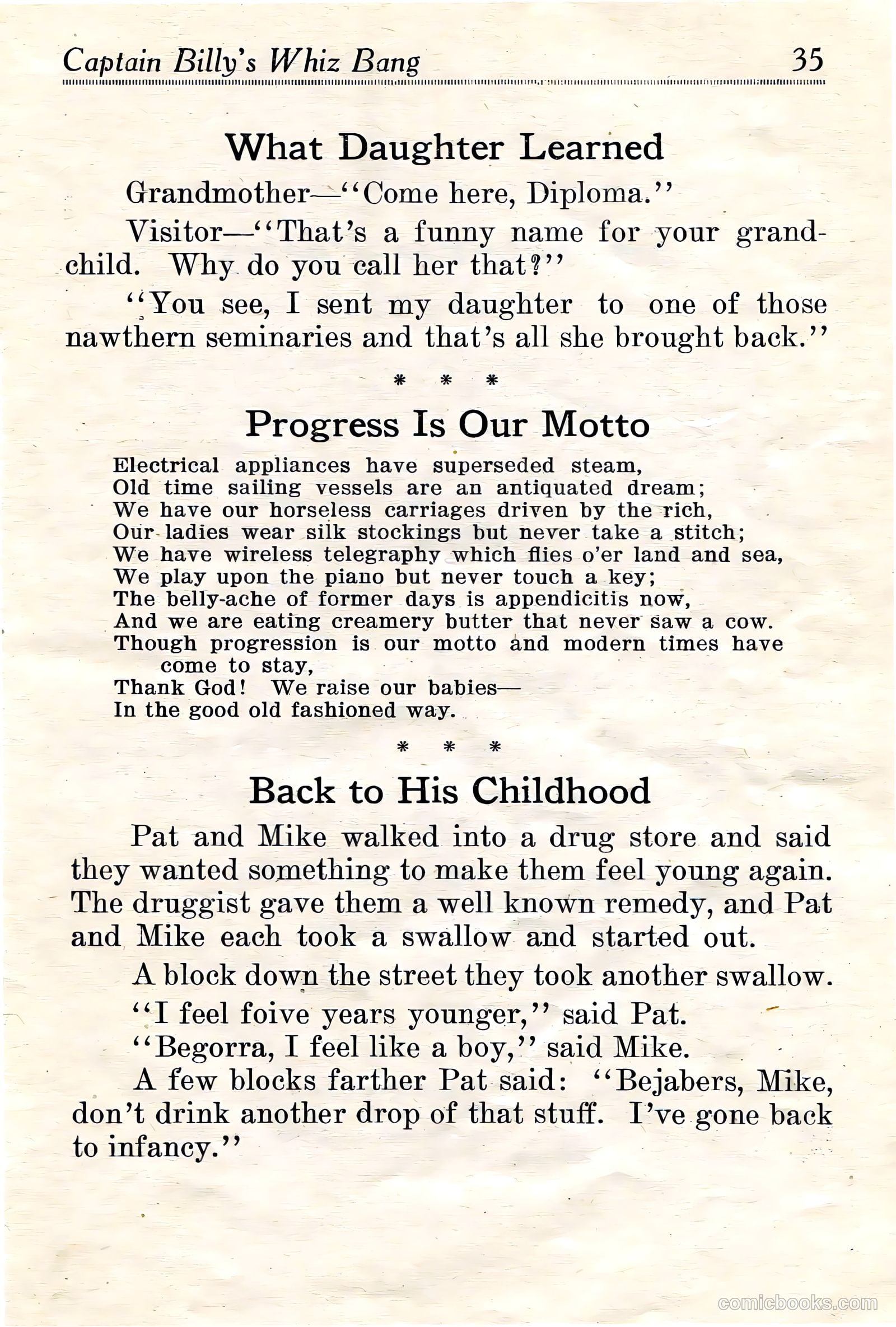
This page from *Captain Billy's Whiz Bang* (a 1920s humor magazine) contains three jokes mocking early 20th-century social changes: **"What Daughter Learned"** satirizes women's education. A grandmother names her granddaughter "Diploma," claiming that's literally all her daughter brought home from northern seminary—implying the education was worthless or that educated women retained nothing practical. **"Progress Is Our Motto"** is ironic social commentary. It celebrates modern conveniences (electricity, cars, wireless telegraph) while lamenting loss of skills and authenticity—silk stockings but no sewing ability, pianos nobody actually plays, factory butter. The poem's twist: despite embracing "progress," they still raise babies the "old-fashioned way," suggesting some traditions remain. **"Back to His Childhood"** uses Irish-immigrant stereotypes (Pat and Mike with dialect spelling) in a joke about patent medicine. They take a remedy to feel young; each dose makes them progressively younger until Pat regresses to infancy—commenting on the era's unregulated, often-ineffective "cure-all" medicines.
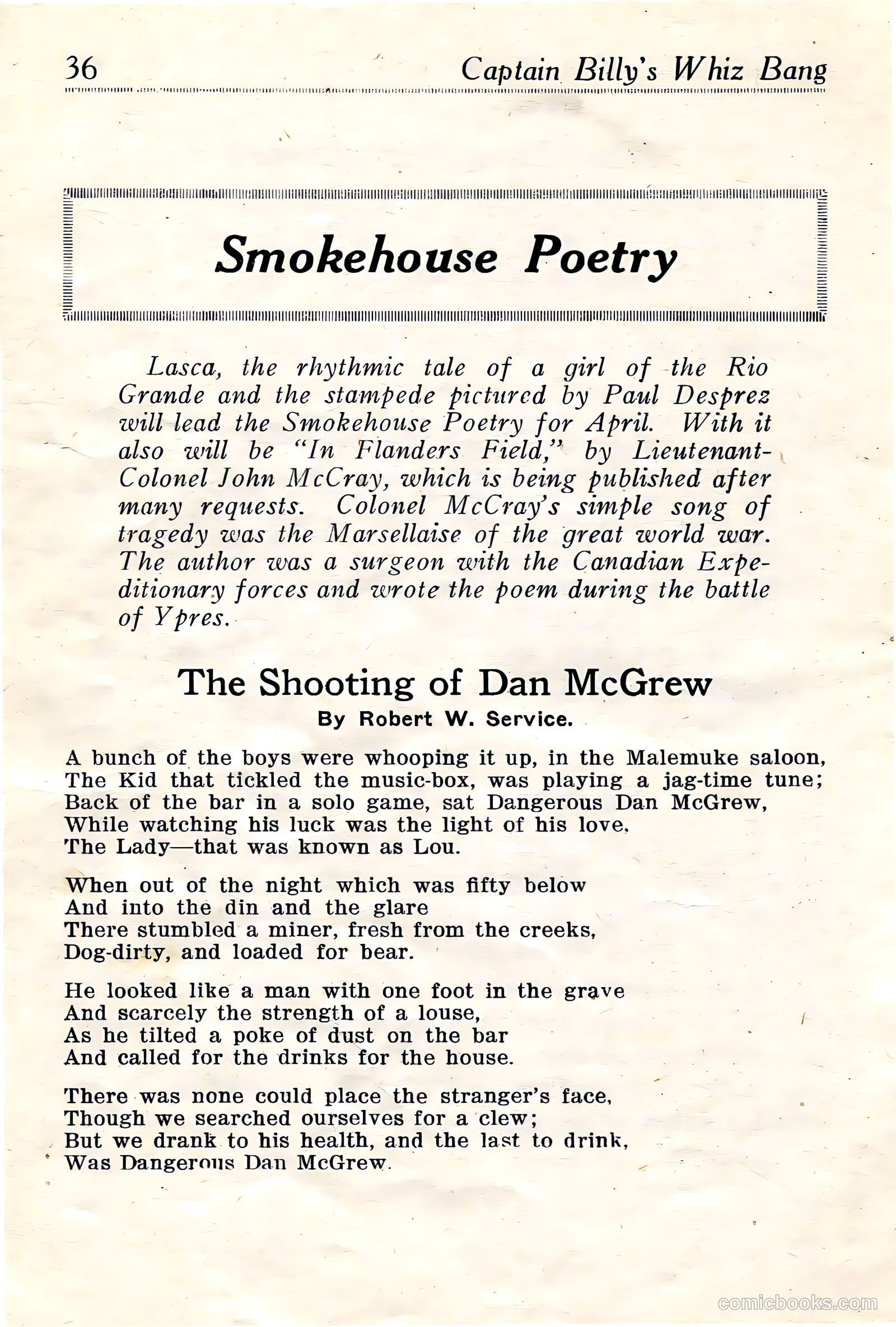
This page announces the April "Smokehouse Poetry" section, featuring classic frontier verse. The main content is Robert W. Service's "The Shooting of Dan McGrew"—a famous narrative poem about a mysterious stranger entering a Yukon saloon during a poker game involving the tough character "Dangerous Dan McGrew" and his love interest "Lou." The page also promotes "In Flanders Field" by Lieutenant-Colonel John McCray, famously written during WWI's Battle of Ypres—though the text incorrectly attributes the famous poem (actually by John McCrae) to McCray. These are literary excerpts rather than political cartoons. The appeal lies in frontier adventure and war poetry—popular "tough" subject matter for *Whiz Bang*'s male readership during the 1920s. Service's poem particularly resonated as rollicking entertainment about frontier masculinity and violence.
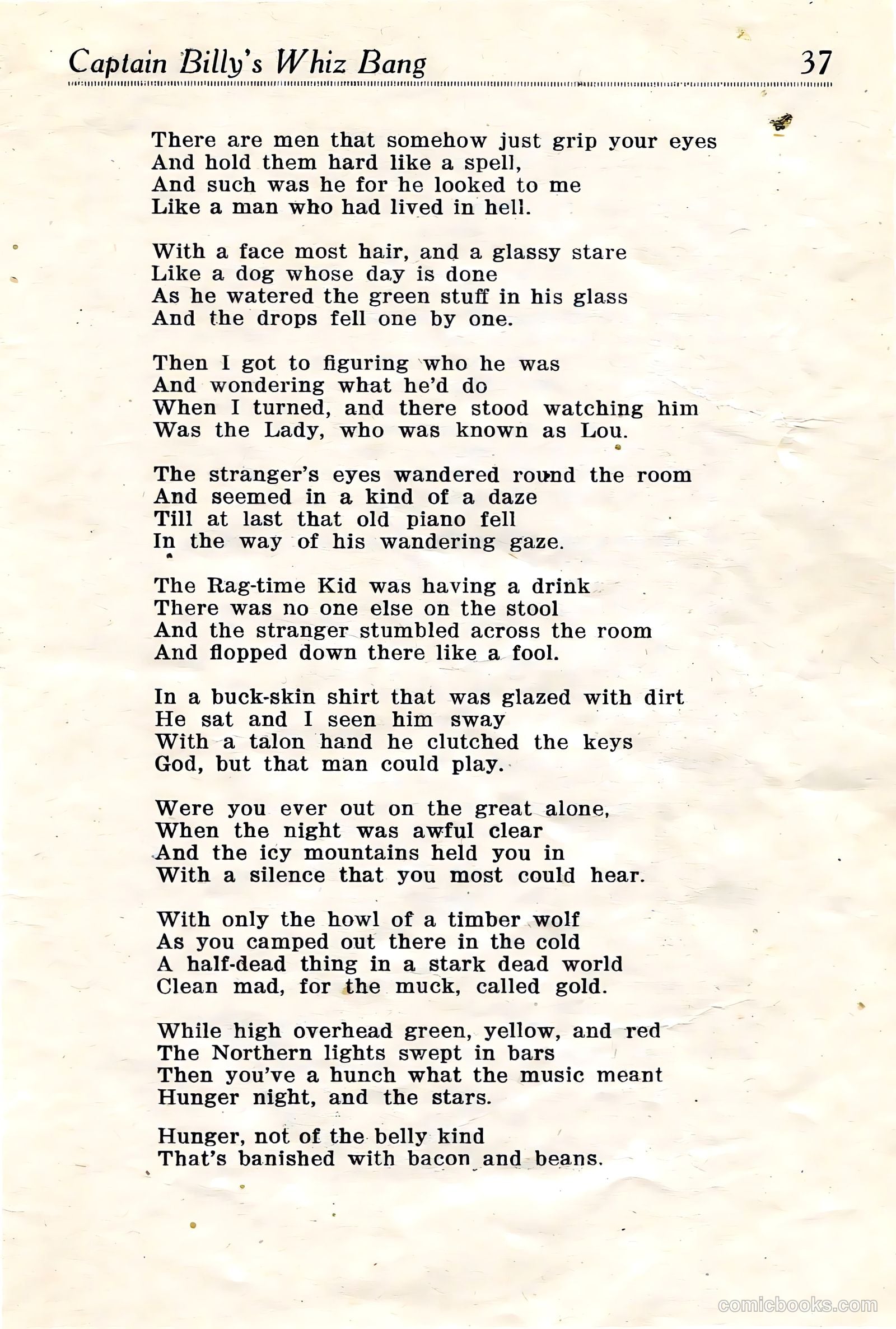
This page contains a narrative poem rather than a cartoon. It tells the story of a mysterious, haggard stranger who enters a bar—a scene suggesting the Yukon gold rush era or frontier setting. The poem depicts a man who appears spiritually broken ("lived in hell"), watches a woman named Lou, and eventually sits at a piano where he plays with surprising skill despite his disreputable appearance. The narrative then shifts to philosophical commentary about a different kind of hunger—existential rather than physical—evoked by the isolation and hardship of gold prospecting in the far north, under the Northern lights. The satire appears directed at romanticized notions of frontier life and gold-rush mythology. The poem suggests that material pursuits (gold) and physical survival mask deeper spiritual emptiness and psychological toll. The "muck, called gold" phrase indicates cynicism toward the enterprise itself. *Whiz Bang* was known for humorous and satirical content mixing poetry, jokes, and social commentary for a post-WWI American audience.
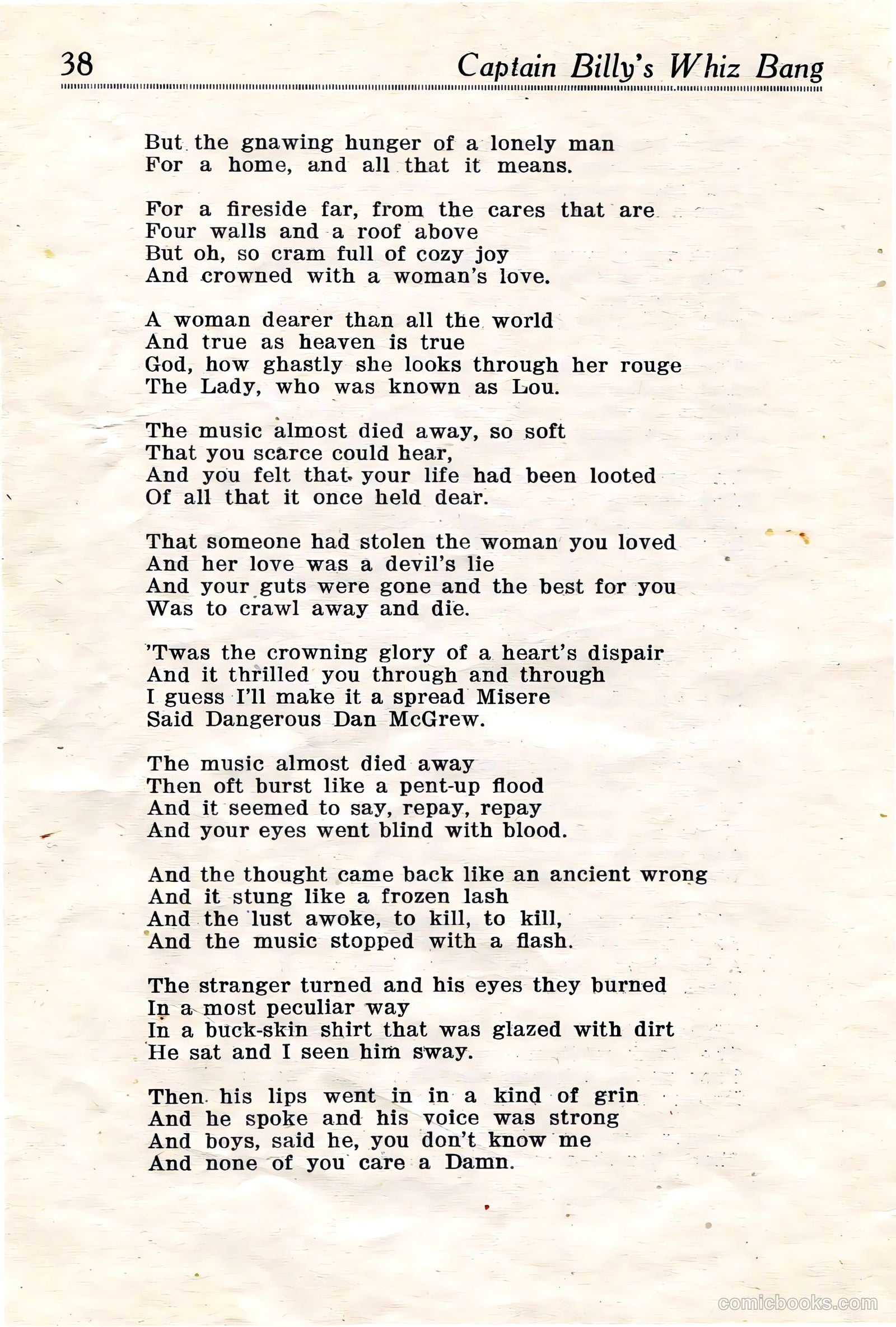
This page contains a narrative poem—likely a parody or adaptation of Robert W. Service's "The Shooting of Dan McGrew" (1907), a famous frontier ballad. The text tells of a lonely man's longing for home and a woman named Lou, whose betrayal triggers violent rage and murderous impulse in a saloon setting. The poem references "Dangerous Dan McGrew," the protagonist of Service's original work, establishing this as satirical retellings or commentary on that popular verse. The melodramatic tone—with its emphasis on betrayed love, homesickness, and masculine violence—reflects early 20th-century sentimental literature that *Whiz Bang* likely mocked for its overwrought emotionalism and predictable frontier-bar drama tropes. Without seeing accompanying illustrations, the satire's full target remains unclear, though the exaggerated emotional escalation ("your eyes went blind with blood") suggests mockery of period sentimentality.
This page contains two satirical poems from *Captain Billy's Whiz Bang*, a 1920s humor magazine known for irreverent content. The first poem parodies Robert W. Service's famous narrative poem "The Shooting of Dan McGrew," recasting it as a saloon murder mystery where the narrator identifies "Dangerous Dan McGrew" and a mysterious "Hound of Hell" as rivals. The twist: the Lady Lou (a character from Service's original) is implicated as the real culprit who "kissed him and pinched his poke" (stole from him), suggesting femme fatale treachery rather than the expected gunfight outcome. The second poem satirizes Prohibition-era hypocrisy. The speaker boasts of his illegal home-made bar ("beneath the stair"), mocking government efforts to eliminate alcohol consumption. He defies what he calls "official blighters" and argues that personal freedoms cannot be legislated away—a common anti-Prohibition sentiment of the era. Both poems use vernacular language and irreverent humor to mock authority and conventional morality, typical of Whiz Bang's satirical style during the Prohibition period.
This page presents a playful debate about moral restraint, likely from the 1920s. The first poem, "I Don't," is a woman's declaration that she obeys all traditional Victorian moral rules: no smoking, no flirting, no drinking, no kissing boys. It's presented as wholesome and proper. The response, "In Answer to the Above," is a man's skeptical rebuttal. He challenges whether anyone—particularly men—could actually resist temptation when faced with attractive women: red lips, soft hands, a shapely waist. His repeated refrain "I doubt it" suggests such self-restraint is unrealistic. The satire targets the gap between stated social morality and actual human behavior during the post-WWI era, when traditional Victorian values were being questioned. Whiz Bang was known for cheeky humor about this generational divide. The "twin sisters of poetic mirth" are meant to be humorous rather than serious moral instruction.
This page contains a poem by Mrs. Henry Mobley published in *Captain Billy's Whiz Bang*, a satirical magazine. The ballad describes a woman abandoned by her blacksmith husband, who left her in Brown (likely a town reference) to pursue younger women. The poem presents a common domestic complaint of the era: male infidelity and the aging-out of wives. The speaker catalogues her mistreatment—his cruel parting words, his preference for younger women, his claim she's "getting old" and "turning gray"—before concluding with resigned dignity: she releases him to the world, confident he'll never find anyone comparable. The satire targets male behavior and the disposability of wives in early 20th-century society, while the poem's sentimental yet defiant tone offers dark humor about marital betrayal. This reflects *Whiz Bang*'s typical blend of risqué humor and social commentary aimed at working-class readers.
This page from *Captain Billy's Whiz Bang* (a 1920s humor magazine) contains darkly comic poetry about Depression-era hardship and morality. "The Dying Hobo" satirizes vagrant life and betrayal: a dying homeless man offers his companion sentimental farewell about an imaginary paradise ("handouts grow in the bushes"), only to be robbed and abandoned the moment he expires. The joke's cruelty reflects period attitudes toward the poor—depicting hobos as disposable and morally corrupt. The brief verse about "Biddy McHugh" is bawdy humor about female sexual temptation, a common magazine joke format of the era. "Two Women" by N.P. Willis (a 19th-century poet) contrasts a virtuous woman, surrounded by symbolic abstractions (Peace, Honor), with implied judgment of her moral opposite—likely the magazine's way of moralizing about respectability versus transgression, reflecting 1920s social anxieties about women's behavior.
This page contains multiple satirical poems from an early 20th-century humor magazine. The content addresses working-class anxieties and social hypocrisy: The opening poem critiques mercenary women who withhold affection unless paid, while condemning an unmarried girl made pregnant by poverty and desperation—condemned by society despite Christ's forgiveness. "The Night Before Pay Day" humorously depicts the financial desperation of a wage worker with empty pockets before payday, personifying time and money as characters. "Hubby came home, tangle-footed" mocks alcoholism and domestic dysfunction, with a wife demanding her husband fetch more liquor. The final entry jokes about a typist named Irene Talbot working for "Dave A. Masterbilt" (likely a play on "master-built"), marking letters "DAM/IT"—suggesting frustrated workplace professionalism. Throughout, the satire targets poverty, alcohol abuse, sexual double standards, and working conditions of the era.
This poem by O. D. Copeland argues for compassion toward "fallen women" while critiquing society's hypocrisy. The author contrasts the biblical parable of the prodigal son—celebrated and forgiven upon return—with how society treats women who've lost their virtue, who face permanent ostracism and scorn. The piece claims men seduce women (describing the seducer as having "the slick tongue of a Judas"), yet society welcomes the man back as a "hero" while casting out the woman. Copeland argues men bear responsibility ("if you search down to the bottom, you will find man the cause") and that "the lowest of fallen women are better than most of the men." The final vignette about young Mary mimics her fashionable mother, suggesting anxiety about changing morality and women's behavior. This reflects early 20th-century concerns about loosening social codes and gender roles.
This page contains four brief humor pieces typical of 1920s American satirical magazines: 1. **"Ahoy, Liza's Fig Tree!"** — A racist joke about a Black soldier returning from WWI France, using dehumanizing language and the stereotype that Black Americans were preoccupied with lynching (the "tree" reference). 2. **"Something to Worry About"** — A one-liner about Persian social customs, presented as exotic trivia. 3. **"Customer in soft drink parlor"** — A Prohibition-era joke: the customer requests flies be killed from his non-alcoholic drink, implying he wants actual alcohol ("kick") rather than the weak substitute. 4. **"Squaring Himself"** — A domestic humor piece where Jones insults Robinson's wife, then recovers by claiming his own wife is even uglier—a "compliment" through relative comparison. The content reflects period attitudes: casual racism, Prohibition commentary, and gendered domestic humor. These jokes would be considered offensive today.
This page contains humorous short jokes and verses typical of *Captain Billy's Whiz Bang*, an early 20th-century satirical magazine known for ribald humor and double entendres. The content includes: **"Pasture Pot Pourri"** — A collection of brief jokes mocking romance and desire. References to "Dan Cupid" making "bad shots" while distracted by women's hosiery reflect contemporary anxieties about male attention to women's legs (newly visible as hemlines rose in the 1920s). **Dialect verses** describing women in crude, objectifying terms — standard for the era's humor. **"Our Latest Song Success"** — A joke about a father coming home drunk ("with a Bun") rather than with bread to feed the family, paired with an advertisement for "sloe gin," mocking Prohibition-era drinking culture. The overall tone is working-class masculine humor with sexual innuendo. No specific political figures are caricatured; instead, the satire targets dating customs, female appearance, and Prohibition enforcement.
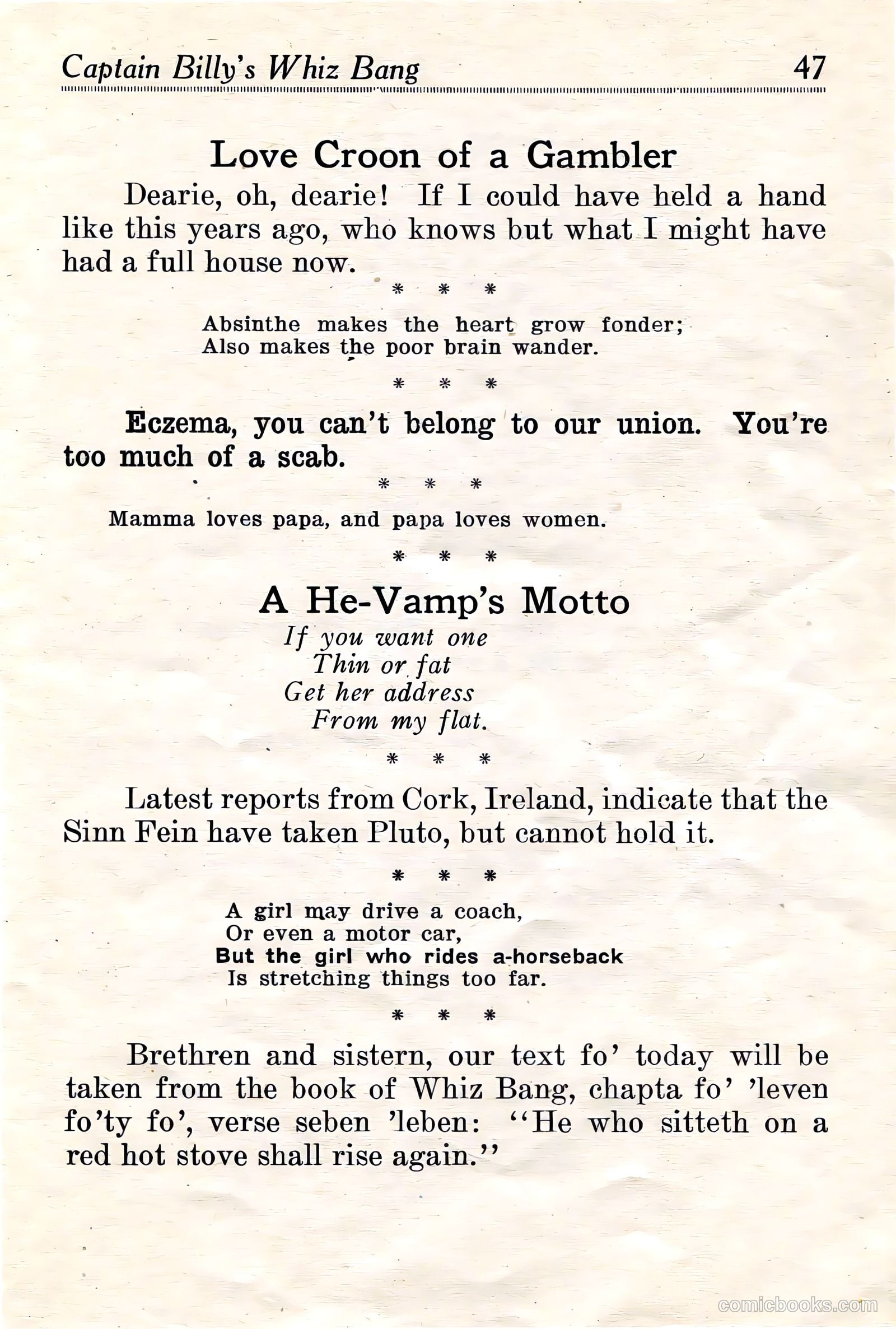
This page collects brief jokes and satirical quips typical of this irreverent 1920s magazine. Most are risqué one-liners targeting social behaviors: a gambler regretting past losses, absinthe's mental effects, labor union membership, infidelity, and women's expanding independence (driving cars, riding horseback). The Sinn Féin reference mocks Irish independence politics—a topical 1920s reference to the Irish nationalist party. "Pluto" appears to be a geographic location (unclear which), used absurdly to suggest the Irish can seize territory but not control it. The final "sermon" parodies Black vernacular preaching while delivering crude humor: sitting on a hot stove will make you "rise again" (jump up). This reflects the magazine's crude comedic style, mixing dated social commentary with slapstick humor and casual stereotyping typical of the era.
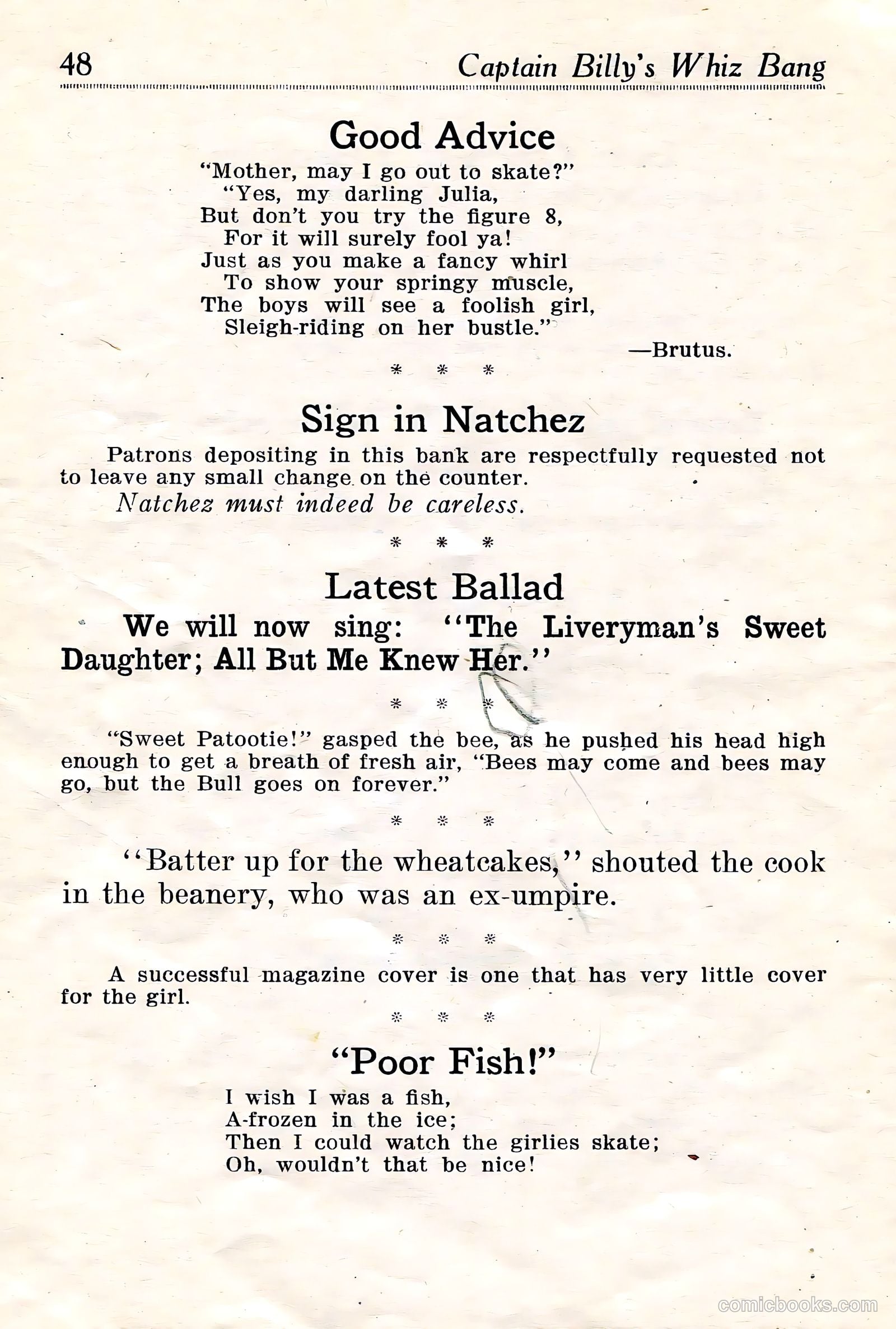
This page contains several short humorous pieces typical of 1920s satirical magazines: **"Good Advice"** mocks Victorian propriety through a mother warning her daughter against ice-skating tricks. The joke: performing a "figure 8" will make her look foolish, particularly when her "bustle" (the padded rear of women's clothing) becomes visible during skating movements. It satirizes both outdated fashion and overly cautious parenting. **"Sign in Natchez"** is a brief joke about carelessness at a Natchez bank that must repeatedly ask patrons not to leave small change on counters. **"Latest Ballad"** and subsequent items are absurdist wordplay and puns: a bee gasping about a "bull," a cook who's an ex-umpire shouting baseball terminology about pancakes. The final piece comments on magazine covers featuring scantily-clad women—a common complaint about 1920s publication practices. Overall, the page reflects *Whiz Bang's* style: lowbrow humor mixing sexual innuendo, puns, and social observation aimed at working-class readers.
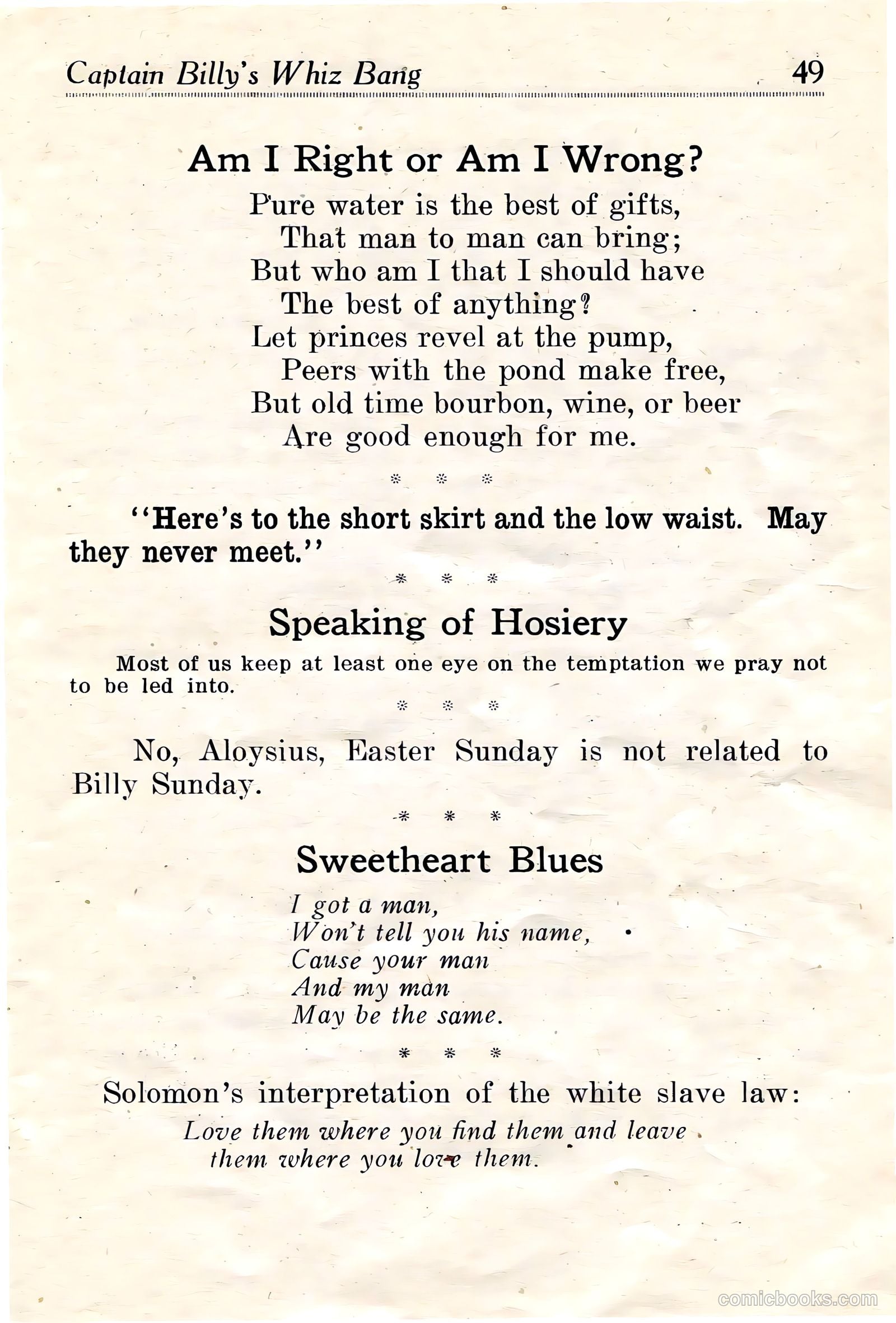
This page from the satirical magazine *Captain Billy's Whiz Bang* contains several short jokes and quips typical of 1920s humor: **"Am I Right or Am I Wrong?"** mocks Prohibition-era temperance movements by having a speaker defend drinking bourbon, wine, and beer over pure water—inverting moral pieties about "pure gifts." **The "short skirt and low waist" toast** jokes about women's changing fashion—shorter hemlines and looser waists were controversial in the 1920s, suggesting moral decay. **"Speaking of Hosiery"** makes a suggestive joke about men's attention to women's legs/stockings as temptation. **The Billy Sunday reference** likely jokes about the famous evangelist preacher's moral crusades (unrelated to the magazine's own "Billy Sunday"). **"Sweetheart Blues"** cynically jokes about infidelity—a woman won't name her lover because he might be someone else's boyfriend. **The final "Solomon" quip** darkly satirizes the "white slave" (human trafficking) problem through crude sexual humor, suggesting casual abandonment of women. The tone is risqué, irreverent humor targeting Prohibition, changing sexual mores, and moral hypocrisy.
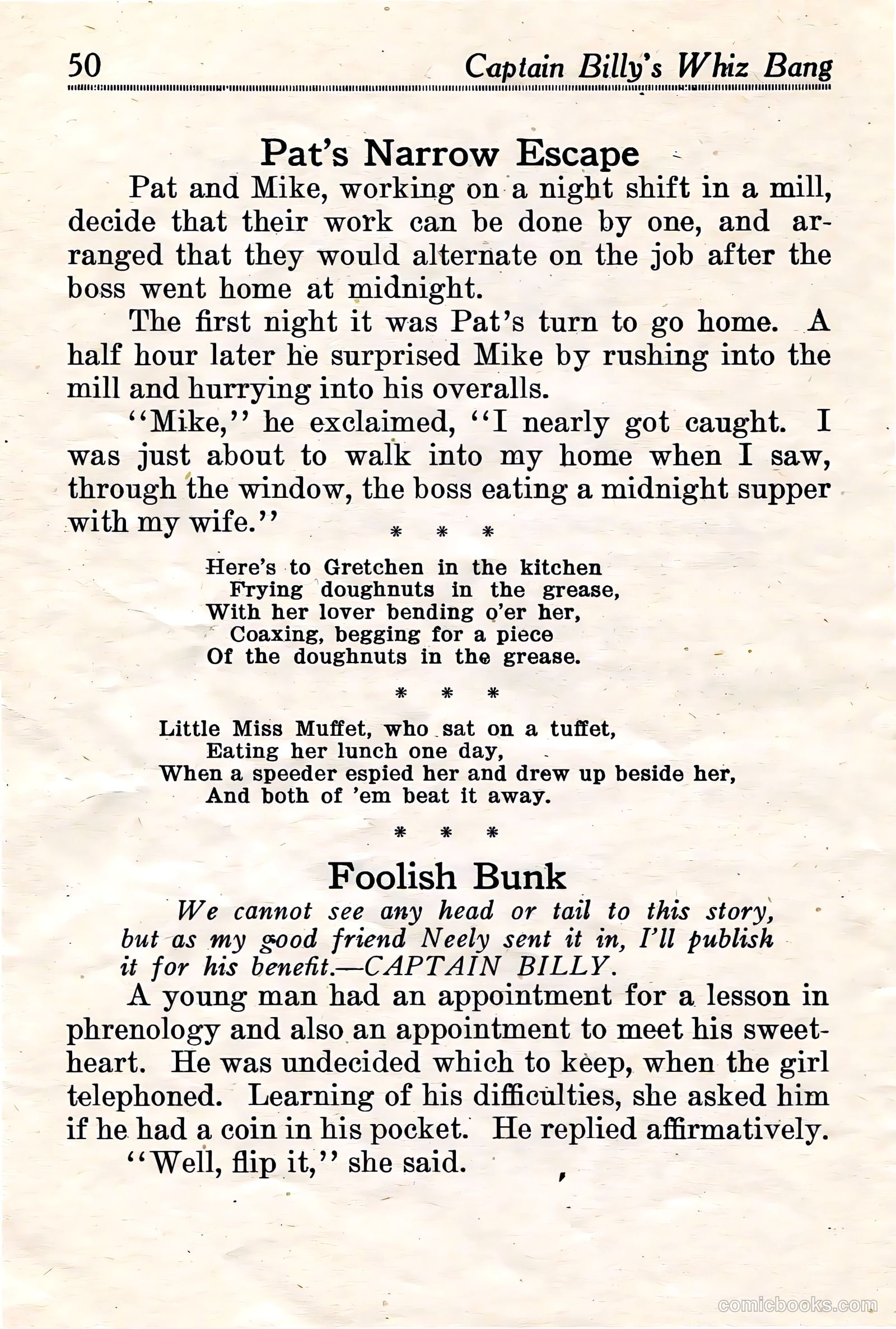
This page from the satirical magazine contains three separate humor pieces typical of early 20th-century American comedy. **"Pat's Narrow Escape"** is a marital infidelity joke: two mill workers arrange to work alternately, but Pat rushes back after discovering his boss dining alone with his wife at midnight—the implication being an affair. The humor relies on the awkward situation and Pat's narrow escape from witnessing something compromising. **The poetry sections** are bawdy parodies of nursery rhymes and folk verse, using double entendre (Gretchen's "doughnuts," the speeding couple "beating it away"). **"Foolish Bunk"** is a brief joke where a young man, torn between a phrenology lesson and meeting his girlfriend, lets her decide by coin flip—the joke being that she tells him to flip a coin, suggesting the decision is trivial or that she's dismissing his indecision as foolish. The recurring theme is sexual innuendo and marital/romantic complications, reflecting the magazine's adult-oriented, cheeky humor style.
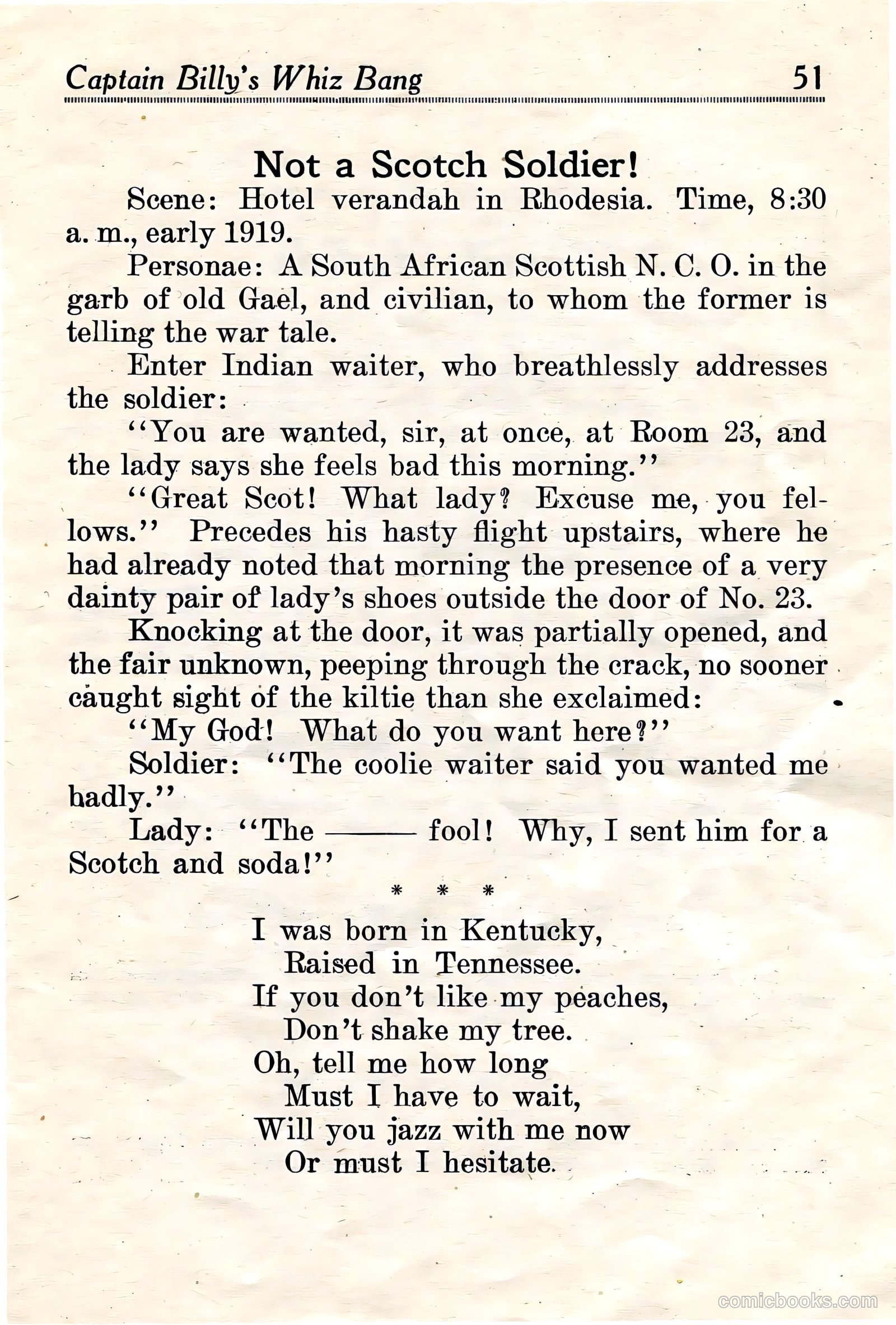
This is a bawdy joke playing on linguistic confusion. A Scottish soldier in Rhodesia misunderstands a hotel waiter's message: a lady requesting "a Scotch and soda" (whisky drink) is misheard as requesting the soldier himself—a "Scotch" (the soldier). The soldier, spotting women's shoes outside Room 23, eagerly assumes a romantic encounter. The humor relies on the double meaning of "Scotch" (the drink vs. the soldier's nationality), the soldier's willingness to misinterpret the message, and the lady's exasperation at receiving a man instead of her requested beverage. The poem below—about peaches, "jazzing," and hesitation—continues the flirtation theme with sexually suggestive language typical of post-WWI American humor magazines.
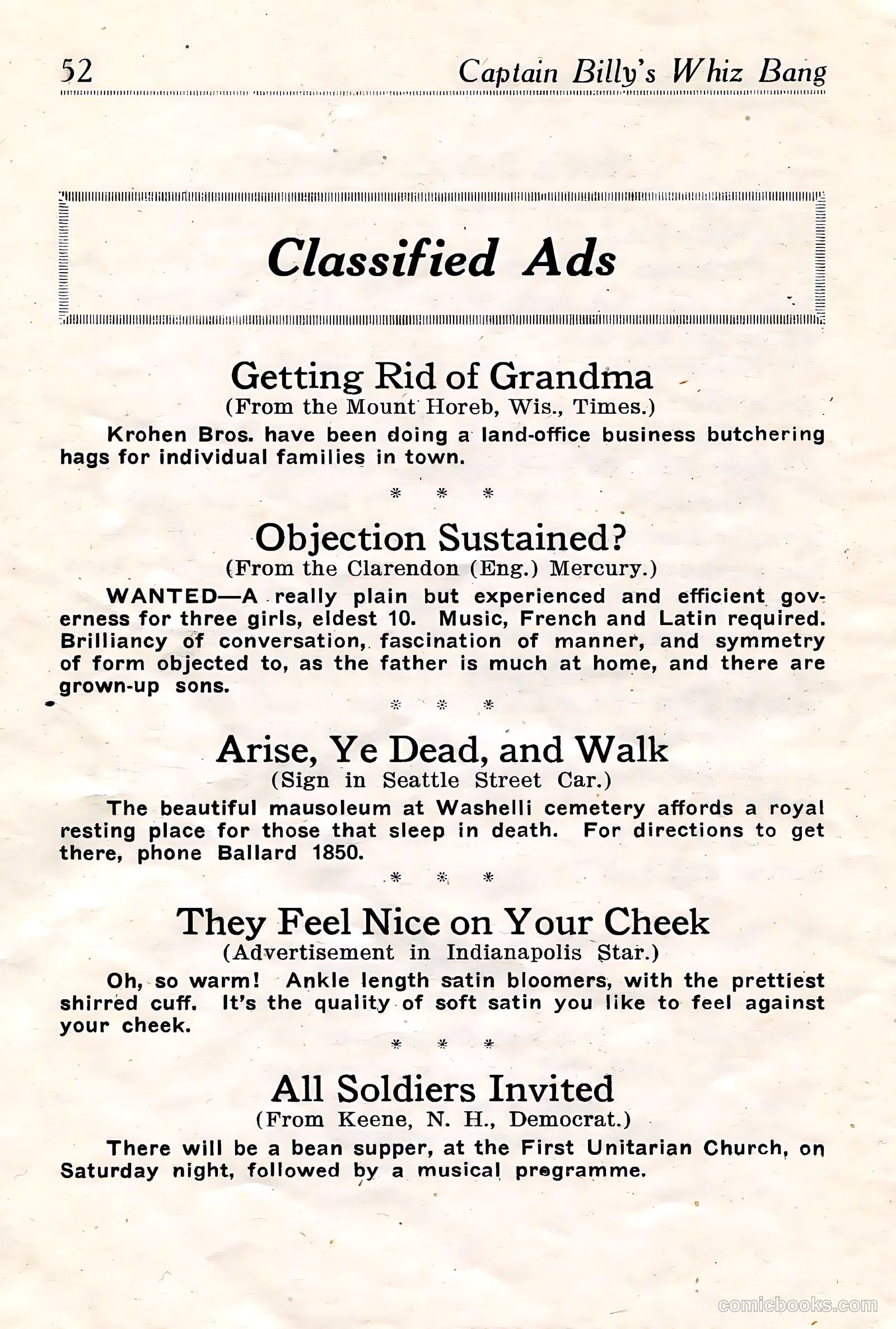
This page collects humorous fake classified ads and notices reprinted from various newspapers. Each item uses absurd or unintended double meanings to create comedy: **"Getting Rid of Grandma"** plays on dark humor about elderly relatives, using "butchering hags" (elderly women) as if it were a literal service. **"Objection Sustained?"** satirizes a governess job listing that explicitly rejects attractive, accomplished women—implying the father's infidelity risk. **"Arise, Ye Dead, and Walk"** mocks a mausoleum advertisement's awkwardly phrased invitation. **"They Feel Nice on Your Cheek"** exploits suggestive language in satin bloomers advertising. **"All Soldiers Invited"** likely jokes about bean suppers' notorious digestive effects on soldiers. The humor relies on misreadings, euphemism, and innuendo. This format—reprinting real classified ads with absurd interpretations—was typical satire in *Captain Billy's Whiz Bang*, a bawdy humor magazine popular in the 1920s-30s.
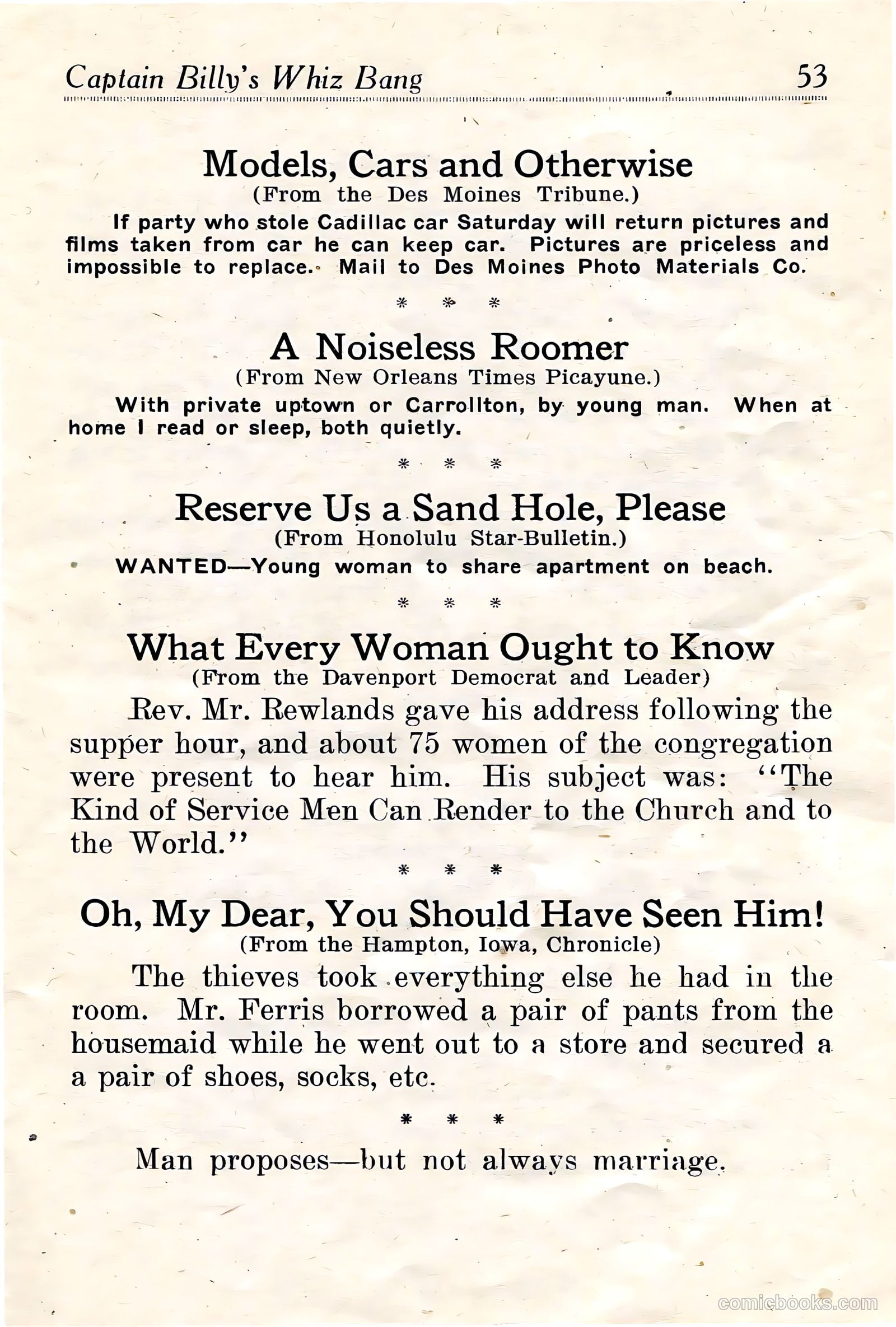
This page contains no illustrations—it's purely text-based humor reprinted from various American newspapers. The content consists of brief, absurdist classified ads and news items designed for comedic effect through incongruity and irony. The jokes rely on understated punchlines: a car thief is offered to keep the stolen vehicle if he returns irreplaceable photographs; a quiet tenant advertises his silence as a virtue; a Hawaii ad euphemistically offers beach "sand hole" sharing; a reverend addresses women about male church service; a robbery victim must borrow clothes from a housemaid to replace stolen items; and the closing line plays on the phrase "man proposes" (suggesting marriage) to mean something entirely different. These are typical Whiz Bang fare—light, satirical observations of everyday American life using deadpan humor and ironic reversals, popular in 1920s satirical magazines.
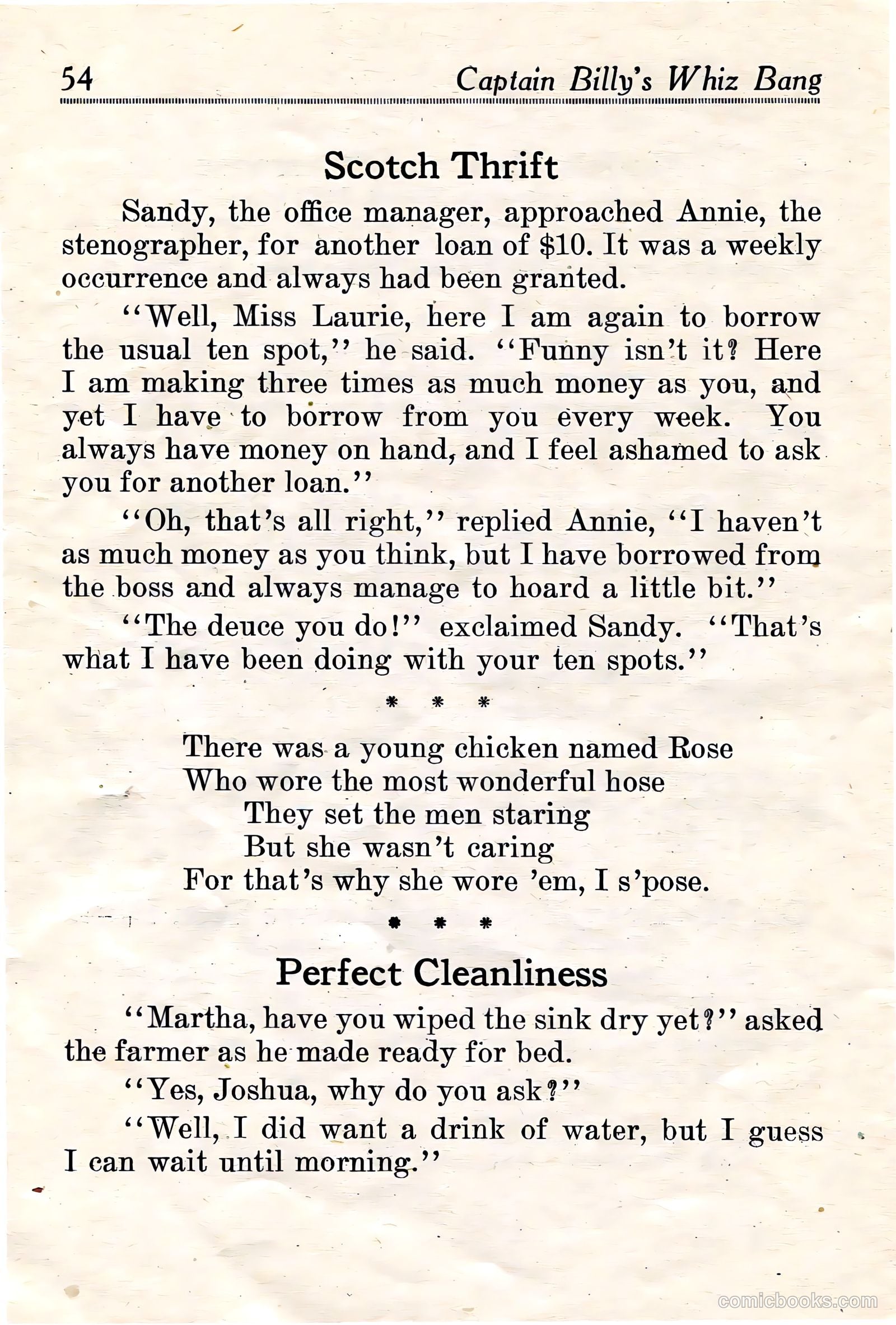
This page from *Captain Billy's Whiz Bang* contains three separate humorous items satirizing everyday human behavior. **"Scotch Thrift"** jokes about financial hypocrisy: Sandy, an office manager earning triple Annie the stenographer's salary, habitually borrows $10 weekly from her. Annie admits she only maintains savings by borrowing from their boss—revealing Sandy has been doing the same with Annie's loans. The humor lies in the ironic chain of debt masquerading as thrift. **The chicken verse** is a lighthearted limerick about Rose's fashionable stockings attracting male attention, which she wears precisely *because* they do. **"Perfect Cleanliness"** depicts a farmer so obsessed with household tidiness that he'd rather go thirsty than wet the sink he required his wife to dry. The satire targets excessive cleanliness obsession at the expense of practical comfort—a relatable domestic absurdity for rural readers. All three pieces target ordinary middle and working-class behaviors with gentle mockery.
This page contains three brief humorous anecdotes typical of 1920s American satirical magazines: **"Miss Allison's Sensation"** reports on actress May Allison's mishap during filming of a Lady Godiva scene in Hollywood. The joke plays on the actress's minimal costuming (only a blonde wig) and the horse's panic at studio lights—implying awkward exposure during the runaway incident. **"A Nice Neighborhood"** presents a neighborly insult battle where Mrs. Jones cleverly counters Mrs. Brown's threat to reveal secrets about her husband by implying she knows compromising information about Mrs. Brown herself—a witty comeback suggesting both women have reputations worth protecting. **"Within the Law"** is a Jewish joke (using ethnic names "Izzy" and "Moe") about clever financial maneuvering. Izzy purchased an expensive diamond pin using money technically designated as a memorial stone, interpreting "stone" literally rather than as a gravestone—a play on technical legal definitions and ethnic stereotypes about shrewd dealings.
This page contains racist humor and Prohibition-era jokes typical of 1920s American satirical magazines. The first joke uses a racist caricature and dialect to mock a condemned Black prisoner with a punchline about ironic self-awareness. The remaining items satirize Prohibition (1920-1933), when alcohol sales were banned. "He Snuffs It" jokes about imagining illegal "hooch" (bootleg whiskey) since it's unavailable. The seasonal verse laments that weather prevents drinking homemade moonshine or beer. "A Hobo's Lament" plays on class irony—a wealthy person reduced to poverty. The dialect spellings ("suh," "jedge," "dat") and caricatured speech reflect the magazine's crude approach to humor. These jokes assumed readers found crude racial stereotypes and Prohibition-evasion amusing. Modern readers should recognize this reflects outdated, offensive attitudes normalized in early 20th-century popular entertainment.
This page collects brief satirical jokes targeting early 20th-century American domestic and military life. The opening exchange mocks military hierarchy: a disrespectful private tells a captain to "hang on to" his rank—implying the officer is lucky to have it. Subsequent jokes target marriage and gender relations: a wife announces late nights out while the husband watches the baby (reversing traditional roles for comedic effect); a man complains his "license" to control his wife is worthless compared to his car license (the "flivver" being a cheap automobile, likely a Model T). The "Feminine Intuition" section sarcastically credits women with superior sense—noting mothers preserve baby carriages while fathers discard them, suggesting maternal foresight. "Filipino Style" advertises decorative necklaces with patronizing language ("quaintly"), while the final aphorism jokes that anyone with a new idea must talk about it constantly. The humor reflects post-WWI American attitudes: marital discord, automobile culture, and mild ethnic condescension.
This is a reader advice column featuring humorous responses from "Captain Billy" to submitted letters. Rather than serious advice, the replies are puns and jokes: - **Sunset Slim's** letter about traveling to Hot Springs gets a pun response about "rheumatic blues" (rheumatism/music wordplay). - **Aromatic Army Cook** submits a pun about Boston soldiers moving to Seattle to "live on the Sound" (Puget Sound/audio pun). - **Blonde Beauty** receives dating advice disguised as wordplay about "Siberian dash board" (unclear reference, possibly whisker-related slang). - **Abe Goldberg** is warned against opening an undertaker in Butte, Montana—the joke implies it's an Irish area where an undertaker would be unwelcome (reference to "Wearin' o' the Green"). - The final rejection of **A. L. Tioga's** story appears to be editorial—the actual submission wasn't included. The format mimics sincere advice columns but delivers jokes instead.
This page from the satirical magazine contains a series of brief humorous exchanges (advice column or reader submissions format). The jokes target common social behaviors and attitudes of the era: **"Sweet Dottie"** mocks someone claiming immoral behavior is justified by necessity (staying warm), sarcastically suggesting they wait until summer. **"Bringemin Young"** references a well-known anecdote, apparently skeptical of claims about cheap stenographer labor. **"Bobby"** appears to reference alcohol consumption (cider's fermentation properties). **"Miss Construe"** uses wordplay—she "misses" her husband while literally throwing things at him. The remaining items include a Depression-era verse about parental drinking and financial hardship, a morbid cemetery joke, and a final exchange where a co-ed's euphemistic request for dormitory clothing is misunderstood (or deliberately reinterpreted) as asking how many people occupy the space. The humor is crude, focused on poverty, domestic discord, and sexual innuendo typical of 1920s-30s magazine satire.
This page contains three separate satirical pieces, not a cartoon. The first anecdote mocks "blue laws"—strict Sunday regulations—through a clash between urban modernity and rural puritanism. Two city girls playing music on Sunday offend a devout old man. Their flippant response ("whistle the first two or three bars") mockingly reduces the Ten Commandments to a tune, suggesting such strict religious enforcement is absurdly outdated. The second passage is philosophical nostalgia, disconnected from the first joke. The third paragraph references post-WWI geopolitics, likely satirizing the League of Nations' territorial settlements. The humor lies in the absurdist redistribution: giving Jerusalem to Jews and Ireland to Irish (seemingly logical) but Iceland to "icemen" and New York to "the United States" (tautological or ridiculous). This appears to mock how League negotiations seemed arbitrary or self-serving to American observers.
This is a brief comedic anecdote about a store mix-up with humorous consequences. A man bought his wife a silk dress, but the saleswoman accidentally swapped parcels with another customer buying a children's kiltie skirt (a Scottish-style pleated skirt). The wife discovered the package while her husband was away, mistook the child's skirt for "the latest style," and wore it to church—causing embarrassment or scandal in their community. The joke relies on the absurdity of an adult woman wearing children's clothing to a formal religious setting, and the husband's exasperation that the saleswoman can easily exchange items but cannot undo the social damage his wife has already caused by appearing publicly in such an inappropriate outfit. The humor reflects 1920s attitudes about fashion propriety and respectability in church settings.
This page contains three pieces of early 20th-century American humor: **"Hubby for Her"** is a joke about class and servant dynamics. A concerned mother tries to discover if her sons are seducing the maid by asking the maid directly. The punchline reveals the maid's honest preference: while she prefers George socially, she'd rather go out with "the master" (the father) for actual excitement. The humor targets both the sons' inadequacy and suggests the father's greater appeal. **"Can't, I'm Hitched Now"** by Tad presents a satirical poem listing symptoms of illness, each followed by the ironic suggestion to "marry the girl"—implying marriage as a cure-all for life's ailments, which is obviously absurd. It's anti-marriage humor common to the era. **The final one-liner** appears to be a separate joke using wordplay: "Little Rock in Arkansas" (the city) as a response to feeling insignificant, suggesting someone else is even less important. All three pieces reflect era-typical cynicism about relationships and class dynamics.
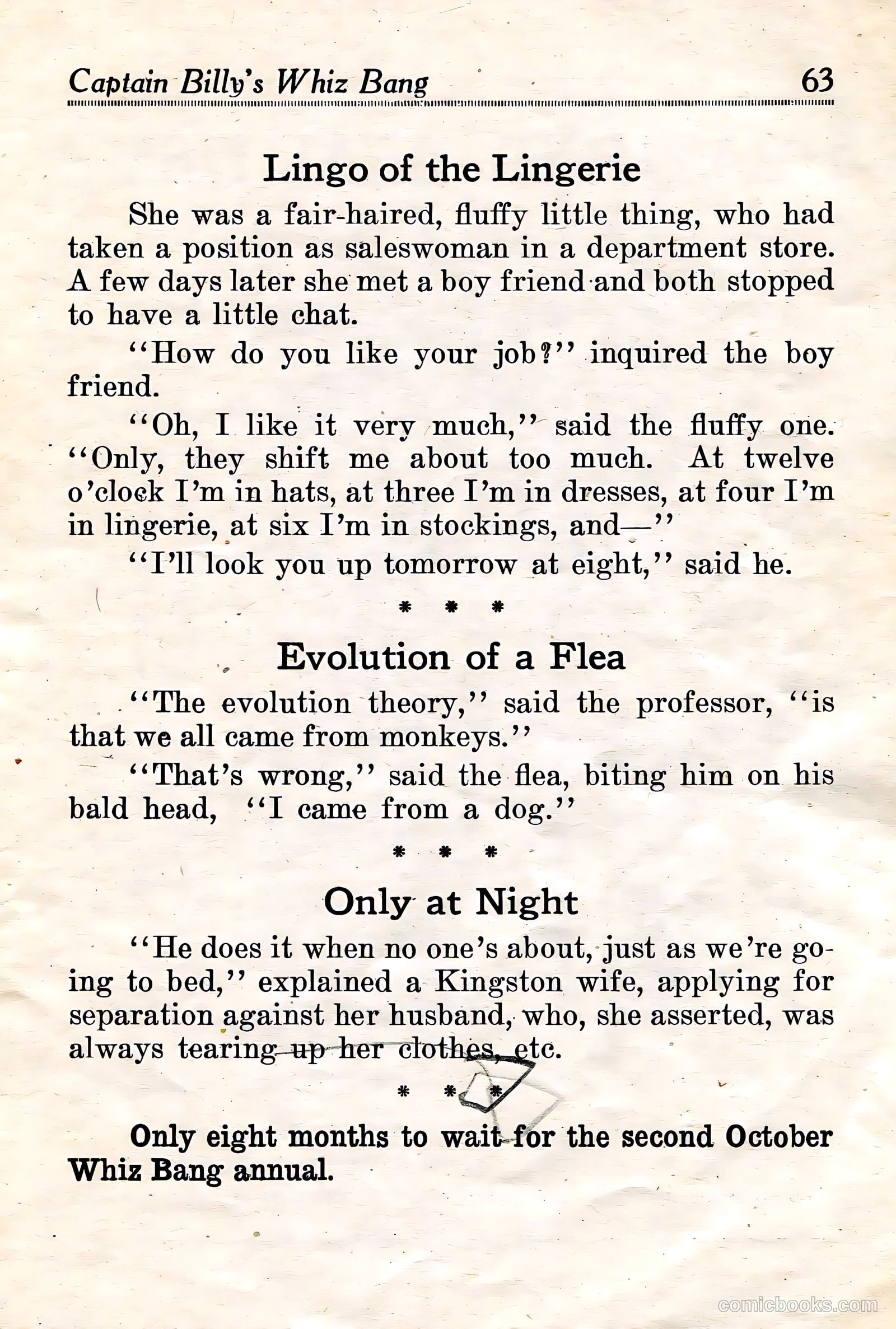
This page contains three brief jokes typical of 1920s satirical humor: **"Lingo of the Lingerie"** is a double-entendre joke. A saleswoman complains about being shifted between departments—hats, dresses, lingerie, stockings—ending at "eight." The boy friend's response ("I'll look you up tomorrow at eight") suggests he's interested in meeting her during her lingerie department shift, implying sexual interest rather than genuine concern for her job satisfaction. The humor relies on innuendo about "lingerie" and the woman's naïveté. **"Evolution of a Flea"** mocks evolution theory through wordplay: a flea corrects a professor's claim that humans evolved from monkeys by asserting it "came from a dog"—a literal, absurd reversal suggesting the flea's own origins, not humanity's. **"Only at Night"** presents a wife's separation complaint: her husband tears up her clothes only when going to bed, implying aggressive or violent sexual behavior. The joke's dark humor treats domestic violence as comedic material. These reflect period attitudes toward women, sexuality, and violence that modern readers would find offensive.
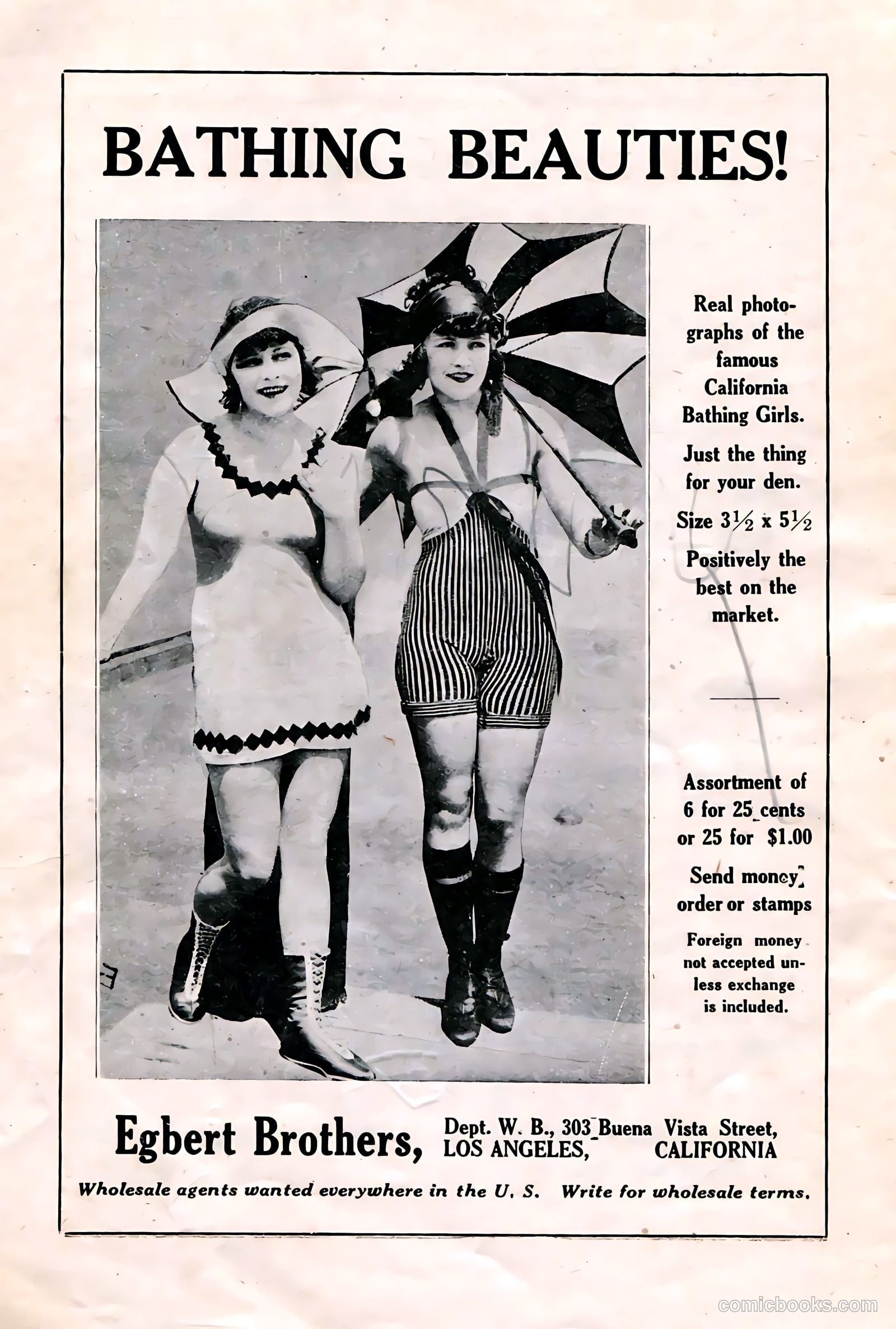
This is primarily **advertising, not satire or political commentary**. The page promotes postcards of "California Bathing Girls"—risqué photographs marketed as decorative items ("just the thing for your den"). The content reflects early 20th-century entertainment culture: "bathing beauties" were popular performers and pin-up subjects. The ad emphasizes these are "real photographs" of "famous" girls, suggesting their celebrity status made them desirable collectibles. The pricing structure (bulk discounts for wholesalers) and aggressive distribution language ("wholesale agents wanted everywhere") indicate this was a mail-order business capitalizing on male consumer interest in suggestive imagery—a common but edgy commerce practice for the era. There's no evident political message, only commercial exploitation of glamour and sexuality normalized for the period.
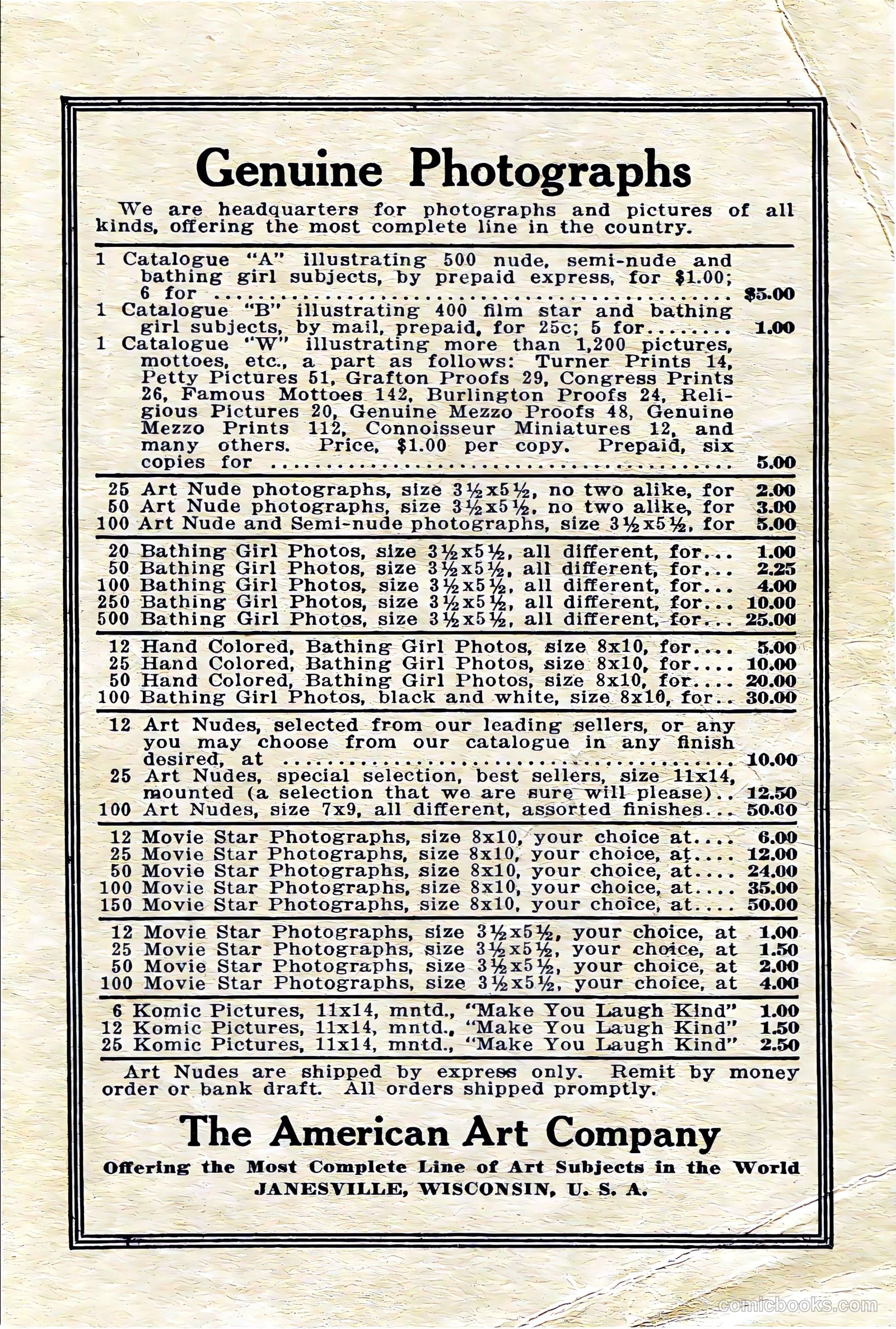
This page is entirely an advertisement for "The American Art Company" of Janesville, Wisconsin, selling photographs by mail order. It lists various categories of images available for purchase: catalogues of nude and semi-nude subjects, bathing girls, film stars, and "art nudes" in various quantities and sizes, plus hand-colored options and movie star photographs. The ad also offers "Komic Pictures" described as "Make You Laugh Kind." There is no political cartoon or satirical content on this page. It's a straightforward (if somewhat risqué for the era) mail-order catalog advertisement typical of early 20th-century publications, where such vendors commonly advertised in magazines and periodicals.
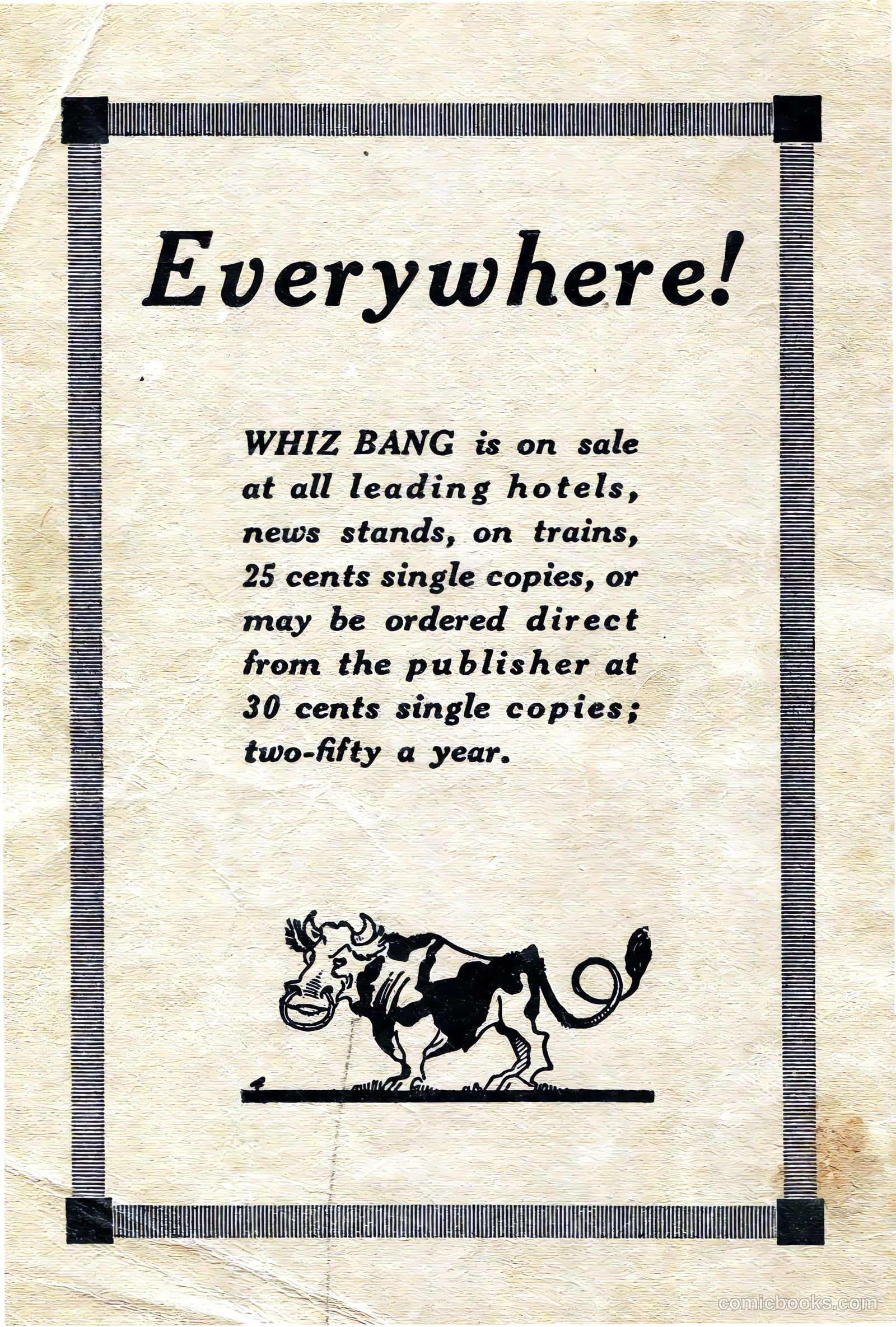
This is primarily an **advertisement page** for *Whiz Bang* magazine itself, not a political cartoon. The page announces where readers can purchase the publication—at hotels, newsstands, and trains—with pricing information (25 cents retail, 30 cents by mail subscription, $2.50 annually). The only illustration is a **cartoon cow** at the bottom, which serves as the magazine's mascot or logo. The cow appears humorous and somewhat crude in style, typical of early 20th-century American comic illustration. The "Everywhere!" headline emphasizes the magazine's wide distribution and accessibility. This was standard marketing language for popular magazines of the era trying to promote broad readership. No political references or satirical content is evident on this particular page.