
Captain Billy's Whiz Bang, March 1921 · page 19 of 68
Captain Billy's Whiz Bang #18 — page 19: what you’re looking at
What you’re looking at
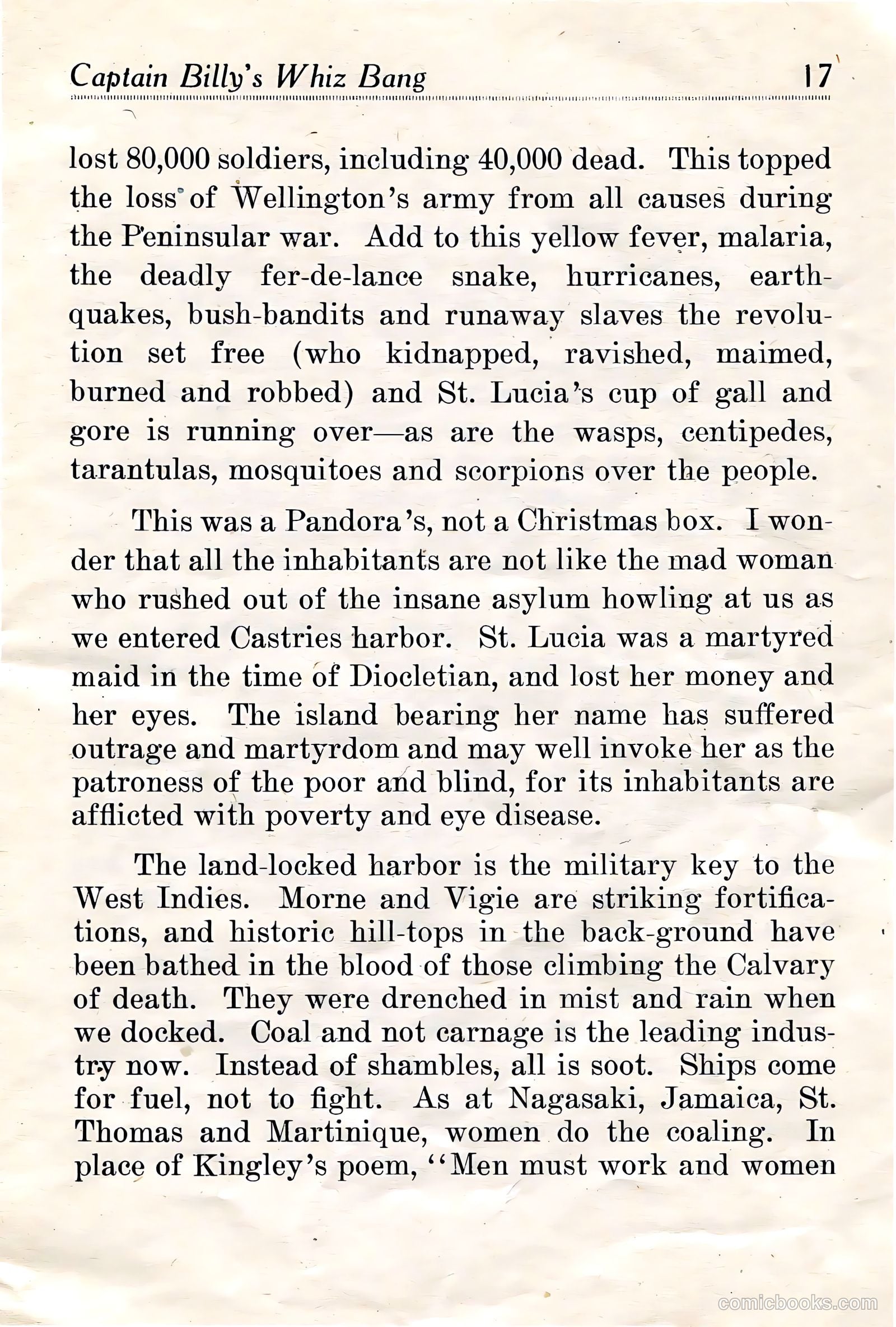
This page contains satirical travel commentary about St. Lucia in the West Indies, likely post-WWI. The unnamed narrator catalogs the island's miseries: military casualties (80,000 soldiers lost—exceeding Wellington's Peninsular War losses), tropical diseases, dangerous wildlife, natural disasters, and social chaos from freed enslaved people's rebellion. The satire employs hyperbolic complaint, comparing St. Lucia to Pandora's Box and invoking the island's namesake saint (a martyred Christian woman who lost her eyes) to suggest the island itself is cursed with poverty and blindness. The piece shifts to describe St. Lucia's current economic role: a coal refueling station where women perform manual labor. The final reference to "Kingley's poem" (likely Rudyard Kipling's gendered role assignments) sardonically notes reality inverts Victorian expectations—women work the grueling coaling jobs. The tone is misanthropic travel writing masquerading as humor.
📄 Transcribed text from this page (OCR, searchable)
Machine-transcribed from the original scan — historical spelling and the odd misread are preserved.
Captain Billy's Whiz Bang 17 lost 80,000 soldiers, including 40,000 dead. This topped the loss of Wellington's army from all causes during the Peninsular war. Add to this yellow fever, malaria, the deadly fer-de-lance snake, hurricanes, earth- quakes, bush-bandits and runaway slaves the revolu- tion set free (who kidnapped, ravished, maimed, burned and robbed) and St. Lucia's cup of gall and gore is running over—as are the wasps, centipedes, tarantulas, mosquitoes and scorpions over the people. This was a Pandora's, not a Christmas box. I won- der that all the inhabitants are not like the mad woman who rushed out of the insane asylum howling at us as we entered Castries harbor. St. Lucia was a martyred maid in the time of Diocletian, and lost her money and her eyes. The island bearing her name has suffered outrage and martyrdom and may well invoke her as the patroness of the poor and blind, for its inhabitants are afflicted with poverty and eye disease. The land-locked harbor is the military key to the West Indies. Morne and Vigie are striking fortifica- tions, and historic hill-tops in the back-ground have been bathed in the blood of those climbing the Calvary of death. They were drenched in mist and rain when we docked. Coal and not carnage is the leading indus- try now. Instead of shambles, all is soot. Ships come for fuel, not to fight. As at Nagasaki, Jamaica, St. Thomas and Martinique, women do the coaling. In place of Kingley's poem, “Men must work and women