
Captain Billy's Whiz Bang, March 1921 · page 51 of 68
Captain Billy's Whiz Bang #18 — page 51: what you’re looking at
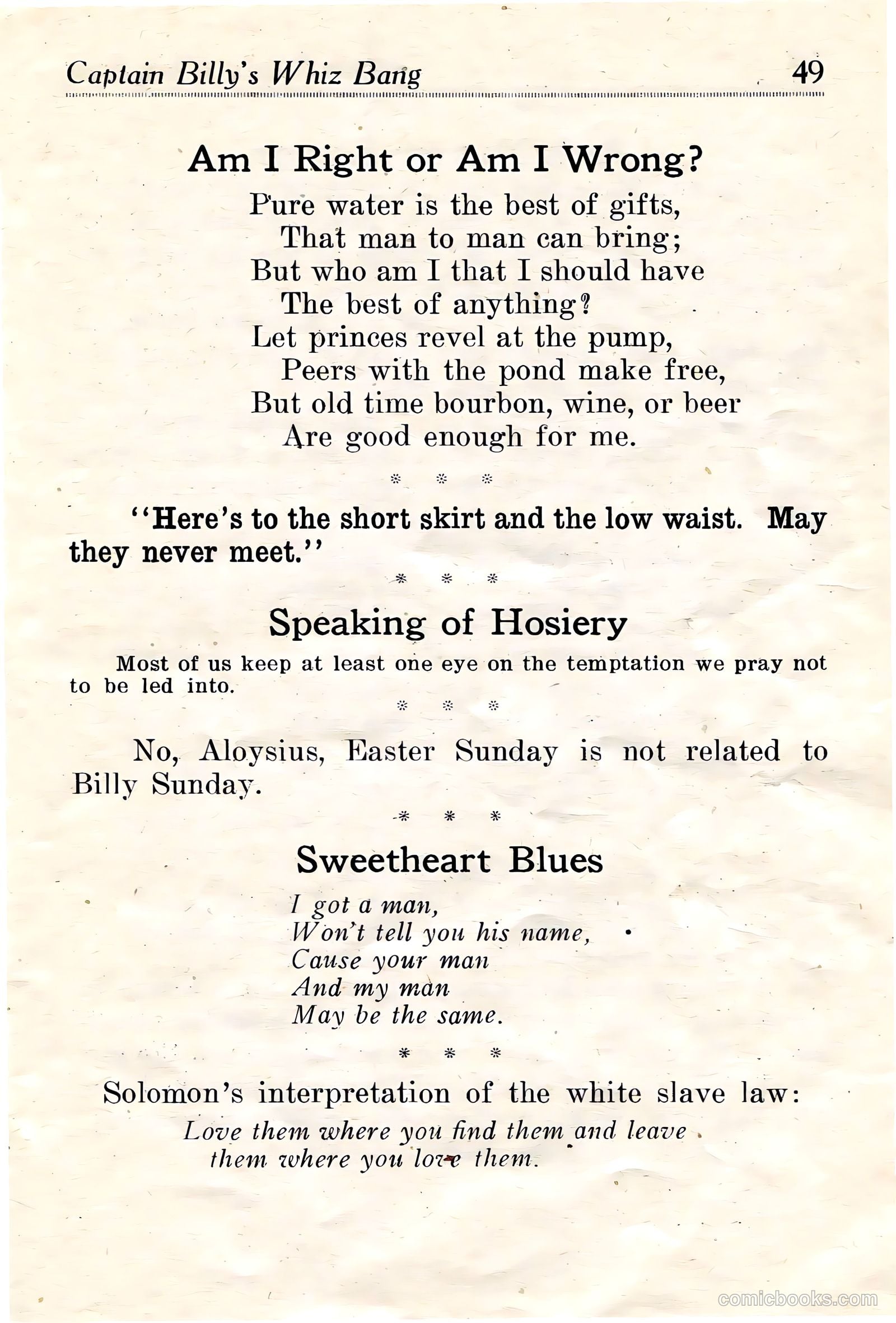
What you’re looking at
This page from the satirical magazine *Captain Billy's Whiz Bang* contains several short jokes and quips typical of 1920s humor: **"Am I Right or Am I Wrong?"** mocks Prohibition-era temperance movements by having a speaker defend drinking bourbon, wine, and beer over pure water—inverting moral pieties about "pure gifts." **The "short skirt and low waist" toast** jokes about women's changing fashion—shorter hemlines and looser waists were controversial in the 1920s, suggesting moral decay. **"Speaking of Hosiery"** makes a suggestive joke about men's attention to women's legs/stockings as temptation. **The Billy Sunday reference** likely jokes about the famous evangelist preacher's moral crusades (unrelated to the magazine's own "Billy Sunday"). **"Sweetheart Blues"** cynically jokes about infidelity—a woman won't name her lover because he might be someone else's boyfriend. **The final "Solomon" quip** darkly satirizes the "white slave" (human trafficking) problem through crude sexual humor, suggesting casual abandonment of women. The tone is risqué, irreverent humor targeting Prohibition, changing sexual mores, and moral hypocrisy.
📄 Transcribed text from this page (OCR, searchable)
Machine-transcribed from the original scan — historical spelling and the odd misread are preserved.
Captain Billy's Whiz Bang 49 Am I Right or Am I Wrong? Pure water is the best of gifts, That man to man can bring; But who am I that I should have The best of anything? Let princes revel at the pump, Peers with the pond make free, But old time bourbon, wine, or beer Are good enough for me. * * * “Here’s to the short skirt and the low waist. May they never meet.” * * * Speaking of Hosiery Most of us keep at least one eye on the temptation we pray not to be led into. * * * No, Aloysius, Easter Sunday is not related to Billy Sunday. * * * Sweetheart Blues I got a man, Won’t tell you his name, Cause your man And my man May be the same. * * * Solomon’s interpretation of the white slave law: Love them where you find them and leave them where you love them.