
Captain Billy's Whiz Bang, March 1921 · page 44 of 68
Captain Billy's Whiz Bang #18 — page 44: what you’re looking at
What you’re looking at
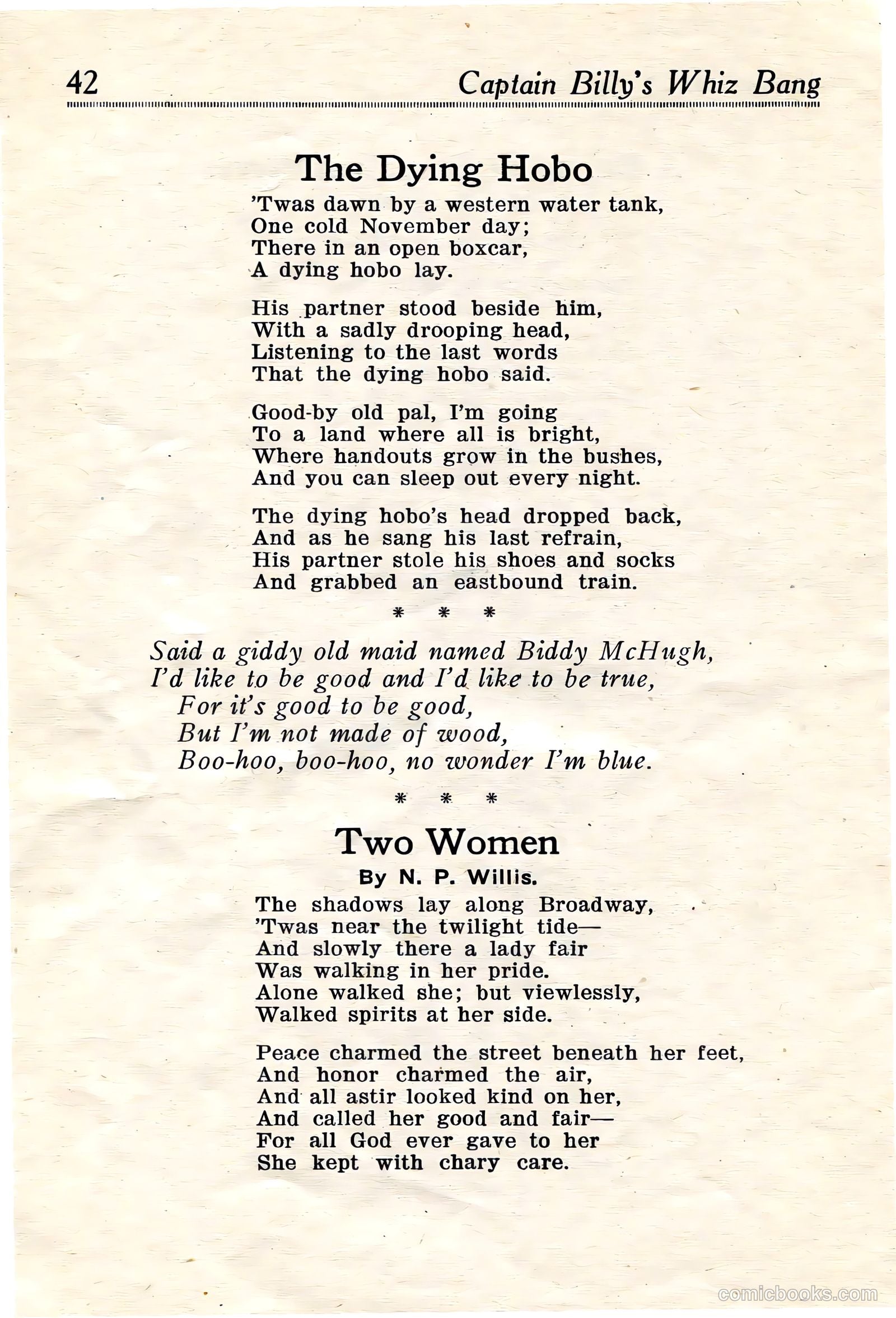
This page from *Captain Billy's Whiz Bang* (a 1920s humor magazine) contains darkly comic poetry about Depression-era hardship and morality. "The Dying Hobo" satirizes vagrant life and betrayal: a dying homeless man offers his companion sentimental farewell about an imaginary paradise ("handouts grow in the bushes"), only to be robbed and abandoned the moment he expires. The joke's cruelty reflects period attitudes toward the poor—depicting hobos as disposable and morally corrupt. The brief verse about "Biddy McHugh" is bawdy humor about female sexual temptation, a common magazine joke format of the era. "Two Women" by N.P. Willis (a 19th-century poet) contrasts a virtuous woman, surrounded by symbolic abstractions (Peace, Honor), with implied judgment of her moral opposite—likely the magazine's way of moralizing about respectability versus transgression, reflecting 1920s social anxieties about women's behavior.
📄 Transcribed text from this page (OCR, searchable)
Machine-transcribed from the original scan — historical spelling and the odd misread are preserved.
42 Captain Billy's Whiz Bang The Dying Hobo ’Twas dawn by a western water tank, One cold November day; There in an open boxcar, A dying hobo lay. His partner stood beside him, With a sadly drooping head, Listening to the last words That the dying hobo said. Good-by old pal, I’m going To a land where all is bright, Where handouts grow in the bushes, And you can sleep out every night. The dying hobo’s head dropped back, And as he sang his last refrain, His partner stole his shoes and socks And grabbed an eastbound train. * * * Said a giddy old maid named Biddy McHugh, I’d like to be good and I’d like to be true, For it’s good to be good, But I’m not made of wood, Boo-hoo, boo-hoo, no wonder I’m blue. * * * Two Women By N. P. Willis. The shadows lay along Broadway, ’Twas near the twilight tide— And slowly there a lady fair Was walking in her pride. Alone walked she; but viewlessly, Walked spirits at her side. Peace charmed the street beneath her feet, And honor charmed the air, And all astir looked kind on her, And called her good and fair— For all God ever gave to her She kept with chary care.