
Captain Billy's Whiz Bang, March 1921 · page 22 of 68
Captain Billy's Whiz Bang #18 — page 22: what you’re looking at
What you’re looking at
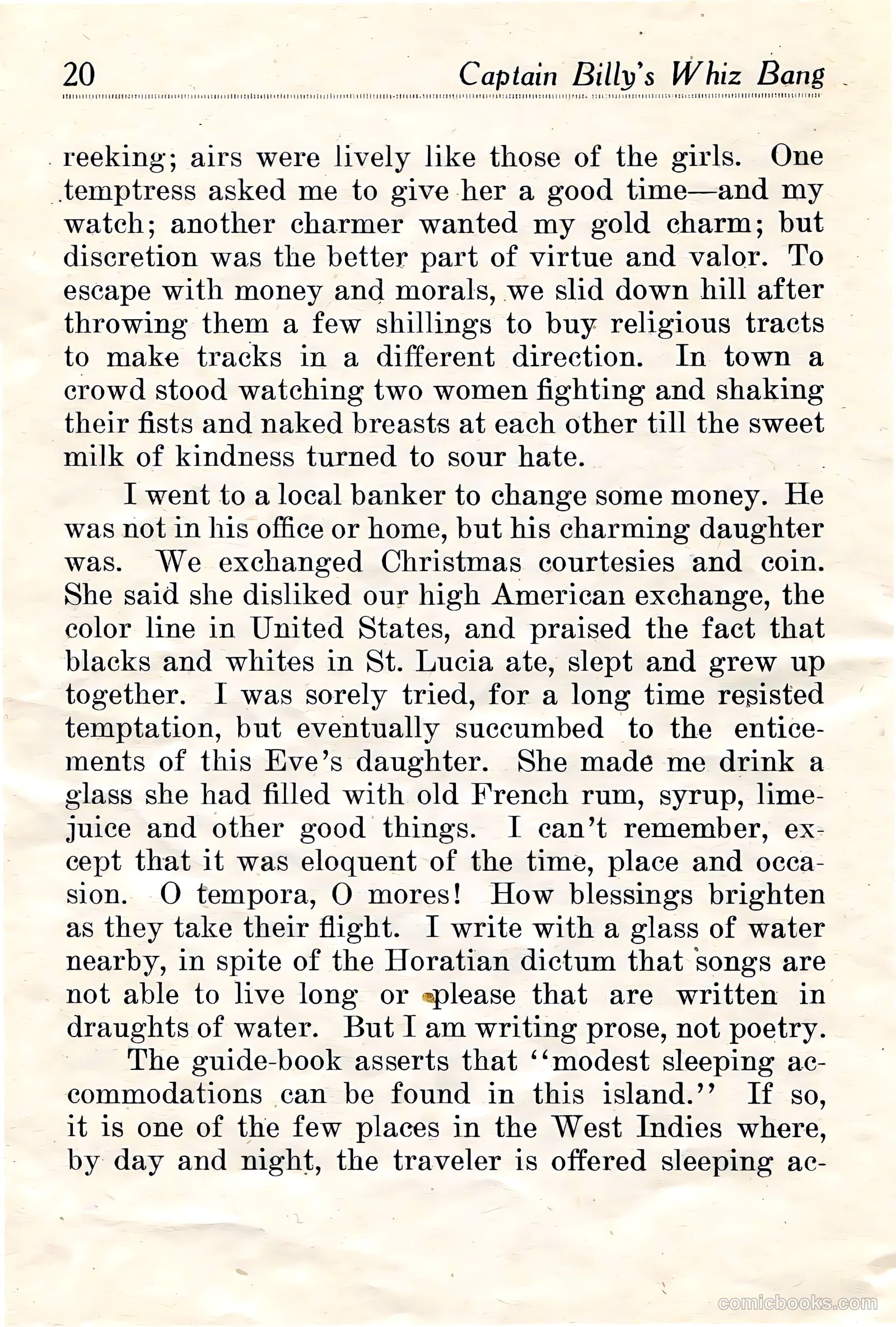
This page contains no visible cartoon or illustration—it's purely text: a humorous travel narrative about the author's experiences in St. Lucia. The piece satirizes colonial travel writing through a first-person account filled with sexual innuendo and self-deprecating humor. The narrator describes encounters with local women who attempt to seduce him for money, which he resists (barely). A key satirical moment occurs when the banker's daughter criticizes America's racial segregation while praising St. Lucia's racial integration—a barbed critique of American racial hypocrisy. The narrative mocks both the author's moral weakness and guidebook clichés about "modest accommodations," implying the island actually offers abundant sexual "hospitality." The classical Latin phrase "O tempora, O mores!" (Oh the times! Oh the customs!) amplifies this mock-serious tone, using high rhetoric to describe low behavior. The writing style—self-aware and irreverent—is characteristic of *Whiz Bang's* satirical humor.
📄 Transcribed text from this page (OCR, searchable)
Machine-transcribed from the original scan — historical spelling and the odd misread are preserved.
20 Captain Billy’s Whiz Bang reeking; airs were lively like those of the girls. One temptress asked me to give her a good time—and my watch; another charmer wanted my gold charm; but discretion was the better part of virtue and valor. To escape with money and morals, we slid down hill after throwing them a few shillings to buy religious tracts to make tracks in a different direction. In town a crowd stood watching two women fighting and shaking their fists and naked breasts at each other till the sweet milk of kindness turned to sour hate. I went to a local banker to change some money. He was not in his office or home, but his charming daughter was. We exchanged Christmas courtesies and coin. She said she disliked our high American exchange, the color line in United States, and praised the fact that blacks and whites in St. Lucia ate, slept and grew up together. I was sorely tried, for a long time resisted temptation, but eventually succumbed to the entice- ments of this Eve’s daughter. She made me drink a glass she had filled with old French rum, syrup, lime- juice and other good things. I can’t remember, ex- cept that it was eloquent of the time, place and occa- sion. O tempora, O mores! How blessings brighten as they take their flight. I write with a glass of water nearby, in spite of the Horatian dictum that songs are not able to live long or please that are written in draughts of water. But I am writing prose, not poetry. The guide-book asserts that “modest sleeping ac- commodations can be found in this island.” If so, it is one of the few places in the West Indies where, by day and night, the traveler is offered sleeping ac-