
Captain Billy's Whiz Bang, March 1921 · page 42 of 68
Captain Billy's Whiz Bang #18 — page 42: what you’re looking at
What you’re looking at
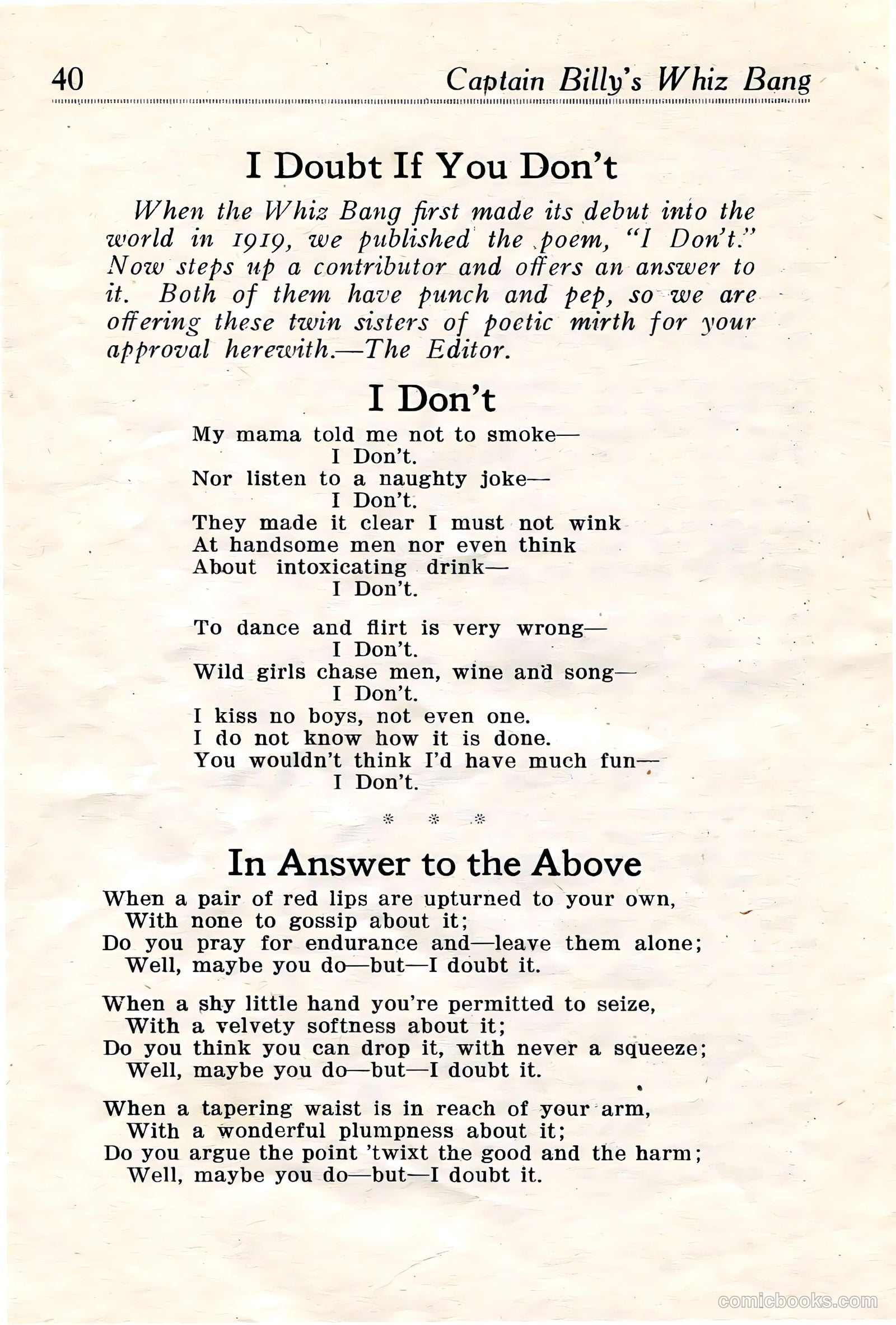
This page presents a playful debate about moral restraint, likely from the 1920s. The first poem, "I Don't," is a woman's declaration that she obeys all traditional Victorian moral rules: no smoking, no flirting, no drinking, no kissing boys. It's presented as wholesome and proper. The response, "In Answer to the Above," is a man's skeptical rebuttal. He challenges whether anyone—particularly men—could actually resist temptation when faced with attractive women: red lips, soft hands, a shapely waist. His repeated refrain "I doubt it" suggests such self-restraint is unrealistic. The satire targets the gap between stated social morality and actual human behavior during the post-WWI era, when traditional Victorian values were being questioned. Whiz Bang was known for cheeky humor about this generational divide. The "twin sisters of poetic mirth" are meant to be humorous rather than serious moral instruction.
📄 Transcribed text from this page (OCR, searchable)
Machine-transcribed from the original scan — historical spelling and the odd misread are preserved.
40 Captain Billy's Whiz Bang I Doubt If You Don't When the Whiz Bang first made its debut into the world in 1919, we published the poem, “I Don’t.” Now steps up a contributor and offers an answer to it. Both of them have punch and pep, so we are offering these twin sisters of poetic mirth for your approval herewith.—The Editor. I Don't My mama told me not to smoke— I Don't. Nor listen to a naughty joke— I Don't. They made it clear I must not wink At handsome men nor even think About intoxicating drink— I Don't. To dance and flirt is very wrong— I Don't. Wild girls chase men, wine and song— I Don't. I kiss no boys, not even one. I do not know how it is done. You wouldn't think I'd have much fun— I Don't. * * * In Answer to the Above When a pair of red lips are upturned to your own, With none to gossip about it; Do you pray for endurance and—leave them alone; Well, maybe you do—but—I doubt it. When a shy little hand you're permitted to seize, With a velvety softness about it; Do you think you can drop it, with never a squeeze; Well, maybe you do—but—I doubt it. When a tapering waist is in reach of your arm, With a wonderful plumpness about it; Do you argue the point 'twixt the good and the harm; Well, maybe you do—but—I doubt it.