
Captain Billy's Whiz Bang, March 1921 · page 36 of 68
Captain Billy's Whiz Bang #18 — page 36: what you’re looking at
What you’re looking at
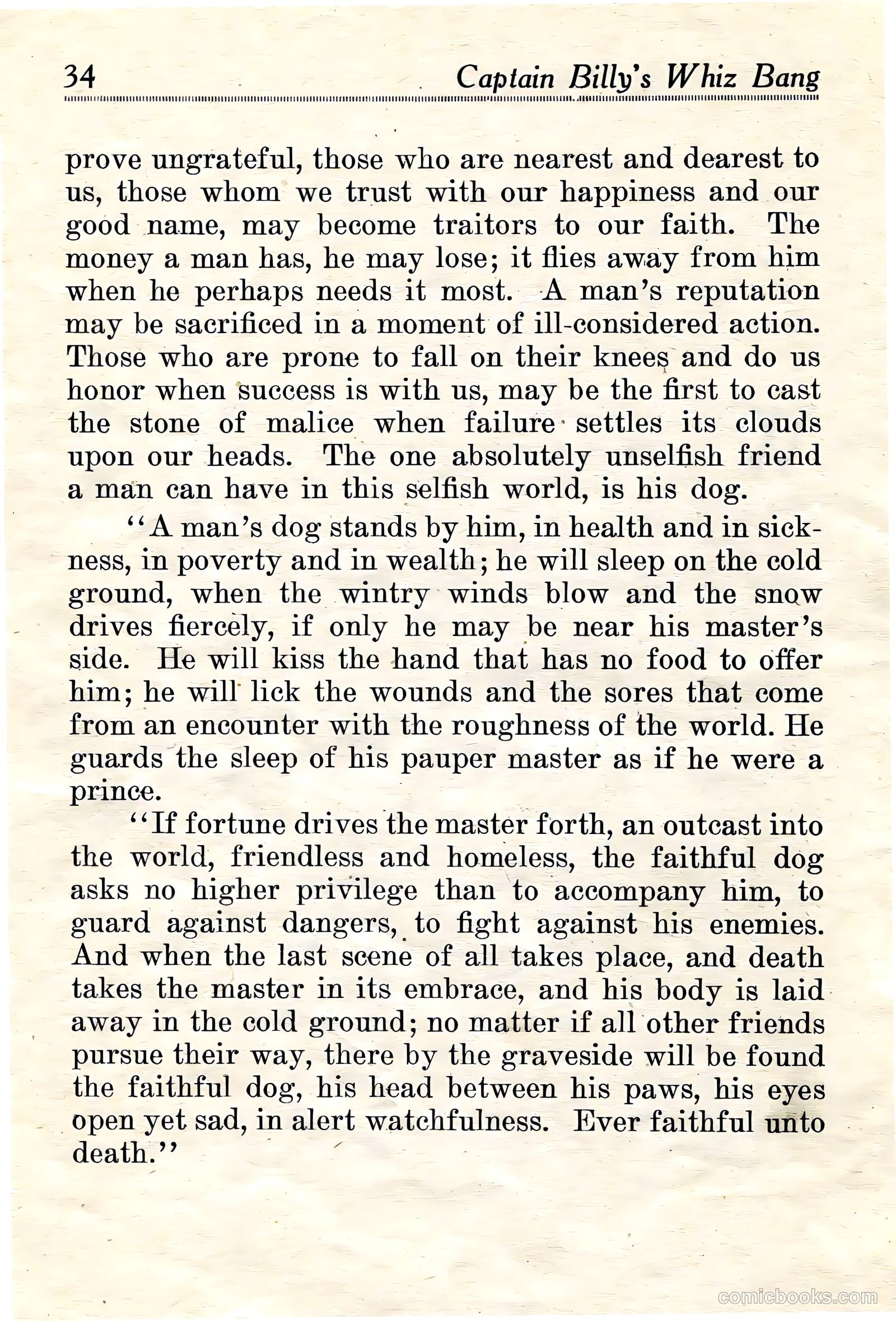
This page from *Captain Billy's Whiz Bang* (a post-WWI satirical magazine) contains no cartoon—it's a sentimental prose passage about dog loyalty. The text presents a philosophical meditation contrasting human faithlessness with canine devotion. The piece argues that people—even loved ones—prove unreliable: they betray trust, abandon us in hardship, and mock failure. By contrast, a dog remains loyal "unto death," standing by his master through poverty, illness, homelessness, and dying alone. The dog "licks the wounds" from life's hardships and keeps vigil at the grave. For modern readers: this reflects post-WWI disillusionment about human relationships and society, common in 1920s satirical magazines. The idealization of dogs as morally superior to humans was a popular sentimental trope of the era, appearing frequently in such publications as counterpoint to cynical social commentary.
📄 Transcribed text from this page (OCR, searchable)
Machine-transcribed from the original scan — historical spelling and the odd misread are preserved.
34 Captain Billy's Whiz Bang prove ungrateful, those who are nearest and dearest to us, those whom we trust with our happiness and our good name, may become traitors to our faith. The money a man has, he may lose; it flies away from him when he perhaps needs it most. A man's reputation may be sacrificed in a moment of ill-considered action. Those who are prone to fall on their knees and do us honor when success is with us, may be the first to cast the stone of malice when failure settles its clouds upon our heads. The one absolutely unselfish friend a man can have in this selfish world, is his dog. “A man's dog stands by him, in health and in sick- ness, in poverty and in wealth; he will sleep on the cold ground, when the wintry winds blow and the snow drives fiercely, if only he may be near his master's side. He will kiss the hand that has no food to offer him; he will lick the wounds and the sores that come from an encounter with the roughness of the world. He guards the sleep of his pauper master as if he were a prince. “If fortune drives the master forth, an outcast into the world, friendless and homeless, the faithful dog asks no higher privilege than to accompany him, to guard against dangers, to fight against his enemies. And when the last scene of all takes place, and death takes the master in its embrace, and his body is laid away in the cold ground; no matter if all other friends pursue their way, there by the graveside will be found the faithful dog, his head between his paws, his eyes open yet sad, in alert watchfulness. Ever faithful unto death.”