
Captain Billy's Whiz Bang, March 1921 · page 46 of 68
Captain Billy's Whiz Bang #18 — page 46: what you’re looking at
What you’re looking at
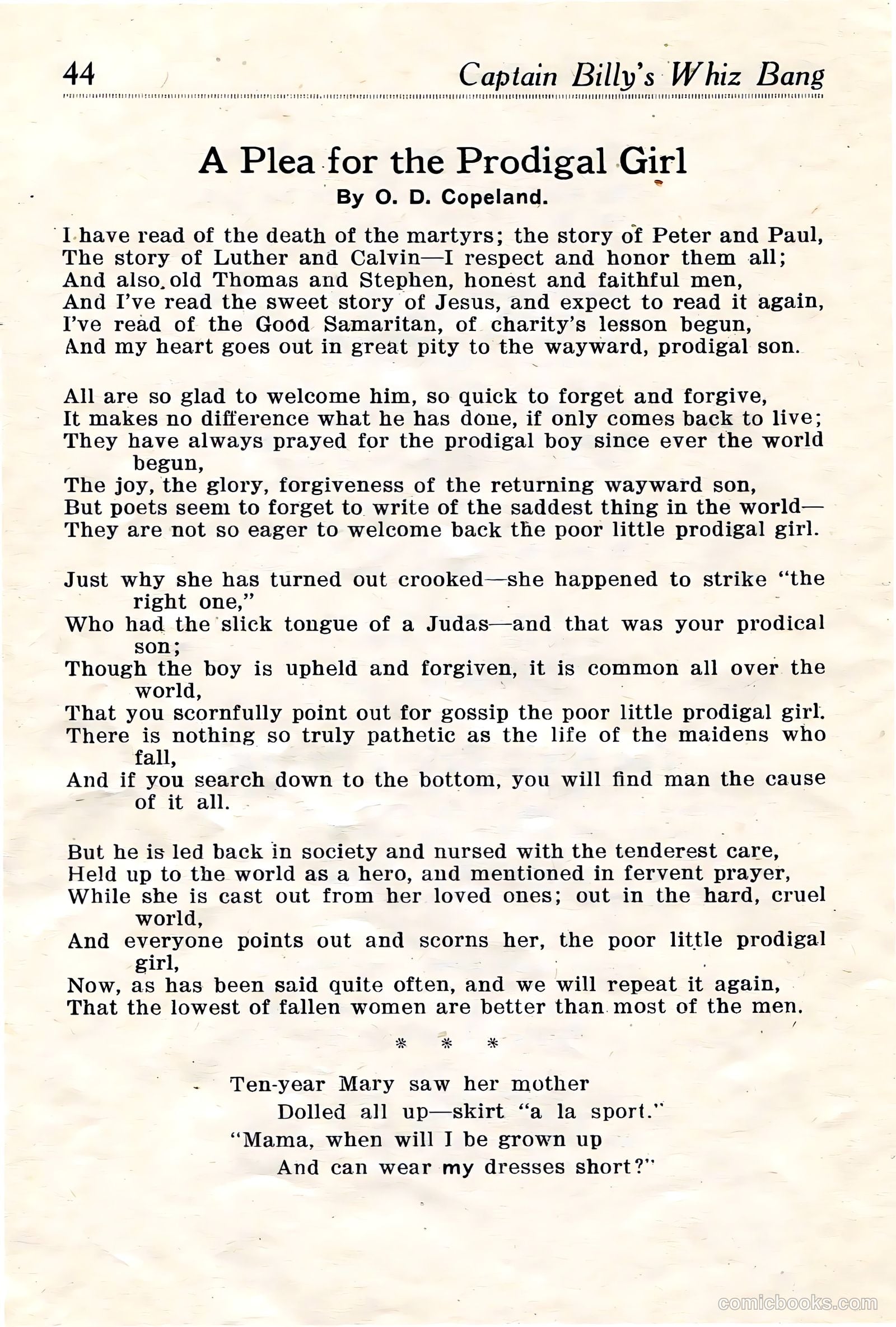
This poem by O. D. Copeland argues for compassion toward "fallen women" while critiquing society's hypocrisy. The author contrasts the biblical parable of the prodigal son—celebrated and forgiven upon return—with how society treats women who've lost their virtue, who face permanent ostracism and scorn. The piece claims men seduce women (describing the seducer as having "the slick tongue of a Judas"), yet society welcomes the man back as a "hero" while casting out the woman. Copeland argues men bear responsibility ("if you search down to the bottom, you will find man the cause") and that "the lowest of fallen women are better than most of the men." The final vignette about young Mary mimics her fashionable mother, suggesting anxiety about changing morality and women's behavior. This reflects early 20th-century concerns about loosening social codes and gender roles.
📄 Transcribed text from this page (OCR, searchable)
Machine-transcribed from the original scan — historical spelling and the odd misread are preserved.
44 Captain Billy’s Whiz Bang A Plea for the Prodigal Girl By O. D. Copeland. I have read of the death of the martyrs; the story of Peter and Paul, The story of Luther and Calvin—I respect and honor them all; And also old Thomas and Stephen, honest and faithful men, And I’ve read the sweet story of Jesus, and expect to read it again, I’ve read of the Good Samaritan, of charity’s lesson begun, And my heart goes out in great pity to the wayward, prodigal son. All are so glad to welcome him, so quick to forget and forgive, It makes no difference what he has done, if only comes back to live; They have always prayed for the prodigal boy since ever the world begun, The joy, the glory, forgiveness of the returning wayward son, But poets seem to forget to write of the saddest thing in the world— They are not so eager to welcome back the poor little prodigal girl. Just why she has turned out crooked—she happened to strike “the right one,” Who had the slick tongue of a Judas—and that was your prodigal son; Though the boy is upheld and forgiven, it is common all over the world, That you scornfully point out for gossip the poor little prodigal girl. There is nothing so truly pathetic as the life of the maidens who fall, And if you search down to the bottom, you will find man the cause of it all. But he is led back in society and nursed with the tenderest care, Held up to the world as a hero, and mentioned in fervent prayer, While she is cast out from her loved ones; out in the hard, cruel world, And everyone points out and scorns her, the poor little prodigal girl, Now, as has been said quite often, and we will repeat it again, That the lowest of fallen women are better than most of the men. * * * Ten-year Mary saw her mother Dolled all up—skirt “a la sport.” “Mama, when will I be grown up And can wear my dresses short?”