
Captain Billy's Whiz Bang, March 1921 · page 43 of 68
Captain Billy's Whiz Bang #18 — page 43: what you’re looking at
What you’re looking at
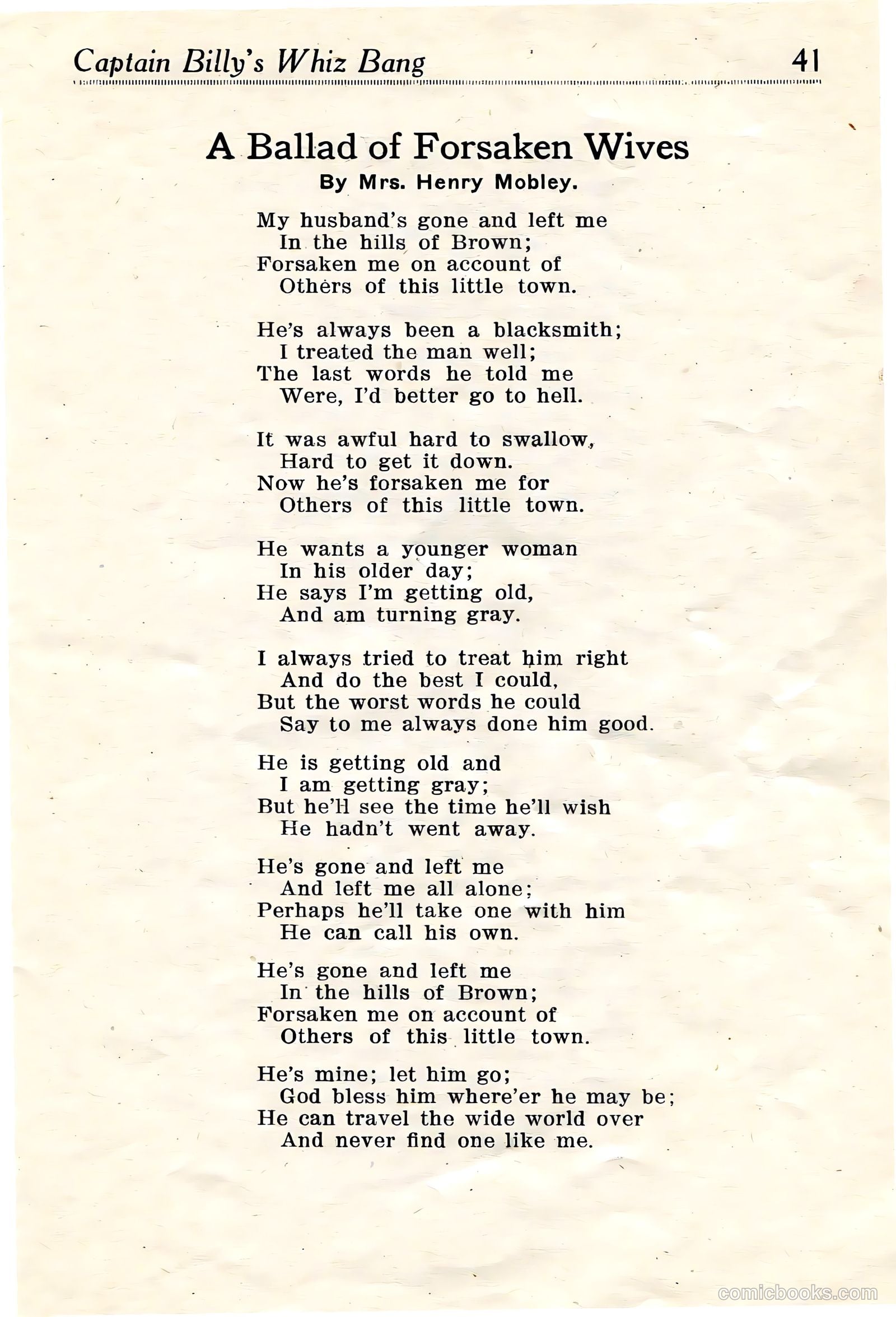
This page contains a poem by Mrs. Henry Mobley published in *Captain Billy's Whiz Bang*, a satirical magazine. The ballad describes a woman abandoned by her blacksmith husband, who left her in Brown (likely a town reference) to pursue younger women. The poem presents a common domestic complaint of the era: male infidelity and the aging-out of wives. The speaker catalogues her mistreatment—his cruel parting words, his preference for younger women, his claim she's "getting old" and "turning gray"—before concluding with resigned dignity: she releases him to the world, confident he'll never find anyone comparable. The satire targets male behavior and the disposability of wives in early 20th-century society, while the poem's sentimental yet defiant tone offers dark humor about marital betrayal. This reflects *Whiz Bang*'s typical blend of risqué humor and social commentary aimed at working-class readers.
📄 Transcribed text from this page (OCR, searchable)
Machine-transcribed from the original scan — historical spelling and the odd misread are preserved.
Captain Billy's Whiz Bang 41 A Ballad of Forsaken Wives By Mrs. Henry Mobley. My husband's gone and left me In the hills of Brown; Forsaken me on account of Others of this little town. He's always been a blacksmith; I treated the man well; The last words he told me Were, I'd better go to hell. It was awful hard to swallow, Hard to get it down. Now he's forsaken me for Others of this little town. He wants a younger woman In his older day; He says I'm getting old, And am turning gray. I always tried to treat him right And do the best I could, But the worst words he could Say to me always done him good. He is getting old and I am getting gray; But he'll see the time he'll wish He hadn't went away. He's gone and left me And left me all alone; Perhaps he'll take one with him He can call his own. He's gone and left me In the hills of Brown; Forsaken me on account of Others of this little town. He's mine; let him go; God bless him where'er he may be; He can travel the wide world over And never find one like me.