
Captain Billy's Whiz Bang, March 1921 · page 34 of 68
Captain Billy's Whiz Bang #18 — page 34: what you’re looking at
What you’re looking at
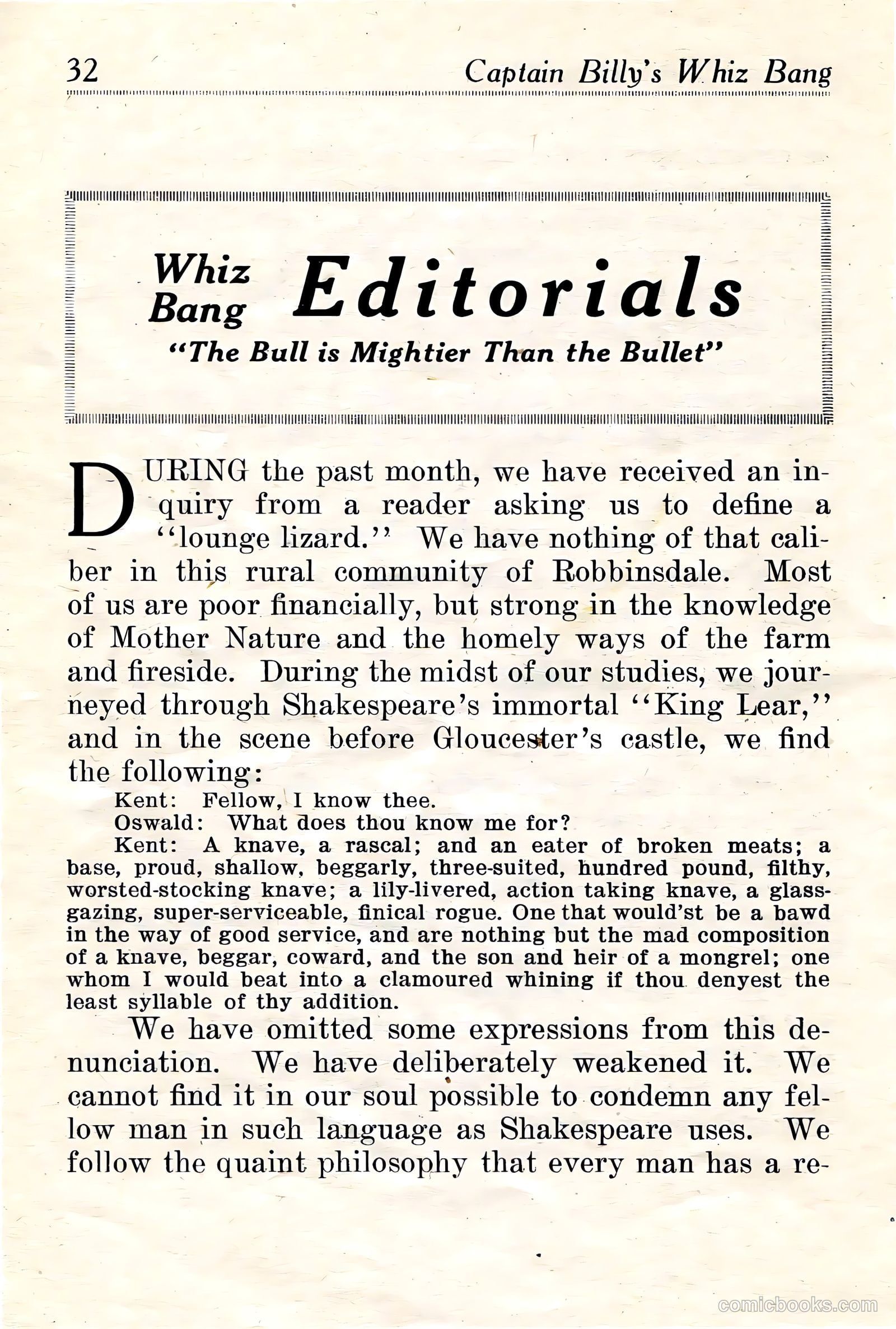
This editorial uses a Shakespeare reference to make a point about human dignity. The *Whiz Bang* editors, identifying themselves as rural poor from Robbinsdale, quote Kent's brutal insult of Oswald from *King Lear*. Rather than fully reproduce Shakespeare's harsh language, they deliberately soften it—omitting the strongest expressions. The satire operates on two levels: First, it mocks the pretension of citing Shakespeare to answer a trivial reader question about "lounge lizards" (idle socialites). Second, it defends a humanistic philosophy against Shakespeare's own misanthropy, arguing that even the lowest person doesn't deserve such verbal abuse. The editorial's title—"The Bull is Mightier Than the Bullet"—suggests that plain, direct criticism ("the bull") is more powerful than sharp-tongued attacks. This reflects the magazine's self-presentation as plain-spoken rural moralists who reject both fashionable villainy and savage condemnation.
📄 Transcribed text from this page (OCR, searchable)
Machine-transcribed from the original scan — historical spelling and the odd misread are preserved.
32 Captain Billy's Whiz Bang Whiz Bang Editorials "The Bull is Mightier Than the Bullet" DURING the past month, we have received an in- quiry from a reader asking us to define a “lounge lizard.” We have nothing of that cali- ber in this rural community of Robbinsdale. Most of us are poor financially, but strong in the knowledge of Mother Nature and the homely ways of the farm and fireside. During the midst of our studies, we jour- neyed through Shakespeare’s immortal “King Lear,” and in the scene before Gloucester’s castle, we find the following: Kent: Fellow, I know thee. Oswald: What does thou know me for? Kent: A knave, a rascal; and an eater of broken meats; a base, proud, shallow, beggarly, three-suited, hundred pound, filthy, worsted-stocking knave; a lily-livered, action taking knave, a glass- gazing, super-serviceable, finical rogue. One that would’st be a bawd in the way of good service, and are nothing but the mad composition of a knave, beggar, coward, and the son and heir of a mongrel; one whom I would beat into a clamoured whining if thou denyest the least syllable of thy addition. We have omitted some expressions from this de- nunciation. We have deliberately weakened it. We cannot find it in our soul possible to condemn any fel- low man in such language as Shakespeare uses. We follow the quaint philosophy that every man has a re-