
Captain Billy's Whiz Bang, March 1921 · page 35 of 68
Captain Billy's Whiz Bang #18 — page 35: what you’re looking at
What you’re looking at
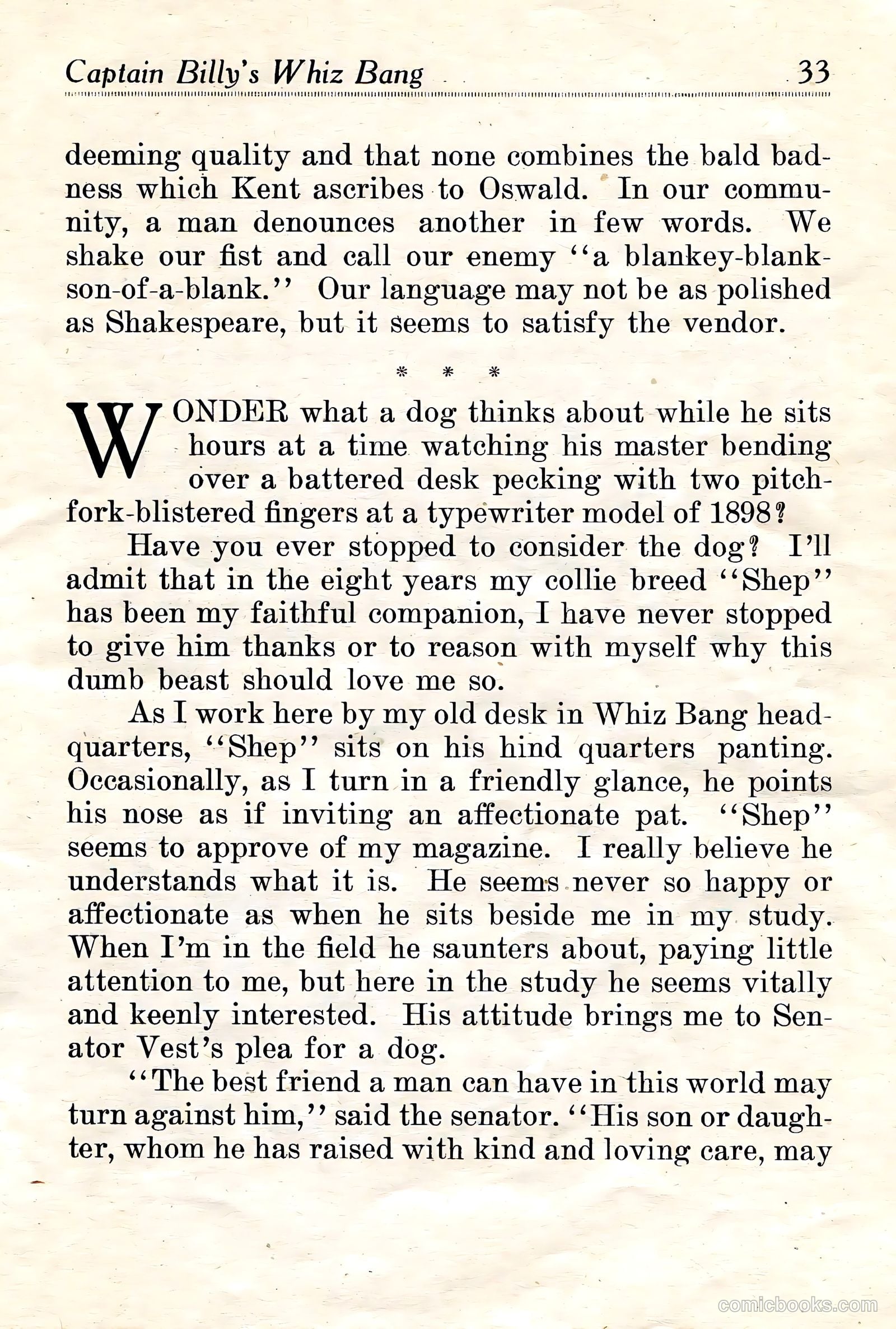
This page contains two distinct pieces of sentimental prose rather than cartoons. The first section mocks overly literary insults, contrasting Shakespeare's eloquent language with working-class America's crude epithet "blankey-blank-son-of-a-blank"—suggesting that plain folk have no need for polished language. The second, longer piece is the author's tribute to his collie dog "Shep" at Whiz Bang headquarters. He observes that his dog seems to understand and approve of the magazine, displaying keen interest while the author works at an 1898 typewriter. The author then references **Senator Vest's famous 1870 speech defending dogs** as man's best friend—a sentimental legal argument. The passage suggests that even family members may betray a man, but a dog's loyalty remains constant. This reflects early-twentieth-century sentimentalism about animal companionship and working-class virtue.
📄 Transcribed text from this page (OCR, searchable)
Machine-transcribed from the original scan — historical spelling and the odd misread are preserved.
Captain Billy's Whiz Bang 33 deeming quality and that none combines the bald bad-ness which Kent ascribes to Oswald. In our commu-nity, a man denounces another in few words. We shake our fist and call our enemy “a blankey-blank-son-of-a-blank.” Our language may not be as polished as Shakespeare, but it seems to satisfy the vendor. * * * WONDER what a dog thinks about while he sits hours at a time watching his master bending over a battered desk pecking with two pitch-fork-blistered fingers at a typewriter model of 1898? Have you ever stopped to consider the dog? I’ll admit that in the eight years my collie breed “Shep” has been my faithful companion, I have never stopped to give him thanks or to reason with myself why this dumb beast should love me so. As I work here by my old desk in Whiz Bang head-quarters, “Shep” sits on his hind quarters panting. Occasionally, as I turn in a friendly glance, he points his nose as if inviting an affectionate pat. “Shep” seems to approve of my magazine. I really believe he understands what it is. He seems never so happy or affectionate as when he sits beside me in my study. When I’m in the field he saunters about, paying little attention to me, but here in the study he seems vitally and keenly interested. His attitude brings me to Sen-ator Vest’s plea for a dog. “The best friend a man can have in this world may turn against him,” said the senator. “His son or daugh-ter, whom he has raised with kind and loving care, may