
A complete issue · 68 pages · 1921
Captain Billy's Whiz Bang #16
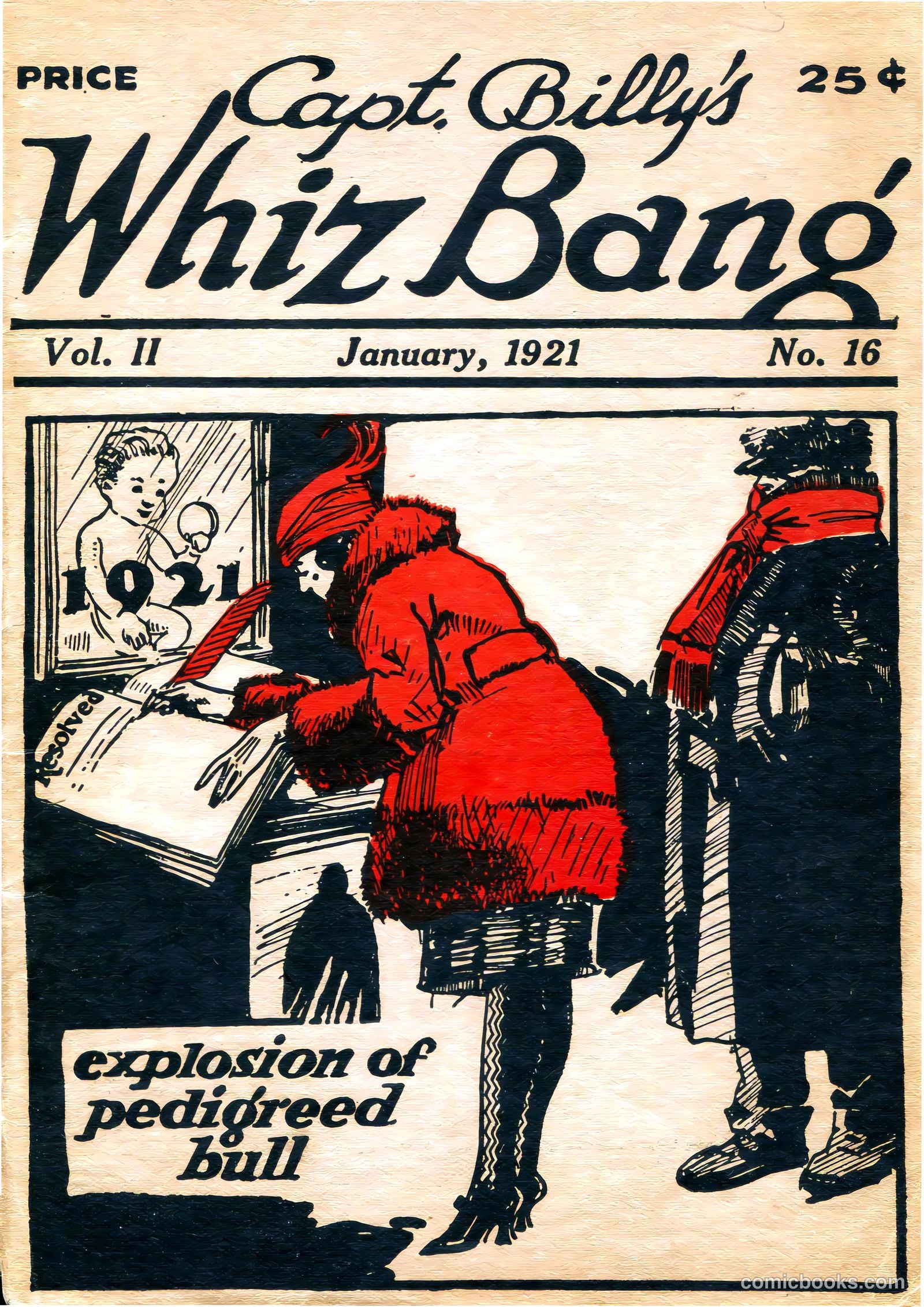
This satirical cartoon depicts what appears to be a New Year's resolution announcement. A woman in a red coat holds a document labeled "1921 Resolved" while presenting it to onlookers, with the caption "explosion of pedigreed bull." The "joke" likely refers to making resolutions to expose or eliminate "pedigreed bull"—meaning pretentious nonsense or false claims from the wealthy or upper classes. The phrase suggests debunking high-status deceptions. The woman's fashionable attire and assertive posture suggest she's championing this satirical resolution. As this appeared in *Whiz Bang*, a humor magazine known for irreverent social commentary, the cartoon mocks society's pretensions and false sophistication through the metaphor of explosive revelation.
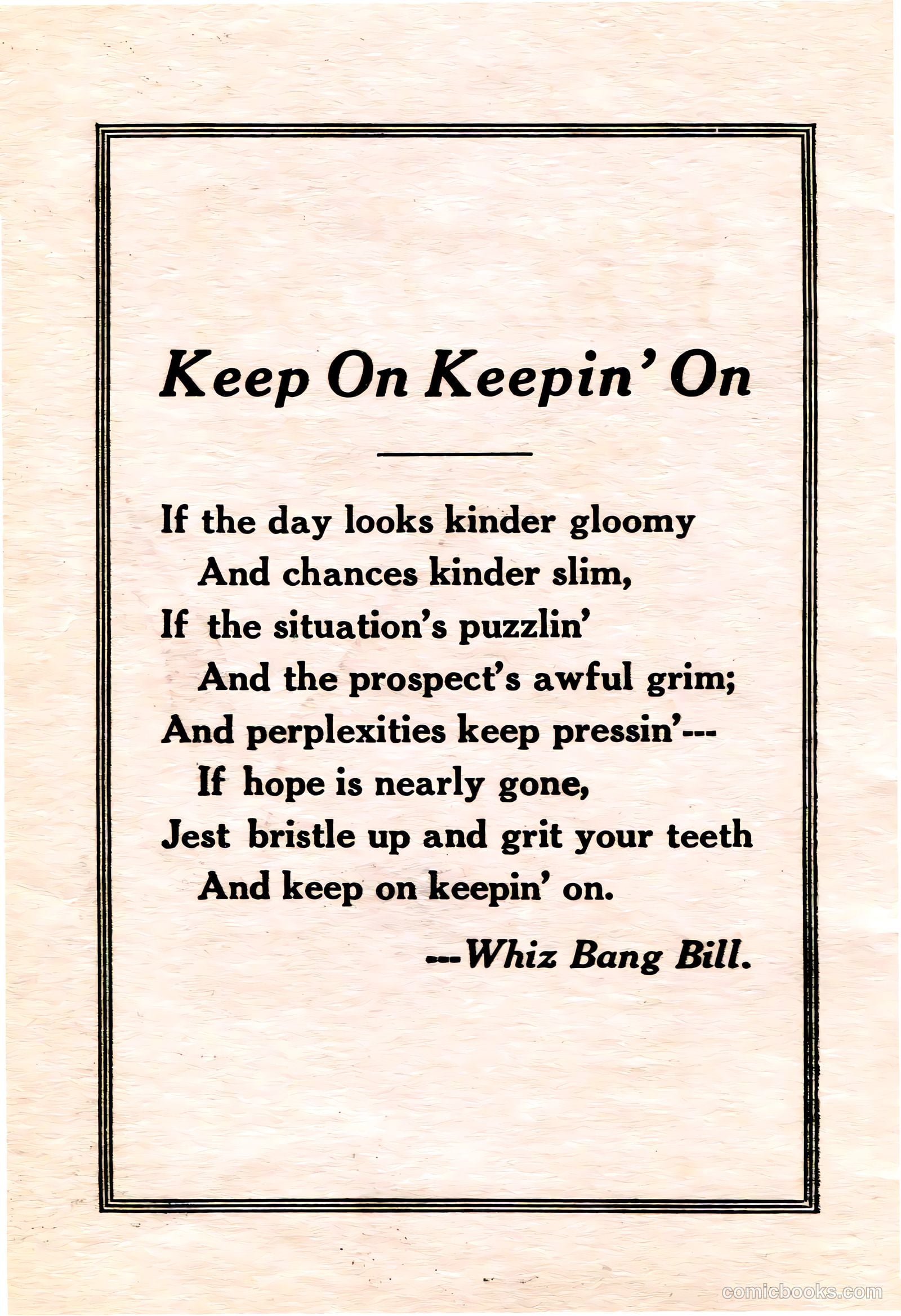
This is an inspirational poem rather than a cartoon or satirical piece. "Keep On Keepin' On" is a motivational verse attributed to "Whiz Bang Bill" (the magazine's persona), offering perseverance advice during difficult times. The poem uses colloquial language ("kinder," "jest," "bristle up") to make its message accessible. It addresses hardship—gloomy days, slim chances, puzzling situations, fading hope—and counsels resilience through determination ("grit your teeth"). The context suggests this likely appeared during a period of national struggle, possibly World War I or the Great Depression, when such morale-boosting messages were common in magazines. Rather than satirizing a specific figure or event, it functions as popular motivational literature, reflecting the stoic, can-do attitude the publication promoted to its readers.
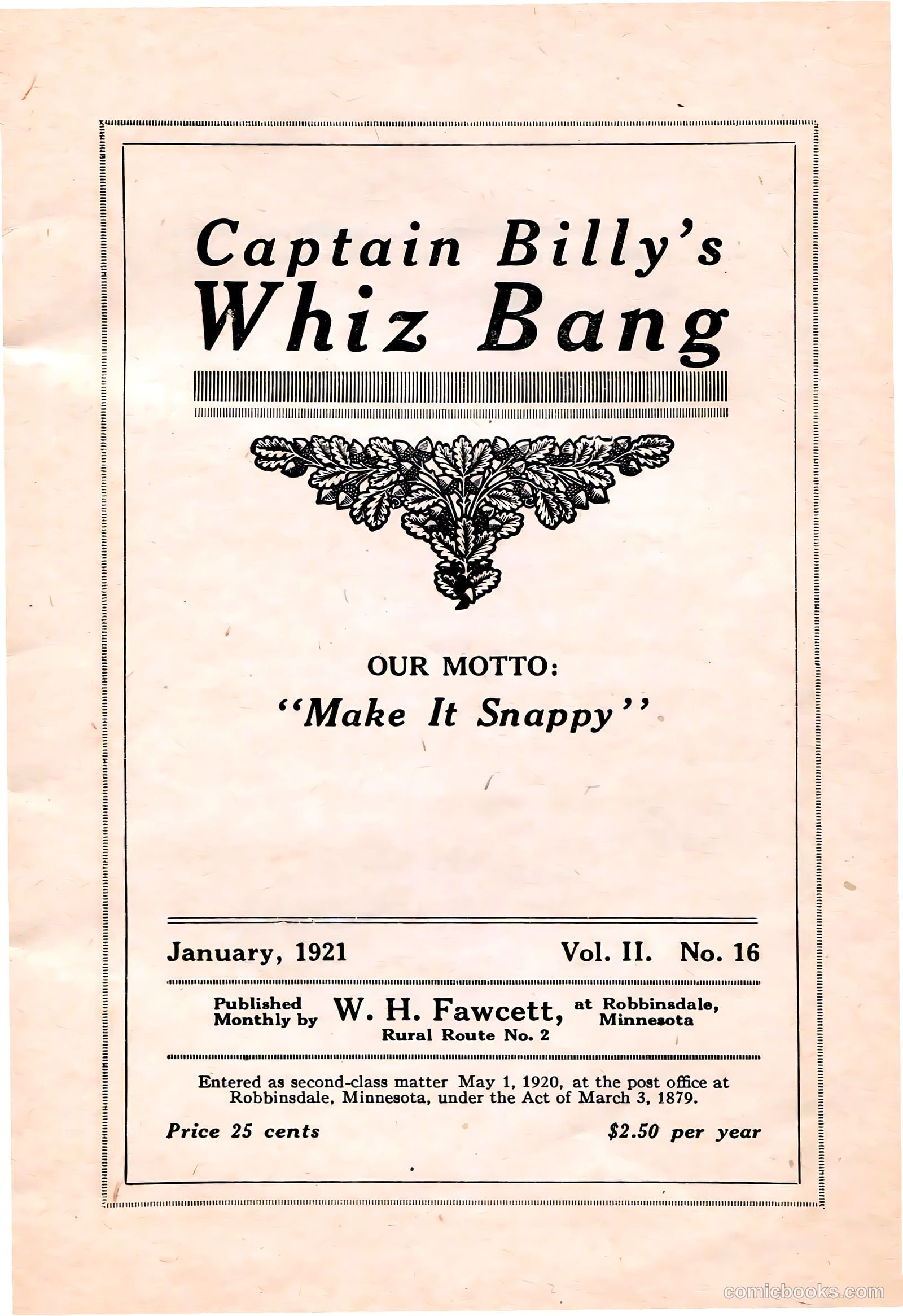
This is a title page for *Captain Billy's Whiz Bang*, a satirical monthly magazine published from rural Minnesota beginning in 1920. The page announces the publication itself rather than containing cartoons. The magazine's motto, "Make It Snappy," suggests the editor's promise of quick, punchy humor. *Whiz Bang* became a popular humor publication of the 1920s, known for irreverent jokes and satirical commentary on contemporary American life. This January 1921 issue cost 25 cents monthly or $2.50 annually—relatively affordable for the era. The decorative flourish beneath the title is typical Art Deco period design work.
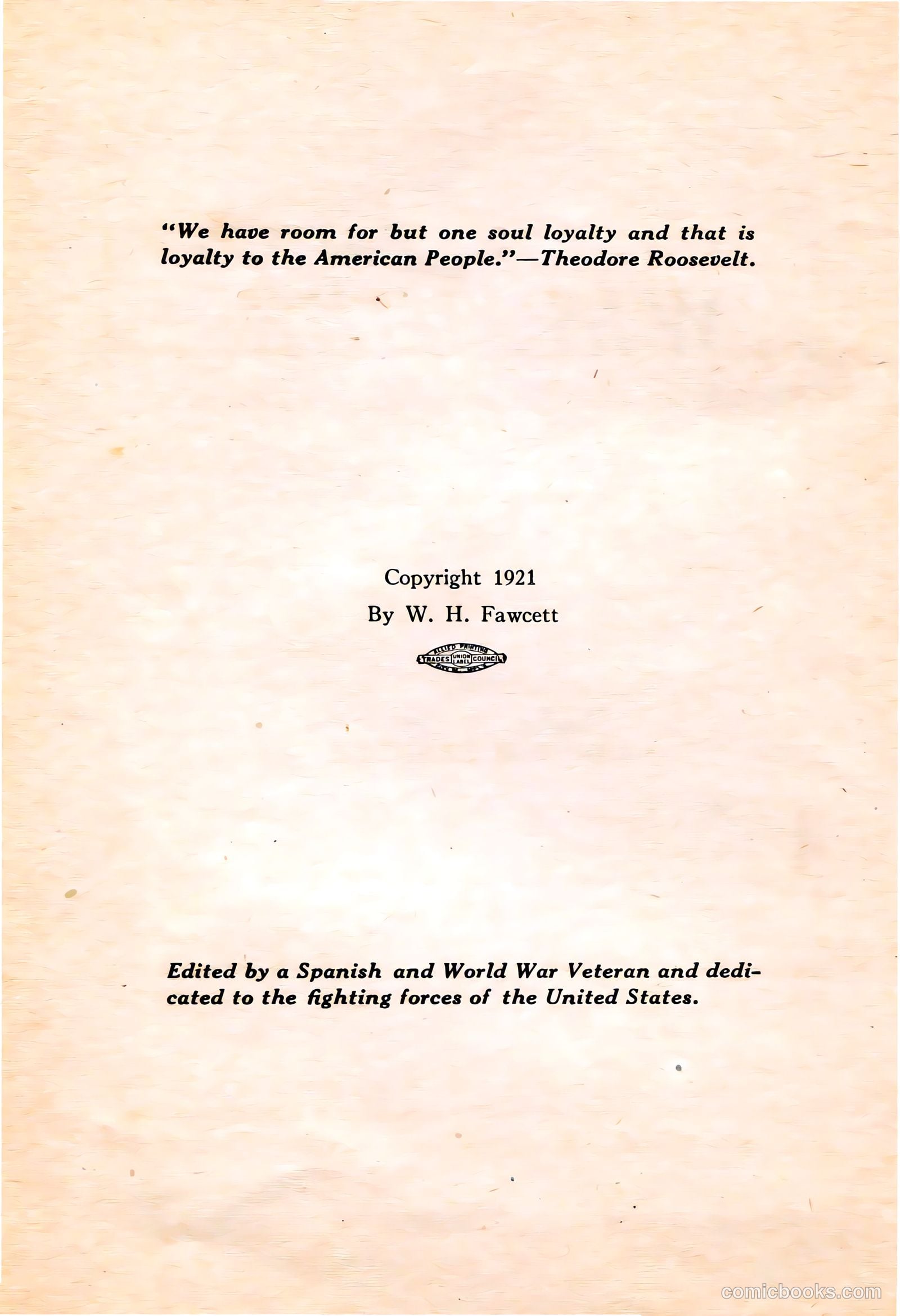
This is the title/copyright page of *Whiz-Bang*, a 1921 satirical magazine. It features a Theodore Roosevelt quote emphasizing undivided American patriotism—likely referencing post-WWI anxieties about divided loyalties, hyphenated Americans, and immigrant communities that allegedly prioritized foreign allegiances. The editor identifies as a Spanish-American War and World War I veteran, suggesting the magazine would appeal to military audiences and patriotic Americans. The publication was dedicated to U.S. fighting forces during a period of heightened nationalist sentiment following America's 1917 entry into World War I. The Roosevelt epigraph sets the magazine's patriotic, anti-cosmopolitan tone for what followed—content presumably satirizing those deemed insufficiently loyal to America or overly sympathetic to foreign interests.
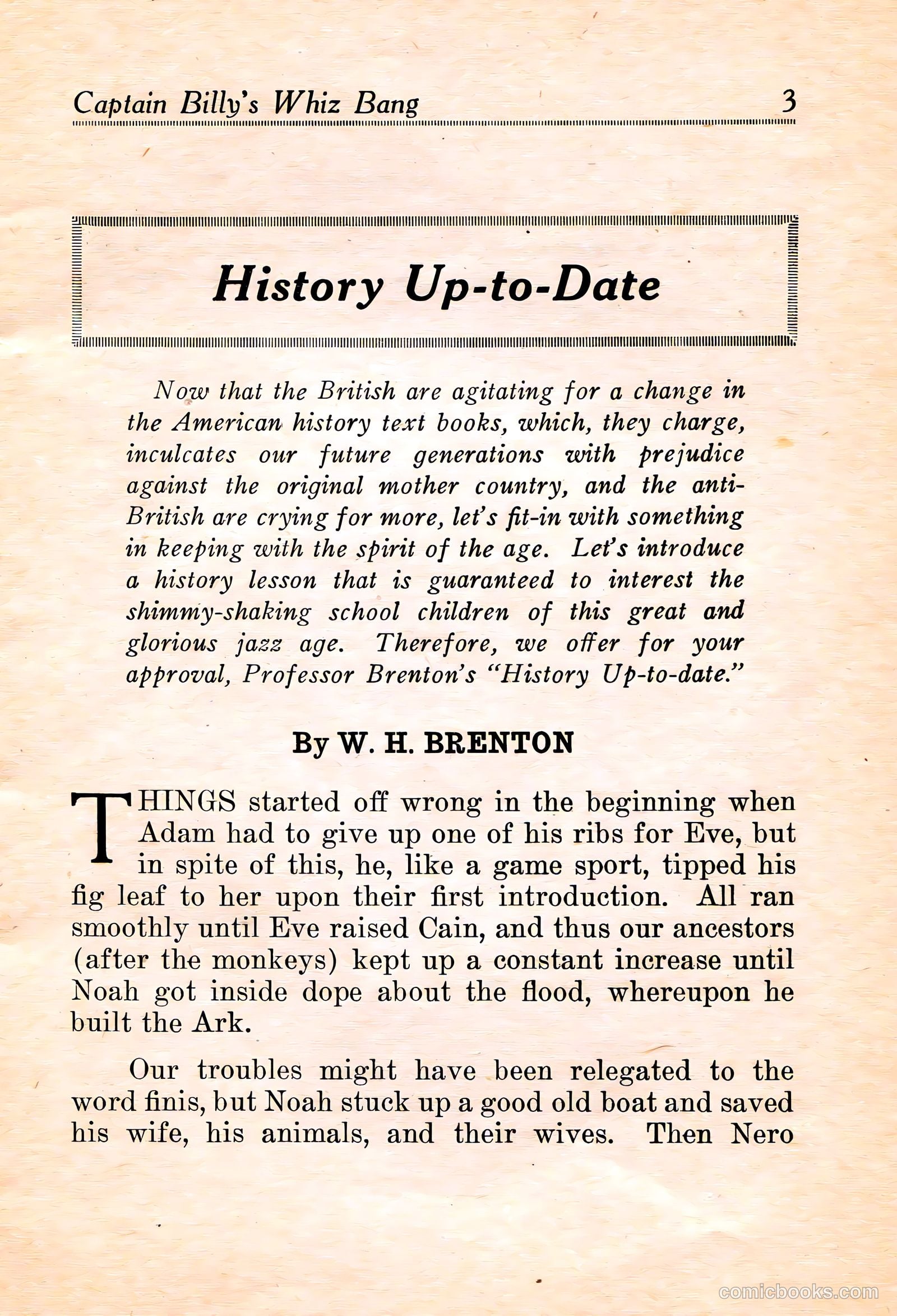
This satirical piece mocks the 1920s debate over American history textbooks. The British government reportedly objected to portrayals they saw as anti-British propaganda in U.S. schools, while American anti-British factions wanted even harsher content. The satire proposes a ridiculous "modern" history lesson by "Professor Brenton" that treats biblical and classical history with anachronistic slang—"Eve raised Cain," Noah "got inside dope," Adam was a "game sport." The tone mimics 1920s jazz-age vernacular ("shimmy-shaking school children"), suggesting that revising history to suit political agendas produces absurd, dumbed-down results. The joke: if we're rewriting textbooks for propaganda purposes rather than accuracy, why not make them entertainingly ridiculous? It's satire criticizing textbook censorship and nationalistic history-doctoring.
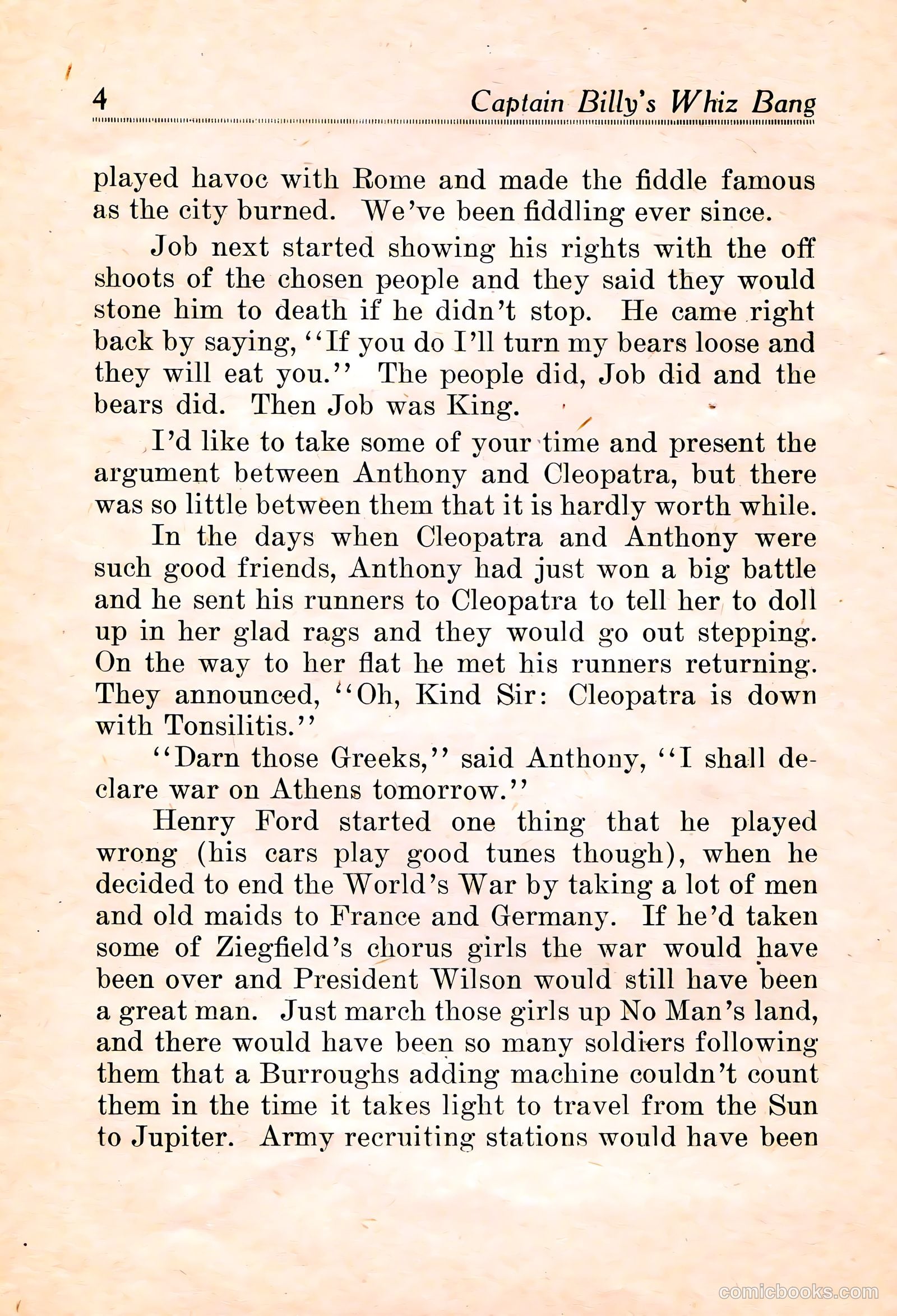
This page from the satirical magazine contains humorous historical anecdotes mixing biblical, classical, and contemporary references. The narrator presents absurdist retellings: Nero fiddling while Rome burned; Job threatening bears against those opposing his rights; and Anthony declaring war on Athens because Cleopatra has tonsilitis (a throat infection). The main satire targets **Henry Ford's 1915 Peace Ship expedition**, where Ford attempted to end World War I by taking pacifists to Europe. The author jokes that Ford erred by not instead sending Ziegfeld Follies chorus girls to the front lines—implying soldiers would abandon fighting to follow them, and the war would end while President Wilson retained his reputation. The exaggeration (using a Burroughs adding machine to count followers, light-travel-time comparisons) emphasizes the absurdity through hyperbole, typical of Whiz Bang's irreverent humor mocking both historical figures and recent events.
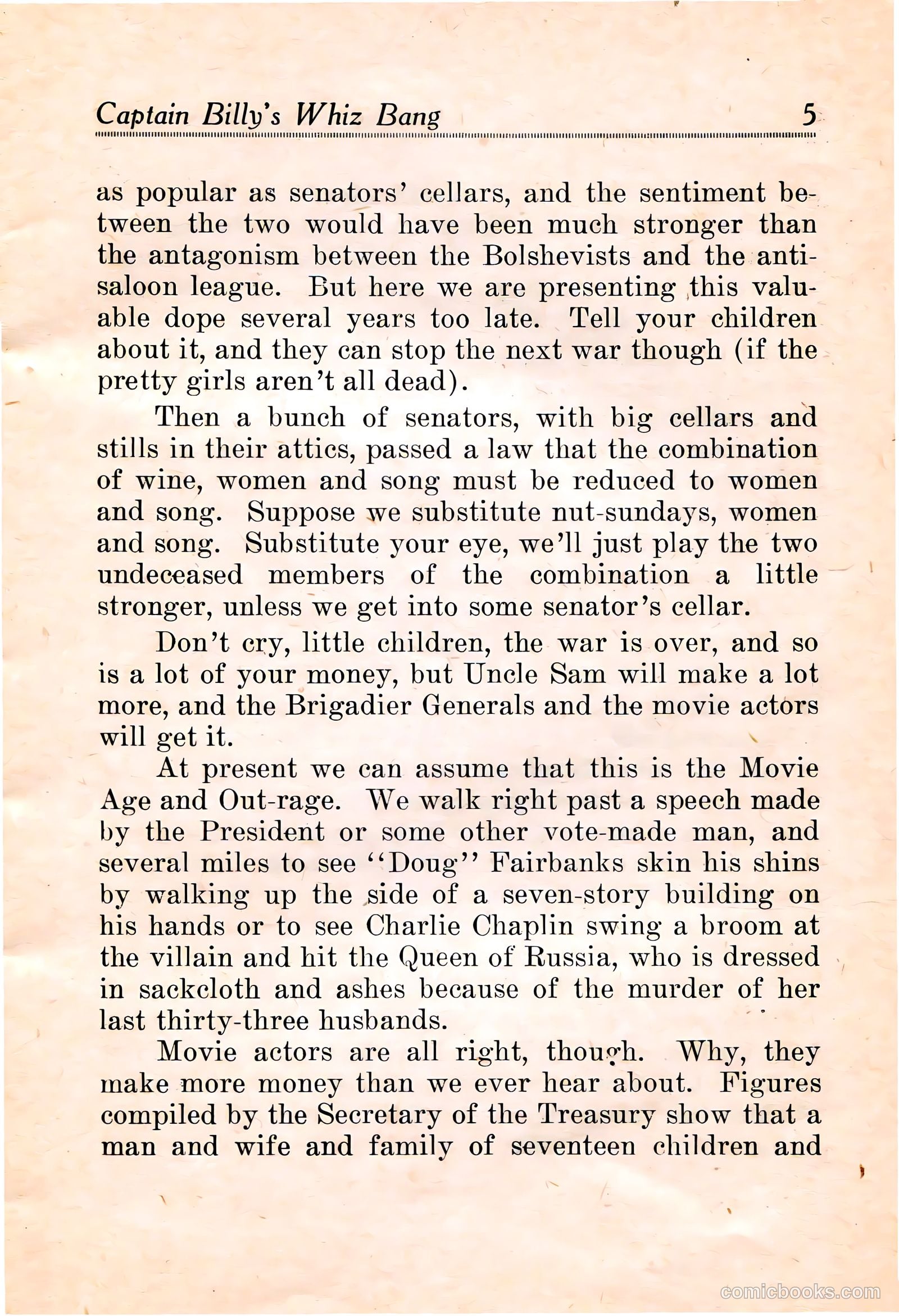
This post-WWI satirical piece mocks Prohibition and postwar American excess. The author sarcastically notes that senators who championed Prohibition secretly maintained illegal alcohol supplies ("cellars" and "stills in their attics"), exposing hypocrisy in the ban on "wine, women and song." The text references silent film stars Douglas Fairbanks and Charlie Chaplin as emblems of frivolous entertainment priorities—Americans ignore presidential speeches to watch Fairbanks perform dangerous stunts or Chaplin perform slapstick. The vague reference to "Queen of Russia" likely alludes to anti-Bolshevik sentiment and wartime propaganda. The core complaint: while ordinary Americans lost money and lives in WWI, wealth flowed to military generals and movie actors. The satire argues that postwar society prioritizes entertainment and profit over addressing real consequences of the war.
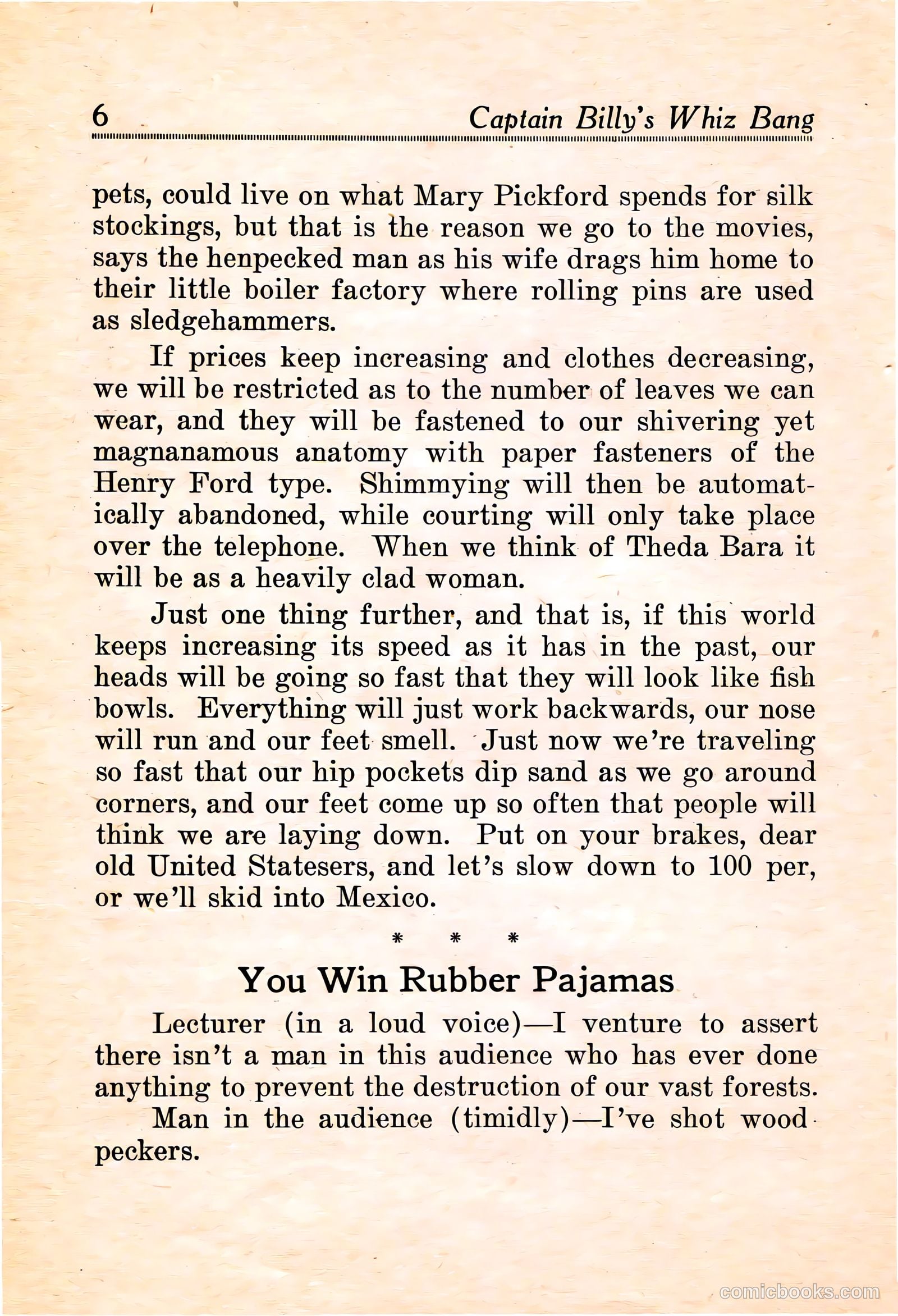
This page from *Captain Billy's Whiz Bang* contains satirical commentary on 1920s American life and a brief joke. The first section mocks modern technological acceleration and consumer culture through exaggerated predictions: shrinking clothing, heads shaped like fish bowls, geographic disorientation. References include **Mary Pickford** (silent film star known for lavish spending), **Theda Bara** (actress known for glamorous roles), and the **Henry Ford assembly line** (representing mass production). The satire targets anxiety about modern life moving too fast and becoming unsustainable. The "You Win Rubber Pajamas" section is a simple joke punchline: a lecturer boasts no one in the audience has helped preserve forests; a timid man claims he has—by shooting woodpeckers, which destroy trees. The absurdist humor works because woodpeckers are small and insignificant compared to industrial deforestation, making the claim ridiculous. Both pieces exemplify *Whiz Bang*'s style: satirizing contemporary anxieties while employing crude humor.
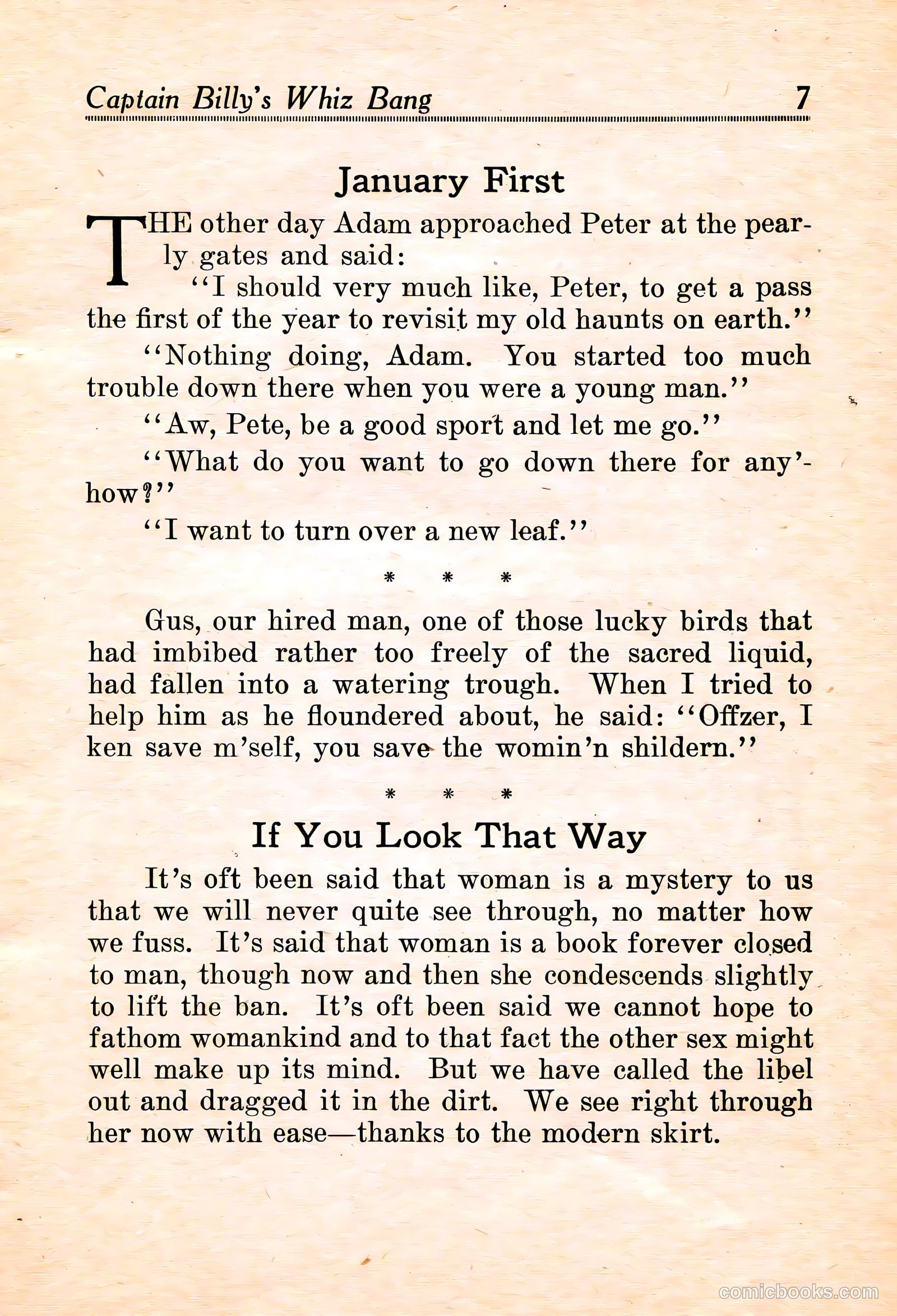
This page from the satirical magazine contains three humorous pieces targeting early 1920s social attitudes: **"January First"** features biblical figures Adam and Peter at heaven's gates, with Adam seeking a New Year's pass to Earth to "turn over a new leaf"—a pun on his original sin and the tradition of New Year's resolutions. **The Gus anecdote** mocks drunk behavior, with an intoxicated hired man fallen in a watering trough. His slurred speech ("Offzer," "womin'n shildern") and chivalrous concern for women and children despite his own predicament satirize masculine pride. **"If You Look That Way"** is the most pointed piece. It sarcastically deconstructs the cliché that women are mysterious and inscrutable. The author argues men can now "see right through her...thanks to the modern skirt"—mocking both the post-WWI fashion trend of shorter hemlines and men's superficial, voyeuristic understanding of women. It's simultaneously a joke about fashion and a commentary on reductive masculine attitudes toward women.
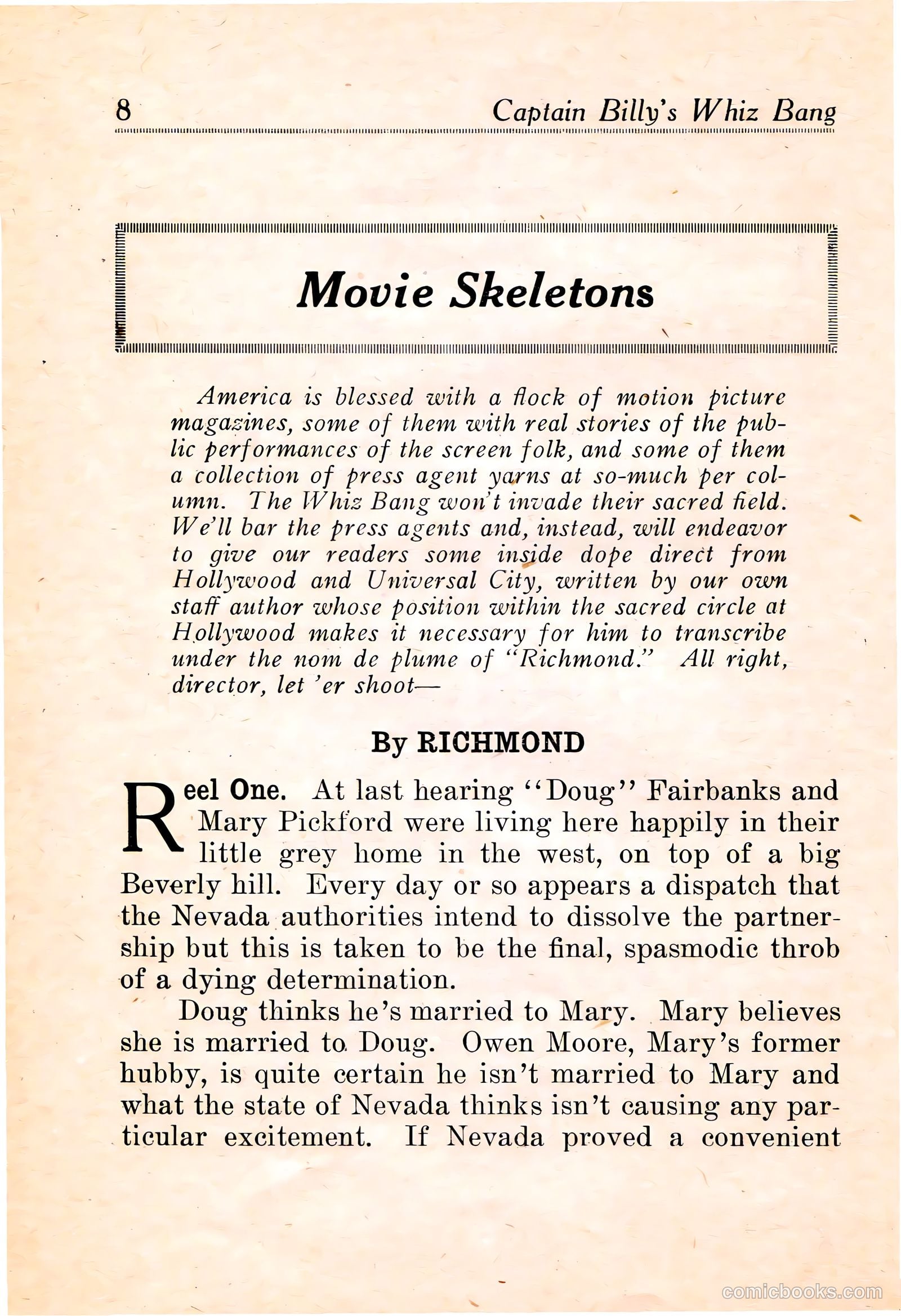
This section introduces "Movie Skeletons," a satirical Hollywood gossip column in *Captain Billy's Whiz Bang* magazine. The piece mocks celebrity tabloid coverage by presenting itself as insider information from an anonymous Hollywood source using the pseudonym "Richmond." The specific target is the marital status of silent film stars **Douglas Fairbanks** and **Mary Pickford**. The satire highlights the confusion and contradictions in their relationship: Doug believes they're married, Mary believes they're married, but her ex-husband **Owen Moore** apparently disputes this—and Nevada's divorce laws apparently matter little to anyone involved. The joke undercuts both the celebrities' credibility and the breathless scandal-mongering of entertainment press. By presenting conflicting versions of a simple fact (who is married to whom), the column satirizes how Hollywood gossip magazines fabricate drama while actual legal and personal realities remain murky or ignored.
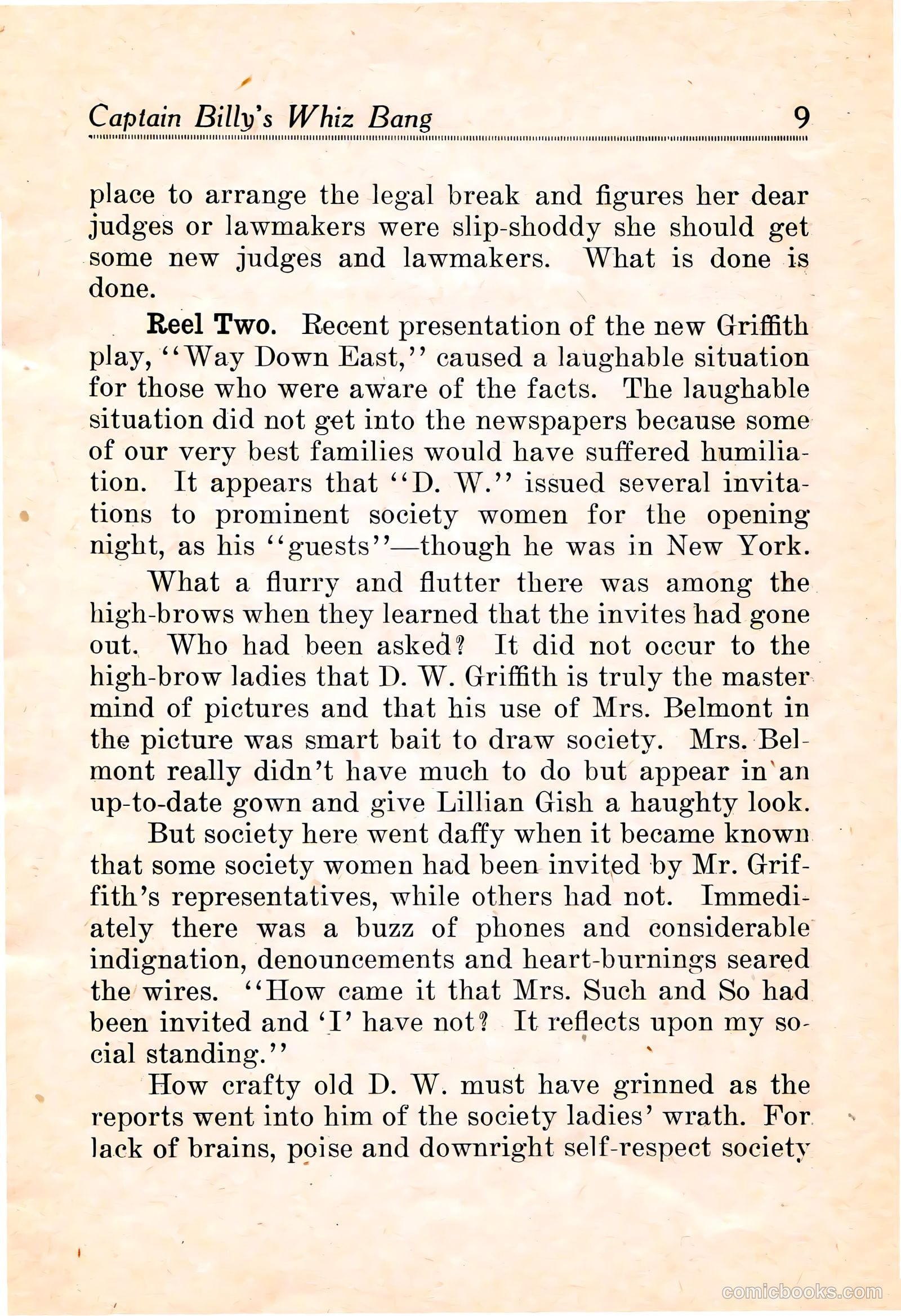
This satirical piece mocks high-society snobbery through director D.W. Griffith's premiere of "Way Down East." Griffith, absent in New York, had his representatives invite select prominent society women to the film's opening, apparently featuring Mrs. Belmont (a real socialite) in a minor role. When not all society women received invitations, widespread outrage erupted via telephone—women questioned why rivals were chosen over them, treating the invitation as a social ranking. The satire targets the vanity and insecurity of "high-brow" society ladies, suggesting Griffith deliberately exploited their status-consciousness as clever publicity. The piece concludes that society women lack "brains, poise and downright self-respect," having allowed themselves to be manipulated by a filmmaker's calculated social maneuvering.
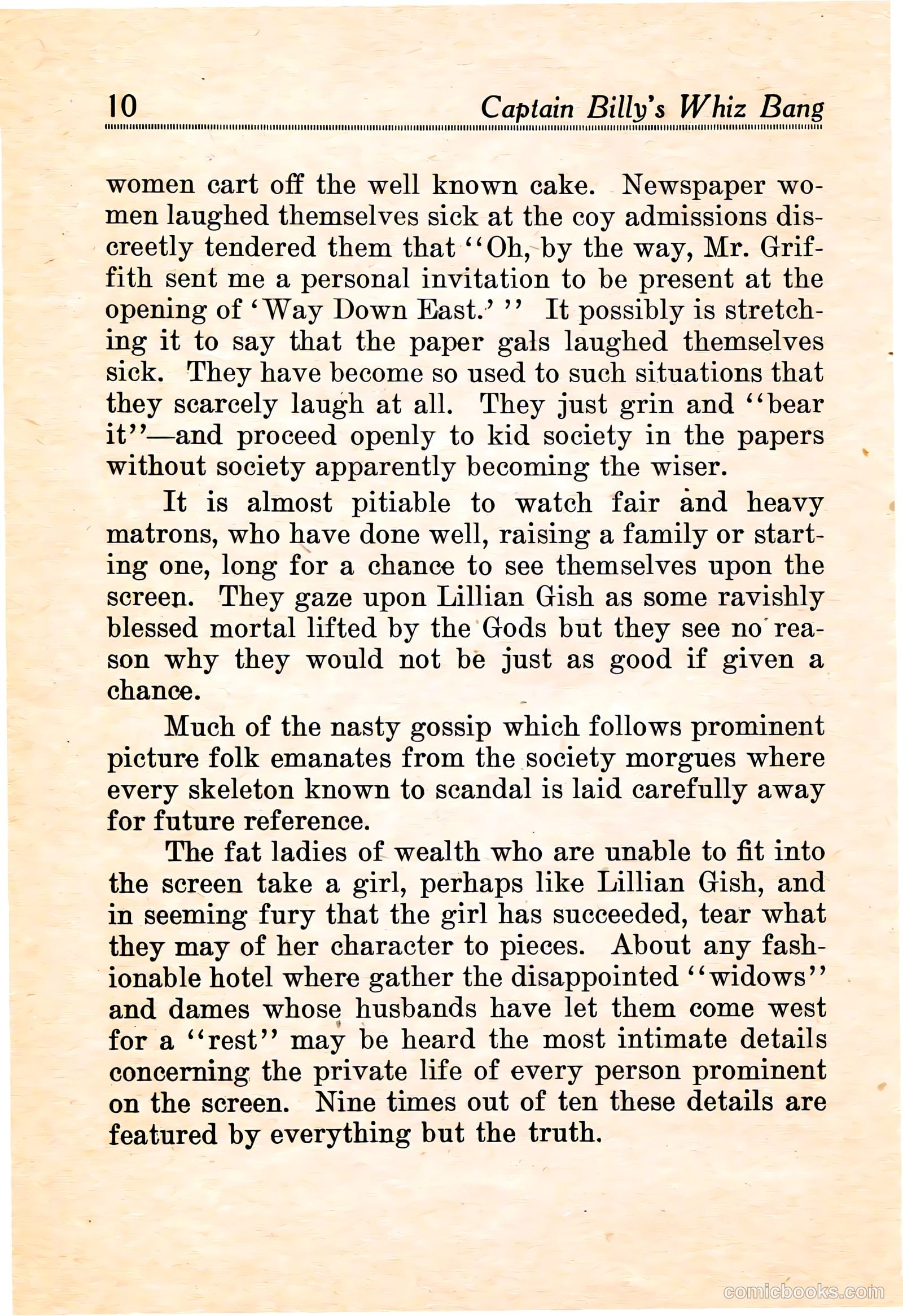
This satirical piece from *Captain Billy's Whiz Bang* criticizes Hollywood's social hierarchy and the gossip machine surrounding silent film stars. The text references **Lillian Gish**, a major actress of the era, and **D.W. Griffith**, the prominent director who directed her in films including "Way Down East" (1920). The satire targets wealthy society women who resent movie stars' fame and glamour. Unable to achieve stardom themselves, these women—described as "fat ladies of wealth"—gather at fashionable hotels to spread malicious rumors about film personalities, fabricating scandalous details about their private lives. The piece mocks newspaper women for accepting dubious "exclusives" about celebrities, and scorns the society matrons whose envy drives them to tear down successful actresses they secretly envy. The core joke: Hollywood's gossip originates not from reliable sources but from bitter, disappointed wealthy women whose husbands brought them west for health "rests."
This page from *Whiz Bang* magazine (page 11) contains no cartoon or illustration—it's entirely text discussing the film industry and personal relationships. The piece defends director D.W. Griffith against gossip, describing him as "shrewd" and "much misunderstood." It discusses actress Lillian Gish and her sister Dorothy, praising their work ethic. The text addresses rumors linking Lillian romantically to Griffith, asserting her mother's protective presence. It also mentions Robert "Bobby" Harron, an actor who worked with Griffith, noting his virtue and the Gish and Harron families' close friendship. The piece appears designed to counter Hollywood scandal-mongering by vouching for the moral character of Griffith's circle during the early 20th-century silent film era.
This is satirical gossip about 1920s Hollywood excess. The piece mocks film industry parties by contrasting the supposed moral superiority of movie stars against their actual behavior. **The satire:** - Film industry figures claim respectability while hosting multi-day parties with heavy drinking - A wealthy director's lavish bash lasted several days, with guests leaving to change clothes and returning - The host provided chauffeurs to prevent drunk guests from driving—suggesting routine intoxication - Female performers are characterized as either maintaining decorum (one woman sitting still) or openly drunk ("Edna's been stewed for two hours") **Social context:** This reflects 1920s anxiety about Hollywood's perceived immorality and the disconnect between stars' public images and private conduct. The magazine satirizes both the industry's hypocrisy and the era's ambivalence about Prohibition-era drinking culture. The piece presents itself as insider gossip while morally judging the "questionable vices" it describes.
This page from Captain Billy's Whiz Bang satirizes a messy Hollywood family situation. A matinee idol (film star) divorced his wife and half-dozen children, remarried, and had a baby with his new wife. The decree granted him custody part-time. The humor—and scandal—centers on a farcical moment: when the ex-wife arrives at a fashionable hotel with her children to visit the father, one of the kids wheels a baby carriage into her room and cheerfully announces he has a "new sister" from his father's second family. The satire mocks both Hollywood's marital instability and the awkward, tangled family situations it creates. The magazine's tone is gently mordant, treating the chaos as representative of celebrity excess and moral confusion. The reference to chauffeurs having "feelings" suggests servants bore witness to the drama.
This page from *Captain Billy's Whiz Bang* (a 1920s-era humor magazine) contains two satirical pieces: **Top section**: A brief joke about custody disputes, mocking the emotional drama ("hysteria") surrounding child custody cases of the era. It's sardonic commentary on how childhood becomes a battleground between parents. **"Our Language"**: A humorous list exploiting English's arbitrary collective nouns (flock, herd, school, etc.). The satire lies in the absurdist progression—it starts with real terms, then subverts them by applying formal collective nouns to people in unexpected ways. Calling a "herd of children" a "troop" is legitimate, but a "mob of whales" a "school" or—most pointedly—"a school of worshippers" a "congregation" creates mock-serious wordplay mocking linguistic inconsistency and pretension. The final entry likely suggests that organized religion is just another collective grouping, a subtle jab at institutional piety.
This page contains two humorous pieces from an early 20th-century American satirical magazine. **"Bull Frog Bull"** is a mock-serious natural history essay that plays on the word "bull" (the animal) while discussing actual frog biology. The humor culminates in a topical reference: it claims the frog "can catch more flies than Tris Speaker, with far less effort." Tris Speaker was a famous baseball player, likely known for poor performance or fumbling catches. The essay concludes with a pun—frogs having "hops"—possibly implying American society itself has lost vitality. **"You Can't Fool a Horse-Fly"** is a dialect joke featuring Irish characters (Mike and Pat, indicated by "Moike," "Begorra," and "blaggard"). Pat becomes offended when told a horse-fly lands on his neck, interpreting the statement as a personal insult. The punchline—"you can't fool a fly"—suggests Pat himself is foolish enough to be compared to a horse-fly.
This page announces an article by Rev. "Golicitly" Morrill about bathing customs in East India, framed as exotic travel journalism. The teaser promises sensationalized content about South America in a future issue, calling Rio de Janeiro "the Gomorrah" and Buenos Aires "the Sodom of South America"—biblical references to sinful cities—while explicitly mentioning "white slave market" content. The article excerpt emphasizes bathing as a quasi-spiritual practice, with Morrill romanticizing a memorable bath in Delhi involving "the girl." The tone blends travelogue with innuendo; references to mixed bathing "where men and women recognize no sex" and the closing line—"cleanliness is not always next to godliness"—suggest sexual content beneath respectable travel writing. *Whiz Bang* was known for mixing crude humor with purported sophistication. This appears designed to attract readers with promises of exotic, titillating material presented under the guise of serious religious commentary.
This page from *Captain Billy's Whiz Bang* (a 1920s American humor magazine) presents a first-person humorous account of an unexpected bathing experience in India. The narrative exploits common satirical tropes of the era: **The Joke**: A Western traveler seeking a "Durbar bath" (a reference to a royal pageant) encounters traditional Indian bathing practices that shock his Victorian sensibilities—specifically, female attendants who bathe male clients as part of standard service. His prudish reaction to nudity contrasts with the matter-of-fact professionalism of the Indian staff. **Social Context**: The humor relies on: - Orientalist assumptions about "exotic" India - Western discomfort with non-Western bathing customs - The incongruity between the narrator's expectations and reality - Casual references to female nudity as comedic material **References**: "Falstaff" (Shakespeare's rotund character), "September Morn" (a 1912 painting frequently used in period humor involving female nudity), and "sweet sixteen" reinforce the sexualized tone typical of 1920s men's magazines. The satire targets the narrator's prudishness rather than Indian culture, though modern readers would note the era's casual exoticization and objectification.
This is a first-person travel narrative mocking Indian religious and cultural practices. The author describes travels through India (Calcutta to Bombay), employing crude stereotypes common to early 20th-century American humor. **Key targets of satire:** - Hindu veneration of sacred cattle, particularly in temples - The Ganges River and ritual bathing practices - Hindu priests and pilgrims - Indian religious customs around weddings (cows as good luck) **Rhetorical strategy:** The narrator positions himself as a Christian ("Old Testament") visitor observing bizarre "heathen" practices. He compares himself to Joseph and Gulliver—civilized men confronting moral corruption and absurdity. The repeated emphasis on dung, filth, and animal waste serves as crude humor meant to suggest Indian practices as unhygienic and primitive. **Historical context:** This reflects early 20th-century American attitudes treating non-Western religions as objects of ridicule and moral judgment. The casual contempt and scatological humor typified satirical magazines of the era, though such content would be considered offensive racist stereotyping today.
This appears to be a travel narrative rather than a cartoon page. The text is a first-person account—likely by the magazine's editor or a contributor—describing visits to Hindu and Buddhist temples in India (Benares, Elephanta caves near Bombay). The piece expresses Western Victorian moral outrage at explicit religious sculptures and "lingam" (phallic) symbolism in temples. The narrator claims shock at sexual imagery in Buddhist and Hindu worship, contrasting "beastly" Buddhism unfavorably with Hinduism, while simultaneously admitting to photographing the carvings secretly. The satire appears self-directed: the narrator's prudish embarrassment and hypocrisy—condemning practices while documenting them—is the likely joke. The passage mocks genteel Victorian attitudes toward non-Western religions and sexuality, a recurring theme in *Whiz Bang*, which specialized in irreverent commentary on social pretension. No specific political figures or cartoons are visible on this page.
This is a humorous travel narrative from *Captain Billy's Whiz Bang*, an American satirical magazine. The passage describes the author's experiences visiting Hindu temples and witnessing Nautch dances in India. The humor derives from the author's irreverent commentary on Indian religious practices and customs. When a middle-aged woman asks him to explain religious symbols and statues, he deliberately delivers an off-color or suggestive explanation, then jokes that even the frogs appear "shocked" by his interpretation rather than the actual temple imagery. The piece employs ethnic stereotyping typical of early 20th-century American humor, presenting Indian marriage customs and dance traditions as exotic and scandalous to Western readers. The origin story of the Nautch dance—linking it to violence and assault—is presented as sensationalist entertainment. The concluding observation about arranged marriages reflects period Western attitudes portraying Indian practices as backward and incomprehensible.
This is a polemical essay (not a cartoon) from *Captain Billy's Whiz Bang*, an American humor magazine. The text is a virulent attack on Hinduism and Indian society, presenting a colonial-era critique that conflates religious practice with social oppression. The author condemns specific practices: child marriage (girls wed at 10 to men of 30), the caste system, female subjugation, and temple practices involving "Nautch girls" (professional dancers, often associated with sex work). The writing treats these as inherent to Hinduism itself rather than contextual social problems. The rhetoric is extreme—describing Hinduism as "darkness and dirt" and "a disease"—reflecting early-20th-century missionary and imperialist discourse that portrayed Western intervention as civilizing. The author positions himself as enlightened while depicting Indian religion, gods, and people as uniformly corrupt and depraved. For modern readers, this represents a historical example of religious prejudice and colonial-era attitudes used to justify Western cultural superiority.
This is a humor advice column from an early 20th-century satirical magazine. The jokes rely on double entendres and deliberate misinterpretation: 1. **Twin names**: The suggestion uses obvious puns ("Pete and Repeat," "Kate and Duplicate") as deliberately bad advice. 2. **The limousine ride**: Captain Billy's cryptic answer ("Let your conscience be your guide") humorously implies the young woman should worry about potential impropriety—a common anxiety about unchaperoned automobile rides in the era. 3. **Tramp in the woods**: Plays on "tramp" (vagrant) versus the innocent meaning (a walk), with the answer innocently endorsing exercise. 4. **The "abused" baby**: The final joke suggests the husband means the baby is frequently spanked/disciplined, though "bust in the mouth" sounds harsher than intended. The humor is typical of *Whiz Bang*'s bawdy, suggestive style—mixing innocent-sounding questions with cheeky or risqué interpretations.
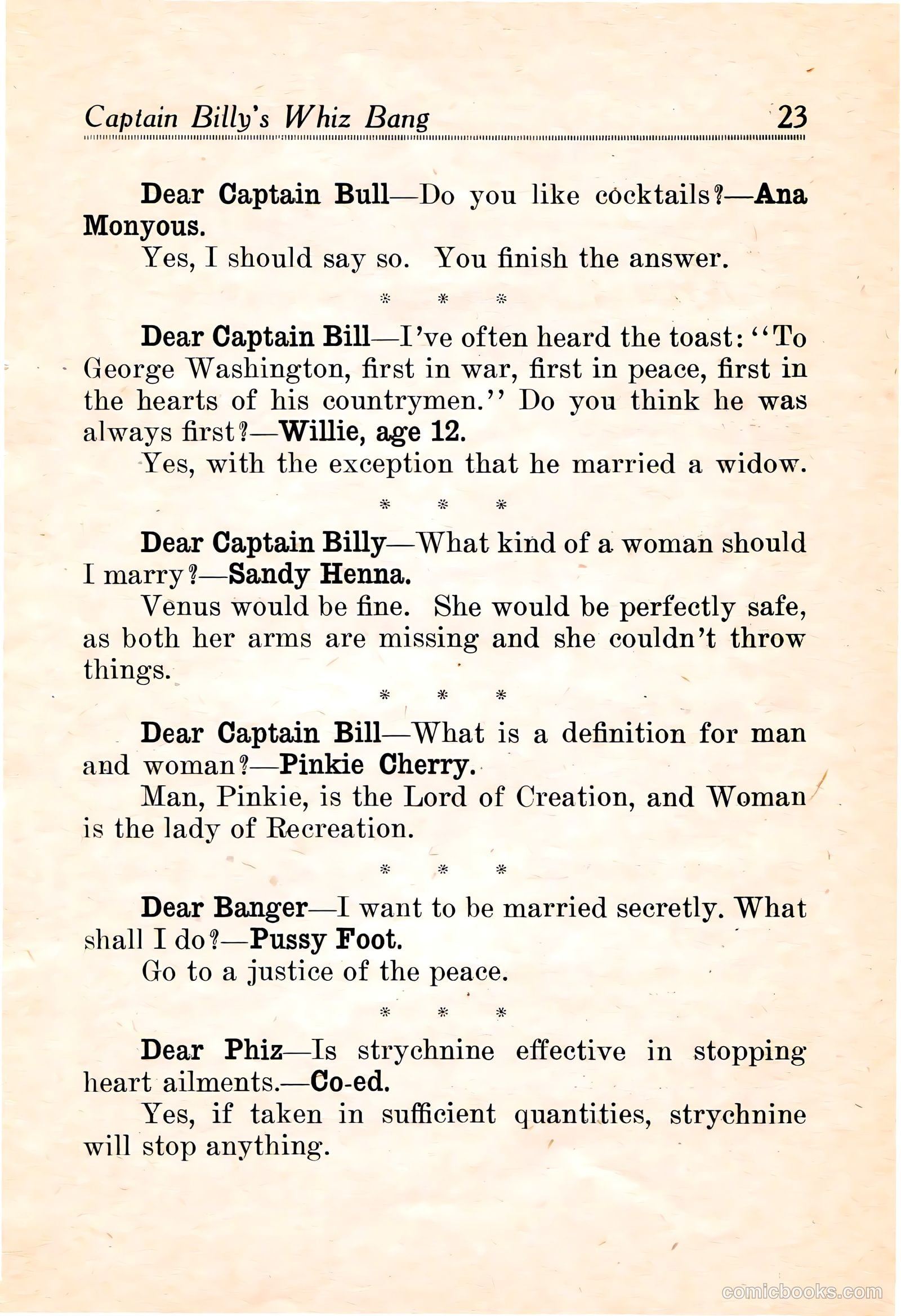
This is a humor advice column from *Whiz Bang*, a 1920s-era satirical magazine. "Captain Billy" answers absurd letters with deliberately irreverent, cynical jokes targeting marriage, women, and social conventions. The humor relies on misogynistic tropes typical of the era: women are portrayed as violent ("couldn't throw things"), materialistic, or dangerous. Jokes about George Washington marrying a widow, or the Venus statue lacking arms, play on crude domestic stereotypes. The strychnine joke darkly puns on "stop anything"—implying death. The "Pussy Foot" pseudonym likely references Prohibition-era temperance advocate Wayne Wheeler, nicknamed "Pussy Foot," making the secret marriage joke a topical jab. The column's appeal was its provocative irreverence—treating serious topics (marriage, poison) with flippant mockery. This reflected post-WWI cynicism and the magazine's transgressive humor, which was considered daring for mainstream American publications of that period.
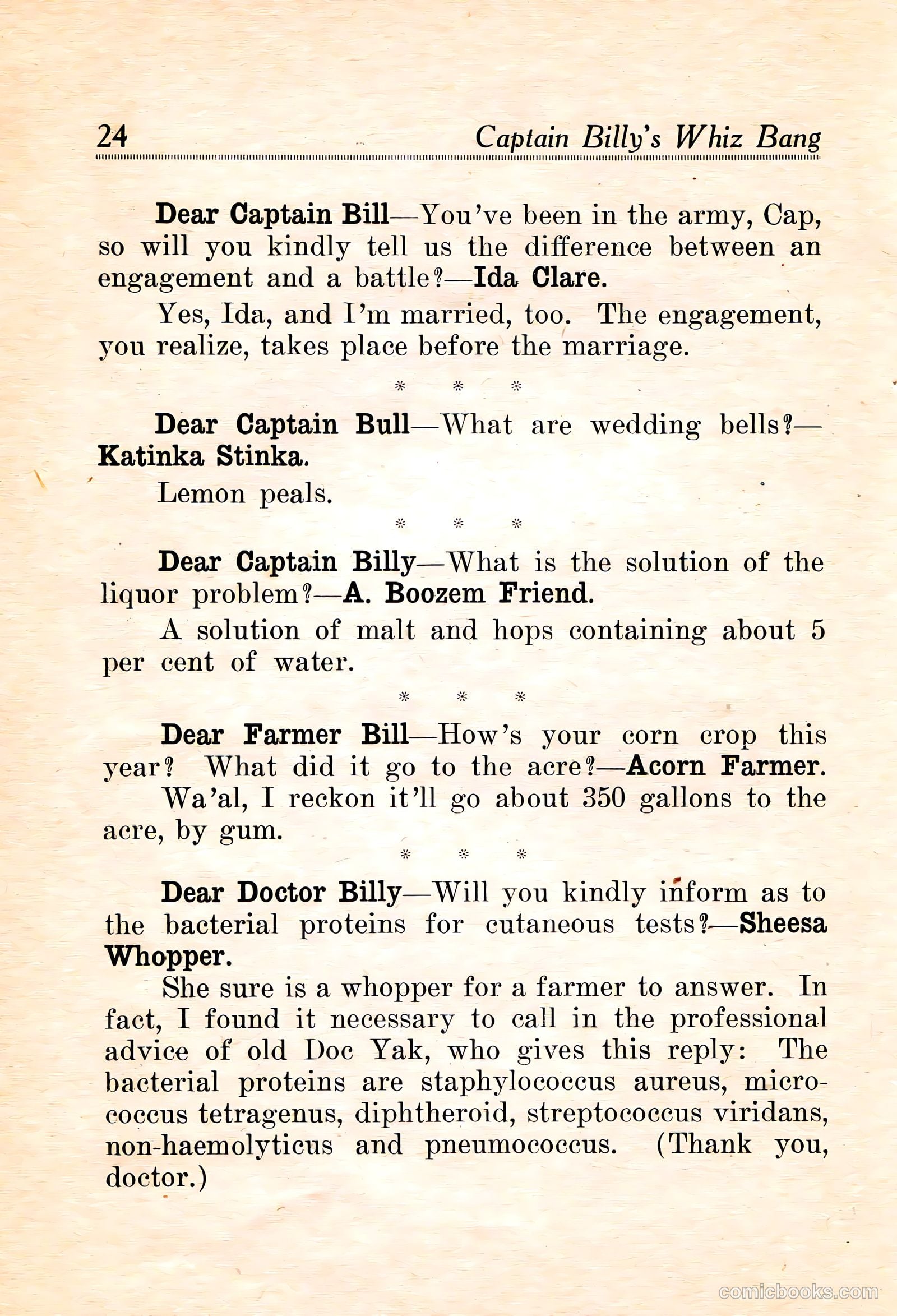
This is a humorous advice column from *Captain Billy's Whiz Bang*, a post-WWI American humor magazine. The satire uses absurd wordplay and puns to mock various social topics: **The jokes:** - **Engagement vs. battle**: Sexual innuendo about marriage - **Wedding bells as "lemon peals"**: Puns on sound/citrus - **Liquor problem**: Defines alcohol as "solution"—a dig at Prohibition-era debates - **Corn crop yielding "350 gallons"**: Implies illegal whiskey distillation from corn during Prohibition - **Technical question answered with jargon**: Mocks pretentious expertise; a farmer asks about bacterial proteins, receiving legitimate medical terminology that's uselessly complex for rural life The publication targets contemporary concerns (Prohibition, farming, marriage) through crude humor, fake-name contributors (Ida Clare, Katinka Stinka, A. Boozem Friend), and deliberately absurd answers. The tone is populist and anti-intellectual, appealing to working-class readers skeptical of authority.
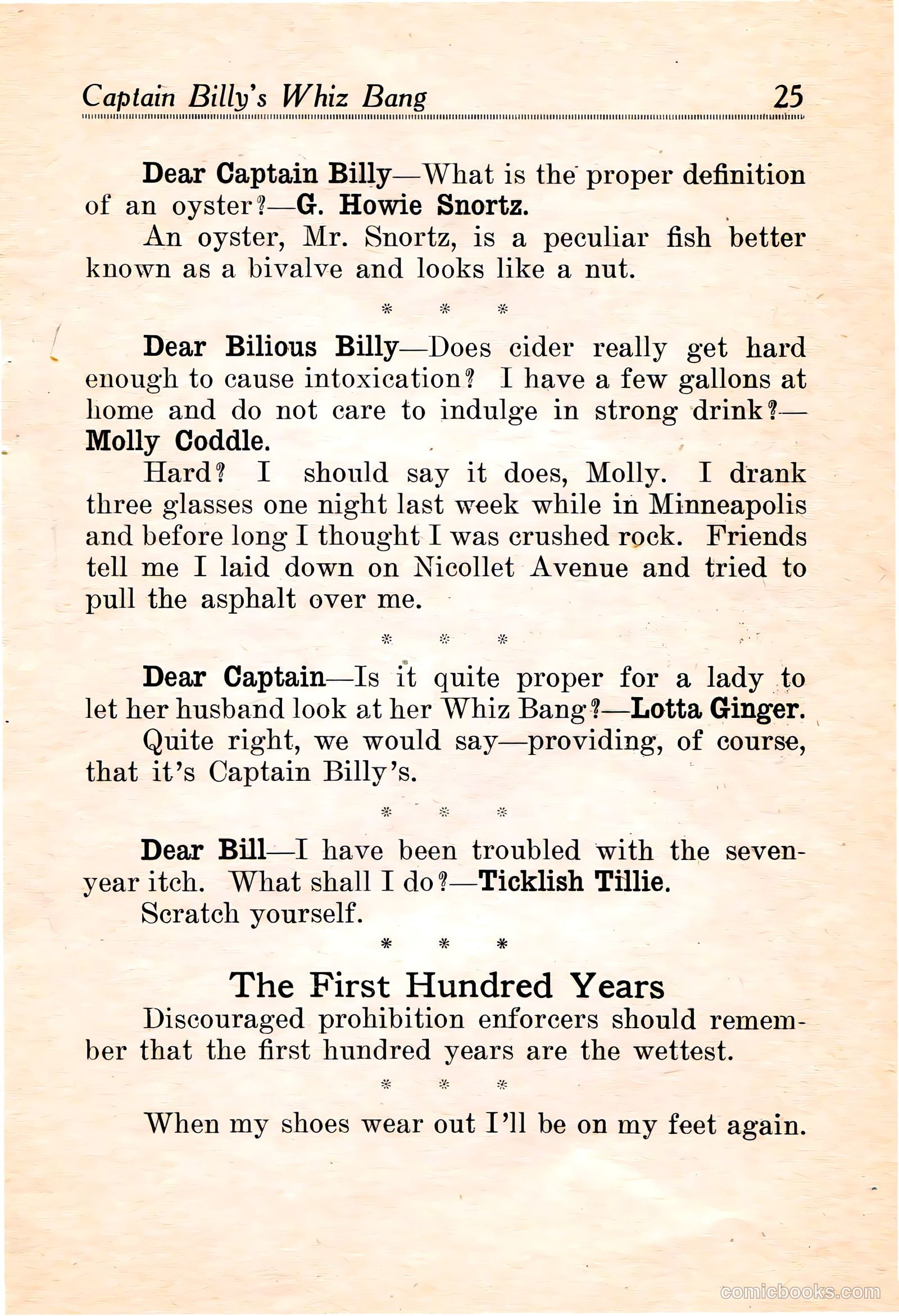
This page from *Whiz Bang*, a popular 1920s satirical magazine, features a advice column with humorous reader letters and responses from "Captain Billy." The humor relies on double entendres and references specific to Prohibition enforcement (1920-1933). Key jokes include: Captain Billy's claim that hard cider intoxicated him so badly in Minneapolis he hallucinated the street surface; a wife asking if it's proper to show her husband the magazine itself (playing on potential embarrassment); and a crack about Prohibition enforcers—the "first hundred years are the wettest" sarcastically suggests illegal drinking will continue despite enforcement efforts. The "seven-year itch" reference is medical (a skin condition), with a deliberately crude response. These brief comedic exchanges exemplify *Whiz Bang's* bawdy, irreverent humor that mocked Prohibition-era social restrictions through wordplay and innuendo.
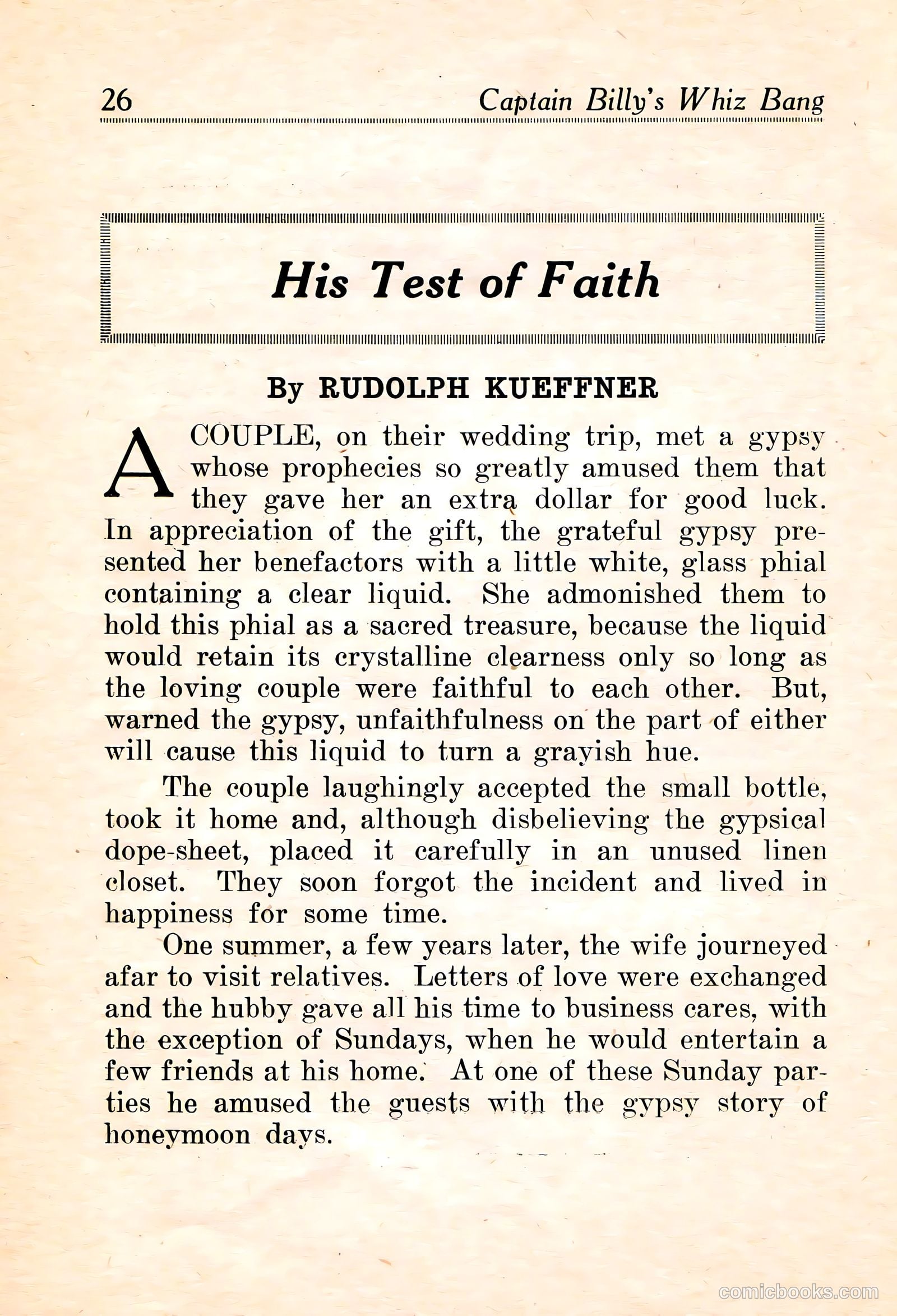
This is a short story (not a cartoon) from *Captain Billy's Whiz Bang*, a satirical humor magazine. The narrative describes a newlywed couple who receive a "magic" potion from a gypsy—a glass vial of clear liquid supposedly guaranteed to stay transparent only if both spouses remain faithful. The story sets up a classic morality-test premise: the couple treats it as a joke initially, but the gypsy's warning about infidelity turning the liquid "grayish" creates narrative tension. When the husband entertains friends while his wife visits relatives, he recalls the gypsy's prophecy—presumably hinting at temptation or unfaithfulness to follow. The satire mocks both gypsy fortune-telling superstitions and marital fidelity anxieties common to the era. The "test of faith" operates on multiple levels: faith in the gypsy's powers, faith between spouses, and readers' faith in whether the magical claim holds true.
This page contains two separate humor pieces from *Captain Billy's Whiz Bang*, an early 20th-century American satirical magazine. **First story**: A practical joke where a husband's friends convince him to add ink to a medicinal phial to fake infidelity and test his wife's faithfulness. The joke's punchline: his wife discovers the deception, cleans it up without confrontation, and the husband never needs his friends to "prove his faithfulness"—she's already caught on and handled it quietly. **Second story ("The Difference")**: Two former schoolfriends reunite. Gladys works as a stenographer with a kind, generous boss who gives her gifts and takes her to dinner/theater for $25/week. Ethel does the same work but pointedly notes hers involves "no shorthand-typing mixed up with it"—a crude euphemism suggesting Ethel's boss demands sexual favors rather than just office work. The satire mocks the exploitation of young working women by authority figures. Both pieces reflect period anxieties about workplace morality and marital trust.
This page satirizes men's resistance to women's suffrage by ironically presenting biblical passages used to justify male superiority. The article mocks "poor, down-trodden he-men" dragged to church by their wives, then quotes Scripture—some authentic, some apparently exaggerated or distorted—to argue women's subordination. The satire's target is clear: men citing religious authority to oppose women's voting rights. The final passage, describing taking captive women as wives and forcing them to shave their heads, appears deliberately absurd—likely fabricated or extremely archaic—to expose how ridiculous these "biblical arguments" become when scrutinized. Published during the women's suffrage movement (likely pre-1920), the piece mocks masculine anxiety about female equality while implying such religious justifications deserve ridicule rather than acceptance.
**"Fast Workers"** satirizes post-WWI dating culture and casual romance. The humor centers on how quickly two people move through relationship stages (introduction to kissing) in under three hours. The satire targets both parties' self-deception: he keeps notches on his brushes (implying serial conquests) while believing himself a "handsome devil," and she maintains a "thick little book" of names since age sixteen, convinced she's "sweet and delightful." Both are performatively romantic yet cynical—treating the encounter as a conquest rather than genuine connection. The piece mocks the era's rapid courtship rituals and the vanity of both sexes. **"Shortcomings"** is a racial stereotype joke relying on dialect humor common to 1920s publications. The punchline plays on the double meaning of "come up to"—the clerk interprets it as meeting expectations, while the customer means the stockings literally don't reach high enough on her legs. The humor depends entirely on racist caricature and dialect representation.
**"Marjorie Was So Obliging"**: This is a humorous anecdote about a mother showing off her obedient young daughter at a social gathering. The joke relies on childish speech patterns ("muvver," "tant," "weach the chain") and the ironic twist: after dutifully fetching water for six guests, little Marjorie innocently reveals she cannot reach the toilet chain to refill the pitcher—implying the "water" came from the toilet. The satire targets vain parents who parade their children's compliance without considering consequences, and the crude humor typical of 1920s men's magazines. **"Fits Most Lunch Foundries"**: This presents a humorous diner sign from Holyoke, Massachusetts, mocking the notoriously poor quality of cheap lunch-counter coffee. The joke: the sign sardonically warns customers not to insult the coffee (claiming it might become weak like them), then suggests aggressive stirring with "sugar like hell," admitting the coffee requires drastic improvement. It's satirizing both low-quality food service and the rough, unapologetic culture of casual American dining establishments.
This page contains several short humorous anecdotes typical of 1920s satirical magazines: **"They Both Walked"** and **"Before July First"** are brief jokes about dishonesty and evasion—the first about a couple who abandon their car cushion, the second a crude joke about a drunk man leaving a saloon, playing on Prohibition-era anxieties about law enforcement. **"Page Mr. Croton"** is a pun exploiting brand names: "Olive Oil" (the cooking product) and "Castor" (castor oil), presenting them as siblings. **"Something to Worry About"** mocks the excessive attention lavished on the famous racehorse Man o' War, comparing his luxury accommodations and retinue to Indian royalty (the Gaekwar of Baroda). The final line—"Love isn't blind—just near-sighted"—appears to be an unrelated aphorism. These are typical **brief, snappy gag pieces** designed for quick laughs, reflecting 1920s concerns about Prohibition enforcement, consumer culture, and animal obsession among the wealthy.
This is an editorial section from *Captain Billy's Whiz Bang*, a satirical humor magazine. The page contains no political cartoon—instead, it's a humorous advice column inviting readers to share embarrassing moments. The editorial presents a risqué joke about "Gus," a hired farmhand who encounters a woman he'd met swimming at Lake Minnetonka. When he greets her on a Minneapolis streetcar, she embarrassingly responds that she didn't recognize him "with your clothes on"—implying they'd met naked while swimming. The joke plays on Prohibition-era drinking culture: Gus uses this mortifying public moment as an excuse to leave the streetcar and drink more ("another little drink"). The satire targets both workplace gossip and the casual dishonesty of alcoholics fabricating excuses. The magazine's subtitle, "The Bull is Mightier Than the Bullet," suggests irreverent, exaggerated storytelling as entertainment.
This page from the satirical magazine consists entirely of brief humorous anecdotes and aphorisms—no illustrations accompany the text. The jokes target 1920s social conventions: a woman embarrassed by a garter mishap (suggesting anxieties about propriety and exposed clothing); women circumventing divorce stigma through casual infidelity; and misogynistic commentary invoking the ancient Greek philosopher Diogenes's search for an honest man, here twisted to mock women's honesty. The remaining quips offer cynical life observations: people remember favors only when seeking return favors, reputation-damaging gossip backfires, and men fail to improve themselves. One joke mocks stingy husbands denying wives shopping pleasures. The final line uses poker terminology metaphorically about bold action. The satire reflects period attitudes toward gender, morality, and social climbing, with heavy emphasis on marital discord and female behavior as comedic subjects.
This page from *Captain Billy's Whiz Bang* opens with a joke poem about a manicurist named Louise whose male clients are called "manicurios" (a pun on "manicure"). The accompanying essay satirizes manicuring as a social practice revealing deeper truths about class and character. The satire operates on multiple levels: **The core critique**: Manicuring exposes moral laziness—people with perfect nails but "rough minds" living in "mental and moral poverty." It's presented as a marker of idle wealth. **Gender dynamics**: The piece references hand-holding's erotic charge, noting manicurists depend on physical contact with attractive male clients for their livelihood. The reflexive defense of manicurists' "purity and true womanly" nature suggests awareness of sexual innuendo. **Class commentary**: The essay dismisses manicuring as affectation for the "polished horde of bores"—society people too delicate to work, fit only for "good catch marriages." The allusion to Othello adds tragic weight, implying lost purpose and masculine decline.
This page from the satirical magazine *Captain Billy's Whiz Bang* (page 35) mocks the then-fashionable practice of manicuring as a sign of idleness and moral decay. The text systematically categorizes who gets manicured, presenting them as social parasites: the wealthy with money to burn, the idle with time to waste, and particularly "libertines" and "hotel leechers"—men who seduce innocent women instead of contributing to society. The satire contrasts idle manicuring against productive hand-use: historical figures like Michelangelo, Raphael, Shakespeare, Beethoven, Washington, and Lincoln achieved greatness through work, not beauty parlors. The text emphasizes hands' anatomical design for labor and spiritual purpose (biblical references), arguing that truly beautiful hands belong to those who help others, not those who waste time in vanity. This reflects post-WWI American anxieties about leisure culture, gender roles, and moral standards.
This page contains editorial commentary on working-class dignity and a high-society divorce scandal. The opening passage defends manual laborers' hands—calloused from labor—against dismissive language, declaring such work honorable. The main subject is **Consuelo Vanderbilt's divorce from the 9th Duke of Marlborough**. The text criticizes international marriages between American heiresses and titled European nobles, characterizing such unions as exchanges of "American gold" for "British title"—doomed ventures motivated by superficial status-seeking rather than genuine compatibility. The satire praises Vanderbilt herself, however, for displaying true nobility through her dignified conduct during divorce proceedings and her apparent letters. The author suggests her American character and maternal sacrifice demonstrate greater inherent worth than the duke's mere aristocratic credentials ("Burke's Peerage" and "Almanach de Gotha" being European noble registries). The piece thus mocks transatlantic fortune-hunting while celebrating American virtue and working-class dignity.
This page is primarily **literary content**, not satire or political commentary. It features two poem selections for *Captain Billy's Whiz Bang*, a 1920s American humor magazine. The first is Carl M. Higdon's "The Shimmy Shaker"—a lighthearted jingle about the shimmy, a popular 1920s dance considered somewhat risqué. The magazine presents it as amusingly crude but energetic. The second is George R. Sims' "Ostler Joe," a melodramatic Victorian-era poem about a fallen woman at her grave. The narrator considers placing flowers there, ultimately choosing a "sweet white blossom of holy love" over symbols of "sin" and "lust." This represents redemptive salvation theology common to sentimental literature. Together, these pieces reflect the magazine's mix of modern, cheeky humor ("Shimmy Shaker") alongside reprinted moral melodrama ("Ostler Joe")—contrasting contemporary irreverence with older literary sentimentality.
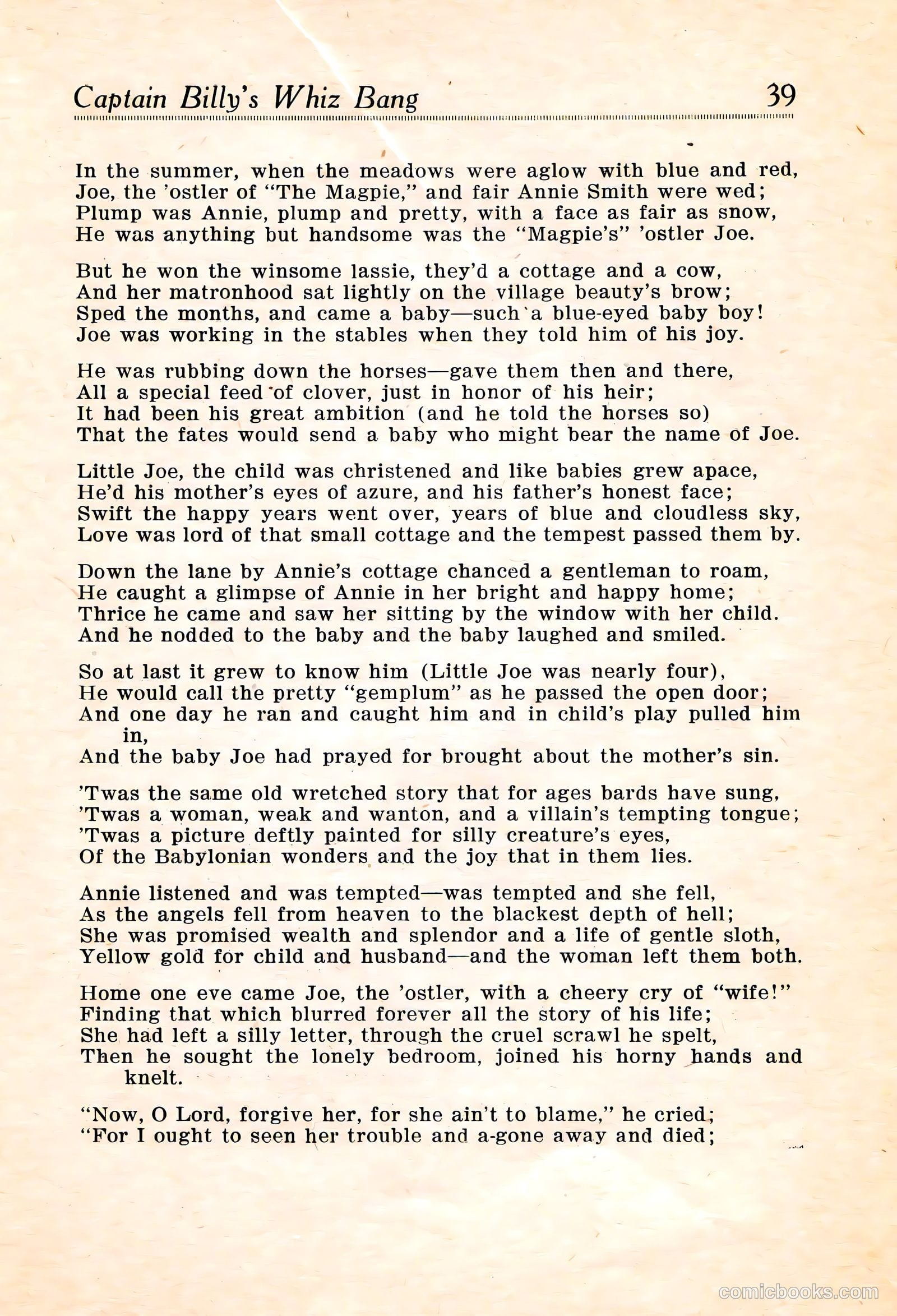
This page contains a serialized narrative poem—not a political cartoon—from *Captain Billy's Whiz Bang*, a popular American humor magazine (1919-1936). The story depicts a moral cautionary tale: Joe, an unattractive stable worker, marries Annie Smith and they have a son. Years of happiness follow until a mysterious gentleman repeatedly visits their cottage, charming young Joe. The man eventually lures the child inside, seducing Annie through flattery and promises of wealth and leisure. The poem morals involve Victorian-era anxieties: a woman's weakness against temptation, class seduction (the "gentleman" preys on a working-class wife), and the corrupting influence of outsiders. The references to "Babylonian wonders" invoke exotic decadence as temptation. Rather than satirizing specific figures, this reflects early 20th-century popular attitudes about female virtue, marital fidelity, and social danger—themes the magazine's audience found entertaining within its mix of humor, advice, and serialized fiction.
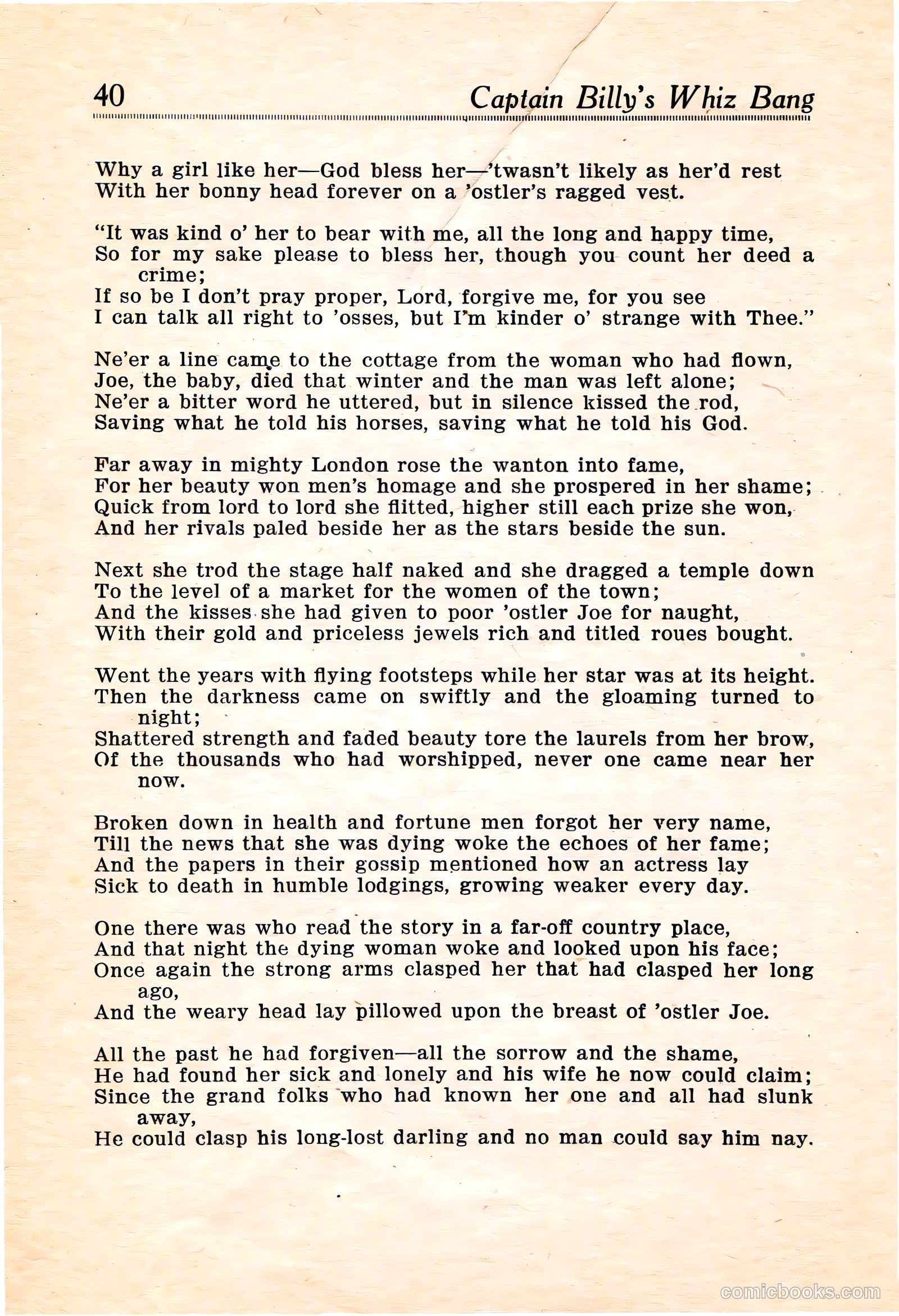
This page contains a sentimental narrative poem—not a political cartoon—about moral redemption and class struggle in early 20th-century Britain. The story follows a working-class ostler (stable worker), Joe, whose lover abandons him and their baby to pursue fame in London as an actress. She achieves celebrity through her beauty and scandalous behavior, "half naked" on stage, selling her favors to wealthy "lords" and "titled roues." However, her beauty and fame fade rapidly. Years later, dying alone and forgotten in humble lodgings, she's reunited with Joe, who has forgiven her completely. He reclaims her as his wife now that her wealthy patrons have abandoned her. The poem's moral is conservative: the working man's humble loyalty and faith ultimately triumph over the woman's pursuit of luxury and sexual liberation. It reflects early 20th-century anxieties about female sexuality, urban vice, and class mobility—suggesting that "fallen women" face inevitable ruin and must ultimately depend on working-class male forgiveness.
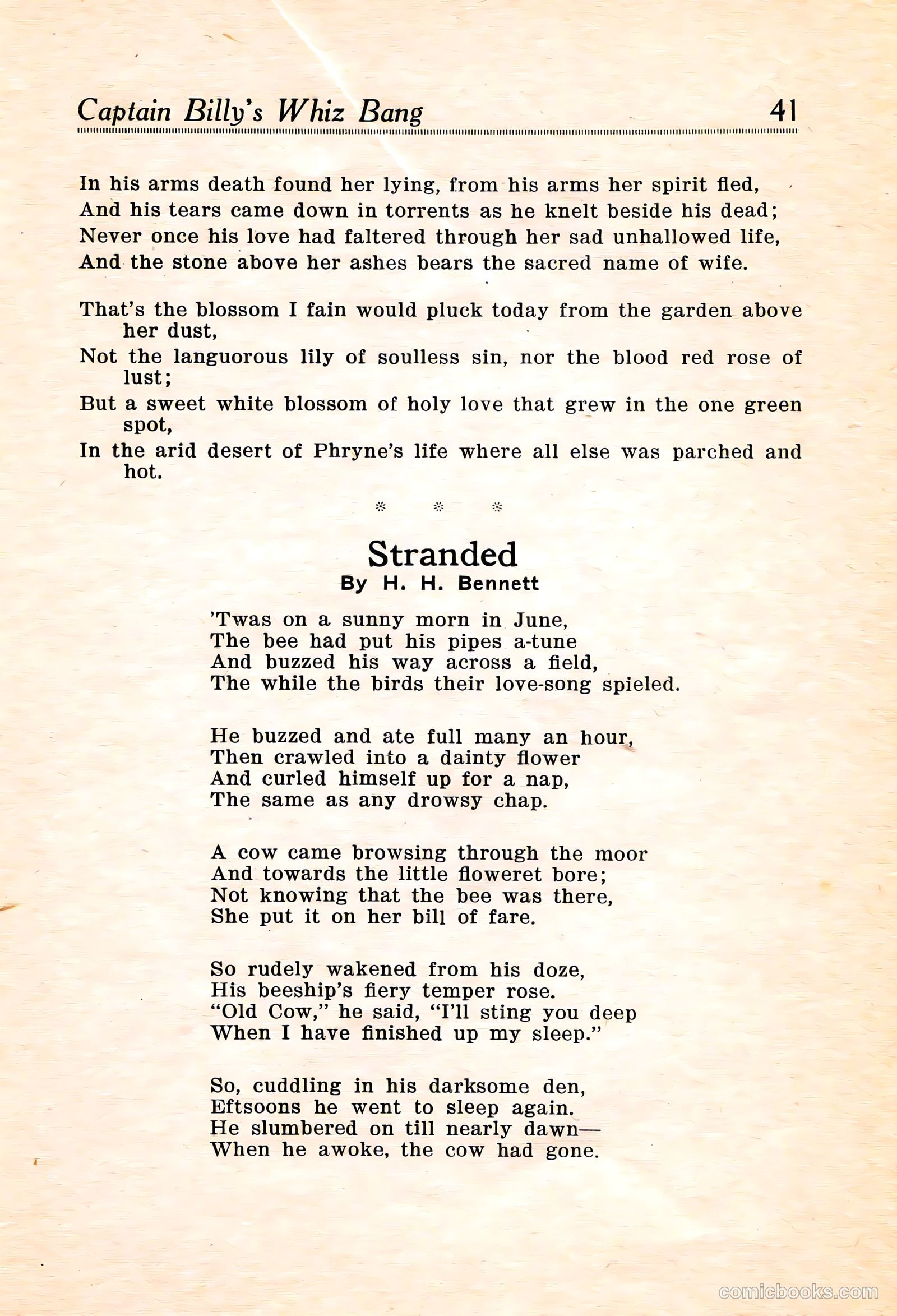
This page contains two pieces of light humor typical of this satirical magazine. The first section is sentimental verse about a woman named Phryne, referencing a famous ancient Greek courtesan. The poem redeems her character through a man's faithful love, contrasting her past ("arid desert") with one pure relationship ("white blossom of holy love"). The second piece, "Stranded" by H. H. Bennett, is a comedic fable: a bee falls asleep in a flower, which a cow unknowingly eats. The bee wakes furious and threatens revenge—but falls back asleep. When he awakens again, the cow is gone, leaving him stranded and unable to follow through on his threat. The humor lies in the deflated anticlimax: the bee's fierce indignation evaporates uselessly. Both pieces exemplify the magazine's blend of sentimental romance and absurdist comedy.
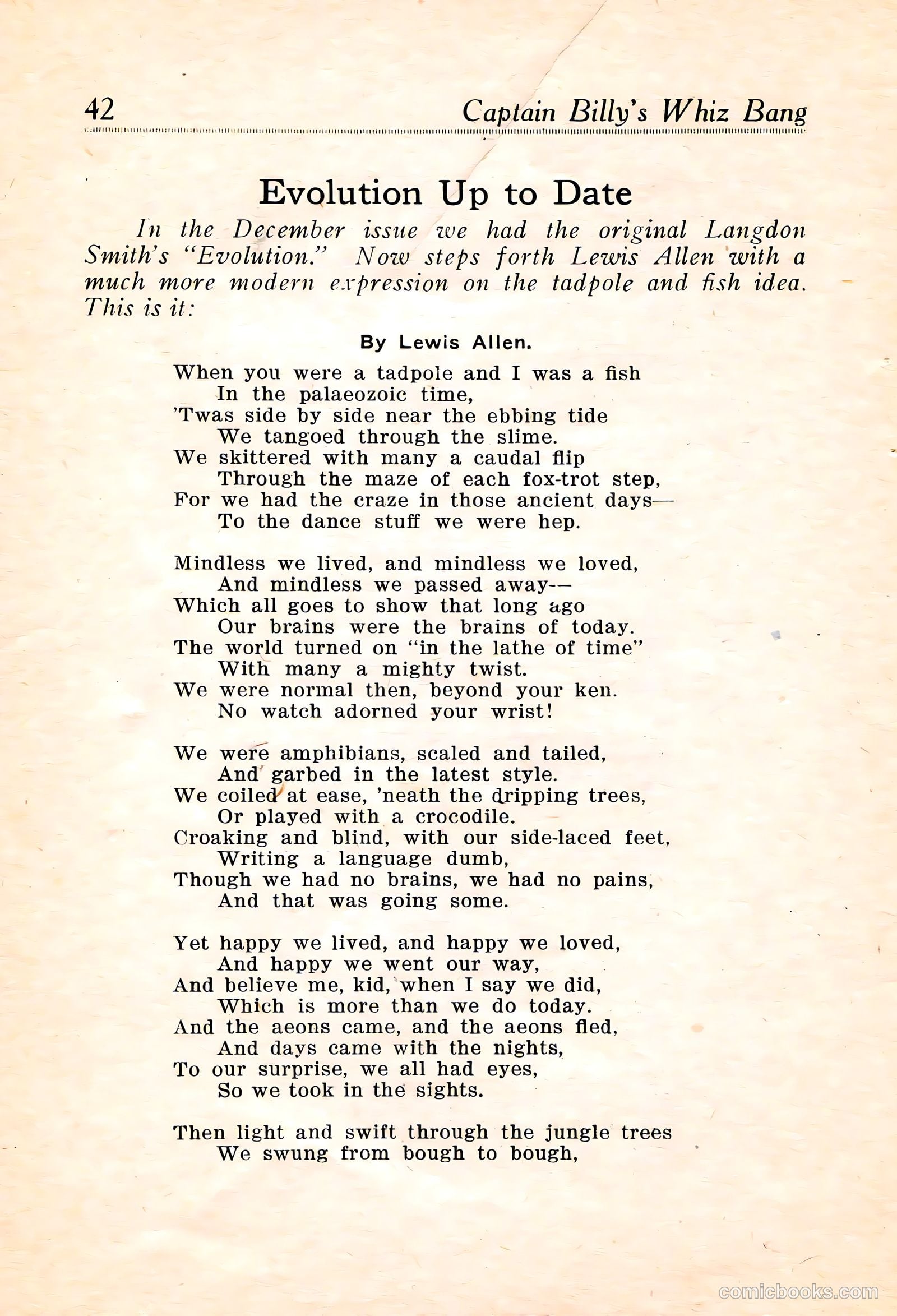
This page reprints a humorous poem by Lewis Allen that playfully updates an earlier evolutionary satire by Langdon Smith. The poem traces human evolution from prehistoric tadpoles and fish through amphibians to modern humans, using 1920s slang and dance references (tangos, fox-trots, "hep") to create anachronistic humor. The satire works on multiple levels: it mocks both evolutionary theory and contemporary modernity. The speaker nostalgically claims ancestral creatures were happier and less anxious than modern humans—"we had no pains, and that was going some"—despite lacking brains. The final jab suggests humans today are *less* content than our primitive predecessors, despite technological advancement (the wristwatch reference). This reflects 1920s anxieties about progress and modernization, suggesting that civilization and sophistication may have made life worse rather than better. The poem is lighthearted satire of both pseudo-scientific evolutionary thinking and contemporary social discontent.
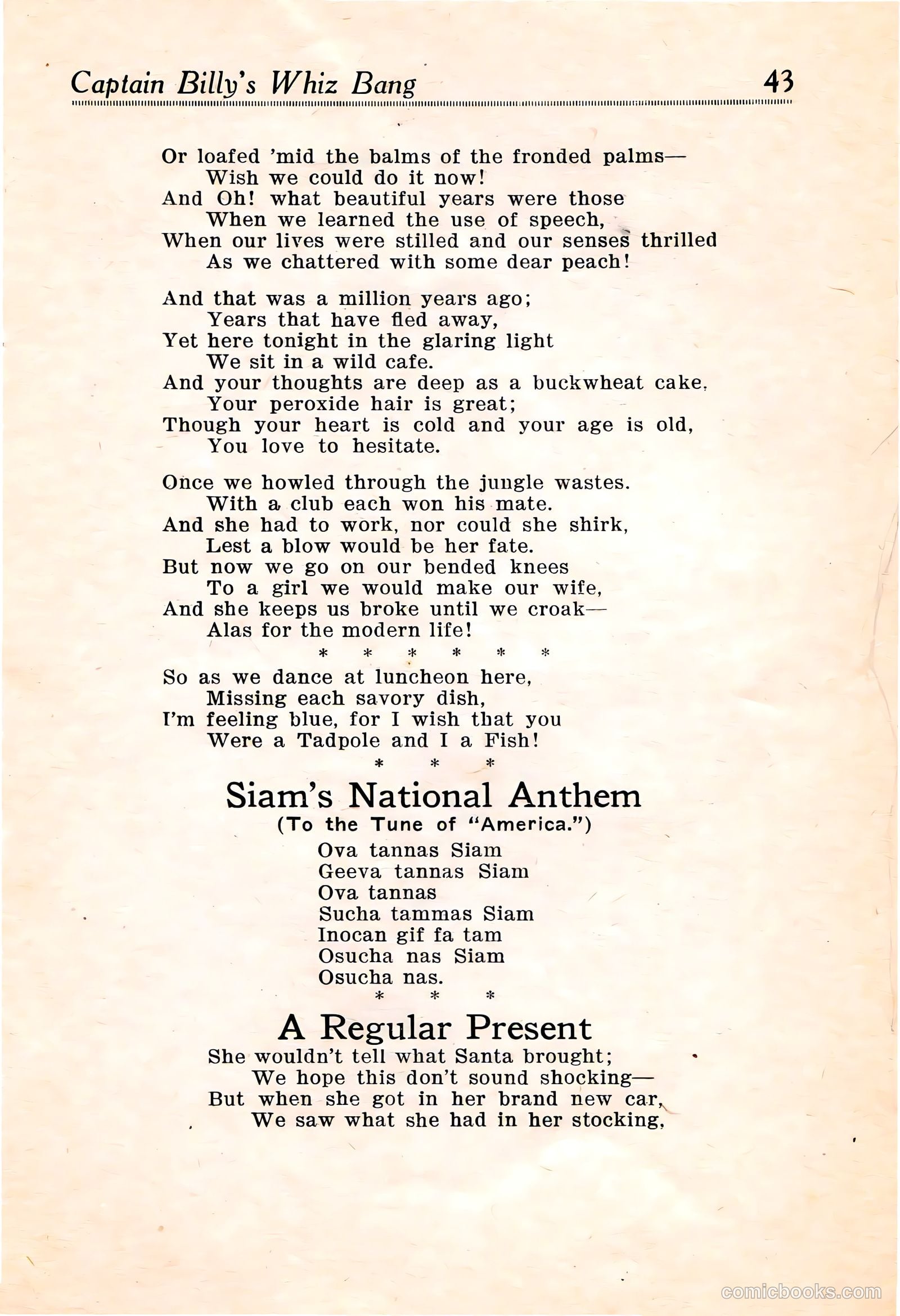
This page contains three separate humorous pieces typical of 1920s-era satirical magazines. The main poem contrasts primitive "jungle" life with modern civilization, lamenting that men once dominated women through physical force but now must court them financially, leaving them perpetually broke. The satire targets contemporary gender dynamics and male anxieties about changing social roles post-WWI. "Siam's National Anthem" parodies the Thai national anthem by rendering it as nonsensical English phonetics sung to "America"—a crude ethnic joke relying on the reader's inability to understand or respect foreign languages, common in period American humor. "A Regular Present" is a mild innuendo joke: a woman receives a car as a Christmas gift, and the implication (deliberately coy about "what she had in her stocking") suggests she received something sexual or scandalous—likely referencing the 1920s "flapper" culture of looser sexual mores that shocked conservative audiences. All three pieces reflect period anxieties about modernity, sexuality, and cultural hierarchies.
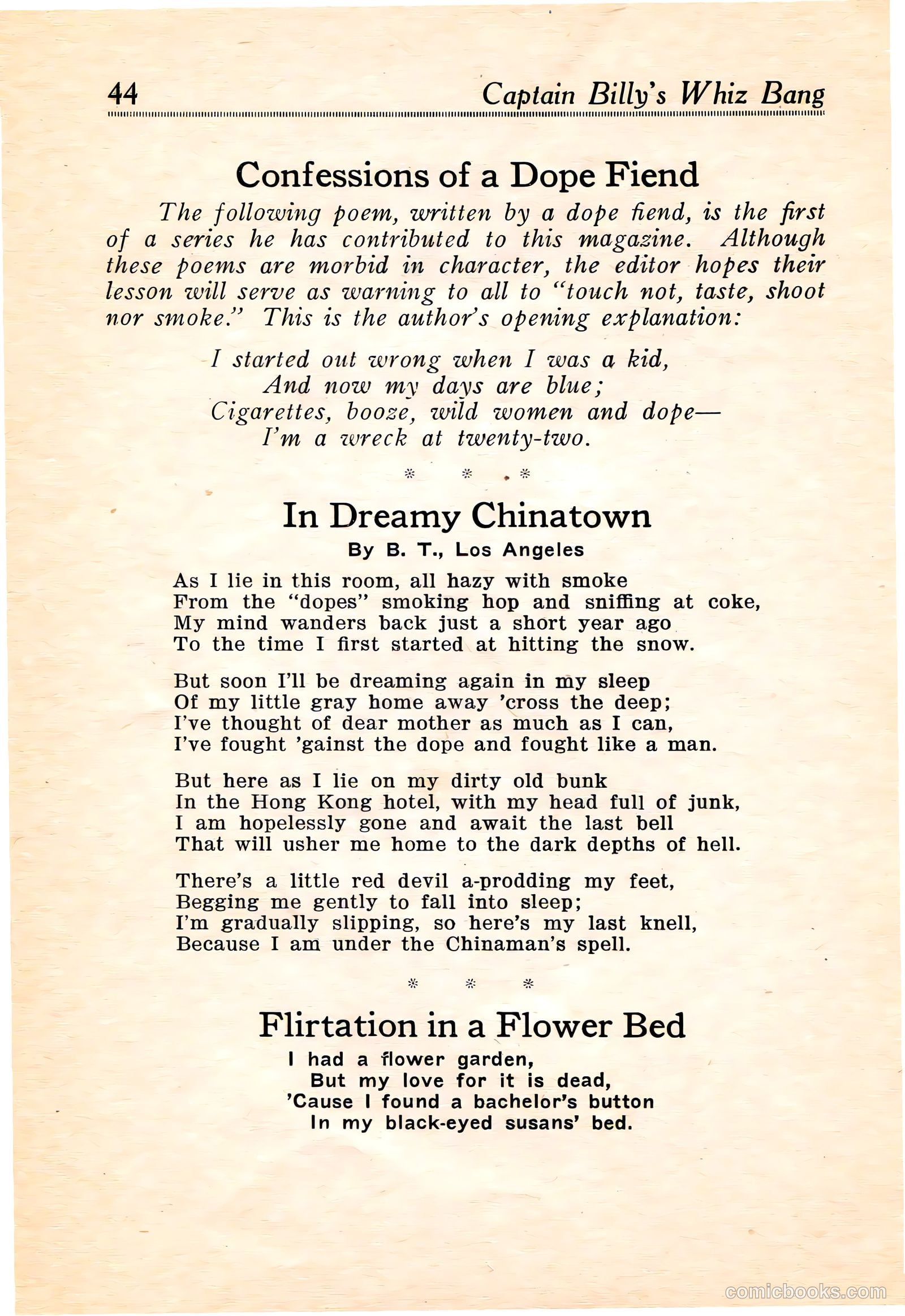
This page presents moralizing anti-drug poetry from *Captain Billy's Whiz Bang*, a 1920s American humor magazine. The editor frames these confessional verses as cautionary tales against drug use ("touch not, taste, shoot nor smoke"). The poems employ dated drug slang: "dope" (narcotics), "hop" (opium), "coke" (cocaine), "snow" (heroin). The author depicts drug addiction in melodramatic terms—ruined youth, moral corruption, and descent into Asian opium dens (reflecting contemporary racist anxieties about Chinese immigrants and drug use). The final poem, "Flirtation in a Flower Bed," offers comic relief through flower puns: a "bachelor's button" (a literal flower) appearing among "black-eyed susans" suggests infidelity in a garden. These pieces reflect 1920s attitudes: anti-drug messaging mixed with ethnic stereotyping and moralistic warnings presented as entertainment.
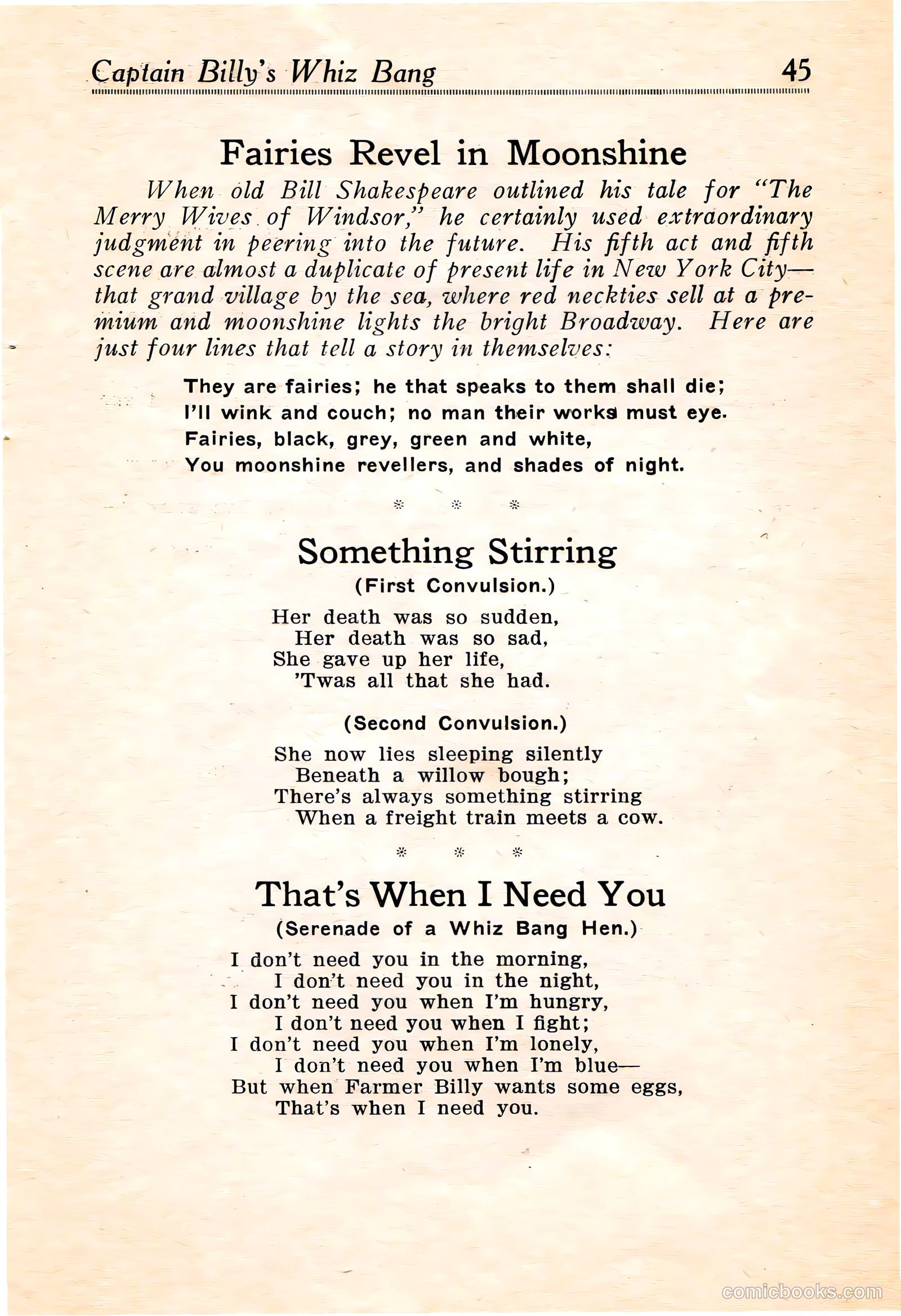
This page contains three humorous poems with no visible illustrations. The content satirizes 1920s American life, particularly Prohibition-era New York City. "Fairies Revel in Moonshine" jokes that Shakespeare's *Merry Wives of Windsor* prophetically described modern Manhattan, where "moonshine" (illegal alcohol) and Broadway revelry dominate. The Shakespeare quotes are recontextualized to mock contemporary drinking culture. "Something Stirring" presents darkly comic verses about a woman's death, culminating in a crude punchline about a cow hit by a freight train—typical of the magazine's crude humor style. "That's When I Need You" parodies romantic songs through a hen's perspective, humorously inverting traditional love-song sentiment: a hen only "needs" the rooster when eggs are required for the farmer. It's bawdy agricultural humor typical of *Whiz Bang*, a publication known for ribald, working-class comedy.
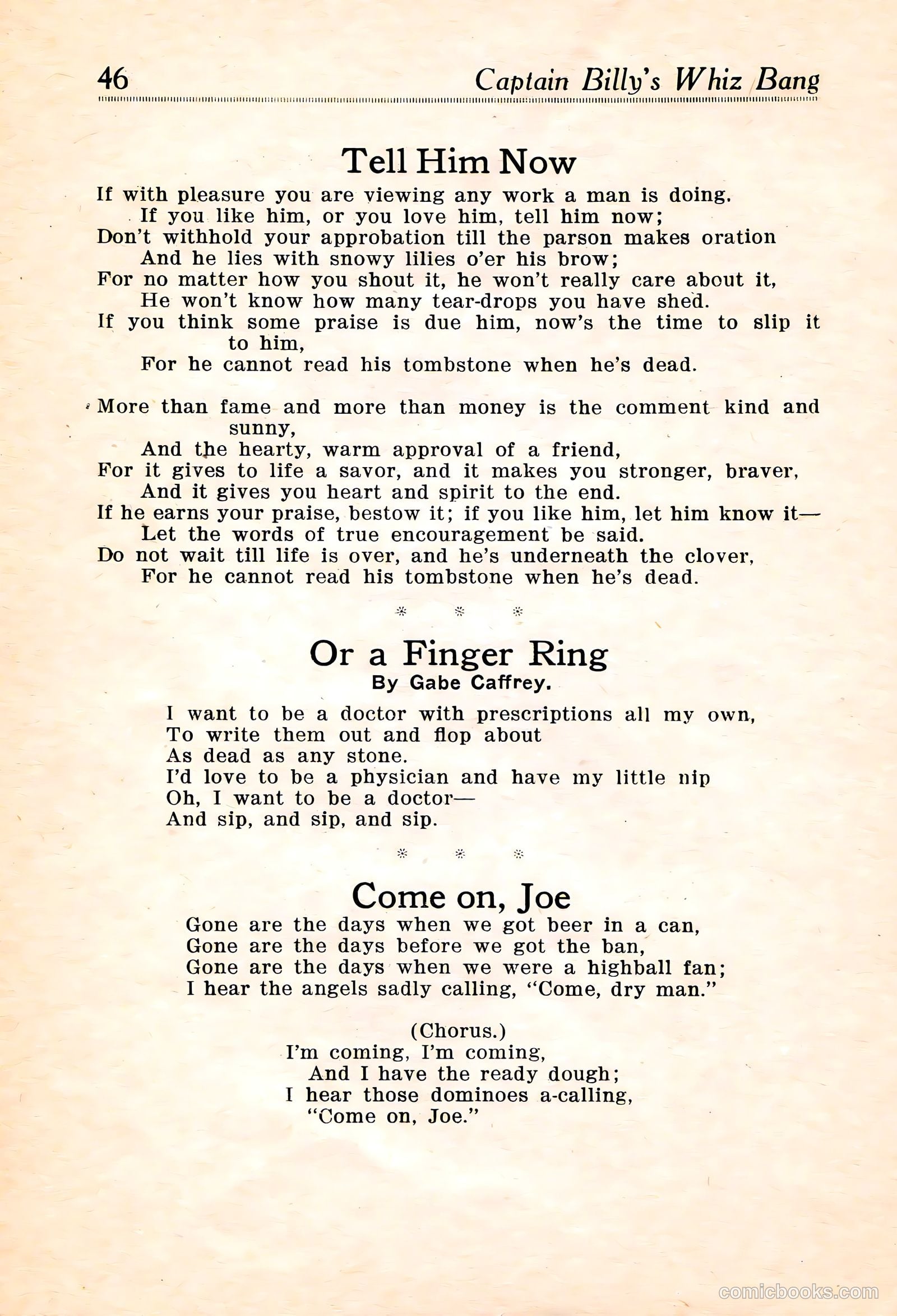
This page contains three poems of social satire from what appears to be the Prohibition era (1920s-1930s). **"Tell Him Now"** advocates giving praise to people while they're alive rather than waiting until their funeral—a straightforward moral message about appreciating others. **"Or a Finger Ring"** by Gabe Caffrey mocks doctors who drink excessively, depicting one who wants to write prescriptions while perpetually intoxicated ("sip, and sip, and sip"). This satirizes medical profession corruption or incompetence. **"Come on, Joe"** directly references Prohibition, lamenting the ban on alcohol ("beer in a can," "highball fan"). The speaker claims he's "coming" with "ready dough" and hears "dominoes a-calling"—likely coded language for illegal speakeasies or gambling establishments where people gathered to drink illegally. The poem humorously depicts the absurdity of Prohibition's failure to stop drinking. The collection reflects *Whiz Bang's* satirical stance on contemporary American social issues, particularly Prohibition's unpopularity.
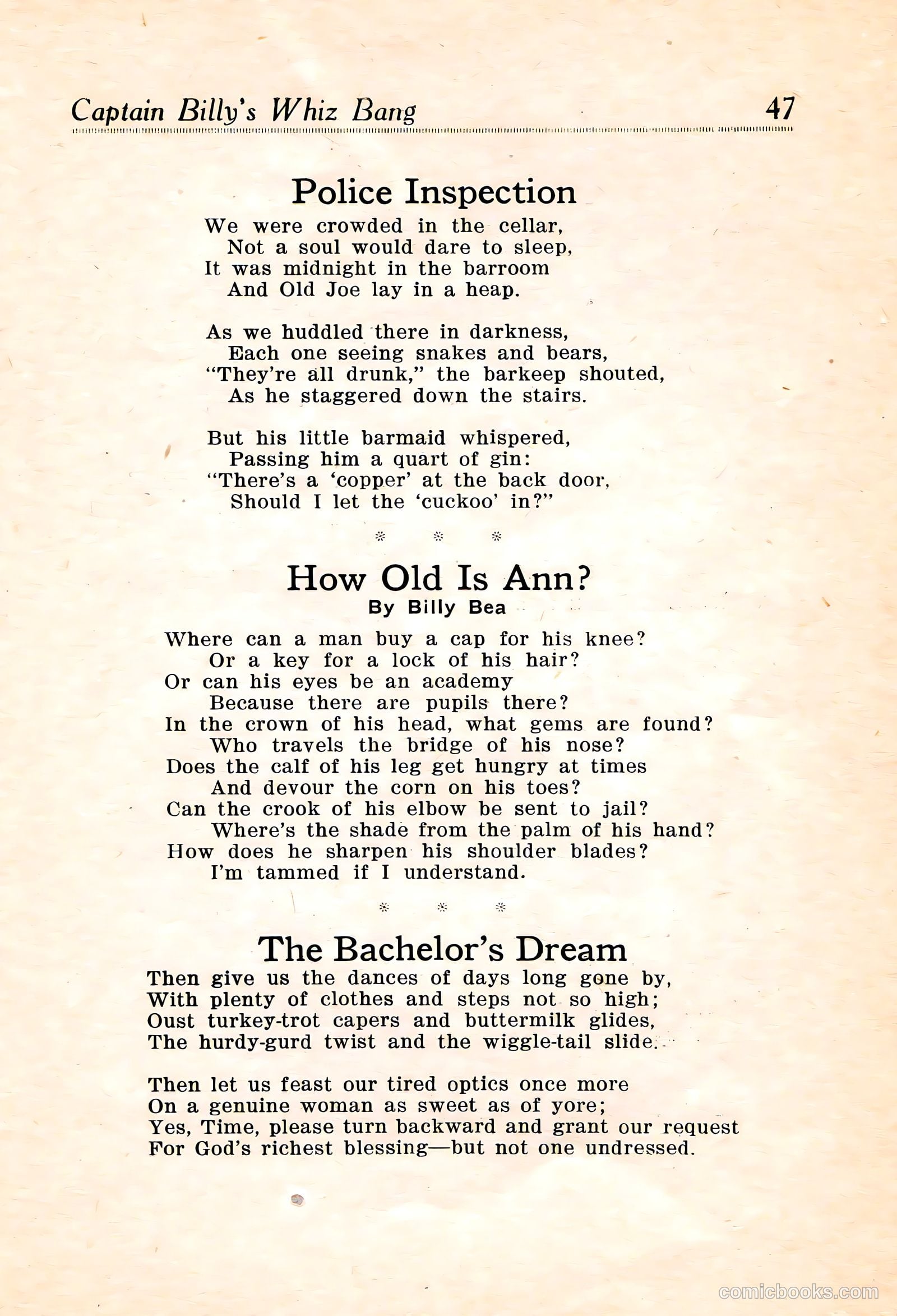
This page from *Captain Billy's Whiz Bang* contains three humorous pieces reflecting 1920s American culture: **"Police Inspection"** satirizes Prohibition enforcement. A speakeasy (illegal bar) hides in a cellar; patrons fear police ("copper") raids. The barmaid asks if she should let the "cuckoo" (police) in—dark humor about the constant cat-and-mouse game between bootleggers and law enforcement during the Prohibition era. **"How Old Is Ann?"** is a riddle-poem playing with anatomical puns ("cap for his knee," "calf of his leg," "palm of his hand")—absurdist wordplay typical of the era's humor magazines. **"The Bachelor's Dream"** expresses nostalgia for pre-modern dancing and women. It critiques contemporary dance crazes (turkey-trot, wiggle-tail slide) as too risqué, requesting a return to "genuine" modest women—reflecting anxieties about changing gender norms and the "New Woman" of the 1920s. The overall tone is bawdy, irreverent satire targeting Prohibition, modern social change, and contemporary morality debates.
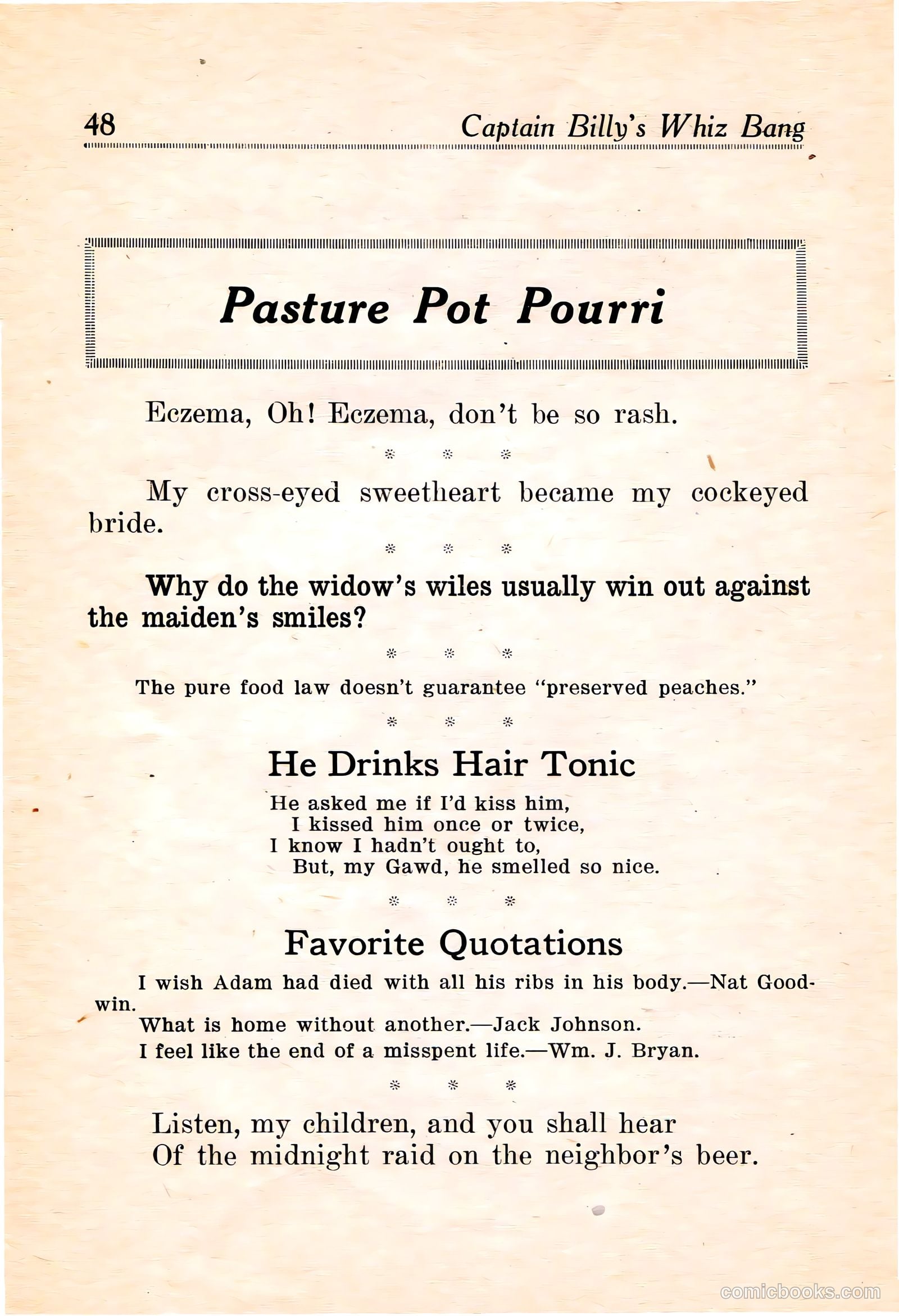
This page from *Captain Billy's Whiz Bang* (a WWI-era satirical magazine) contains ribald humor and social commentary typical of the period. The jokes mix crude puns ("Eczema, don't be so rash") with marital/sexual humor. "He Drinks Hair Tonic" jokes about a man's grooming being attractive despite poor judgment. The "Favorite Quotations" section attributes misogynistic and cynical remarks to real figures—Nat Goodwin (actor), Jack Johnson (boxer), and William Jennings Bryan (politician)—mocking them through false attribution. The final couplet references Prohibition-era illegal alcohol raids, treating law-breaking humorously. Overall, the page satirizes marriage, gender relations, and contemporary public figures through bawdy humor and wordplay—reflecting post-WWI American irreverence toward authority and propriety that the magazine was known for.
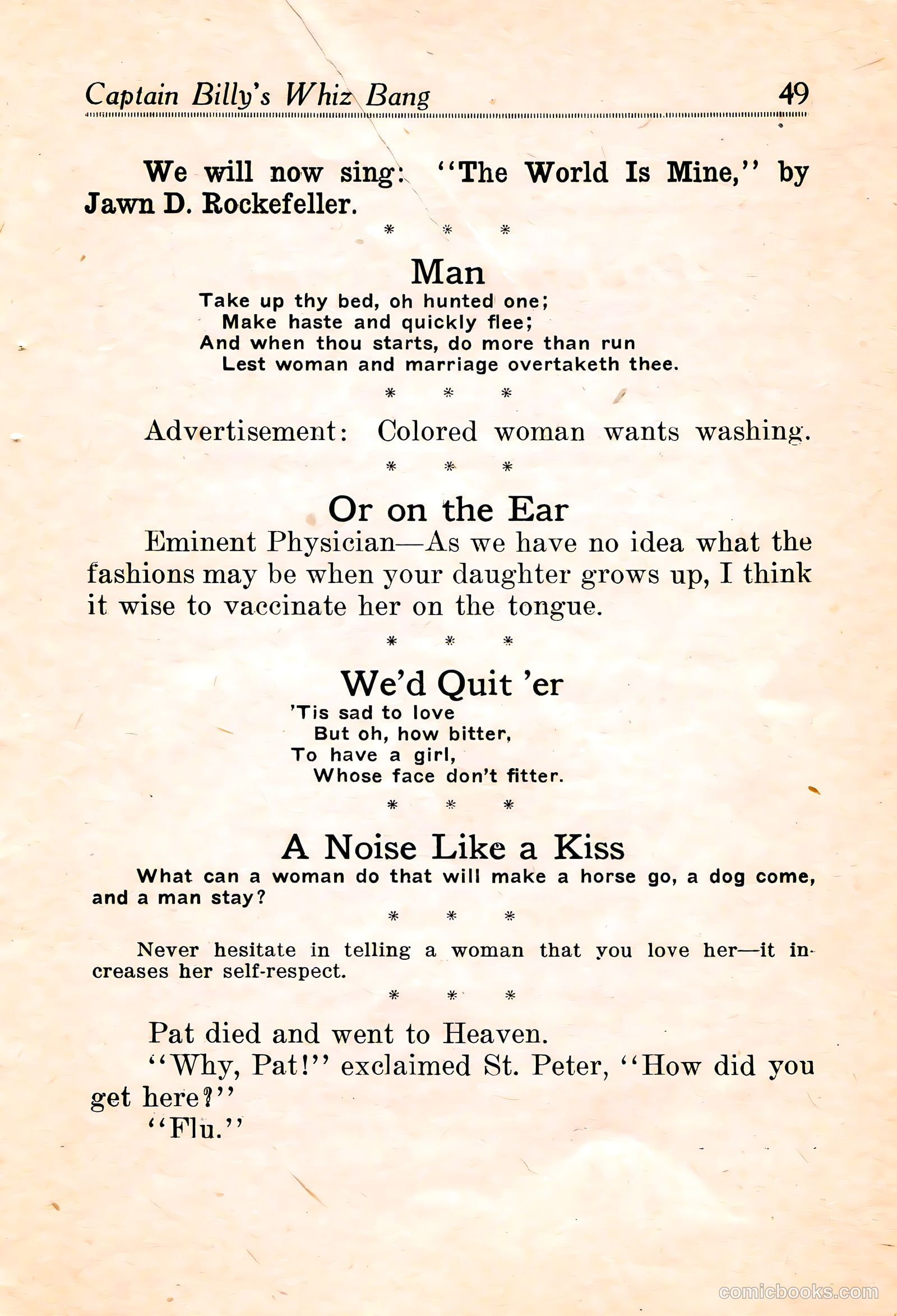
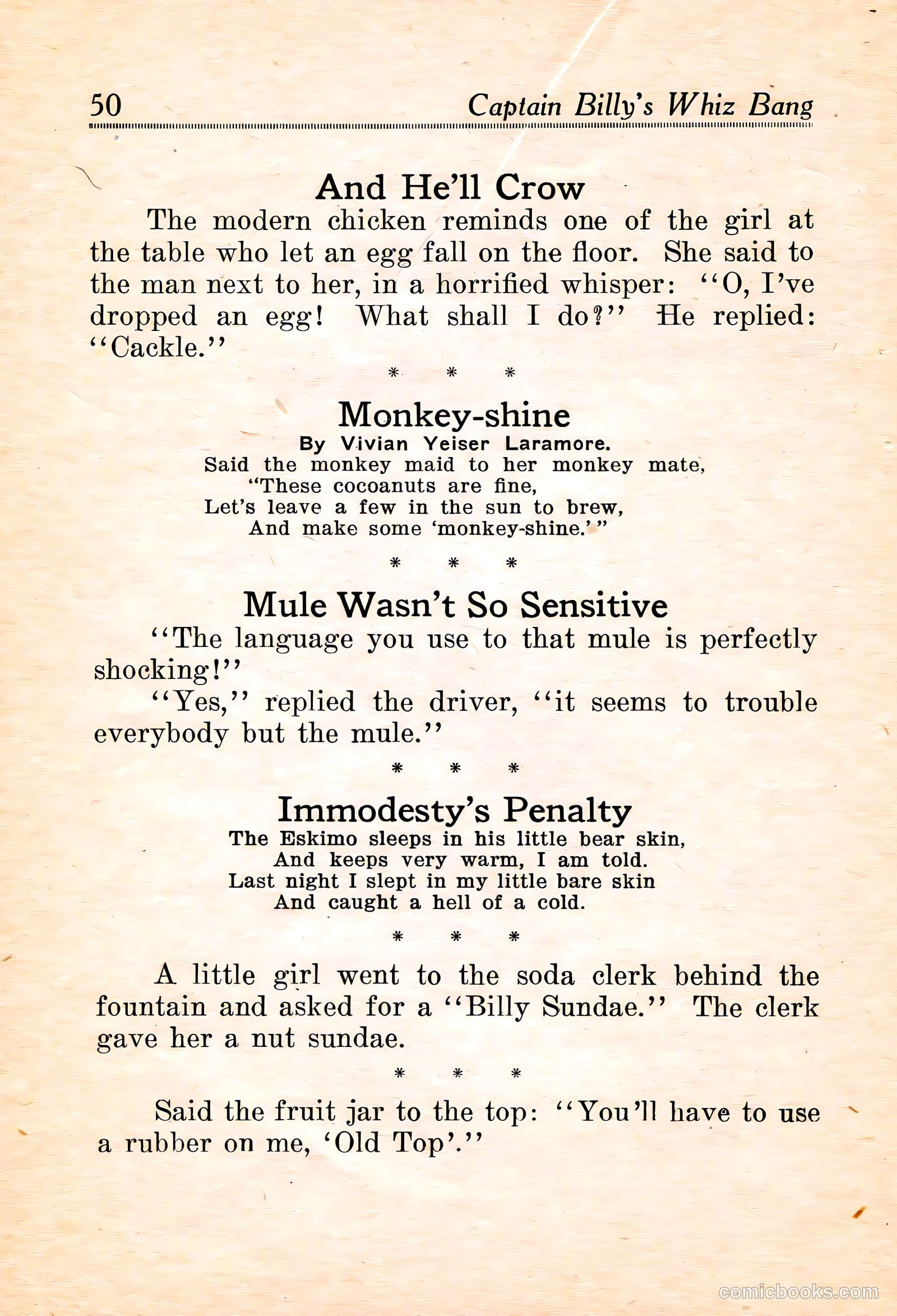
This is a collection of brief, ribald jokes typical of 1920s-era American humor magazines. The jokes rely on double entendres and wordplay: - **"And He'll Crow"**: A girl drops an egg; she's told to "cackle"—mocking her dramatic reaction. - **"Monkey-shine"**: Puns on making "monkey-shine" (liquor), likely referencing Prohibition-era bootlegging. - **"Mule Wasn't So Sensitive"**: Crude language toward animals doesn't bother them—a commentary on society's selective morality. - **"Immodesty's Penalty"**: Plays on "bare skin" versus "bear skin"—nudity causes illness, a morality joke. - **"Billy Sundae"**: A pun on "Billy Sunday" (the famous evangelist), with sexual innuendo in the "nut sundae" response. - **"Fruit Jar"**: Sexual double entendre about rubber (condoms) and jar-sealing. These represent typical lowbrow humor of the era—crude, punning, and mildly transgressive for the time.
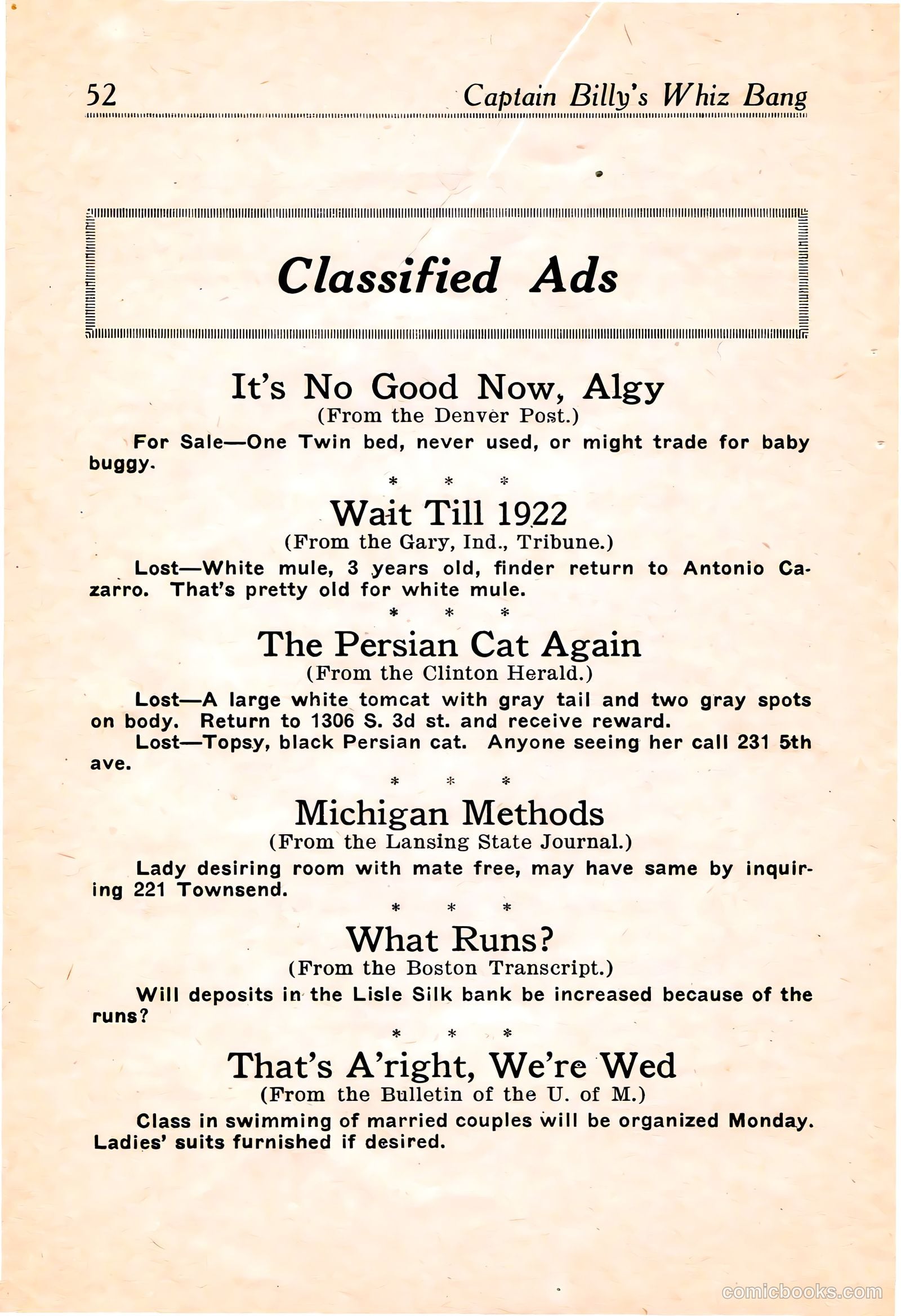
This page contains reprinted classified ads from various newspapers, presented as humor through unintentional double meanings and awkward phrasing. The jokes exploit ambiguous language: "twin bed, never used, or might trade for baby buggy" (suggesting marital problems); "pretty old for white mule" (questioning the mule's age/value); "room with mate free" (unclear roommate arrangement); "Will deposits...be increased because of the runs?" (conflating bank runs with physical running); and "swimming of married couples" with "Ladies' suits furnished" (implying impropriety). This was a popular satirical format—presenting real classified ads that inadvertently created humorous interpretations through sloppy wording or unfortunate juxtaposition. The magazine credited various newspapers, suggesting these were actual published ads. The humor relies on readers catching the unintended double meanings or social impropriety embedded in innocent-sounding advertisements.
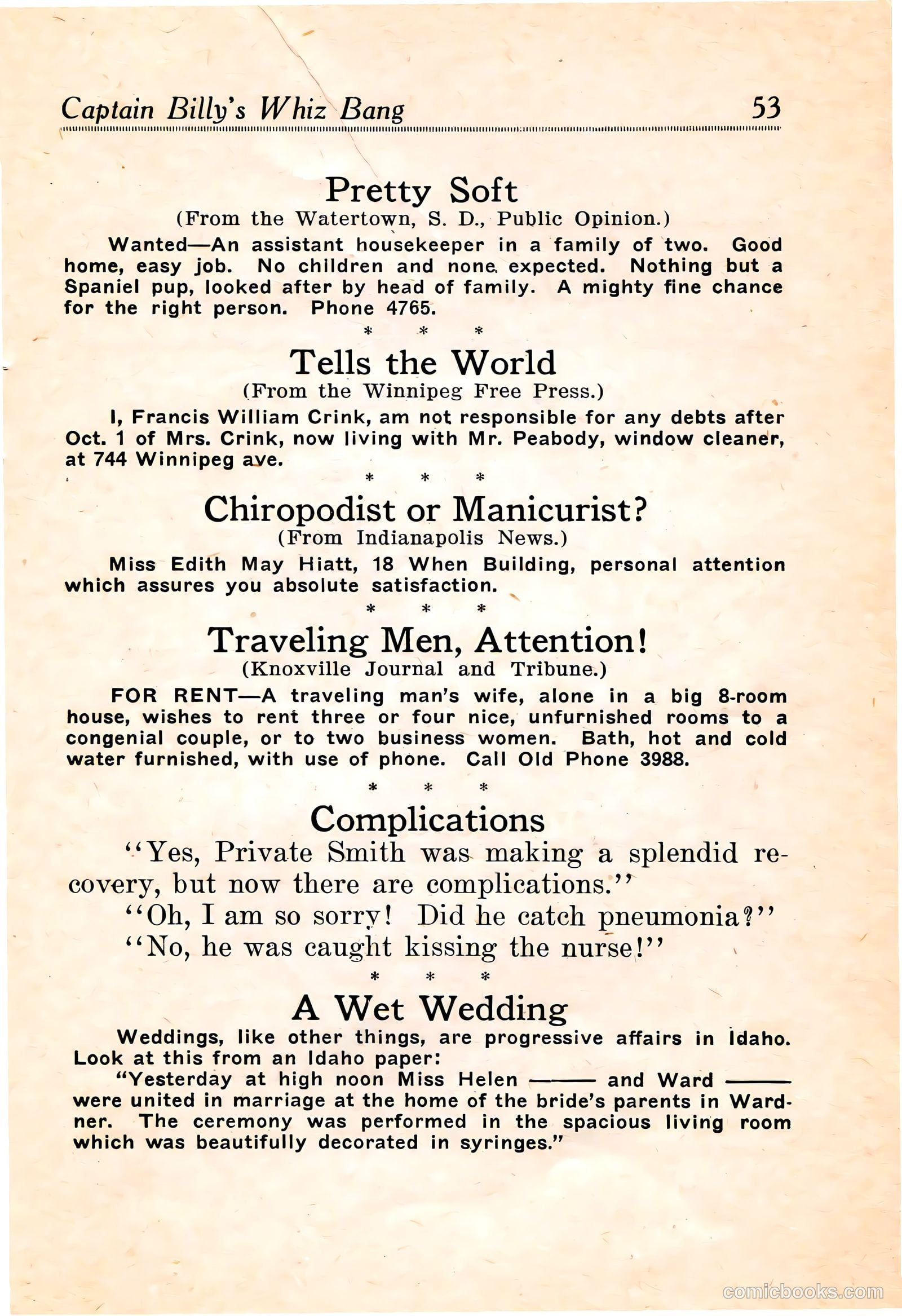
This page is a collection of satirical short pieces and classified ads mocking social situations of the era (appears to be 1920s). **Key pieces:** - **"Pretty Soft"** and **"Tells the World"**: Joke classifieds where the humor lies in unspoken marital troubles—one advertising a housekeeper position suspiciously free of children, another a man publicly disavowing responsibility for his wife's debts after she leaves him for another man. - **"Traveling Men, Attention!"**: A woman renting rooms in her house while her husband travels, phrased suggestively to prompt reader inference about impropriety. - **"Complications"**: A hospital joke where a recovering soldier's "complication" is being caught kissing a nurse—playing on double meaning. - **"A Wet Wedding"**: The satire hinges on a typo or malapropism—"syringes" instead of "springs" (flowers)—creating an absurdly medicalized wedding image. The humor targets infidelity, marital discord, and sexual innuendo typical of 1920s "adult" magazine comedy.
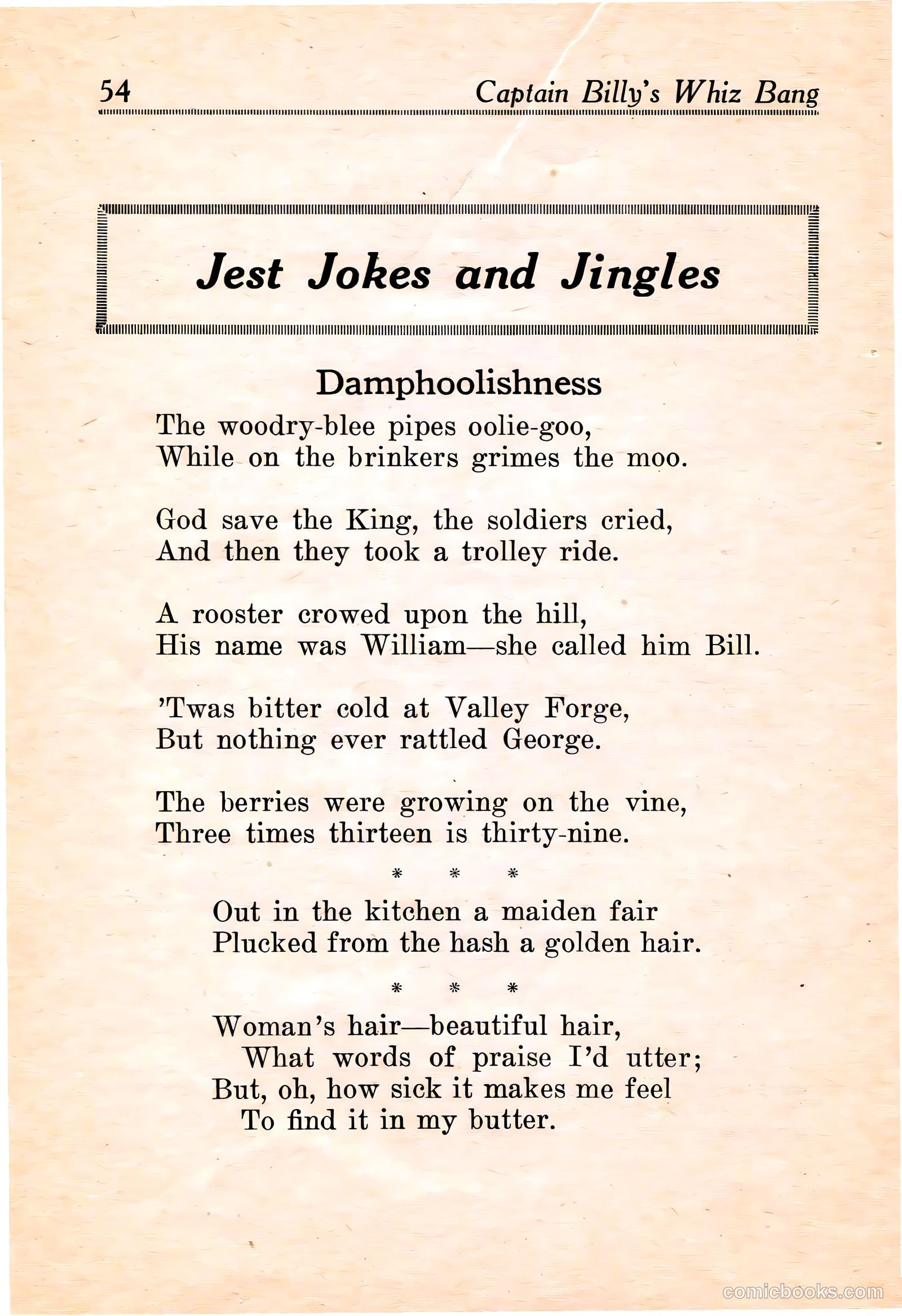
This page from **Captain Billy's Whiz Bang** contains humorous verses rather than political cartoons. The "Damphoolishness" section is a collection of absurdist and nonsense jokes typical of the magazine's satirical humor. The jokes mix patriotic references (Valley Forge, "God save the King") with deliberately silly rhymes and non-sequiturs. The Valley Forge joke appears to mock the seriousness of Revolutionary War hardship by contrasting it with mundane trolley rides. The final two sections use grotesque domesticity for humor: a maiden finding hair in food, then a longer complaint about discovering a woman's hair in butter. This reflects early-20th-century anxiety about hygiene, domestic servants, and the unpleasant realities of food preparation—playing the contrast between idealized "beautiful hair" and the disgusting reality of it contaminating food for comic effect. These aren't sophisticated political satires but rather lowbrow comic verses aimed at working-class readers seeking quick laughs.
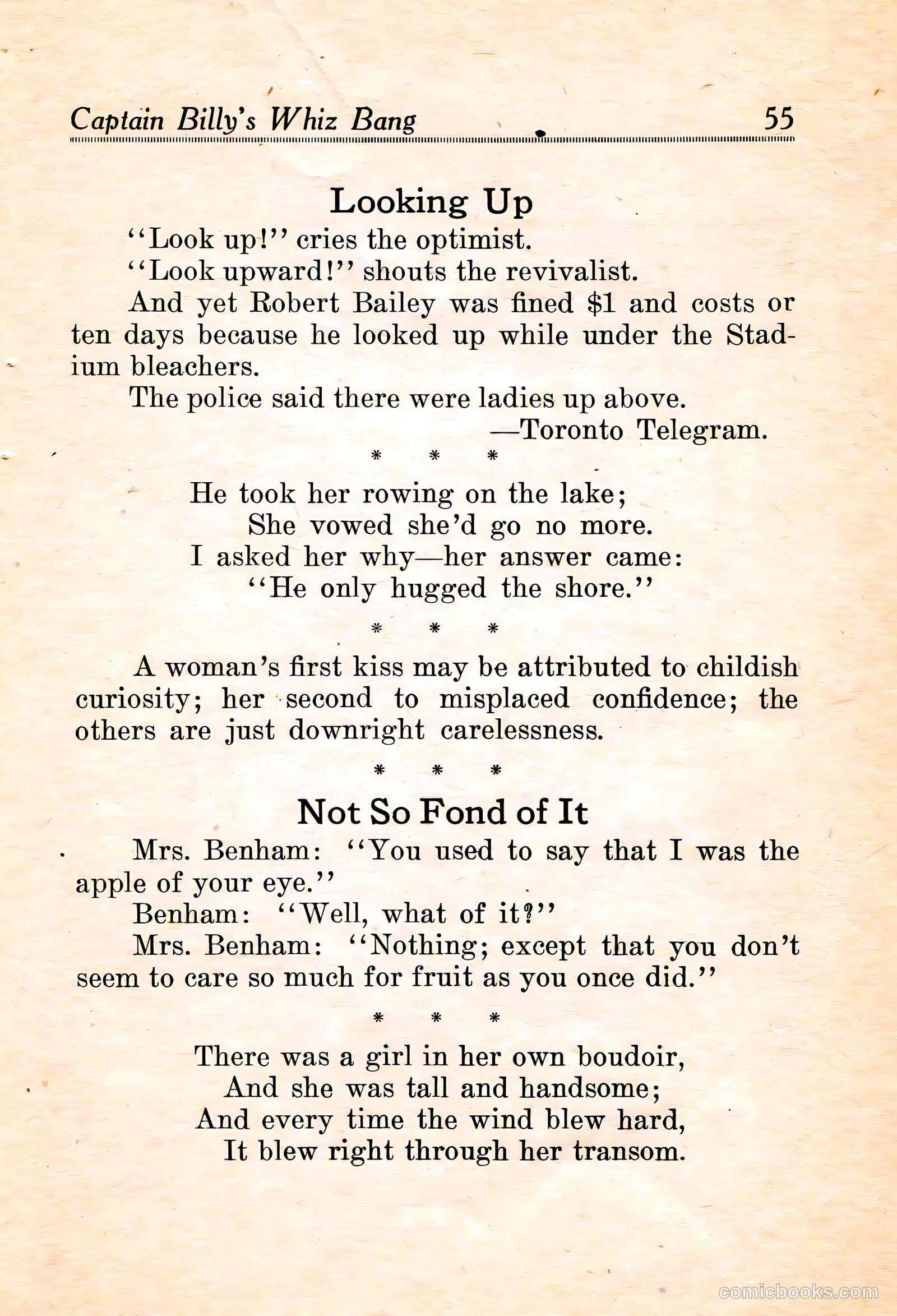
This page from *Whiz Bang* (a 1920s American humor magazine) contains several brief jokes exploiting sexual innuendo and marital discord—typical of the publication's irreverent style. The opening piece mocks overly optimistic advice ("Look up!") by reporting Robert Bailey's arrest for looking upward beneath stadium bleachers where women sat—implying he was peeping. The Toronto Telegram sourcing suggests this was a real incident used for comedic effect. Subsequent jokes play on double meanings: a woman won't row because her companion "only hugged the shore" (sexual passivity); a married woman complains her husband no longer cherishes her like "the apple of your eye" (he's lost interest); and a final verse about wind blowing through a girl's transom suggests her undergarments or state of undress. The humor targets romantic disappointment, marital boredom, and sexual behavior—reflecting post-WWI American attitudes where such frank wordplay was becoming acceptable in certain publications.
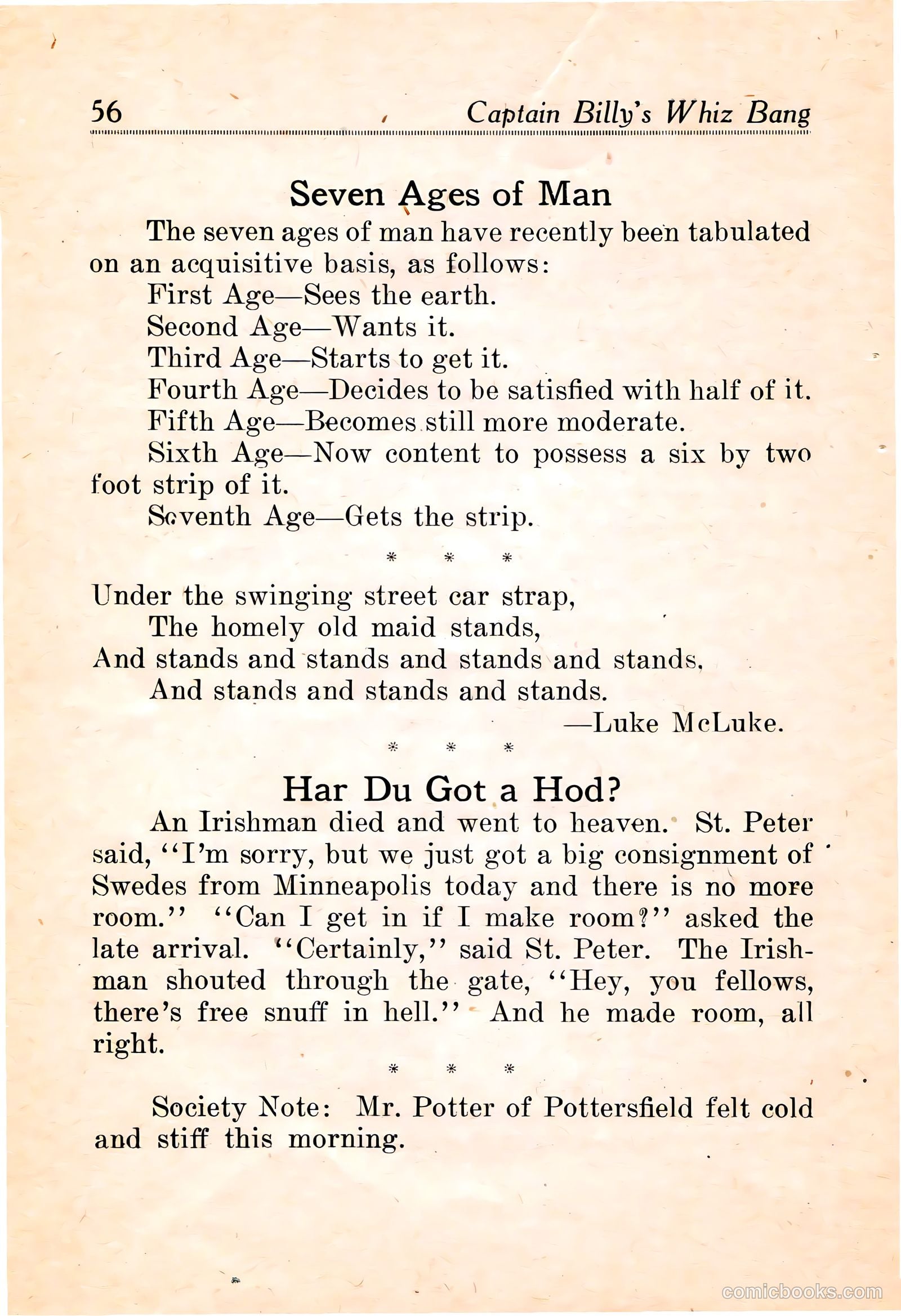
This page from **Captain Billy's Whiz Bang** (a satirical magazine popular in the 1920s-30s) contains three humorous pieces with social commentary: **"Seven Ages of Man"** satirizes materialism and mortality—tracing how human ambition gradually diminishes from wanting to possess everything to ultimately accepting just a grave ("six by two foot strip"). **The street car poem** mocks spinsters, suggesting an unmarried woman's repetitive, unchanging life. **"Har Du Got a Hod?"** is an ethnic joke playing on anti-immigrant sentiment. It depicts an Irishman tricking Swedes (reflecting 1920s Minneapolis's large Swedish population) into leaving heaven by falsely claiming "free snuff in hell." The crude humor relies on ethnic stereotyping common to the era—portraying both groups as unsophisticated and easily manipulated. The final "Society Note" is a dark joke: Potter "felt cold and stiff" likely means he's dead. These pieces reflect the magazine's irreverent, sometimes mean-spirited humor typical of American satire from this period.
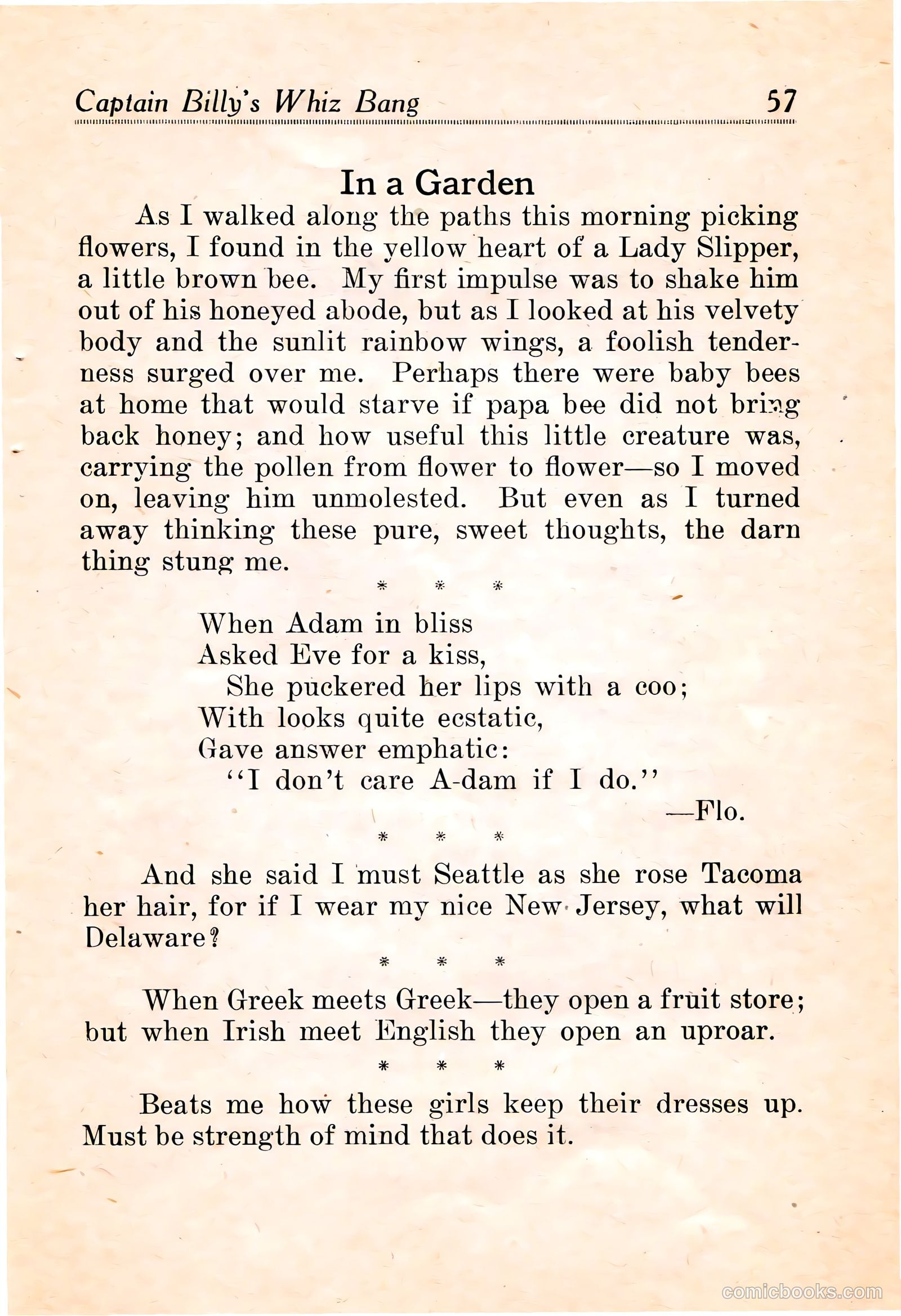
This page from *Captain Billy's Whiz Bang* (a 1920s-era humor magazine) contains multiple brief satirical pieces: **"In a Garden"** presents ironic humor: the narrator shows mercy to a bee, rationalizing its usefulness and imagining its family, only to be stung anyway—the punchline being that good intentions don't prevent consequences. **The Adam and Eve verse** is risqué wordplay typical of the era, turning a biblical seduction into flirtation with suggestive language ("I don't care A-dam if I do"). **The geographic pun** exploits place names (Seattle/Tacoma, New Jersey/Delaware) as homophones for verbs and possessives—low-brow wordplay common to period humor magazines. **The ethnic joke** stereotypes Greeks as shopkeepers and Irish as quarrelsome—crude ethnic humor standard for the 1920s. **The final quip** about women keeping dresses up likely references the era's rising hemlines and changing fashion standards, treating female modesty as requiring exceptional willpower. All pieces reflect period attitudes: sentimental contradiction, sexual innuendo, ethnic caricature, and skepticism toward women's propriety.
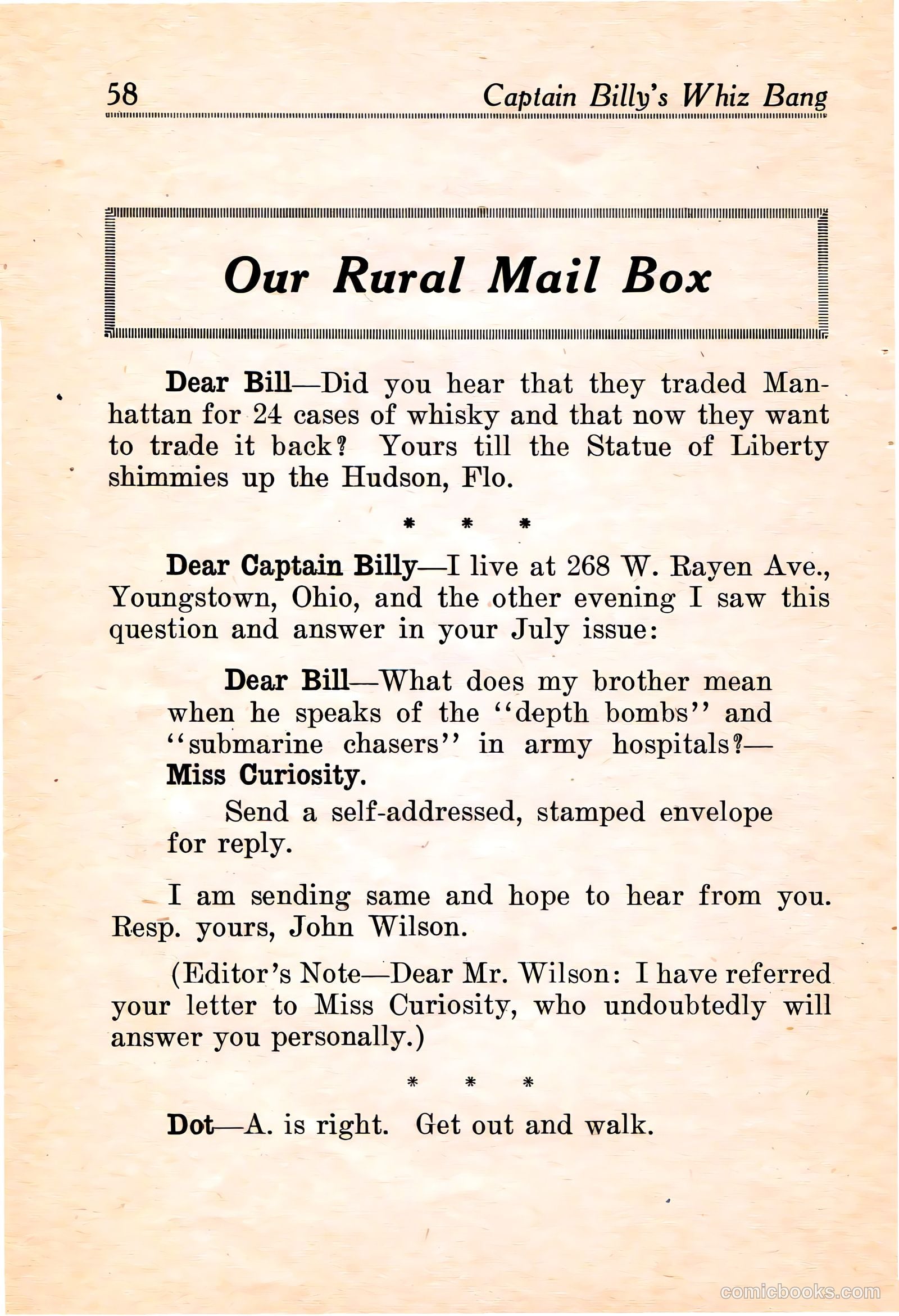
This is a letters-to-the-editor page from *Captain Billy's Whiz Bang*, a humor magazine. The content includes: **First letter**: A joke about Manhattan being "traded for 24 cases of whisky"—likely referencing the historical (1626) purchase of Manhattan from Native Americans, repurposed as absurdist humor suggesting it's now worthless enough to trade back. **Second letter**: A reader asks about military hospital slang terms—"depth bombs" and "submarine chasers." The editor's response and reader follow-up suggest these are euphemisms for venereal diseases (likely syphilis/gonorrhea), common among soldiers. The coy handling reflects 1920s-era squeamishness about discussing STIs directly. **Final item**: A cryptic one-liner responding to someone identified only as "Dot," advising physical exercise rather than unspecified behavior. The page exemplifies the magazine's bawdy, irreverent humor mixing historical jokes, sexual innuendo, and contemporary soldier culture.
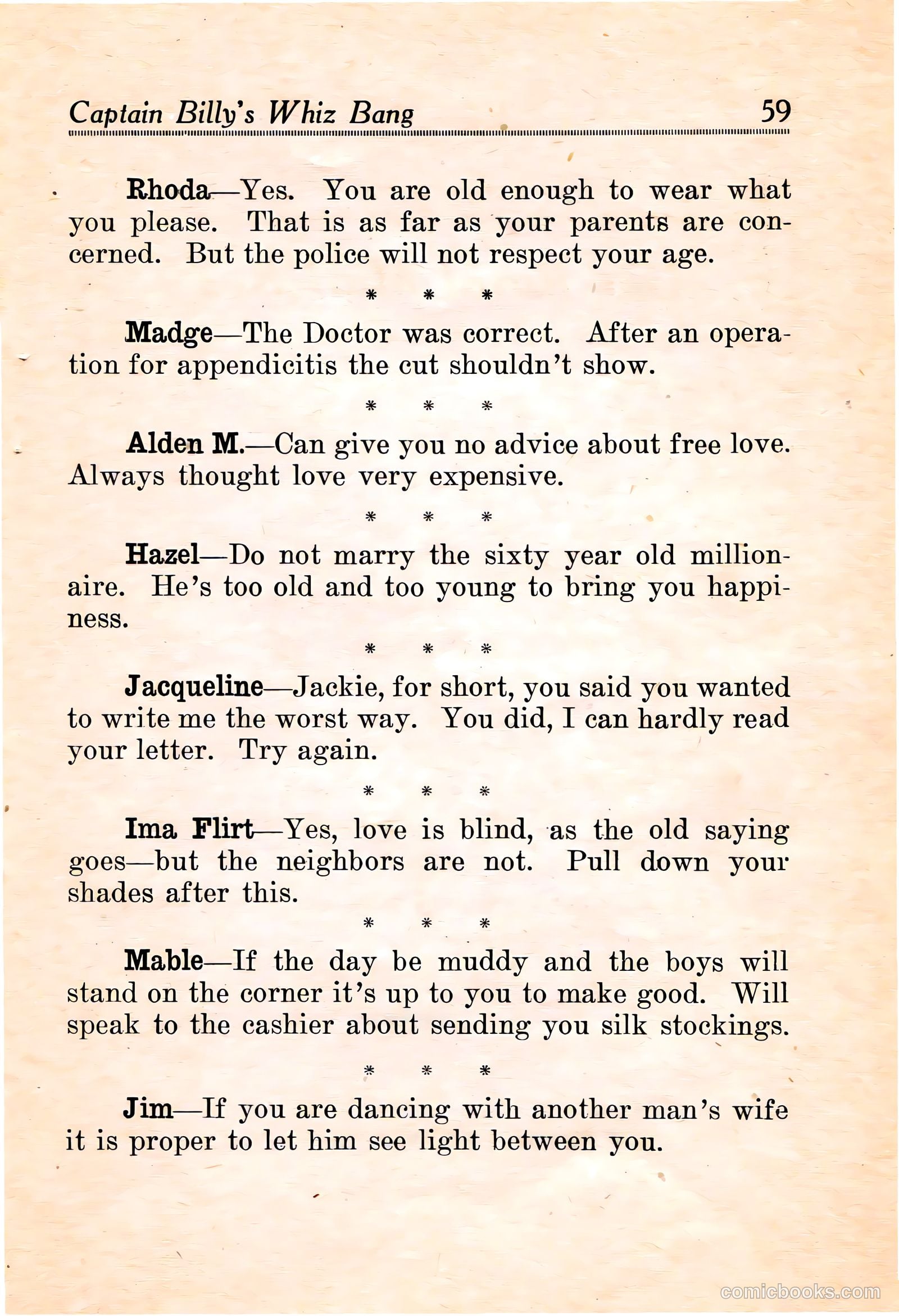
This page contains advice-column humor from an early 20th-century American satirical magazine. Each item offers mock-serious counsel responding to reader queries with witty, often risqué commentary on social conventions and dating behavior. The satire targets 1920s etiquette and morality: Rhoda gets warned police won't respect her fashion choices; Ima Flirt is told neighbors can see through drawn shades during romantic encounters; Mable is advised to "make good" with boys on rainy days, with a joke about receiving silk stockings (period slang suggesting impropriety). Other items mock courtship pretensions—the sixty-year-old millionaire paradox, "free love" as expensive, proper dancing distance from another man's wife. Jacqueline's illegible handwriting joke is straightforward. The humor reflects Jazz Age anxieties about changing sexual mores, women's increasing independence, and class distinctions—all wrapped in supposedly innocent advice-column format.
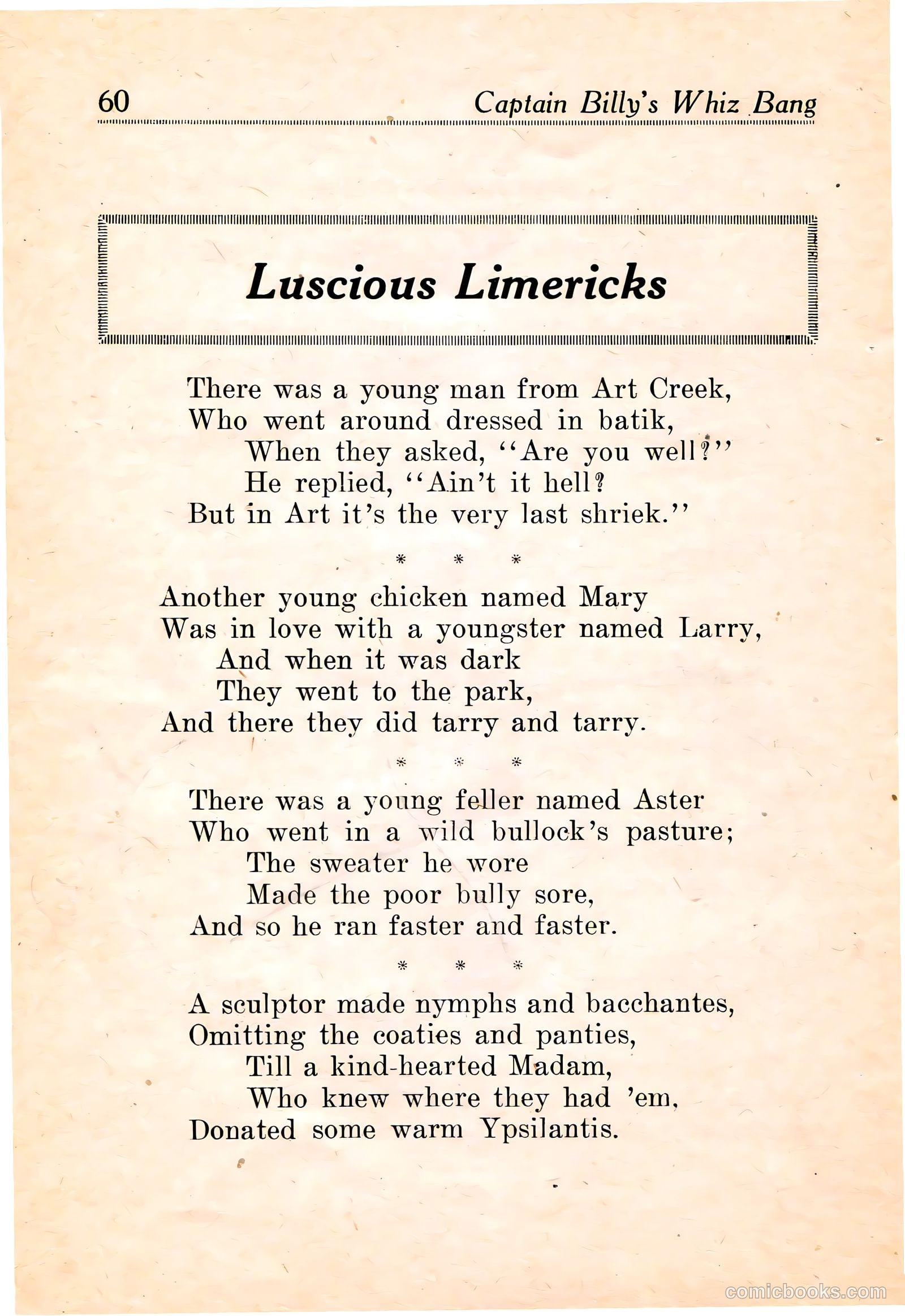
This page contains four bawdy limericks typical of *Whiz Bang*, a satirical magazine known for crude humor. The jokes target: 1. **Art Creek bohemian**: Mocks artistic pretension—a man in fashionable batik fabric claims his suffering is trendy ("the very last shriek"). 2. **Mary and Larry**: A double-entendre about young lovers "tarrying" in the park after dark—euphemistic for sexual activity. 3. **Aster and the bullock**: A man's sweater irritates a wild bull, which chases him—likely innuendo about masculine inadequacy or sexual performance. 4. **The sculptor**: A joke about an artist making nude female statues without undergarments. A "kind-hearted Madam" provides "Ypsilantis" (women's undergarments)—satirizing both artistic pretension and sexuality. The humor is deliberately crude and juvenile, reflecting *Whiz Bang's* appeal to soldiers and working-class readers seeking irreverent, sex-adjacent comedy that mocked both artistic elites and social conventions.
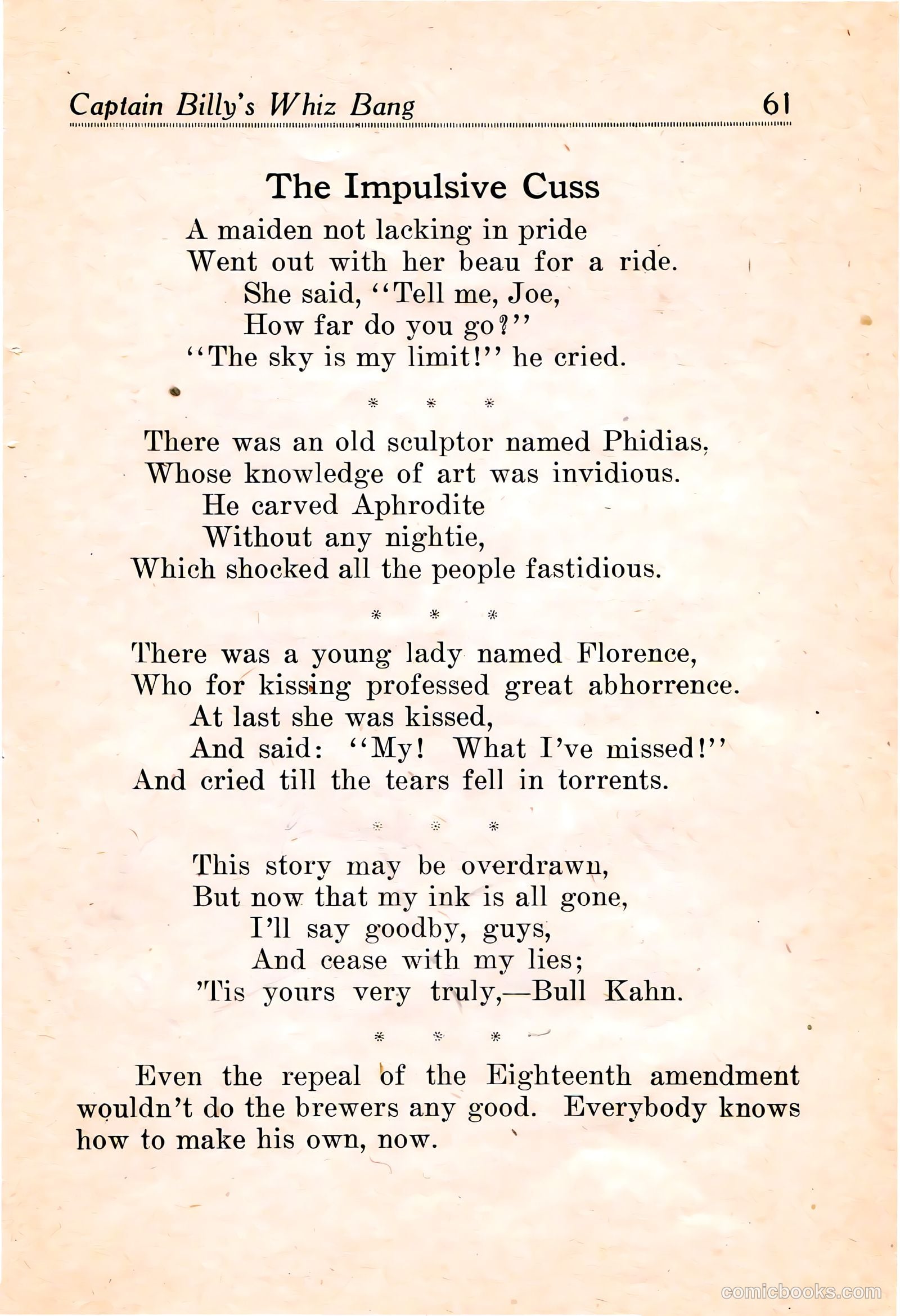
This page contains five humorous limericks by "Bull Kahn" satirizing various social behaviors. The first mocks male boasting about romantic prowess ("the sky is my limit"). The second ridicules prudish outrage at classical nude art (referencing the ancient sculptor Phidias). The third jokes about female hypocrisy regarding kissing—women claiming to oppose it while secretly enjoying it. The final commentary references Prohibition's repeal (the Eighteenth Amendment). It satirizes brewers' economic concerns by noting that home brewing had become so widespread during Prohibition that legal beer's return wouldn't restore their business—ordinary citizens had already learned to manufacture alcohol illegally at home. The page captures *Whiz Bang's* irreverent humor targeting social pretension, sexual double standards, and the unintended consequences of Prohibition policy.
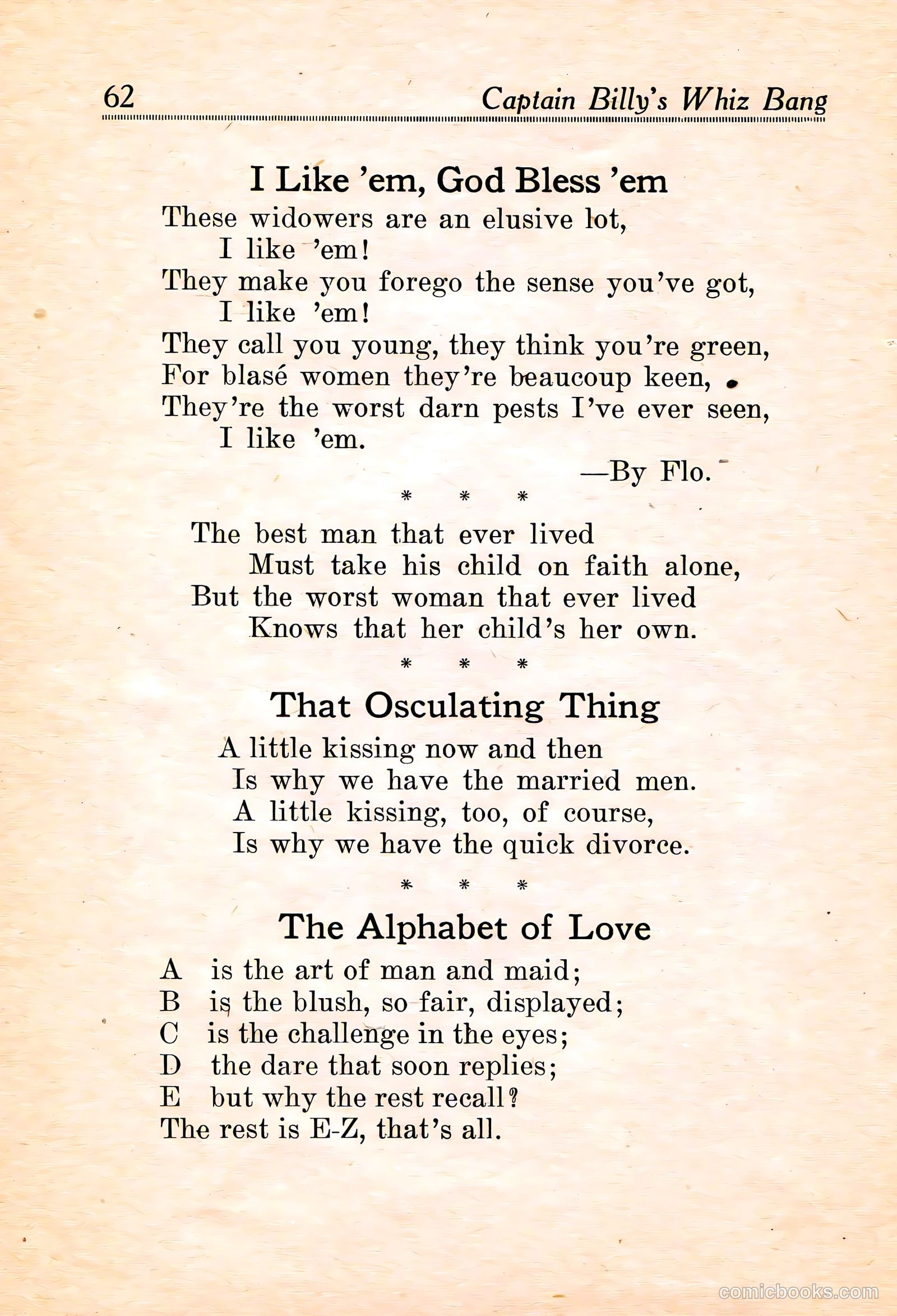
This page from *Captain Billy's Whiz Bang* (a 1920s-era American humor magazine) contains four short comic poems mocking romantic and marital relationships. **"I Like 'em, God Bless 'em"** (by Flo) satirizes widowers as manipulative suitors who exploit naive women by flattering them and preying on divorcées. **Untitled verse** plays on gender double standards: men must accept paternity "on faith," while women have biological certainty—a dig at masculine insecurity. **"That Osculating Thing"** uses kissing as a metaphor for marital instability: casual romance leads to marriage, but infidelity causes divorce. **"The Alphabet of Love"** humorously reduces courtship to five steps (A-E), then puns on "E-Z" (easy) to suggest the rest is predictable or foregone. Overall, the page reflects post-WWI cynicism about marriage and gender relations, treating romance as inherently comedic and somewhat disappointing.
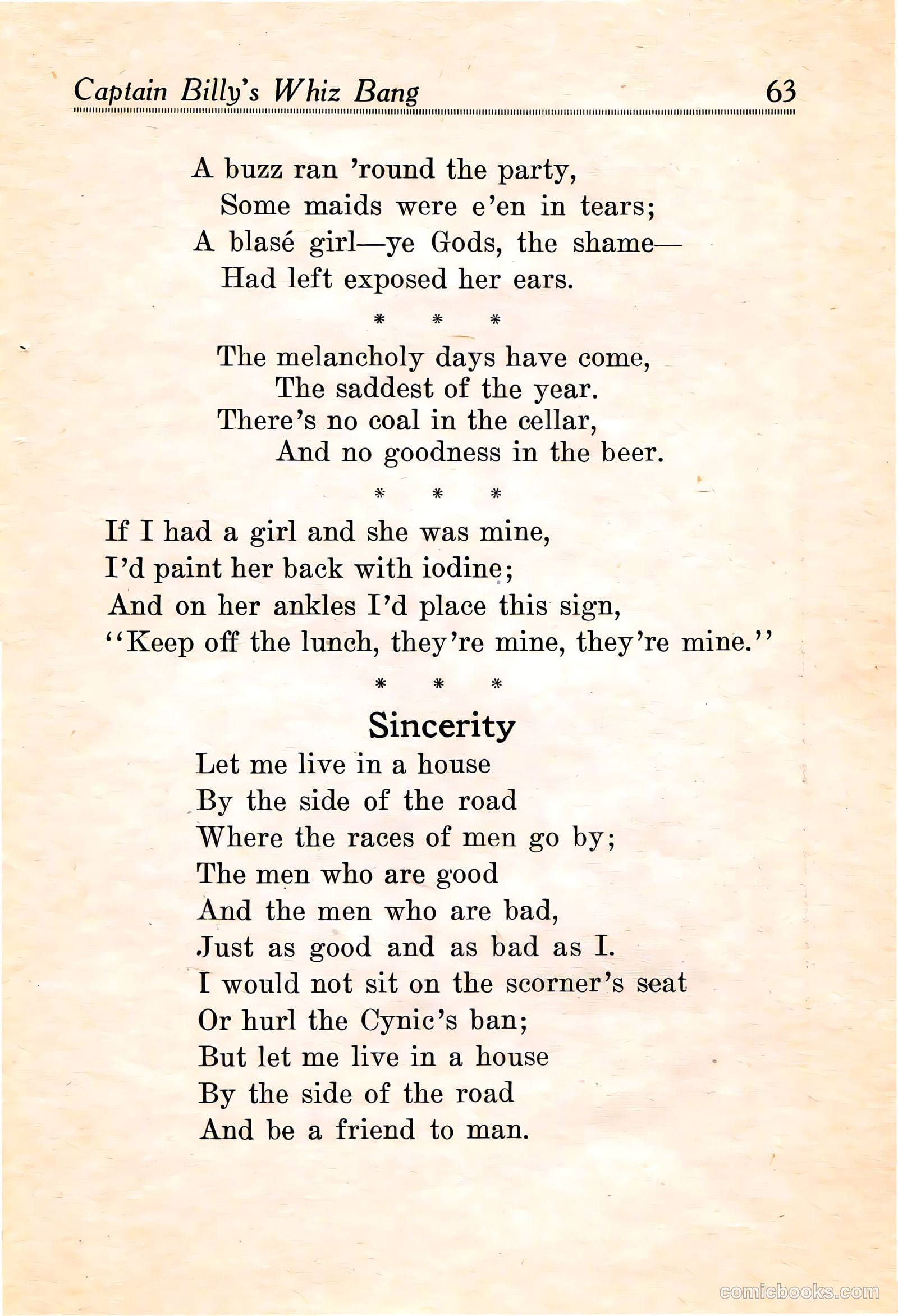
This page from the satirical magazine contains three humorous poems with no visible illustrations. The first two poems are brief jokes: one mocks social propriety by treating exposed ears as scandalous, the other complains about post-WWI shortages (no coal, poor beer quality). The third poem is a possessive humor piece about marking a girlfriend with iodine and warning signs—crude 1920s dating humor playing on male jealousy. The final poem, "Sincerity," is notably different in tone—a sincere philosophical piece advocating humble, non-judgmental living "by the side of the road," accepting people regardless of morality. It appears to be either serious verse or gentle satire of earnest moralism, contrasting sharply with the crude jokes above it. The page likely dates to the 1920s based on content and typography.
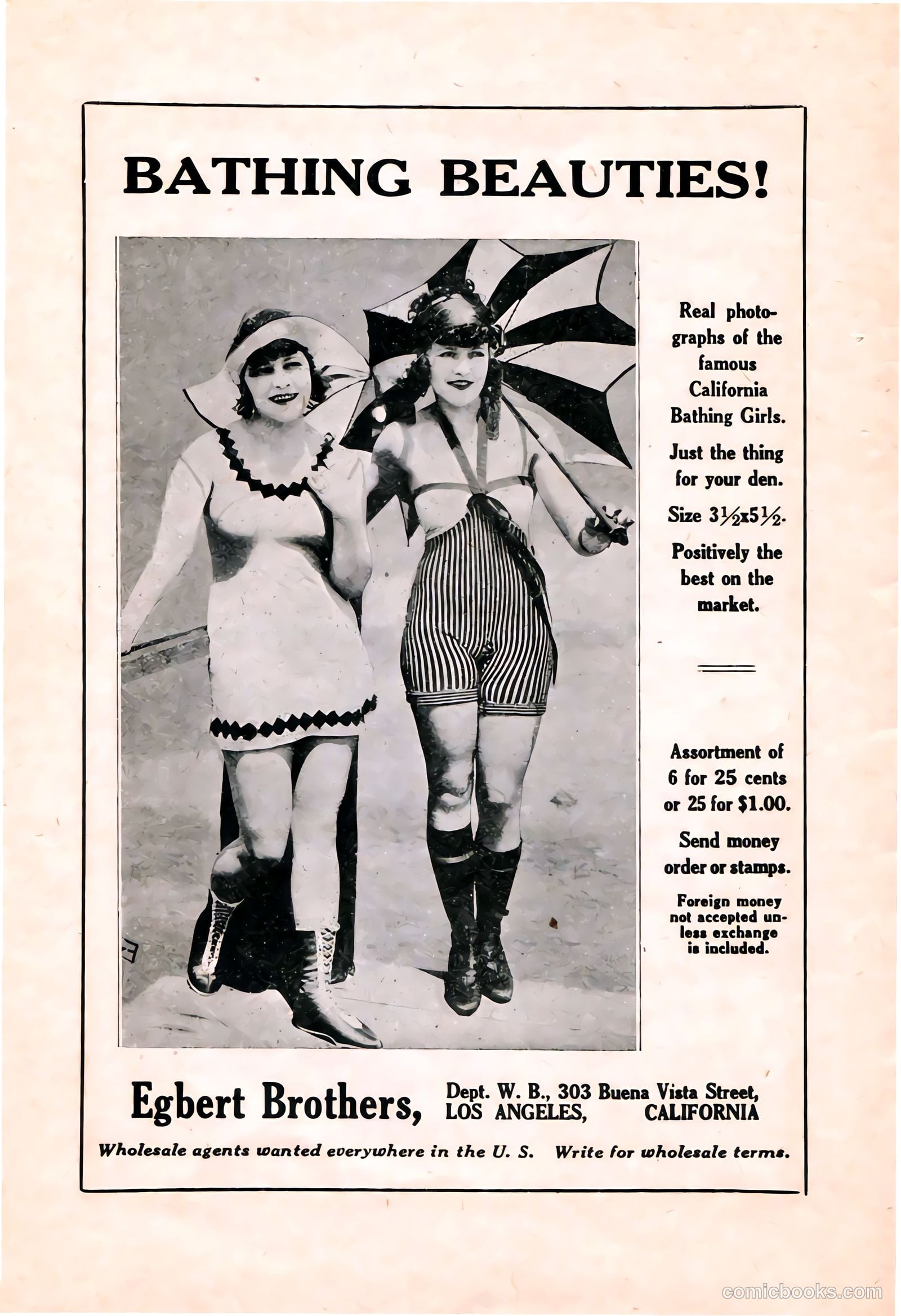
This is **not a cartoon or satire**—it's a straightforward advertisement. Egbert Brothers is selling photograph sets of "California Bathing Girls," marketed as decorative prints for men's spaces ("your den"). The image shows two women in 1920s-style swimwear with theatrical accessories (parasols, headpieces). This reflects the era's fascination with "bathing beauty" culture—glamorized images of young women in swimwear that were popular in films, postcards, and pinups. The pricing (6 photos for 25¢, or 25 for $1) indicates these were mass-produced, affordable collectibles. The wholesale solicitation at bottom suggests Egbert Brothers operated a mail-order photo business with national distribution. There's no political commentary here—it's period advertising reflecting contemporary tastes in entertainment and décor.
This is primarily a **subscription advertisement**, not a political cartoon. The page uses a double entendre as its sales pitch: comparing women's stockings to a doctor's prescription blank—both must be "filled" to have value. The joke plays on post-WWI era attitudes toward women's hosiery as fashionable, desirable items. The main content is a subscription coupon for *Capt. Billy's Whiz Bang*, a humor magazine edited by Captain Billy Fawcett, published from Robbinsdale, Minnesota. The ad encourages readers to start their subscription in the New Year for $2.50 annually. Rather than satirizing political figures or events, this represents typical early-20th-century magazine advertising: using suggestive humor to sell subscriptions to a working-class audience. The "prescription blank" metaphor is the advertisement's entire comedic strategy.
This is a **title/advertisement page** for *Whiz Bang*, an American satirical magazine. The page announces the publication's availability and subscription options rather than presenting editorial content or satire. The illustration shows a **cartoon cow** (the publication's apparent mascot), rendered in a simple, bold silhouette style typical of early 20th-century advertising graphics. The cow appears animated or exaggerated, consistent with humorous magazine branding of the era. The text emphasizes widespread distribution—hotels, newsstands, trains—reflecting the magazine's commercial ambitions. Pricing is given in two tiers: 25 cents at retail outlets versus 30 cents direct from the publisher, with annual subscriptions at $2.50. This page functioned as both promotion and subscription information for potential readers.