
Captain Billy's Whiz Bang, January 1921 · page 35 of 68
Captain Billy's Whiz Bang #16 — page 35: what you’re looking at
What you’re looking at
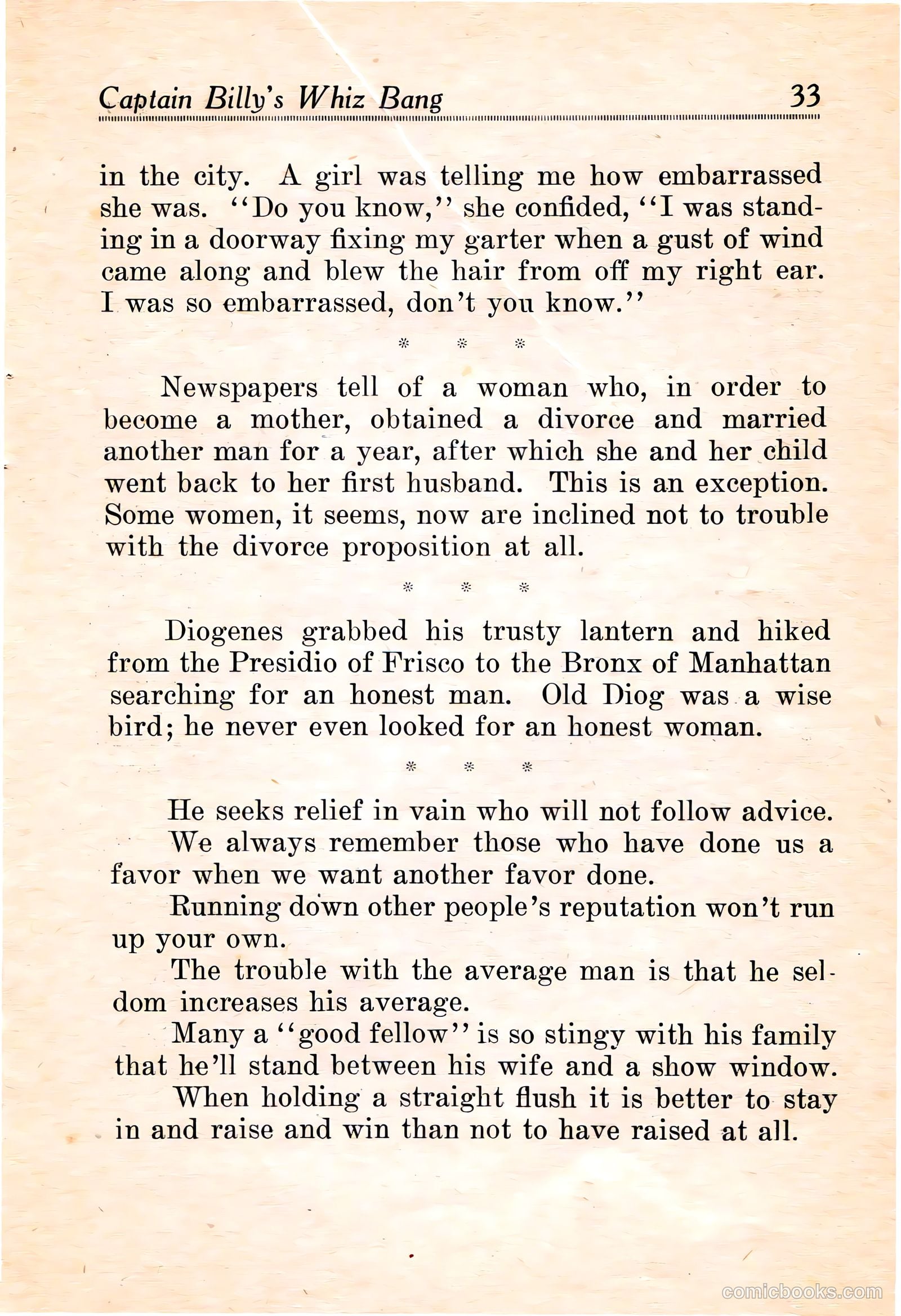
This page from the satirical magazine consists entirely of brief humorous anecdotes and aphorisms—no illustrations accompany the text. The jokes target 1920s social conventions: a woman embarrassed by a garter mishap (suggesting anxieties about propriety and exposed clothing); women circumventing divorce stigma through casual infidelity; and misogynistic commentary invoking the ancient Greek philosopher Diogenes's search for an honest man, here twisted to mock women's honesty. The remaining quips offer cynical life observations: people remember favors only when seeking return favors, reputation-damaging gossip backfires, and men fail to improve themselves. One joke mocks stingy husbands denying wives shopping pleasures. The final line uses poker terminology metaphorically about bold action. The satire reflects period attitudes toward gender, morality, and social climbing, with heavy emphasis on marital discord and female behavior as comedic subjects.
📄 Transcribed text from this page (OCR, searchable)
Machine-transcribed from the original scan — historical spelling and the odd misread are preserved.
Captain Billy's Whiz Bang 33 in the city. A girl was telling me how embarrassed she was. “Do you know,” she confided, “I was stand- ing in a doorway fixing my garter when a gust of wind came along and blew the hair from off my right ear. I was so embarrassed, don’t you know.” * * * Newspapers tell of a woman who, in order to become a mother, obtained a divorce and married another man for a year, after which she and her child went back to her first husband. This is an exception. Some women, it seems, now are inclined not to trouble with the divorce proposition at all. * * * Diogenes grabbed his trusty lantern and hiked from the Presidio of Frisco to the Bronx of Manhattan searching for an honest man. Old Diog was a wise bird; he never even looked for an honest woman. * * * He seeks relief in vain who will not follow advice. We always remember those who have done us a favor when we want another favor done. Running down other people’s reputation won’t run up your own. The trouble with the average man is that he sel- dom increases his average. Many a “good fellow” is so stingy with his family that he’ll stand between his wife and a show window. When holding a straight flush it is better to stay in and raise and win than not to have raised at all.