
Captain Billy's Whiz Bang, January 1921 · page 20 of 68
Captain Billy's Whiz Bang #16 — page 20: what you’re looking at
What you’re looking at
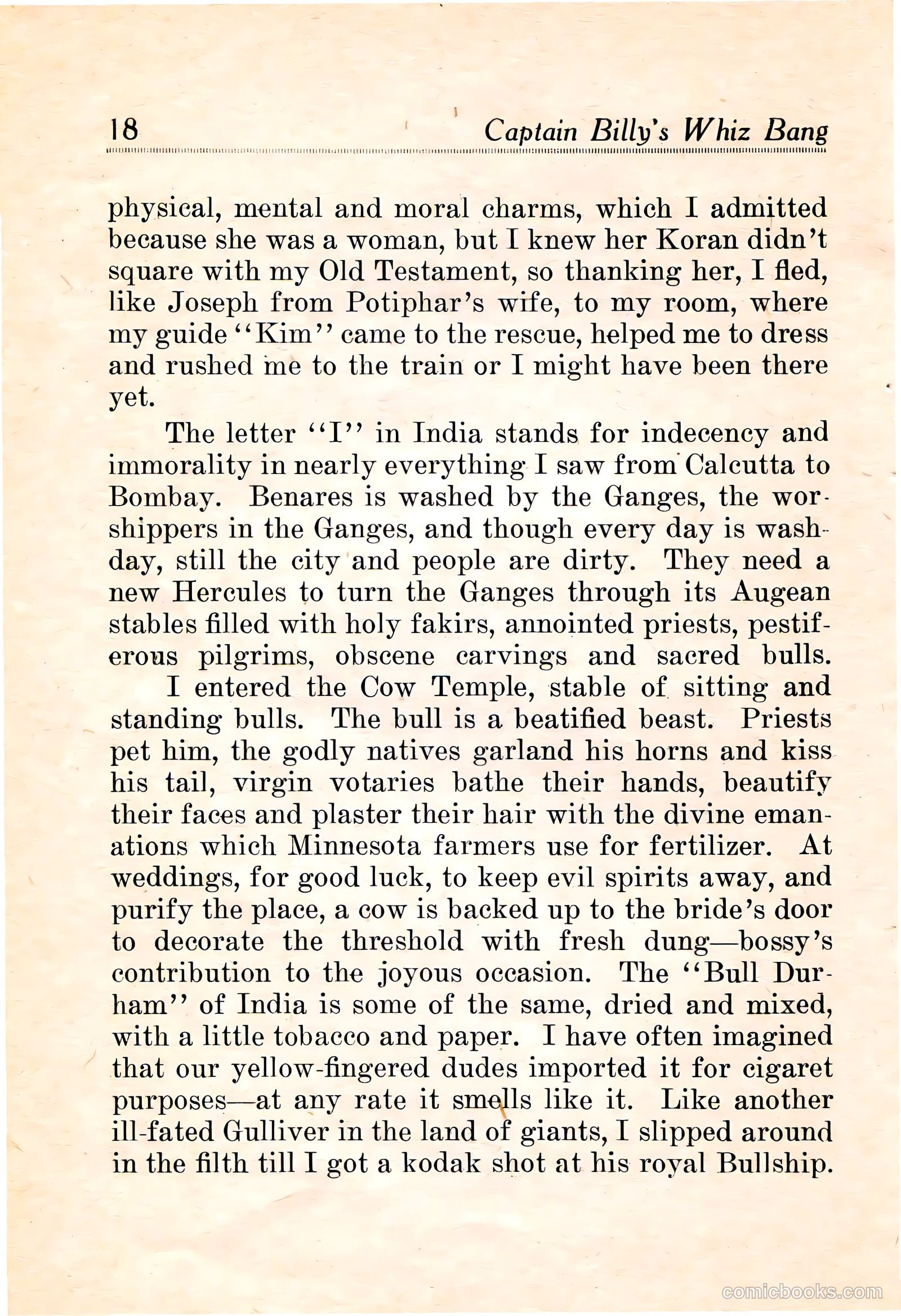
This is a first-person travel narrative mocking Indian religious and cultural practices. The author describes travels through India (Calcutta to Bombay), employing crude stereotypes common to early 20th-century American humor. **Key targets of satire:** - Hindu veneration of sacred cattle, particularly in temples - The Ganges River and ritual bathing practices - Hindu priests and pilgrims - Indian religious customs around weddings (cows as good luck) **Rhetorical strategy:** The narrator positions himself as a Christian ("Old Testament") visitor observing bizarre "heathen" practices. He compares himself to Joseph and Gulliver—civilized men confronting moral corruption and absurdity. The repeated emphasis on dung, filth, and animal waste serves as crude humor meant to suggest Indian practices as unhygienic and primitive. **Historical context:** This reflects early 20th-century American attitudes treating non-Western religions as objects of ridicule and moral judgment. The casual contempt and scatological humor typified satirical magazines of the era, though such content would be considered offensive racist stereotyping today.
📄 Transcribed text from this page (OCR, searchable)
Machine-transcribed from the original scan — historical spelling and the odd misread are preserved.
18 Captain Billy's Whiz Bang physical, mental and moral charms, which I admitted because she was a woman, but I knew her Koran didn't square with my Old Testament, so thanking her, I fled, like Joseph from Potiphar's wife, to my room, where my guide “Kim” came to the rescue, helped me to dress and rushed me to the train or I might have been there yet. The letter “I” in India stands for indecency and immorality in nearly everything I saw from Calcutta to Bombay. Benares is washed by the Ganges, the wor- shippers in the Ganges, and though every day is wash- day, still the city and people are dirty. They need a new Hercules to turn the Ganges through its Augean stables filled with holy fakirs, annointed priests, pestif- erous pilgrims, obscene carvings and sacred bulls. I entered the Cow Temple, stable of sitting and standing bulls. The bull is a beatified beast. Priests pet him, the godly natives garland his horns and kiss his tail, virgin votaries bathe their hands, beautify their faces and plaster their hair with the divine eman- ations which Minnesota farmers use for fertilizer. At weddings, for good luck, to keep evil spirits away, and purify the place, a cow is backed up to the bride's door to decorate the threshold with fresh dung—bossy's contribution to the joyous occasion. The “Bull Dur- ham” of India is some of the same, dried and mixed, with a little tobacco and paper. I have often imagined that our yellow-fingered dudes imported it for cigaret purposes—at any rate it smells like it. Like another ill-fated Gulliver in the land of giants, I slipped around in the filth till I got a kodak shot at his royal Bullship.