
Captain Billy's Whiz Bang, January 1921 · page 38 of 68
Captain Billy's Whiz Bang #16 — page 38: what you’re looking at
What you’re looking at
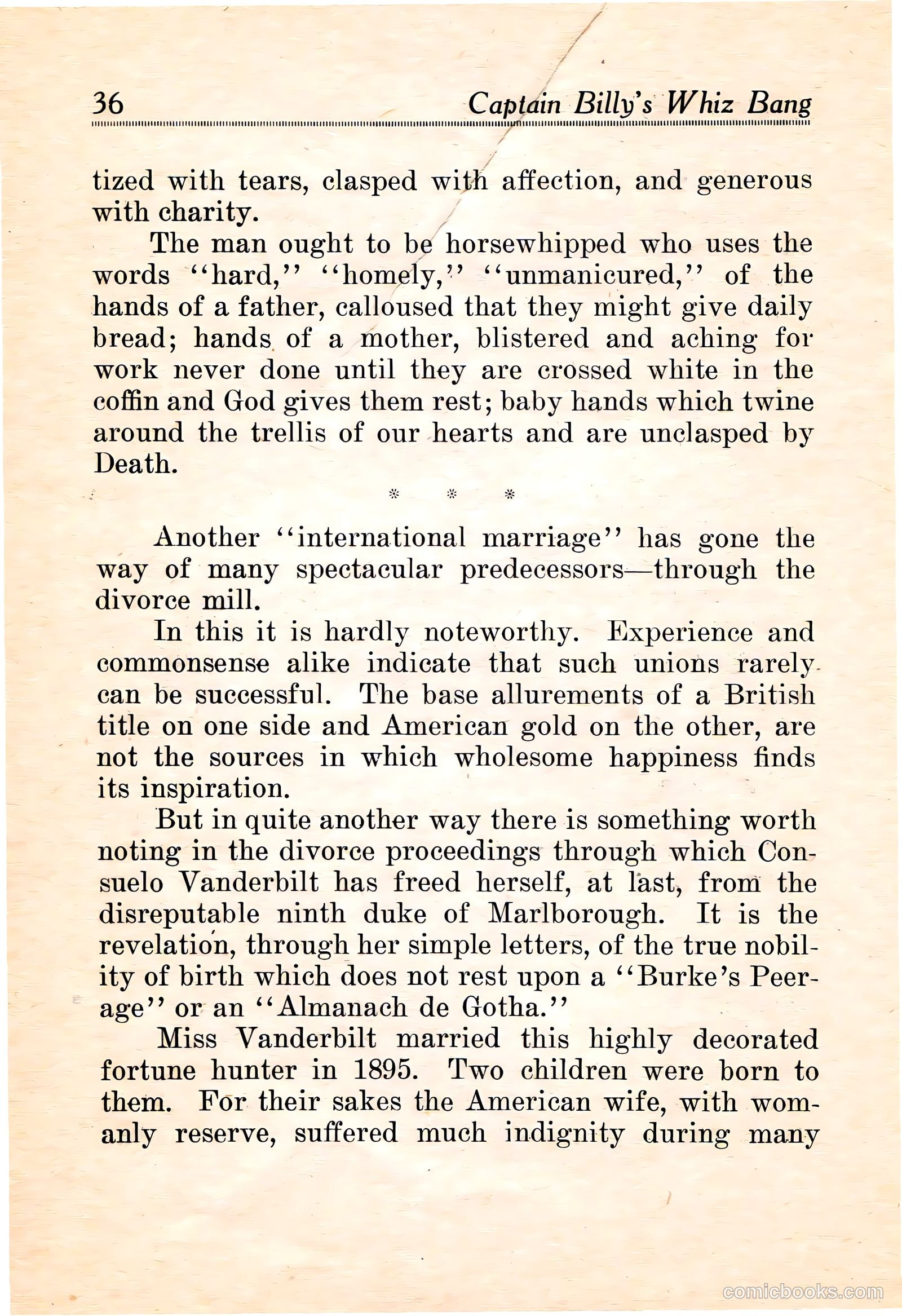
This page contains editorial commentary on working-class dignity and a high-society divorce scandal. The opening passage defends manual laborers' hands—calloused from labor—against dismissive language, declaring such work honorable. The main subject is **Consuelo Vanderbilt's divorce from the 9th Duke of Marlborough**. The text criticizes international marriages between American heiresses and titled European nobles, characterizing such unions as exchanges of "American gold" for "British title"—doomed ventures motivated by superficial status-seeking rather than genuine compatibility. The satire praises Vanderbilt herself, however, for displaying true nobility through her dignified conduct during divorce proceedings and her apparent letters. The author suggests her American character and maternal sacrifice demonstrate greater inherent worth than the duke's mere aristocratic credentials ("Burke's Peerage" and "Almanach de Gotha" being European noble registries). The piece thus mocks transatlantic fortune-hunting while celebrating American virtue and working-class dignity.
📄 Transcribed text from this page (OCR, searchable)
Machine-transcribed from the original scan — historical spelling and the odd misread are preserved.
36 Captain Billy's Whiz Bang tized with tears, clasped with affection, and generous with charity. The man ought to be horsewhipped who uses the words “hard,” “homely,” “unmanicured,” of the hands of a father, calloused that they might give daily bread; hands of a mother, blistered and aching for work never done until they are crossed white in the coffin and God gives them rest; baby hands which twine around the trellis of our hearts and are unclasped by Death. * * * Another “international marriage” has gone the way of many spectacular predecessors—through the divorce mill. In this it is hardly noteworthy. Experience and commonsense alike indicate that such unions rarely can be successful. The base allurements of a British title on one side and American gold on the other, are not the sources in which wholesome happiness finds its inspiration. But in quite another way there is something worth noting in the divorce proceedings through which Con- suelo Vanderbilt has freed herself, at last, from the disreputable ninth duke of Marlborough. It is the revelation, through her simple letters, of the true nobil- ity of birth which does not rest upon a “Burke’s Peer- age” or an “Almanach de Gotha.” Miss Vanderbilt married this highly decorated fortune hunter in 1895. Two children were born to them. For their sakes the American wife, with wom- anly reserve, suffered much indignity during many