
Captain Billy's Whiz Bang, January 1921 · page 22 of 68
Captain Billy's Whiz Bang #16 — page 22: what you’re looking at
What you’re looking at
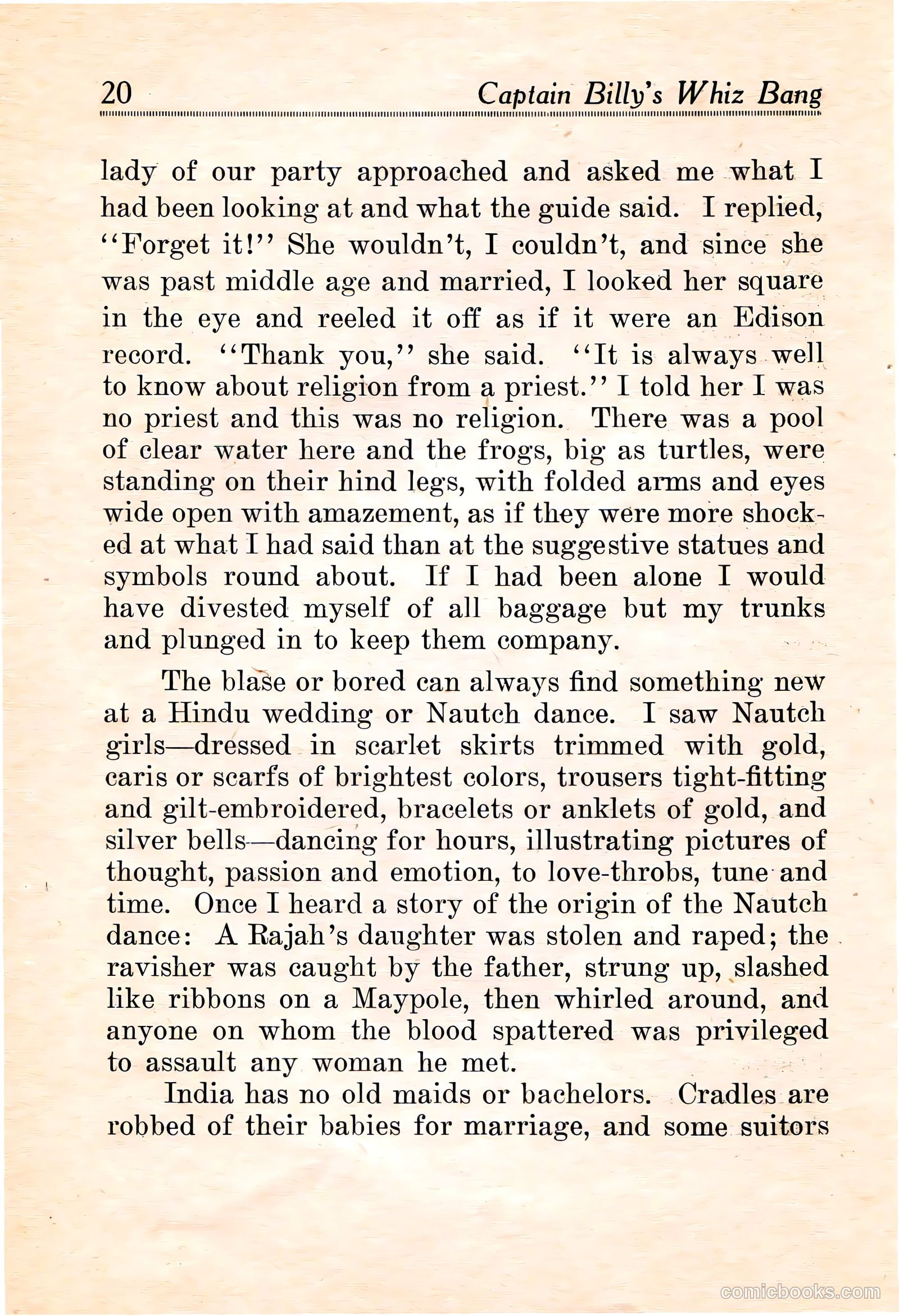
This is a humorous travel narrative from *Captain Billy's Whiz Bang*, an American satirical magazine. The passage describes the author's experiences visiting Hindu temples and witnessing Nautch dances in India. The humor derives from the author's irreverent commentary on Indian religious practices and customs. When a middle-aged woman asks him to explain religious symbols and statues, he deliberately delivers an off-color or suggestive explanation, then jokes that even the frogs appear "shocked" by his interpretation rather than the actual temple imagery. The piece employs ethnic stereotyping typical of early 20th-century American humor, presenting Indian marriage customs and dance traditions as exotic and scandalous to Western readers. The origin story of the Nautch dance—linking it to violence and assault—is presented as sensationalist entertainment. The concluding observation about arranged marriages reflects period Western attitudes portraying Indian practices as backward and incomprehensible.
📄 Transcribed text from this page (OCR, searchable)
Machine-transcribed from the original scan — historical spelling and the odd misread are preserved.
20 Captain Billy's Whiz Bang lady of our party approached and asked me what I had been looking at and what the guide said. I replied, “Forget it!” She wouldn’t, I couldn’t, and since she was past middle age and married, I looked her square in the eye and reeled it off as if it were an Edison record. “Thank you,” she said. “It is always well to know about religion from a priest.” I told her I was no priest and this was no religion. There was a pool of clear water here and the frogs, big as turtles, were standing on their hind legs, with folded arms and eyes wide open with amazement, as if they were more shock- ed at what I had said than at the suggestive statues and symbols round about. If I had been alone I would have divested myself of all baggage but my trunks and plunged in to keep them company. The blase or bored can always find something new at a Hindu wedding or Nautch dance. I saw Nautch girls—dressed in scarlet skirts trimmed with gold, earis or scarfs of brightest colors, trousers tight-fitting and gilt-embroidered, bracelets or anklets of gold, and silver bells—dancing for hours, illustrating pictures of thought, passion and emotion, to love-throbs, tune and time. Once I heard a story of the origin of the Nautch dance: A Rajah’s daughter was stolen and raped; the ravisher was caught by the father, strung up, slashed like ribbons on a Maypole, then whirled around, and anyone on whom the blood spattered was privileged to assault any woman he met. India has no old maids or bachelors. Cradles are robbed of their babies for marriage, and some suitors