
Captain Billy's Whiz Bang, January 1921 · page 40 of 68
Captain Billy's Whiz Bang #16 — page 40: what you’re looking at
What you’re looking at
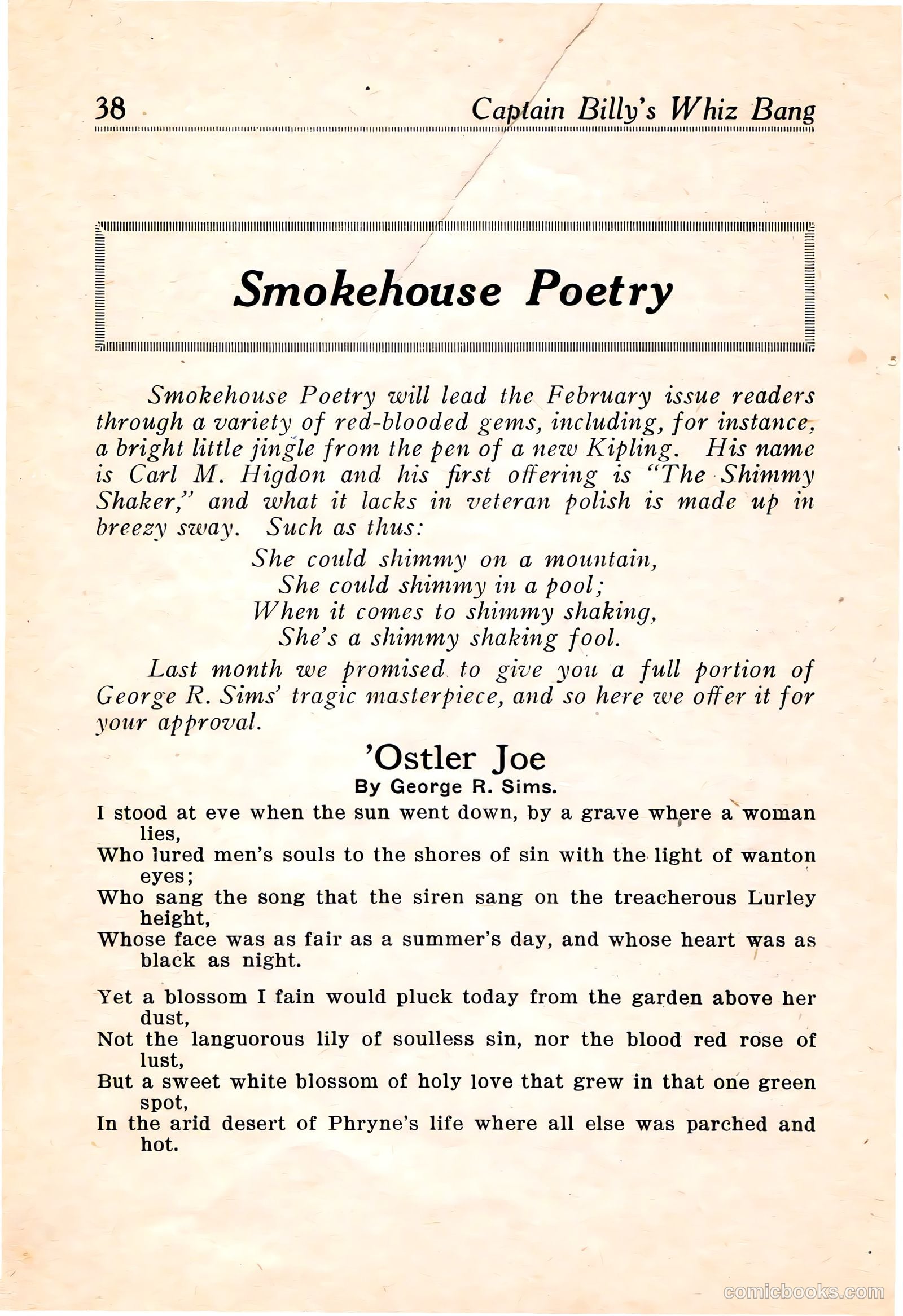
This page is primarily **literary content**, not satire or political commentary. It features two poem selections for *Captain Billy's Whiz Bang*, a 1920s American humor magazine. The first is Carl M. Higdon's "The Shimmy Shaker"—a lighthearted jingle about the shimmy, a popular 1920s dance considered somewhat risqué. The magazine presents it as amusingly crude but energetic. The second is George R. Sims' "Ostler Joe," a melodramatic Victorian-era poem about a fallen woman at her grave. The narrator considers placing flowers there, ultimately choosing a "sweet white blossom of holy love" over symbols of "sin" and "lust." This represents redemptive salvation theology common to sentimental literature. Together, these pieces reflect the magazine's mix of modern, cheeky humor ("Shimmy Shaker") alongside reprinted moral melodrama ("Ostler Joe")—contrasting contemporary irreverence with older literary sentimentality.
📄 Transcribed text from this page (OCR, searchable)
Machine-transcribed from the original scan — historical spelling and the odd misread are preserved.
38 Captain Billy's Whiz Bang Smokehouse Poetry Smokehouse Poetry will lead the February issue readers through a variety of red-blooded gems, including, for instance, a bright little jingle from the pen of a new Kipling. His name is Carl M. Higdon and his first offering is “The Shimmy Shaker,” and what it lacks in veteran polish is made up in breezy sway. Such as thus: She could shimmy on a mountain, She could shimmy in a pool; When it comes to shimmy shaking, She’s a shimmy shaking fool. Last month we promised to give you a full portion of George R. Sims’ tragic masterpiece, and so here we offer it for your approval. 'Ostler Joe By George R. Sims. I stood at eve when the sun went down, by a grave where a woman lies, Who lured men’s souls to the shores of sin with the light of wanton eyes; Who sang the song that the siren sang on the treacherous Lurley height, Whose face was as fair as a summer’s day, and whose heart was as black as night. Yet a blossom I fain would pluck today from the garden above her dust, Not the languorous lily of soulless sin, nor the blood red rose of lust, But a sweet white blossom of holy love that grew in that one green spot, In the arid desert of Phryne’s life where all else was parched and hot.