
Captain Billy's Whiz Bang, January 1921 · page 12 of 68
Captain Billy's Whiz Bang #16 — page 12: what you’re looking at
What you’re looking at
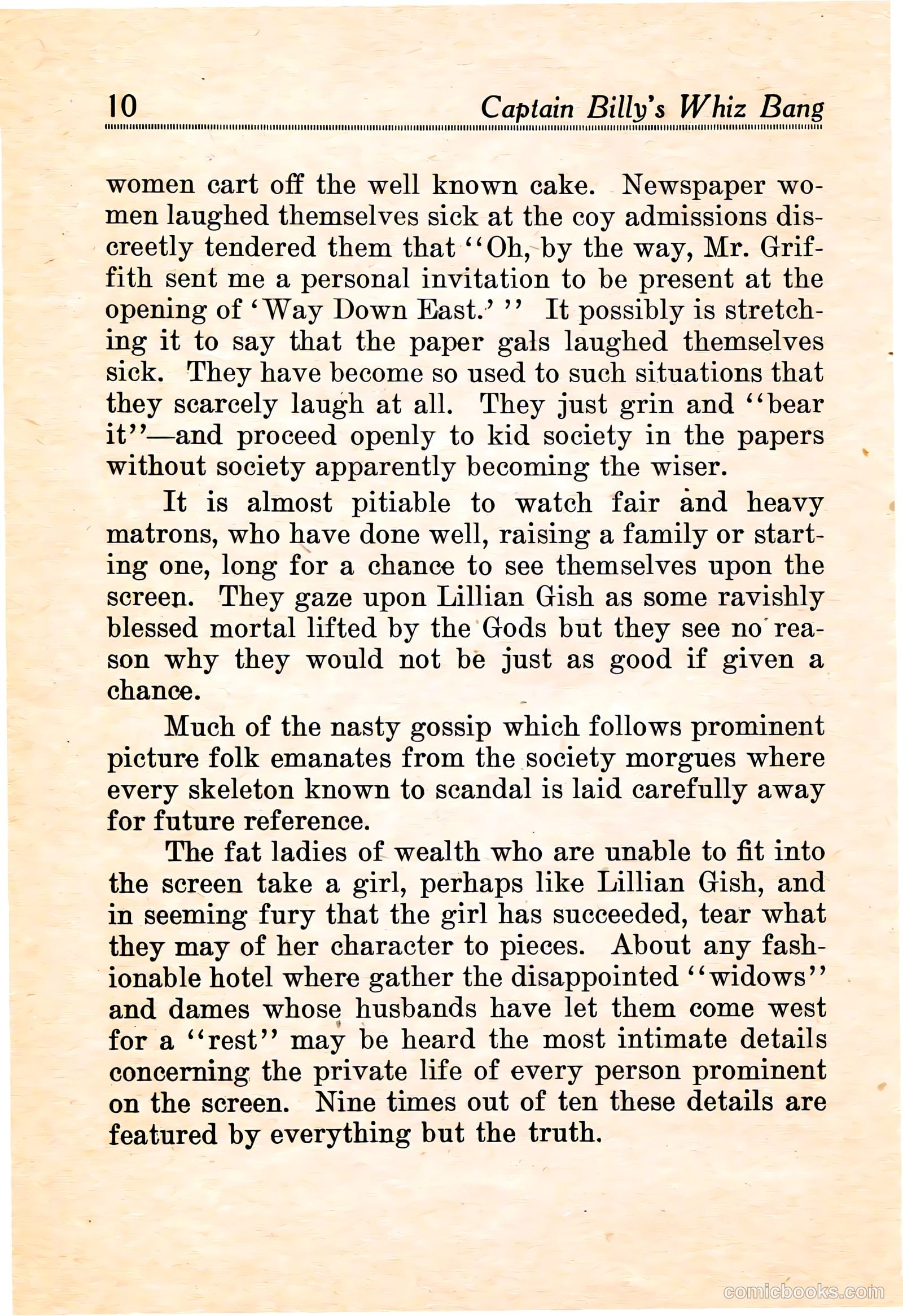
This satirical piece from *Captain Billy's Whiz Bang* criticizes Hollywood's social hierarchy and the gossip machine surrounding silent film stars. The text references **Lillian Gish**, a major actress of the era, and **D.W. Griffith**, the prominent director who directed her in films including "Way Down East" (1920). The satire targets wealthy society women who resent movie stars' fame and glamour. Unable to achieve stardom themselves, these women—described as "fat ladies of wealth"—gather at fashionable hotels to spread malicious rumors about film personalities, fabricating scandalous details about their private lives. The piece mocks newspaper women for accepting dubious "exclusives" about celebrities, and scorns the society matrons whose envy drives them to tear down successful actresses they secretly envy. The core joke: Hollywood's gossip originates not from reliable sources but from bitter, disappointed wealthy women whose husbands brought them west for health "rests."
📄 Transcribed text from this page (OCR, searchable)
Machine-transcribed from the original scan — historical spelling and the odd misread are preserved.
10 Captain Billy's Whiz Bang women cart off the well known cake. Newspaper wo- men laughed themselves sick at the coy admissions dis- creetly tendered them that “Oh, by the way, Mr. Grif- fith sent me a personal invitation to be present at the opening of ‘Way Down East.’ ” It possibly is stretch- ing it to say that the paper gals laughed themselves sick. They have become so used to such situations that they scarcely laugh at all. They just grin and “bear it”—and proceed openly to kid society in the papers without society apparently becoming the wiser. It is almost pitiable to watch fair and heavy matrons, who have done well, raising a family or start- ing one, long for a chance to see themselves upon the screen. They gaze upon Lillian Gish as some ravishly blessed mortal lifted by the Gods but they see no rea- son why they would not be just as good if given a chance. Much of the nasty gossip which follows prominent picture folk emanates from the society morgues where every skeleton known to scandal is laid carefully away for future reference. The fat ladies of wealth who are unable to fit into the screen take a girl, perhaps like Lillian Gish, and in seeming fury that the girl has succeeded, tear what they may of her character to pieces. About any fash- ionable hotel where gather the disappointed “widows” and dames whose husbands have let them come west for a “rest” may be heard the most intimate details concerning the private life of every person prominent on the screen. Nine times out of ten these details are featured by everything but the truth.