
Captain Billy's Whiz Bang, January 1921 · page 36 of 68
Captain Billy's Whiz Bang #16 — page 36: what you’re looking at
What you’re looking at
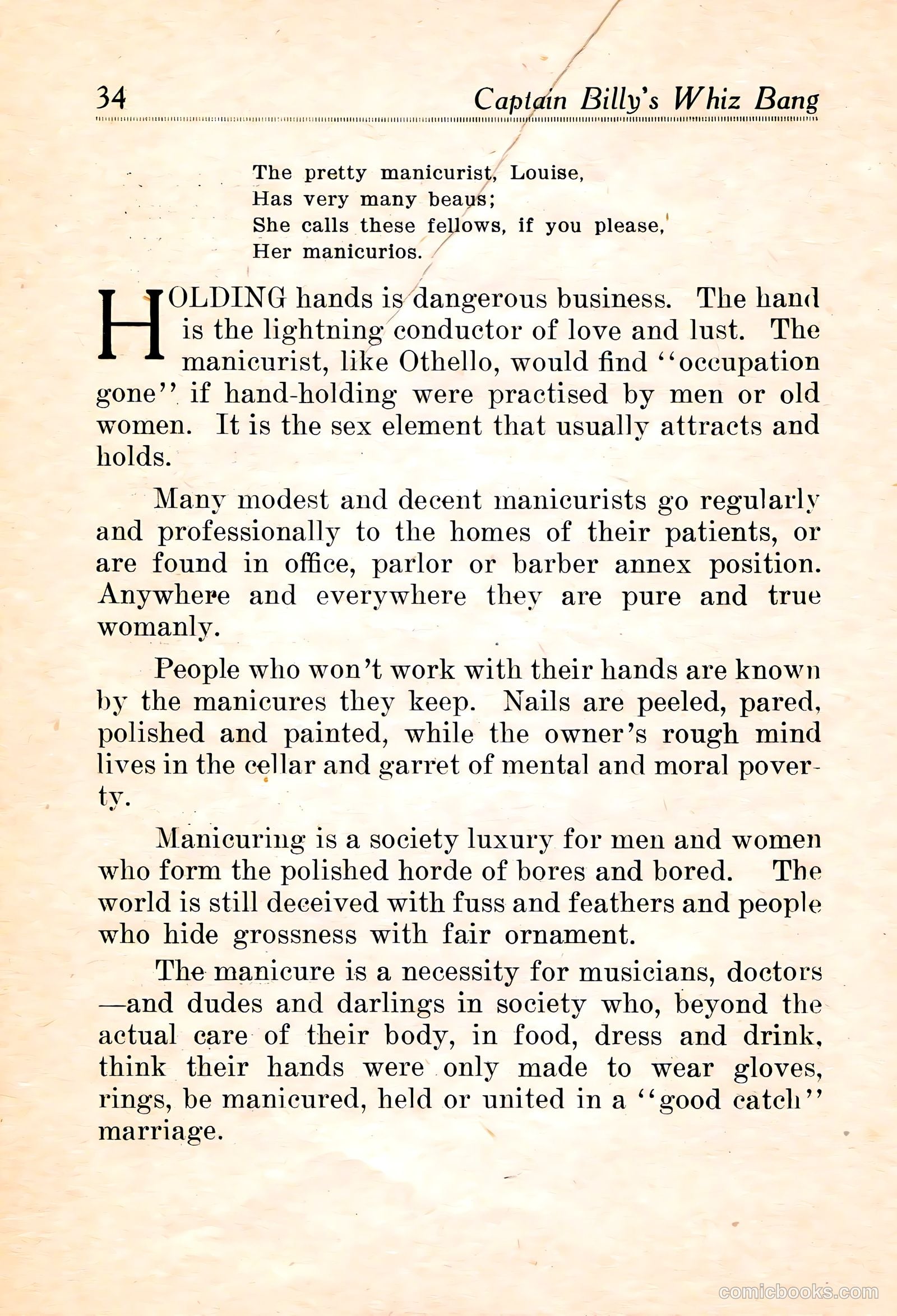
This page from *Captain Billy's Whiz Bang* opens with a joke poem about a manicurist named Louise whose male clients are called "manicurios" (a pun on "manicure"). The accompanying essay satirizes manicuring as a social practice revealing deeper truths about class and character. The satire operates on multiple levels: **The core critique**: Manicuring exposes moral laziness—people with perfect nails but "rough minds" living in "mental and moral poverty." It's presented as a marker of idle wealth. **Gender dynamics**: The piece references hand-holding's erotic charge, noting manicurists depend on physical contact with attractive male clients for their livelihood. The reflexive defense of manicurists' "purity and true womanly" nature suggests awareness of sexual innuendo. **Class commentary**: The essay dismisses manicuring as affectation for the "polished horde of bores"—society people too delicate to work, fit only for "good catch marriages." The allusion to Othello adds tragic weight, implying lost purpose and masculine decline.
📄 Transcribed text from this page (OCR, searchable)
Machine-transcribed from the original scan — historical spelling and the odd misread are preserved.
34 Captain Billy's Whiz Bang The pretty manicurist, Louise, Has very many beaus; She calls these fellows, if you please, Her manicurios. HOLDING hands is dangerous business. The hand is the lightning conductor of love and lust. The manicurist, like Othello, would find “occupation gone” if hand-holding were practised by men or old women. It is the sex element that usually attracts and holds. Many modest and decent manicurists go regularly and professionally to the homes of their patients, or are found in office, parlor or barber annex position. Anywhere and everywhere they are pure and true womanly. People who won’t work with their hands are known by the manicures they keep. Nails are peeled, pared, polished and painted, while the owner’s rough mind lives in the cellar and garret of mental and moral pover- ty. Manicuring is a society luxury for men and women who form the polished horde of bores and bored. The world is still deceived with fuss and feathers and people who hide grossness with fair ornament. The manicure is a necessity for musicians, doctors —and dudes and darlings in society who, beyond the actual care of their body, in food, dress and drink, think their hands were only made to wear gloves, rings, be manicured, held or united in a “good catch” marriage.