
Captain Billy's Whiz Bang, January 1921 · page 37 of 68
Captain Billy's Whiz Bang #16 — page 37: what you’re looking at
What you’re looking at
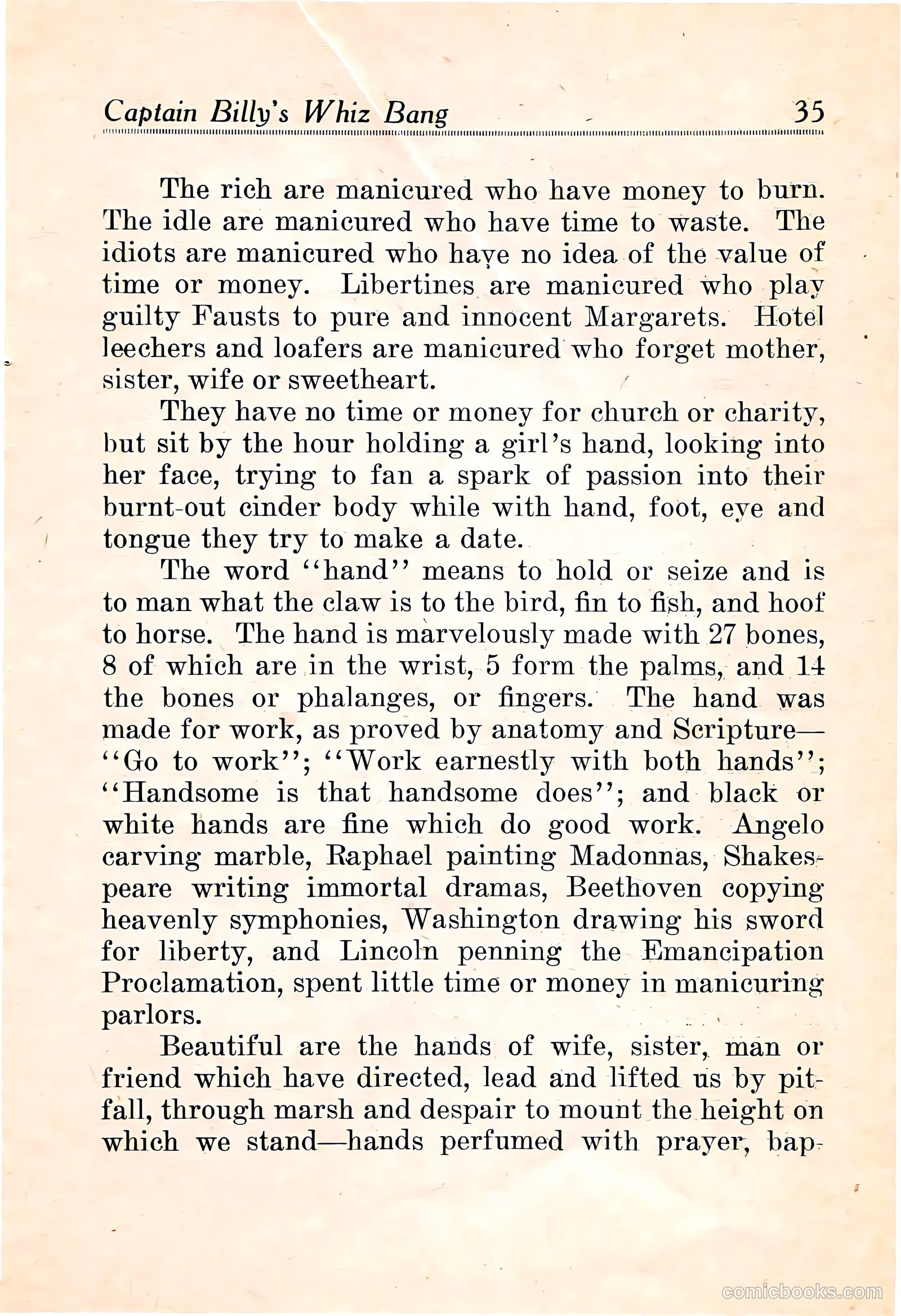
This page from the satirical magazine *Captain Billy's Whiz Bang* (page 35) mocks the then-fashionable practice of manicuring as a sign of idleness and moral decay. The text systematically categorizes who gets manicured, presenting them as social parasites: the wealthy with money to burn, the idle with time to waste, and particularly "libertines" and "hotel leechers"—men who seduce innocent women instead of contributing to society. The satire contrasts idle manicuring against productive hand-use: historical figures like Michelangelo, Raphael, Shakespeare, Beethoven, Washington, and Lincoln achieved greatness through work, not beauty parlors. The text emphasizes hands' anatomical design for labor and spiritual purpose (biblical references), arguing that truly beautiful hands belong to those who help others, not those who waste time in vanity. This reflects post-WWI American anxieties about leisure culture, gender roles, and moral standards.
📄 Transcribed text from this page (OCR, searchable)
Machine-transcribed from the original scan — historical spelling and the odd misread are preserved.
Captain Billy's Whiz Bang 35 The rich are manicured who have money to burn. The idle are manicured who have time to waste. The idiots are manicured who have no idea of the value of time or money. Libertines are manicured who play guilty Fausts to pure and innocent Margarets. Hotel leechers and loafers are manicured who forget mother, sister, wife or sweetheart. They have no time or money for church or charity, but sit by the hour holding a girl's hand, looking into her face, trying to fan a spark of passion into their burnt-out cinder body while with hand, foot, eye and tongue they try to make a date. The word "hand" means to hold or seize and is to man what the claw is to the bird, fin to fish, and hoof to horse. The hand is marvelously made with 27 bones, 8 of which are in the wrist, 5 form the palms, and 14 the bones or phalanges, or fingers. The hand was made for work, as proved by anatomy and Scripture— "Go to work"; "Work earnestly with both hands"; "Handsome is that handsome does"; and black or white hands are fine which do good work. Angelo carving marble, Raphael painting Madonnas, Shakespeare writing immortal dramas, Beethoven copying heavenly symphonies, Washington drawing his sword for liberty, and Lincoln penning the Emancipation Proclamation, spent little time or money in manicuring parlors. Beautiful are the hands of wife, sister, man or friend which have directed, lead and lifted us by pitfall, through marsh and despair to mount the height on which we stand—hands perfumed with prayer, bap-