
A complete issue · 36 pages · 1928
Life — September 28, 1928
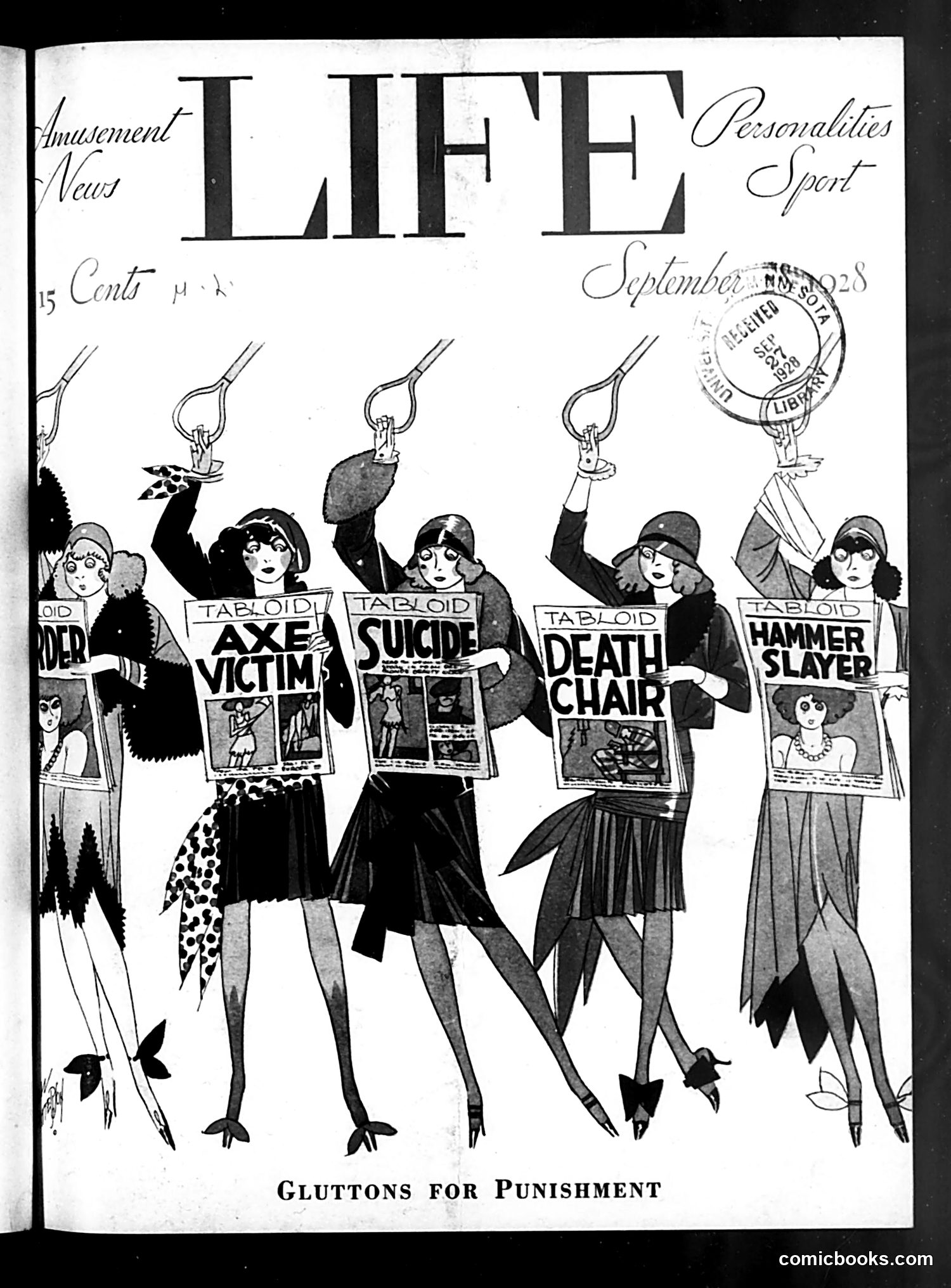
This September 1928 *Life* magazine cover satirizes sensational tabloid journalism through a dark comic image. Five women hold up exaggerated newspaper headlines representing lurid crime stories: "Axe Victim," "Suicide," "Death Chair" (execution), and "Hammer Slayer." The caption "Gluttons for Punishment" suggests these women eagerly consume—and thereby fuel demand for—sensational crime coverage. The cartoon critiques both tabloid excess and the public appetite for gruesome news. The women's fashionable 1920s attire and the noose-like objects they hold emphasize how mainstream audiences were captivated by violent crime narratives. This reflects broader 1920s anxieties about tabloid culture's influence on society during the era of famous crime trials and executions.
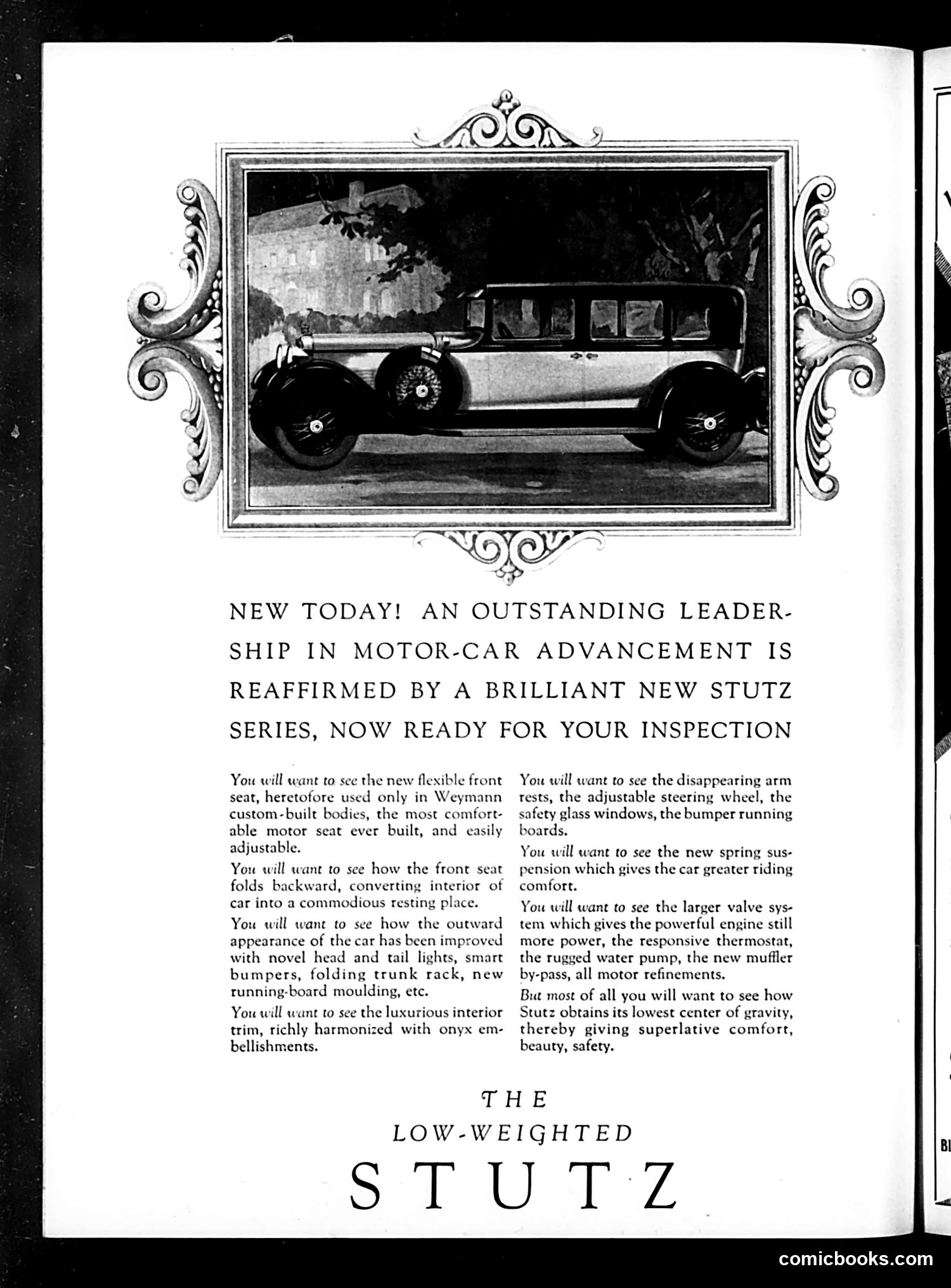
This page is primarily **advertising, not satire or editorial content**. It promotes the Stutz automobile's new series, emphasizing technical innovations like flexible front restoration, adjustable steering, spring suspension, and engine improvements. The decorative ornamental frame and formal typography reflect early-twentieth-century advertising design conventions. The side-view photograph showcases the vehicle's profile—a standard automotive marketing approach of the era. The headline "NEW TODAY! AN OUTSTANDING LEADERSHIP IN MOTOR-CAR ADVANCEMENT" positions Stutz as an industry innovator. The bullet-point list of features targets wealthy buyers interested in comfort, safety, and mechanical superiority. There is no political cartoon or satire present. This is straightforward luxury automobile marketing from Life magazine's advertising section.
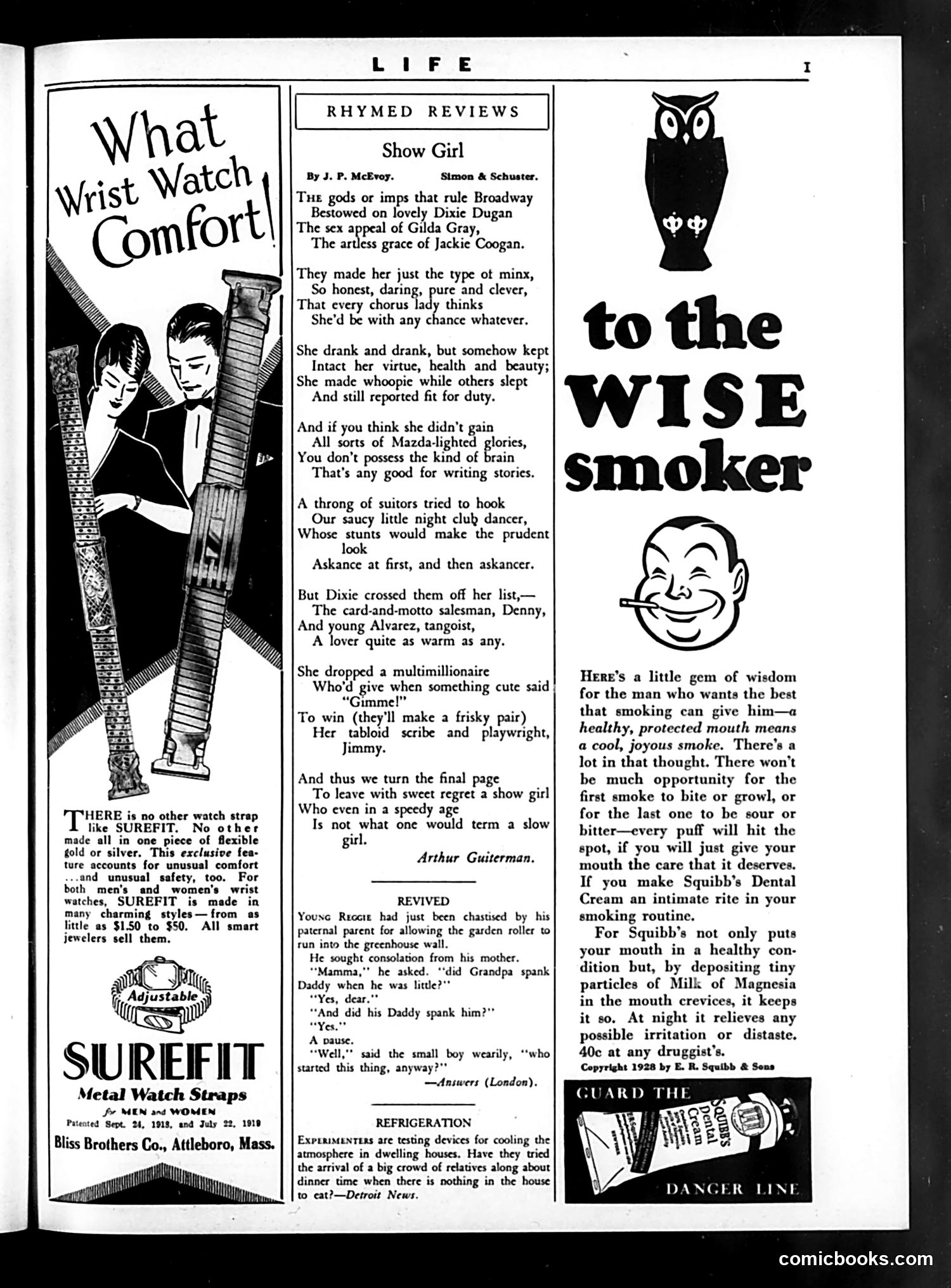
This page is primarily **advertising and entertainment content** rather than political satire. The main elements are: 1. **"What Wrist Watch Comfort"** - A SUREFIT watch strap advertisement featuring an illustration of a couple, emphasizing practicality and durability. 2. **"Show Girl" - A rhymed theater review** by J.P. McEvoy praising Dixie Dugan's performance on Broadway, celebrating her talent, virtue, and ability to attract suitors while maintaining professionalism. 3. **"To the Wise Smoker"** - An advertisement for Squibb's Dental Cream, using humor (a grinning face) to market oral hygiene benefits for smokers. 4. **"Revived"** and **"Refrigeration"** sections - Brief humorous anecdotes about parental discipline and domestic cooling experiments. The page reflects 1920s consumer culture and entertainment interests rather than political commentary.
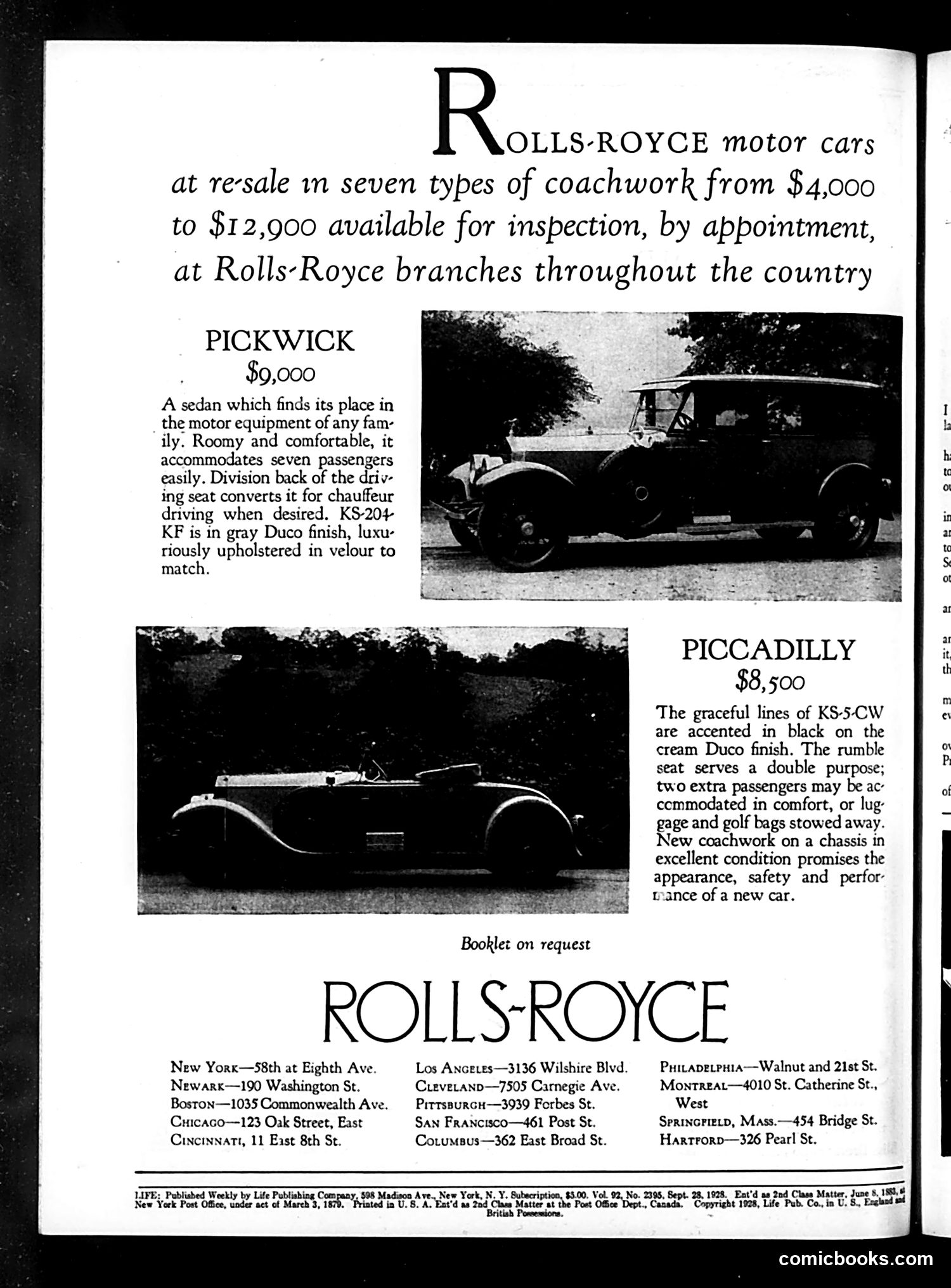
This is **not a political cartoon or satirical content**—it's a straightforward advertisement for Rolls-Royce motor cars from the 1920s (dated September 28, 1928, per the footer). The page showcases two re-sale vehicle models available through Rolls-Royce branches: the **Pickwick** sedan ($9,000) and the **Piccadilly** ($8,500). Both feature period photographs and detailed descriptions emphasizing luxury, comfort, and craftsmanship—the rumble seat converts to chauffeur seating, for instance. The advertisement lists Rolls-Royce locations across major U.S. cities (New York, Boston, Chicago, Los Angeles, etc.), targeting wealthy buyers interested in pre-owned luxury automobiles. **This is purely commercial content, not satire.**
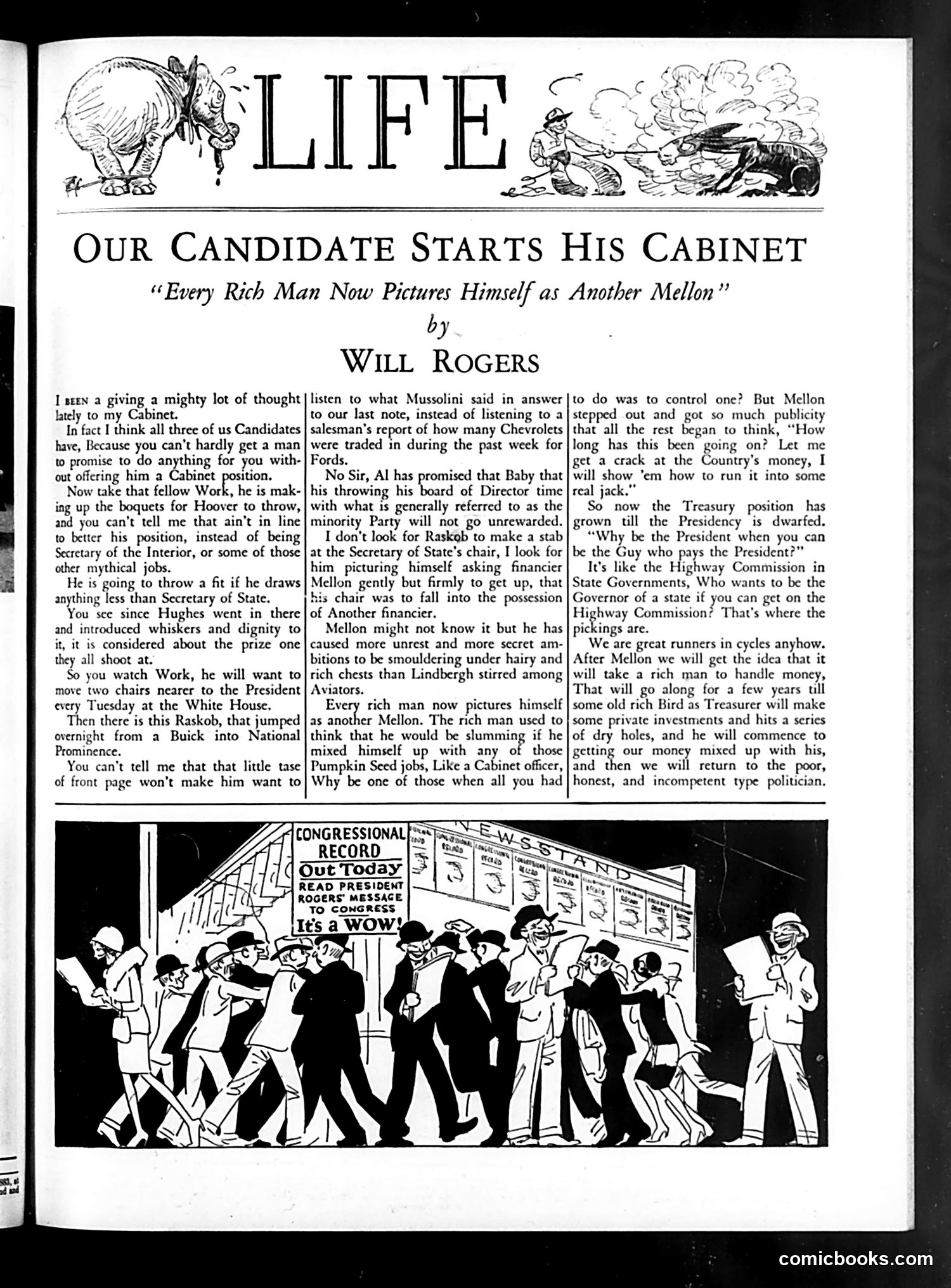
This Will Rogers column satirizes a wealthy presidential candidate assembling a Cabinet. Rogers mocks how rich men, particularly those like Andrew Mellon (Secretary of Treasury under Coolidge/Hoover), treat high office as personal vanity projects rather than serious governance. The satire targets: - **Wealthy Cabinet appointments**: Rogers suggests rich industrialists view Cabinet positions as status symbols, comparable to owning multiple luxury cars - **Mellon specifically**: Rogers criticizes Mellon's influence on economic policy and his use of the Treasury Department for personal financial benefit - **Political corruption**: The implicit critique that wealth buys political power and that unqualified men fill important positions The bottom cartoon depicts chaos outside a newsstand—likely representing public confusion or outcry over such appointments. Rogers's point: Government shouldn't reward wealth with power; competent but humble politicians would serve better than vain rich men playing at statesmanship.
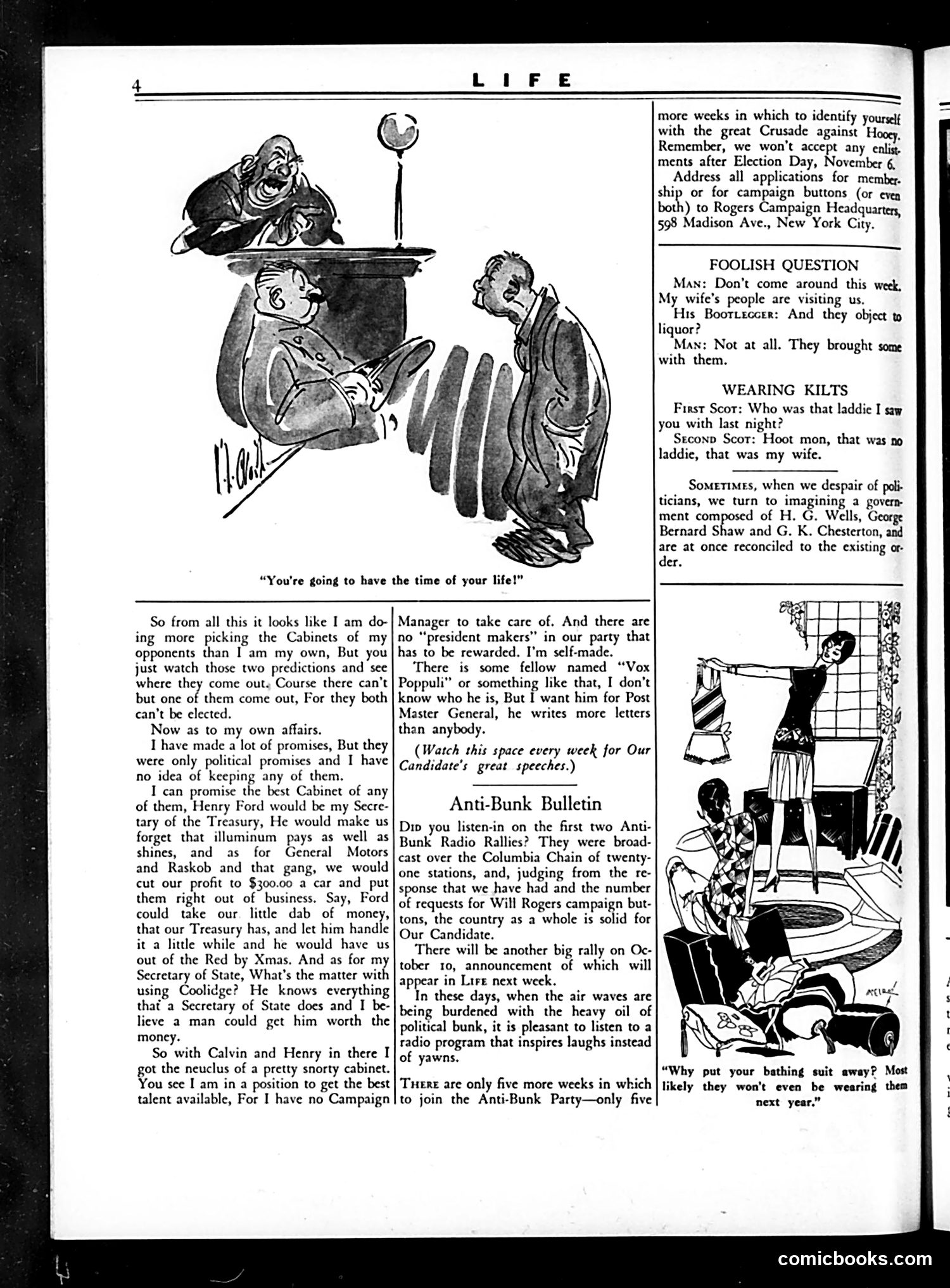
The main cartoon depicts a magician performing a trick where a figure emerges from a hat—a visual metaphor for political surprises or unexpected candidates. The caption "You're going to have the time of your life" suggests ironic commentary. The accompanying text discusses cabinet-building and political promises, mentioning specific names like Henry Ford and references to "Vox Populi" (public voice). The author expresses skepticism about political pledges, noting they were "only political promises" with no guarantee of fulfillment. The "Anti-Bunk Bulletin" section references Will Rogers campaign buttons and radio rallies, indicating this supports a political candidate's campaign against what they frame as political deception ("bunk"). The right-side comics appear unrelated domestic humor about bathing suits and visitors.
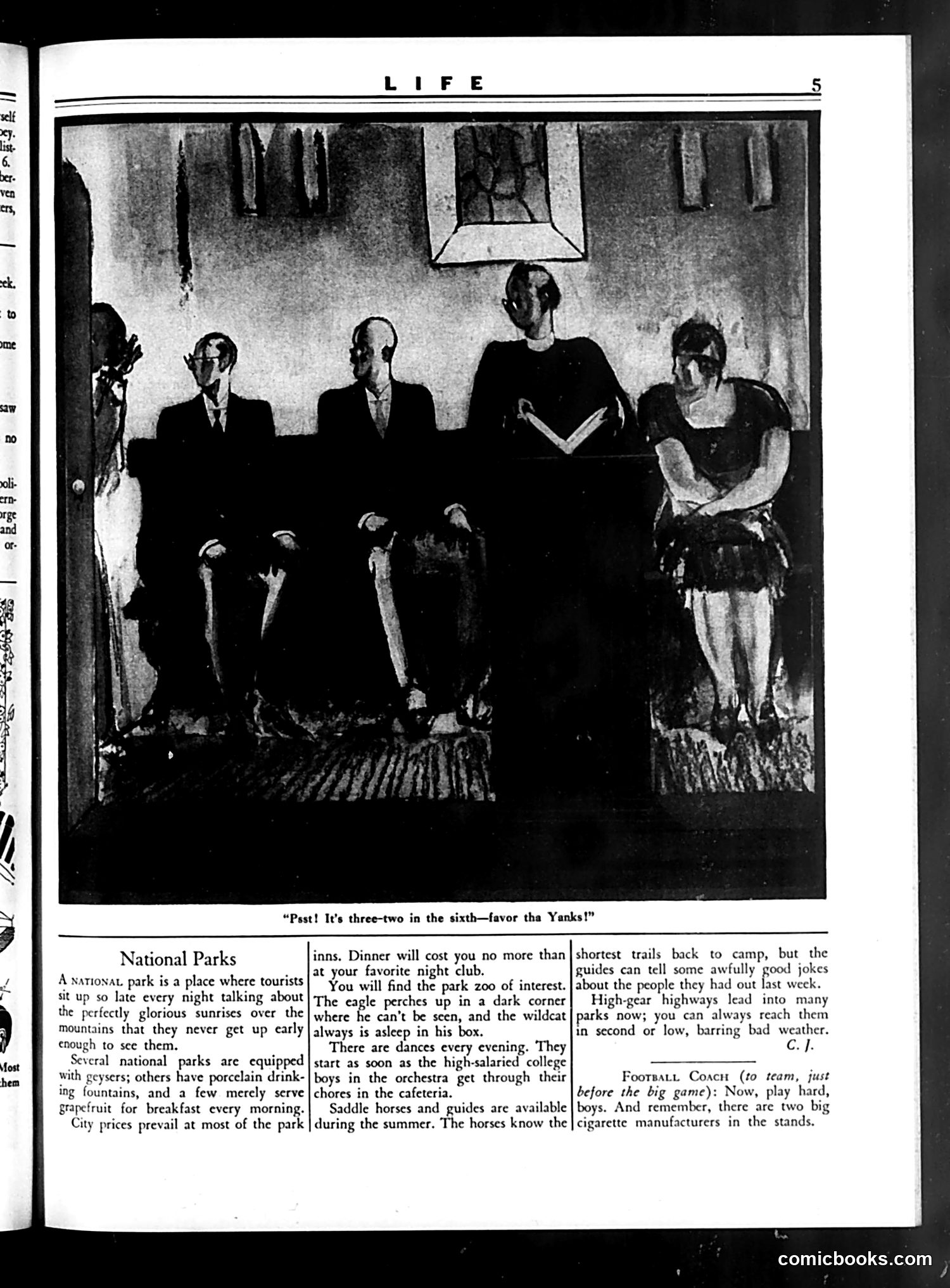
The page features a photograph captioned "Past! It's three-two in the sixth—favor the Yanks!" showing five figures in what appears to be a formal or theatrical setting. The caption references baseball scoring (3-2 in the sixth inning) and favors "the Yanks"—the New York Yankees. The image likely satirizes either a baseball game, sports betting, or gambling culture of the era. The formal dress and indoor setting suggest this may be parodying high-society interest in baseball or illegal gambling operations disguised as respectable venues. Below the image, the page includes unrelated articles on National Parks and Football Coaching tips, suggesting this is a typical miscellaneous content page from Life's satirical humor sections. Without additional context about the publication date, the specific identities of the figures remain unclear.
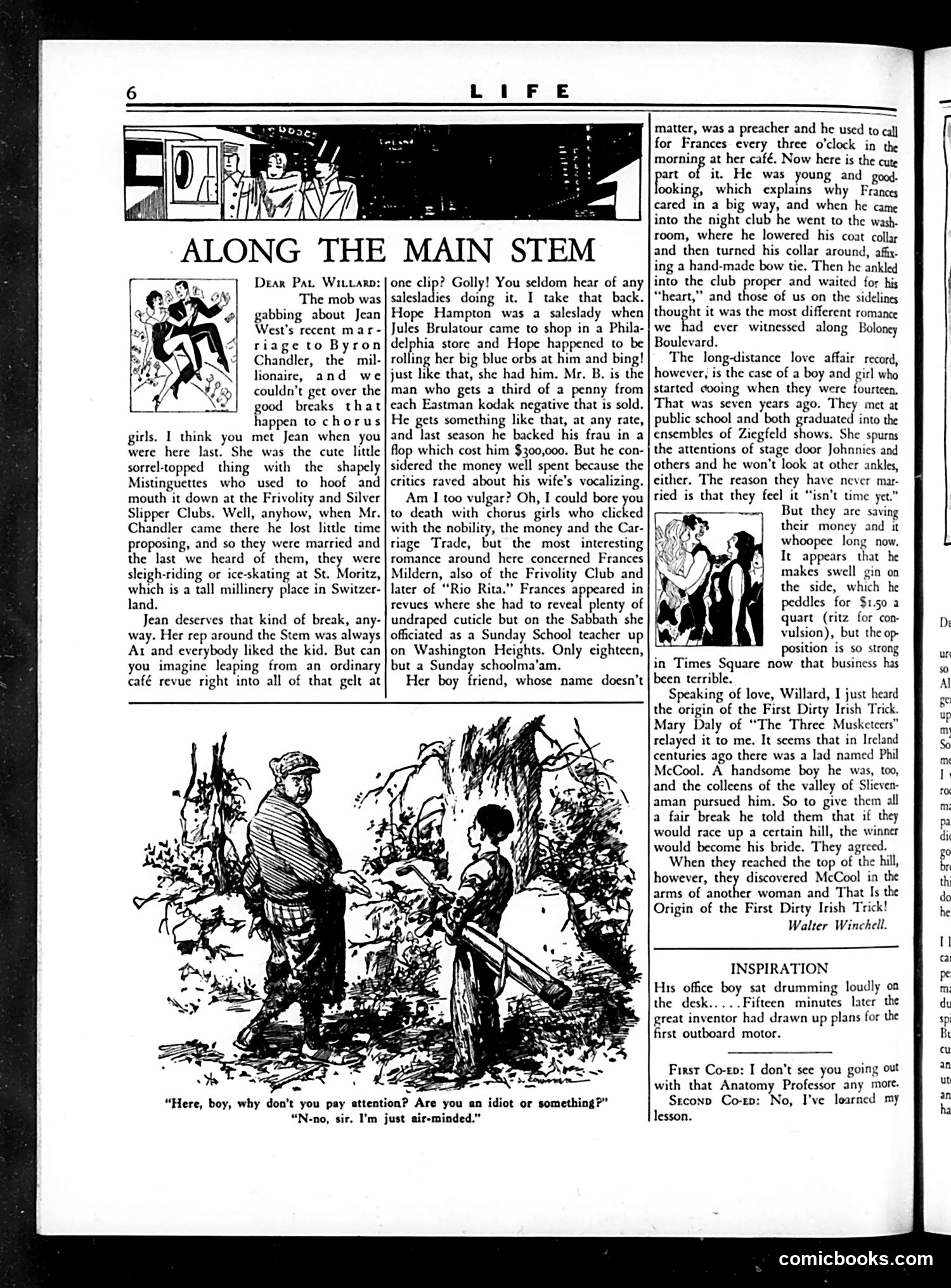
This page contains a humor column by "Dear Pal Willard" discussing entertainment and romance scandals. The main cartoon depicts a bicycle rider stopping a boy who appears distracted or daydreaming, with the caption "Here, boy, why don't you pay attention? Are you an idiot or something?" / "N-no, sir. I'm just air-minded." The joke plays on "air-minded" — likely referencing contemporary fascination with aviation and aircraft. The column discusses various show-business gossip, including stories about actresses Frances Mulford and Hope Hampton, and mentions a "First Dirty Irish Trick" origin story. The humor targets both celebrity scandals and public preoccupation with romantic entanglements among performers.
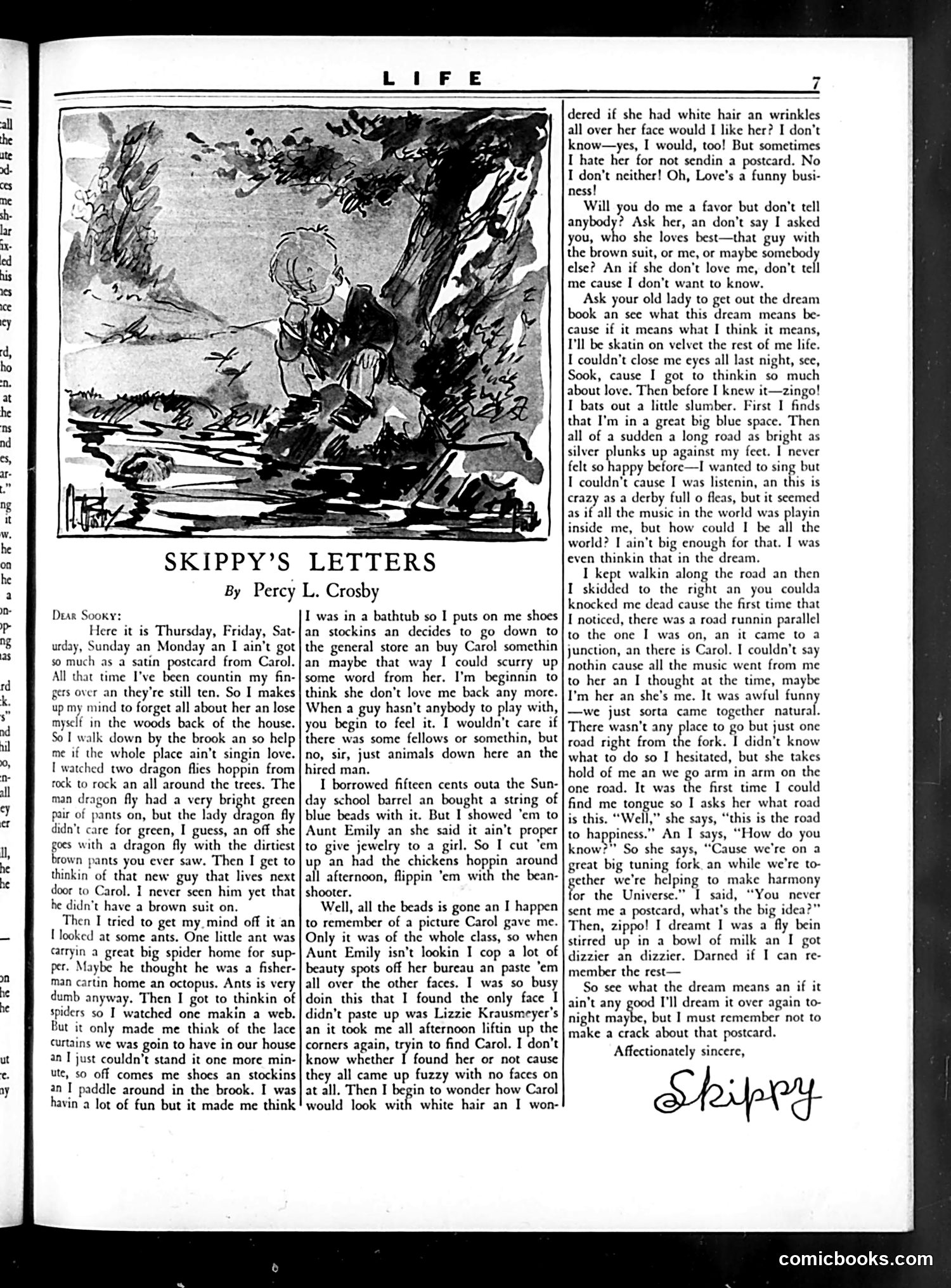
This is a humorous advice column disguised as a letter from "Skippy," a young boy writing to "Dear Sooky" about his romantic entanglements. The illustration shows a child sitting beneath a large tree, establishing the innocent, youthful perspective. Skippy's rambling letter describes various romantic confusions—worrying whether a girl named Carol loves him, seeking dream interpretation about skating, and getting tangled up in the logic of love. The humor derives from a child's earnest but naive understanding of adult romance: he conflates different girls, misinterprets romantic signals, and treats love with simultaneously serious and comical confusion. This is light domestic humor targeting early 20th-century magazine readers, poking fun at both childhood innocence and romantic anxiety.
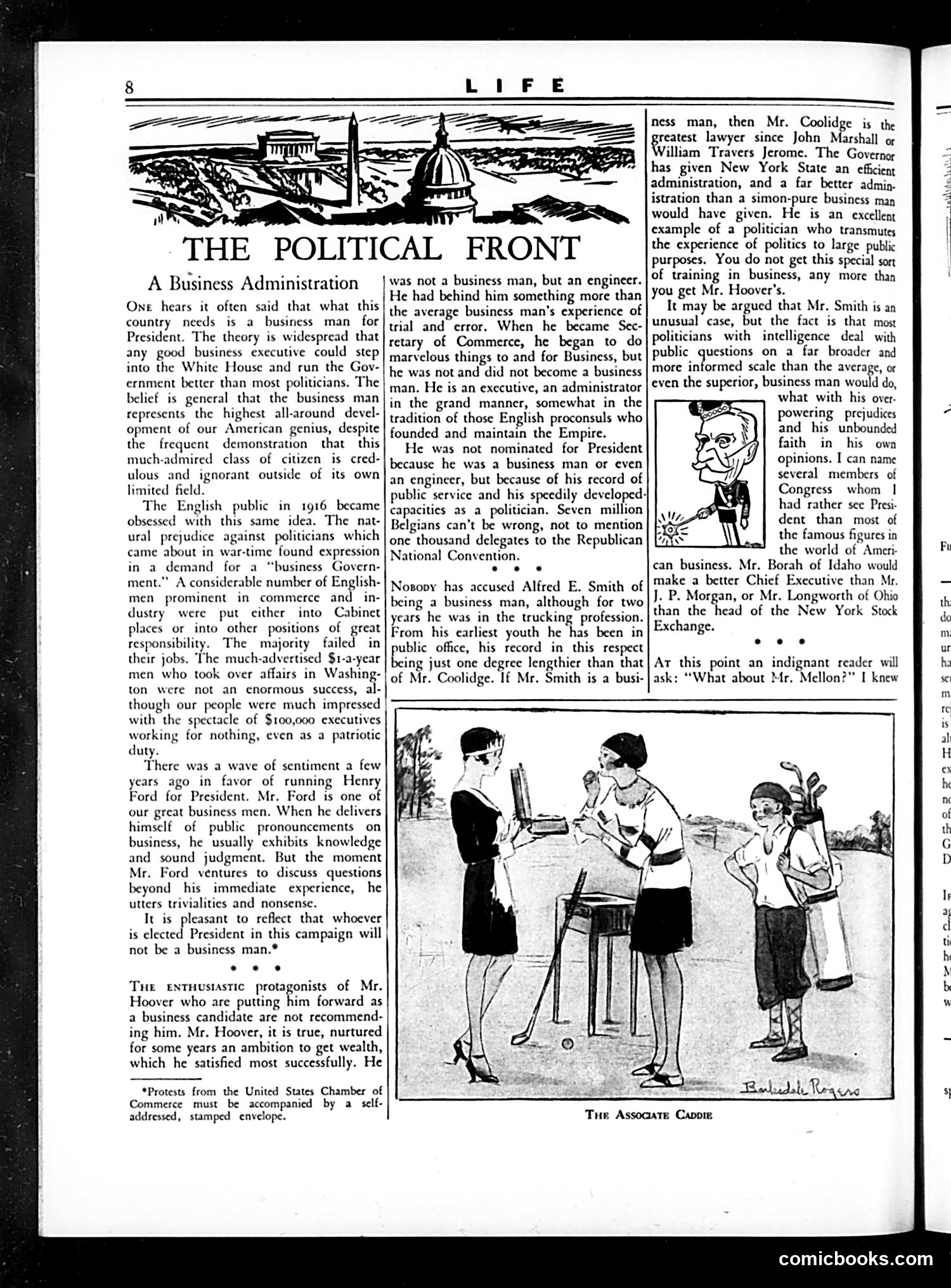
This page discusses whether business executives should become politicians. The article debates whether Herbert Hoover—presented as a successful businessman-turned-politician—represents good governance or whether politicians should remain separate from business. The cartoon titled "The Associate Caddie" (bottom) appears to satirize political campaigning, showing women in what looks like a golf setting, likely mocking the superficiality of campaign activities or the involvement of society women in politics. The article mentions Alfred E. Smith (a competitor) and references debates about whether business experience qualifies someone for high political office. The overall tone questions whether business success translates to political competence, expressing skepticism about mixing commerce and governance despite contemporary enthusiasm for "business government."
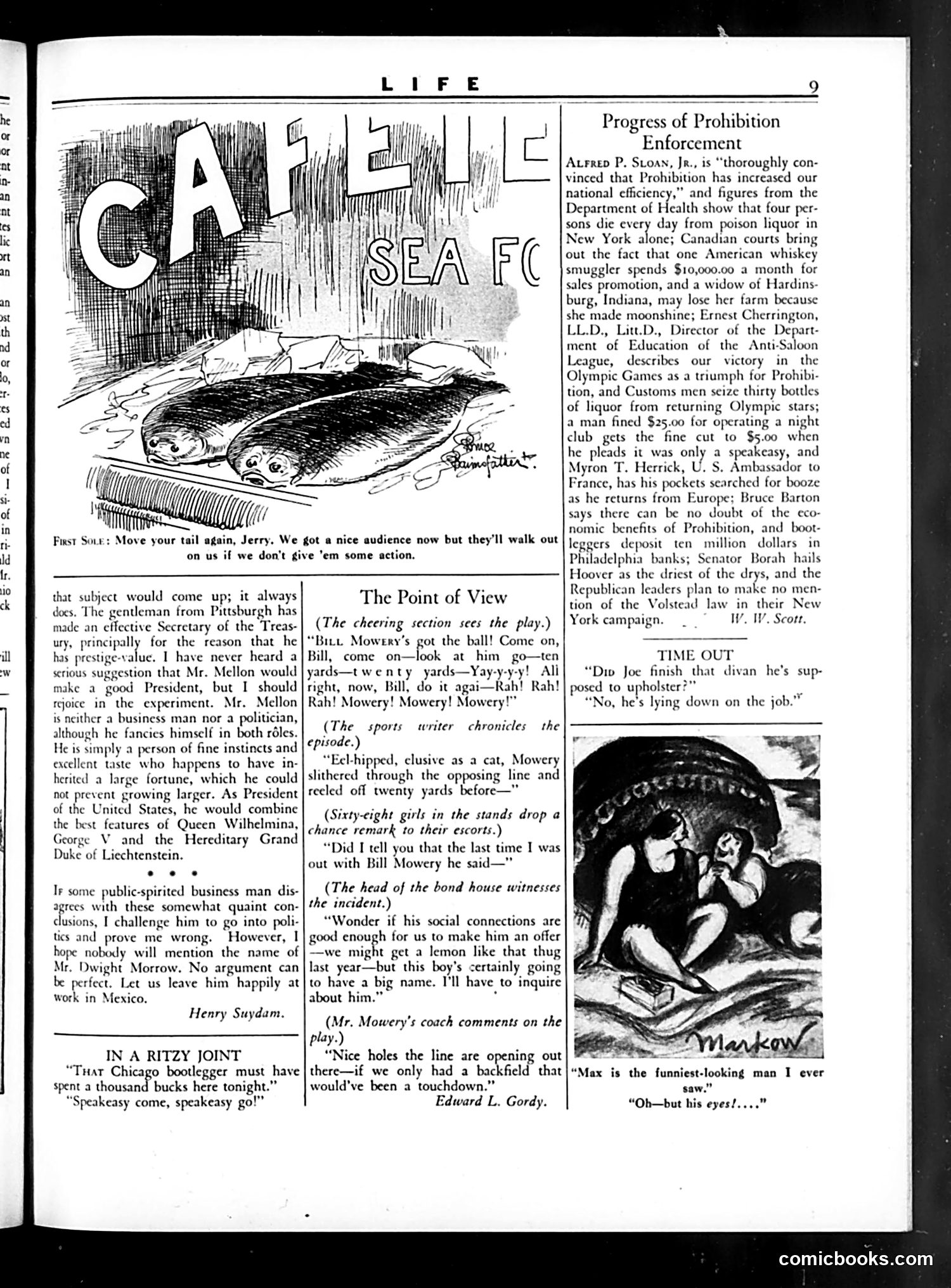
The main cartoon depicts a dead fish labeled "CAFE" with its tail, illustrating a caption: "Move your tail again, Jerry. We got a nice audience now but they'll walk out on us if we don't give 'em some action." This satirizes a failing nightclub or entertainment venue during Prohibition. The "dead fish" represents a speakeasy struggling to attract customers despite legal pressure. The joke is that even with an audience present, the establishment has "died"—it's unresponsive and lifeless, suggesting the venue can't sustain itself or provide entertainment. The text section "Progress of Prohibition Enforcement" reports on anti-alcohol efforts, including bootlegger fines and liquor seizures, providing context for why such establishments were struggling during this period of alcohol prohibition in America.
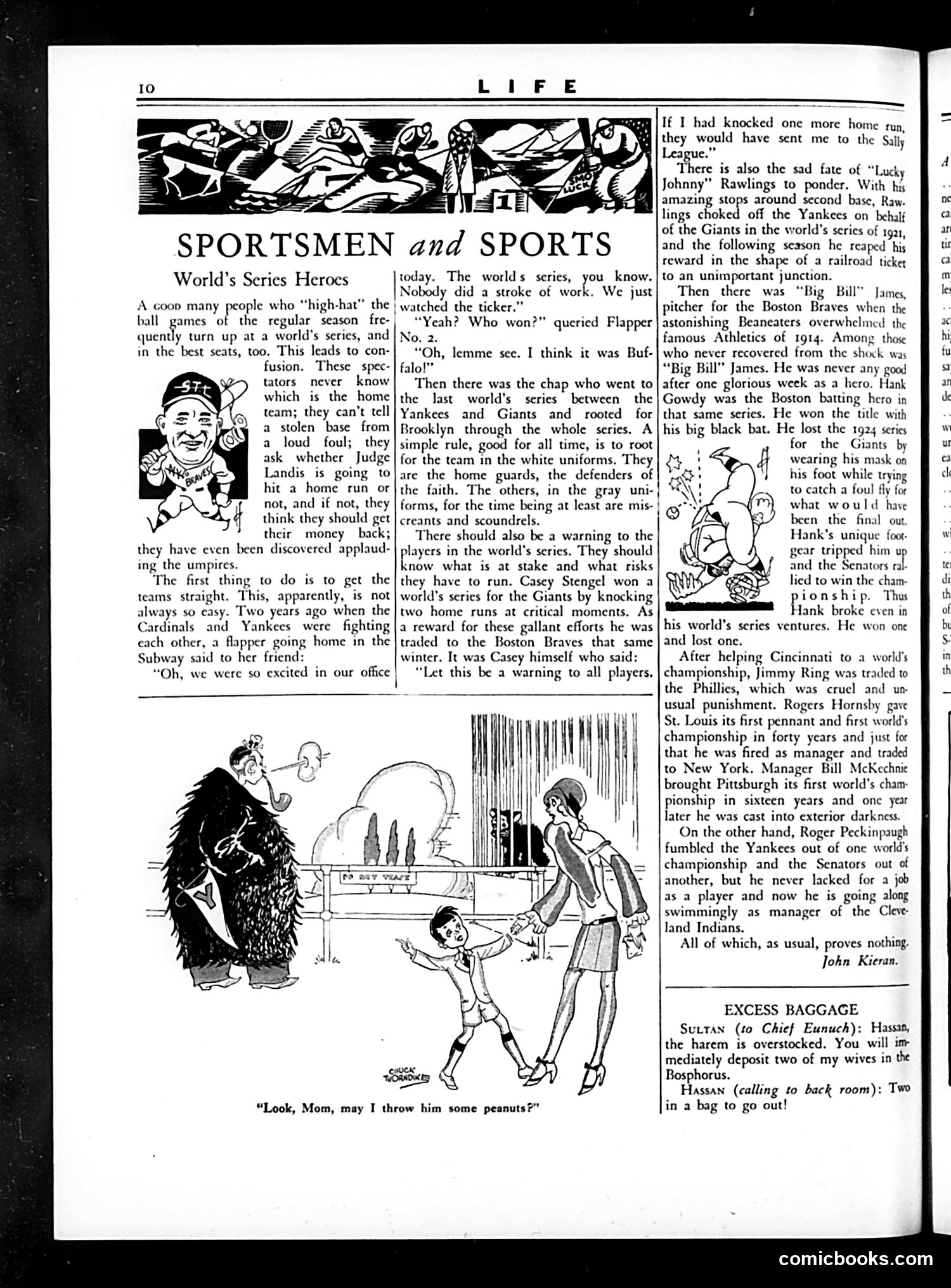
This page discusses World Series baseball controversies. The main article criticizes how umpires and players sometimes act unprofessionally during championship games. It mentions specific players like "Big Bill" James and Hank Gowdy, who reportedly had poor performances or behavioral issues in World Series play. The cartoon at bottom shows a mother at a baseball game asking "Look, Mom, may I throw him some peanuts?" — a joke about unruly fan behavior and spectator heckling at games. The "Excess Baggage" joke at bottom right plays on marital humor, with a sultan joking about depositing wives in a harem. The overall tone criticizes unsportsmanlike conduct in professional baseball during this early 20th-century era.
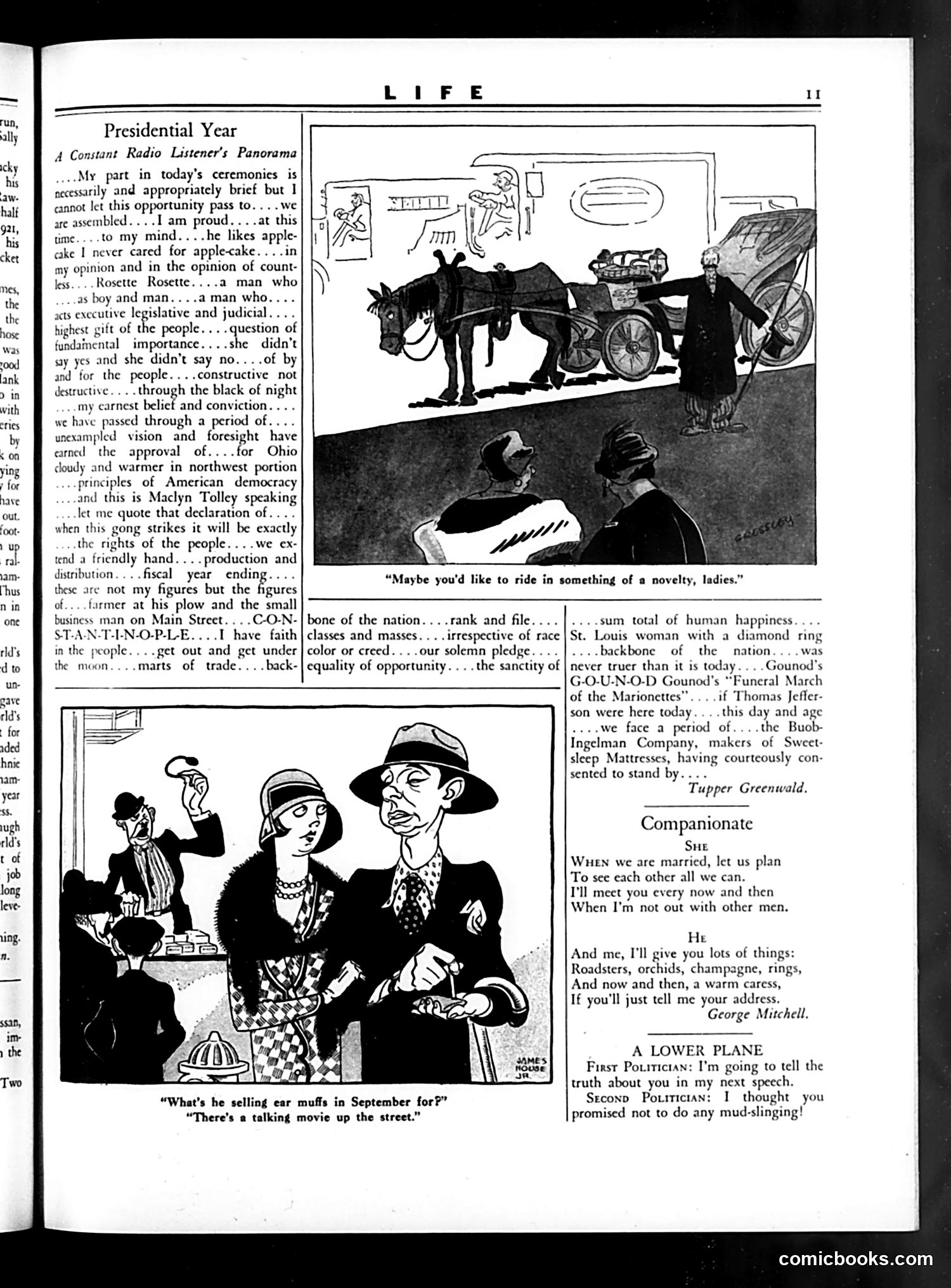
This page contains political satire from the "Presidential Year" section. The top cartoon mocks someone (likely a politician) offering ladies a ride in an old-fashioned vehicle, with the caption "Maybe you'd like to ride in something of a novelty, ladies"—satirizing outdated political appeals. The lower cartoon shows three well-dressed people discussing "ear muffs in September" and "a talking movie up the street," referencing early sound film technology as novelty entertainment. The text includes a lengthy radio address transcript and humorous poems titled "Companionate" and "A Lower Plane," where two politicians argue about campaign promises. The overall theme ridicules political rhetoric, outmoded campaigning methods, and the gap between promises and delivery. The magazine uses satire to critique contemporary political culture.
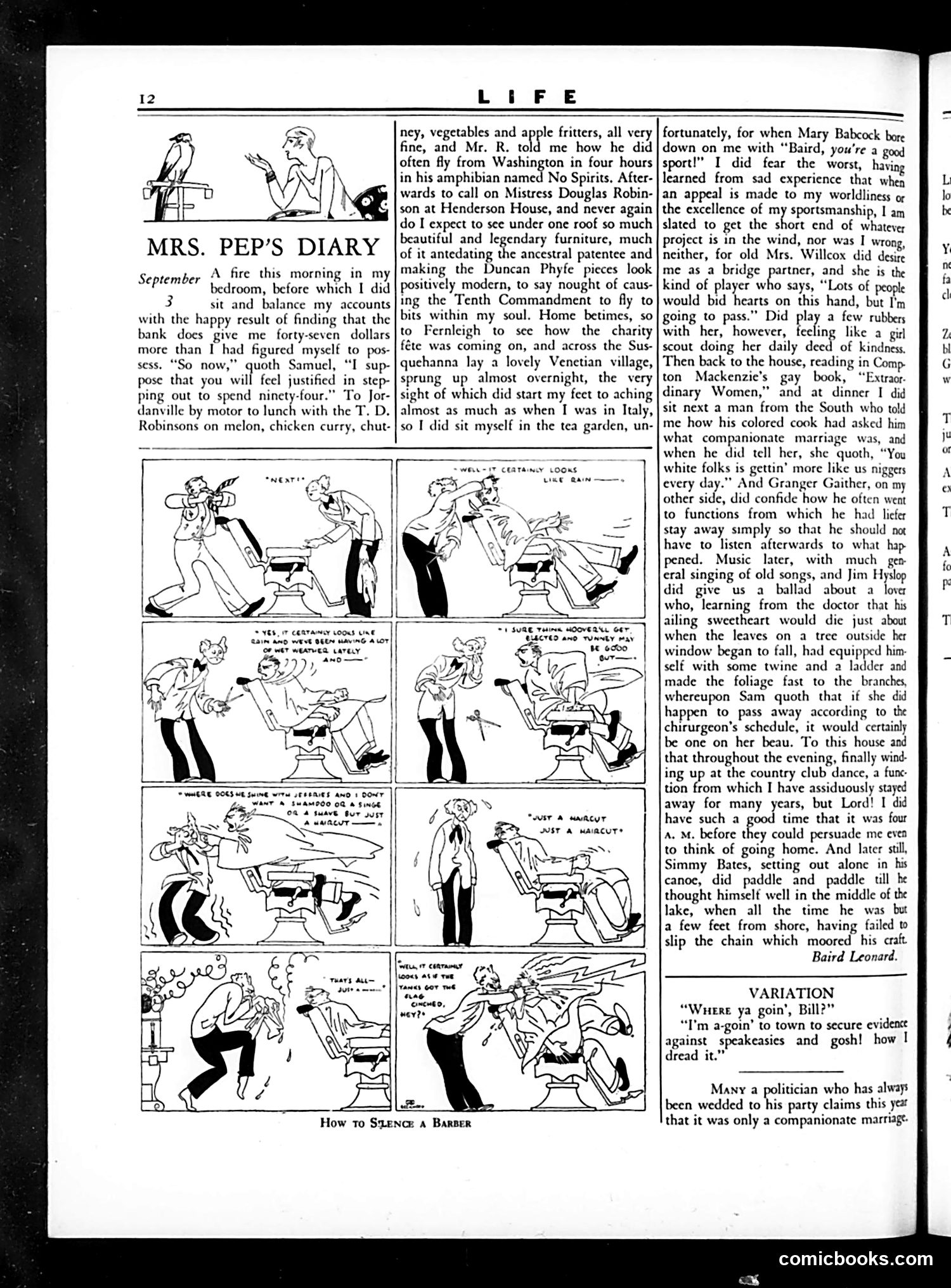
This page features two distinct items from *Life* magazine: **Mrs. Pep's Diary** is a domestic humor column describing social activities—bank interest, dinner parties, charity fundraising—written in the voice of a society woman. The tone is gently satirical of upper-class leisure pursuits. **"How to Spend a Barber"** is a comic strip (bottom half) depicting slapstick physical comedy. A man visits a barber repeatedly, with each panel showing escalating chaos and mishaps—the barber chair malfunctioning, the customer getting knocked around. The humor targets the indignity and violence of the barbering experience, played for broad comedic effect through exaggerated illustrations and minimal dialogue. Both pieces reflect early 20th-century magazine humor aimed at middle and upper-class readers.
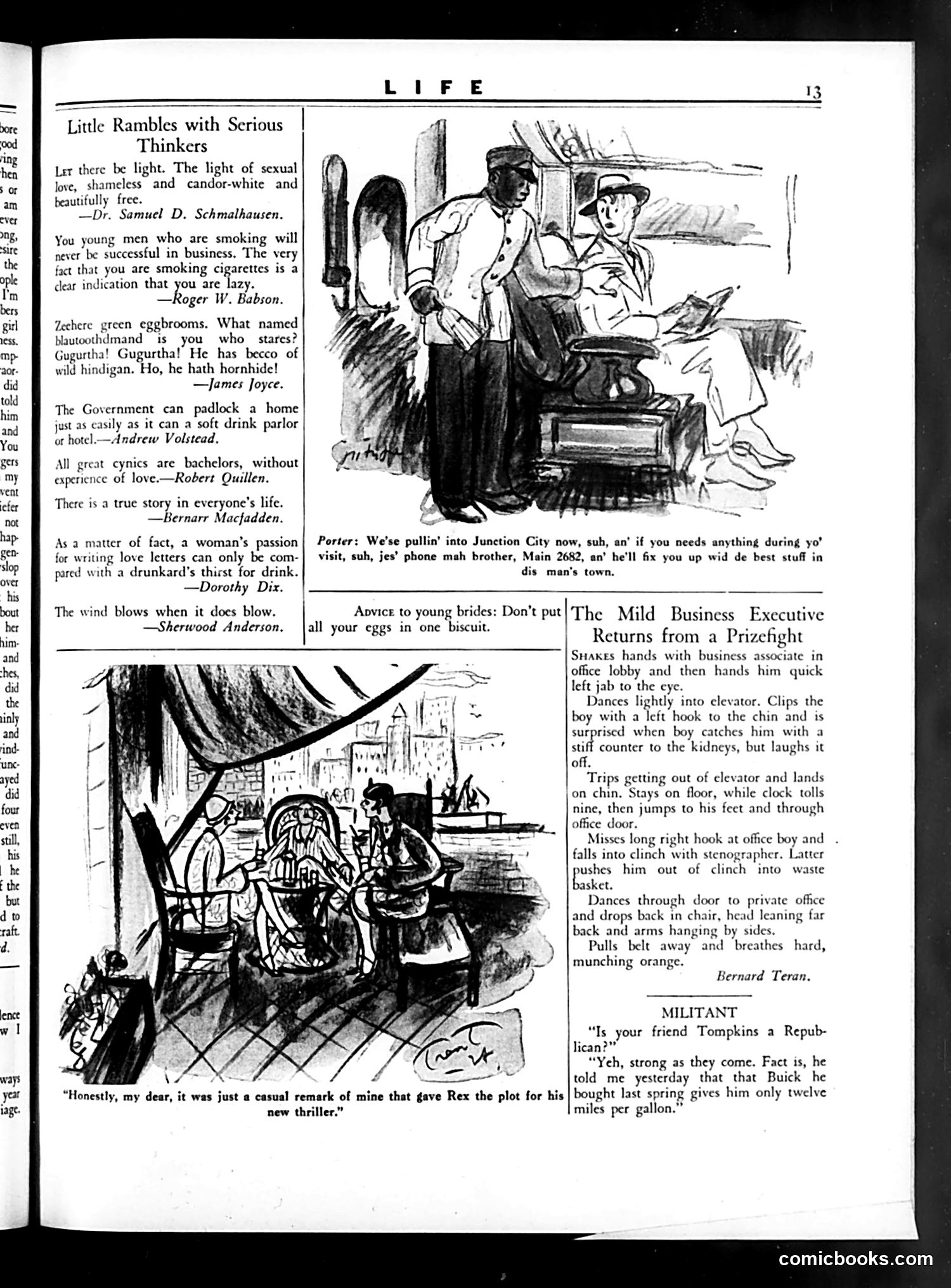
This page contains two main cartoons satirizing American social life and business culture. The **upper cartoon** depicts a porter at a train station (Junction City) offering services to passengers, capturing early 20th-century working-class vernacular and the casual racism of that era in his dialect speech. The **lower cartoon** appears to illustrate a domestic scene where a wife explains to her husband that a casual remark of his inspired the plot of his "new thriller" (likely a published work). This satirizes how writers mine personal life and marital moments for creative material. The accompanying text includes various witty aphorisms attributed to named figures, mocking bachelors, government regulation, and romantic conventions typical of Life's satirical humor tradition.
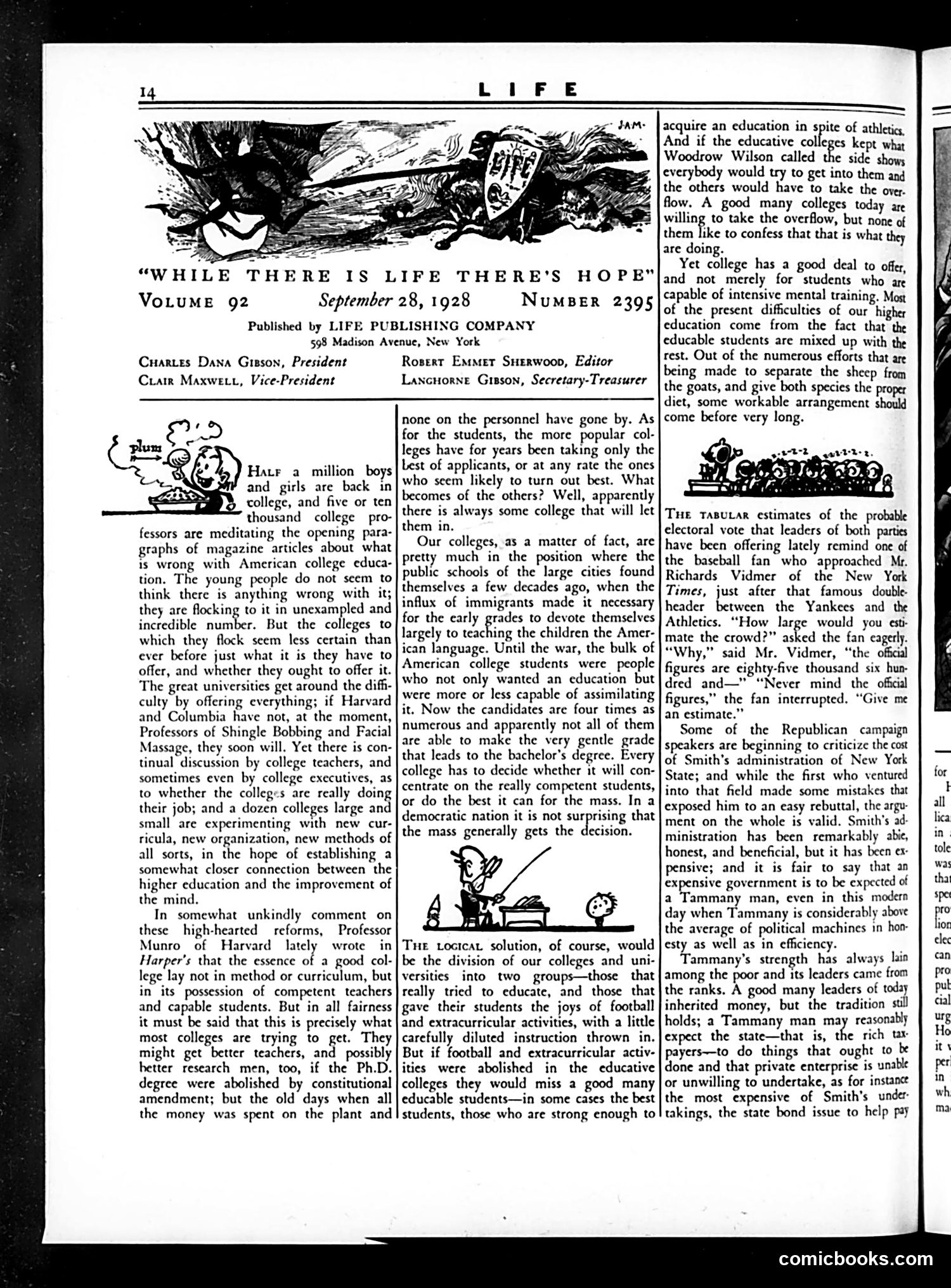
This page discusses American college education's challenges. The two cartoons illustrate the tension between academic and athletic priorities: **Top cartoon**: Shows a sleeping figure labeled "ATHLETICS" dominating over education, captioning "WHILE THERE IS LIFE THERE'S HOPE"—suggesting sports overshadow learning. **Bottom cartoon**: Depicts what appears to be a political figure (likely related to the 1928 election discussion in the text), illustrating the article's pivot to criticizing Tammany Hall and Smith's administration in New York politics. The text argues colleges admit too many students unable to handle rigorous education, while criticizing both athletic emphasis and political corruption. The page satirizes how institutions—educational and political—prioritize the wrong values over genuine merit and learning.
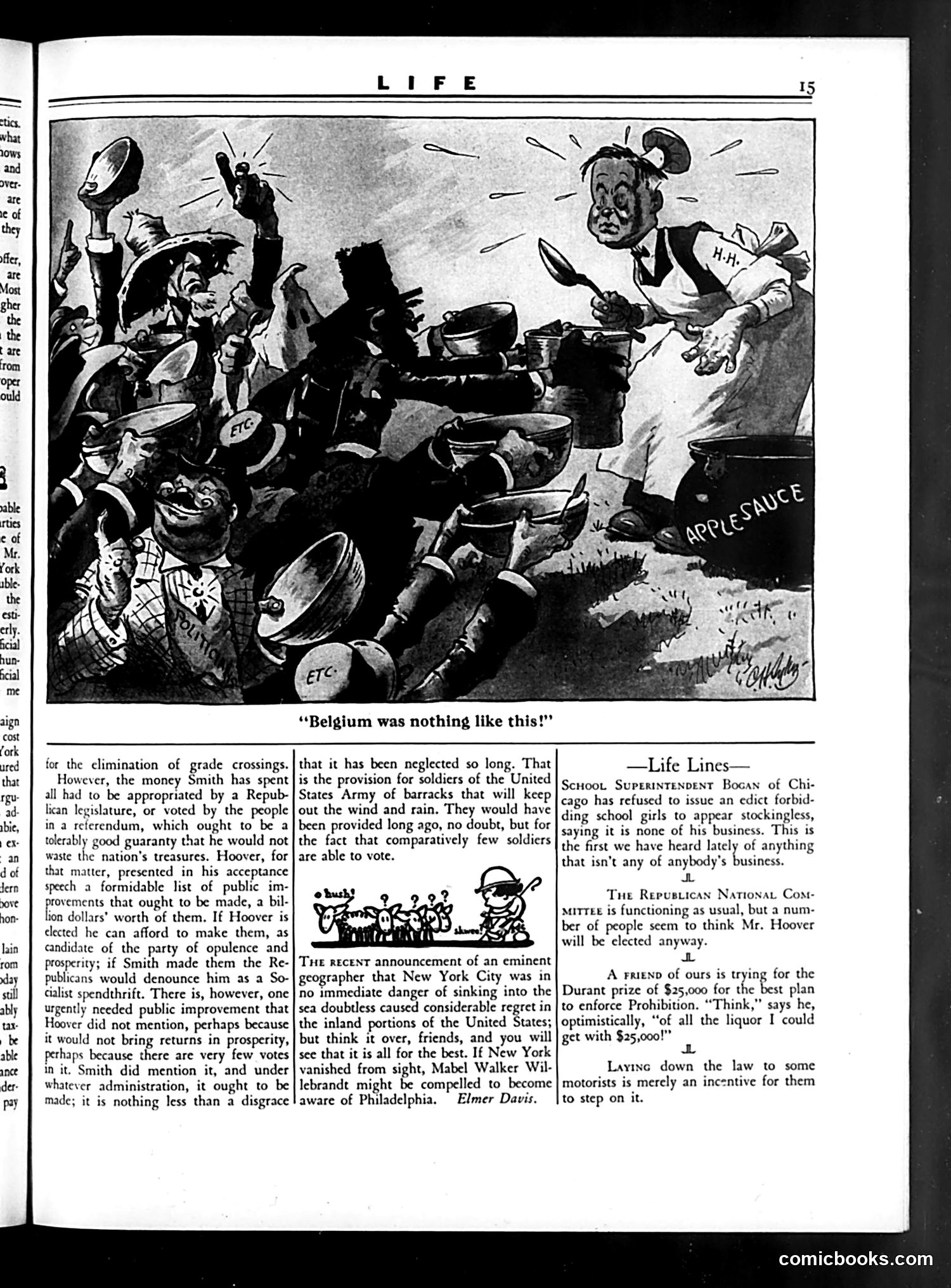
This cartoon depicts a chaotic kitchen scene where a figure labeled "H.H." (likely Herbert Hoover, who led Belgian relief efforts in WWI) stands wielding a large knife amid flying pots, pans, and an "ETC" label. Smaller figures below appear to be engaged in frantic activity. A pot labeled "APPLESAUCE" sits nearby. The satire appears to criticize inefficient or chaotic American domestic management—possibly referencing food policy, rationing, or household economy during or after WWI. The caption suggests that Belgian conditions were "nothing like this" chaos, implying American homemakers or administrators were mismanaging resources or creating unnecessary disorder compared to European efficiency under crisis conditions.
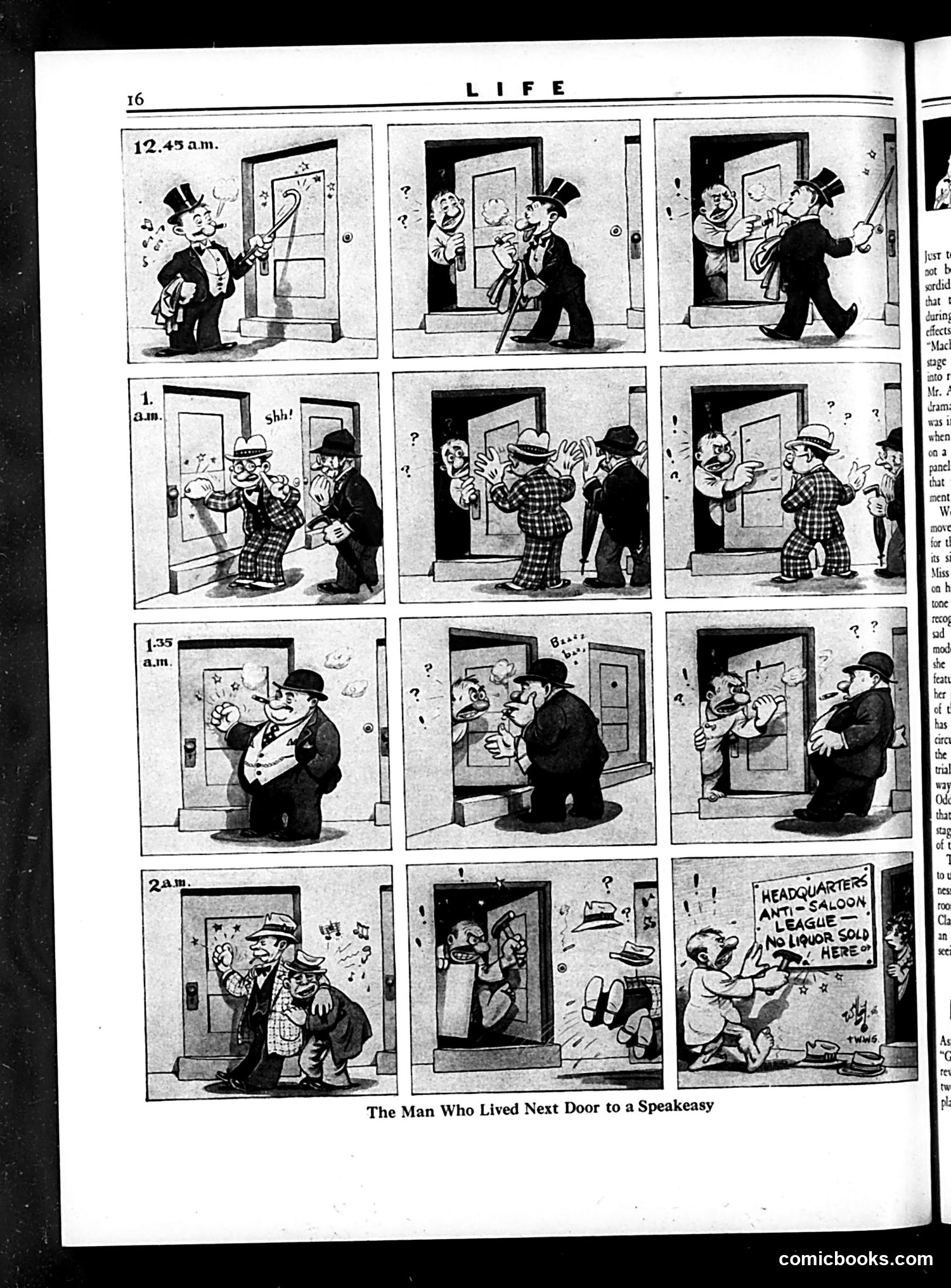
This comic strip satirizes Prohibition-era life, specifically the annoyance of living adjacent to an illegal alcohol establishment. The numbered panels (12:45 a.m. through 2 a.m.) show a man repeatedly trying to sleep while his neighbor's speakeasy operates noisily next door. He encounters drunken patrons, hears loud noise and music, and experiences escalating disruption throughout the night. The humor targets two aspects of 1920s Prohibition: the widespread prevalence of illegal speakeasies despite the alcohol ban, and the social disruption they caused to ordinary citizens. The "Anti-Saloon League" sign in the final panel appears ironic—suggesting that Prohibition advocates' goals (eliminating alcohol establishments) clearly failed in practice. The strip mocks how Prohibition created more problems than it solved.
This page reviews theatrical productions from an unspecified era (likely 1920s-1930s based on style). The main reviews discuss "Machinal," "Good Boy," and "Heavy Traffic." The small cartoons illustrate theater-related humor rather than political satire. One shows figures in exaggerated poses suggesting theatrical melodrama. Another depicts what appears to be stage setup or props. The text criticizes theatrical conventions—particularly Charles Butterworth's comedic timing and the presence of polished actors like Reginald Mason—while praising emotional performances by actresses like Zita Johann. The reviewer, Robert Benchley, complains that "The High Road" disappointed despite ten previous similar plays. This is primarily **theater criticism with illustrative cartoons**, not political commentary. The satire targets theatrical clichés and audience expectations rather than political figures or events.
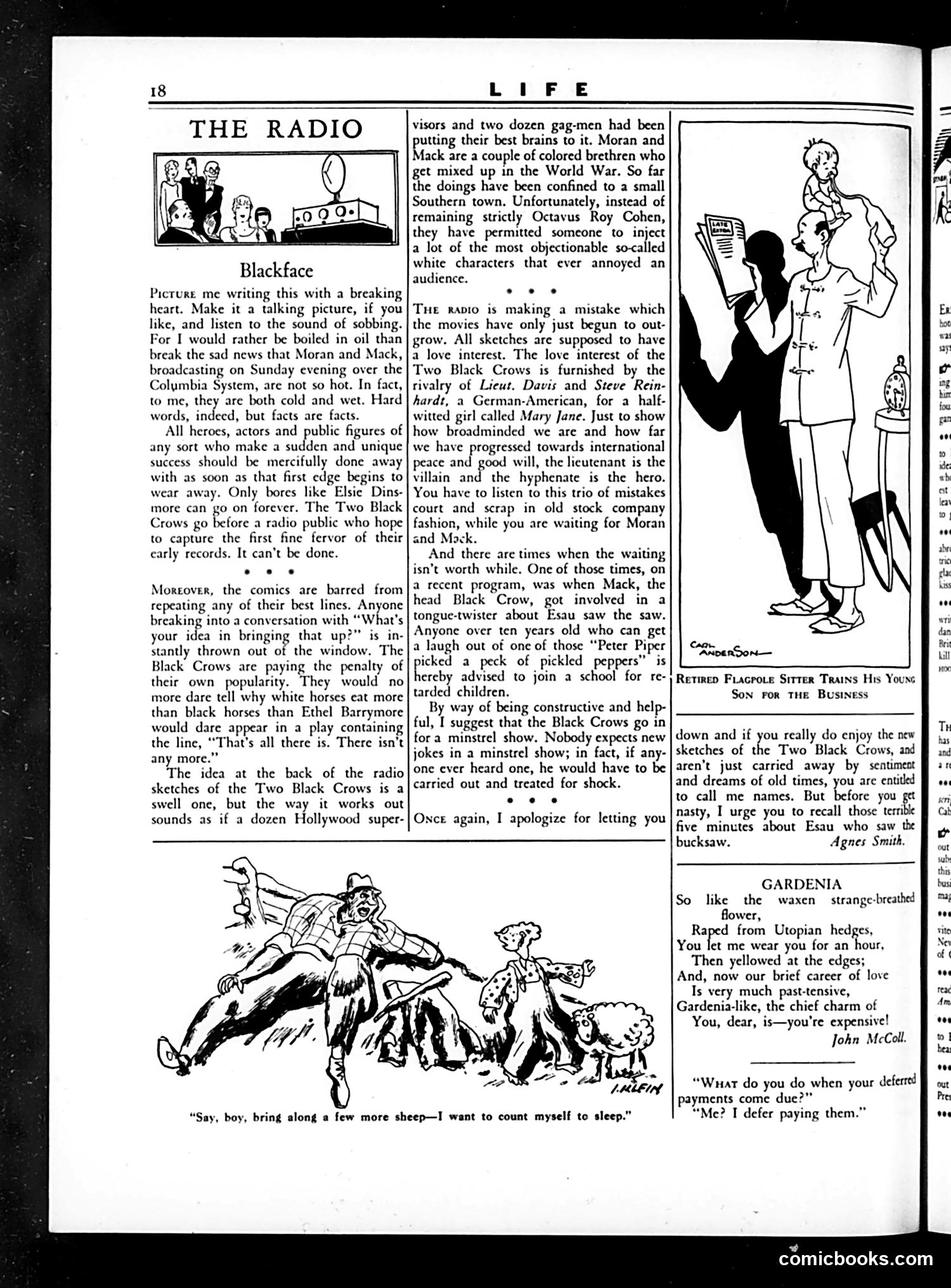
This 1920s column critiques "The Two Black Crows," a popular radio comedy duo (Moran and Mack), who performed in blackface. The author praises their early records but argues their new radio sketches have declined in quality. **Key targets of satire:** - **Moran and Mack**: A successful comedy team whose material has become stale and derivative - **Radio industry mistakes**: The author attacks how radio (like early film) relies on tired conventions—mandatory love interests, recycled gags, predictable ethnic stereotypes - **Specific complaints**: The sketch's addition of "objectionable" white characters, a contrived love triangle, and painfully dated tongue-twisters ("Esau saw the saw") **The underlying point**: Popular entertainers who achieve success quickly lose their edge when overworked and committee-produced. The author suggests they'd be better suited to traditional minstrel shows, where audiences expect no originality. The column represents contemporary radio criticism, though today the blackface performance itself would be the primary focus rather than the secondary creative concerns raised here.
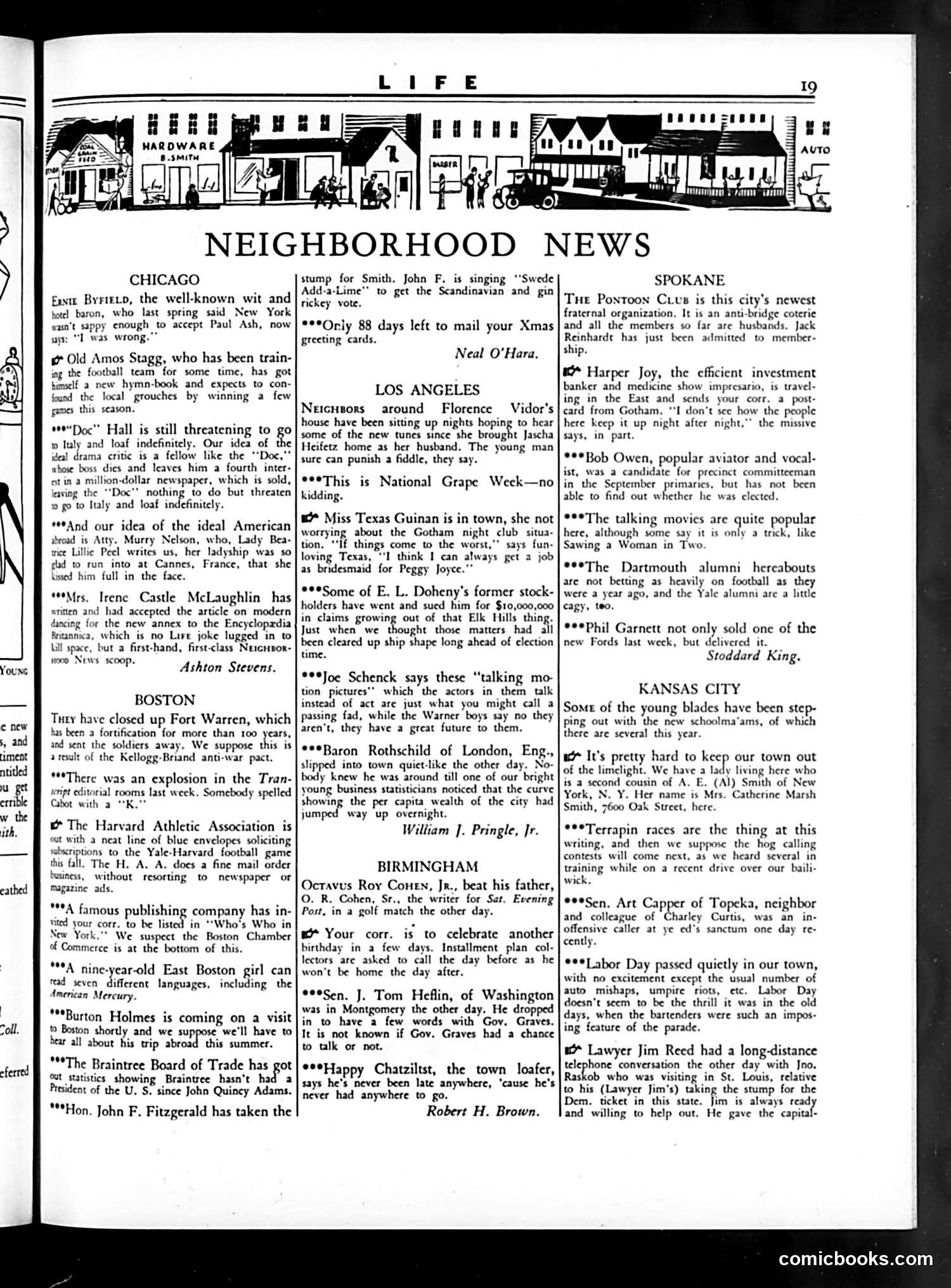
This page from *Life* magazine presents a humor column featuring brief, gossipy anecdotes about celebrities and local figures in major American cities (Chicago, Boston, Los Angeles, Birmingham, Spokane, Kansas City). The jokes rely on: 1. **Celebrity schadenfreude**: Mocking prominent figures' contradictions—hotel baron Eadie Byrfield claiming New York "isn't sappy" then admitting he was wrong. 2. **Local pride/ribbing**: Boston's complaint that no U.S. President has come from Braintree since John Quincy Adams; Kansas City's boasting about avoiding "hoodlum auto mishaps." 3. **Dated references**: Texas Guinan (nightclub owner), Peggy Joyce (society figure), Jascha Heifetz (violinist), suggesting contemporary scandal or notoriety. 4. **Wry observations**: The "Doc" Hall anecdote satirizes drama critics by imagining one who could quit and "loaf indefinitely" after inheriting newspaper wealth. The column's appeal depended on readers recognizing these names and finding humor in intimate, cattily-told details about their private lives and perceived foibles.
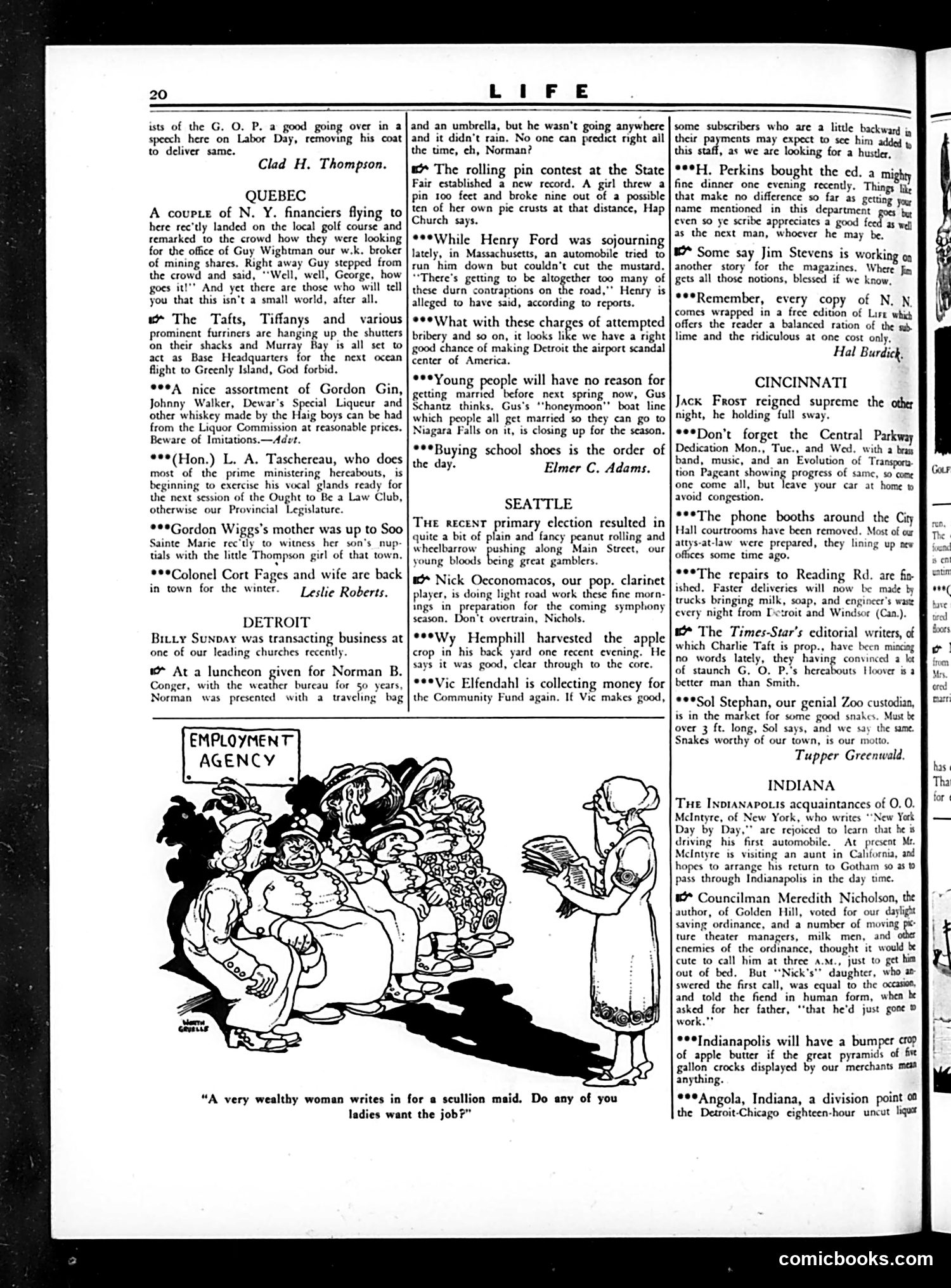
This page from **Life magazine** (a satirical weekly popular in the early-to-mid 20th century) contains regional gossip columns and a cartoon about employment agencies. ## The Main Cartoon The "Employment Agency" cartoon depicts a chaotic scene: a rotund, overwhelmed employment agent is surrounded by a crowd of desperate job-seekers. The caption reads: "A very wealthy woman writes in for a scullion maid. Do any of you ladies want the job?" **The satire**: This mocks the absurdity of job-seeking during economically difficult times. Even though a wealthy woman is offering employment, no one wants the lowly servant position—illustrating the desperation and pickiness of both employers and workers. ## The Text The page contains humorous local news snippets from Quebec, Detroit, and Seattle, reporting trivial gossip: business transactions, weather mishaps, rolling-pin contests, and Henry Ford's near-accident. These exemplify Life's style of satirizing small-town American life through mock-serious reporting of mundane events.
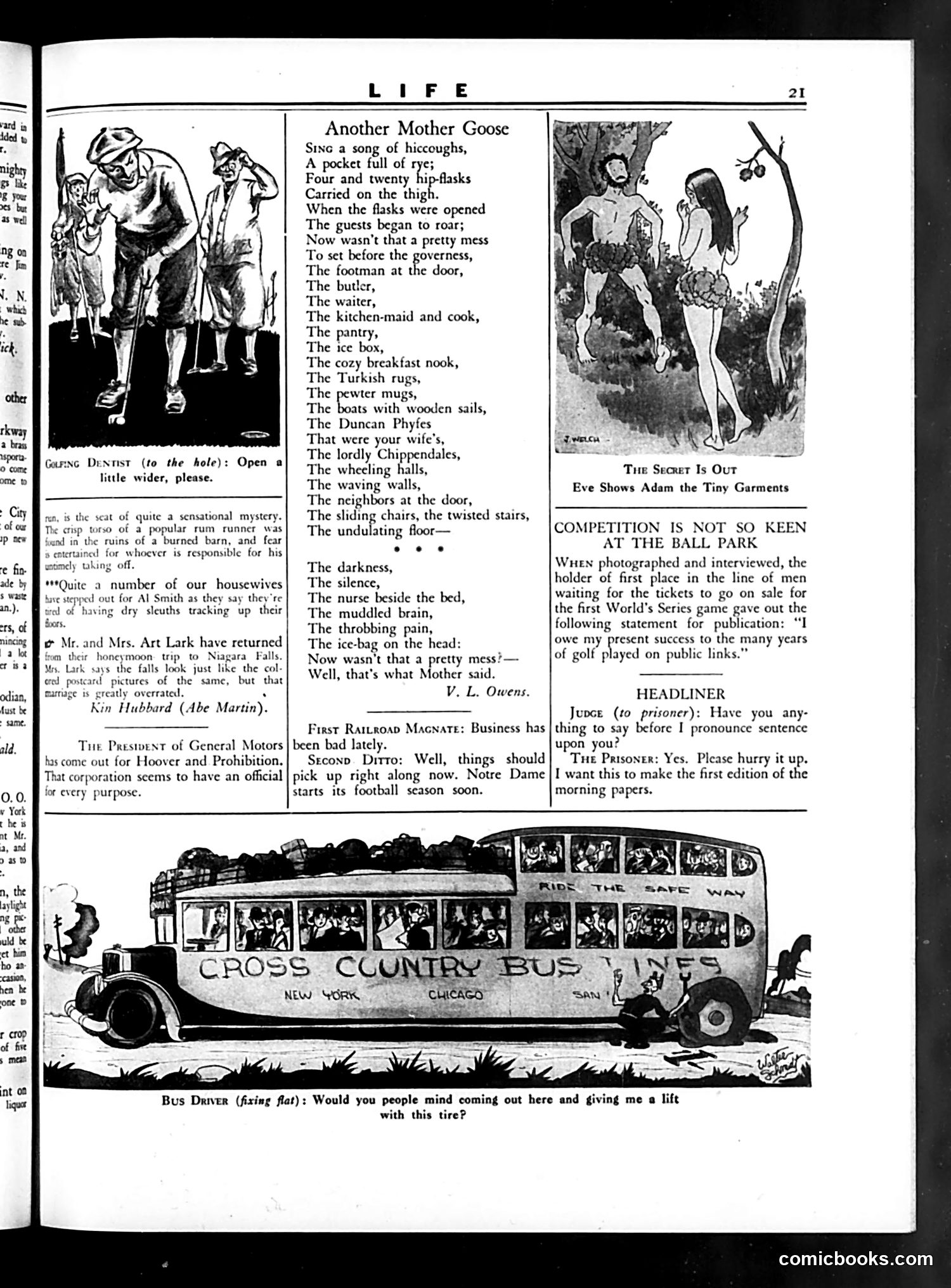
This page from *Life* satirizes American life during **Prohibition** (1920-1933), when alcohol sales were illegal. The "Another Mother Goose" poem parodies the nursery rhyme while cataloging the chaos of a Prohibition-era house party. "Hip-flasks" (hidden alcohol containers) replace the original's innocent items. The poem humorously lists the aftermath: drunk guests, muddled brains, throbbing pain—a pointed critique of how Prohibition drove drinking underground into private homes rather than eliminating it. The **"Golfing Dentist"** cartoon makes a separate joke: a dentist asks a patient to "open wider," but the visual context (unclear from description) likely contains wordplay or double meaning. The bus advertisement and other brief items add general humor about 1920s American life. The overall message: Prohibition created chaos and hypocrisy. Rather than reducing drinking, the law simply moved it behind closed doors where respectable families descended into drunken disorder—the opposite of what temperance advocates promised.
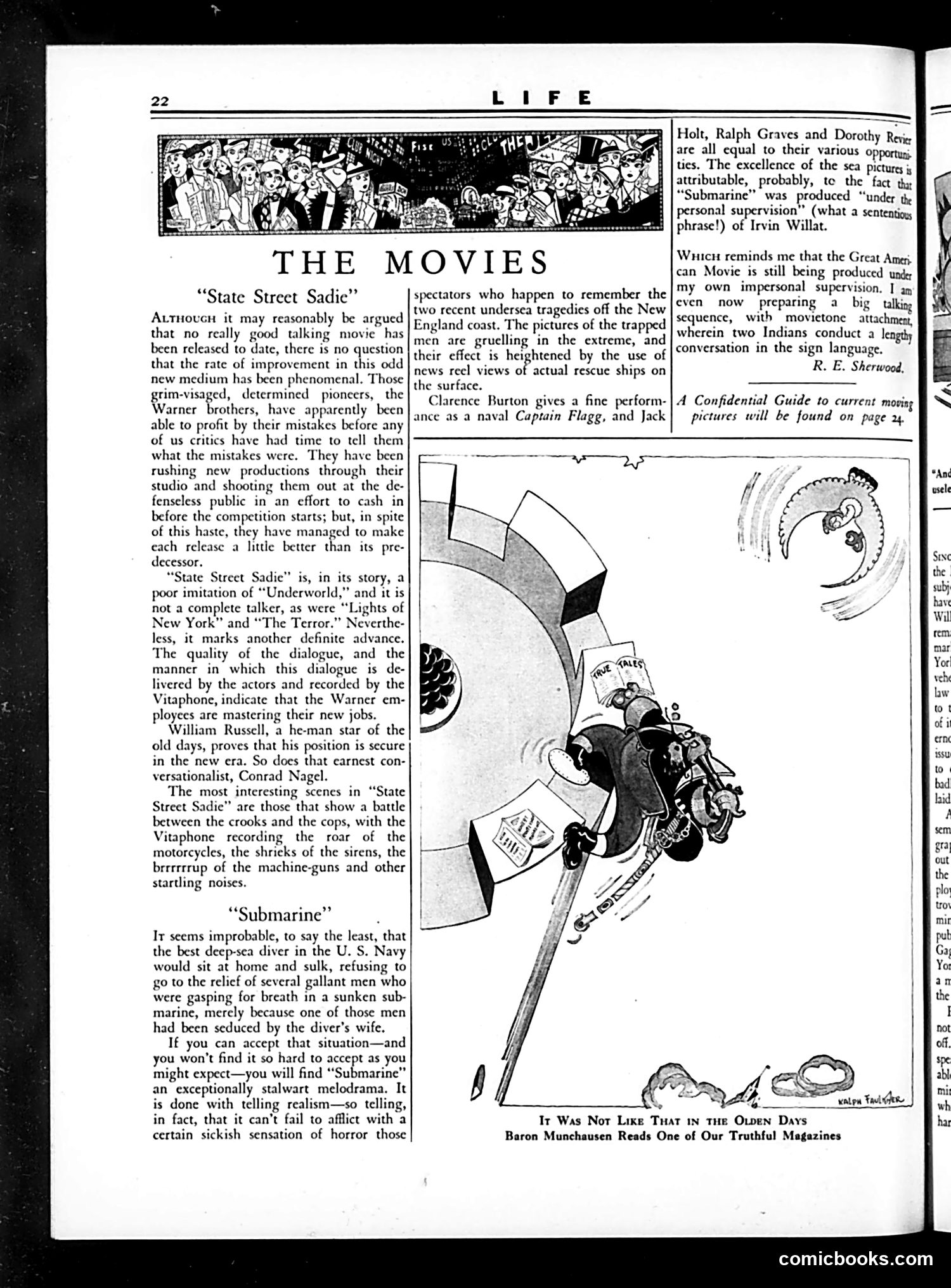
This page reviews early sound films ("talkies"), a new technology. The main cartoon depicts Baron Munchausen reading a magazine—a satirical jab at the absurdity of movie plots. **"State Street Sadie"**: A crime film criticized as inferior to "Underworld," but praised for technical improvements in dialogue recording via Vitaphone. The reviewer credits Warner Brothers' rapid production methods for steady quality improvement, despite haste. **"Submarine"**: A melodrama about a Navy diver refusing rescue duty after his wife is seduced by another sailor. The reviewer notes the implausible premise but praises its "telling realism"—which unfortunately reminded audiences of two recent actual undersea tragedies, making scenes of trapped men genuinely distressing rather than entertainingly dramatic. The cartoon's caption suggests modern movie plots are so exaggerated they rival Baron Munchausen's fictional tall tales, implying studios prioritize sensationalism over plausibility—even when competing with actual tragedy.
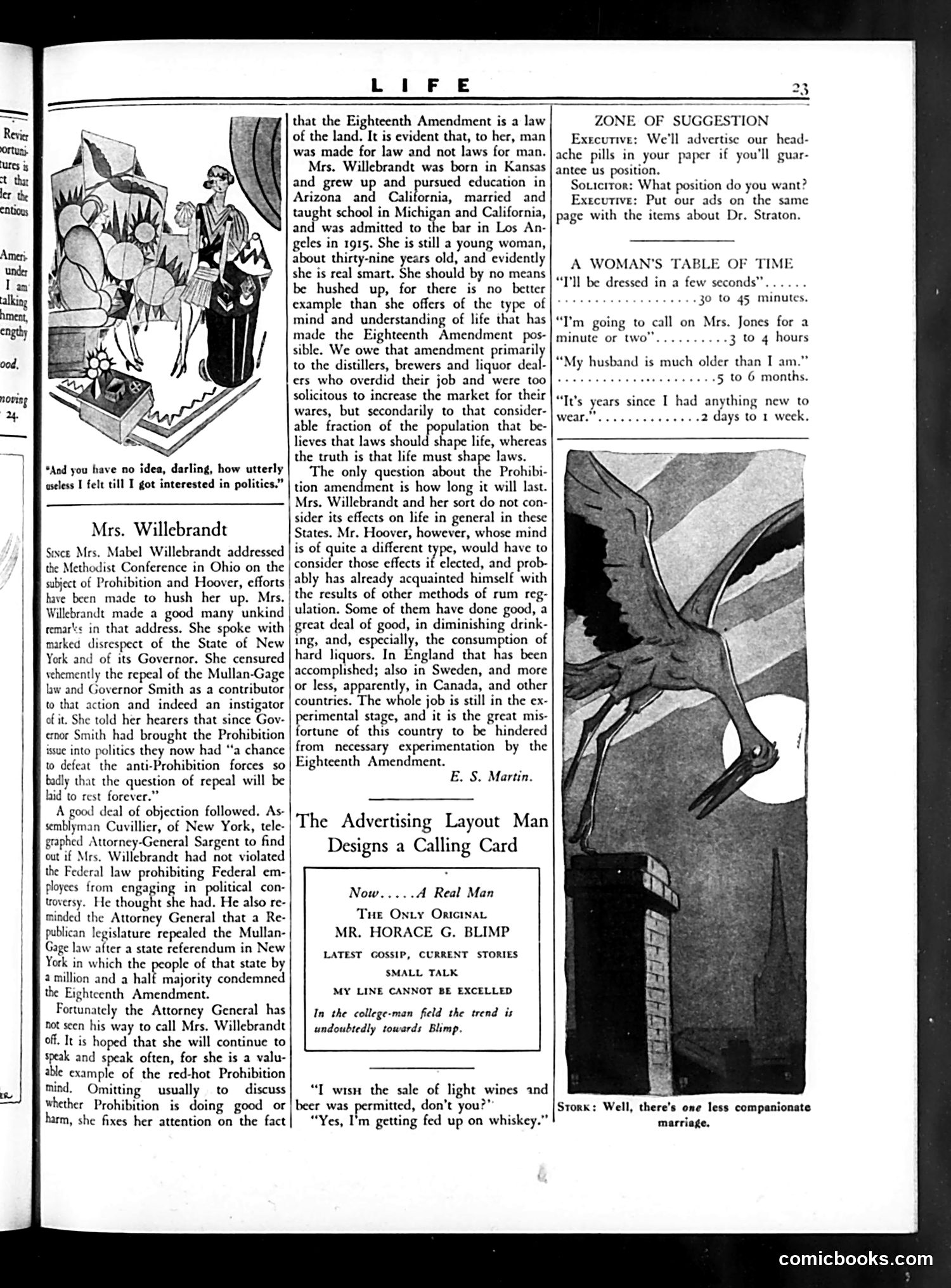
This page critiques **Mabel Willebrandt**, the Assistant Attorney General under President Hoover, who publicly campaigned for Prohibition enforcement. The article attacks her as embodying a rigid, legalistic mindset that prioritizes laws over human reality—believing "man was made for law and not laws for man." The satire argues Prohibition itself resulted from alcohol industry excess and this type of authoritarian thinking. Life suggests Hoover, by contrast, would pragmatically evaluate Prohibition's actual effects, noting other countries achieved drinking reduction through gentler methods. The cartoon's opening quote mocks how Willebrandt found personal satisfaction only through political activism, suggesting she lacks broader wisdom about life's complexity. A secondary joke features a calling card parody of "Mr. Horace G. Blimp," satirizing advertising clichés about masculine self-promotion—likely unrelated to the main article.
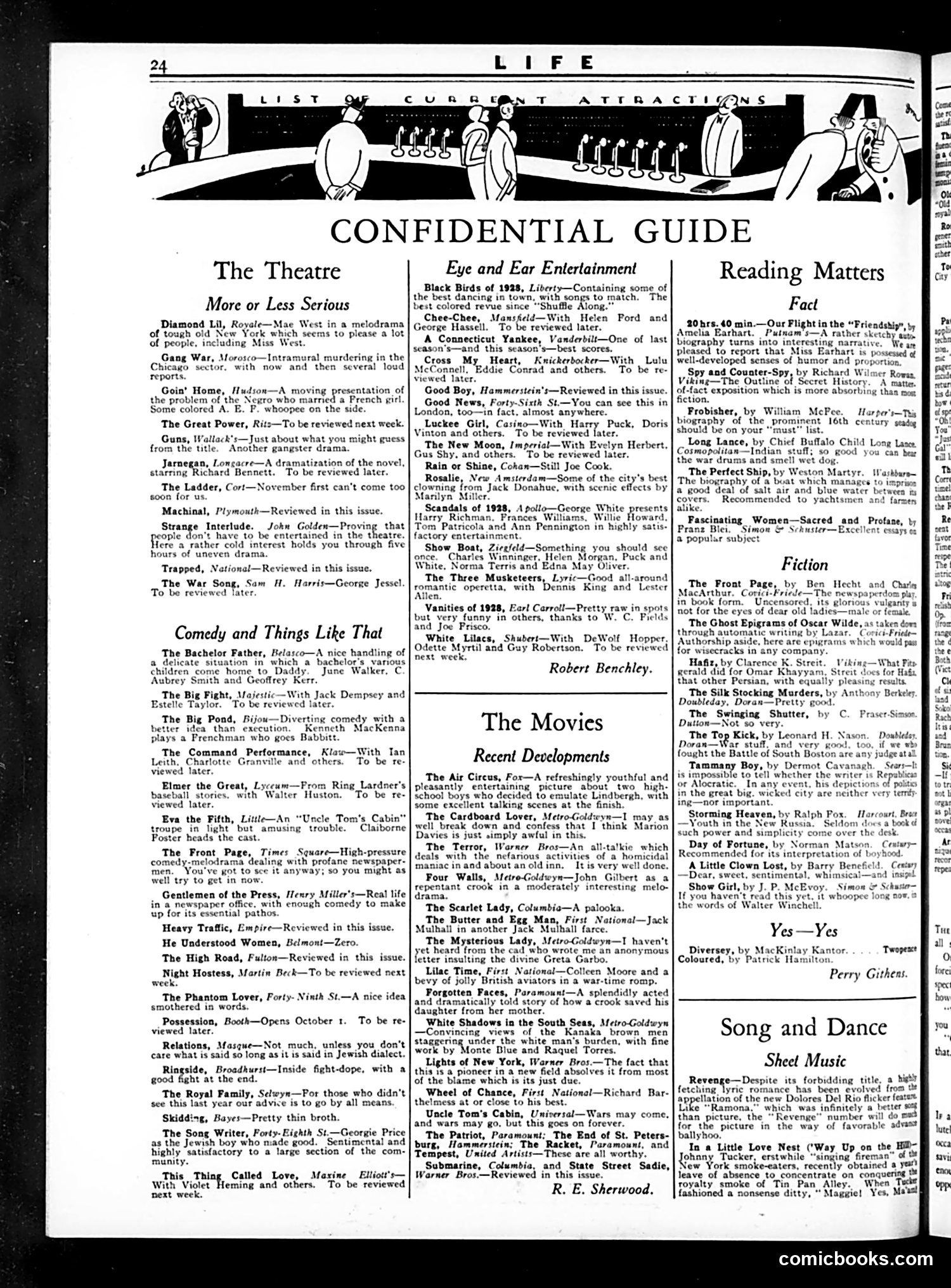
This is a **theater and entertainment guide** ("Confidential Guide") rather than a political cartoon page. It's a listing of current Broadway productions and movies with brief critical notes, organized by category. The page reflects **1920s entertainment culture**, including: - **Theater**: References to popular plays like Mae West's "Diamond Lil" (melodrama), "Strange Interlude" (experimental theater), and "The Front Page" (newspaper comedy) - **Social attitudes**: Notes about "Negro" themes in "Goin' Home" and Jewish dialect humor in "Relations" reveal period attitudes - **Entertainment trends**: Heavy gangster/crime drama listings ("Gang War," "Guns") reflect Prohibition-era interests - **Notable performers**: Jack Dempsey, Ring Lardner adaptations, and other celebrities of the era The tone is gossipy and informal ("You've got to see it anyway"), typical of Life's satirical approach to cultural criticism. The guide helps readers navigate what was worth seeing among numerous theatrical options available in the 1928 Broadway season.
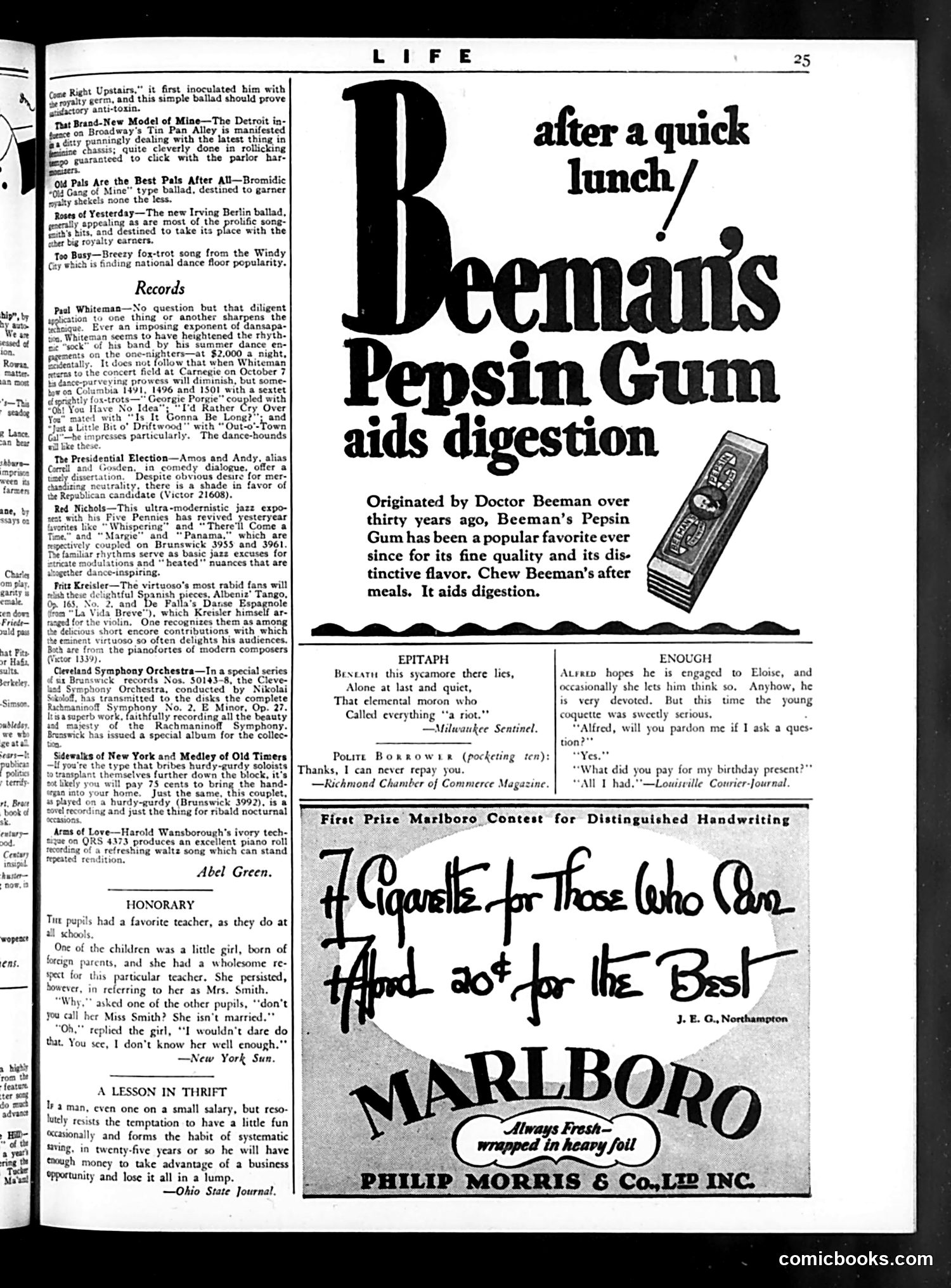
This page is primarily advertising, specifically for **Beeman's Pepsin Gum**. The large central advertisement claims the product "aids digestion" and was "originated by Doctor Beeman over thirty years ago." The pitch targets post-lunch digestive concerns—a common early 20th-century marketing angle. The advertisement emphasizes the gum's "fine quality" and "distinctive flavor," positioning it as a popular, established product. Below this is a **Marlboro cigarette advertisement** featuring handwriting in a "First Prize Marlboro Contest for Distinguished Handwriting," showcasing cigarettes as a luxury product worthy of penmanship contests. The surrounding text consists of **music industry reviews** and brief humorous anecdotes typical of Life magazine's miscellaneous content. These sections are unrelated to the advertisements and represent the publication's general editorial material. The page reflects 1920s-era advertising strategies emphasizing digestive aids and lifestyle products.
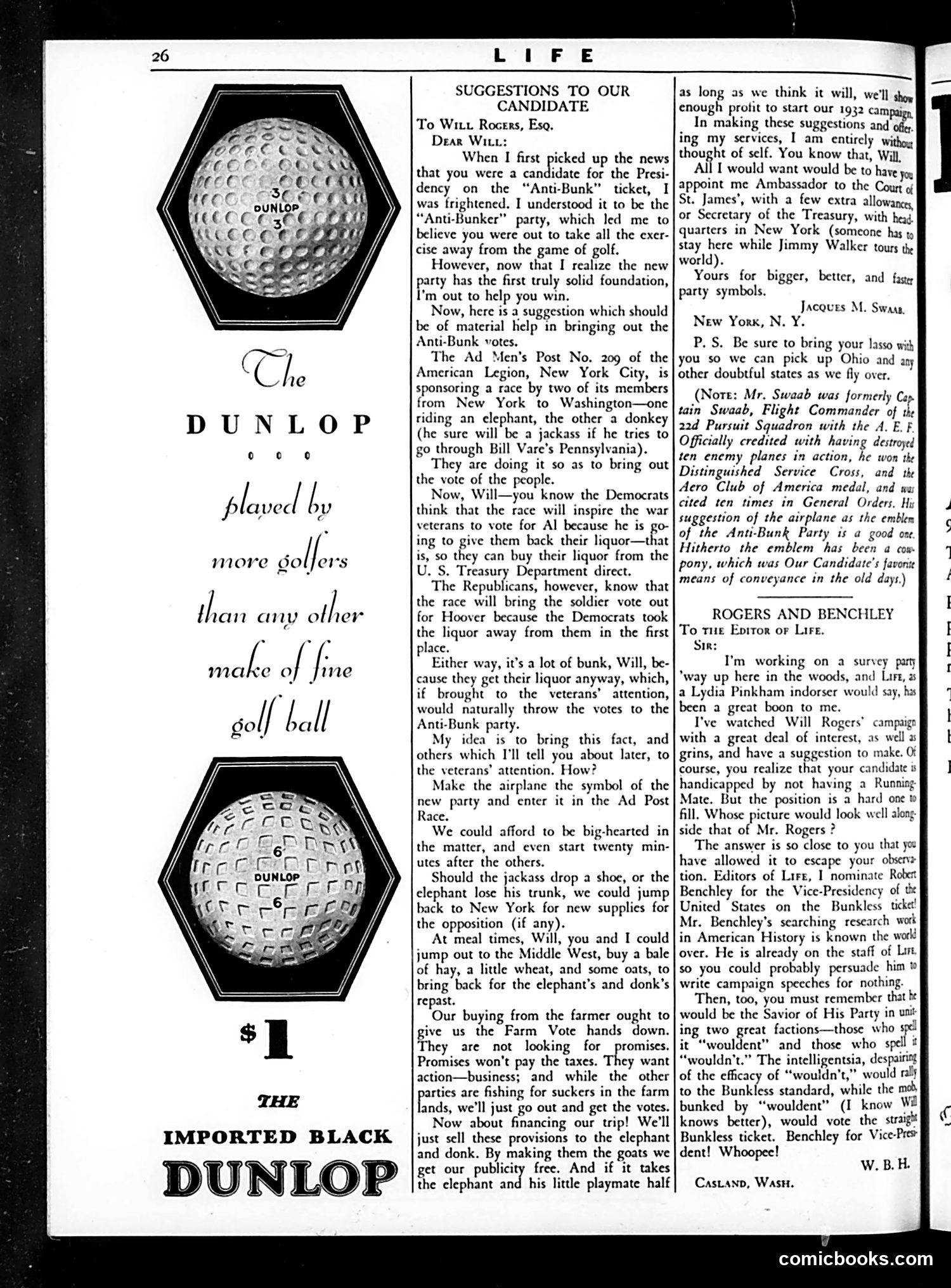
This page satirizes the 1928 U.S. presidential election, specifically mocking the "Anti-Bunk" party candidate Will Rogers (a famous entertainer and political commentator). The left side advertises Dunlop golf balls. The main text is a humorous letter "suggesting" absurd campaign strategies to Rogers. The satire targets 1920s politics: it mockingly references competing parties' appeals to war veterans through liquor policy (Prohibition was active), and jokes about buying farmer votes through actual commerce rather than empty promises. The letter's author proposes entering an airplane in a New York-to-Washington race alongside a Democratic donkey and Republican elephant, suggesting this stunt would somehow secure the "Anti-Bunk" vote while profiting by selling provisions to the competing animals. The postscript humorously nominates Robert Benchley (a notable humorist and Life contributor) for Vice-President, reinforcing the piece's satirical tone about election absurdities. The overall joke mocks how parties compete for voters through gimmicks rather than substance.

This is primarily a **corporate advertisement**, not satire or political content. It appears in *Life* magazine (page 27) promoting Dunlop pneumatic tires. The ad claims dramatically rising sales ("99% above last August") tied to "peak quality." It emphasizes competitive advantages: 40 years' manufacturing experience, owned rubber plantations with $195 million in resources, and 45,000 trained workers. The visual shows an oversized tire dominating an industrial factory landscape, symbolizing Dunlop's manufacturing scale. The "lifetime warranty" guarantee against material and workmanship defects was the ad's central selling point—a bold claim suggesting superior reliability compared to competitors. **For modern readers:** This reflects pre-WWII consumer confidence messaging, when tire quality varied significantly and corporate size/resources signaled trustworthiness. The hyperbolic sales figures and guarantee language are typical of 1930s advertising before modern consumer protection laws.
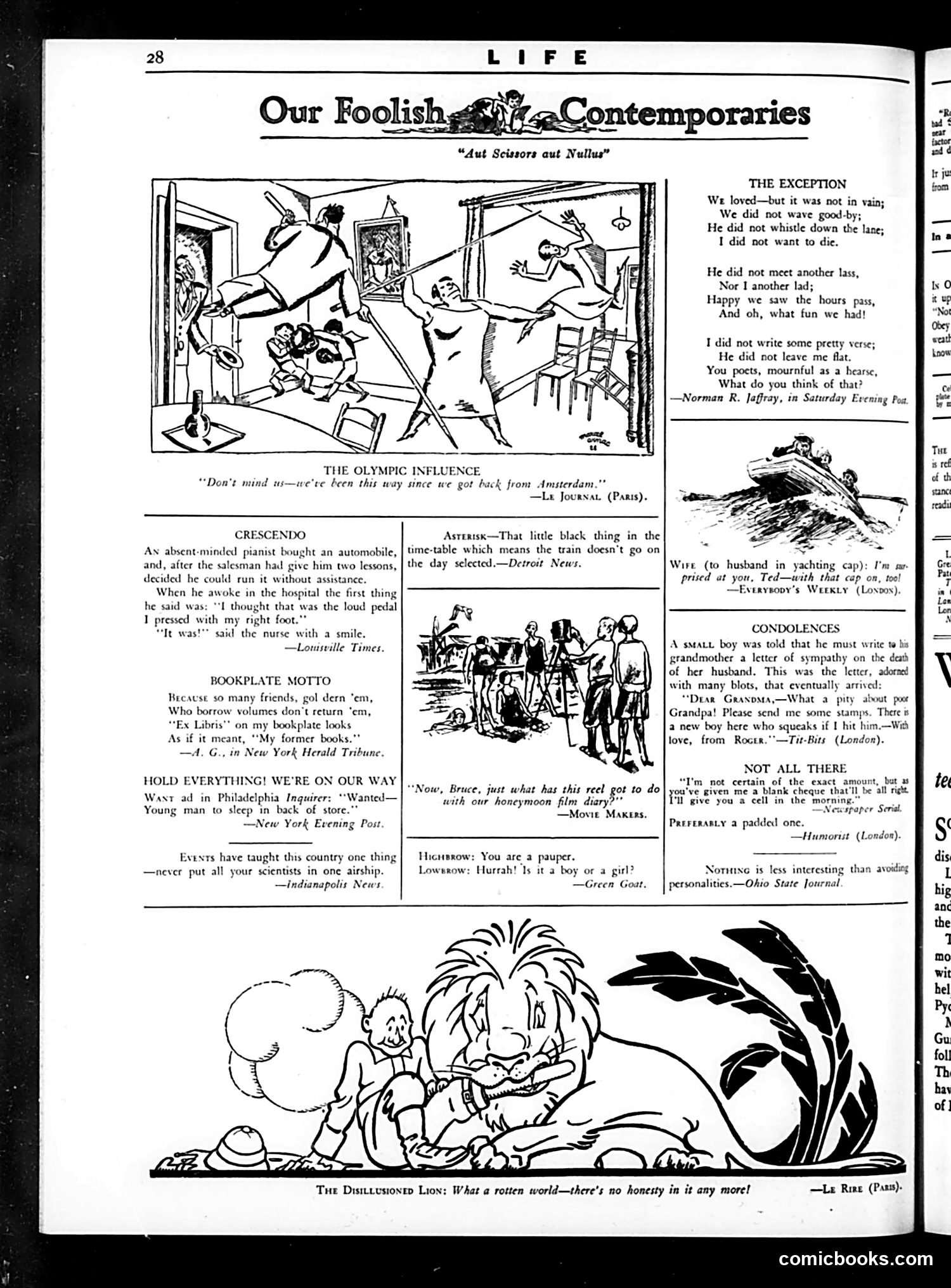
This page collects brief humorous observations and cartoons mocking everyday absurdities and human folly. Key items include: **"The Olympic Influence"** cartoon depicts chaotic indoor activity, captioned about Amsterdam visitors—likely referencing how the 1920 Olympics in Antwerp made continental Europeans seem wild or unsophisticated to American eyes. **Individual quips** mock modern life: an absent-minded pianist confuses car pedals with piano ones; a Philadelphia job ad seeking someone to "sleep in back of store" (implying poor working conditions); definitions of modern annoyances like train asterisks meaning cancelled service. **"The Exception"** poem parodies sentimental romantic verse, boasting of a relationship *without* the usual dramatic tropes (no tearful goodbyes, no infidelity). **The bottom cartoon** shows a disillusioned lion declaring "there's no honesty" in the world—ironic commentary on cynicism itself. The page's recurring theme: gently mocking human pretension, modern inconveniences, and sentimental clichés through wit rather than sharp political attack.
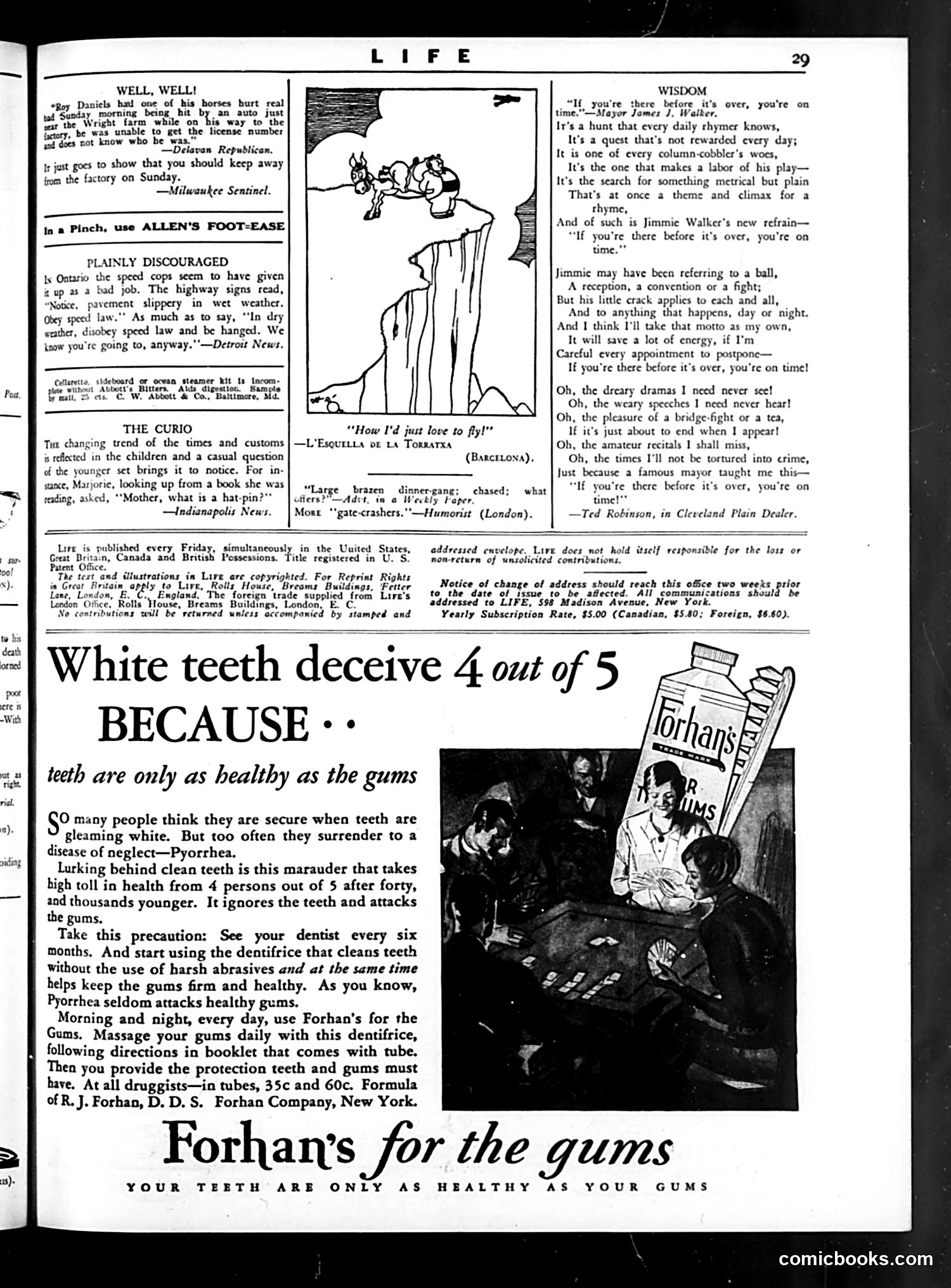
This page contains several satirical short pieces and advertisements typical of Life magazine's format. **The cartoons/jokes** are brief social commentary: one about a horse hit by a car (the owner couldn't identify the driver), followed by quips about traffic enforcement and changing customs. The "hat-pin" reference is unclear without context but likely concerns a dated fashion item. **The "Wisdom" section** features Mayor James J. Walker's quote about being on time—"if you're there before it's over, you're on time"—which the writer humorously interprets as an excuse to skip obligations by arriving just as things end. **The advertisement** for Forhan's toothpaste dominates the lower half, promoting gum health with a claim that "white teeth deceive 4 out of 5" because people ignore gum disease (pyorrhea). This reflects early-twentieth-century dental marketing emphasizing newly medicalized oral hygiene concerns. The page is primarily advertising-driven, with satirical filler content typical of Life's commercial-literary hybrid model.
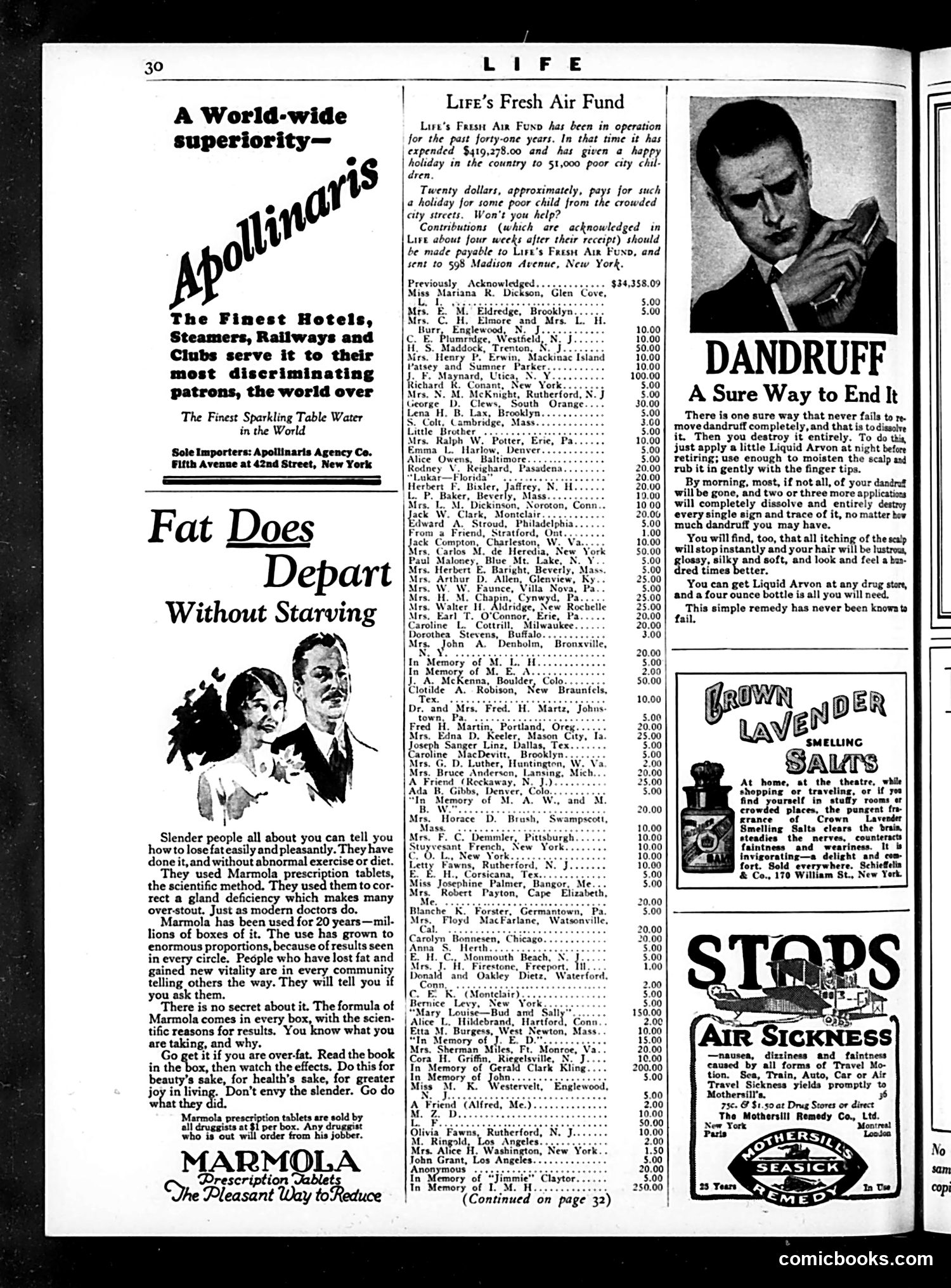
This page is **primarily advertising**, with a charitable announcement insert. **Main advertisements:** 1. **Apollinaris water** — promotes European mineral water as a luxury product for elite establishments (hotels, steamers, clubs) 2. **Marmola tablets** — a weight-loss product marketed as a "scientific method" using thyroid extract to treat supposed "gland deficiency." The cartoon shows a slim couple; the pitch promises fat loss without starvation or excessive exercise 3. **Dandruff remedy, Brown Lavender salts, Stops air sickness, and Seasick remedy** — standard patent medicines of the era **Charitable content:** Life magazine's **Fresh Air Fund** listing acknowledges donations for sending poor city children on country holidays—a genuine Progressive Era charitable initiative. The contrast is striking: while advertisements promise easy transformation of the body through commercial products, Life simultaneously promotes charity for underprivileged urban children—reflecting 1920s tensions between consumerism and social welfare.
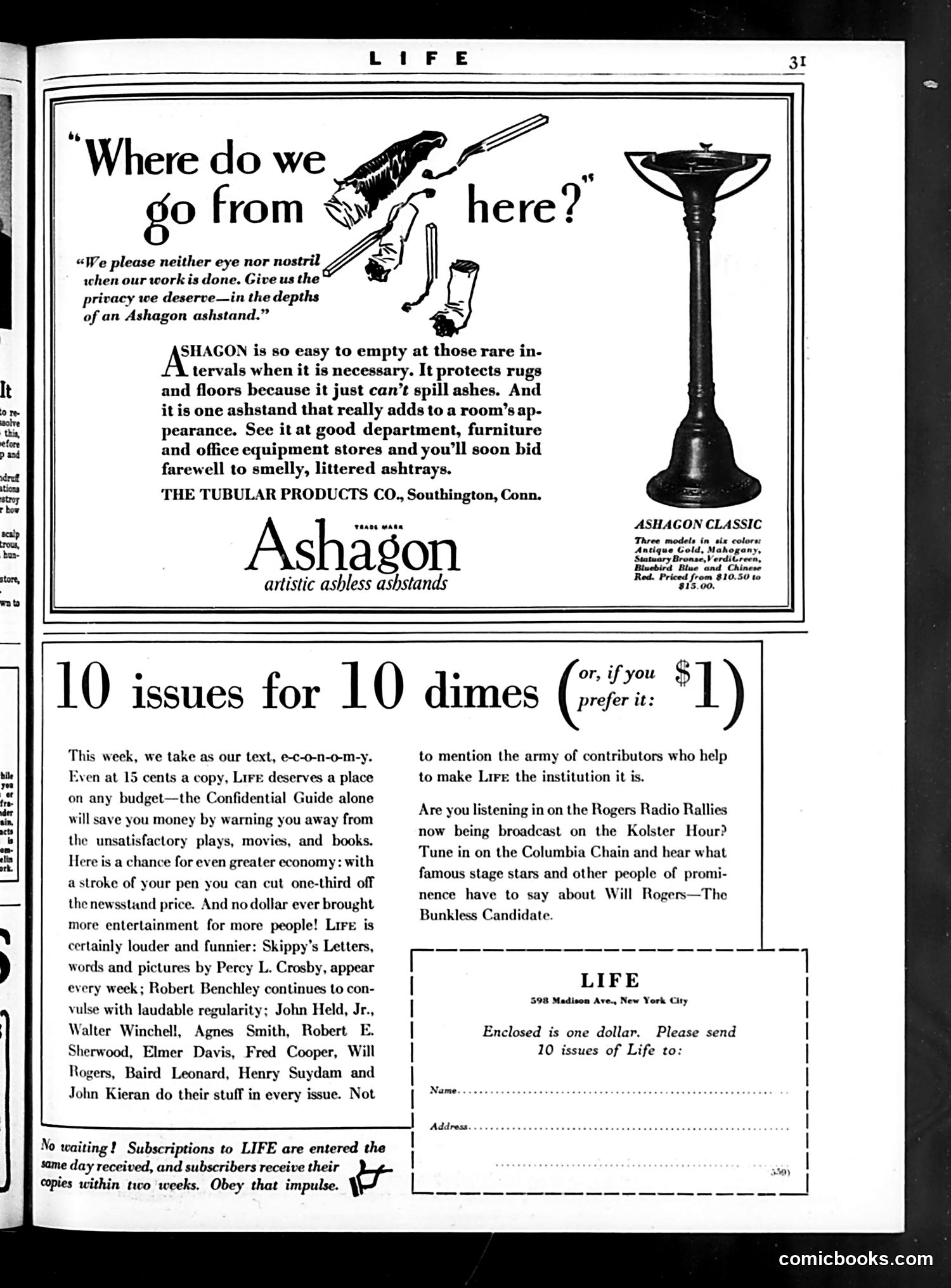
This page is primarily a **product advertisement** for the Ashagon ashtray, with subscription promotion below. The cartoon shows a cigarette butt and ash personified, asking "Where do we go from here?" The copy humorously presents ashtrays as having feelings—they "please neither eye nor nostril" and deserve privacy "in the depths of an Ashagon ashstand." This is **anthropomorphic satire**: giving human dignity and complaints to inanimate waste products to sell the product's discretion and cleanliness. The joke plays on 1920s anxieties about smoking debris marring home appearance. By granting the ashes a "voice," the ad cleverly positions the Ashagon as solving a social embarrassment—visible, smelly smoking residue—which mattered greatly to status-conscious households of the era. Below is a subscription pitch for *Life* magazine itself, emphasizing economy and featuring contributors like Will Rogers and Robert Benchley.
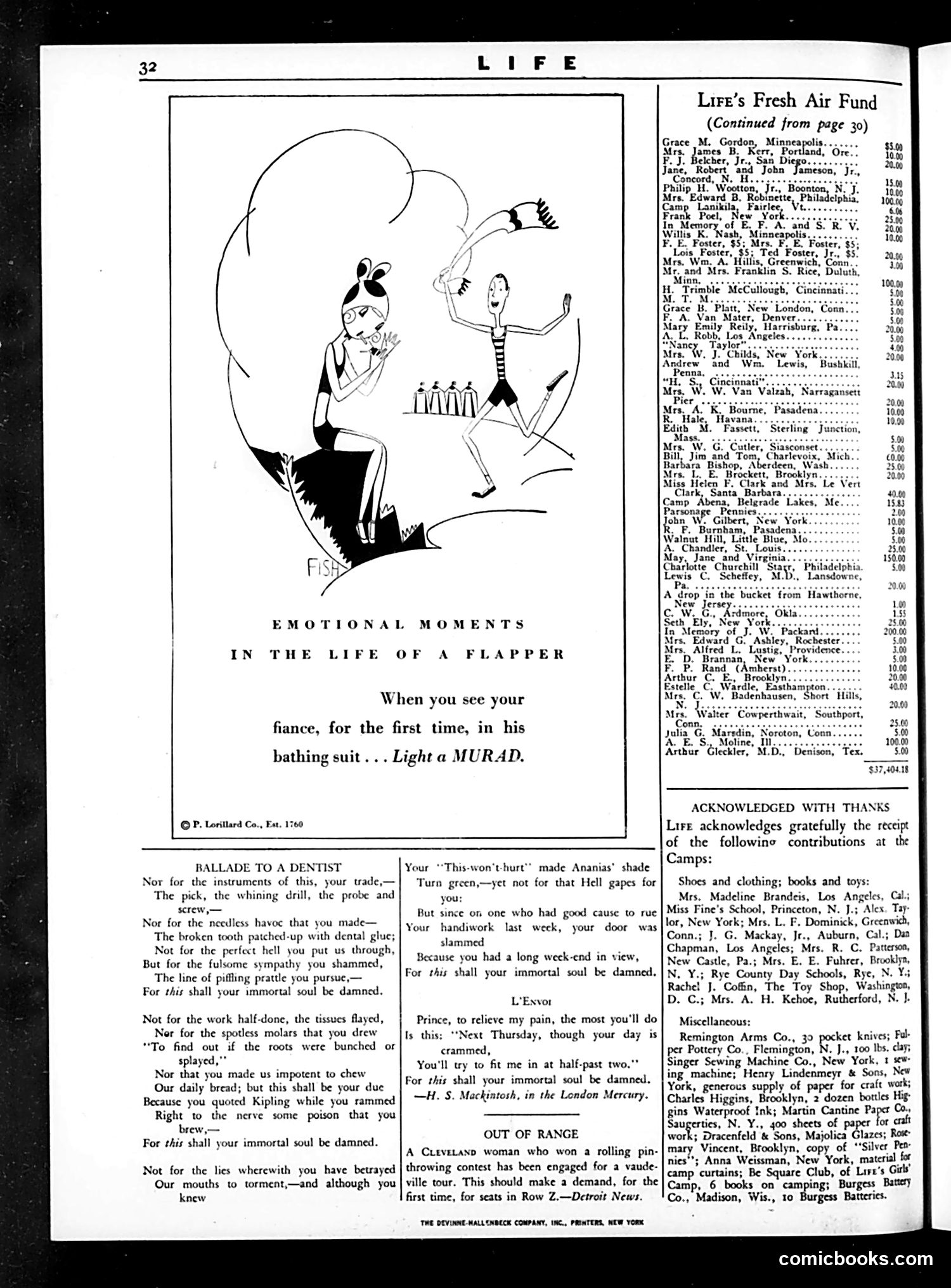
This page from *Life* magazine (a satirical publication, not the photo magazine) features several humorous pieces from the Jazz Age era. The main cartoon, titled "Emotional Moments in the Life of a Flapper," depicts a young woman reacting with shock upon seeing her fiancé in a bathing suit for the first time. The joke advertises Murad cigarettes as the solution to this awkward moment—using humor to sell the product. "Flappers" were modern, unmarried young women of the 1920s known for challenging social conventions. Below are three satirical poems and brief jokes mocking dentists, the dental experience, and women's strength (a rolling-pin-throwing contest). These reflect common anxieties of the era around medical procedures and gender roles. The bulk of the page lists donors to *Life's* Fresh Air Fund—a real charitable initiative providing camp experiences for underprivileged children, with contributions ranging from small individual gifts to larger donations.
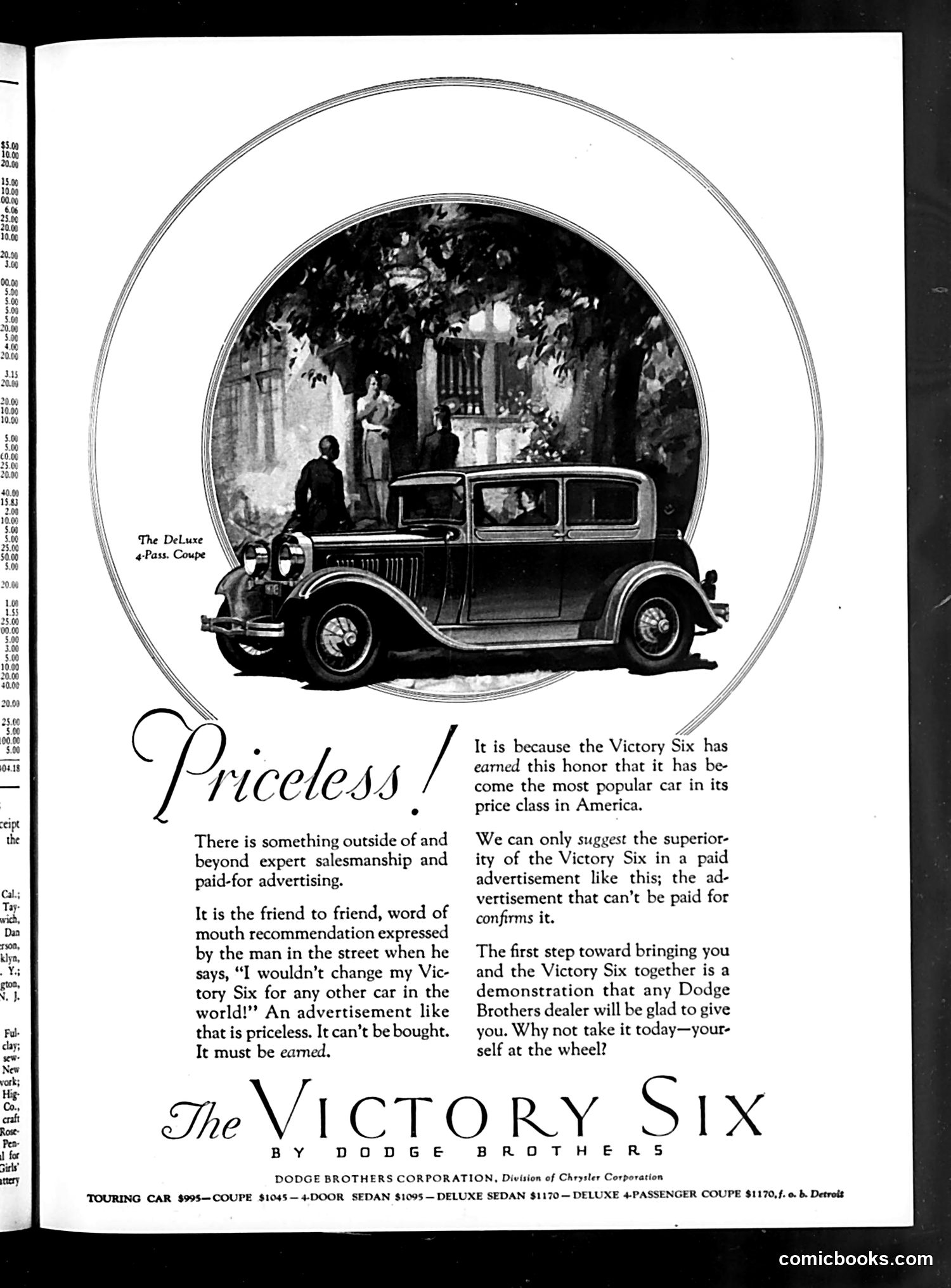
This is not a cartoon or satire—it's a **straight automobile advertisement** from Dodge Brothers (a Chrysler division). The page promotes the Victory Six automobile, emphasizing that its popularity stems from word-of-mouth recommendation rather than paid advertising alone. The circular vignette illustration shows the elegant four-door sedan in a romantic nighttime scene with figures and foliage. The advertisement's rhetorical strategy claims the Victory Six's success is "priceless"—earned through quality, not marketing spend. It positions word-of-mouth endorsement as more credible than paid promotion, then paradoxically uses a paid advertisement to promote test drives. **Context for modern readers:** This reflects 1920s-30s car marketing, when the automobile industry was still competitive and new. Pricing ($995-$1170) suggests mid-market positioning. The emphasis on "earning" customer loyalty through quality reflects manufacturing pride of the era.
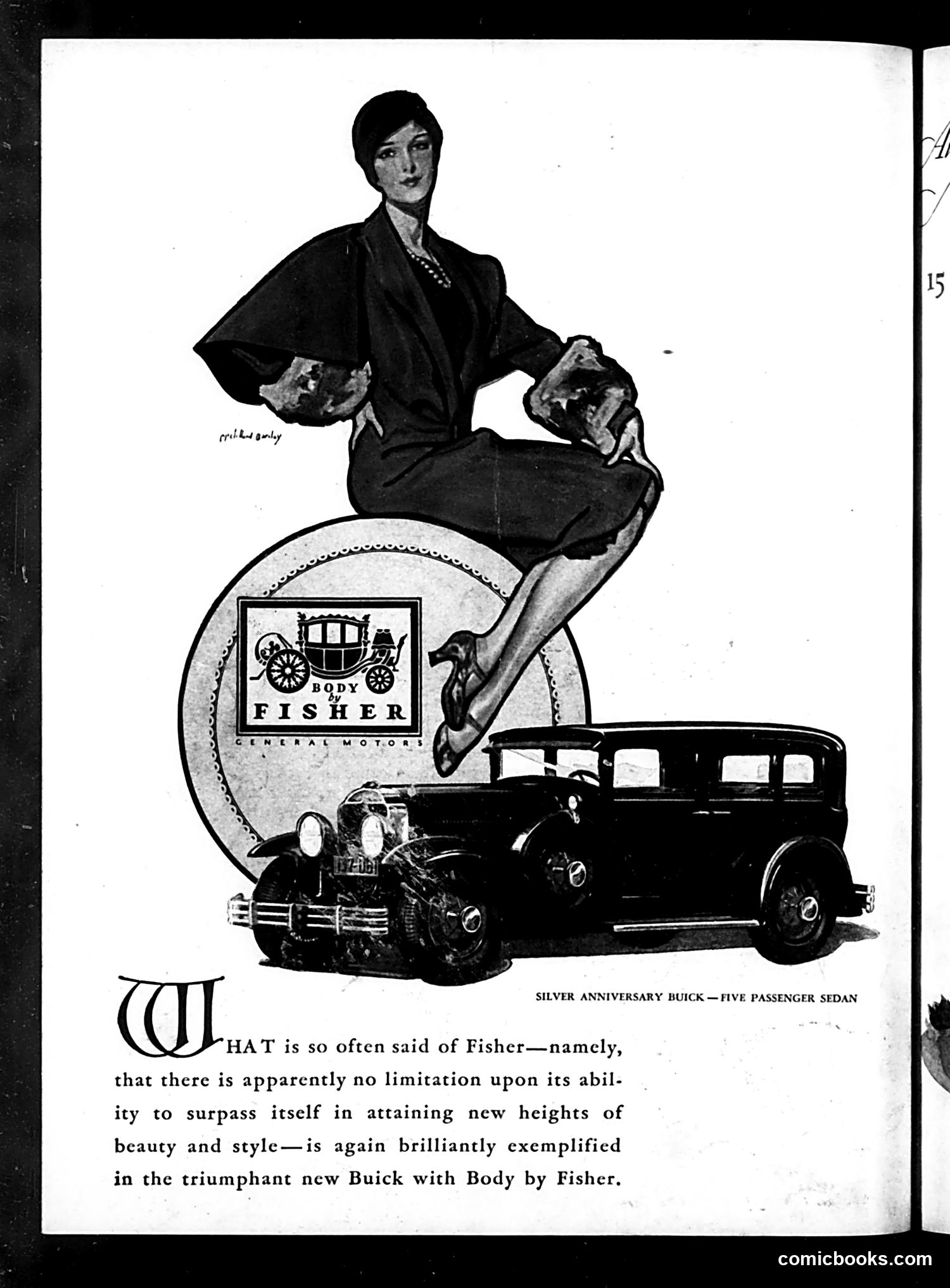
This is a **Fisher Body automobile advertisement**, not political satire. It advertises a "Silver Anniversary Buick" sedan with bodywork by Fisher (General Motors' coachbuilding division). The image shows a stylishly dressed woman posed dramatically atop the car, legs crossed, holding fur stoles. The visual metaphor suggests that Fisher Body's craftsmanship is as refined and elegant as haute couture fashion. The text claims Fisher has unlimited ability to achieve new heights in automotive beauty and style, exemplified by this particular Buick model. This reflects 1920s-30s advertising conventions: pairing luxury automobiles with fashionable women to suggest sophistication, elegance, and modernity. The "Silver Anniversary" branding indicates this marks a significant milestone for the brand. The page is primarily **commercial advertisement** rather than satirical editorial content.