
Life, 1928-09-28 · page 16 of 36
Life — September 28, 1928 — page 16: what you’re looking at
What you’re looking at
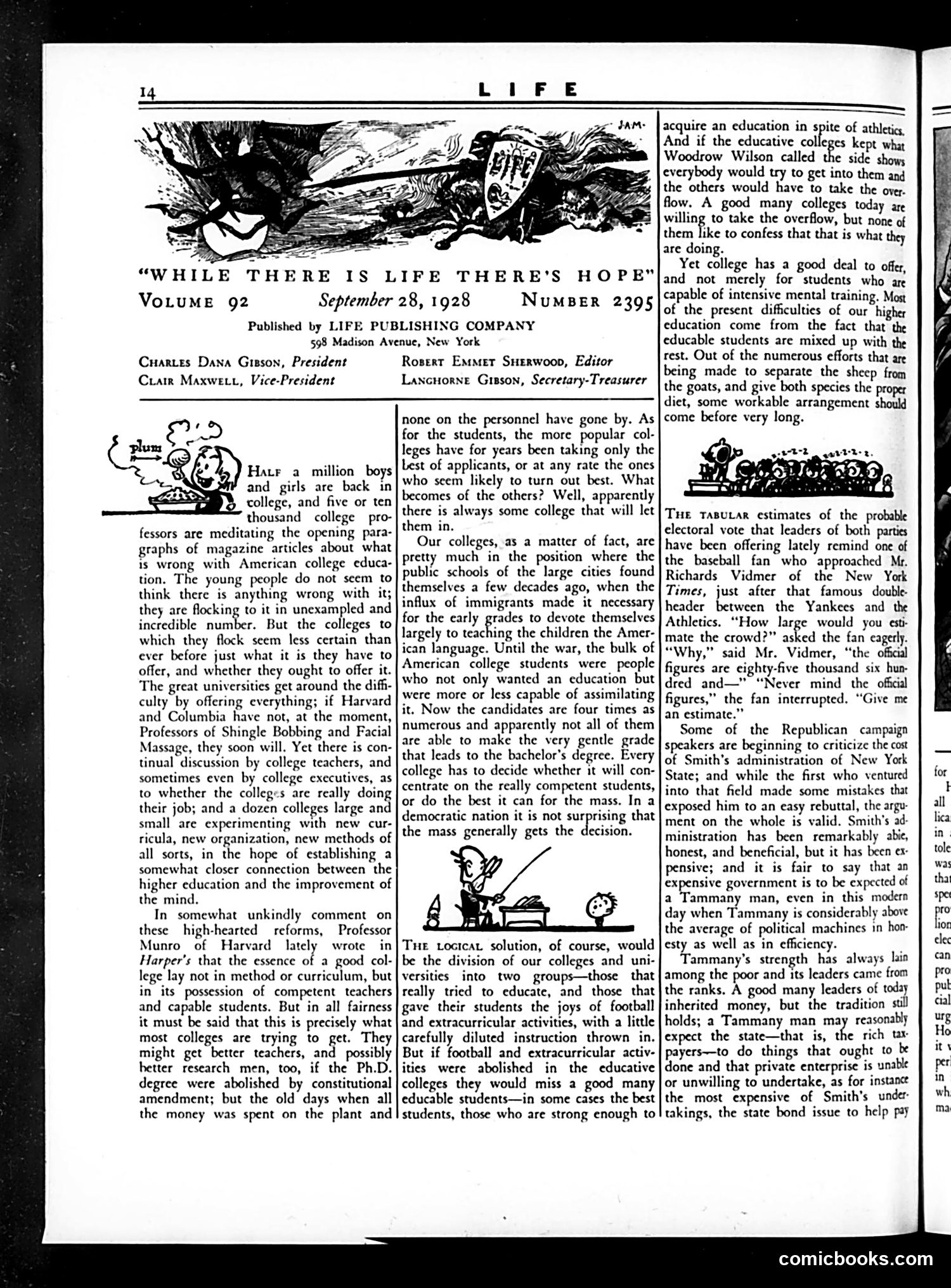
This page discusses American college education's challenges. The two cartoons illustrate the tension between academic and athletic priorities: **Top cartoon**: Shows a sleeping figure labeled "ATHLETICS" dominating over education, captioning "WHILE THERE IS LIFE THERE'S HOPE"—suggesting sports overshadow learning. **Bottom cartoon**: Depicts what appears to be a political figure (likely related to the 1928 election discussion in the text), illustrating the article's pivot to criticizing Tammany Hall and Smith's administration in New York politics. The text argues colleges admit too many students unable to handle rigorous education, while criticizing both athletic emphasis and political corruption. The page satirizes how institutions—educational and political—prioritize the wrong values over genuine merit and learning.
📄 Transcribed text from this page (OCR, searchable)
Machine-transcribed from the original scan — historical spelling and the odd misread are preserved.
“WHILE THERE IS LIFE THERE'S HOPE” VoLUME 92 September 28, 1928 NuMBER 2395 Published by LIFE PUBLISHING COMPANY 598 Madison Avenue, New York Cuarces Dana Gisson, President Cram Maxwect, Vice-President wn C= a Harr a million boys and girls are back in college, and five or ten thousand college pro- fessors are meditating the opening para- graphs of magazine articles about what is wrong with American college educa- tion. The young people do not seem to think there is anything wrong with it; they are flocking to it in unexampled and incredible number. But the colleges to which they flock seem less certain than ever before just what it is they have to offer, and whether they ought to offer it. The great universities get around the diff- culty by offering everything; if Harvard and Columbia have not, at the moment, Professors of Shingle Bobbing and Facial Massage, they soon will. Yet there is con- tinual discussion by college teachers, and sometimes even by college executives, as to whether the colleges are really doing their job; and a dozen colleges large and small are experimenting with new cur- ricula, new organization, new methods of all sorts, in the hope of establishing a somewhat closer connection between the higher education and the improvement of the mind. In somewhat unkindly comment on these high-hearted reforms, Professor Munro of Harvard lately wrote in Harper's that the essence of a good col- lege lay not in method or curriculum, but in its possession of competent teachers and capable students. But in all fairness it must be said that this is precisely what most colleges are trying to get. They might get better teachers, and possibly better research men, too, if the Ph.D. degree were abolished by constitutional amendment; but the old days when all the money was spent on the plant and ow Rosert Emmet Suerwoon, Editor Lancuorne Gipson, Secretary-Treasurer none on the personnel have gone by. As for the students, the more popular col- leges have for years been taking only the Lest of applicants, or at any rate the ones who seem likely to turn out best. What becomes of the others? Well, apparently there is always some college that will let them in, Our colleges, as a matter of fact, are pretty much in the position where the public schools of the large cities found themselves a few decades ago, when the influx of immigrants made it necessary for the early grades to devote themselves largely to teaching the children the Amer- ican language. Until the war, the bulk of American college students were people who not only wanted an education but were more or less capable of assimilating it. Now the candidates are four times as numerous and apparently not all of them are able to make the very gentle grade that leads to the bachelor’s degree. Every college has to decide whether it will con- centrate on the really competent students, or do the best it can for the mass. In a democratic nation it is not surprising that the mass generally gets the decision. Tue coctca solution, of course, would be the division of our colleges and uni- versities into two groups—those that really tried to educate, and those that gave their students the joys of football and extracurricular activities, with a little carefully diluted instruction thrown in. But if football and extracurricular activ- ities were abolished in the educative colleges they would miss a good many educable students—in some cases the best students, those who are strong enough to acquire an education in spite of athletics, And if the educative colleges kept what Woodrow Wilson called be side shows everybody would try to get into them and the others would have to take the over. flow. A good many colleges today are willing to take the overflow, but none of them like to confess that that is what they are doing. Yet college has a good deal to offer, and not merely for students who are capable of intensive mental training. Most of the present difficulties of our higher education come from the fact that the educable students are mixed up with the rest. Out of the numerous efforts that are being made to separate the sheep from the goats, and give both species the proper diet, some workable arrangement should come before very long. THE TABULAR estimates of the probable electoral vote that leaders of both parties have been offering lately remind one of the baseball fan who approached Mr. Richards Vidmer of the New York Times, just after that famous double- header between the Yankees and the Athletics. “How large would you esti- mate the crowd?” asked the fan eagerly. “Why,” said Mr. Vidmer, “the official figures are eighty-five thousand six hun- dred and—" “Never mind the official figures,” the fan interrupted. “Give me an estimate.” Some of the Republican campaign speakers are beginning to criticize the cost of Smith's administration of New York State; and while the first who ventured into that field made some mistakes that exposed him to an easy rebuttal, the argu ment on the whole is valid. Smiths ad- ministration has been remarkably abie, honest, and beneficial, but it has been ex pensive; and it is fair to say that an expensive government is to be expected of a Tammany man, even in this modern day when Tammany is considerably above the average of political machines in hon- esty as well as in efficiency. : Tammany’s strength has always lain among the poor and its leaders came from the ranks. A good many leaders of today inherited money, but the tradition still holds; a Tammany man mai reasonably expect the state—that is, the rich tar payers—to do things that ought to be done and that private enterprise is unable or unwilling to undertake, as for instance the most expensive of Smith's under takings, the state bond issue to help pay comicbooks.com