
Life, 1928-09-28 · page 24 of 36
Life — September 28, 1928 — page 24: what you’re looking at
What you’re looking at
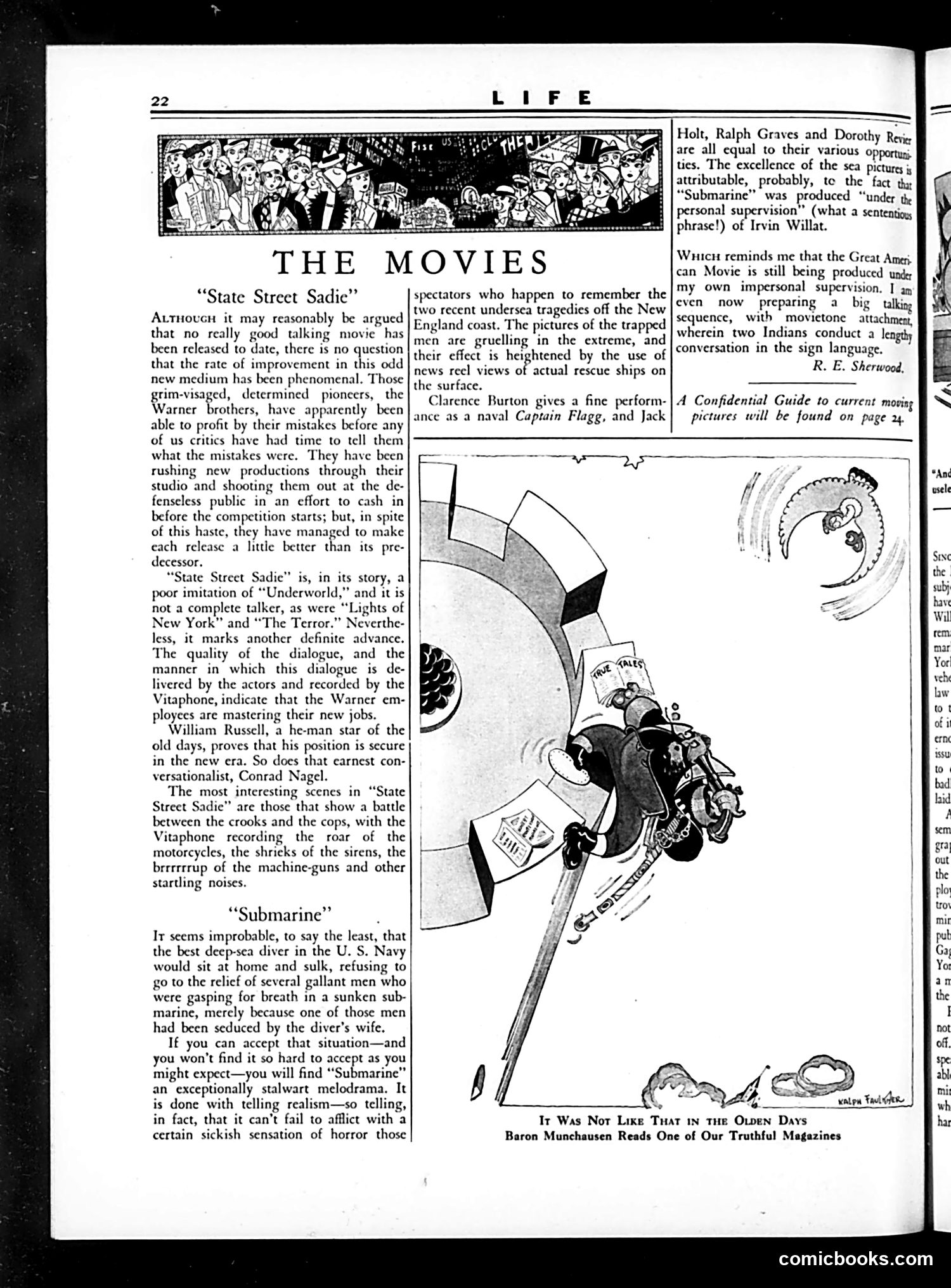
This page reviews early sound films ("talkies"), a new technology. The main cartoon depicts Baron Munchausen reading a magazine—a satirical jab at the absurdity of movie plots. **"State Street Sadie"**: A crime film criticized as inferior to "Underworld," but praised for technical improvements in dialogue recording via Vitaphone. The reviewer credits Warner Brothers' rapid production methods for steady quality improvement, despite haste. **"Submarine"**: A melodrama about a Navy diver refusing rescue duty after his wife is seduced by another sailor. The reviewer notes the implausible premise but praises its "telling realism"—which unfortunately reminded audiences of two recent actual undersea tragedies, making scenes of trapped men genuinely distressing rather than entertainingly dramatic. The cartoon's caption suggests modern movie plots are so exaggerated they rival Baron Munchausen's fictional tall tales, implying studios prioritize sensationalism over plausibility—even when competing with actual tragedy.
📄 Transcribed text from this page (OCR, searchable)
Machine-transcribed from the original scan — historical spelling and the odd misread are preserved.
“State Street Sadie” AttnoucH it may reasonably be argued that no really good talking movie has been released to date, there is no question that the rate of improvement in this odd new medium has been phenomenal. Those grim-visaged, determined pioncers, the Warner brothers, have apparently been able to profit by their mistakes before any of us critics have had time to tell them what the mistakes were. They have been rushing new productions through their studio and shooting them out at the de- fenseless public in an effort to cash in before the competition starts; but, in spite of this haste, they have managed to make each release a little better than its pre- decessor, “State Street Sadie” is, in its story, a poor imitation of “Underworld,” and it is not a complete talker, as wer: New York” and “The Terror.” less, it marks another definite advance. The quality of the dialogue, and the manner in which this dialogue is de- livered by the actors and recorded by the Vitaphone, indicate that the Warner em- ployees are mastering their new jobs. William Russell, a he-man star of the old days, proves that his position is secure in the new era. So does that earnest con- versationalist, Conrad Nagel. The most interesting scenes in “State Street Sadie” are those that show a battle between the crooks and the cops, with the Vitaphone recording the roar of the motorcycles, the shricks of the sirens, the brrrrrrup of the machine-guns and other startling noises. “Submarine” Ir seems improbable, to say the least, that the best deep-sea diver in the U. S. Navy would sit at home and sulk, refusing to go to the relief of several gallant men who were gasping for breath in a sunken sub- marine, merely because one of those men had been seduced by the diver’s wife. If you can accept that situation—and you won't find it so hard to accept as you might expect—you will find “Submarine” an exceptionally stalwart melodrama. It is done with telling realism—so telling, in fact, that it can’t fail to afflict with a certain sickish sensation of horror those spectators who happen to remember the two recent undersea tragedies off the New England coast. The pictures of the trapped men are gruelling in the extreme, and their effect is heightened by the use of news reel views of actual rescue ships on the surface. Clarence Burton gives a fine perform- ance as a naval Captain Flagg, and Jack Holt, Ralph Graves and Dorothy Revie are all equal to their various opportuni ties. The excellence of the sea pictures i attributable, probably, te the fact tu: “Submarine” was produced “under the personal supervision” (what a sententioys phrase!) of Irvin Willat. Wnuicu reminds me that the Great Amer. can Movie is still being produced unde, my own impersonal supervision. I an even now preparing a big talking sequence, with movietone attachment, wherein two Indians conduct a len; conversation in the sign language. R. E. Sherwood, A Confidential Guide to current moving pictures will be found on page 4 mame | | Tt Was Nor Like Tuat in tHE Owen Days Baron Munchausen Reads One of Our Truthful Magazines comicbooks.com