
Life, 1928-09-28 · page 10 of 36
Life — September 28, 1928 — page 10: what you’re looking at
What you’re looking at
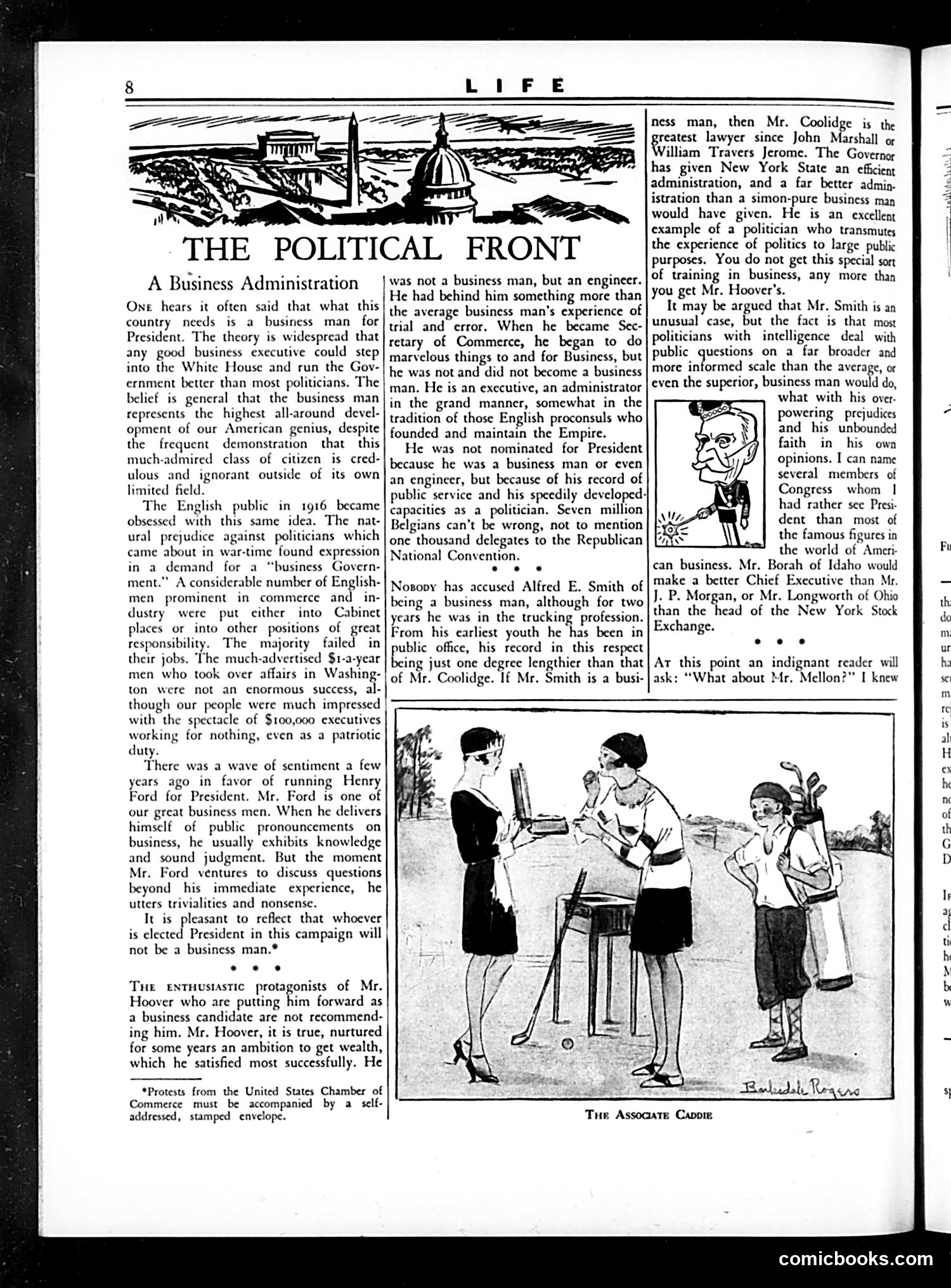
This page discusses whether business executives should become politicians. The article debates whether Herbert Hoover—presented as a successful businessman-turned-politician—represents good governance or whether politicians should remain separate from business. The cartoon titled "The Associate Caddie" (bottom) appears to satirize political campaigning, showing women in what looks like a golf setting, likely mocking the superficiality of campaign activities or the involvement of society women in politics. The article mentions Alfred E. Smith (a competitor) and references debates about whether business experience qualifies someone for high political office. The overall tone questions whether business success translates to political competence, expressing skepticism about mixing commerce and governance despite contemporary enthusiasm for "business government."
📄 Transcribed text from this page (OCR, searchable)
Machine-transcribed from the original scan — historical spelling and the odd misread are preserved.
THE POLITICAL FRONT A Business Administration One hears it often said that what this country needs is a business man for President. The theory is widespread that any good business executive could step into the White House and run the Gov- ernment better than most politicians. The belief is general that the business man represents the highest all-around devel- opment of our American genius, despite the frequent demonstration that this much-admired class of citizen is cred- ulous and ignorant outside of its own limited field. The English public in 1916 became obsessed with this same idea. The nat- ural prejudice against politicians which came about in war-time found expression in a demand for a “business Govern- ment.” A considerable number of English- men prominent in commerce and in- dustry were put cither into Cabinet places or into other positions of great responsibility. The majority failed in their jobs. The much-advertised $1-a-year men who took over affairs in Washing- ton were not an enormous success, al- though our people were much impressed with the spectacle of $100,000 executives working for nothing, even as a patriotic duty. There was a wave of sentiment a few years ago in favor of running Henry Ford for President. Mr. Ford is one of our great business men. When he delivers himself of public pronouncements on business, he usually exhibits knowledge and sound judgment. But the moment Mr. Ford ventures to discuss questions beyond his immediate experience, he utters trivialities and nonsense. It is pleasant to reflect that whoever is clected President in this campaign will not be a business man.®* oe. Tue ENTHUSIASTIC protagonists of Mr. Hoover who are putting Fim forward as a business candidate are not recommend- ing him. Mr. Hoover, it is true, nurtured for some years an ambition to get wealth, which he satisfied most successfully. He *Protests from the United States Chamber of Commerce must be accompanied by a self- addressed, stamped envelope. | was not a business man, but an engineer. He had behind him something more than the average business man’s experience of trial and error. When he became Sec- retary of Commerce, he began to do marvelous things to and for Business, but he was not and did not become a business man. He is an executive, an administrator in the grand manner, somewhat in the tradition of those English proconsuls who founded and maintain the Empire. He was not nominated for President because he was a business man or even an engineer, but because of his record of capacities as a politician. Seven million Belgians can’t be wrong, not to mention one thousand delegates to the Republican National Convention. eee Nosovy has accused Alfred E. Smith of being a business man, although for two years he was in the trucking profession. From his earliest youth he has been in parle office, his record in this respect ing just one degree lengthier than that of Mr. Coolidge. If Mr. Smith is a busi- public service and his speedily developed: ness man, then Mr. Coolidge is the reatest lawyer since John Marshall or William Travers Jerome. The Governor has given New York State an efficient administration, and a far better admin. istration than a simon-pure business man would have given. He is an excellent example of a politician who transmutes the experience of politics to large public purposes. You do not get this special sort of training in business, any more than you get Mr. Hoover's. It may be argued that Mr. Smith is an unusual case, but the fact is that most politicians with intelligence deal with public questions on a far broader and more intormed scale than the average, or even the superior, business man would do, what with his over. powering prejudices and his unbounded faith in his own opinions. I can name several members of Congress whom | had rather see Presi- dent than most of the famous figures in the world of Ameri- can business. Mr. Borah of Idaho would make a better Chief Executive than Mr. J. P. Morgan, or Mr. Longworth of Ohio than the head of the New York Stock Exchange. Art this point an indignant reader will ask: “What about Mr. Mellon?” I knew Tue Assocate Canoie comicbooks.com