
Life, 1928-09-28 · page 25 of 36
Life — September 28, 1928 — page 25: what you’re looking at
What you’re looking at
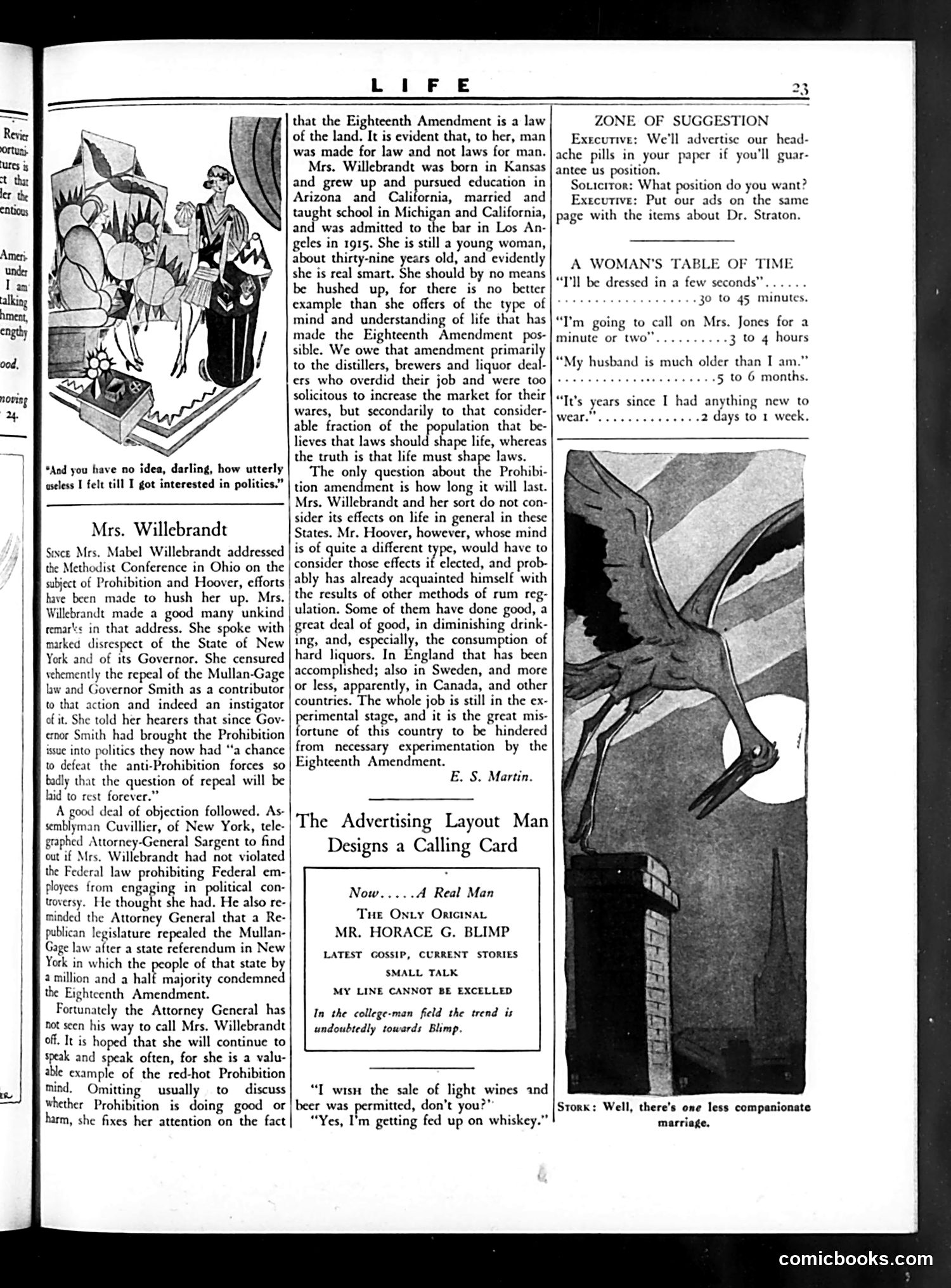
This page critiques **Mabel Willebrandt**, the Assistant Attorney General under President Hoover, who publicly campaigned for Prohibition enforcement. The article attacks her as embodying a rigid, legalistic mindset that prioritizes laws over human reality—believing "man was made for law and not laws for man." The satire argues Prohibition itself resulted from alcohol industry excess and this type of authoritarian thinking. Life suggests Hoover, by contrast, would pragmatically evaluate Prohibition's actual effects, noting other countries achieved drinking reduction through gentler methods. The cartoon's opening quote mocks how Willebrandt found personal satisfaction only through political activism, suggesting she lacks broader wisdom about life's complexity. A secondary joke features a calling card parody of "Mr. Horace G. Blimp," satirizing advertising clichés about masculine self-promotion—likely unrelated to the main article.
📄 Transcribed text from this page (OCR, searchable)
Machine-transcribed from the original scan — historical spelling and the odd misread are preserved.
LIFE *And you have no idea, darling, how utterly aseless I felt till I got interested in politics.” Mrs. Willebrandt Sisce Mrs. Mabel Willebrandt addressed the Methodist Conference in Ohio on the subject of Prohibition and Hoover, efforts have been made to hush her up. Mrs. | Willebrandt made a good many unkind temart’s in that address. She spoke with marked disrespect of the State of New York and of its Governor. She censured vehemently the repeal of the Mullan-Gage lw and Governor Smith as a contributor to that action and indeed an instigator of it. She told her hearers that since Gov- enor Smith had brought the Prohibition issue into politics they now had “a chance to defeat the anti-Prohibition forces so tadly that the question of repeal will be hid to rest forever.” A good deal of objection followed. As- semblyman Cuvillier, of New York, tele- graphed Attorney-General Sargent to find out if Mrs. Willebrandt had not violated the Federal law prohibiting Federal em- ployees from engaging in political con- toversy. He thought she had. He also re- minded the Attorney General that a Re- publican legislature repealed the Mullan- Gage law after a state referendum in New York in which the people of that state by a million and a half majority condemned the Eighteenth Amendment. Fortunately the Attorney General has not seen his way to call Mrs. Willebrandt off. It is hoped that she will continue to speak and speak often, for she is a valu- able example of the red-hot Prohibition mind. Omitting usually to discuss whether Prohibition is doing good or harm, she fixes her attention on the fact that the Eighteenth Amendment is a law of the land. It is evident that, to her, man was made for law and not laws for man. Mrs. Willebrandt was born in Kansas and grew up and pursued education in Arizona and California, married and taught school in Michigan and California, and was admitted to the bar in Los An- geles in 1915. She is still a young woman, about thirty-nine years old, and evidently she is real smart. She should by no means be hushed up, for there is no better example than she offers of the type of mind and understanding of life that has made the Eighteenth Amendment pos- sible. We owe that amendment primaril to the distillers, brewers and liquor deal- ers who overdid their job and were too solicitous to increase the market for their wares, but secondarily to that consider- able fraction of the population that be- lieves that laws should shape life, whereas the truth is that life must shape laws. The only question about the Prohibi- tion amendment is how long it will last. Mrs. Willebrandt and her sort do not con- sider its effects on life in general in these States. Mr. Hoover, however, whose mind is of quite a different type, would have to consider those effects it elected, and prob- ably has already acquainted himself with the results of other methods of rum reg- ulation. Some of them have done good, a great deal of good, in diminishing drink- ing, and, especially, the consumption of hard liquors. In England that has been accomplished; also in Sweden, and more or less, apparently, in Canada, and other countries. The whole job is still in the ex- perimental stage, and it is the great mis- fortune of this country to be hindered from necessary experimentation by the Eighteenth Amendment. E. S. Martin. The Advertising Layout Man Designs a Calling Card A Real Man Tue Onry Ortcinac MR. HORACE G. BLIMP LATEST GOSSIP, CURRENT STORIES SMALL TALK MY LINE CANNOT BE EXCELLED In the college-man field the trend is undoubtedly towards Blimp. “I wisn the sale of light wines and beer was permitted, don’t you?’ “Yes, I'm getting fed up on whiskey.” OF SUGGESTION Executive: We'll advertise our head- ache pills in your paper if you'll guar- antee us position. Soticrror: What position do you want? Executive: Put our ads on the same page with the items about Dr. Straton. ZONE A WOMAN'S TABLE OF TIME “T'll be dressed in a few seconds” 30 to 45 minutes. “I'm going to call on Mrs. Jones for a minute or two" 3 to 4 hours “My husband is much older than I am.” 5 to 6 months. “It’s years since I had anything new to WALL ee veeineesesee 2 days to 1 week. Stork: Well, there’s one less companionate marriage. comicbooks.com