
Life, 1928-09-28 · page 19 of 36
Life — September 28, 1928 — page 19: what you’re looking at
What you’re looking at
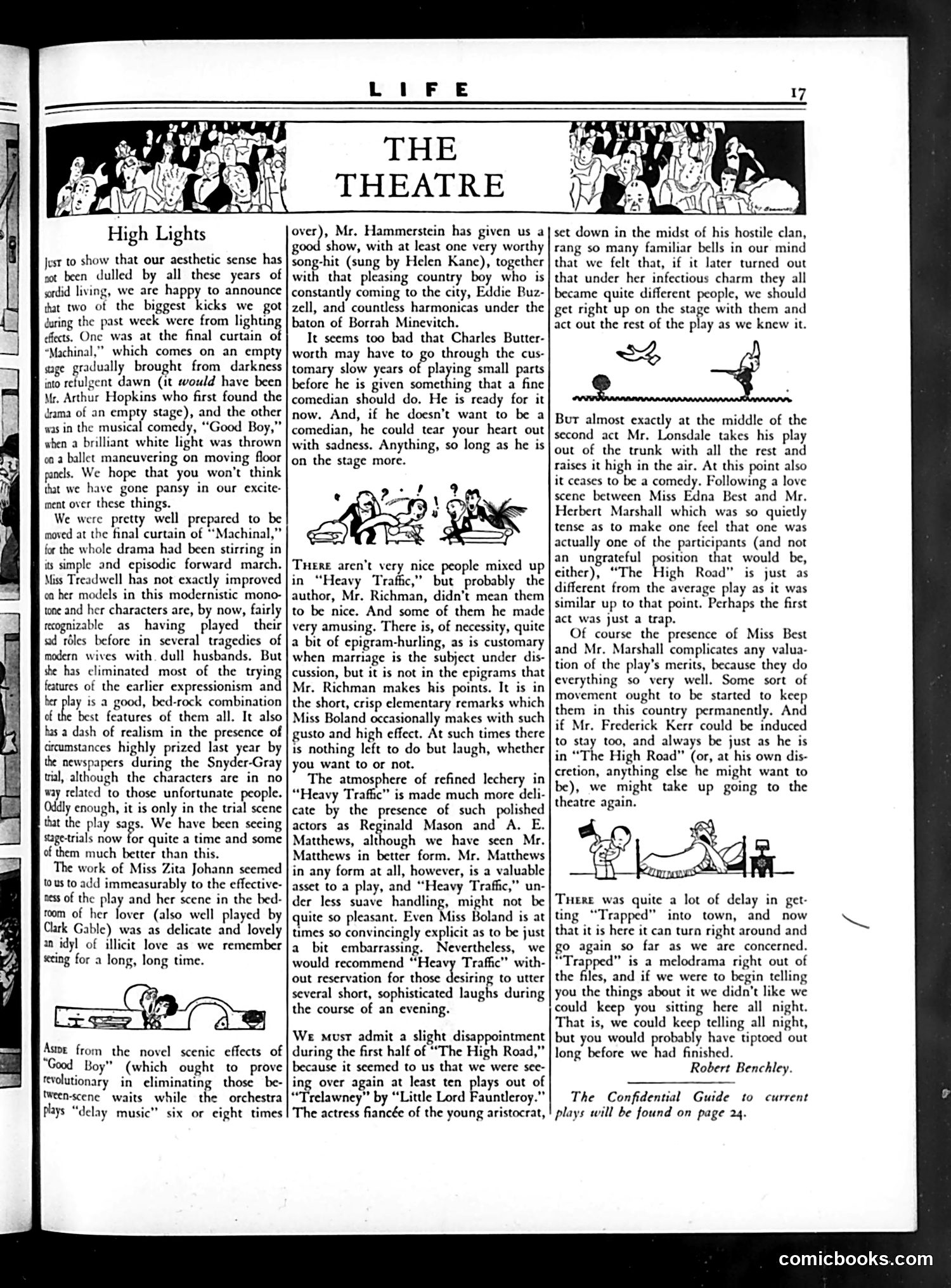
This page reviews theatrical productions from an unspecified era (likely 1920s-1930s based on style). The main reviews discuss "Machinal," "Good Boy," and "Heavy Traffic." The small cartoons illustrate theater-related humor rather than political satire. One shows figures in exaggerated poses suggesting theatrical melodrama. Another depicts what appears to be stage setup or props. The text criticizes theatrical conventions—particularly Charles Butterworth's comedic timing and the presence of polished actors like Reginald Mason—while praising emotional performances by actresses like Zita Johann. The reviewer, Robert Benchley, complains that "The High Road" disappointed despite ten previous similar plays. This is primarily **theater criticism with illustrative cartoons**, not political commentary. The satire targets theatrical clichés and audience expectations rather than political figures or events.
📄 Transcribed text from this page (OCR, searchable)
Machine-transcribed from the original scan — historical spelling and the odd misread are preserved.
Jest to show that our aesthetic sense has sot been dulled by all these years of srdid living, we are happy to announce that two of the biggest kicks we got during the past week were from lighung eects. One was at the final curtain of “Machinal,” which comes on an empty sage gradually brought from darkness into reftulgent dawn (it would have been Mr, Arthur Hopkins who first found the dama of an empty stage), and the other was in the musical comedy, “‘Good Boy,” when a brilliant white light was thrown oa a ballet maneuvering on moving floor panels. We hope that you won't think that we have gone pansy in our excite- ment over these things. We were pretty well prepared to be moved at the final curtain of “*Machinal,” for the whole drama had been stirring in its simple and episodic forward march. Miss Treadwell has not exactly improved oa her models in this modernistic mono- tone and her characters are, by now, fairly recognizable as having played their sd réles before in several tragedies of modern wives with. dull husbands. But she has climinated most of the trying features of the earlier expressionism and ber play is a good, bed-rock combination of the best features of them all. It also has a dash of realism in the presence of arcumstances highly prized last year by the newspapers during the Snyder-Gray tial, although the characters are in no way related to those unfortunate people. Oddly enough, it is only in the trial scene that the play sags. We have been seeing sage-trials now 3 quite a time and some of them much better than this. The work of Miss Zita Johann seemed tous to add immeasurably to the effective- sess of the play and her scene in the bed- toom of her lover (also well played by Clark Gable) was as delicate and lovely an idyl of illicit love as we remember sting for a long, long time. Aspe from the novel scenic effects of Good Boy” (which ought to prove revolutionary in eliminating those be- tween-scene waits while the orchestra Plays “delay music” six or eight times THEATRE orer)s Mr. Hammerstein has given us a good show, with at least one very worthy song-hit (sung by Helen Kane), together with that pleasing country boy who is constantly coming to the city, Eddie Buz- zell, and countless harmonicas under the baton of Borrah Minevitch. It seems too bad that Charles Butter- worth may have to go through the cus- tomary slow years of playing small parts before he is given something that a fine comedian should do. He is ready for it now. And, if he doesn’t want to be a comedian, he could tear your heart out with sadness. Anything, so long as he is on the stage more. © O41 2 Tere aren't very nice le mixed u in “Heavy Trae,” bat probably Ae author, Mr. Richman, didn’t mean them to be nice. And some of them he made very amusing. There is, of necessity, quite a bit of epigram-hurling, as is customary when marriage is the subject under dis- cussion, but it is not in the epigrams that Mr. Richman makes his points. It is in the short, crisp elementary remarks which Miss Boland occasionally makes with such gusto and high effect. At such times there is nothing left to do but laugh, whether you want to or not. The atmosphere of refined lechery in “Heavy Traffic” is made much more deli- cate by the presence of such polished actors as Reginald Mason and A. E. Matthews, although we have seen Mr. Matthews in better form. Mr. Matthews in any form at all, however, is a valuable asset to a play, and “Heavy Traffic,” un- der less suave handling, might not be uite so pleasant. Even Miss Boland is at times so convincingly explicit as to be just a bit embarrassing. Nevertheless, we would recommend “Heavy Traffic” with- out reservation for those desiring to utter several short, sophisticated laughs during the course of an evening. We usr admit a slight disappointment during the first half of “The High Road,” because it seemed to us that we were see- ing over again at least ten per out of “Trelawney” by “Little Lord Fauntleroy.” The actress fiancée of the young aristocrat, set down in the midst of his hostile clan, rang so many familiar bells in our mind that we felt that, if it later turned out that under her infectious charm they all became quite different people, we should get right up on the stage with them and act out the rest of the play as we knew it. 3% Bur almost exactly at the middle of the second act Mr. Lonsdale takes his play out of the trunk with all the rest and raises it high in the air. At this point also it ceases to be a comedy. Following a love scene between Miss Edna Best and Mr. Herbert Marshall which was so quictly tense as to make one feel that one was actually one of the participants (and not an_ ungrateful ition that would be, either), “The High Road” is just as different from the average play as it was similar up to that point. Perhaps the first act was just a trap. Of course the presence of Miss Best and Mr. Marshall complicates any valua- tion of the play’s merits, because they do everything so very well. Some sort of movement ought to be started to keep them in this country permanently. And if Mr. Frederick Kerr could be induced to stay too, and always be just as he is in “The High Road” (or, at his own dis- cretion, anything else he might want to be), we might take up going to the theatre again. Tere was quite a lot of delay in get- ting “Trapped” into town, and now that it is here it can turn right around and go again so far as we are concerned. “Trapped” is a melodrama right out of the files, and if we were to begin telling you the things about it we didn’t like we could keep you sitting here all night. That is, we could keep telling all night, but you would probably have tiptoed out long before we had finished. Robert Benchley. The Confidential Guide to current plays will be found on page 24. comicbooks.com