
Life, 1928-09-28 · page 11 of 36
Life — September 28, 1928 — page 11: what you’re looking at
What you’re looking at
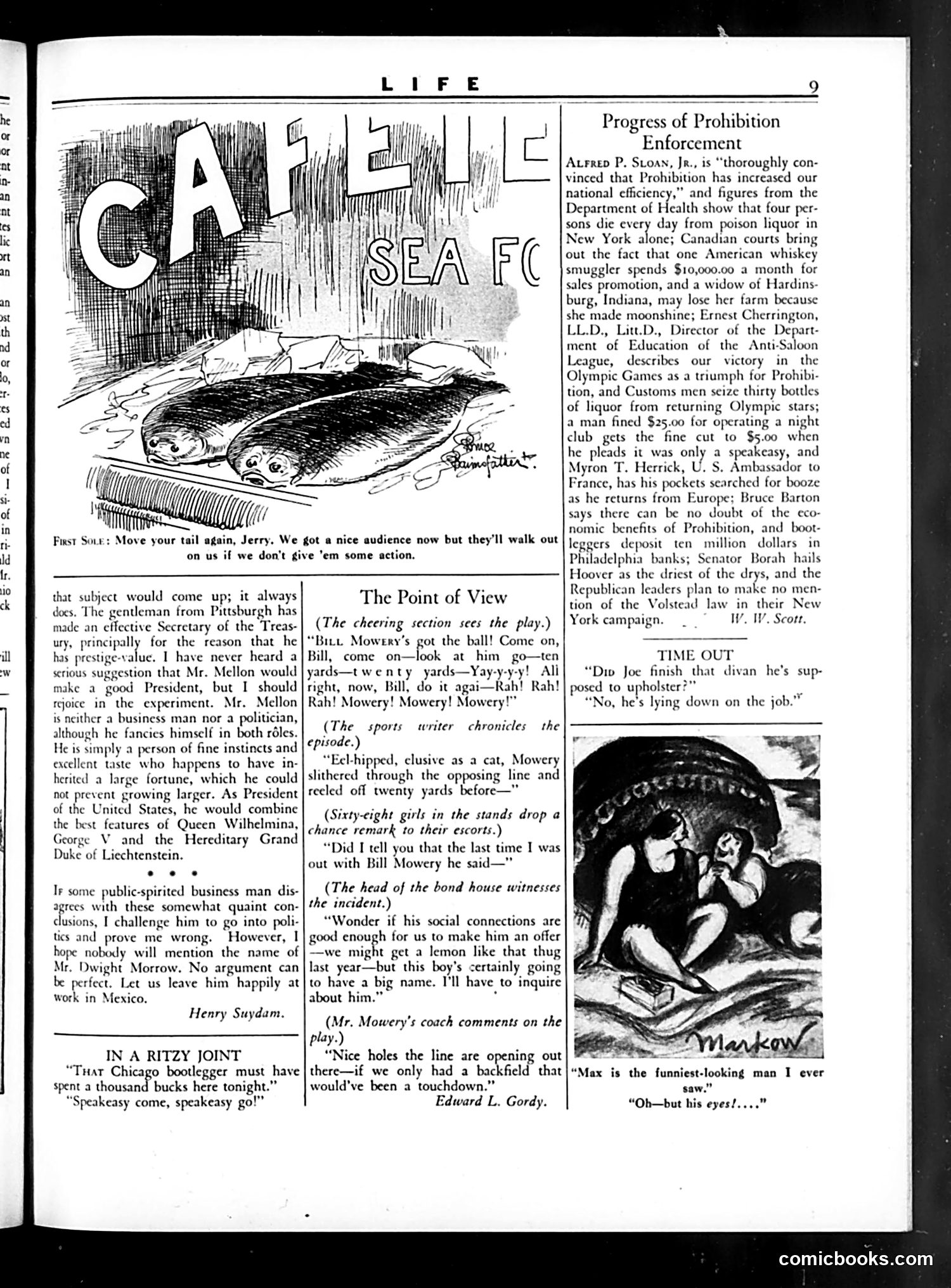
The main cartoon depicts a dead fish labeled "CAFE" with its tail, illustrating a caption: "Move your tail again, Jerry. We got a nice audience now but they'll walk out on us if we don't give 'em some action." This satirizes a failing nightclub or entertainment venue during Prohibition. The "dead fish" represents a speakeasy struggling to attract customers despite legal pressure. The joke is that even with an audience present, the establishment has "died"—it's unresponsive and lifeless, suggesting the venue can't sustain itself or provide entertainment. The text section "Progress of Prohibition Enforcement" reports on anti-alcohol efforts, including bootlegger fines and liquor seizures, providing context for why such establishments were struggling during this period of alcohol prohibition in America.
📄 Transcribed text from this page (OCR, searchable)
Machine-transcribed from the original scan — historical spelling and the odd misread are preserved.
First Soe: Move your tail again, Jerry. We got a nice audience now but they'll walk out on us if we don't give 'em some action, that subject would come up; it always docs. The gentleman from Pittsburgh has made an effective Secretary of the Treas- ury, principally for the reason that he has prestige-value. I have never heard a scrious suggestion that Mr. Mellon would make a good President, but I should rqjoice in the experiment. Mr. Mellon is neither a business man nor a politician, although he fancies himself in both réles. He is simply a person of fine instincts and excellent taste who happens to have in- herited a large fortune, which he could not prevent growing larger. As President of the United States, he would combine the best features of Queen Wilhelmina, George V and the Hereditary Grand Duke of Liechtenstein. Ir some public-spirited business man dis- agrecs with these somewhat quaint con- clusions, I challenge him to go into poli- tics and prove me wrong. However, | hope nobody will mention the name of Mr. Dwight Morrow. No argument can be perfect. Let us leave him happily at work in Mexico. Henry Suydam, IN A RITZY JOINT “Tuat Chicago bootlegger must have spent a thousand bucks here tonight.” “Speakeasy come, speakeasy go!” The Point of View (The cheering section sees the play.) “Birt Mowery’s got the ball! Come on, Bill, come on—look at him go—ten yards—t wenty yards—Yay-y-y-y! All right, now, Bill, do it agai—Rah! Rah! Rah! Mowery! Mowery! Mowery!” (The episode.) “Ecl-hipped, clusive as a cat, Mowery slithered through the opposing line and recled off twenty yards before—" sports writer chronicles the (Sixty-eight girls in the stands drop a chance remark to their escorts.) “Did I tell you that the last time I was out with Bill Mowery he said—" (The head of the bond house witnesses the incident.) “Wonder if his social connections are good enough for us to make him an offer —we might get a lemon like that thug last year—but this boy's certainly going to have a big name. I'll have to inquire about him.” . Progress of Prohibition Enforcement Atrrep P. Stoan, Jr., is “thoroughly con- vinced that Prohibition has increased our national efficiency,” and figures from the Department of Health show that four per- sons die every day from poison liquor in New York alone: Canadian courts bring out the fact that one American whiskey smuggler spends $10,000.00 a month for sales promotion, and a widow of Hardins- burg, Indiana, may lose her farm because she made moonshine; Ernest Cherrington, LL.D., Litt.D., Director of the Depart- ment of Education of the Anti-Saloon League, describes our victory in the Olympic Games as a triumph for Prohibi- tion, and Customs men seize thirty bottles of liquor from returning Olympic stars; a man fined $25.00 for operating a night club gets the fine cut to $5.00 when he pleads it was only a speakeasy, and Myron T. Herrick, U. S. Ambassador to France, has his pockets searched for booze as he returns from Europe; Bruce Barton says there can be no doubt of the eco- nomic benefits of Prohibition, and boot- leggers deposit ten million dollars in Philadelphia banks; Senator Borah hails Hoover as the driest of the drys, and the Republican leaders plan to make no men- tion of the Volstead law in their New York campaign. W. IW. Scott, TIME OUT “Div Joe finish that divan he's sup- to upholste! . Yo, he’s lying down on the job.” (Mr. Mowery’s coach comments on the| ~~ play.) ‘Nice holes the line are opening out there—if we only had a backfield that would've been a touchdown.” Edward L. Gordy. saw. “Oh—but his eyes/....” comicbooks.com