
A complete issue · 36 pages · 1928
Life — August 23, 1928
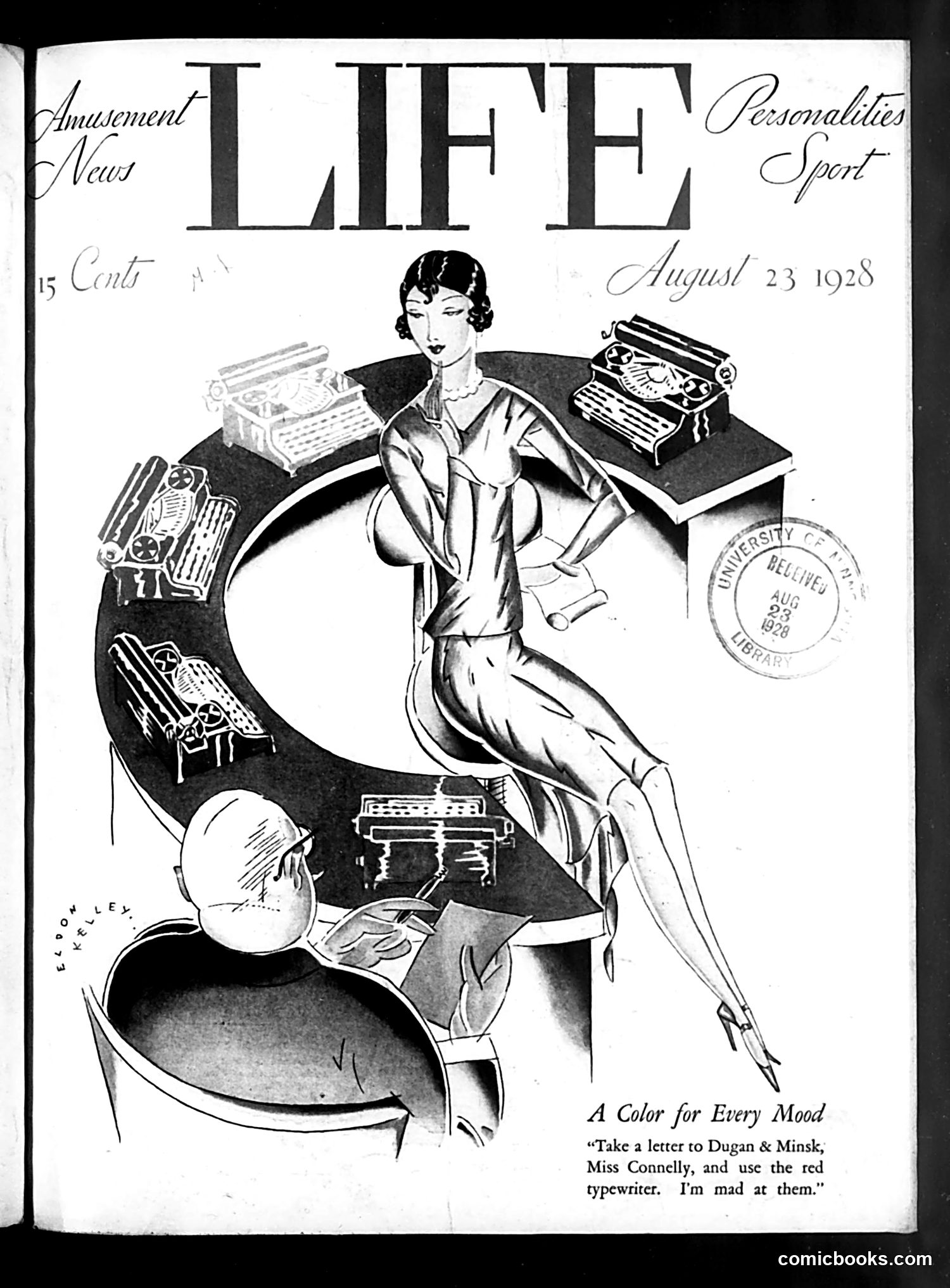
This cover illustrates the magazine's sections: "Amusement News," "Personalities," and "Sport." The central image shows a stylishly dressed woman at a desk surrounded by modern office equipment—typewriters, adding machines, and papers—depicting the "New Woman" of the 1920s workforce. The bottom caption advertises a typewriter color option, playing on the phrase "A Color for Every Mood." The joke references irritation at colleagues Dugan & Minsk and Miss Connelly, with the quip "I'm mad at them"—suggesting the red typewriter expresses her anger. This reflects 1920s humor about women entering professional workplaces in greater numbers during the post-WWI era, mixing mild sexism with admiration for modern female independence and workplace participation.
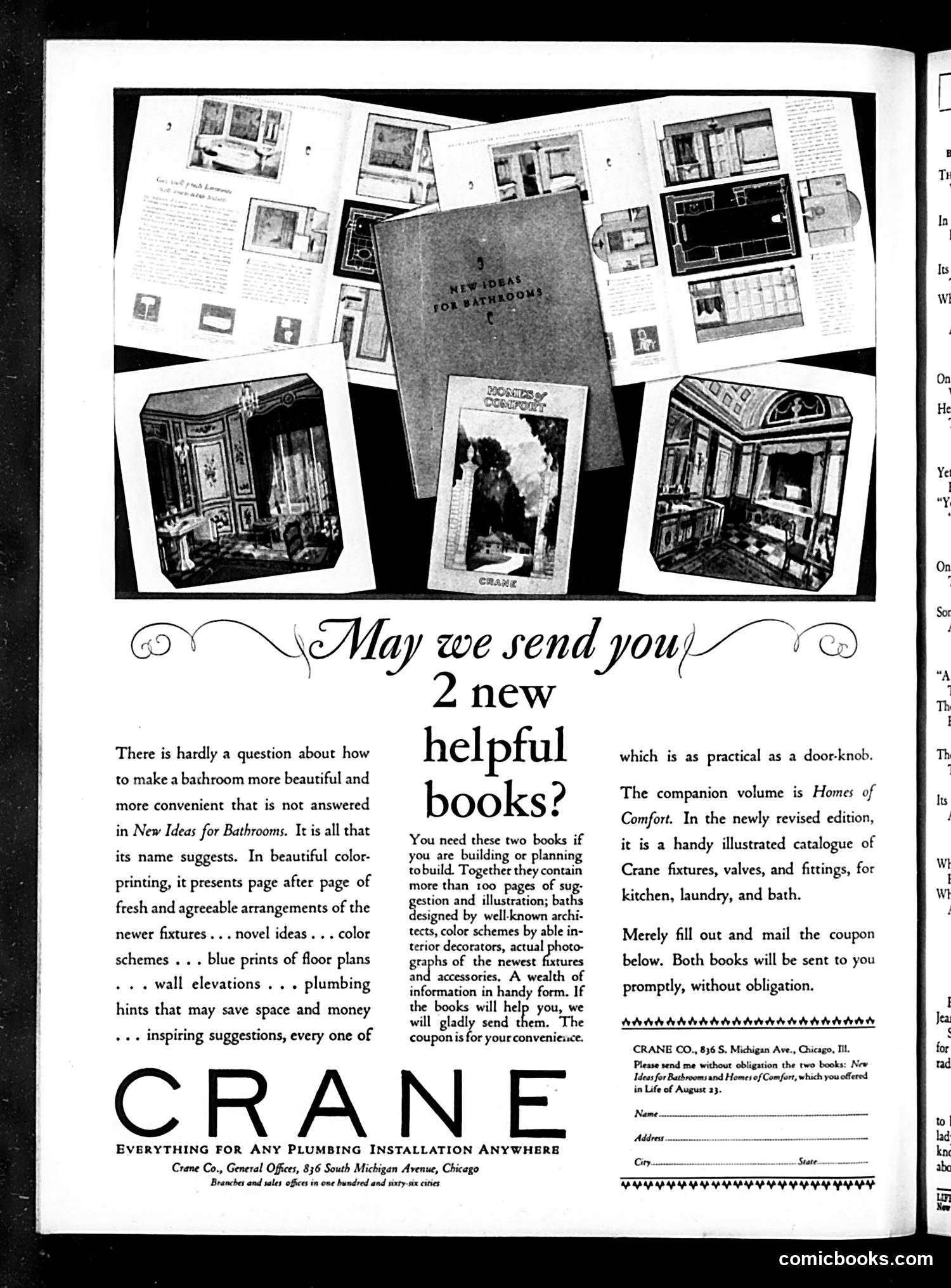
This page is **primarily advertising, not satire or editorial content**. It's a Crane Company advertisement for plumbing fixtures and related products. The ad promotes two books: "New Ideas for Bathrooms" and "Homes of Comfort," positioning them as helpful resources for consumers planning bathroom renovations. The visual collage displays bathroom designs, floor plans, and product photographs to showcase Crane's offerings. There is **no political cartoon or satirical content** present. The decorative text ("May we send you") and layout are typical early-20th-century advertising design. The coupon at bottom invites readers to request the free books. This represents standard commercial marketing from *Life* magazine's advertising section, not editorial commentary.
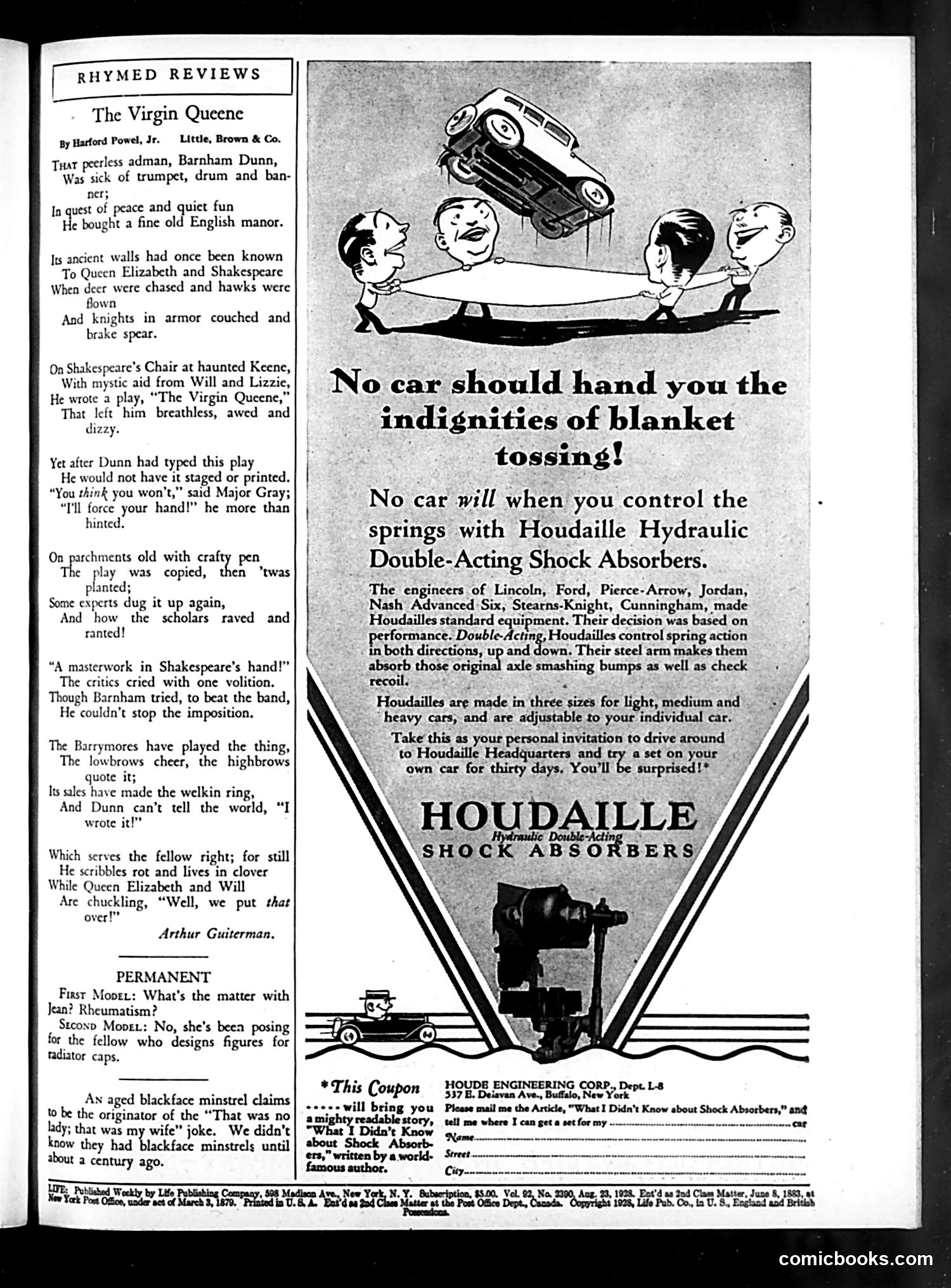
This page combines literary satire with automotive advertising. The left column reviews "The Virgin Queene," a play by Harford Powell Jr. about Barnham Dunn, a trumpeter who purchases an English manor. The review humorously describes the play's theatrical journey—Dunn initially refused to stage or print it, then scholars debated its merit, eventually embracing it as Shakespeare-quality work. The right side features a Houdaille shock absorber advertisement using the play's theme of "blanket tossing"—the ad jokes that no car should subject you to such indignities without proper suspension control. The advertisement emphasizes that major automobile manufacturers standardly equipped their vehicles with Houdaille absorbers, positioning the product as essential for ride comfort and safety.
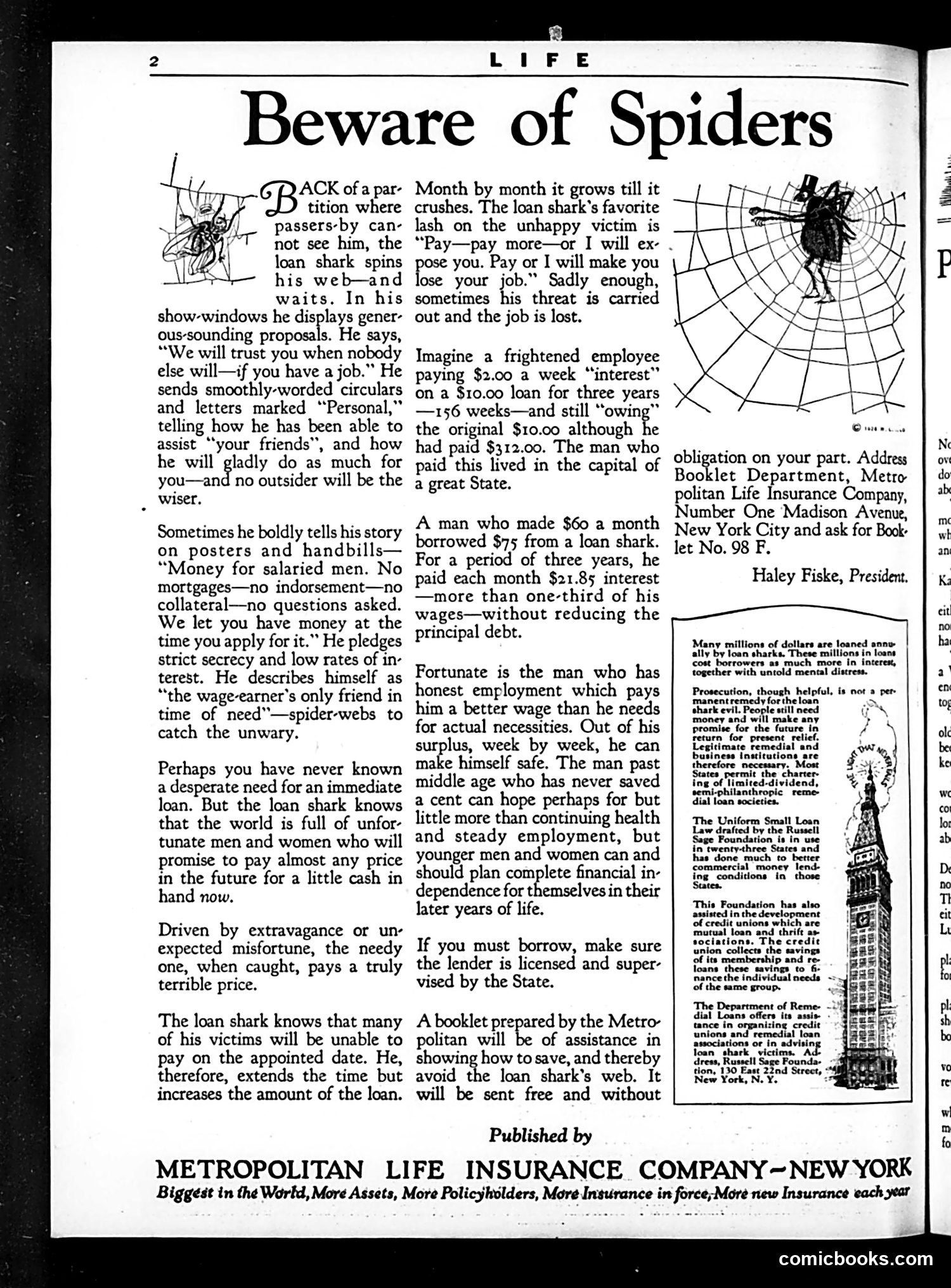
This is a public service article warning against **loan sharks** — illegal lenders who exploited desperate borrowers with predatory terms. The "spider" metaphor compares loan sharks to predators spinning webs to trap victims. The article describes their tactics: smooth-talking salesmen displaying financial proposals in window displays, offering quick cash with seemingly reasonable terms. The reality: a borrower earning $60/month who borrows $75 ends up paying over one-third of his wages in interest alone over three years, never reducing the principal debt. The Metropolitan Life Insurance Company published this as consumer protection, offering a free booklet on legitimate small loans and credit unions as safer alternatives—essentially competitor advocacy against illegal lending while promoting financial literacy.
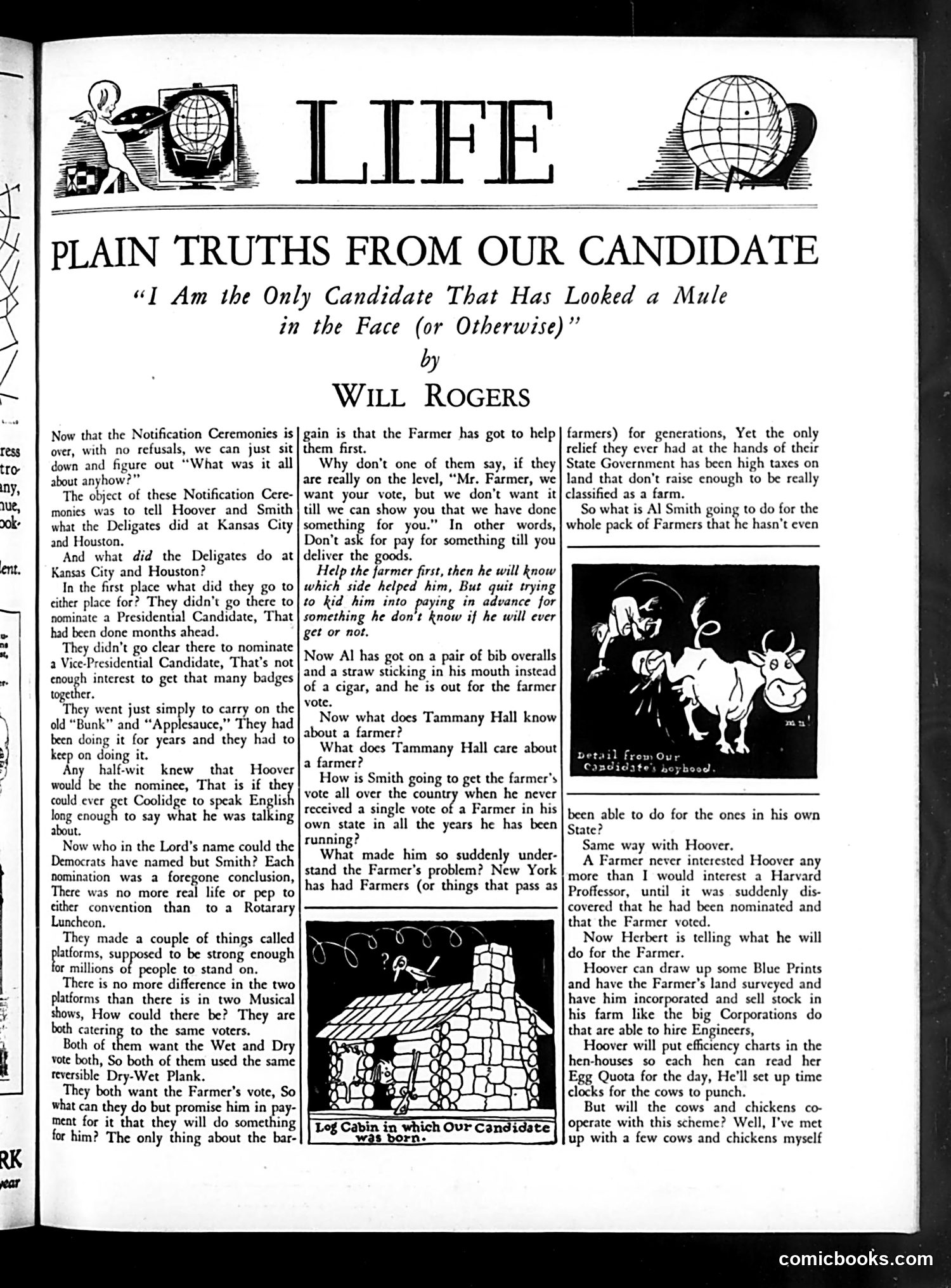
This is a satirical piece by Will Rogers from *Life* magazine attacking candidates' disconnection from farmers' concerns during what appears to be a 1928 presidential election cycle. Rogers criticizes how candidates like Hoover and Smith made vague campaign promises to farmers without understanding agricultural issues. He mocks their platforms as nearly identical ("both entering to the same waters") despite claiming different positions. The cartoon contrasts a mule (representing the farmer being figuratively "kicked") with a log cabin—symbols of rural American life that candidates exploited rhetorically. Rogers's central complaint: candidates who never received farmer votes pretended to champion farming interests, while ignoring actual relief measures farmers needed. The satire exposes the gap between political rhetoric and genuine policy concern for rural America.
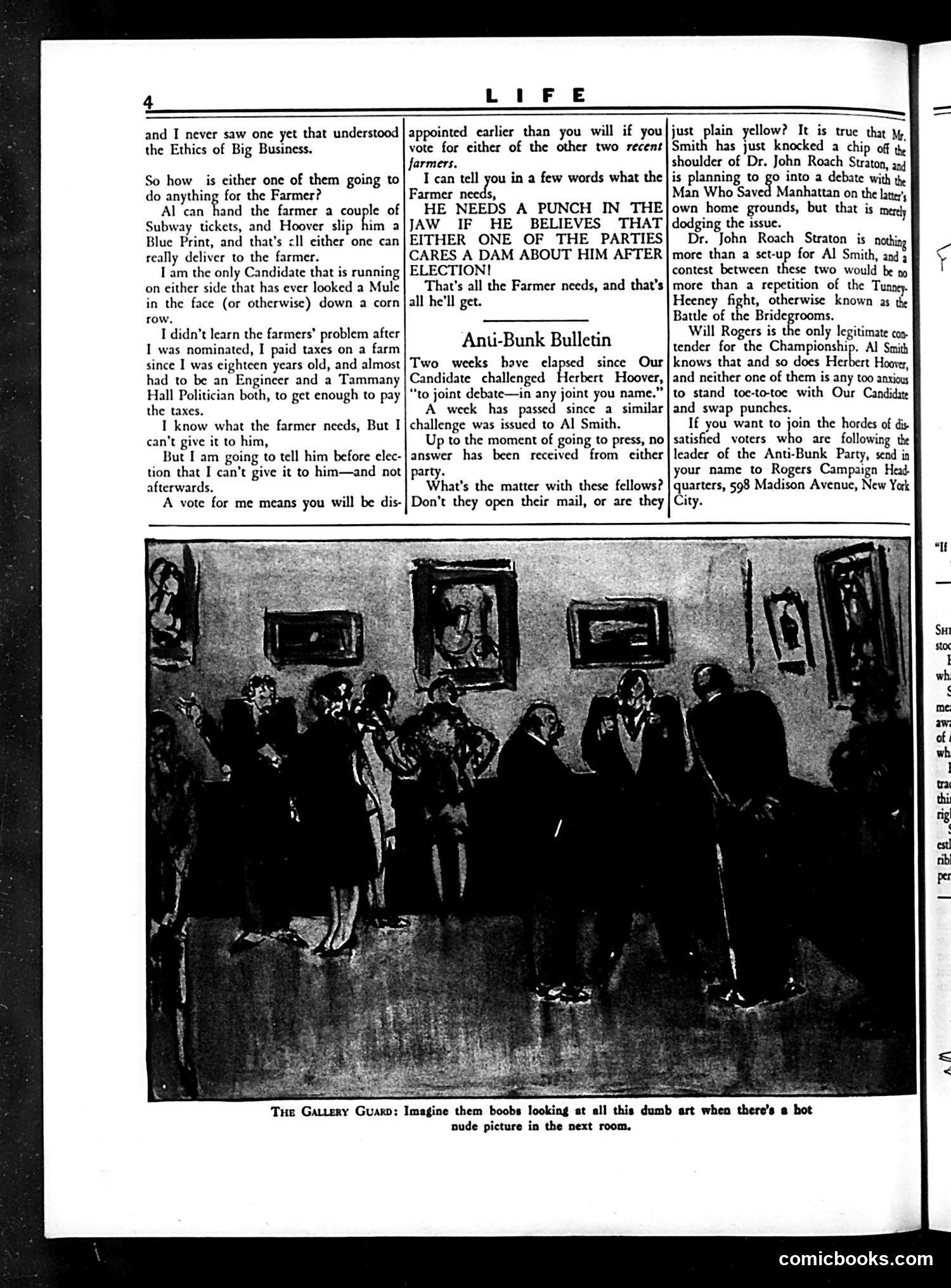
This page contains political commentary about a farmers' election issue. The left column discusses how neither major-party candidate (likely from a 1920s election) has addressed agricultural concerns. The writer promises to explain "what the Farmer needs" before election day. The "Anti-Bunk Bulletin" section mocks Herbert Hoover and Al Smith for ignoring challenges to debate each other on farmers' issues. It satirizes their silence by suggesting they don't read mail or are deliberately avoiding the topic. The photograph caption jokes about gallery visitors admiring "dumb art" while distracted by knowing there's a "hot nude picture in the next room"—a humorous commentary on public taste and art appreciation rather than political content.
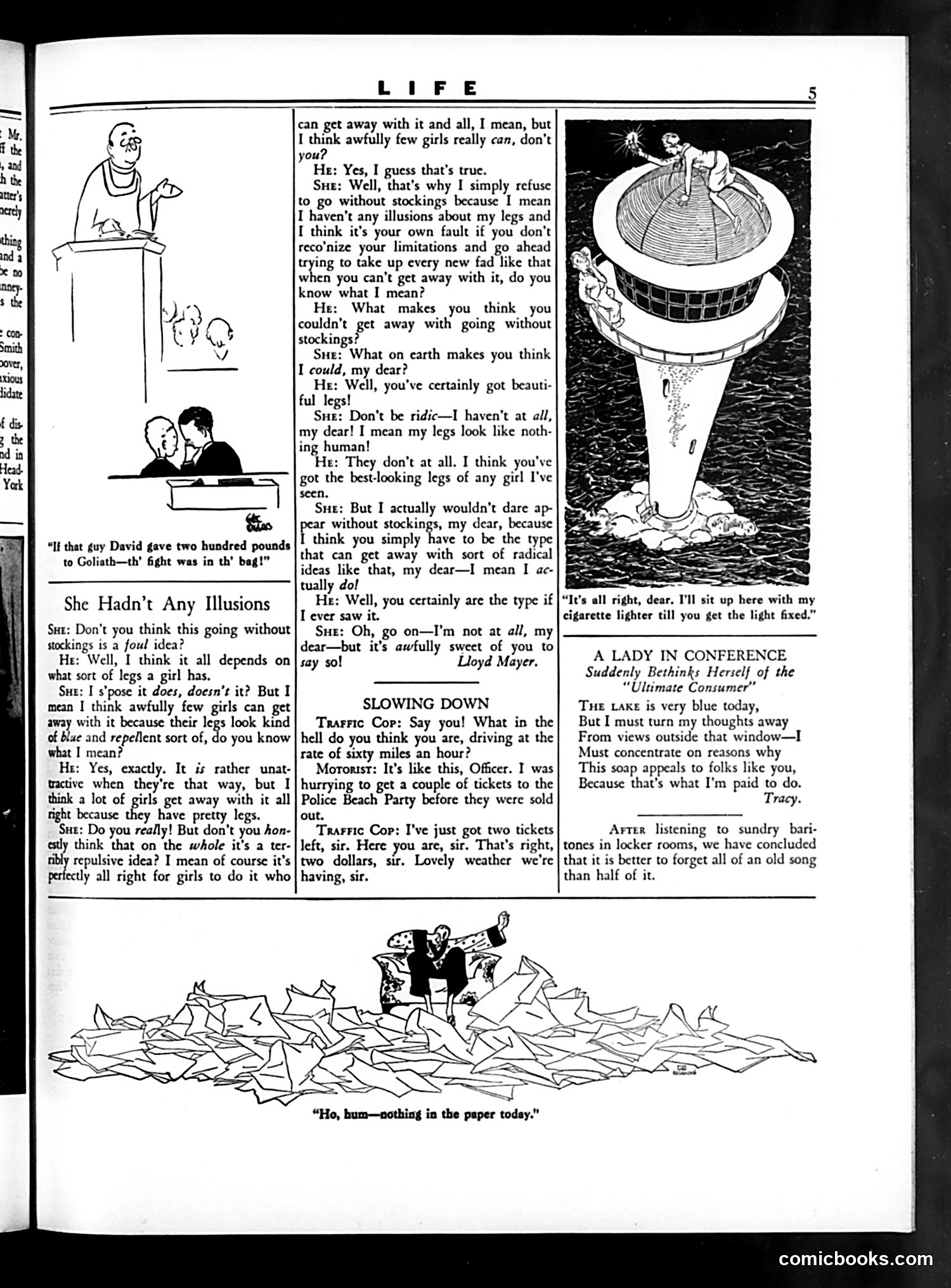
This page contains several humorous sketches satirizing 1920s social attitudes: **"She Hadn't Any Illusions"** depicts a conversation between a man and woman debating whether women need stockings. The woman argues going without is a "foul idea," while the man counters that few girls can "get away with it" due to leg appearance. The satire mocks both 1920s fashion anxieties and gender dynamics around women's appearance standards. **"Slowing Down"** shows a traffic officer stopping a speeding driver, humorously subverting expectations—the driver is actually rushing to escape a Police Beach Party. **"A Lady in Conference"** depicts a woman literally sitting on a lightbulb to fix it, with the caption suggesting patience with household problems. The bottom cartoon shows a man buried in newspapers with the caption "Ho hum—nothing in the paper today," satirizing media consumption habits.
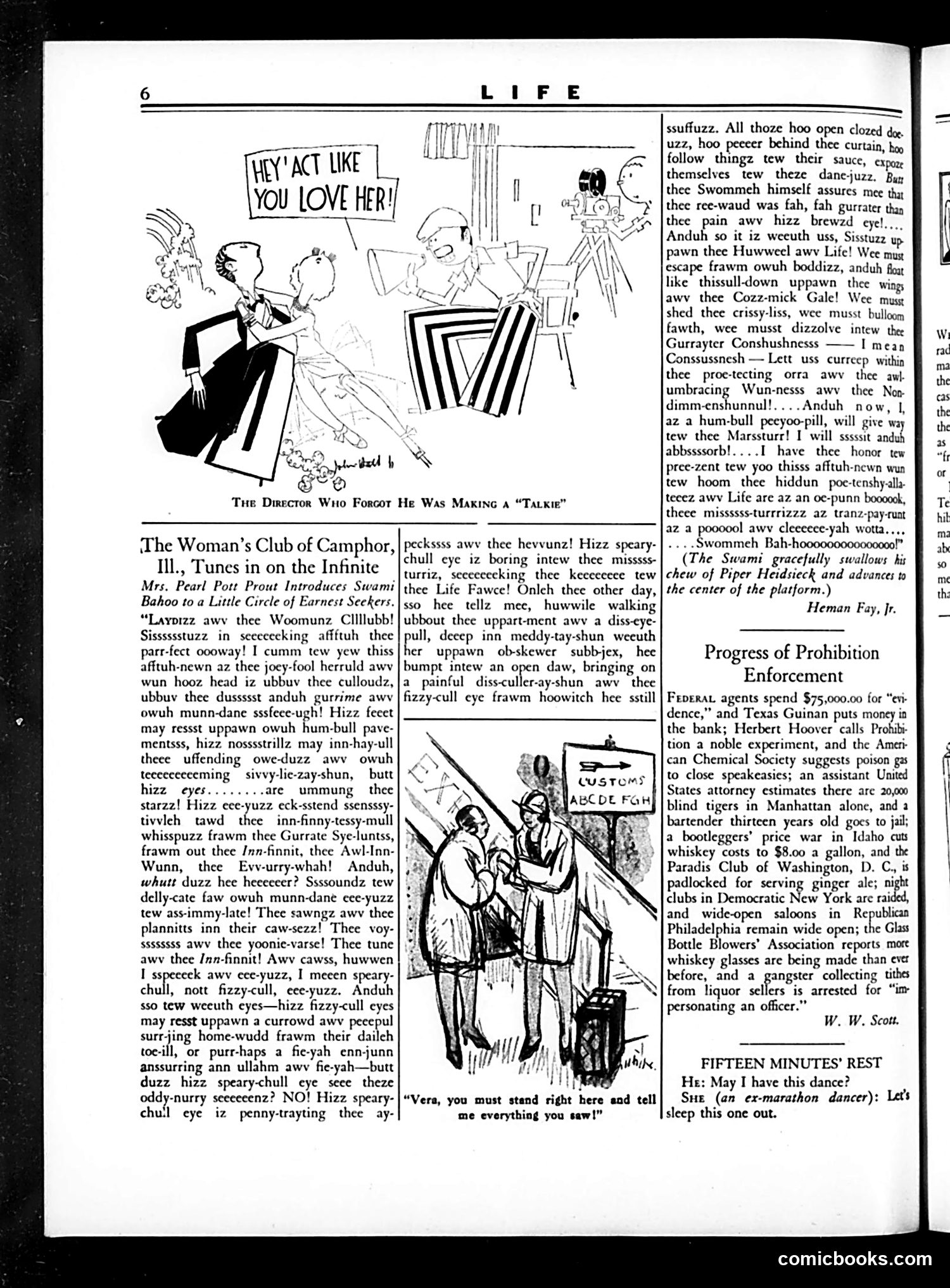
The top cartoon satirizes a film director who has become so absorbed in making a "talkie" (early sound film) that he's forgotten his actual romantic relationship. The woman says "Hey! Act like you love her!" — the irony being that the director treats his real girlfriend with less attention than he demands his actors display on screen. The main article parodies the "Swami Babu" — likely a reference to Indian spiritualism trends popular in 1920s America — speaking in exaggerated, nonsensical pseudo-mystical language about a Woman's Club event. It's mocking both the spiritual fad and theatrical affectation of the era. The side article discusses Prohibition enforcement efforts, showing federal agents conducting raids, reflecting the 1920s-era "noble experiment" of alcohol bans.
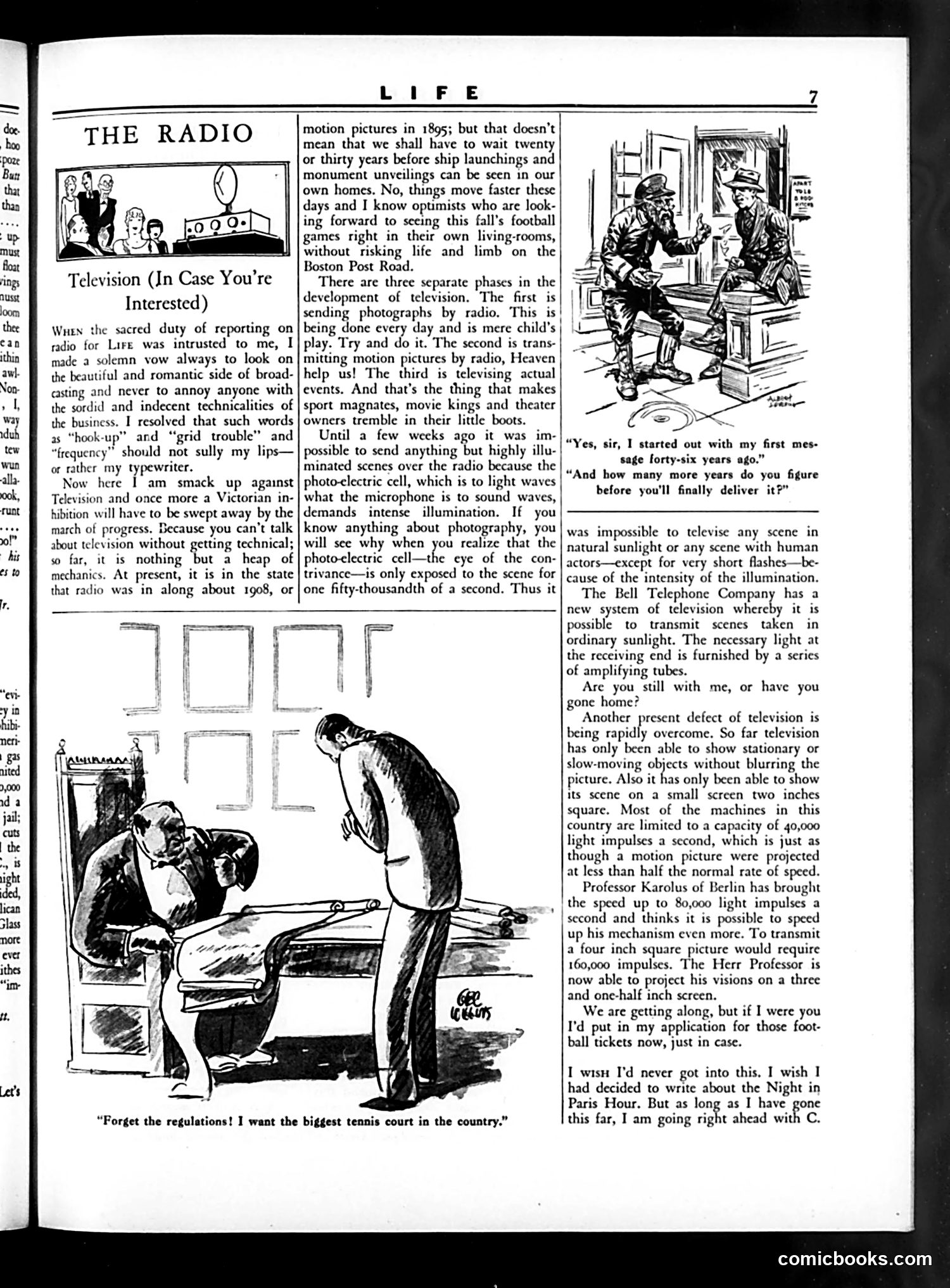
This page discusses early television technology circa the 1920s. The main cartoon depicts a man at a desk speaking to another man, with the caption: "Forget the regulations! I want the biggest tennis court in the country." The joke satirizes bureaucratic red tape and regulatory obstacles impeding television development. The desk operator appears to be a regulatory official blocking ambitious plans for televising sports—specifically tennis—due to technical and legal constraints. The article text explains television's three developmental phases: transmitting photographs via radio, then motion pictures, then live events. It discusses technical limitations of the era, including the photo-electric cell's light requirements and screen size constraints. The satire mocks how regulations and mechanical limitations prevent the ambitious goal of broadcasting major sporting events, a concern relevant to early television's regulatory environment.
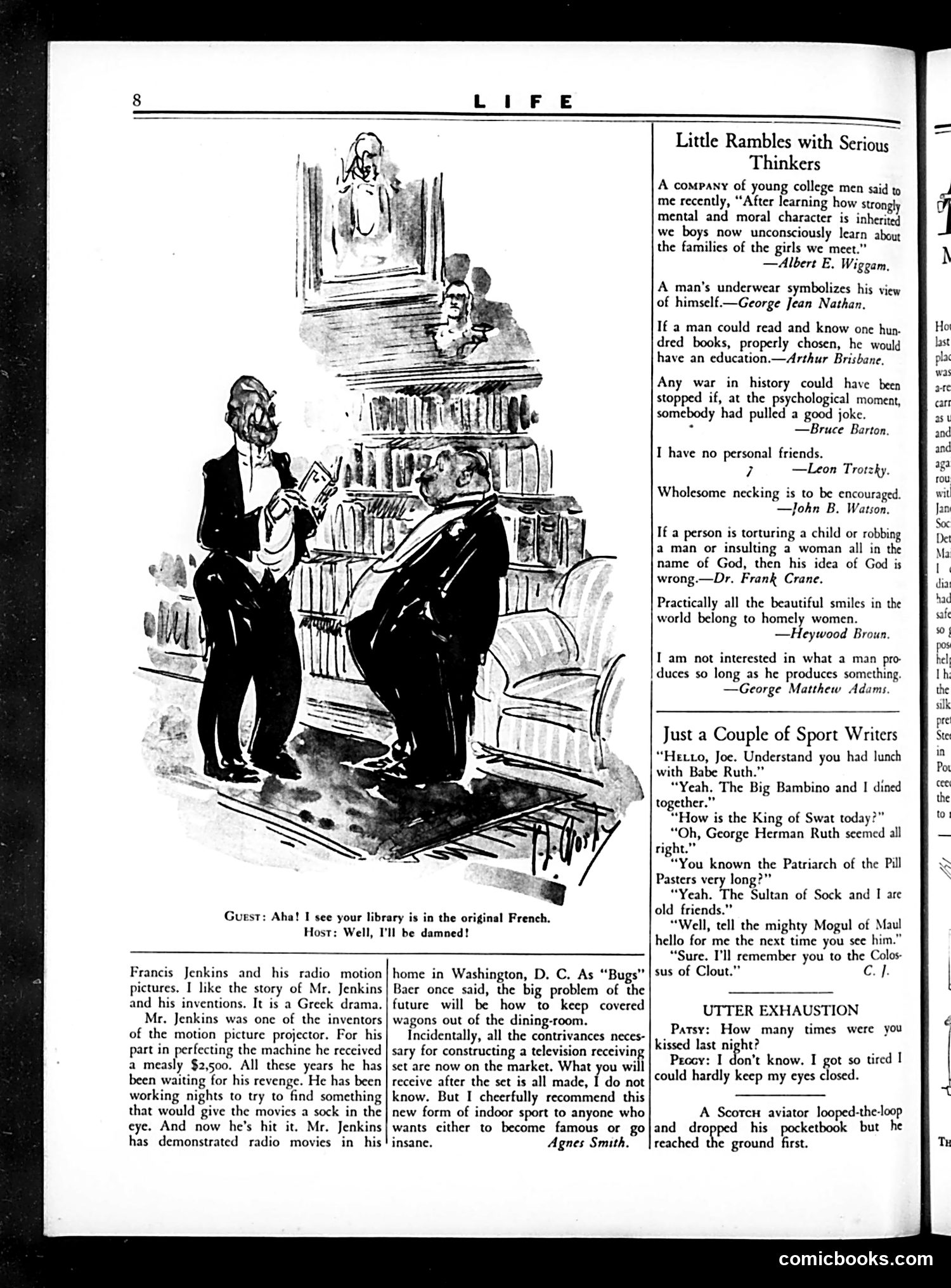
The main cartoon depicts two gentlemen in a library examining books, with one telling the other: "Ah! I see your library is in the original French." The host replies, "Well, I'll be damned!" The joke satirizes pretentiousness about owning books in foreign languages—specifically French editions—as a status symbol of sophistication. The implication is that the guest assumes the host's French volumes signal intellectual refinement, when the host himself may not even read French or intentionally collected them for appearance rather than substance. The page also includes various witty quotations about education, character, and personal conduct, plus humor columns like "Just a Couple of Sport Writers" featuring casual banter about lunch and celebrity gossip, and "Utter Exhaustion" with brief comedic anecdotes.
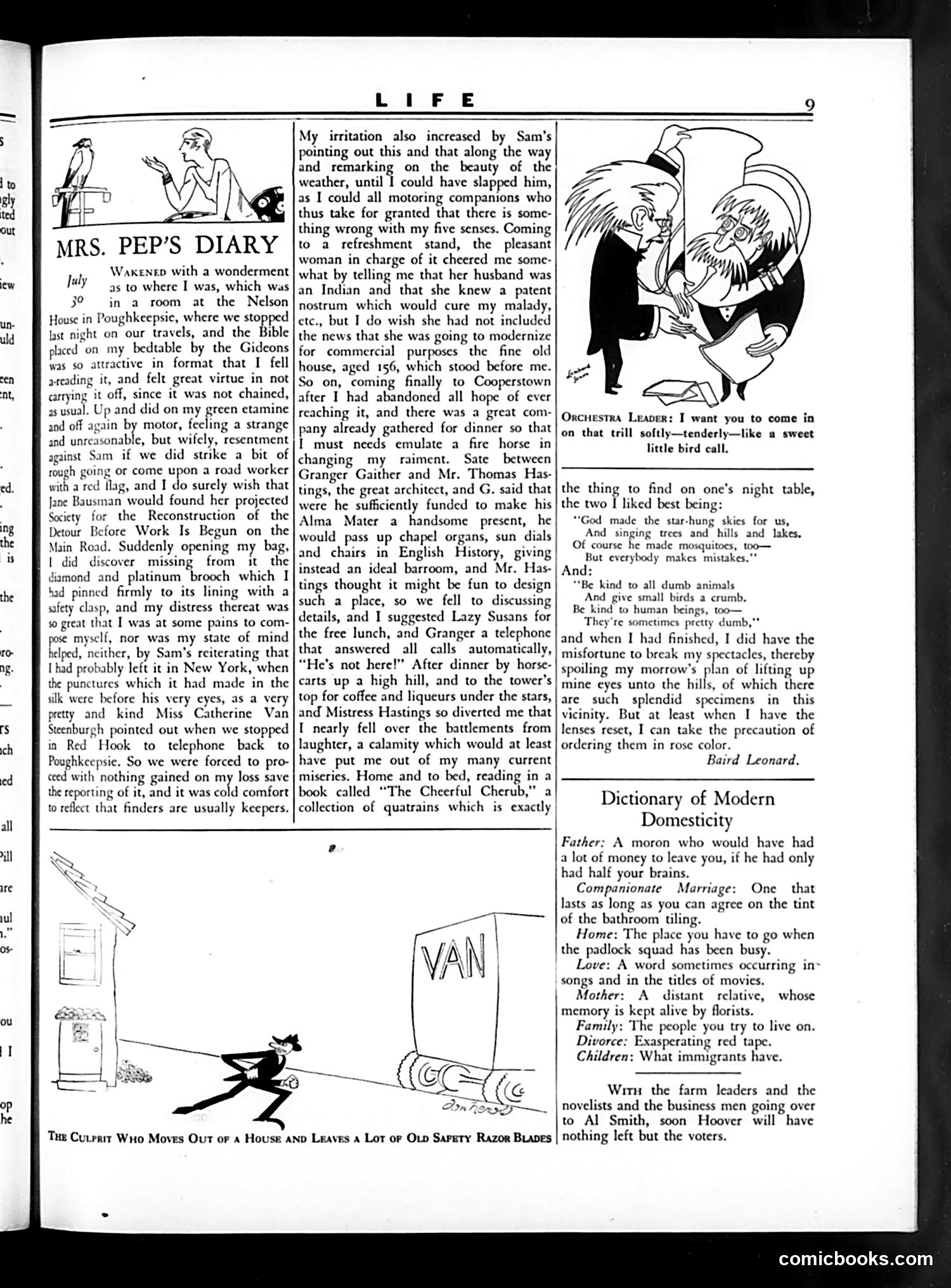
This page contains **"Mrs. Pep's Diary,"** a humorous domestic column describing a motorcar trip where the narrator is annoyed by her companion Sam's constant commentary on scenery and weather. The satire targets tedious travel companions who over-explain obvious observations. The cartoon at bottom depicts **"The Culprit Who Moves Out of a House and Leaves a Lot of Old Safety Razor Blades"**—mocking inconsiderate movers who discard worn razor blades carelessly, creating hazards for others. It's slapstick visual humor about domestic irresponsibility. The "Dictionary of Modern Domesticity" offers tongue-in-cheek definitions mocking family life, marriage, and household dynamics with cynical humor typical of 1920s satirical magazines.
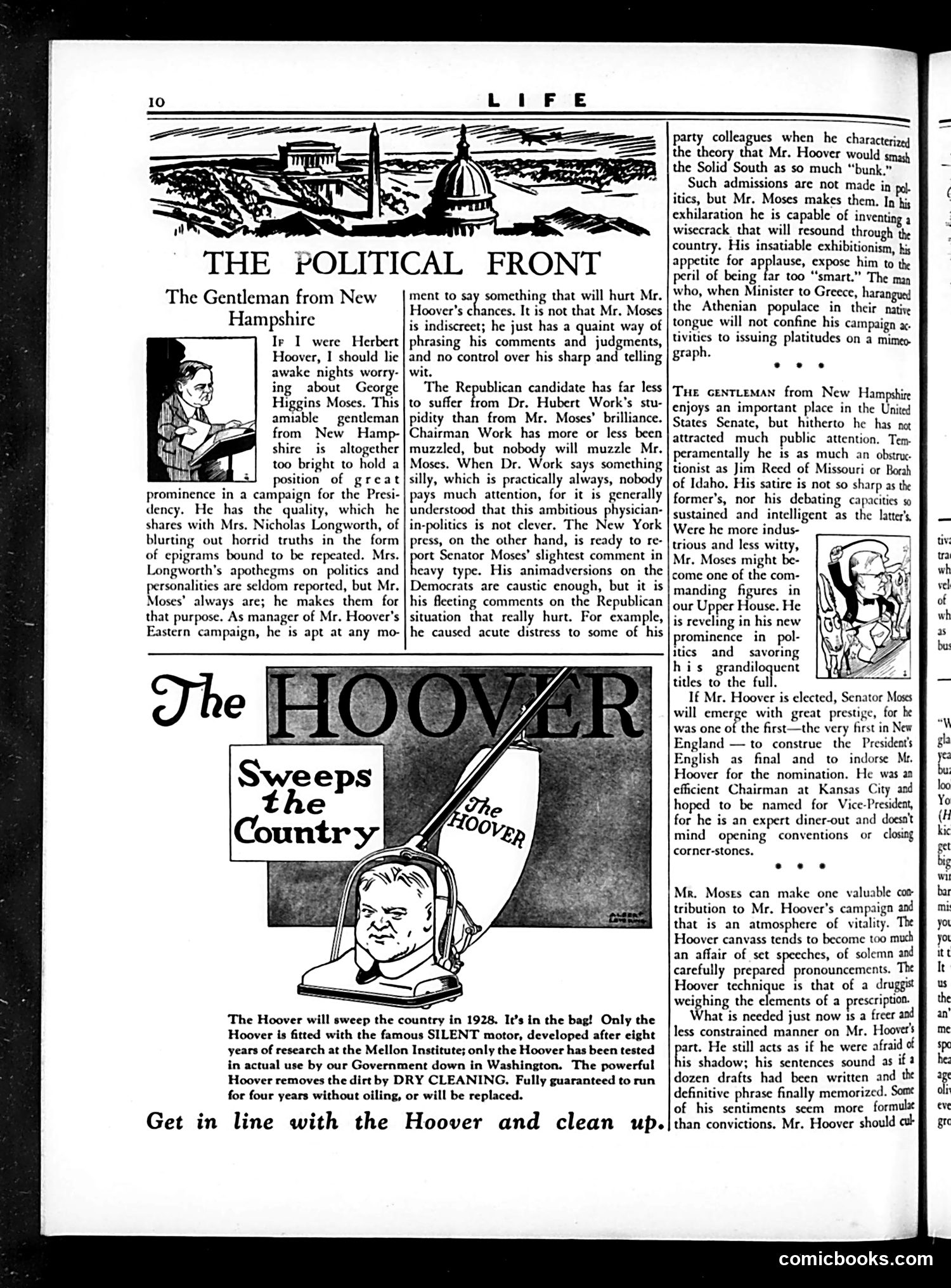
This page satirizes the 1928 U.S. presidential campaign. The main article discusses **Herbert Hoover** and **George Higgins Moses**, a New Hampshire Republican senator. The central cartoon parodies campaign advertising, depicting the **Hoover vacuum cleaner** as a political tool. The caption "The Hoover Sweeps the Country" makes a pun on both the vacuum's cleaning function and Hoover's expected electoral victory. The exaggerated face suggests mocking Hoover's campaign momentum. The article criticizes **Moses' rhetorical style**—praising Hoover while harshly attacking Democratic opponents. It suggests Moses is an effective but blunt campaigner whose sharp comments damage Hoover's image and appeal to independent voters. The satire targets both campaign excess and Moses' inflammatory political rhetoric during what appears to be Hoover's successful 1928 presidential run.
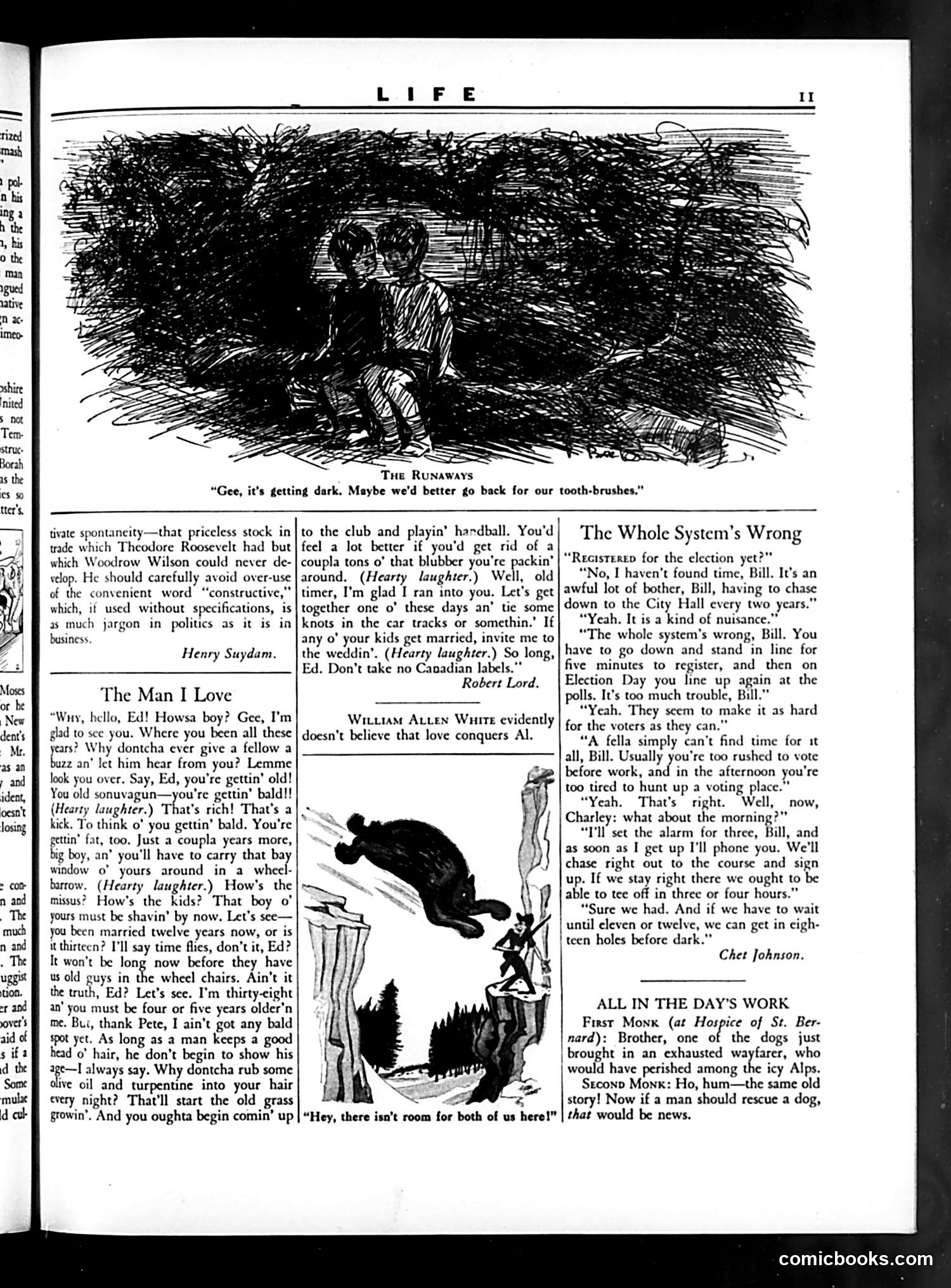
The top cartoon titled "The Runaways" depicts two children hiding in dark brush, with the caption "Gee, it's getting dark. Maybe we'd better go back for our tooth-brushes." This is a humorous domestic scene about children running away—the joke being that even in their rebellion, they remain concerned with civilized routines like brushing teeth. The page contains three separate short humor pieces: "The Man I Love" (a domestic dialogue between spouses), "The Whole System's Wrong" (satirizing election procedures and voter inconvenience), and "All in the Day's Work" (a brief anecdote about monks and rescue). These are typical *Life* magazine humor vignettes—light satirical observations on American domestic life and civic processes rather than sharp political commentary.
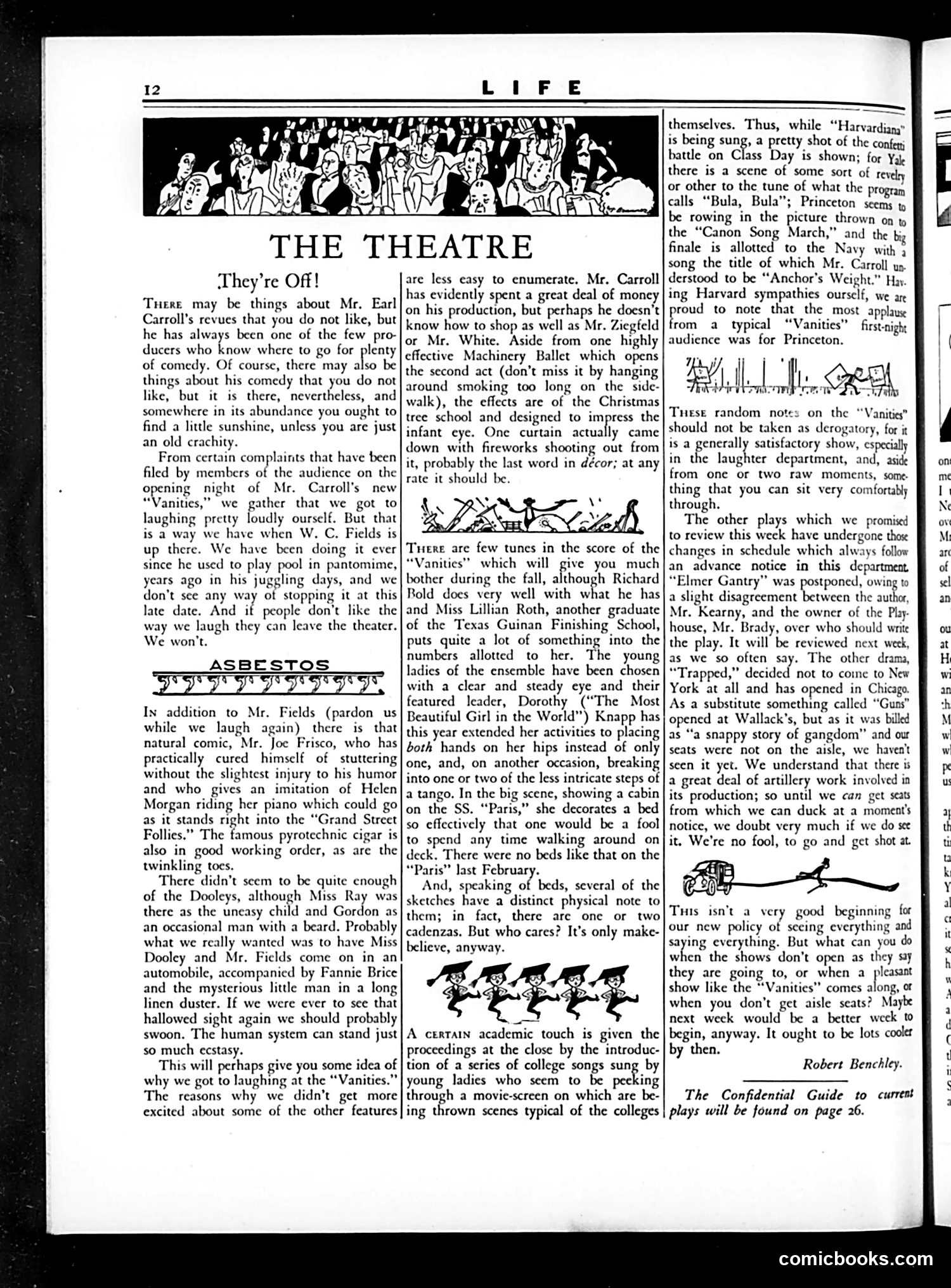
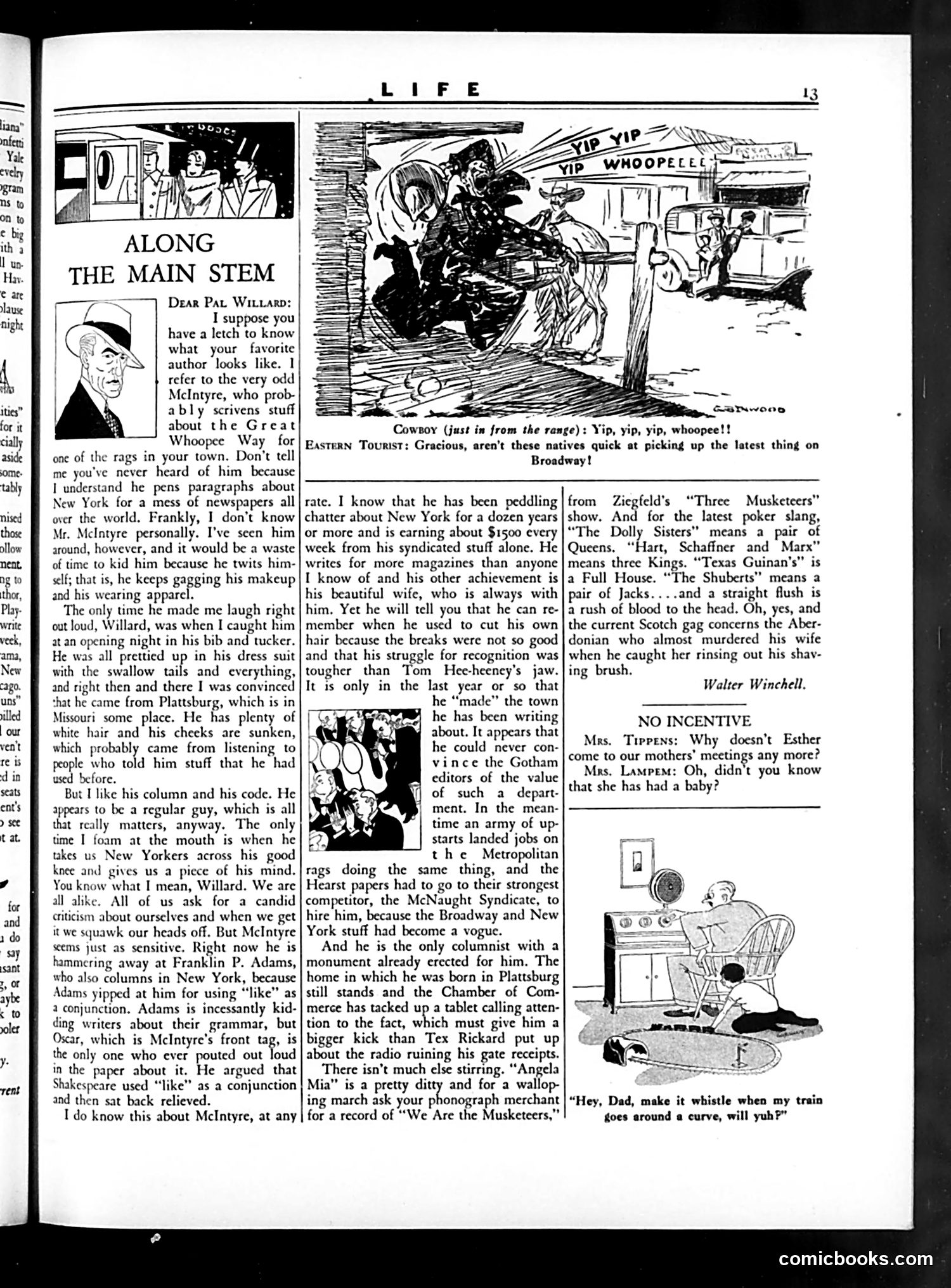
**Main Content: "Along the Main Stem"** This column by Walter Winchell discusses columnist O.O. McIntyre, a New York writer. Winchell describes McIntyre as sensitive and talented, noting he came from Pittsburgh but became a successful Broadway/New York figure. The piece mentions McIntyre's syndicated work and acknowledges rival columnists like Frank P. Adams. **Top Cartoon:** Shows a cowboy encountering an "Eastern Tourist," satirizing the tourist's enthusiasm for Western stereotypes—the tourist excitedly sees the cowboy as embodying authentic frontier culture ("natives quick at picking up the latest thing on Broadway"). **Bottom Cartoon:** Depicts a child asking his father to make a train whistle sound—domestic humor with no political content. The page reflects 1920s-30s media culture and Broadway's dominance in American entertainment discourse.
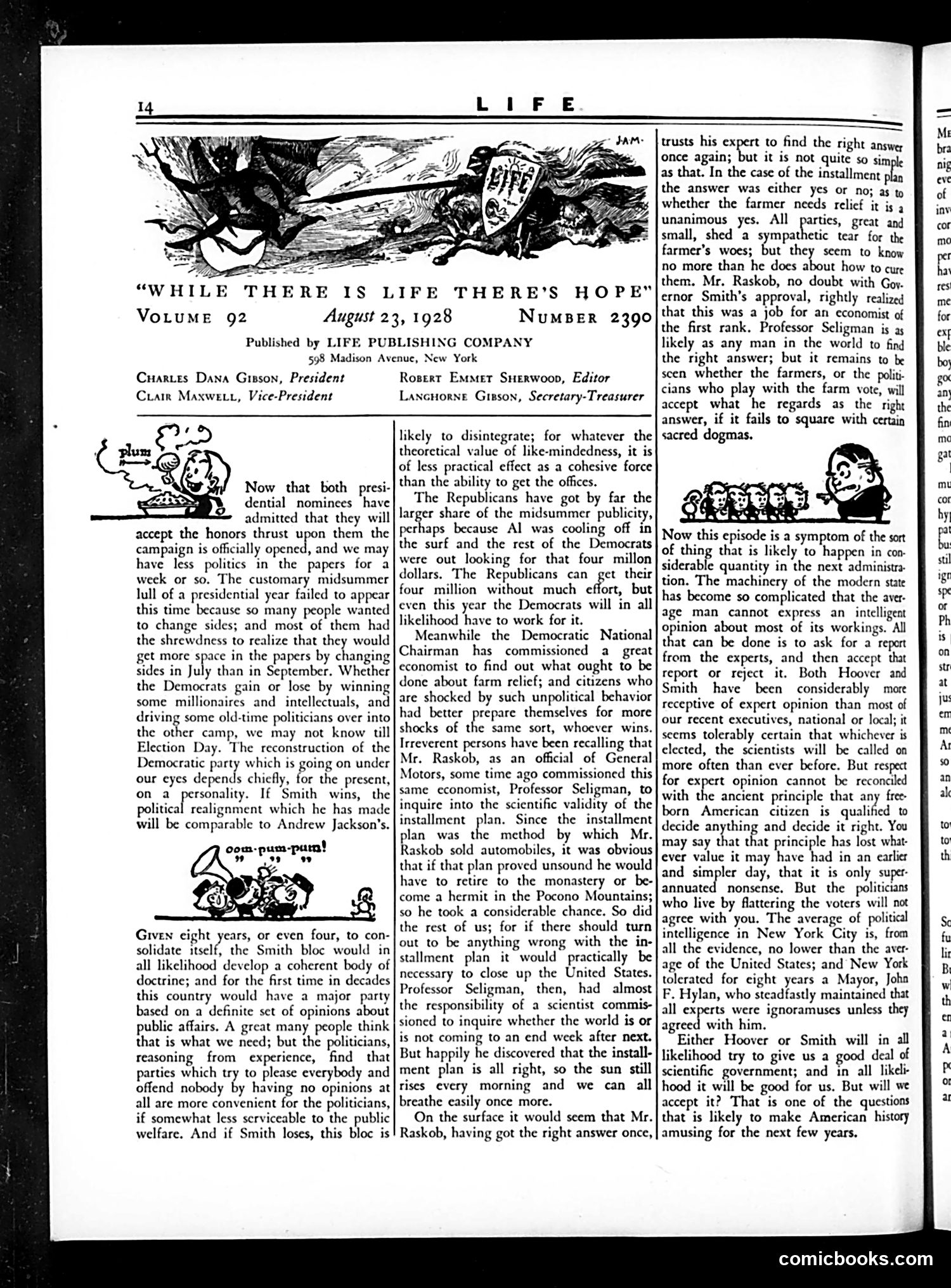
This editorial page discusses the 1928 U.S. presidential election between Republican Herbert Hoover and Democrat Al Smith. The text criticizes both candidates' reliance on expert opinions regarding farm relief policies—a major issue of the era. The cartoon at top left (labeled "WHILE THERE IS LIFE THERE'S HOPE") appears to show a figure struggling or drowning, likely representing the troubled American farm economy. The second cartoon depicts what appears to be a political figure surrounded by children or supporters, suggesting manipulation or pandering to voters. The article argues that politicians oversimplify complex economic problems and that citizens should demand direct answers rather than accepting expert rhetoric. It questions whether either candidate truly understands or can solve agricultural crisis effectively.
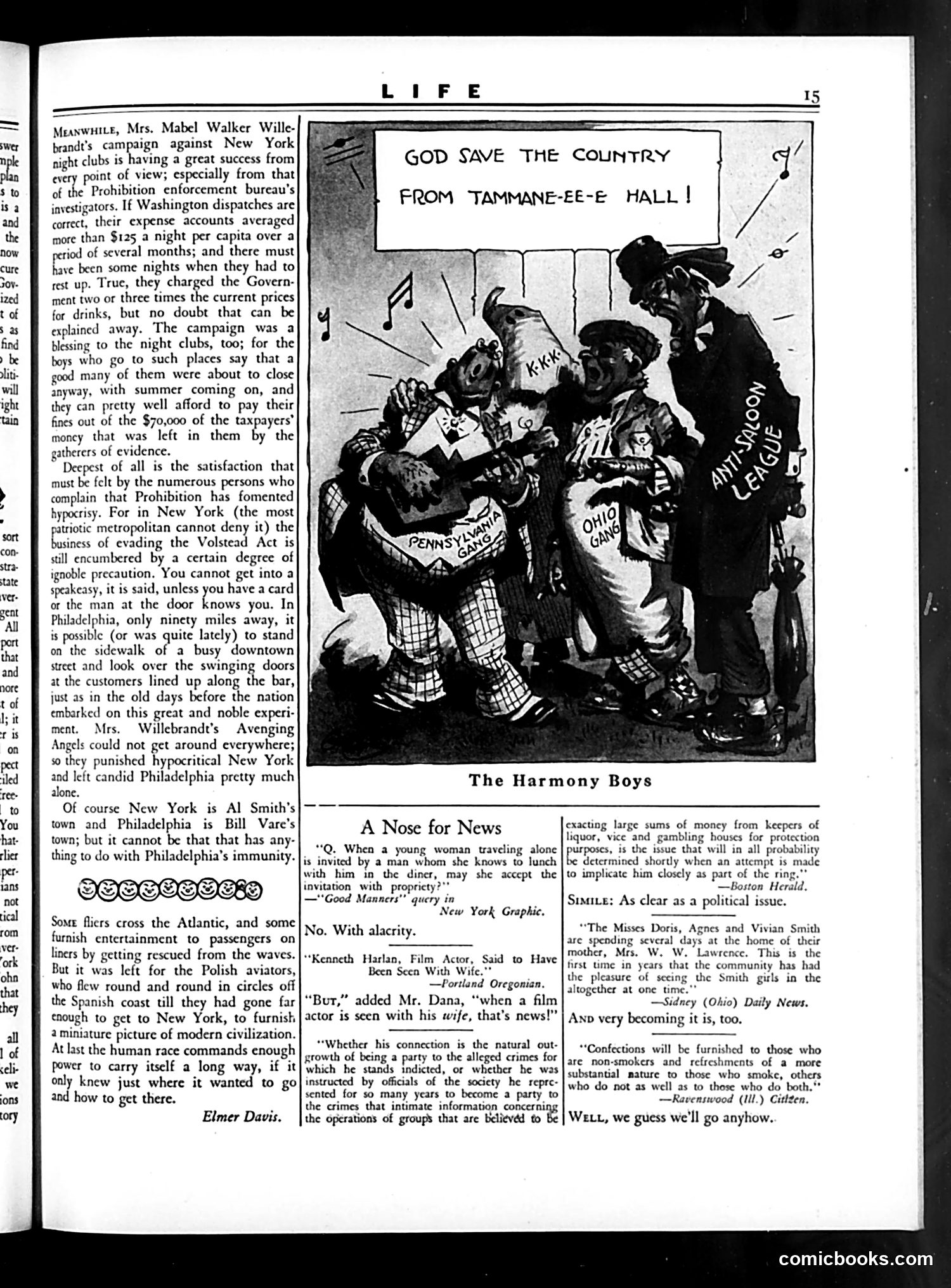
This political cartoon satirizes Prohibition enforcement hypocrisy. The central image shows figures labeled with state names (Pennsylvania, Ohio, KKK visible) clustered together under the banner "God Save the Country from Tammany-ee-e Hall!" while simultaneously displaying "Anti-Booze League" insignia. The accompanying article criticizes New York's Prohibition enforcement campaign, particularly under Mrs. Mabel Walker Willebrandt, accusing investigators of exaggerated expense accounts and selective enforcement. The cartoon's "harmony" is ironic—it depicts various state and organizational interests (including the KKK) unified only in opposing Tammany Hall (New York's Democratic political machine) while themselves engaging in the corruption and vice they publicly condemn. The satire targets the moral hypocrisy of Prohibition's enforcement: enforcers claiming virtue while profiting from their positions.
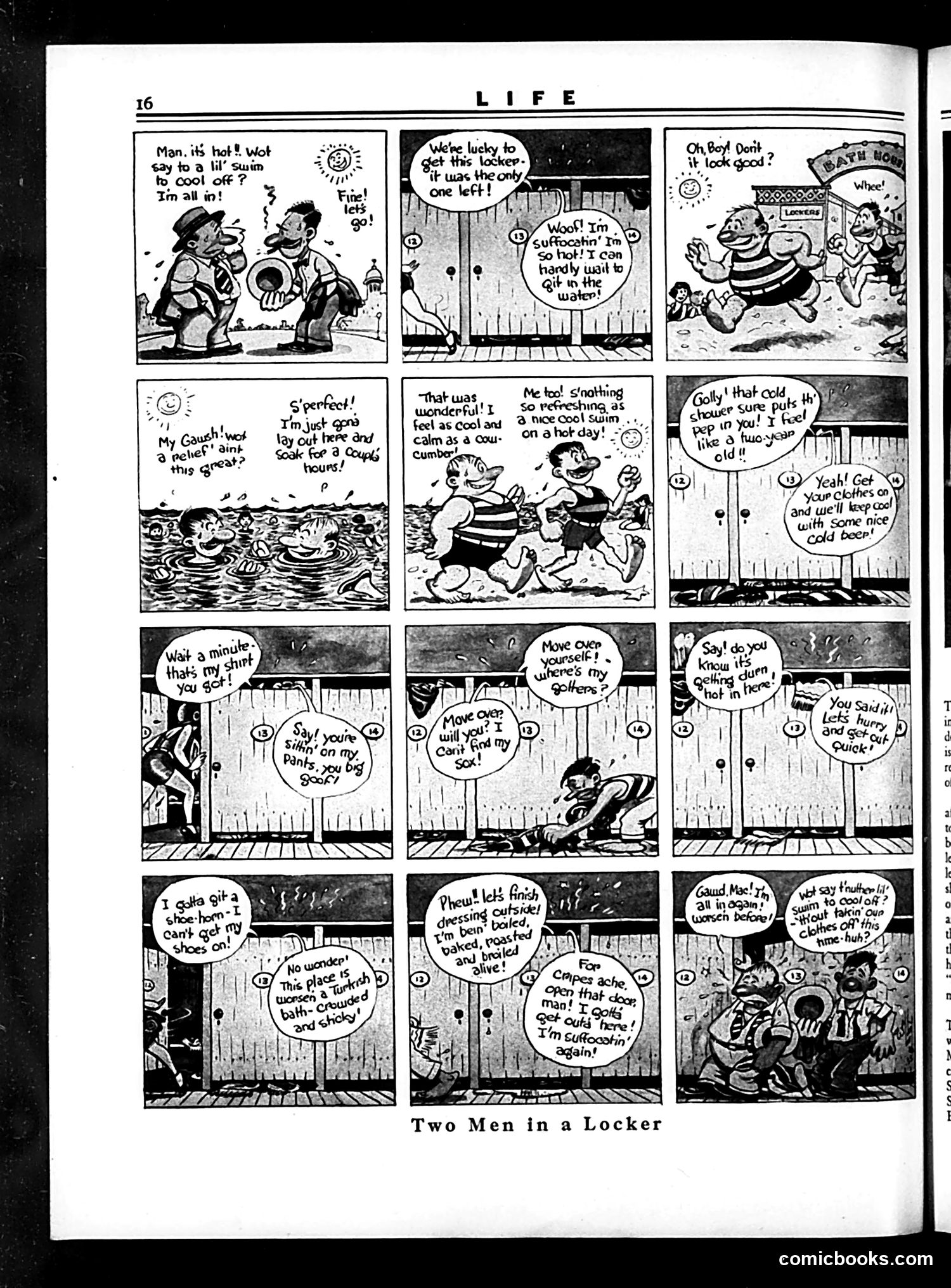
This is a humorous comic strip about two men at what appears to be a beach or swimming facility. The narrative follows their escalating misfortune: they arrive hot and seek relief by swimming, but one man's clothes go missing from the locker. What begins as a search for "golfers" (likely their missing clothes) becomes increasingly absurd as the man without pants struggles to retrieve them while avoiding public embarrassment. The satire appears to target masculine vanity and the desperation men face when caught in compromising social situations. The repeated references to being seen "without pants" play on period anxieties about public decorum and dignity. The humor relies on slapstick predicament comedy rather than political commentary.
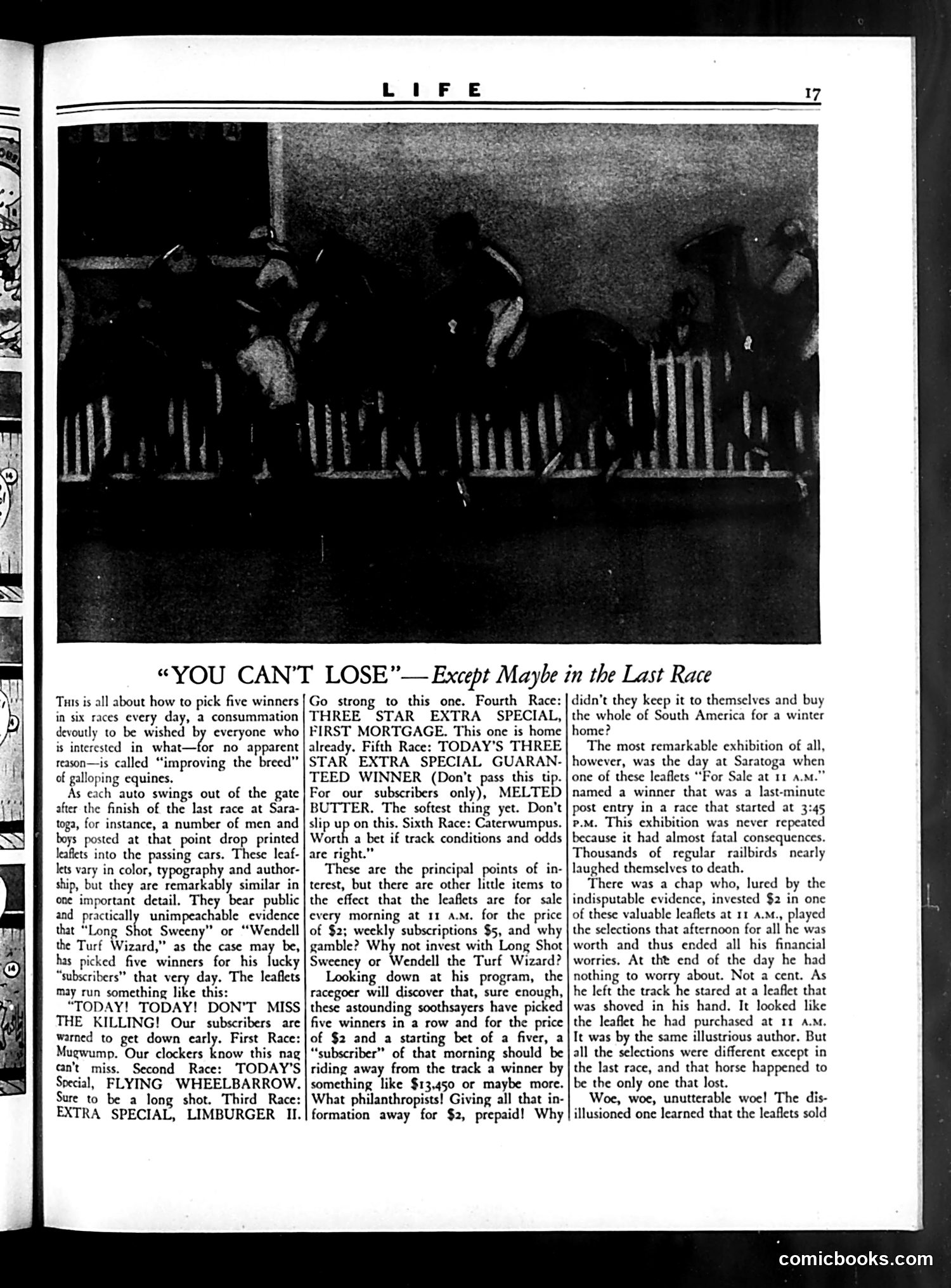
This page satirizes horse racing tipsters and gambling schemes. The article mocks subscription services that claim to help bettors "pick five winners in six races" by selling "leaflets" with purported insider tips. The satire targets the false promises of these schemes: subscribers pay $2-$5 for weekly "guaranteed" winning selections, yet the article reveals one famous case where a tipster's recommended horse lost—the *only* loss in his entire program. The joke exposes how these services exploit desperate gamblers with pseudo-scientific claims about "improving the breed" while profiting from people's hope. The headline's paradox—"You Can't Lose"—ironically captures the contradiction: the schemes promise certainty while delivering inevitable failure.
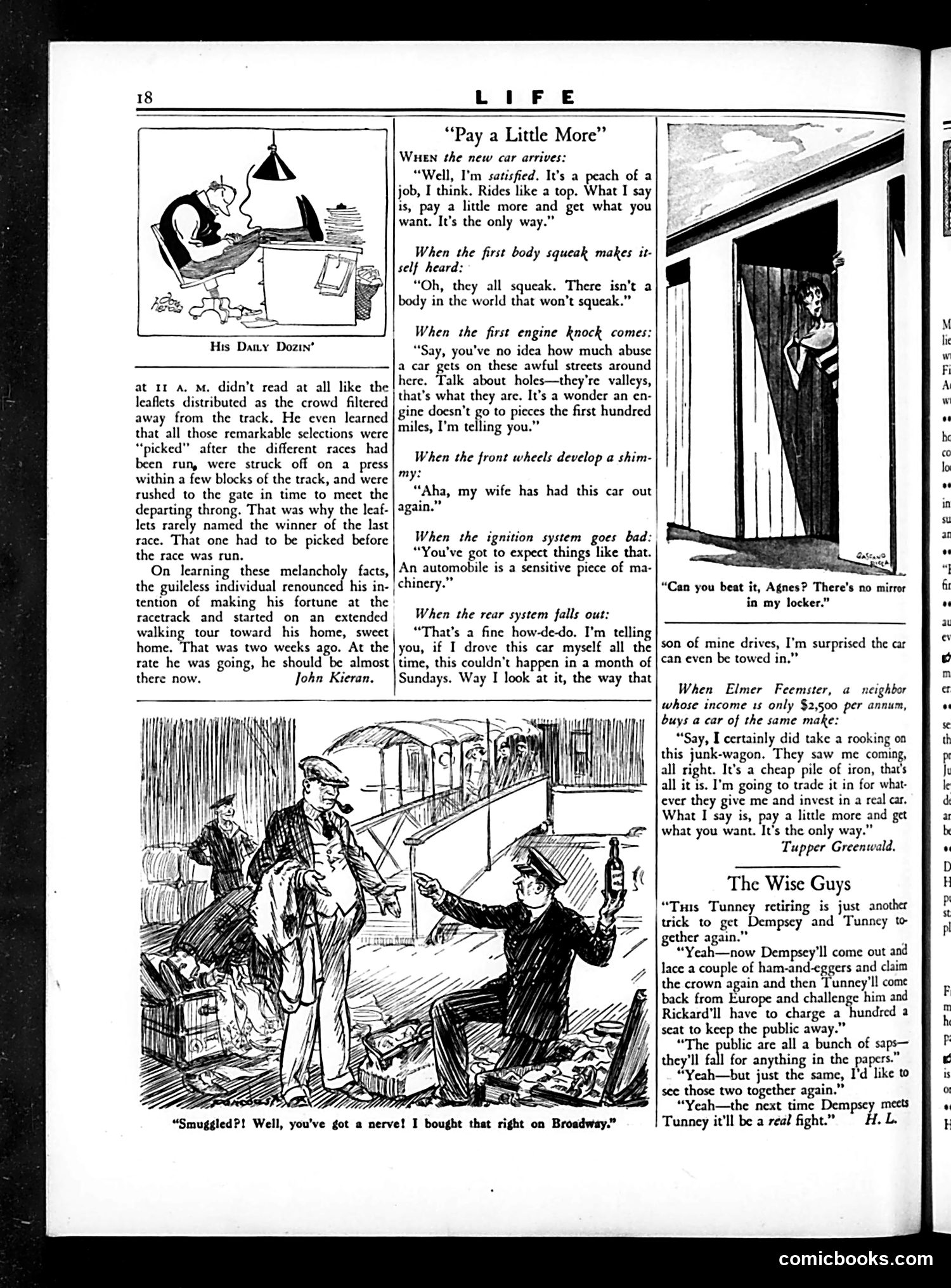
This page contains three distinct satirical pieces: **"His Daily Dozin'"** mocks racetrack gambling. A naive bettor discovers that winning horse picks are printed *after* races conclude, making them worthless predictions. He abandons get-rich-quick schemes and walks home—a two-week journey—illustrating the folly of trusting dubious racing tips. **"Pay a Little More"** satirizes buyer's remorse and rationalization. A car owner praises his new purchase, but when problems emerge (squeaks, knocks, wheel shimmy), he invents excuses—blaming roads, his wife's driving, the car's "sensitivity." When a poorer neighbor (Elmer Feemster, earning $2,500 annually) buys the same model, the owner suddenly calls it "junk," claiming he overpaid. The satire exposes how people justify purchases differently depending on their ego and social standing. **"The Wise Guys"** references boxer Gene Tunney's rumored retirement, speculation it's a publicity stunt to reunite him with rival Jack Dempsey for a lucrative rematch. The cynics dismiss the public as credulous ("saps"), yet admit curiosity about seeing the fighters together again.
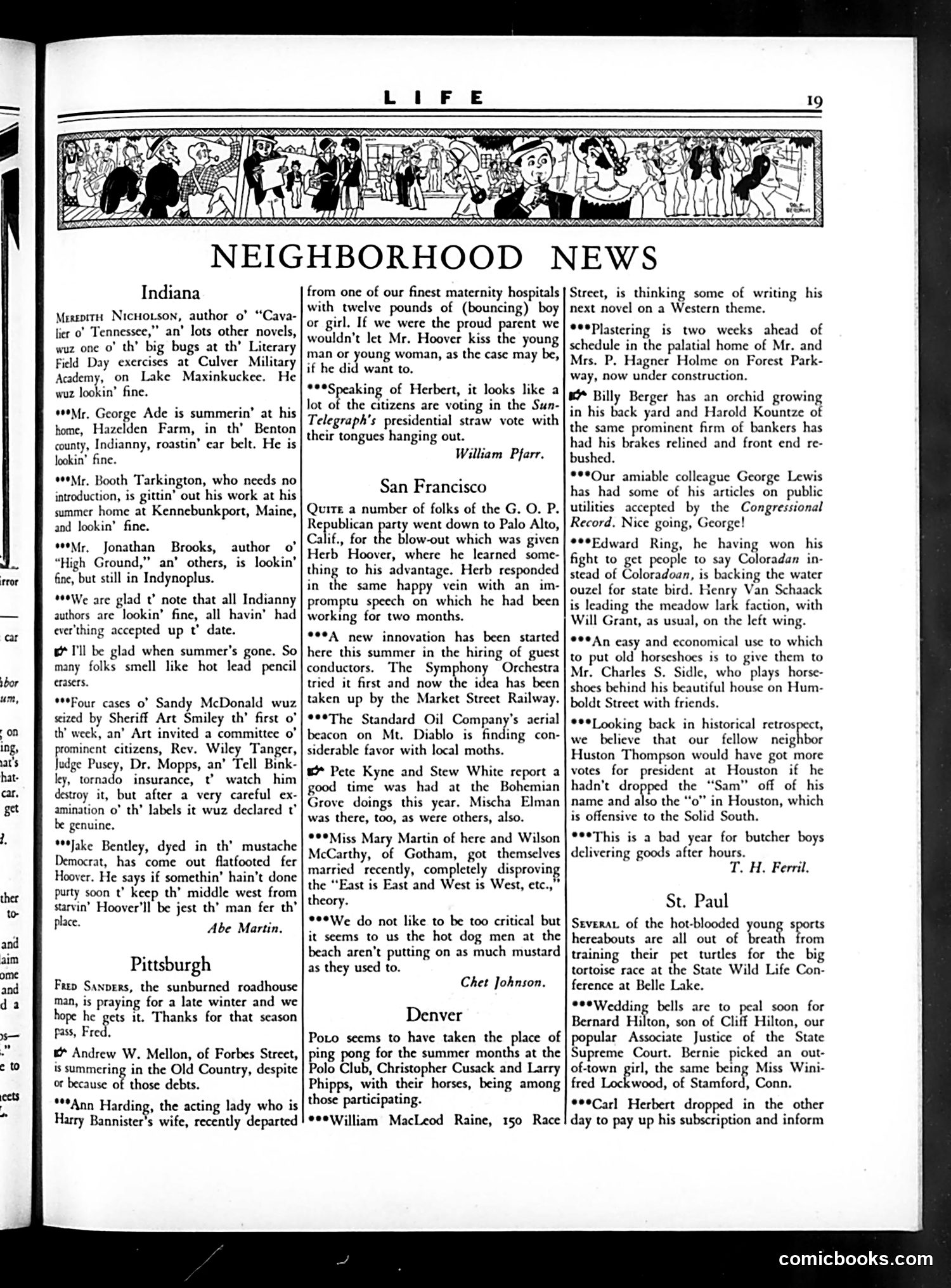
This is a **humor column**, not a political cartoon. "Neighborhood News" collects gossipy, satirical local reports from American cities, written in folksy dialect. The satire targets: 1. **Indiana authors**: Repeatedly notes that Meredith Nicholson, George Ade, and Booth Tarkington are "lookin' fine"—mocking provincial pride in local literary figures. 2. **Prohibition era**: References "Sandy McDonald" liquor being seized, with humorous skepticism about the authorities' "examination" of labels—satirizing the absurdity of Prohibition enforcement. 3. **Herbert Hoover**: Multiple digs at the presidential candidate, including a joke about not wanting him to kiss a newborn, and mockery of citizens voting for him in a newspaper straw poll with "tongues hanging out"—suggesting desperate enthusiasm. 4. **Social pretension**: References to the Bohemian Grove and polo club activities lampoon upper-class leisure activities. The column's appeal lies in its casual, irreverent tone mocking celebrities, politicians, and local social hierarchies through exaggerated rural dialect.
This page contains **regional gossip columns** from American cities (Boston, Philadelphia, Detroit, Chicago, Spokane, Newport), not political cartoons. The content reflects early 20th-century American social life. Key satirical elements include: - **Al Smith references**: Boston Democrats complaining Al Smith plates aren't standard on cars—mocking both Smith's popularity and trivial consumer culture debates - **Natural gas discovery joke**: Mentioning rival state politicians checking whether newly-discovered gas is "Republican or Democratic"—absurdist satire on partisan everything - **Minor social commentary**: Spitting fines ignored by "nullificationists," whooping cough outbreaks, subway delays The humor relies on local references to specific people (Gene Gregory, Fred Scott) and places now obscure, plus gentle mockery of small-town concerns. The overall tone is lighthearted gossip rather than sharp political satire, typical of Life's gossipy regional sections during this era.
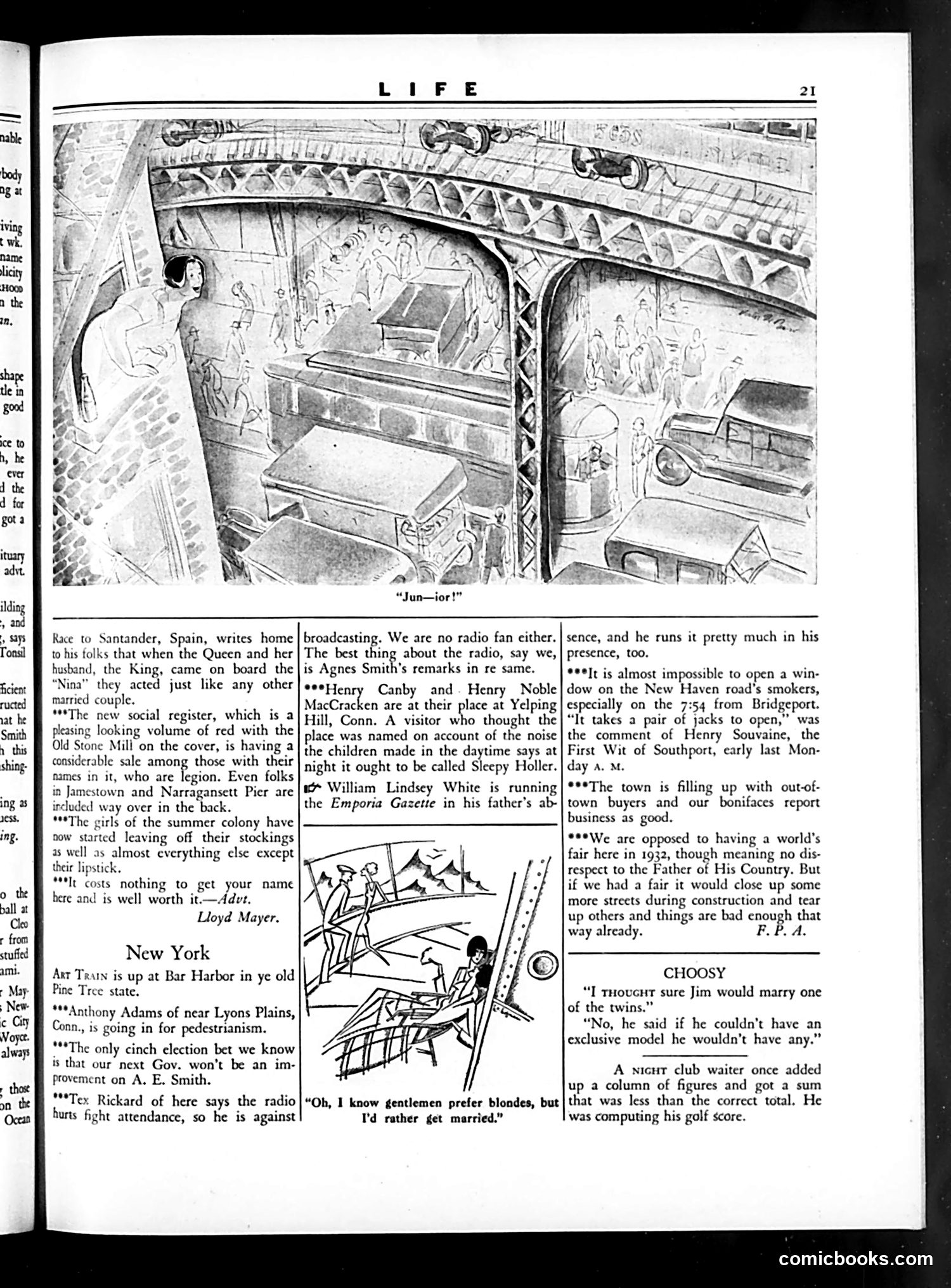
This page contains **social gossip and humor columns** from Life's "New York" section, plus two cartoon jokes. The main content is lighthearted commentary on East Coast society—references to summer colonies, social registers, and prominent figures like Henry Canby (editor) and William Lindsey White (running the Emporia Gazette). A recurring joke mocks radio broadcasting's impact on boxing attendance (Tex Rickard's complaint). The **top cartoon** titled "Jun-ior!" shows a man looking at what appears to be a ship's interior with crowds, illustrating a gossipy note about the Queen and King visiting like "any other married couple." The **lower cartoon** depicts two figures on what looks like a boat or ship rigging with the caption about preferring blondes versus marriage—a play on the famous saying "gentlemen prefer blondes." The **"Choosy" section** contains brief jokes: one about exclusive dating preferences, and another about a night-club waiter miscalculating his golf score. The humor targets upper-class leisure activities and social pretensions typical of 1920s-30s American satirical magazines.
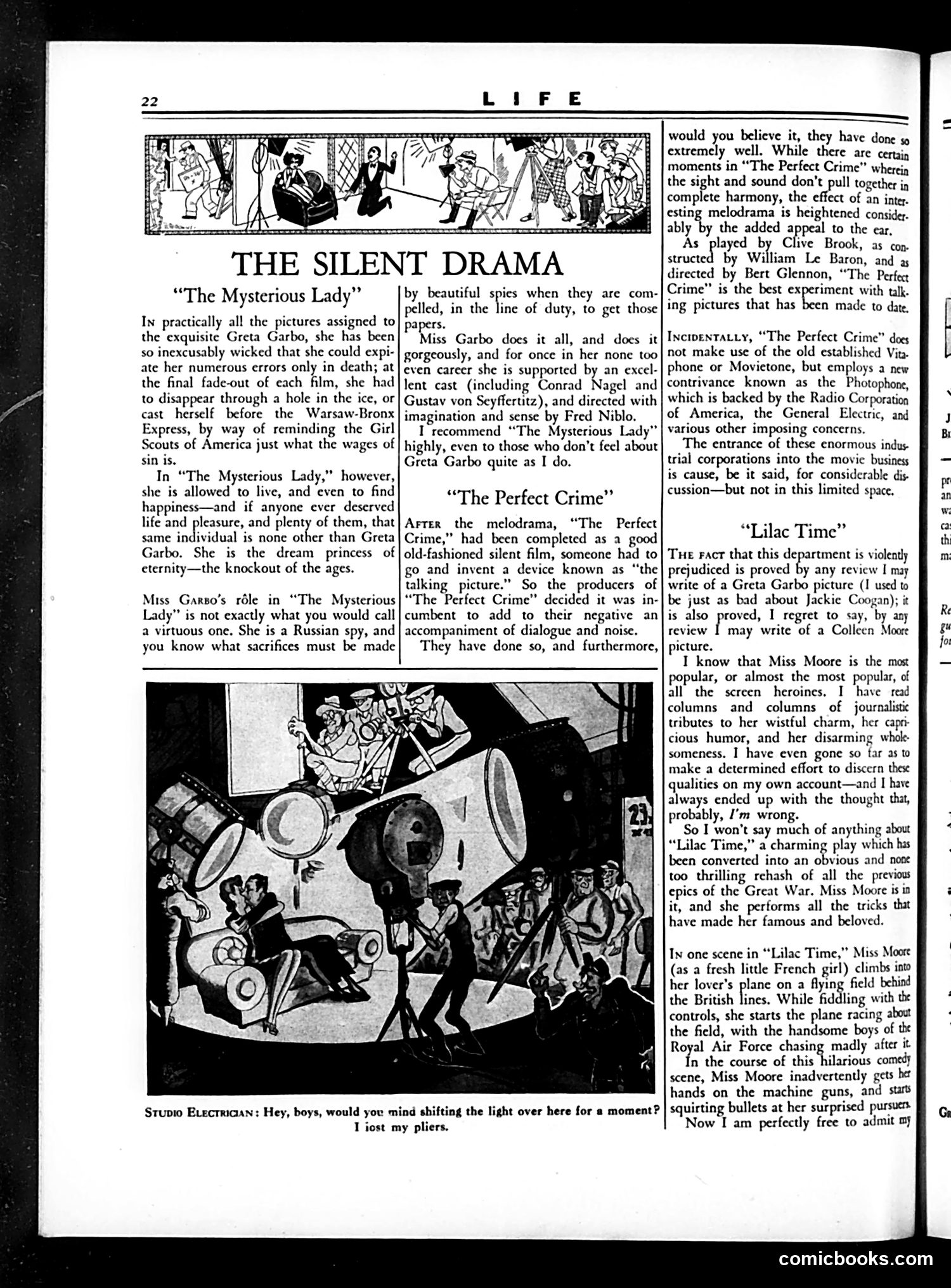
This page reviews three silent films from the 1920s. The main content discusses **Greta Garbo** in "The Mysterious Lady," praising her performance despite her character being a Russian spy—a role requiring moral compromises. The reviewer notes this film unusually allows Garbo's character to survive and find happiness, departing from her typical tragic endings. "The Perfect Crime" review discusses an early experiment adding synchronized sound to a silent film using a "Photophone" device backed by major corporations like General Electric and RCA—representing Hollywood's emerging technological transition. The bottom review of "Lilac Time" features comedian commentary about **Colleen Moore**, another popular screen actress. The reviewer humorously admits personal bias favoring Moore, similar to his admitted prejudice for Garbo, while describing the film as a WWI rehash. The page's cartoon shows a studio electrician requesting light adjustment—typical behind-the-scenes studio humor for the era.
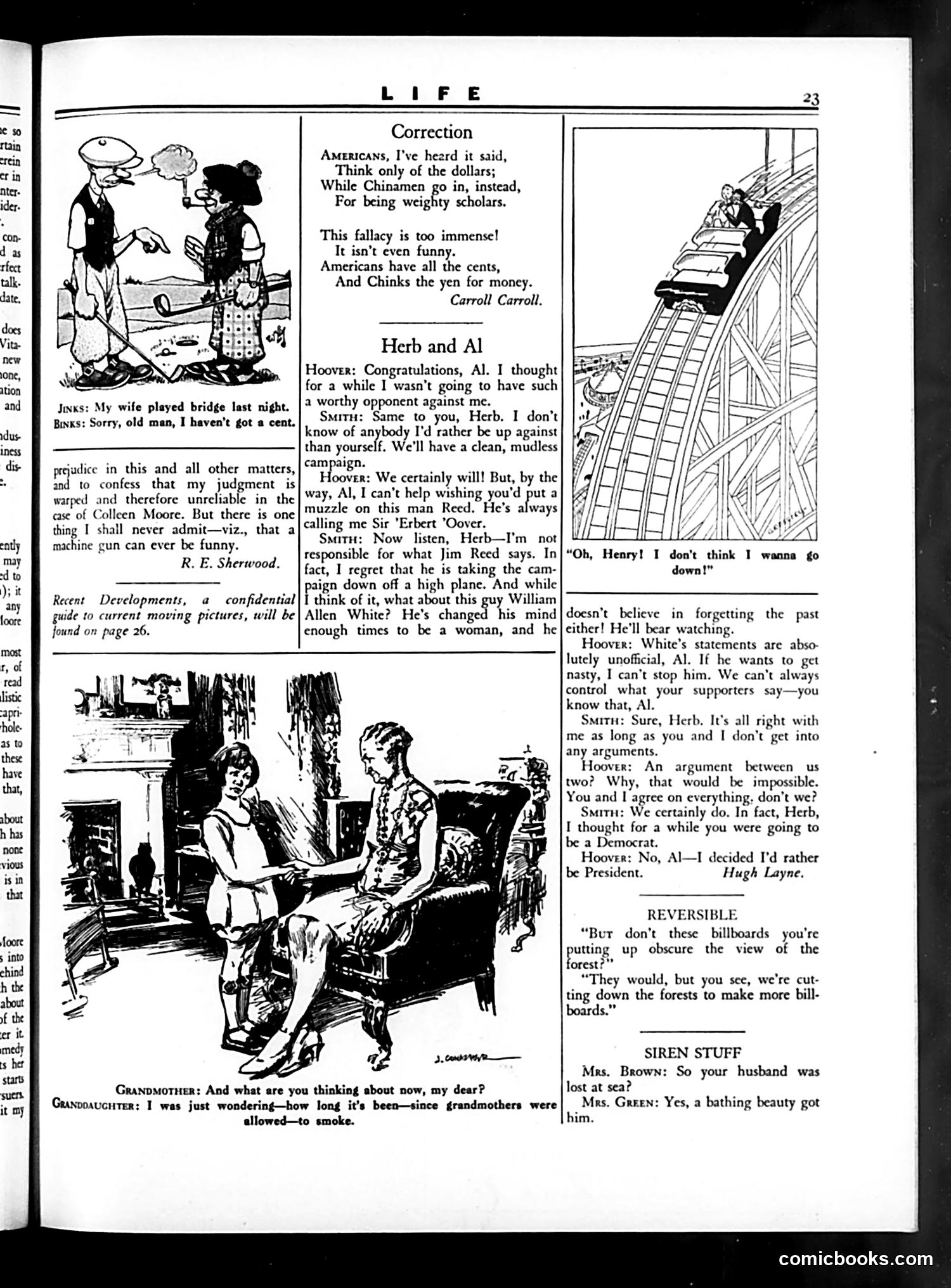
This page contains several satirical pieces from the 1928 U.S. presidential campaign: **"Herb and Al"** depicts a conversation between Herbert Hoover and Al Smith, the Republican and Democratic candidates. The satire mocks their disingenuous claims of running a "clean, mudless campaign" while blaming surrogates (Jim Reed and William Allen White) for negative attacks. The joke is their transparent hypocrisy—both deny responsibility for their supporters' attacks while admitting they agree on everything, making their competition absurdly artificial. **Other items** include: - A "Correction" poem satirizing the stereotype that Americans care only about money while Chinese scholars pursue learning—inverting it to mock the original prejudice - A joke about grandmothers smoking (social commentary on changing norms) - Reversible and Siren Stuff sections offering brief satirical one-liners on billboards destroying forests and infidelity The page exemplifies *Life* magazine's tradition of sharp political and social commentary through humor.
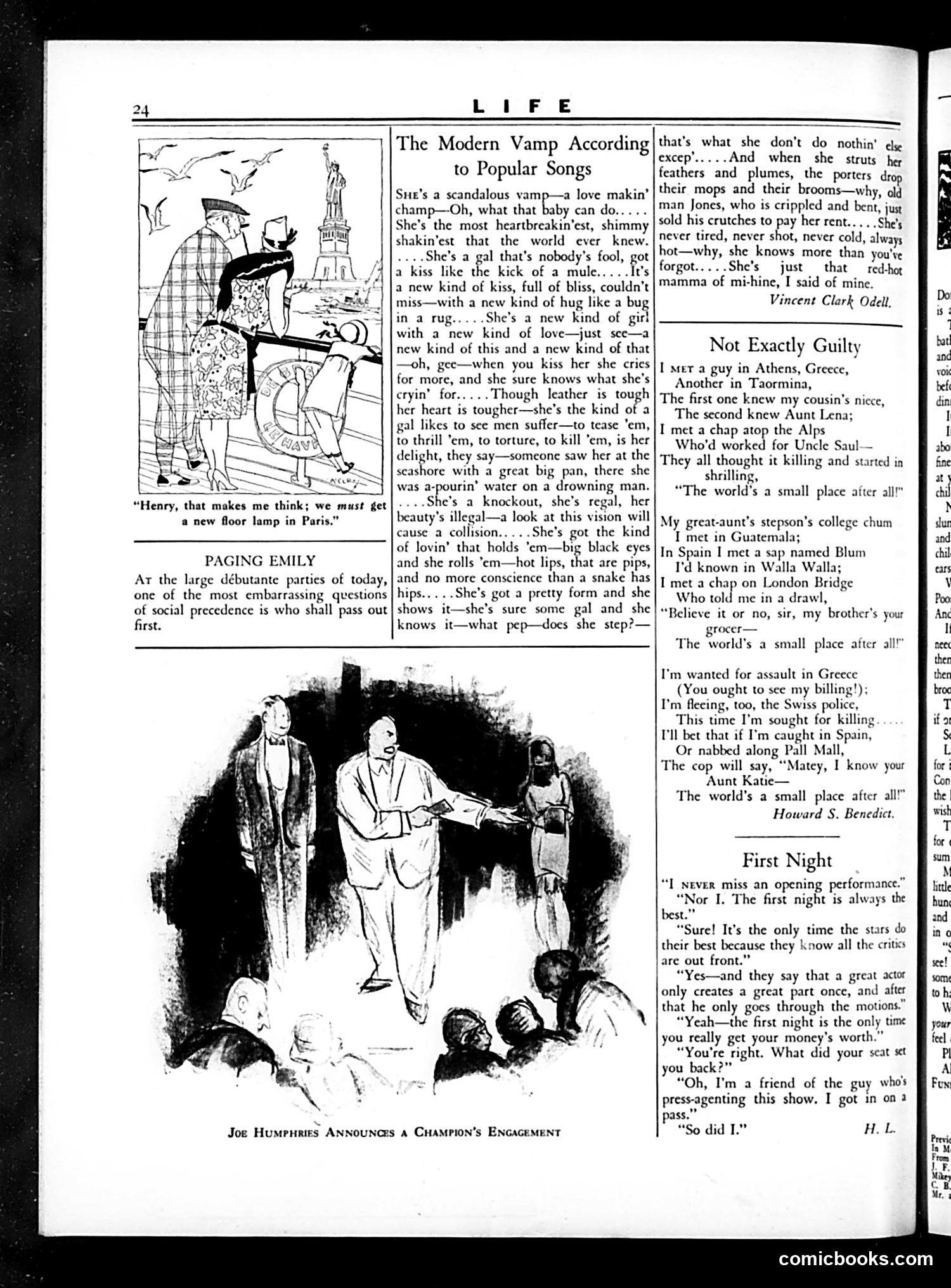
This page contains three satirical pieces typical of 1920s American humor: **"Paging Emily"** mocks debutante etiquette—specifically the awkward question of social precedence at large parties: who leaves first without causing offense? **"The Modern Vamp According to Popular Songs"** is a humorous compilation of song lyrics describing the archetypal 1920s "vamp"—a seductive, manipulative woman. The satire lies in stringing together actual popular song clichés about this character type, highlighting how formulaic and absurd these descriptions had become. **"Not Exactly Guilty"** by Howard S. Benedict uses the cliché "it's a small world" ironically: a criminal fleeing multiple countries for assault and murder keeps encountering people connected to his victims or past, each invoking the platitude. The joke is the dark contrast between the cheerful phrase and his serious crimes. The cartoon at bottom shows Joe Humphries (a well-known announcer of the era) announcing an engagement—likely a celebrity engagement, though specific individuals aren't identified. All three pieces exemplify Life's satirical approach to contemporary social conventions and popular culture.
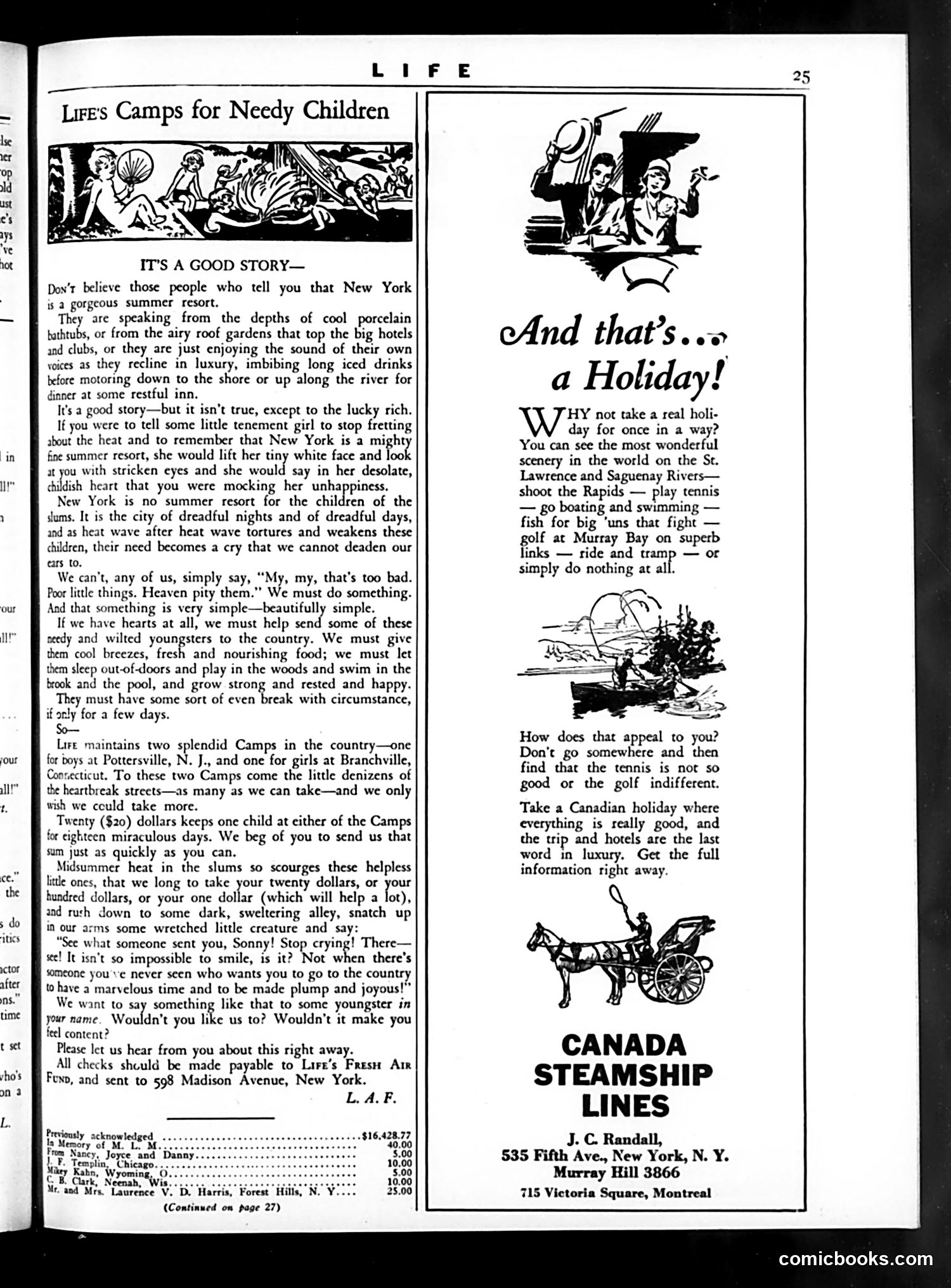
This page combines **charitable fundraising with travel advertising**. The left column solicits donations for LIFE magazine's Fresh Air Fund camps for poor children in New York City slums. The text contrasts the myth of New York as a luxurious summer resort (enjoyed by wealthy people in "cool porcelain bathtubs") with the reality faced by tenement children suffering through oppressive heat. The appeal argues that $20 can send one child to camp for eighteen days for fresh air, food, and swimming—a moral imperative framed as basic human decency ("We can't, any of us, simply say 'My, my, that's too bad'"). The right column ironically advertises Canadian holidays and steamship travel, featuring images of leisure activities (boating, golf, tennis). This juxtaposition—luxury vacations alongside pleas for impoverished children—reflects early 20th-century progressivism: simultaneous awareness of class inequality and acceptance that affluent readers would naturally pursue their own pleasures while being shamed into modest charitable contributions.
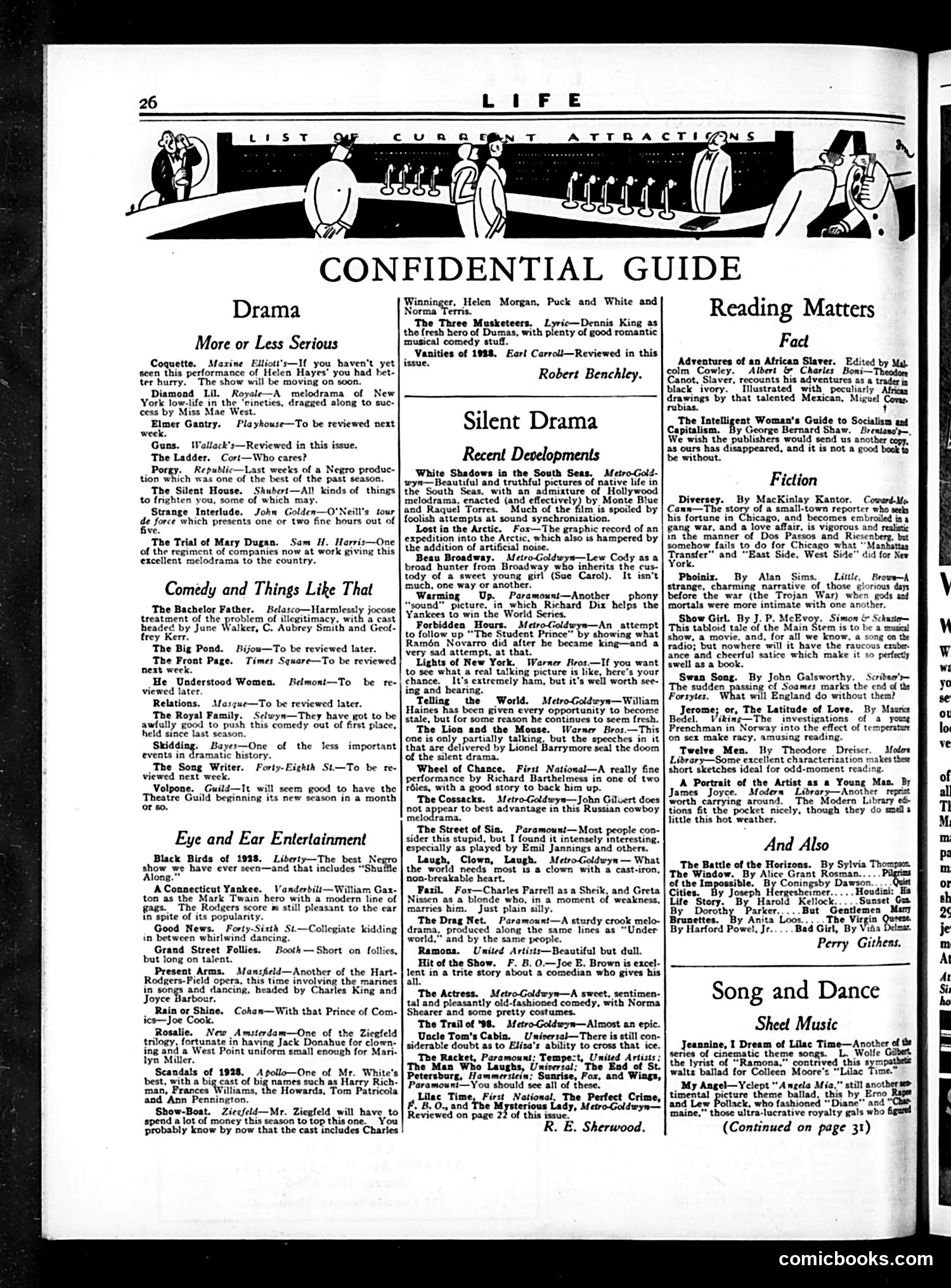
This page is a **theater and entertainment guide**, not a political cartoon. It's a "Confidential Guide" reviewing Broadway shows, silent films, and vaudeville acts currently playing in New York. The content reflects **1928 entertainment culture**: Broadway dominated leisure, silent films were transitioning to sound (reviews note "artificial noise" hampering movies), and vaudeville was still popular. Notable references include: - **Helen Hayes** in *Coquette* (major star) - **Mae West** in *Diamond Lil* (famous for provocative roles) - **O'Neill's** *Strange Interlude* (experimental theater) - Ziegfeld productions featuring **Marilyn Miller** (major entertainment figure) - Silent films being awkwardly fitted with sound effects **For modern readers**: This documents a moment when live theater dominated entertainment, before Hollywood's complete takeover. The snide tone ("Who cares?" about *The Ladder*) shows contemporary critics' preferences, while references to sound-synchronized films reveal the industry's uncertain transition to "talkies." It's essentially a **weekly entertainment listing with reviews**, not satire.
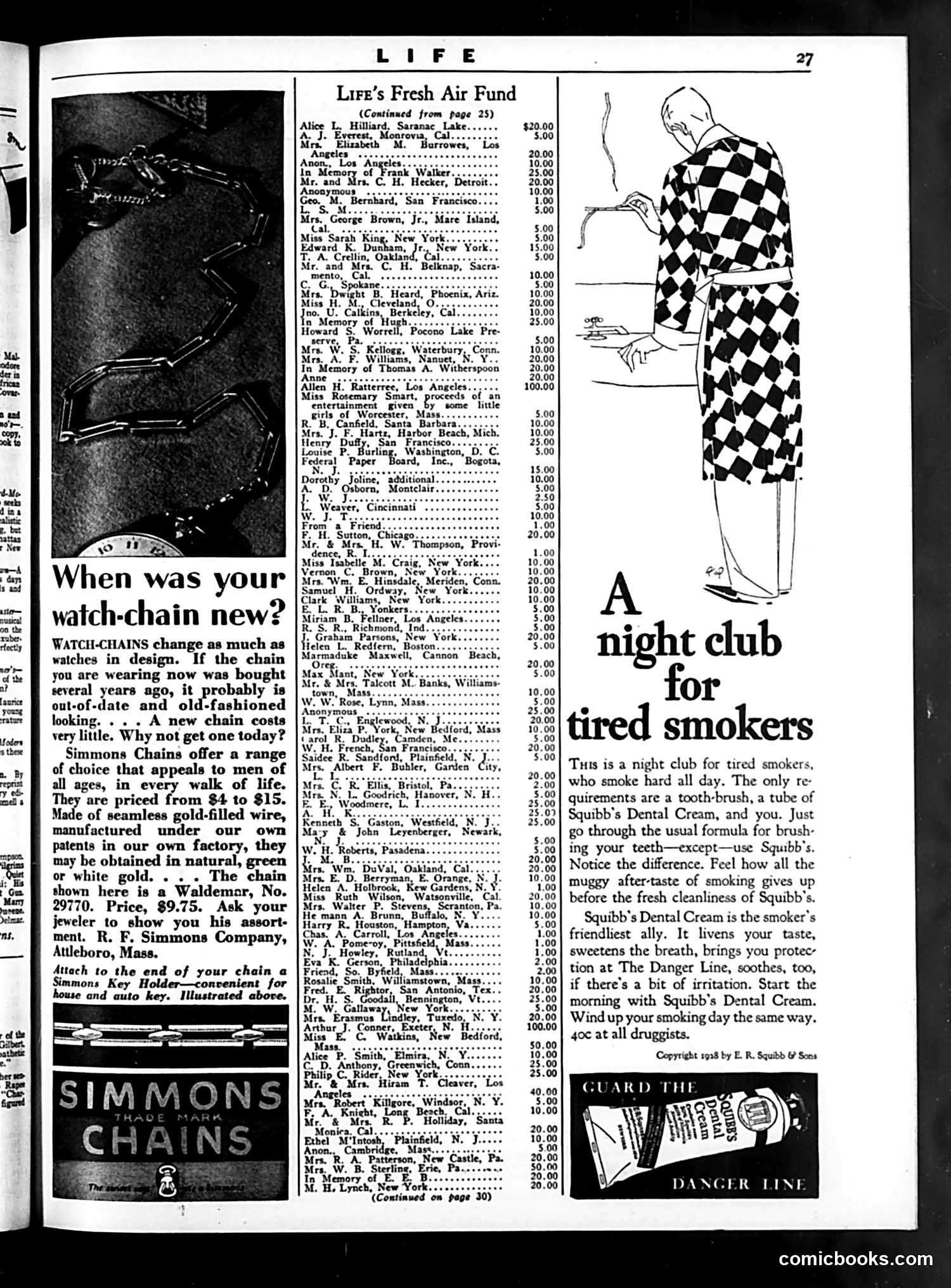
This page contains **advertisements rather than political cartoons**. The dominant content includes: 1. **Simmons Watch Chains** (left): An ad arguing that watch chains go out of style like watches themselves, urging readers to buy a modern Waldemar chain ($9.75). The pitch targets men concerned about appearing fashionable. 2. **Squibb's Dental Cream** (right): A humorous ad personifying a "night club for tired smokers"—depicting a figure in a harlequin diamond pattern brushing teeth. The joke is that heavy smokers should use Squibb's to combat stale tobacco taste and "muggy after-taste." 3. **Life's Fresh Air Fund** (center): A charitable contribution list showing donations from readers. The page reflects **1920s consumer culture**: anxiety about obsolescence, targeted advertising toward specific behaviors (smoking), and humor built on everyday inconveniences. There are no political cartoons or caricatures present—this is straightforward commercial messaging.
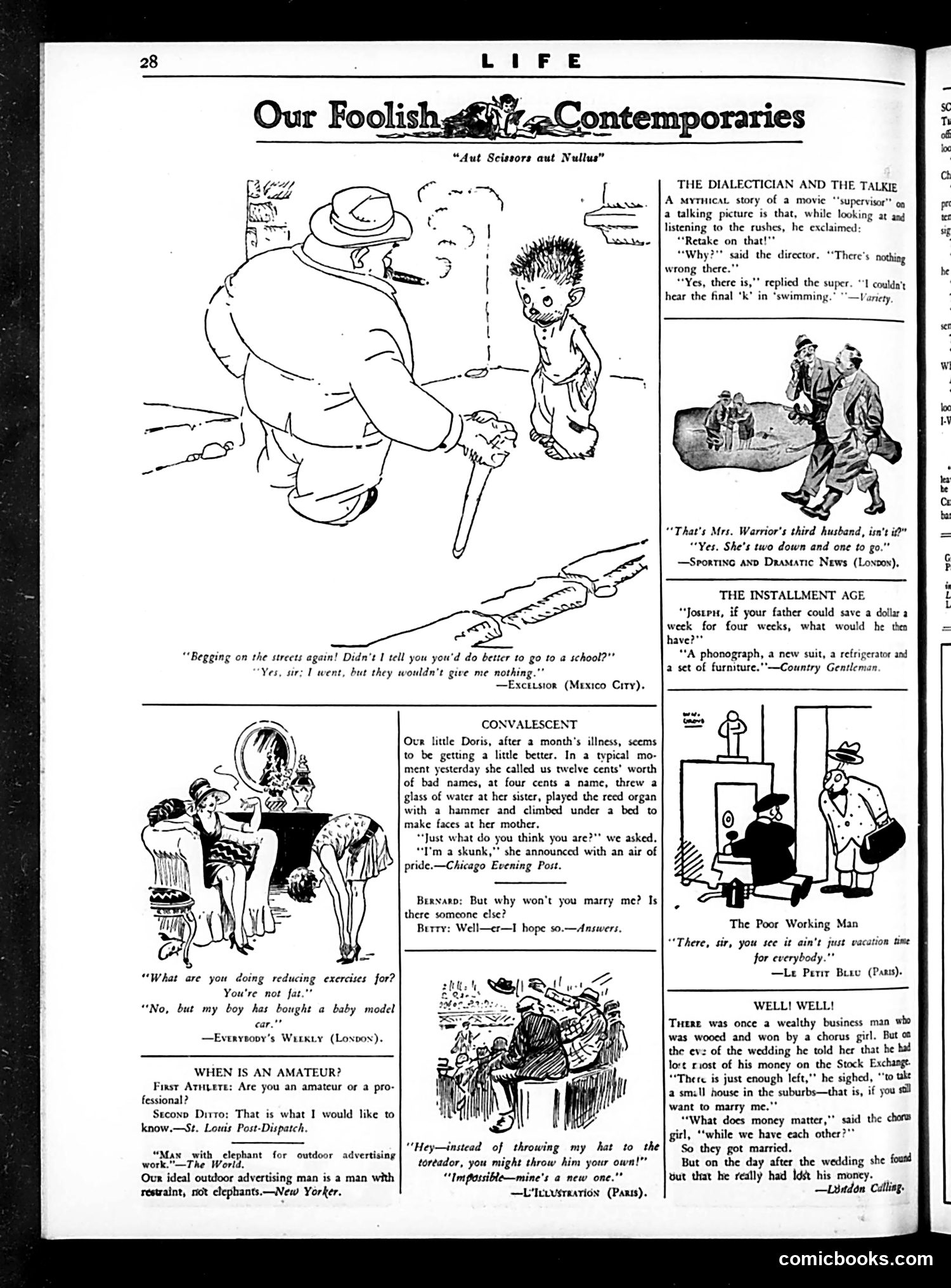
This is a satirical humor page featuring short jokes and anecdotes from various sources, lampooning modern life circa the 1920s-30s. **Key satirical targets:** - **Poverty & education**: A street beggar says school wouldn't help him anyway—mocking both his hopelessness and institutional failure - **Consumer culture**: A man does exercises because his son bought a toy car—absurd materialism affecting family priorities - **Early talking pictures**: A movie supervisor demands retakes over trivial sound details, satirizing overzealous new technology adoption - **Marriage/relationships**: Multiple jokes mock women (chorus girls after money, wives as economic burdens) and men's romantic foolishness - **Economic anxiety**: References to stock market losses and installment buying reflect Depression-era financial precarity - **Class divisions**: Servants, working men, and the wealthy appear as distinct social types The cartoon style is simple line-drawing caricature. The humor relies on irony, exaggeration, and period-specific social anxieties about modern life, technology, consumerism, and gender relations. The international attribution (London, Paris, Mexico City) suggests Life reprinted humor from foreign publications.
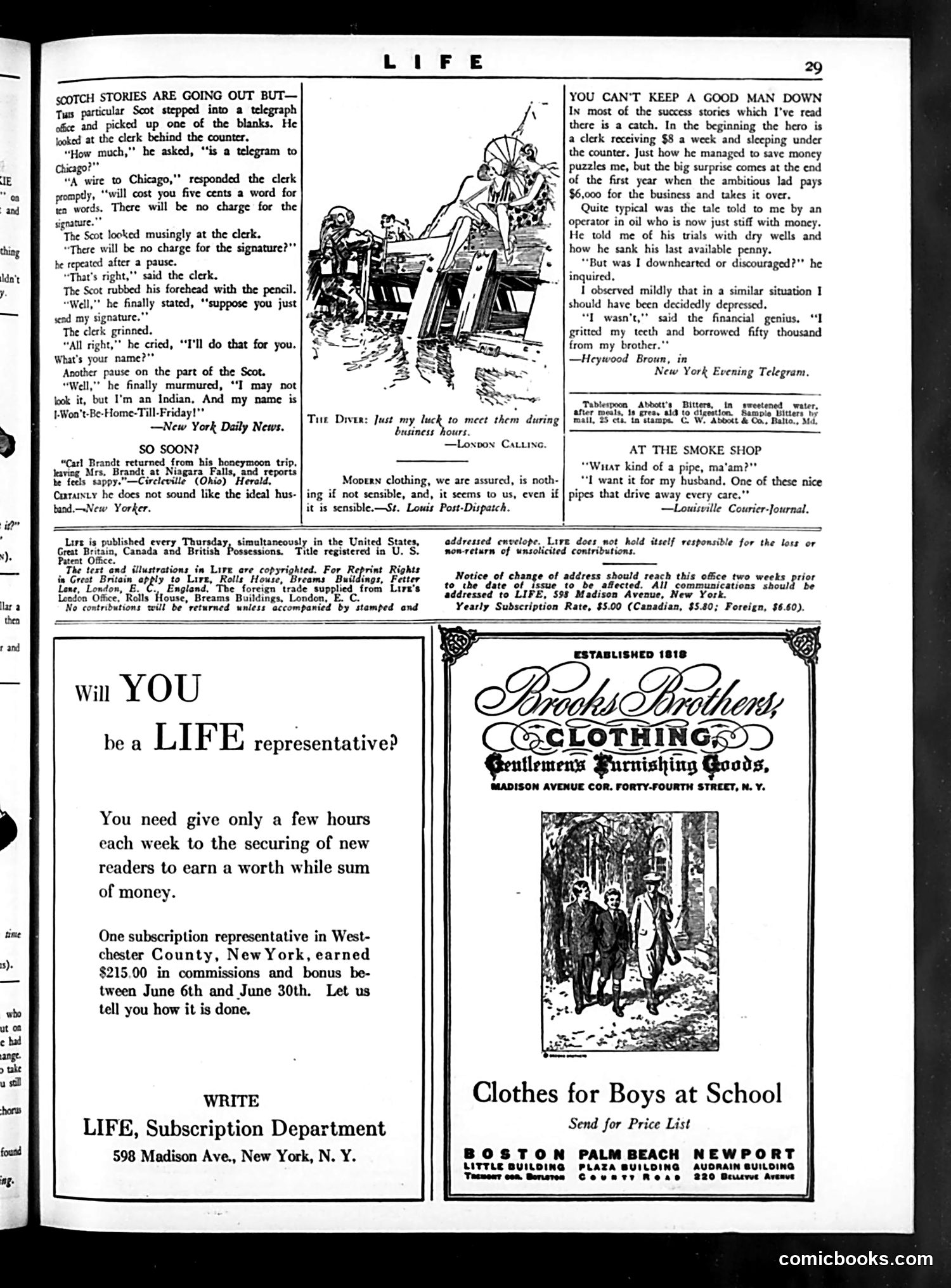
This page contains **humor anecdotes and advertisements** rather than political cartoons. The content reflects early 20th-century American satirical humor: **"Scotch Stories"** section: A joke playing on Scottish stereotypes—specifically the cultural caricature of Scottish people as extremely frugal. A Scot enters a telegraph office, learns he won't be charged for his signature, then decides to just send his name instead of a message to save money. The humor relies on the ethnic stereotype of Scottish stinginess being pushed to absurd extremes. **"You Can't Keep a Good Man Down"**: A satirical piece mocking rags-to-riches success stories. It notes the implausibility of these narratives—how does a clerk earning $8/week save $6,000?—then provides a "realistic" version where success requires family money, not just determination. **Minor jokes** about honeymoons and pipe-smoking husbands round out the page, alongside **Brooks Brothers and other period advertisements**. The page reflects 1920s American humor conventions: ethnic stereotyping, financial anxieties, and skepticism toward popular success narratives.
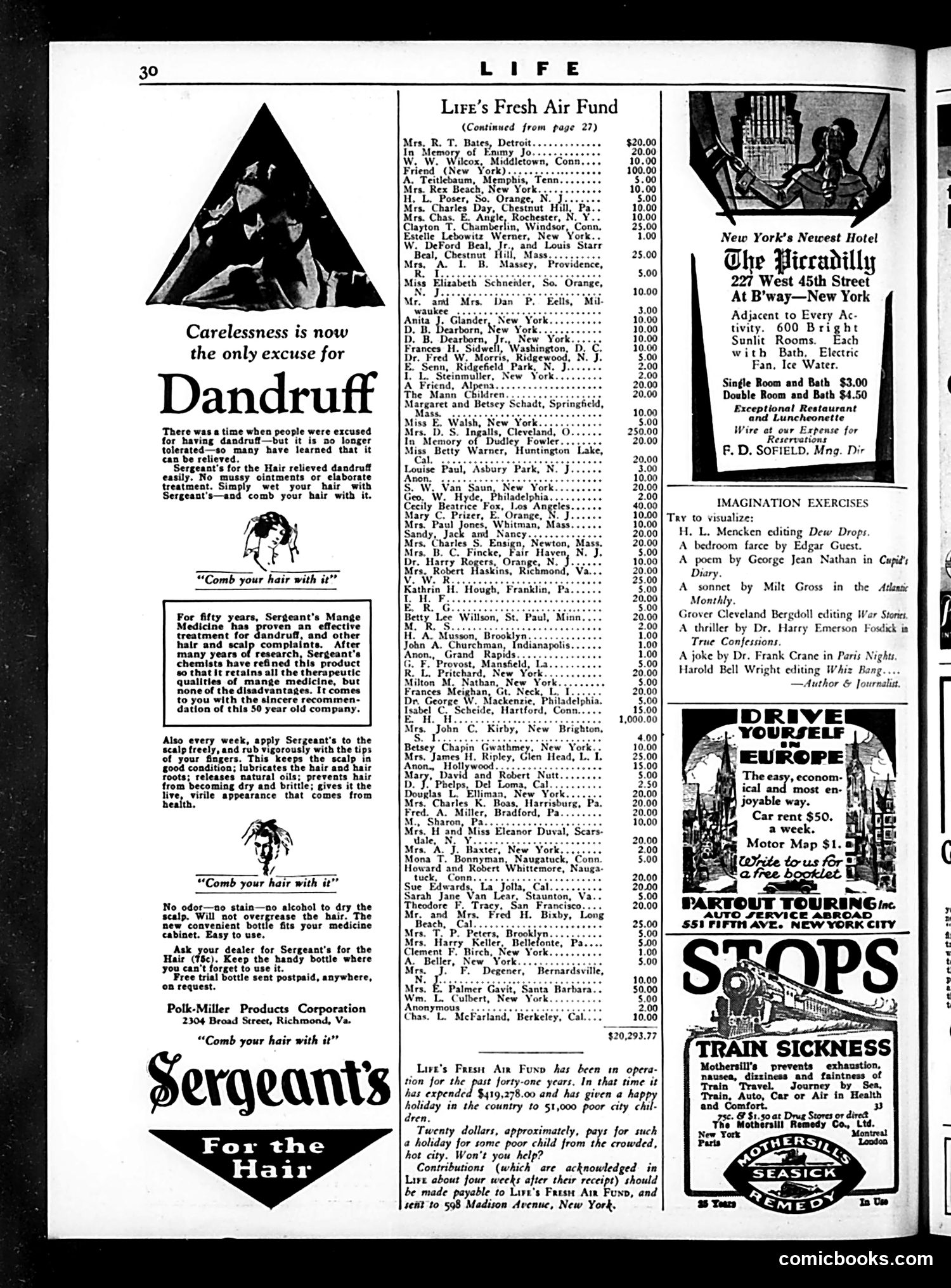
This page is primarily **advertising and charitable content** rather than political satire. The main feature is a **Sergeant's Hair Product advertisement** using humor to market dandruff treatment. The tagline "Carelessness is now the only excuse for Dandruff" jokes that there's no longer a legitimate reason to have dandruff, given the product's availability. The accompanying illustrations show people combing their hair, with the repeated phrase "Comb your hair with it" emphasizing the product's ease of use. The copy emphasizes that Sergeant's has refined its formula over fifty years to retain medicinal qualities while eliminating unpleasant side effects (odor, staining, over-greasing). The page also features: - **Life's Fresh Air Fund**: a charitable campaign listing donors who contributed to send poor urban children on country holidays - **Hotel and travel advertisements** for The Piccadilly and European car rentals - **Remedies for motion sickness** The content reflects early 20th-century advertising strategy: combining gentle humor with earnest product claims to build consumer confidence.
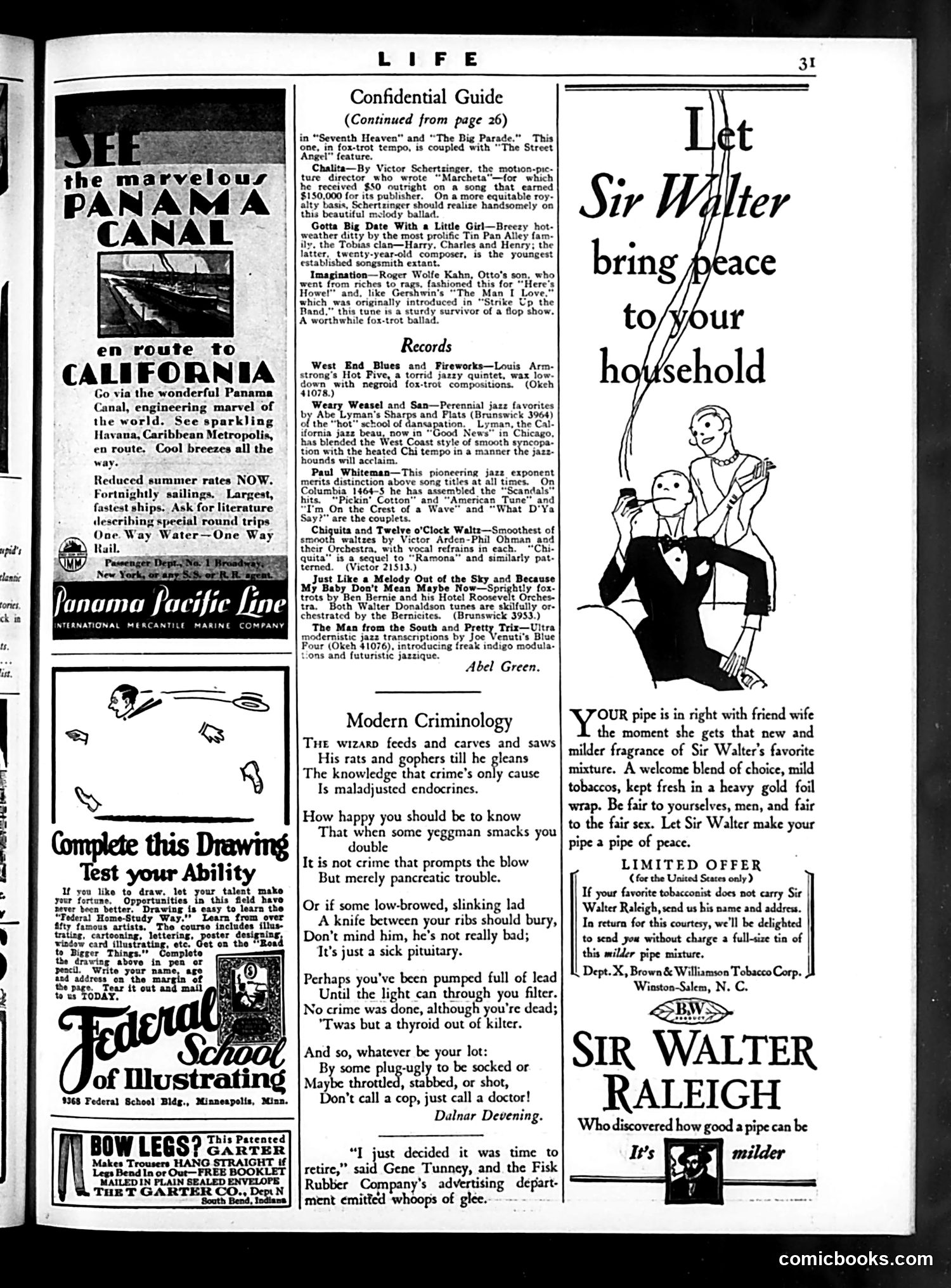
This page is primarily **advertising and entertainment content** from a 1920s Life magazine, not political satire. The main items are: 1. **Panama Pacific Line advertisement** promoting luxury cruise travel to California via the Panama Canal—positioned as a modern engineering marvel and tourist destination. 2. **Federal School of Illustrating ad** recruiting art students with promises of career opportunities. 3. **Music/Records section** reviewing current jazz and popular songs, featuring artists like Louis Armstrong and Paul Whiteman—reflecting the Jazz Age's cultural prominence. 4. **"Modern Criminology" poem** by Dalnar Devening—a humorous piece mocking pseudoscientific criminology theories that blamed crime on "maladjusted endocrines" rather than social factors. The joke is that this medical excuse-making is absurd. 5. **Sir Walter Raleigh pipe tobacco advertisement** using a gentleman illustration to market smoking as civilized leisure. The page reflects 1920s consumer culture, entertainment trends, and light satire of contemporary scientific fads—not political commentary.
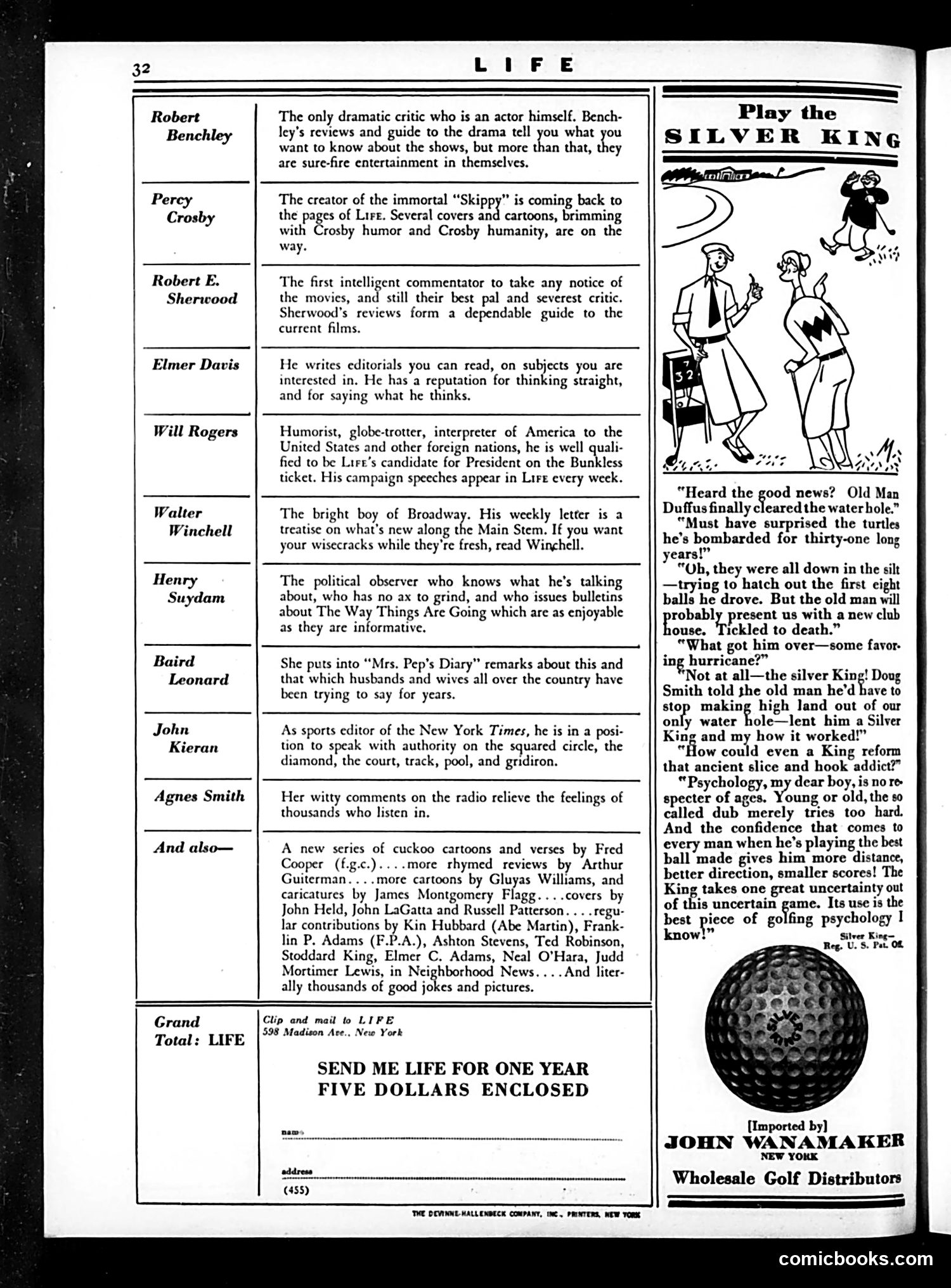
This page primarily showcases **Life magazine's editorial contributors** and includes a **golf equipment advertisement**. The left column lists prominent early 20th-century journalists and entertainers—Robert Benchley (drama critic), Percy Crosby (cartoonist), Will Rogers (humorist/political commentator), and Walter Winchell (Broadway columnist)—describing their respective expertise and appeal to readers. The right side features the "Silver King" golf advertisement, which humorously depicts an elderly man who improved his golf game using this club. The comic dialogue suggests the club's psychological benefits boost confidence and performance, reducing "slice" problems (a common golf error). The ad conflates golf clubs with life transformation—a common early advertising technique. Together, the page positions Life as a magazine of sophisticated commentary and humor, while capitalizing on period consumer culture through advertisement placement.
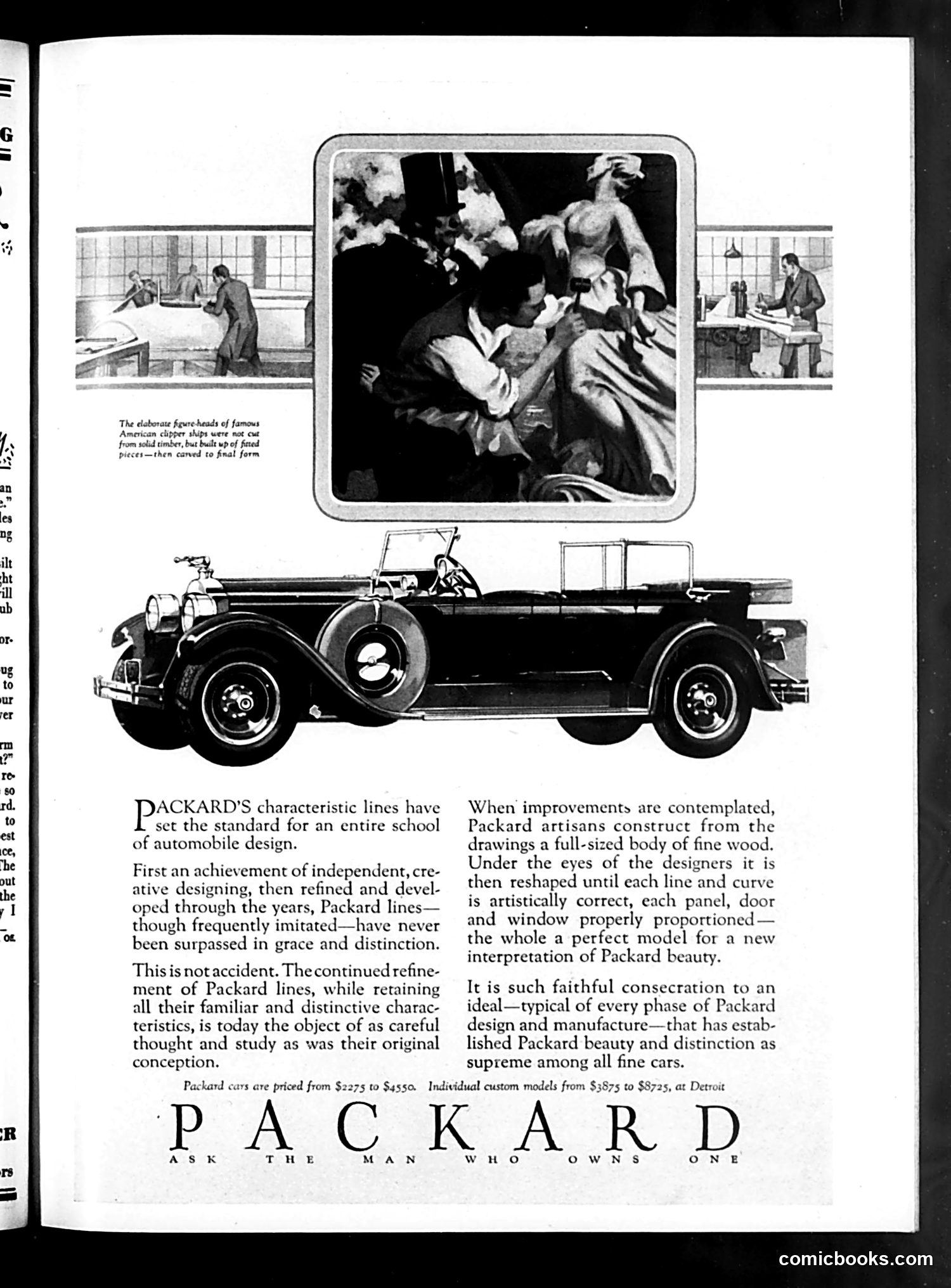
This is **not a cartoon or satire**—it's a luxury car advertisement from Packard, a high-end American automobile manufacturer. The page uses an analogy comparing Packard's design process to the construction of elaborate figureheads on historic American clipper ships: both are built from carefully assembled pieces that are then refined to artistic perfection. The advertisement emphasizes that Packard's "characteristic lines" set industry standards and are frequently imitated but never surpassed. The images show craftsmen meticulously shaping a full-sized wooden body prototype under designers' supervision, suggesting that each improvement undergoes rigorous artistic refinement. The price range ($2,275–$8,725) positions this as a premium product for wealthy customers. This reflects early 20th-century luxury marketing that equated automobiles with fine craftsmanship and artistic achievement.
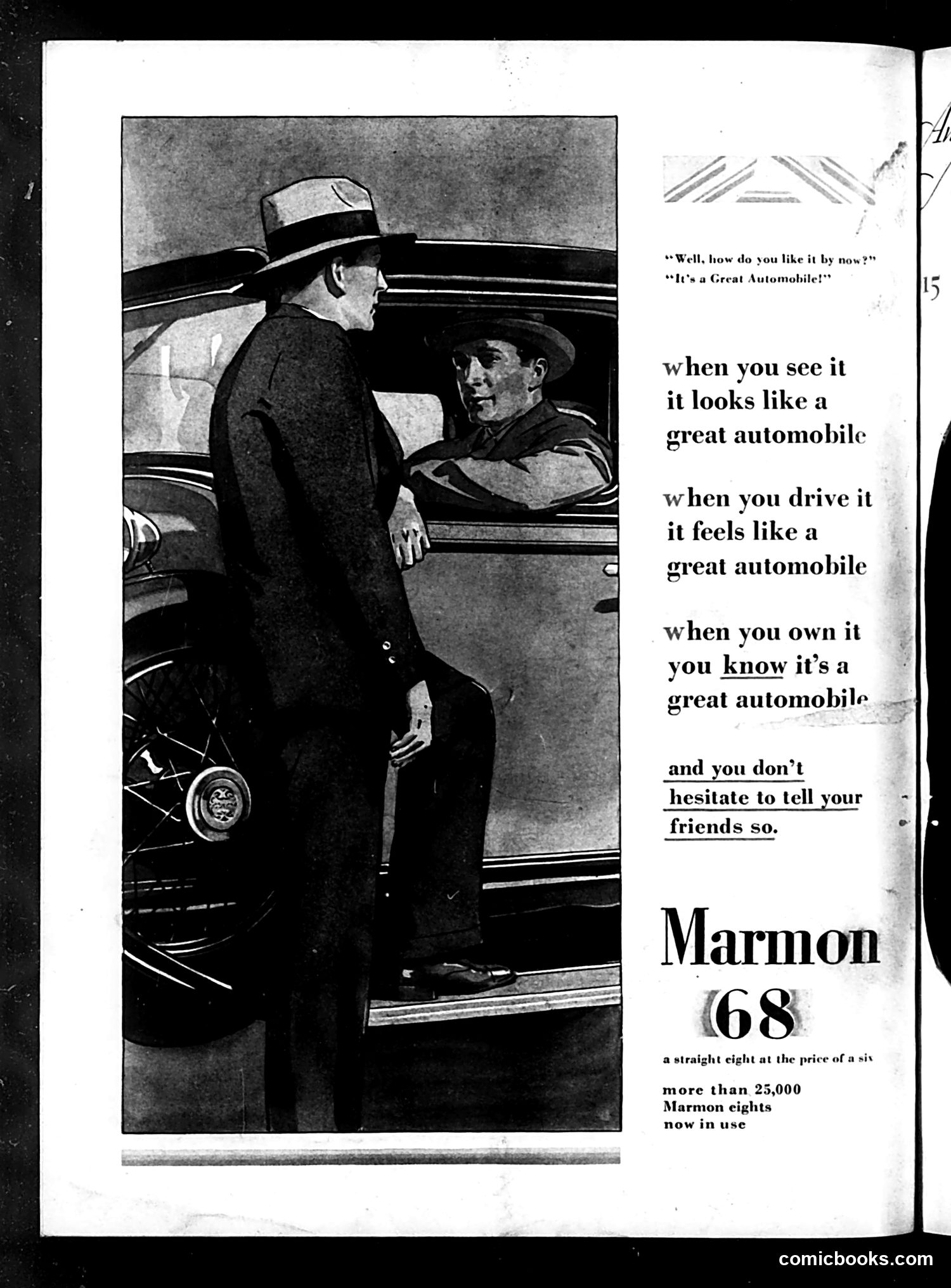
This is a **Marmon automobile advertisement**, not political satire. It depicts two men examining a Marmon 68 car, with the dialogue establishing the sales pitch: the vehicle impresses at every stage of ownership. The ad employs a common marketing technique by emphasizing cumulative satisfaction—visual appeal, driving experience, and ownership pride. The tagline "you don't hesitate to tell your friends so" appeals to social status and word-of-mouth promotion. The key selling point is stated at bottom: "a straight eight at the price of a six"—meaning the car offers eight-cylinder engine performance at six-cylinder pricing, positioning it as a value proposition. The note that "more than 25,000 Marmon eights now in use" serves as social proof of the vehicle's reliability and popularity. This appears to be from an era when Marmon was a legitimate automotive competitor (likely 1920s-1930s).