
Life, 1928-08-23 · page 24 of 36
Life — August 23, 1928 — page 24: what you’re looking at
What you’re looking at
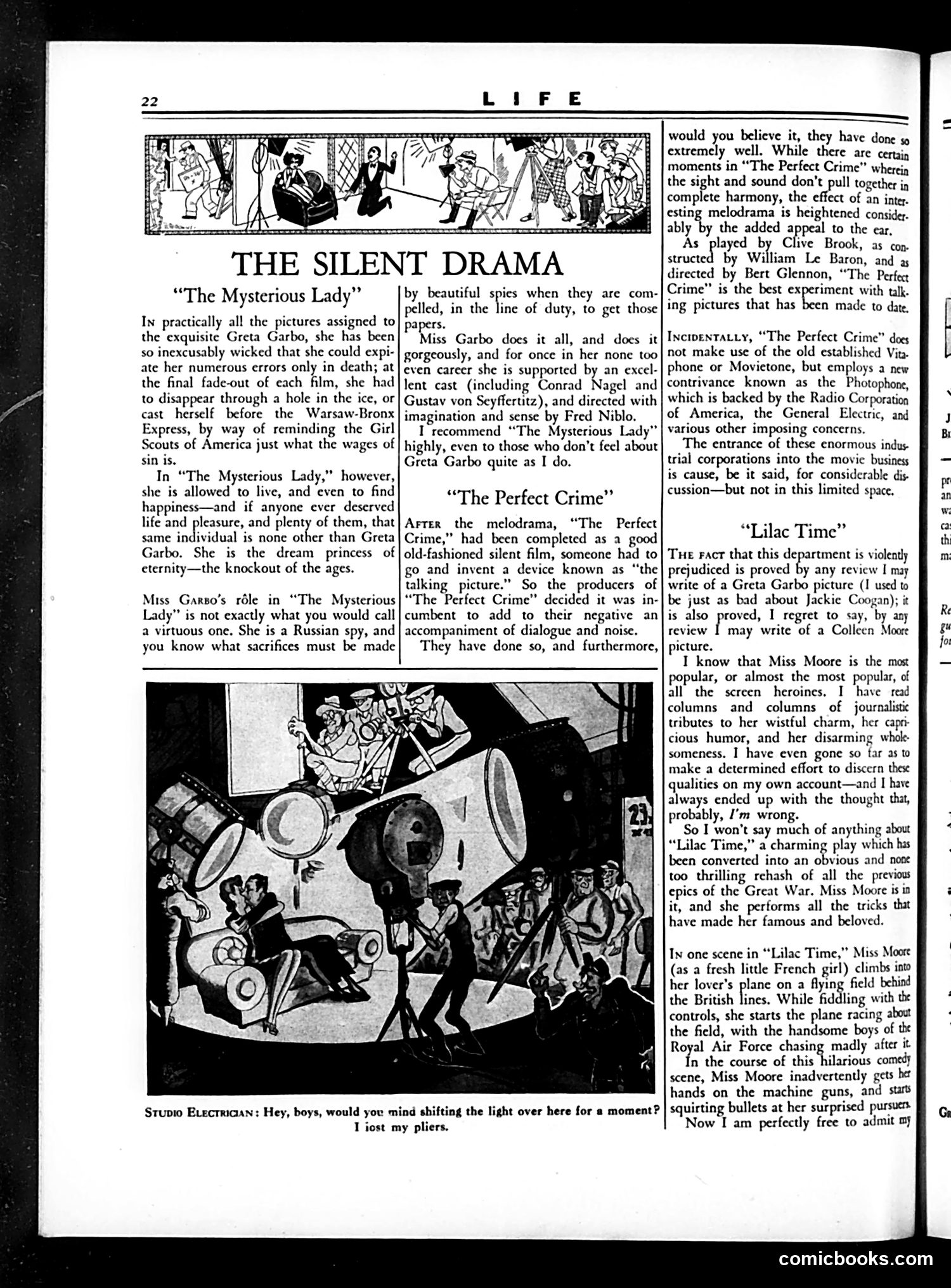
This page reviews three silent films from the 1920s. The main content discusses **Greta Garbo** in "The Mysterious Lady," praising her performance despite her character being a Russian spy—a role requiring moral compromises. The reviewer notes this film unusually allows Garbo's character to survive and find happiness, departing from her typical tragic endings. "The Perfect Crime" review discusses an early experiment adding synchronized sound to a silent film using a "Photophone" device backed by major corporations like General Electric and RCA—representing Hollywood's emerging technological transition. The bottom review of "Lilac Time" features comedian commentary about **Colleen Moore**, another popular screen actress. The reviewer humorously admits personal bias favoring Moore, similar to his admitted prejudice for Garbo, while describing the film as a WWI rehash. The page's cartoon shows a studio electrician requesting light adjustment—typical behind-the-scenes studio humor for the era.
📄 Transcribed text from this page (OCR, searchable)
Machine-transcribed from the original scan — historical spelling and the odd misread are preserved.
THE SILENT DRAMA “The Mysterious Lady” In practically all the pictures assigned to the exquisite Greta Garbo, she has been so inexcusably wicked that she could expi- ate her numerous errors only in death; at the final fade-out of each film, she had to disappear through a hole in the ice, or cast herself before the Warsaw-Bronx Express, by way of reminding the Girl Scouts of America just what the wages of sin is. In “The Mysterious Lady,” however, she is allowed to live, and even to find happiness—and if anyone ever deserved life and pleasure, and plenty of them, that same individual is none tet than Greta Garbo. She is the dream princess of eternity—the knockout of the ages. Miss Garso’s rdle in “The Mysterious Lady” is not exactly what you would call a virtuous one. She is a Russian spy, and you know what sacrifices must be made by beautiful spies when they are com- pelled, in the line of duty, to get those Poties fiss Garbo does it all, and does it gorgeously, and for once in her none too even career she is supported by an excel- lent cast (including Conrad Nagel and Gustav von Seyffertitz), and directed with imagination and sense by Fred Niblo. I recommend “The Mysterious Lady” highly, even to those who don’t feel about Greta Garbo quite as I do. “The Perfect Crime” Arter the melodrama, “The Perfect Crime,” had been completed as a good old-fashioned silent film, someone had to go and invent a device known as “the talking picture.” So the producers of “The Perfect Crime” decided it was in- cumbent to add to their negative an accompaniment of dialogue and noise. They have done so, and furthermore, Stupto Evectriaan: Hey, boys, would you mind shifting the light over here for a moment? I iost my pliers. would you believe it, they have done extremely well. While there are certain moments in “The Perfect Crime” wherein the i and sound don’t pull together in complete harmony, the effect of an inter. esting melodrama is heightened consider. ably hy the added appeal to the ear, As played b chive Brook, as con. structed by William Le Baron, and as directed by Bert Glennon, “The Perfect Crime” is the best experiment with talk. ing pictures that has been made to date, Inciwentatiy, “The Perfect Crime” docs not make use of the old established Vita. phone or Movietone, but employs a new contrivance known as the Photophone, which is backed by the Radio Corporation of America, the General Electric, and various other imposing concerns. The entrance of these enormous indus trial corporations into the movie business is cause, be it said, for considerable dis cussion—but not in this limited space. “Lilac Time” Tue Fact that this department is violently prejudiced is proved by any review [| may write of a Greta Garbo picture (I used to be just as bad about Jackie Coogan); it is also pretees I regret to say, by any review I may write of a Colleen Moore picture. I know that Miss Moore is the mos popular, or almost the most popular, of all the screen heroines, I have read columns and columns of journalistic tributes to her wistful charm, her capri- cious humor, and her disarming whok- someness. I have even gone so tar as to make a determined effort to discern these qualities on my own account—and I have always ended up with the thought thi, probably, /'m wrong. So I won't say much of anything about “Lilac Time,” a charming play which has been converted into an obvious and none too thrilling rehash of all the previous epics of the Great War. Miss Moore is in it, and she performs all the tricks that have made her famous and beloved. Iw one scene in “Lilac Time,” Miss Moore (as a fresh little French girl) climbs into her lover's plane on a flying field behind the British lines. While fiddling with te controls, she starts the plane racing about the field, with the handsome boys of th Royal Air Force chasing madly after it n the course of this hilarious comedy scene, Miss Moore inadvertently gets be hands on the machine guns, and start squirting bullets at her surprised pursues. Now I am perfectly free to admit my comicbooks.com