
Life, 1928-08-23 · page 28 of 36
Life — August 23, 1928 — page 28: what you’re looking at
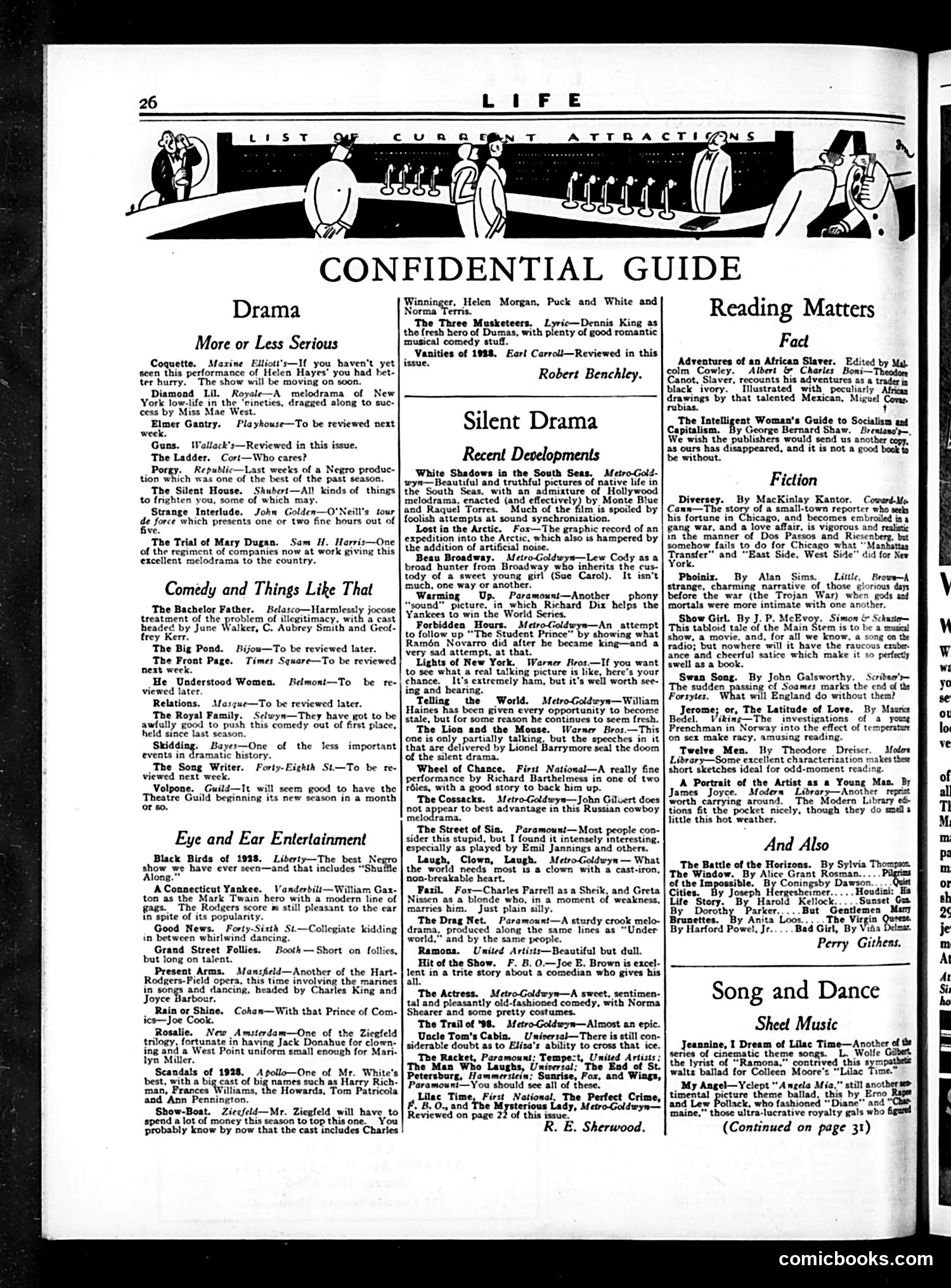
What you’re looking at
This page is a **theater and entertainment guide**, not a political cartoon. It's a "Confidential Guide" reviewing Broadway shows, silent films, and vaudeville acts currently playing in New York. The content reflects **1928 entertainment culture**: Broadway dominated leisure, silent films were transitioning to sound (reviews note "artificial noise" hampering movies), and vaudeville was still popular. Notable references include: - **Helen Hayes** in *Coquette* (major star) - **Mae West** in *Diamond Lil* (famous for provocative roles) - **O'Neill's** *Strange Interlude* (experimental theater) - Ziegfeld productions featuring **Marilyn Miller** (major entertainment figure) - Silent films being awkwardly fitted with sound effects **For modern readers**: This documents a moment when live theater dominated entertainment, before Hollywood's complete takeover. The snide tone ("Who cares?" about *The Ladder*) shows contemporary critics' preferences, while references to sound-synchronized films reveal the industry's uncertain transition to "talkies." It's essentially a **weekly entertainment listing with reviews**, not satire.
📄 Transcribed text from this page (OCR, searchable)
Machine-transcribed from the original scan — historical spelling and the odd misread are preserved.
CONFIDENTIAL GUIDE Drama More or Less Serious Coquette. Marine Elliott's—If you haven't yet ‘seen this performance of Helen Hayes’ you had het- ter hurry. The show will be moving on soon. Diamond Lil. Royale—A melodrama of New York low-life in the ‘vineties, dragged along to suc- cess by Miss Mae West. Elmer Gantry. Playhouse—To be reviewed next week, Guns. |Wallack's—Reviewed in this issue. The Ladder. Cor!—Who cares? Porgy. Republic—Last weeks of a Negro produc- tion which was one of the best of the past season. The Silent House. Shubert—Al! kinds of things to frighten you, some of which may. Strange Interlude. John Golden—O'Neill's tour de force which presents one or two fine hours out of ve. The Trial of Mary Dugan. Som H. Harris—One of the regiment of companies now at work giving this excellent melodrama to the country. Comedy and Things Like That The Bachelor Father. Belasco—Harmlessly jocose treatment of the problem of illegitimacy. with a cast headed by June Walker, C, Aubrey Smith and Geof- frey Kerr. The Big Pond. The Front Page. next week. He Understood Women. Selmont—To viewed later. Relations. \asgue—To be reviewed later. The Royal Family. Sclwyn—They have got to be awfully good to push this comedy out of first place, held since last season. Skidding. Bayes—One of events in dramatic history. _ The Song Writer. Forty-Eighth St—To be re- viewed next week. Volpone. Guild—It will seem good to have the Theatre Guild beginning its new season in a month £0. Bijou—To be reviewed later. Times Square—To be reviewed be re- the less important Eye and Ear Entertainment Black Birds of 1928. Liberty—The best _N. show we have ever seen—and that includes “Shuffle Along.” AConnecticut Yankee. Vanderbilt—William Gax- ton as the Mark Twain hero with a modern line of .. The Rodgers score ws still pleasant to the ear in spite of its popularity. Good News. Forty-Sixth St—C in between whirlwind dancing. Grand Street Follies. Booth—Short on follies, but long on talent. Present Arms. Mansfeld—Another of the Hart- Rodgers-Pield opera, this time involving the marines in songs and dancing, headed by Charles King and Joyce Barbour. Rain or Shine. ics—Joe Cook. Rosalie. New Amsterdam—One of the Ziegfeld trilogy, fortunate in having Jack Donahue for clown- ing and a West Point uniform small enough for Mari- lyn Miller. Scandals of 1928. Apollo—One of Mr. White's best, with a big cast of big names such as Harry Rich- man, Frances Williams, the Howards, Tom Patricola and Ann Pennington. Show-Boat. Ziecfeld—Mr. Ziegfeld will have to spend a lot of money this season to top this one. You probably know by now that the cast includes Charles legiate kidding Cohan—With that Prince of Com- Winni: Helen Morgan, Puck and White and Norma Terris. The Three Musketeers. Ale Deania King as the fresh hero of Dumas, with plenty of good romantic musical comedy stuff. Vanities of 1938. Ear! Carroli—Reviewed in this issue. Robert Benchley. Silent Drama Recent Developments White Shadows in the South Seas. Metro-Gold- wyn—Beautiful and truthful pictures of native life in the South Seas, with an admixture of Holly melodrama, enacted (and ¢ffectively) by. Monte Blue and Raquel Torres. Much of the film is spoiled by foolish attempts at sound synchronization. Lost in the Arctic. Fox—The graphic record of an expedition into the Arctic, which also is hampered by the addition of artificial noise. Beau Broad MetroGoldwyn—Lew Cody broad hunter from Broadway who inherits the cus- tody of a sweet young girl (Sue Carol). It isn't much, one way or another. Warming Up. Paramount—Another phony “sound” picture. in which Richard Dix helps the Yankees to win the World Series. Forbidden Hours. MetroGoldw; ‘An attempt to follow up “The Student Prince” by showing what Ramén Novarro did after he became king—and a very sad attempt, at that. Lights of New York. Warner Bros.—If you want to see what_a real talking picture is like, here's your chance. It's extremely ham, but it’s well worth see- ing and bearing. Telling the World. Metro-Goldweyn—William Haines has been given every opportunity to become stale, but for some reason he continues to seem {resh. The Lion and the Mouse. Warner Bros.—This one is only partially talking, but the specches in it that are delivered by Lionel Barrymore seal the doom of the silent drama. Wheel of Chance. First National—A really fine performance by Richard Barthelmess in one of two roles, with a good story to back him up. The Cossacks. Metro-Goldwyn—John Gilvert does not appear to best advantage in this Russian cowboy melodrama. The Street of Sin. Paramount—Most people con- sider this stupid, but I found it intensely interesting, especially as played by Emil Jannings and others. Laugh, Clown, Laugh. MetroGoldwyn— What the world needs ‘most is a clown with a cast-iron, non-breakable heart. Fazil. Fox—Charles Parrell as a Sheik, and Greta Nissen as a blonde who, in a moment of weakness, marries him. Just plain silly, The Drag Net. Paramount—A sturdy crook melo- drama, produced along the same lines as “Under work and by the same people. Ramona. United Artists—Beautiful but dull. Hit of the Show. F. B. 0.—Joe E. Brown is excel- lent in a trite story about a comedian who gives his all. The Actress. Metro-Goldwyn—A sweet, sentimen- tal and pleasantly old-fashioned comedy, with Norma Shearer and some pretty costumes. The Trail of "98. Afetro-Goldwyn—Almost an epic. Uncle Tom's Cabin. Universal—There is still con- siderable doubt as to Elisa's ability to cross that ice. The Racket, Paramount: Tempe-t, United Artists: The Man Who Laughs, Universal; The End of St. Petersburg, Hammerstein; Sunrise, Fox, and Wings, Paramount—You should see all of the Lilac Time, First National, The Perfect Crime, F. B. 0., and The Mysterious Lady, Metro-Goldwyn— Reviewed on page 22 of this issue. R. E. Sherwood. Reading Matters Fact Adventures of an African Slaver. Edited by Mab colm Cowley. Albert & Charles Boni—Theodere Canot, Slaver, recounts his adventures as a traders black ‘ivory. \ Mlustrated with peculiarly Africas drawings by that talented Mexican, Miguel Cover rubias. 1 The Intelligent Woman’s Guide to Socialism and Capitalism. Hy George Bernard Shaw. Brentano’p—_ We wish the publishers would send us another copy, ‘as ours has disappeared, and it is not a good book 4 be without. Fiction Diversey. By MacKinlay Kantor. Cann—The story of a small-town reporter who seeks his fortune in Chicago, and becomes embroiled ina ang war, and a love affair, is vigorous and realatic fa'the manner of Dos Passos and. Ri somehow fails to do for Chicago wh Transfer” and “East Side, West Sid ‘or! Phoinix. By Alan Sims. Little, Browe—A strange, charming narrative of those glonous day: before the war (the Trojan War) when gods anf mortals were more intimate with one another. Show Girl. By J.P, McEvoy. Simon & Schuste— This tabloid tale of the Main Stem is to be a musical show, a movie, and, for all we know, a song on the radio; but nowhere will it have the raucous exube ance and cheerful satice which make it so perfectly swell as a book. Swan Song. By John Galsworthy. Scribsa’— The sudden passing of Soames marks the end of the Forsytes. at will England do without them? Jerome; or, The Latitude of Love. By Maarke Bedel. Viking—The investigations of a youg Frenchman in Norway into the effect of temperater: on sex make racy, amusing reading. Twelve Men. By Theodore Dreiser. Modes Library—Some excellent characterization makes these short sketches ideal for odd-moment reading. A Portrait of the Artist as a Young Man. By James Joyce. Modern Library—Another reprist worth carrying around. The Modern Library eé- tions fit the pocket nicely, though they do mel s little this hot weather, And Also The Battle of the Horizons. By Sylvia Thompson The Window. By Alice Grant Rosman..... of the Impossible. By Coningsby Dawson... Cities. By Joseph Hergesheimer.....Houdisi: Hs Life Story. By Harold Kellock. Sunset Ga By _Doroth: ‘arker.....But Gentlemen Many Brunettes. Anita Loos... ..The Virgin By Harford Powel, Jr... Bad Girl, By Vina Delos Perry Githens, Song and Dance Sheet Music Jeannine, I Dream of Lilac Time—Another of th series of cinematic theme songs. L. Wolfe Gilbet the lyrist of “Ramona,” contrived this sympat! waltz ballad for Colleen Moore's “Lilac Time. My Angel—Yclept “Angela Mi ttaetals icture theme ballad. this by, Erno, and Lew Pollack, who fashioned “ Diane" and maine,” those ultra-lucrative royalty gals who figamt (Continued on page 31) comicbooks.com Eeresc Pes r-eaweseeocaprsEe