
Life, 1928-08-23 · page 16 of 36
Life — August 23, 1928 — page 16: what you’re looking at
What you’re looking at
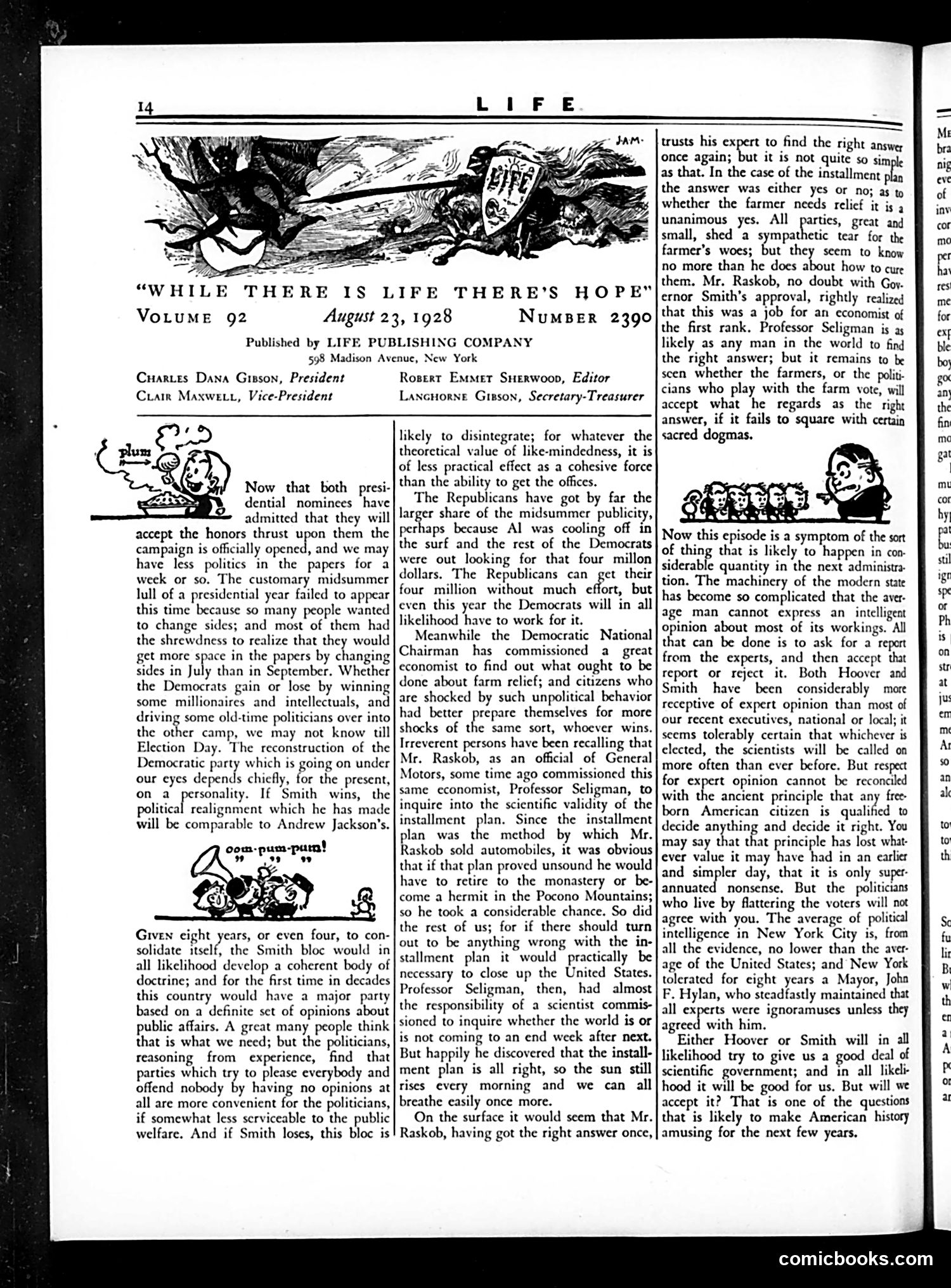
This editorial page discusses the 1928 U.S. presidential election between Republican Herbert Hoover and Democrat Al Smith. The text criticizes both candidates' reliance on expert opinions regarding farm relief policies—a major issue of the era. The cartoon at top left (labeled "WHILE THERE IS LIFE THERE'S HOPE") appears to show a figure struggling or drowning, likely representing the troubled American farm economy. The second cartoon depicts what appears to be a political figure surrounded by children or supporters, suggesting manipulation or pandering to voters. The article argues that politicians oversimplify complex economic problems and that citizens should demand direct answers rather than accepting expert rhetoric. It questions whether either candidate truly understands or can solve agricultural crisis effectively.
📄 Transcribed text from this page (OCR, searchable)
Machine-transcribed from the original scan — historical spelling and the odd misread are preserved.
VOLUME 92 Angust 23, 1928 NuMBER 2390 Published by LIFE PUBLISHING COMPANY 598 Madison Avenue, New York Cuarces Dana Ginson, President Crain Maxwe tt, Vice-President anf & Now that both presi- dential nominees have admitted that they will accept the honors thrust upon them the campaign is officially opened, and we may have less politics in the papers for a week or so. The customary midsummer lull of a presidential year failed to appear this time because so many people wanted to change sides; and most of them had the shrewdness to realize that they would get more space in the papers by changing sides in July than in September. Whether the Democrats gain or lose by winning some millionaires and intellectuals, and driving some old-time politicians over into the other camp, we may not know till Election Day. The reconstruction of the Democratic party which is going on under our eyes depends chiefly, for the present, on a personality. If Smith wins, the political realignment which he has made will be comparable to Andrew Jackson's. * = i] at a Gwen eight years, or even four, to con- solidate itself, the Smith bloc would in all likelihood develop a coherent body of doctrine; and for the first time in decades this country would have a major party based on a definite set of opinions about public affairs. A great many people think that is what we need; but the politicians, reasoning from experience, find that parties which try to please everybody and offend nobody by having no opinions at all are more convenient for the politicians, if somewhat less serviceable to the public welfare. And if Smith loses, this bloc is Rosert Emmet SuHerwoop, Editor Lancorne Ginson, Secretary-Treasurer likely to disintegrate; for whatever the theoretical value of like-mindedness, it is of less practical effect as a cohesive force than the ability to get the offices. The Republicans have got by far the larger share of the midsummer publicity, perhaps because Al was cooling off in the surf and the rest of the Democrats were out looking for that four millon dollars. The Republicans can get their four million without much effort, but even this year the Democrats will in all likelihood have to work for it. Meanwhile the Democratic National Chairman has commissioned a great economist to find out what ought to be done about farm relief; and citizens who are shocked by such unpolitical behavior had better prepare themselves for more shocks of the same sort, whoever wins. Irreverent persons have been recalling that Mr. Raskob, as an official of General Motors, some time ago commissioned this same economist, Professor Seligman, to inquire into the scientific validity of the installment plan. Since the installment plan was the method by which Mr. ‘askob sold automobiles, it was obvious that if that plan proved unsound he would have to retire to the monastery or be- come a hermit in the Pocono Mountains; so he took a considerable chance. So did the rest of us; for if there should turn out to be anything wrong with the in- stallment plan it would practically be necessary to close up the United States. Professor Seligman, then, had almost the responsibility of a scientist commis- sioned to inquire whether the world is or is not coming to an end week after next. But happily he discovered that the install- ment plan is all right, so the sun still rises every morning and we can all breathe easily once more. On the surface it would seem that Mr. Raskob, having got the right answer once, trusts his expert to find the right answer once again; but it is not quite so sim as that. In the case of the installment pl the answer was cither yes or no; as to whether the farmer needs relief it is 3 unanimous yes. All parties, great and small, shed a sympathetic tear for the farmer’s woes; but they seem to know no more than he does about how to cure them. Mr. Raskob, no doubt with Goy. ernor Smith's approval, rightly realized that this was a job for an economist of the first rank. Professor Seligman is as likely as any man in the world to find the right answer; but it remains to be scen whether the farmers, or the politi- cians who play with the farm vote, will accept what he regards as the right answer, if it fails to square with certain sacred dogmas, Now this episode is a symptom of the sort of thing that is likely to happen in con- siderable quantity in the next administra tion. The machinery of the modern state has become so complicated that the aver- age man cannot express an_ intelligent opinion about most of its workings. All that can be done is to ask for a report from the experts, and then accept that report or reject it. Both Hoover and Smith have been considerably more receptive of expert opinion than most of our recent executives, national or local; it seems tolerably certain that whichever is clected, the scientists will be called on more often than ever before. But respect for expert opinion cannot be reconciled with the ancient principle that any free- born American citizen is qualified to decide anything and decide it right. You may say that that principle has lost what- ever value it may have had in an earlier and simpler day, that it is only super- annuated nonsense. But the politicians who live by flattering the voters will not agree with you. The average of political intelligence in New York City is, from all the evidence, no lower than the aver- age of the United States; and New York tolerated for eight years a Mayor, John F. Hylan, who steadfastly maintained that all experts were ignoramuses unless agreed with him. Either Hoover or Smith will in all likelihood try to give us a good deal of scientific government; and in all likeli- hood it will be good for us. But will we accept it? That is one of the questions that is likely to make American history amusing for the next few years. comicbooks.com