
Life, 1928-08-23 · page 9 of 36
Life — August 23, 1928 — page 9: what you’re looking at
What you’re looking at
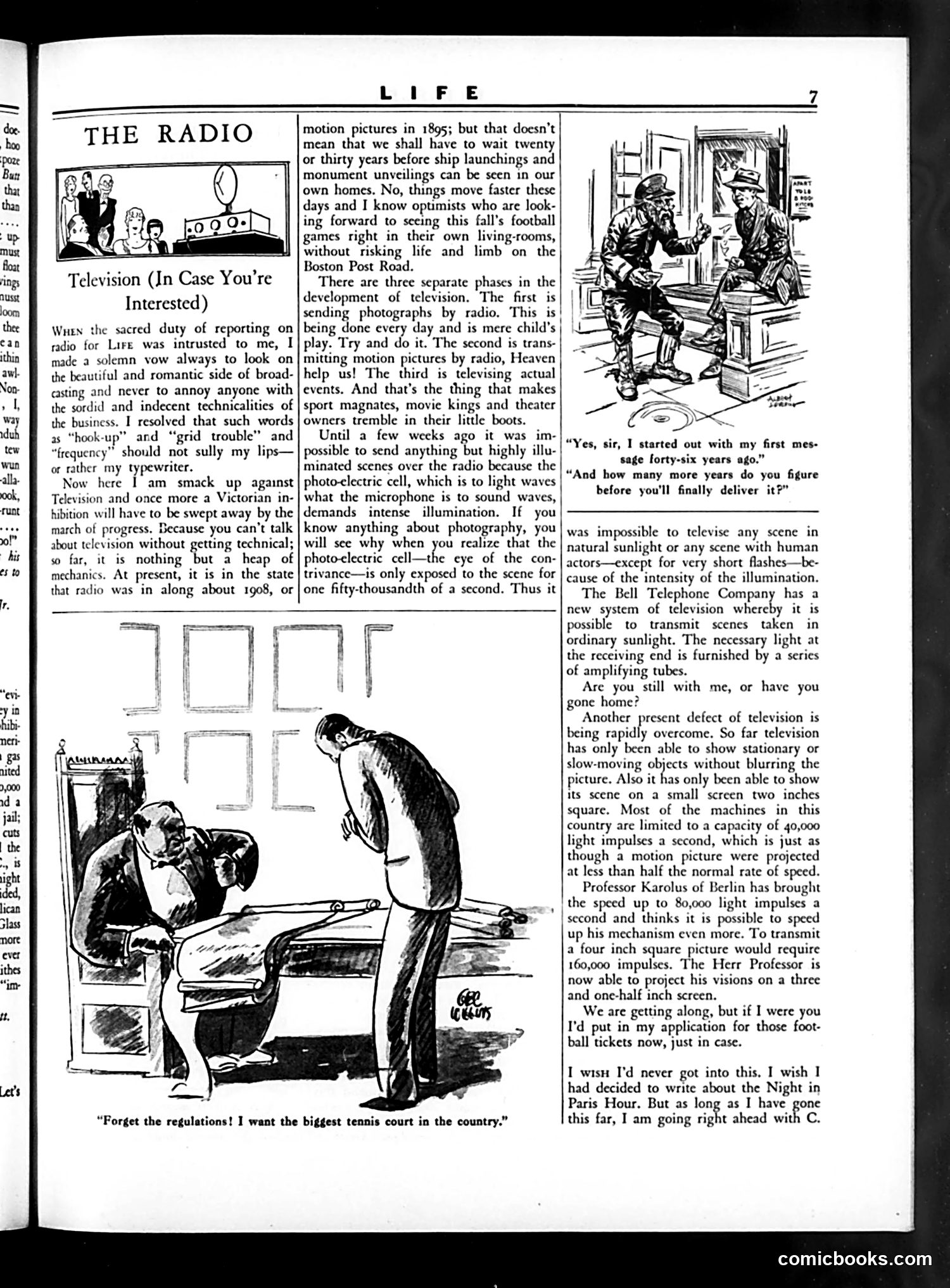
This page discusses early television technology circa the 1920s. The main cartoon depicts a man at a desk speaking to another man, with the caption: "Forget the regulations! I want the biggest tennis court in the country." The joke satirizes bureaucratic red tape and regulatory obstacles impeding television development. The desk operator appears to be a regulatory official blocking ambitious plans for televising sports—specifically tennis—due to technical and legal constraints. The article text explains television's three developmental phases: transmitting photographs via radio, then motion pictures, then live events. It discusses technical limitations of the era, including the photo-electric cell's light requirements and screen size constraints. The satire mocks how regulations and mechanical limitations prevent the ambitious goal of broadcasting major sporting events, a concern relevant to early television's regulatory environment.
📄 Transcribed text from this page (OCR, searchable)
Machine-transcribed from the original scan — historical spelling and the odd misread are preserved.
LIFE TH Television (In Case You’re Interested) Wen the sacred duty of reporting on radio for Lire was intrusted to me, I made a solemn vow always to look on the beautiful and romantic side of broad- casting and never to annoy anyone with the sordid and indecent technicalities of the business. I resolved that such words as “hook-up” and “grid trouble”? and “frequency” should not sully my lips— or rather my typewriter. Now here I am smack up against Television and once more a Victorian in- hibition will have to be swept away by the march of progress. Because you can’t talk about television without getting technical; so far, it is nothing but a heap of mechanics. At present, it is in the state that radio was in along about 1908, or motion pictures in 1895; but that doesn’t mean that we shall have to wait twenty or thirty years before ship launchings and monument unveilings can be seen in our own homes. No, things move faster these days and I know optimists who are look- ing forward to seeing this fall's football games right in their own living-rooms, without risking life and limb on the Boston Post Road. There are three separate phases in the development of television. The first is sending photographs by radio, This is being done every day and is mere child's play. Try and do it. The second is trans- mitting motion pictures by radio, Heaven help us! The third is televising actual events. And that’s the thing that makes sport magnates, movie kings and theater owners tremble in their little boots. Until a few weeks ago it was im- possible to send anything but highly illu- minated scenes over the radio because the photo-electric cell, which is to light waves what the microphone is to sound waves, demands intense illumination. If you know anything about photography, you will see why when you realize that the photo-electric cell—the eye of the con- trivance—is only exposed to the scene for one fifty-thousandth of a second. Thus it “Forget the regulations! I want the biggest tennis court in the country.” | “Yes, sir, I started out with my first mes- sage forty-six years ago.” |“And how many more years do you figure before you'll finally deliver it?” was impossible to televise any scene in natural sunlight or any scene with human actors—except for very short flashes—be- cause of the intensity of the illumination. The Bell Telephone Company has a new system of television whereby it is possible to transmit scenes taken in ordinary sunlight. The necessary light at the receiving end is furnished by a series of amplifying tubes. Are you still with me, or have you gone home? Another present defect of television is being rapidly overcome. So far television has only been able to show stationary or slow-moving objects without blurring the picture. Also it has only been able to show its scene on a small screen two inches square. Most of the machines in this country are limited to a capacity of 40,000 light impulses a second, which is just as though a motion picture were projected at less than half the normal rate of speed. Professor Karolus of Berlin has brought the speed up to 80,000 light impulses a | second and thinks it is possible to speed up his mechanism even more. To transmit a four inch square picture would require 160,000 impulses. The Herr Professor is now able to project his visions on a three and one-half inch screen. We are getting along, but if I were you I'd put in my application for those foot- ball tickets now, just in case. I wis I'd never got into this. I wish I had decided to write about the Night in Paris Hour. But as long as I have gone this far, I am going right ahead with C. comicbooks.com