
A complete issue · 35 pages · 1928
Life — June 28, 1928
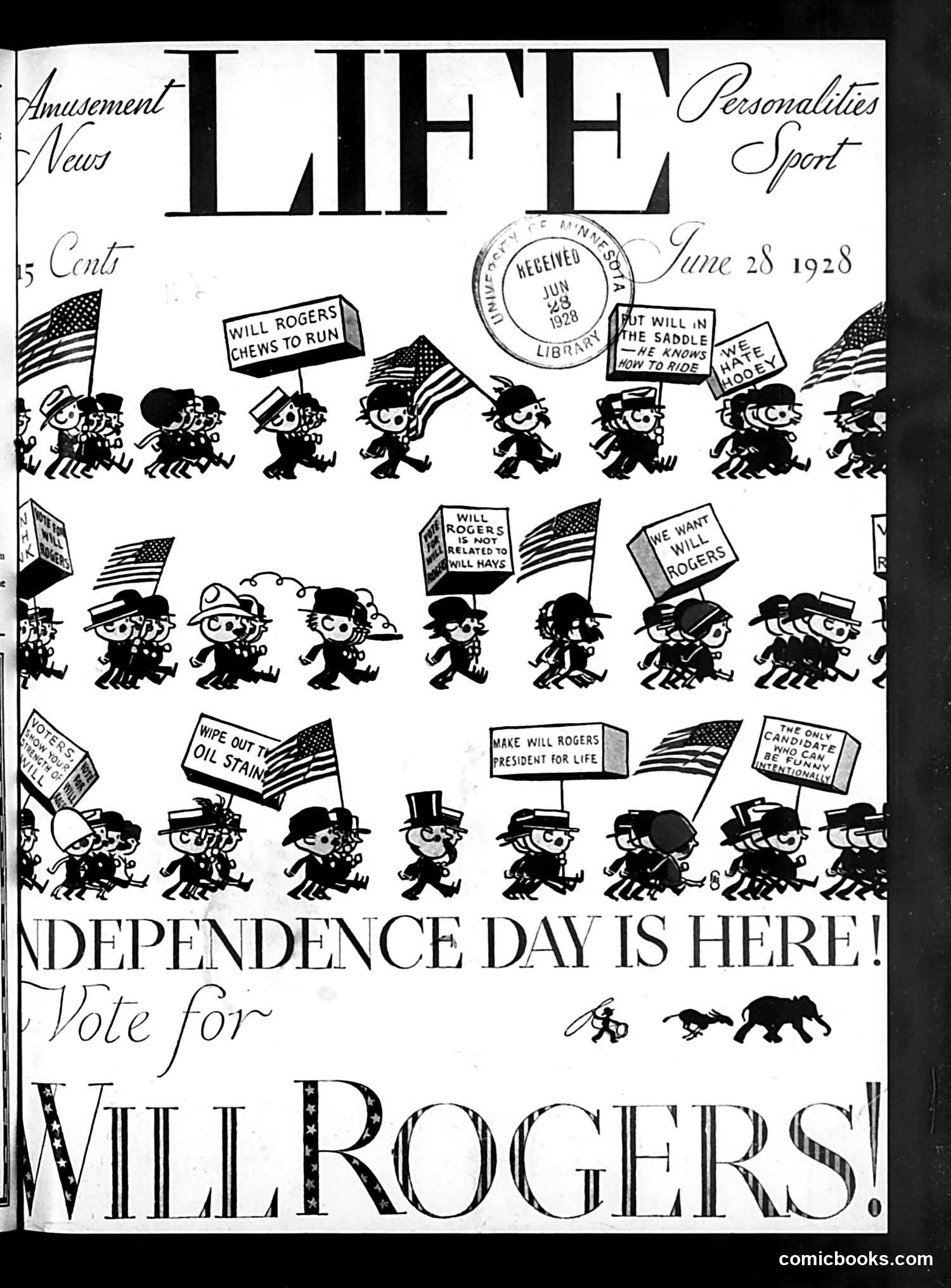
This is a pro-Will Rogers political advertisement for Independence Day 1928. The cartoon shows multiple small figures (likely voters or citizens) carrying American flags and various signs supporting Will Rogers as a presidential candidate. Signs read "Will Rogers chews to run," "Put will in the saddle," "Make Will Rogers president for life," and other campaign slogans. The satire appears to be humorous rather than serious—suggesting Rogers, a famous comedian and actor, should run for president. This likely reflects contemporary sentiment that Rogers, known for his political wit and social commentary, would be an amusing alternative to serious candidates. The illustrated parade of enthusiastic supporters ironically champions a celebrity candidacy, possibly mocking both Rogers and the political process itself.
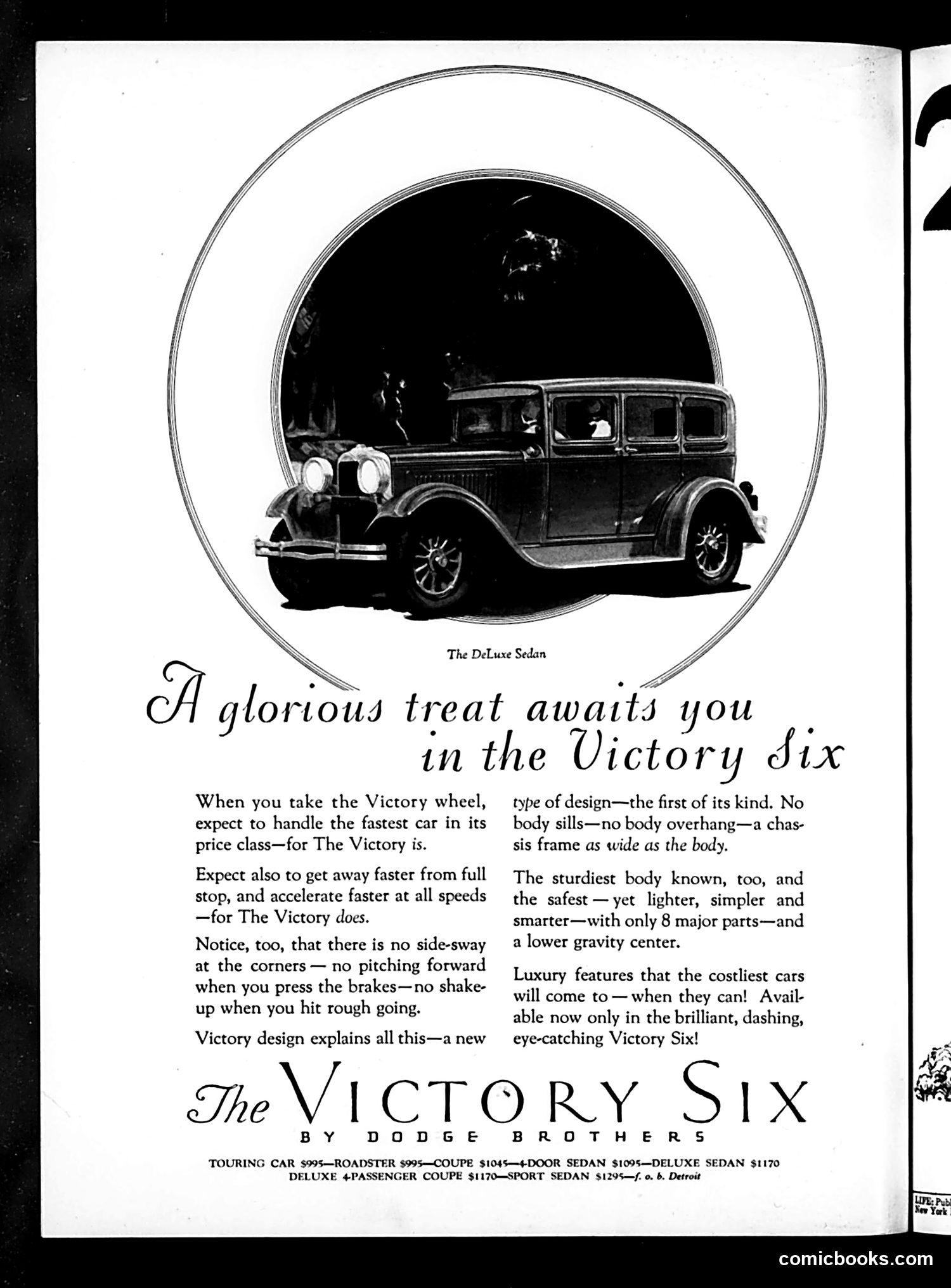
This page is **not a political cartoon or satirical content**—it's a straightforward advertisement for the Victory Six automobile by Dodge Brothers. The image shows "The DeLuxe Sedan" model in a circular frame, with marketing copy emphasizing the car's engineering advantages: superior handling, faster acceleration, no body overhang, and a wide chassis frame. The ad highlights luxury features previously available only in expensive cars, now offered in the Victory Six. The tagline "A glorious treat awaits you in the Victory Six" uses aspirational language typical of 1920s automotive advertising. Various model prices are listed at the bottom (Touring Car $995, Roadster $995, etc.). This is commercial advertising, not editorial satire or political commentary.
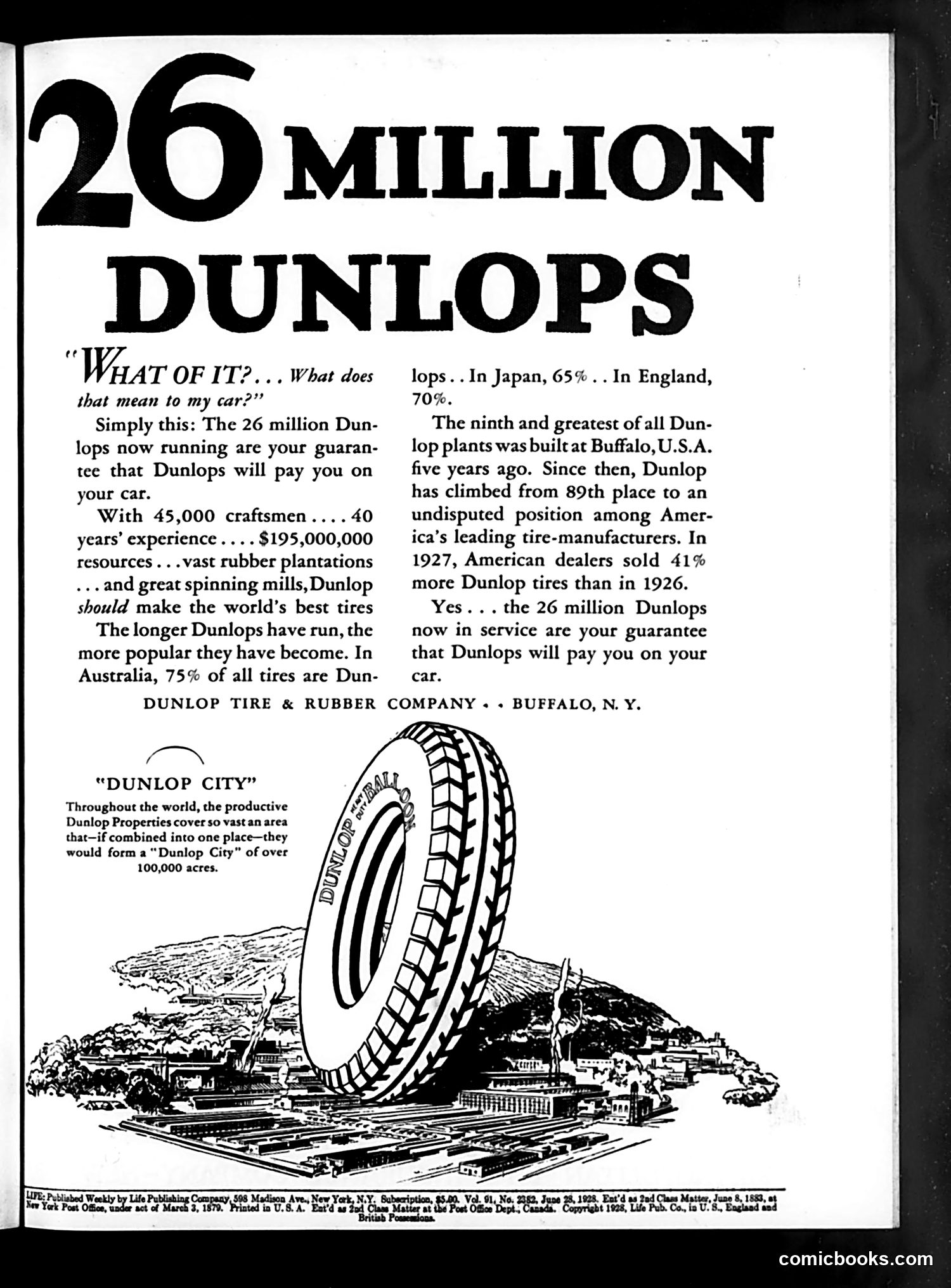
This is **not a political cartoon or satire**—it's a **straightforward advertisement** for Dunlop tires from the Dunlop Tire & Rubber Company (Buffalo, N.Y.). The page promotes Dunlop's market dominance: 26 million tires in service, with strong market share in Australia (75%), Japan (65%), and England (70%). It emphasizes the company's manufacturing scale—45,000 craftsmen, vast rubber plantations, and spinning mills. The illustration depicts an oversized Dunlop tire dominating a miniaturized landscape labeled "Dunlop City," symbolizing the company's vast global operations (stated to cover 100,000 acres if consolidated). The sales pitch: Dunlop's longevity and popularity guarantee they'll "pay you on your car"—meaning their durability justifies the cost. This is standard early-20th-century brand advertising emphasizing scale and reliability.
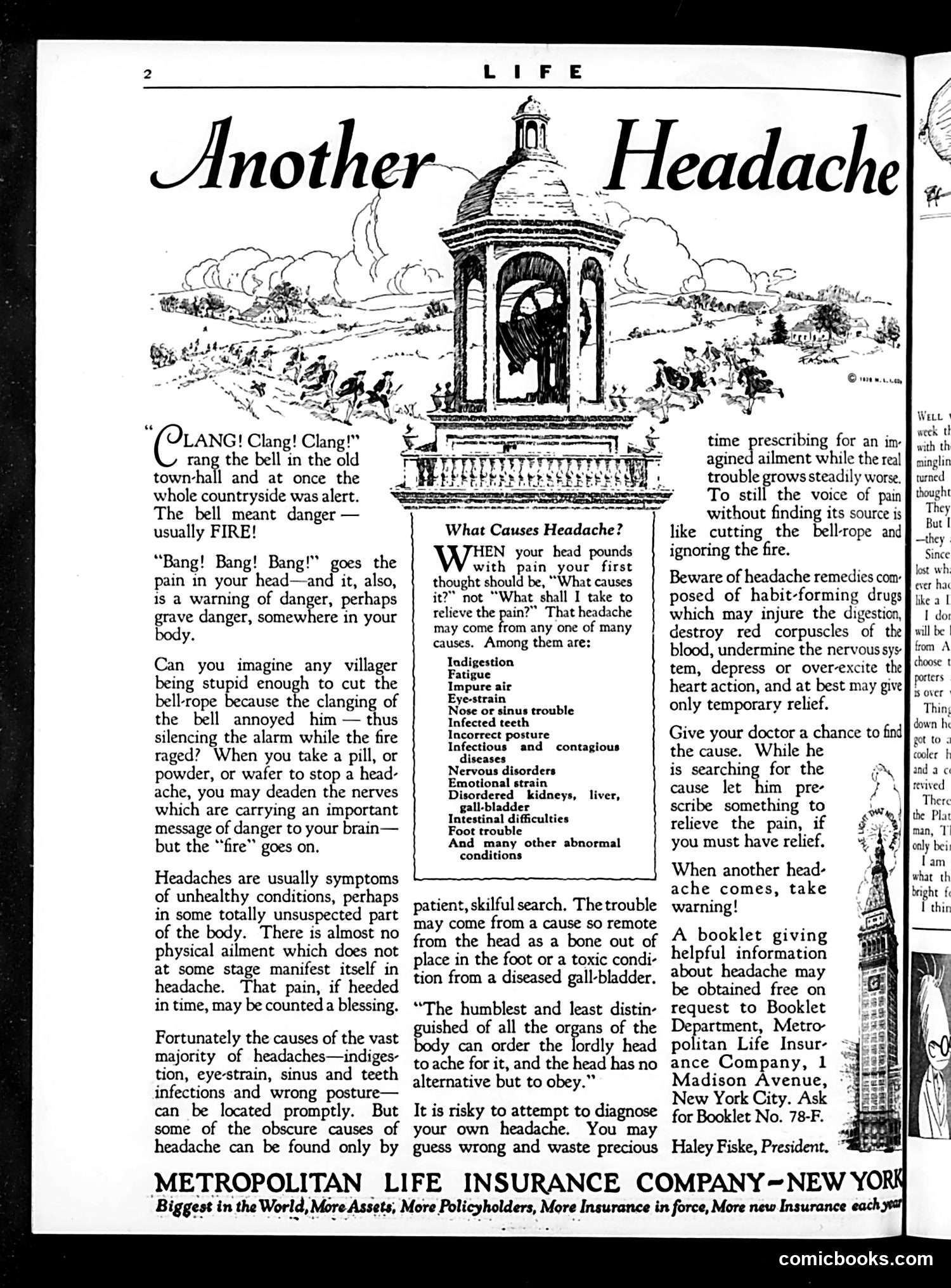
This is a satirical advertisement for Metropolitan Life Insurance Company disguised as medical/social commentary. The "headache" is a metaphor for life's problems and dangers. The opening joke references a town bell that rings to signal fire—cutting the rope to silence the alarm while the fire rages is presented as obviously foolish. The parallel message: taking headache pills to mask symptoms while ignoring underlying causes is similarly unwise. The piece lists legitimate headache causes (indigestion, fatigue, sinus trouble, emotional strain, etc.) and warns against habit-forming drugs that merely provide temporary relief. The central pitch: see a doctor to find the *real* cause rather than self-medicate. This pitches Metropolitan Life's insurance and free informational booklet as the responsible solution to life's health uncertainties—a clever blend of public health advice and corporate marketing.
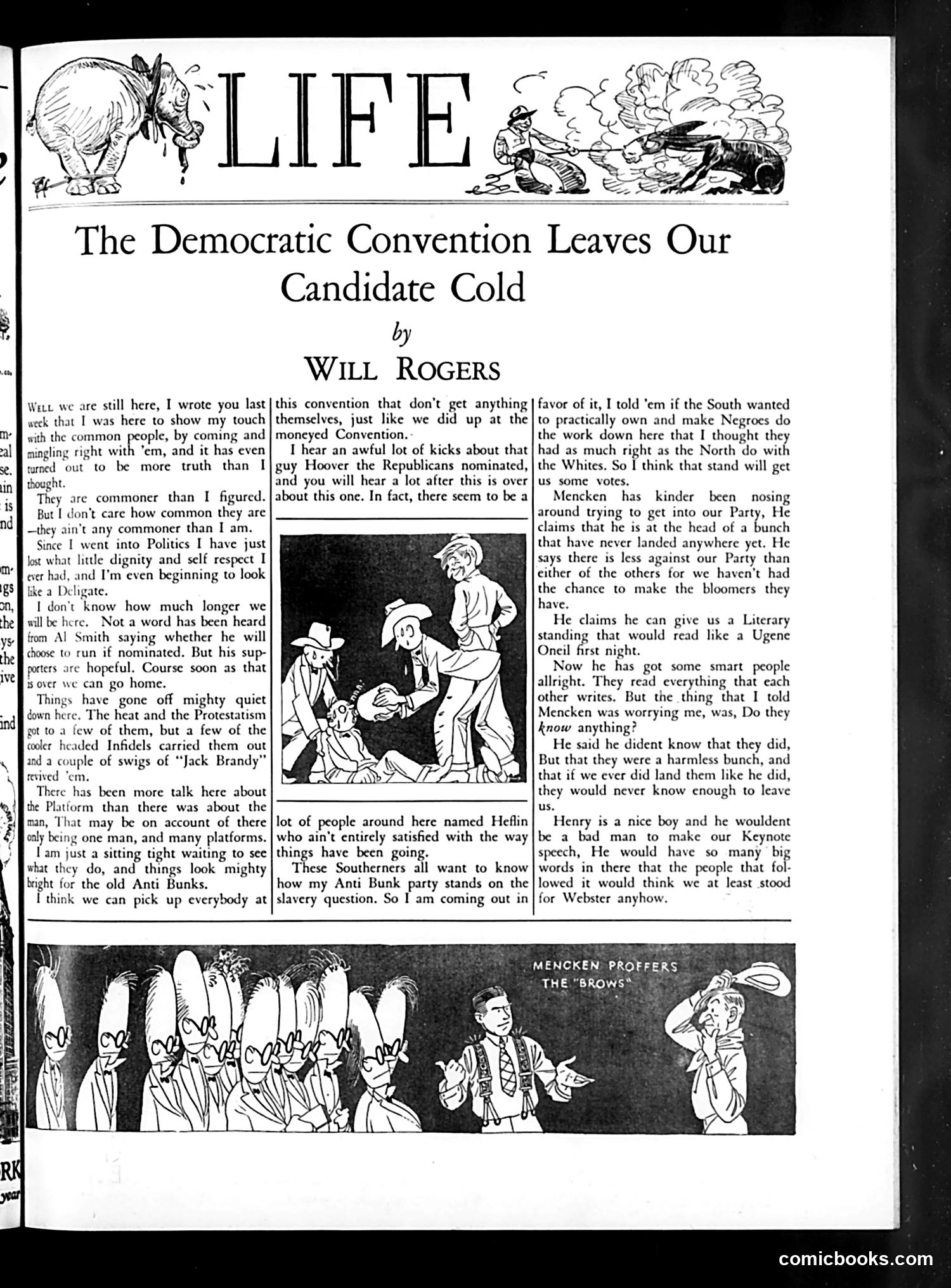
This Will Rogers column satirizes the 1928 Democratic National Convention. Rogers criticizes the party's infighting, particularly Southern delegates' concerns about slavery and race relations. He mocks Mencken (the journalist H.L. Mencken, referenced as someone attempting to influence the party platform) for his literary pretensions while claiming ignorance about political reality. Rogers appears skeptical of the party's nominee selection process, noting numerous candidates and platforms under discussion. He's particularly critical of the South's demands regarding racial issues, suggesting their political demands are unreasonable. The cartoon below ("Mencken Proffers The Brows") likely mocks Mencken's intellectual posturing during convention debates. Rogers employs his characteristic folksy criticism of political hypocrisy and backroom dealings.
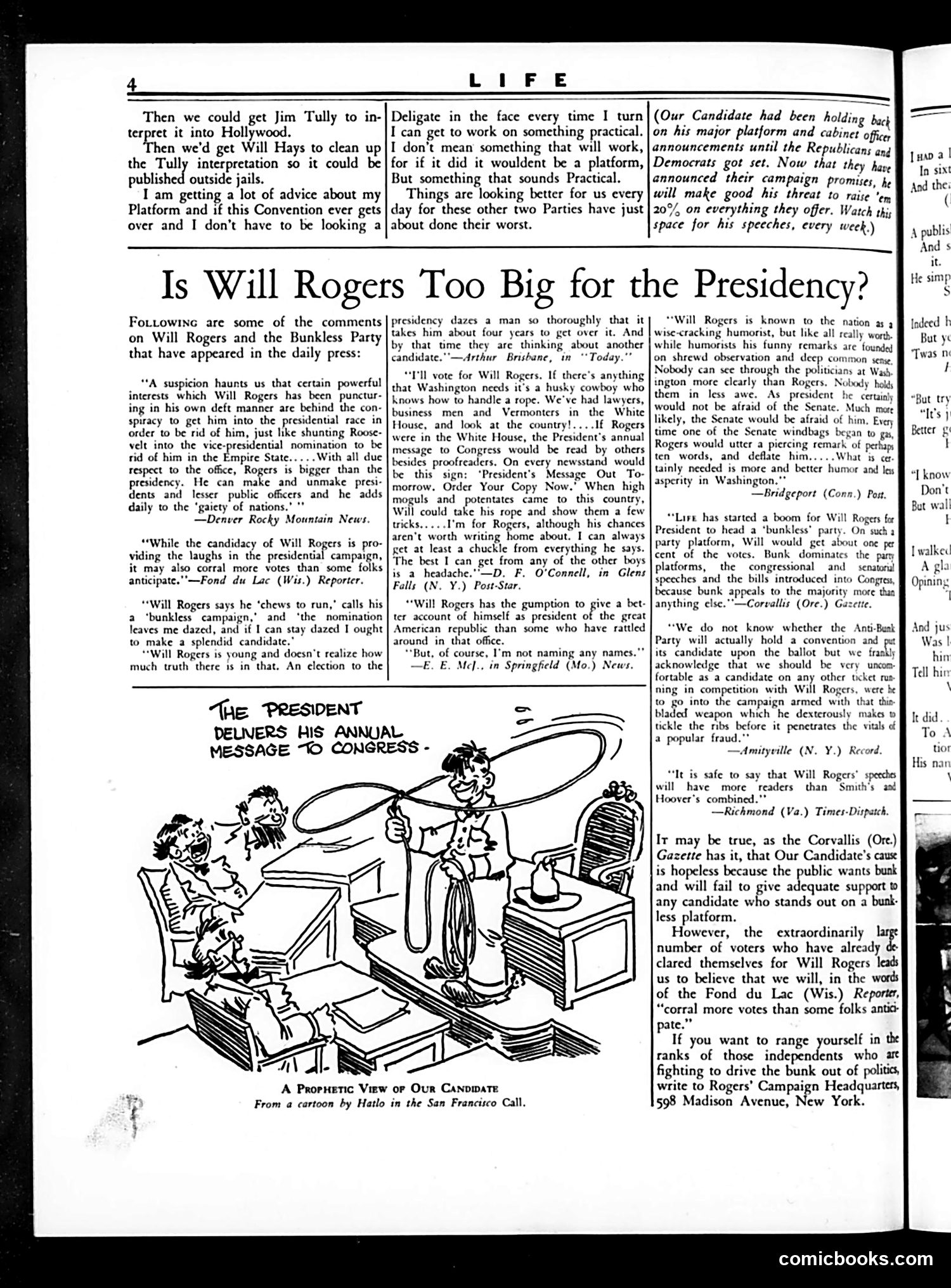
This page satirizes the 1920s proposal that humorist **Will Rogers**—famous for rope tricks and comedic commentary—should run for president on the "Bunkless Party" platform. The cartoon depicts Rogers as a performer using a lasso on Congress members during a presidential address, suggesting his unconventional methods would treat serious governance as entertainment. The accompanying text collects newspaper opinions debating whether Rogers' popularity, wit, and "common sense" appeal made him viable despite his lack of political experience. Supporters argue his outsider status could reform politics; skeptics contend elections require serious candidates, not celebrities. The satire critiques both the public's desire for anti-establishment figures and the absurdity of conflating entertainment skill with executive competence—a surprisingly modern political concern.
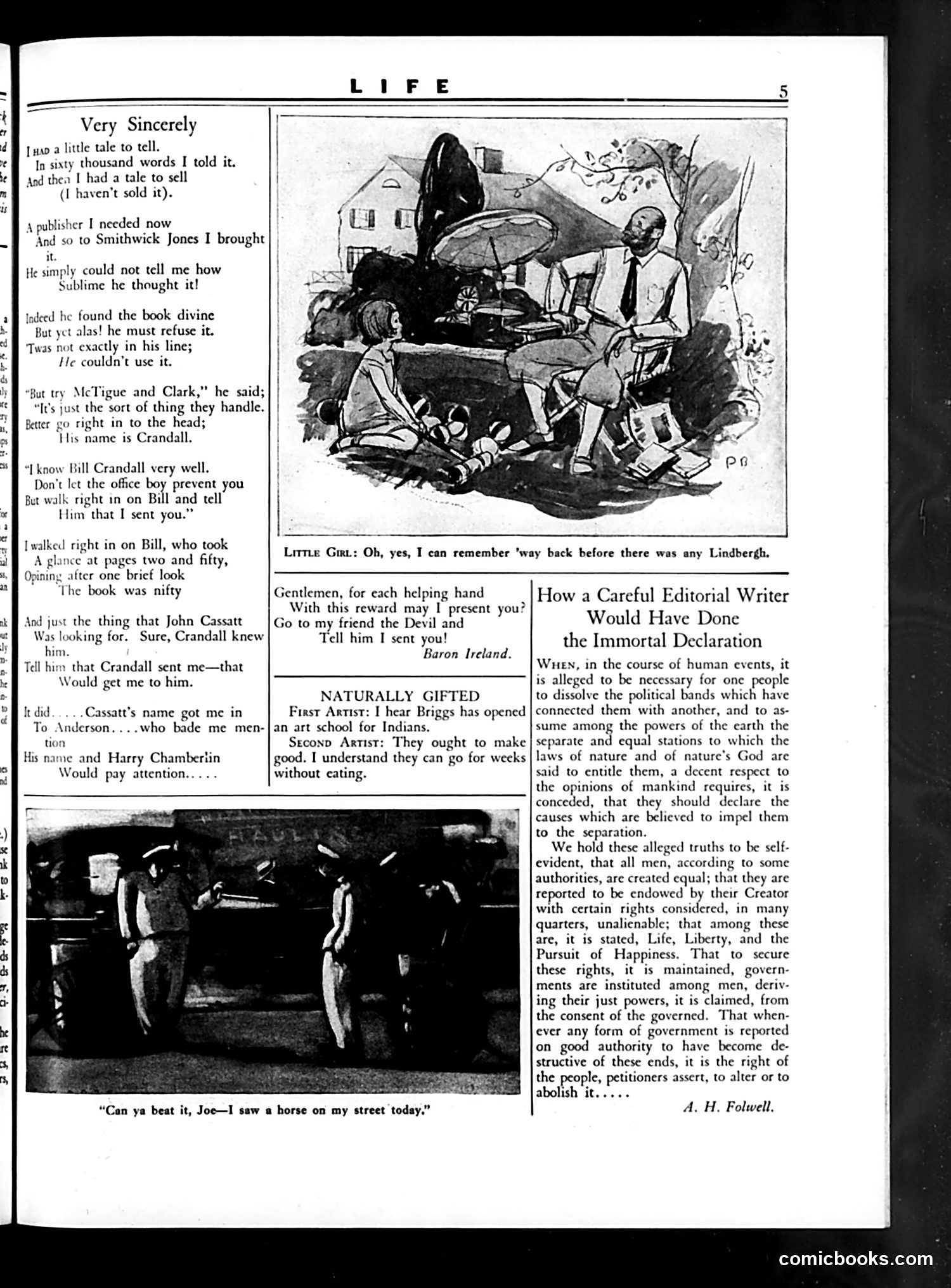
This page contains three distinct sections: **"Very Sincerely"** (left column): A humorous anecdote about pitching a manuscript to publisher Smithwick Jones, who refers the author to editors "McTigue and Clark" at the magazine *Life*. The joke appears to be about the difficulty of getting published and editorial gatekeeping. **Cartoon** (top right): Shows a young girl speaking with adults near a typewriter and papers, captioned about remembering "way back before there was any Lindbergh"—likely referencing Charles Lindbergh's famous 1927 transatlantic flight, treating it as a watershed historical moment even a child would reference. **"How a Careful Editorial Writer Would Have Done the Immortal Declaration"** (right): A mock rewrite of the Declaration of Independence in dry, legalistic language, satirizing bureaucratic and editorial over-writing of historical documents. The overall theme appears to be satire about writing, publishing, and historical perspective.
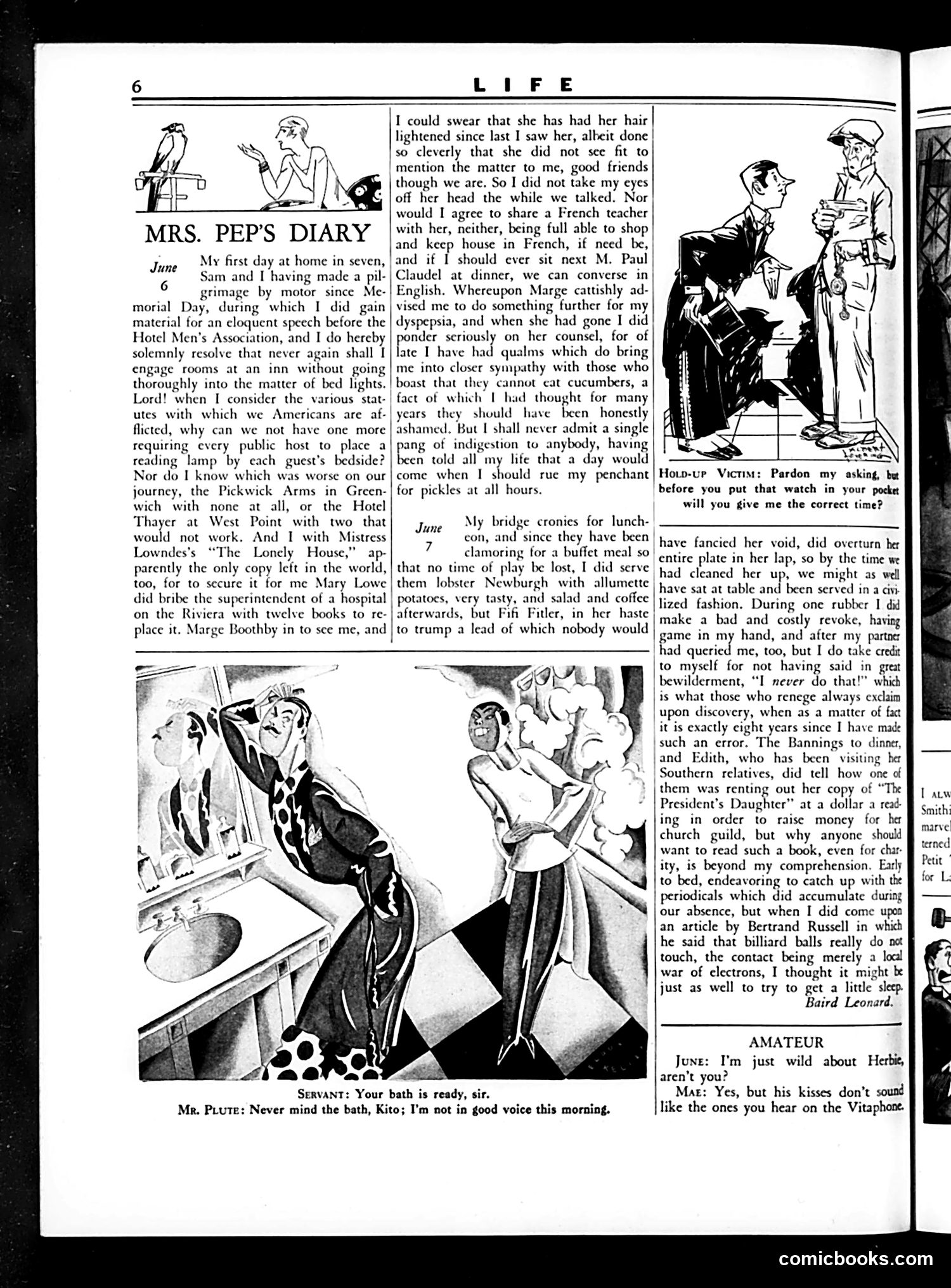
This page contains "Mrs. Pep's Diary," a humorous column describing a woman's domestic experiences. The diary entries (June 6-7) recount social awkwardness: Mrs. Pep discusses her hair being lightened, struggles with French conversation, and describes a lunch party where she accidentally overturned a plate of food on a guest. The cartoon below shows a servant announcing a bath is ready to a poorly-groomed man (Mr. Plute), with the servant noting he's "not in good voice this morning"—suggesting Mr. Plute is hungover or ill. The "Hold-up Victim" cartoon shows a holdup scenario used as a joke setup about asking for the correct time. The humor relies on relatable domestic embarrassments and situational comedy typical of 1920s-era satirical magazine content.
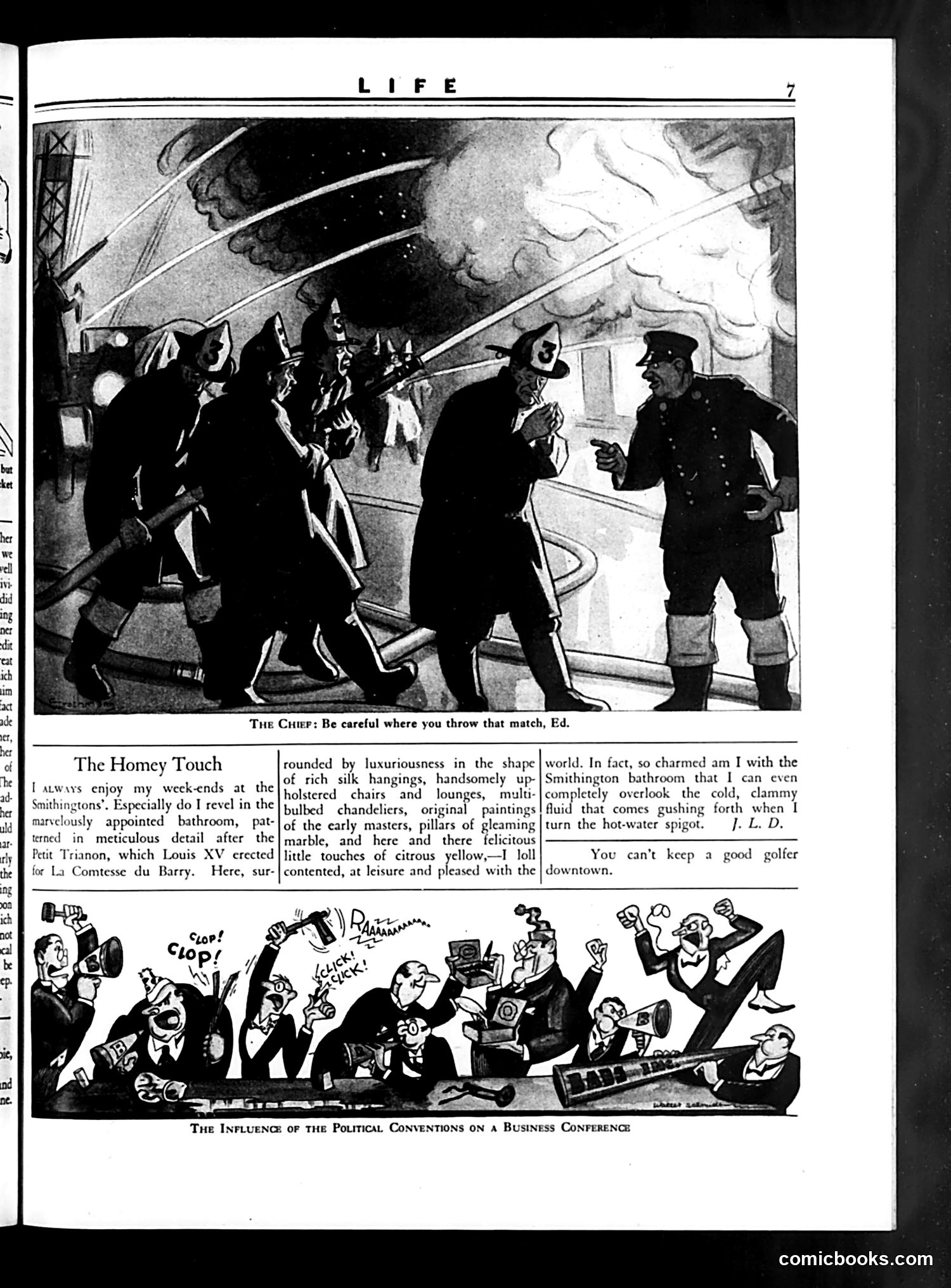
The top cartoon depicts firefighters at work, with the caption "The Chief: Be careful where you throw that match, Ed"—a straightforward safety joke about workplace carelessness. Below, "The Homey Touch" is an article praising the luxurious bathroom of La Comtesse du Barry's residence, celebrating its ornate details and modern amenities. The accompanying caption reads "You can't keep a good golfer downtown." The bottom cartoon, "The Influence of the Political Conventions on a Business Conference," satirizes how political conventions disrupt normal business activities. It depicts businessmen descending into chaos—shouting, waving signs and megaphones, seemingly unable to conduct orderly meetings due to the surrounding political frenzy, likely referencing early 20th-century political convention season's broader cultural disruption.
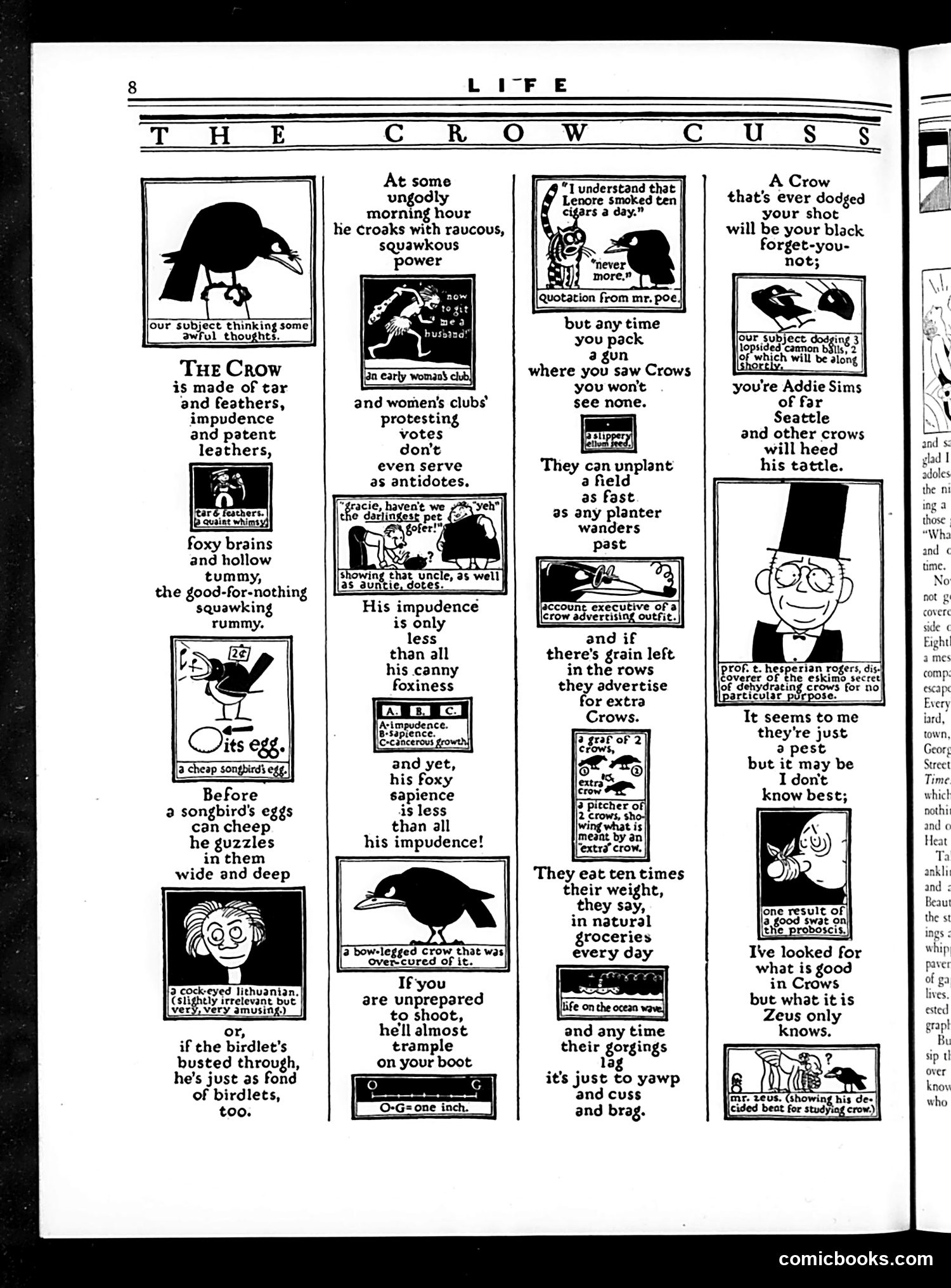
This is a humorous essay-cartoon hybrid mocking crows as agricultural pests. The piece catalogs the crow's negative qualities: intelligence without morality ("foxy brains and hollow rummy"), destructive habits (eating crops, unplugging planted fields), and shameless behavior (eating ten times their weight daily, cursing at farmers). The satire targets both the bird itself and the helplessness of farmers and civic organizations against them. References to "women's clubs' protesting voices" suggest animal-welfare advocates of the era who opposed shooting crows, creating conflict between pest control and emerging conservation sentiment. The cartoons humorously personify crows—showing them operating businesses, advertising, and generally thriving despite human attempts at control. The joke: crows are unstoppable, amoral pests that outwit farmers systematically.
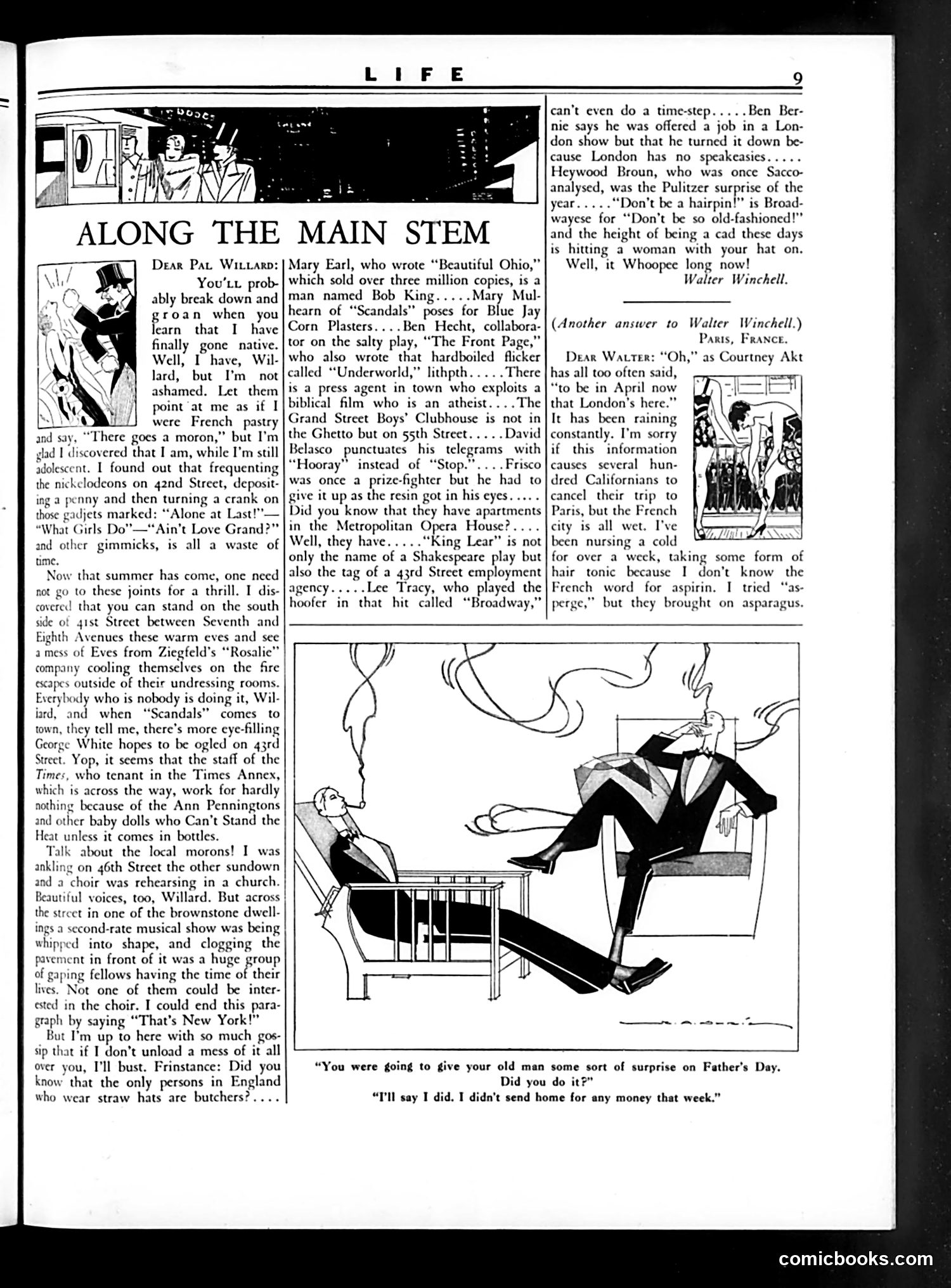
This is a gossip/humor column by Pal Willard about New York theater and entertainment. The main cartoon depicts a Father's Day scenario: a man lounging in a chair while a woman asks if he planned to surprise his father. His response—"I'll say I did. I didn't send home for any money that week"—is the joke: the "surprise" is financial deprivation rather than a gift. The column itself discusses theatrical personalities (Mary Earl, Bob King, Ben Hecht), Broadway shows, and New York street life anecdotes. References include "Beautiful Ohio" (a popular song), various Broadway productions, and local gossip about entertainers. The humor relies on insider knowledge of 1920s New York theater culture and celebrities now largely forgotten.
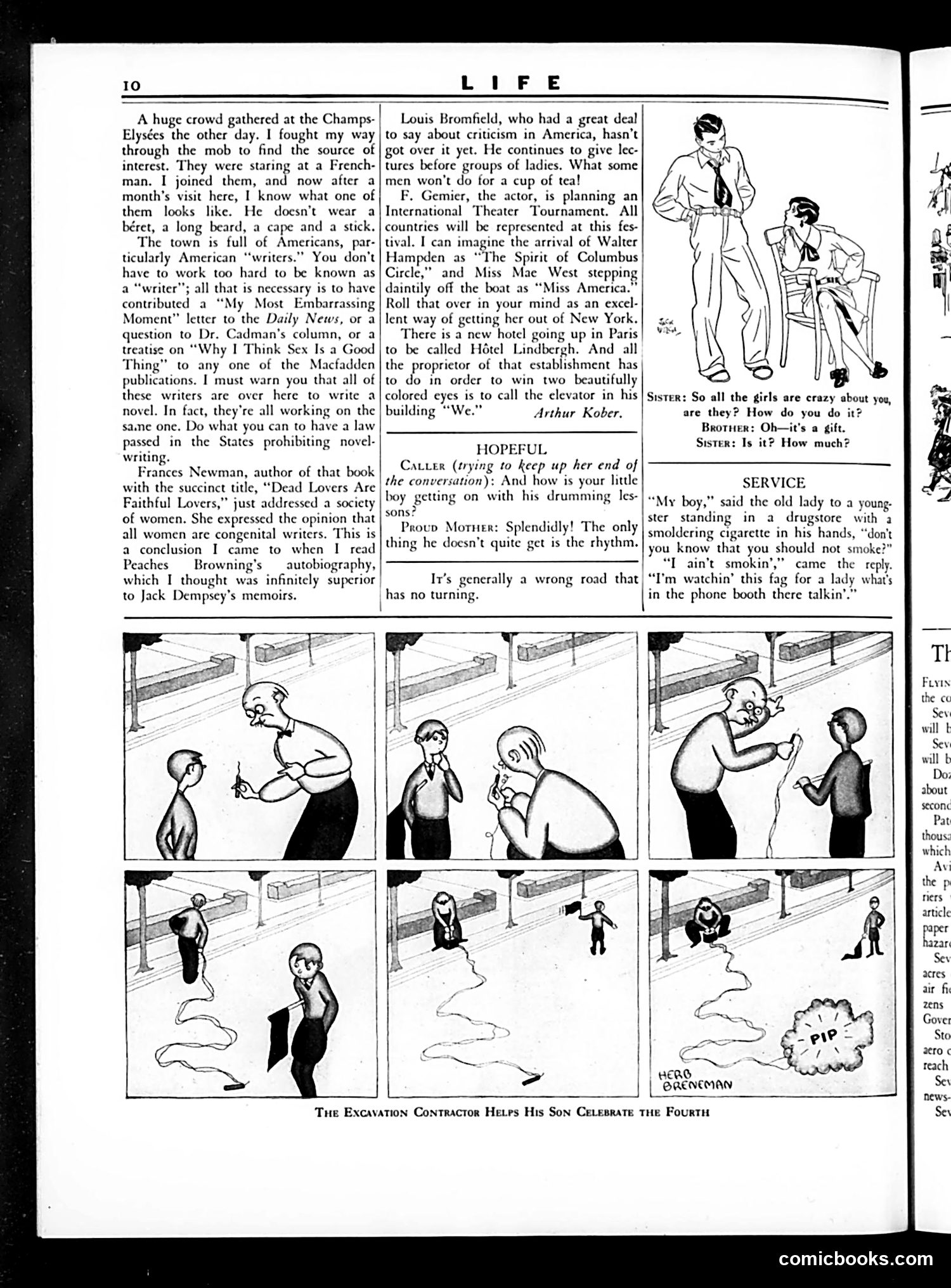
This page contains social commentary and a comic strip titled "The Excavation Contractor Helps His Son Celebrate the Fourth." The comic depicts a father using construction equipment (appears to be a steam shovel or excavator) as an improvised Fourth of July celebration tool for his young son. The sequence shows the father operating the machinery to create increasingly elaborate "fireworks" effects—spraying dirt and creating explosions—as a substitute for actual fireworks. The satire critiques working-class ingenuity and safety practices: a contractor repurposes industrial equipment for holiday entertainment, suggesting both resourcefulness and recklessness. The joke relies on the absurdity of using dangerous construction machinery as a children's entertainment device, reflecting early 20th-century attitudes toward workplace safety and parental supervision.
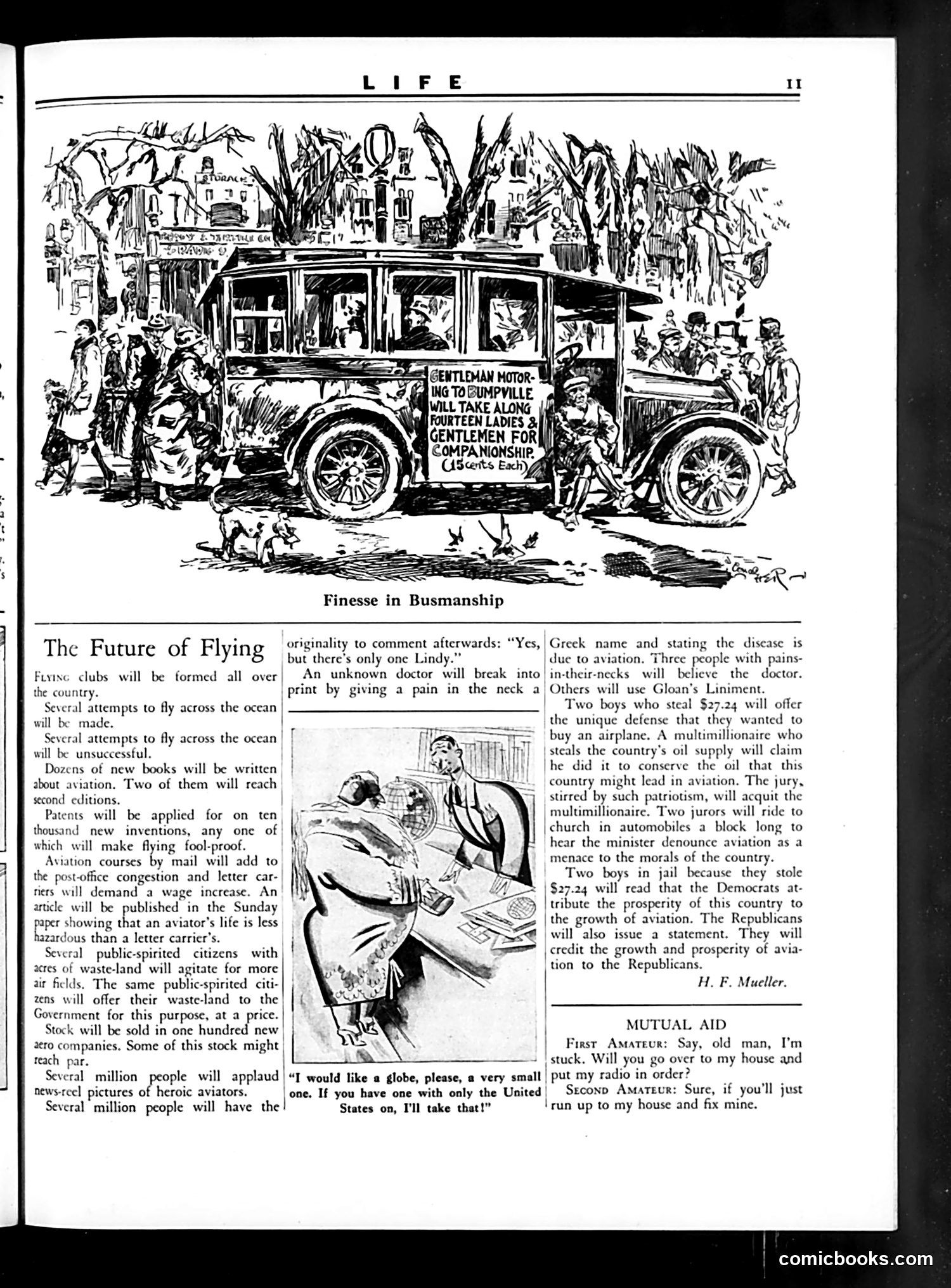
The top illustration satirizes early automotive advertising and genteel marketing. A crowded touring car displays a sign promoting a "gentleman motoring" excursion to Bumpsville with "fourteen ladies and gentlemen for companionship" (15 cents each). The cartoon mocks the pretentiousness of calling a commercial joyride "gentlemanly" while packing paying passengers into an overcrowded vehicle—contrasting the fancy language with the undignified reality of mass transportation. The chaotic street scene underscores the absurdity. Below, "The Future of Flying" satirizes overly optimistic predictions about aviation's societal impact, predicting failed ocean crossings, new aviation-related diseases, legal disputes, and political corruption tied to airplane manufacturing—poking fun at how boosters ignore aviation's practical problems while promoting it as transformative.
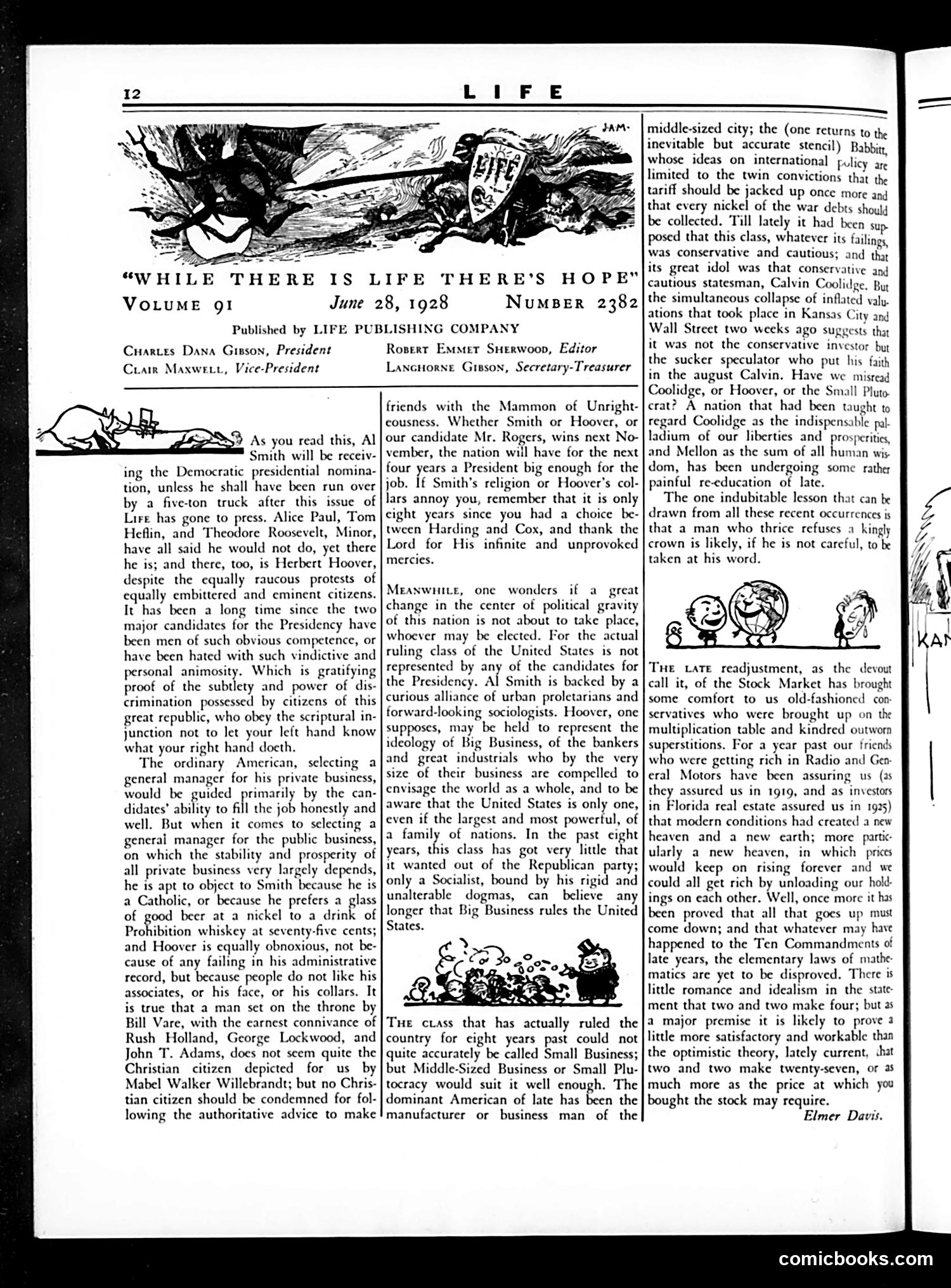
This Life magazine page (June 28, 1928) discusses the upcoming U.S. presidential election. The article examines potential Democratic nominees, mentioning Al Smith specifically. It references the "Mammom of Unrighteousness"—a biblical allusion suggesting corruption. The text argues that major presidential candidates have recently been businessmen or conservative figures (Harding, Coolidge, Hoover), and questions whether actual power lies with "Big Business" rather than elected officials. The author suggests the ruling class is represented by bankers and industrialists who control policy regardless of who wins elections. The satirical point: American democracy may be theater masking the real power of wealthy business interests. The cartoons (small figures visible) likely reinforce this cynical view of political choice under capitalist control.
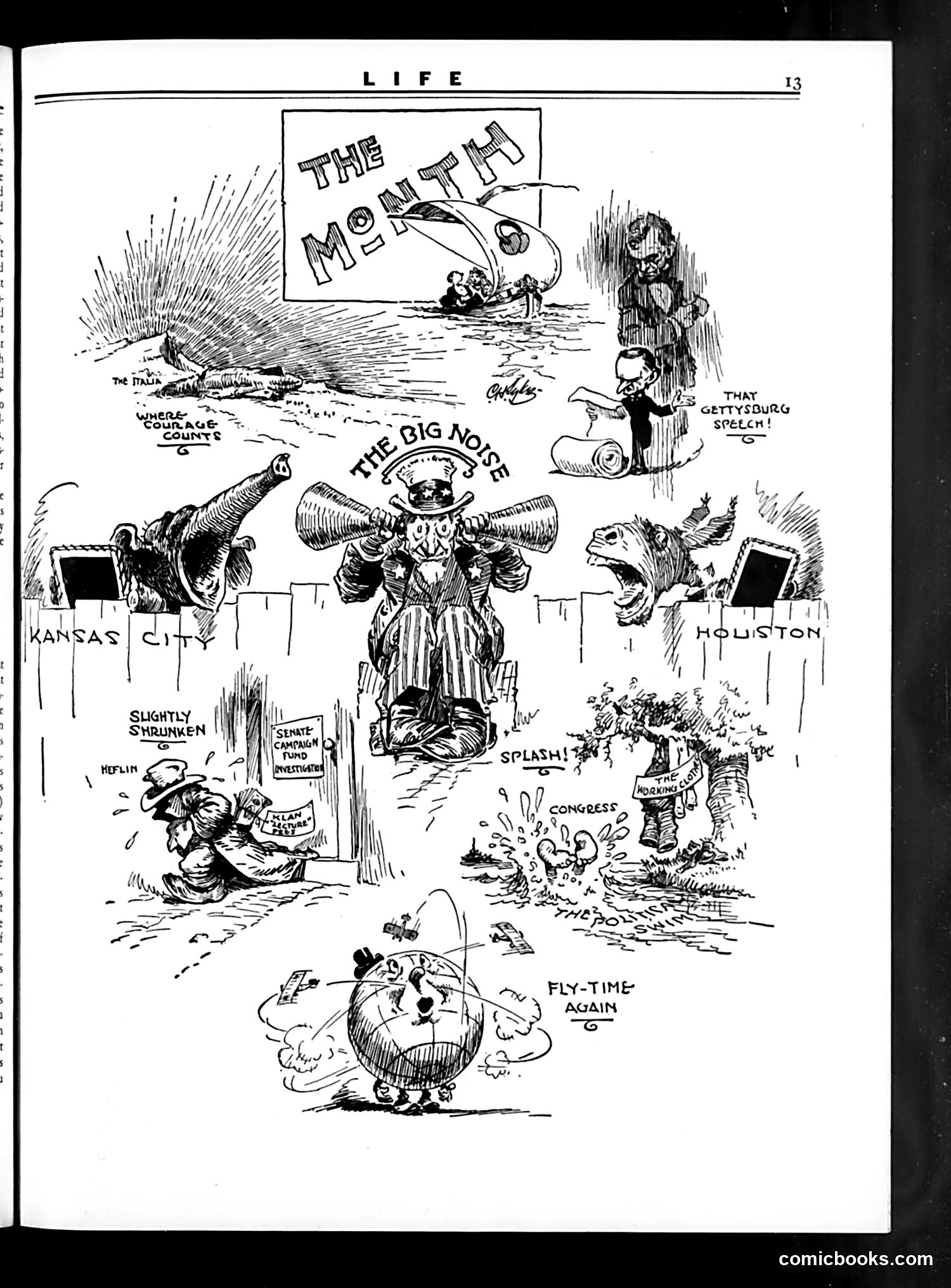
This satirical cartoon depicts American political and social figures being overwhelmed by "the big noise"—represented by a central figure with megaphones for ears, symbolizing deafening political clamor. The labeled figures being knocked down or affected include: - **Kansas City** and **Houston** (regional interests) - **Heflin** (likely Senator Thomas Heflin) - References to **Congress**, **Senate**, and **"Graft Fund"** - **"The Italians' Courage Courts"** and **"That Gettysburg Speech"** (historical references) The bottom panel shows "Fly-Time Again"—apparently suggesting these political disturbances are cyclical nuisances. The cartoon satirizes how political noise and corruption scandals overwhelm reasonable governance, with various constituencies and institutions rendered helpless by the chaotic din of American politics.
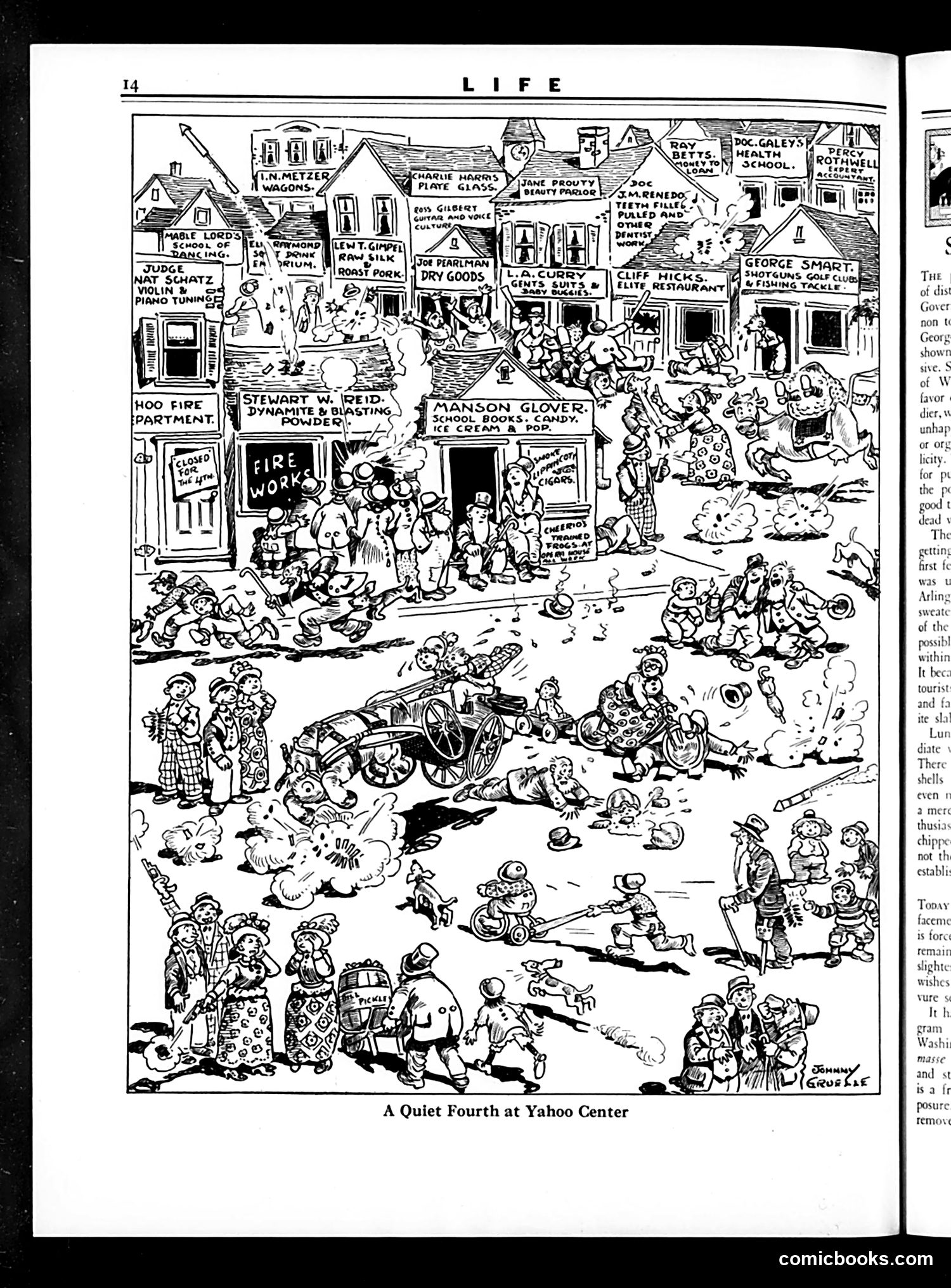
This is a satirical illustration depicting a chaotic Fourth of July celebration at what appears to be a public gathering space called "Yahoo Center." The cartoon is crowded with dozens of figures engaged in various activities—children playing with toys and firecrackers, adults socializing, vendors selling goods from storefronts visible in the background (including businesses like "Cliff's Elite Restaurant" and various shops). The title's ironic phrase "A Quiet Fourth" contrasts sharply with the visual pandemonium, where explosions, children running amok, and general disorder dominate the scene. The satire mocks the impossibility of a peaceful Independence Day celebration in an urban setting, capturing the noisy, uncontrolled nature of holiday festivities among the masses.
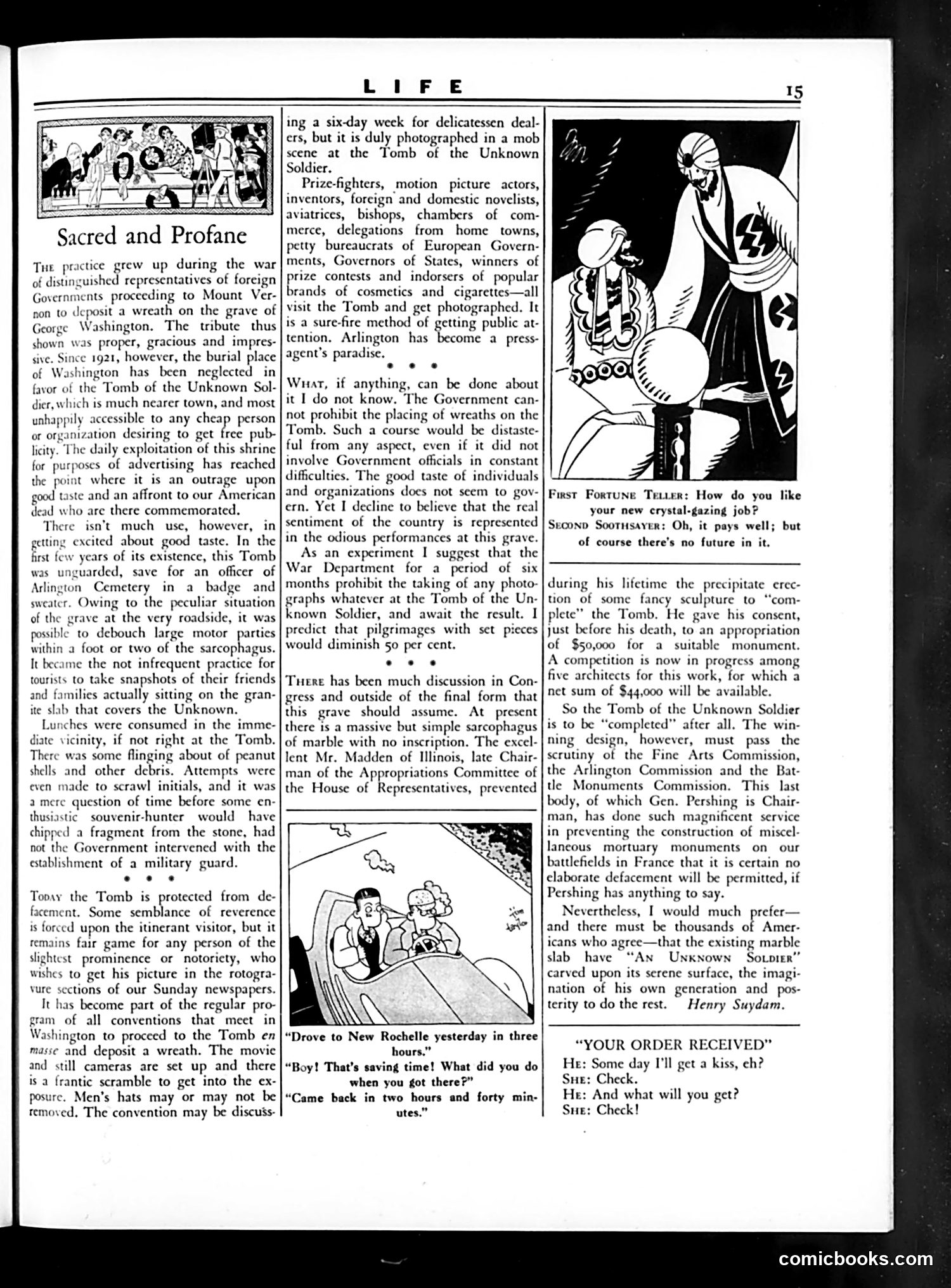
This page satirizes the commercialization of the Tomb of the Unknown Soldier in Arlington Cemetery. The main article criticizes how the burial site—intended as a solemn memorial—has become a tourist attraction exploited for publicity. The cartoon shows visitors being ushered through like a commercial operation, with one figure (appearing to be a promoter or guide) directing traffic. The satire targets: - Government officials and celebrities using the tomb for photo opportunities - Newspapers sensationalizing visits - The general degradation of the sacred space into entertainment The author suggests the War Department should ban photography at the tomb to preserve its dignity. The piece represents early-20th-century frustration with how commercialism and media were corrupting solemn national monuments.
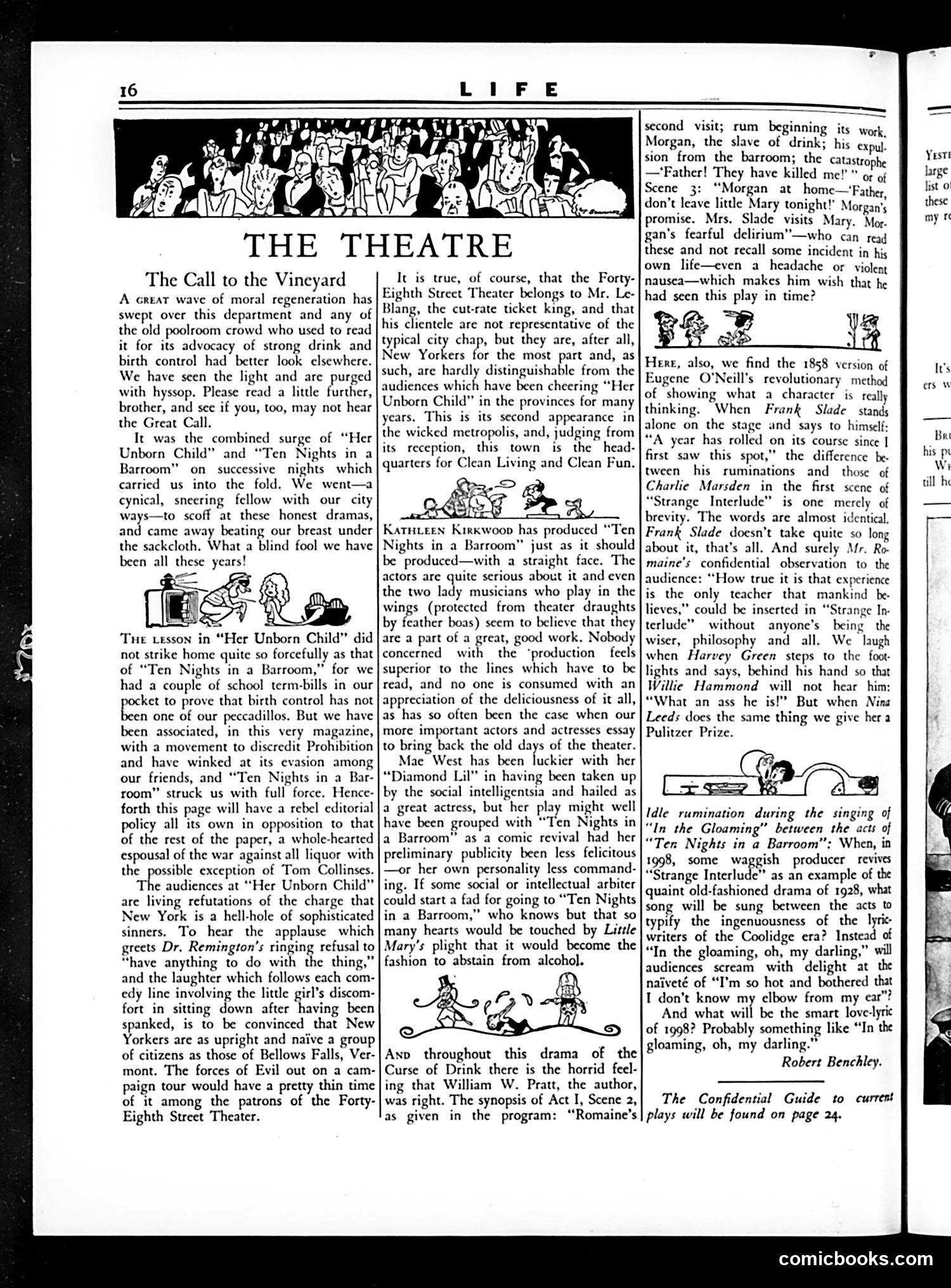
This is a theatre review page discussing Broadway productions. The main content critiques "The Call to the Vineyard" and praises "Her Unborn Child" and "Ten Nights in a Barroom," which the reviewer considers superior dramatic works. The cartoons appear to illustrate scenes from these plays—one shows a crowded theatre audience, another depicts what seems to be domestic drama with multiple figures. The text emphasizes these plays' advocacy for "birth control" and "strong drink" temperance, noting they represent honest drama with social messages. The reviewer contrasts them favorably against lighter theatrical fare typical of the Forty-Eighth Street Theatre crowd. The satire targets New York's sophisticated theatre-goers as "upright and naive," suggesting they underestimate serious drama's impact while overlooking its actual merit.
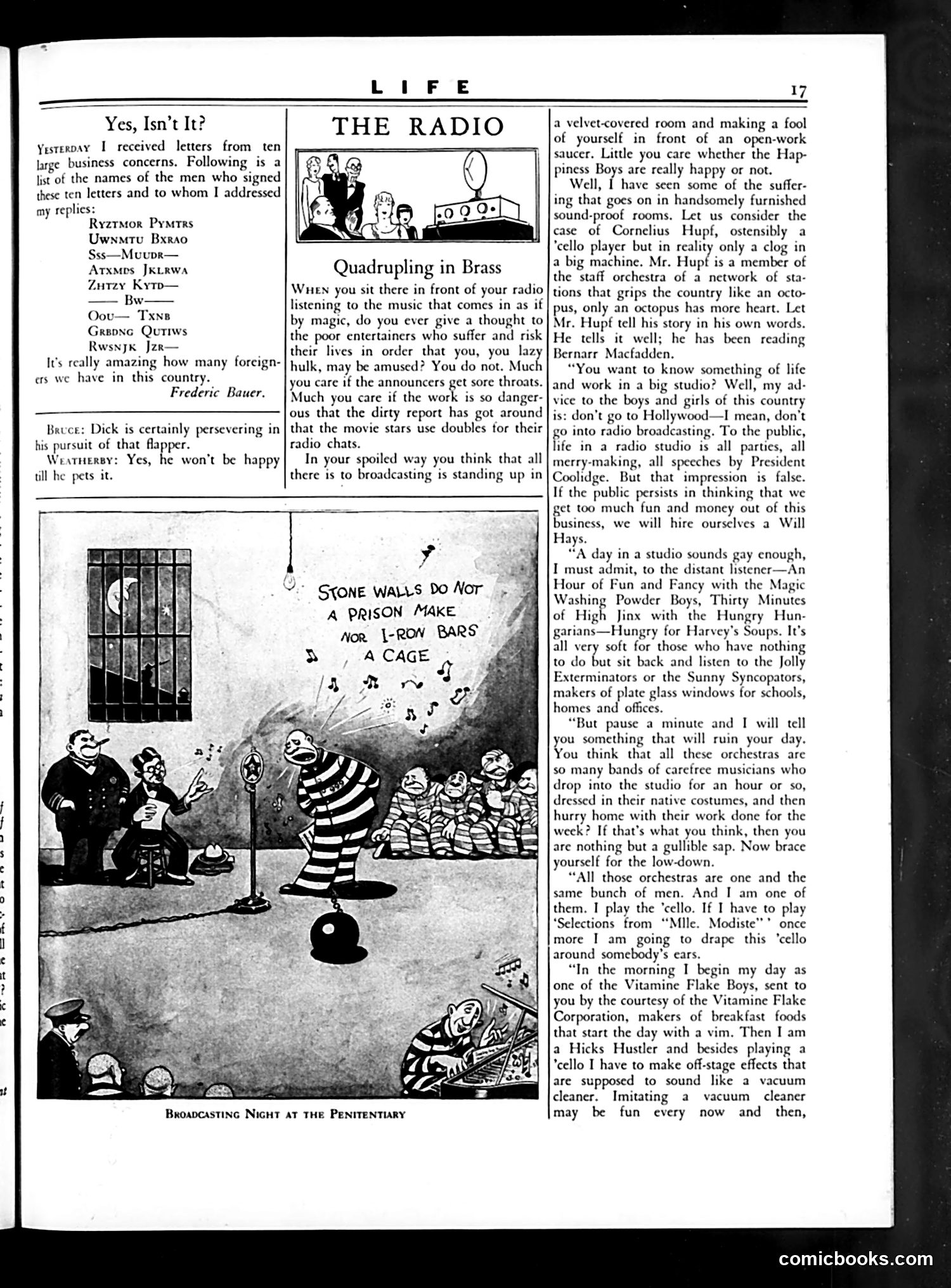
This cartoon satirizes early radio broadcasting by depicting a prison concert performance. Inmates in striped uniforms perform music while guards and prisoners listen, with the caption joking that "stone walls do not a prison make, nor iron bars a cage." The satire appears to mock two things: (1) the novelty and appeal of radio as entertainment that could reach anywhere, even prisons, and (2) the quality of radio orchestras—the text alongside discusses how radio "orchestras are one and the same bunch of men" who perform generic music. The joke suggests that radio performance, like imprisonment, confines both entertainer and audience to an artificial, somewhat absurd experience. The cartoon ironically presents prisoners as the perfect captive audience for mediocre broadcast entertainment.
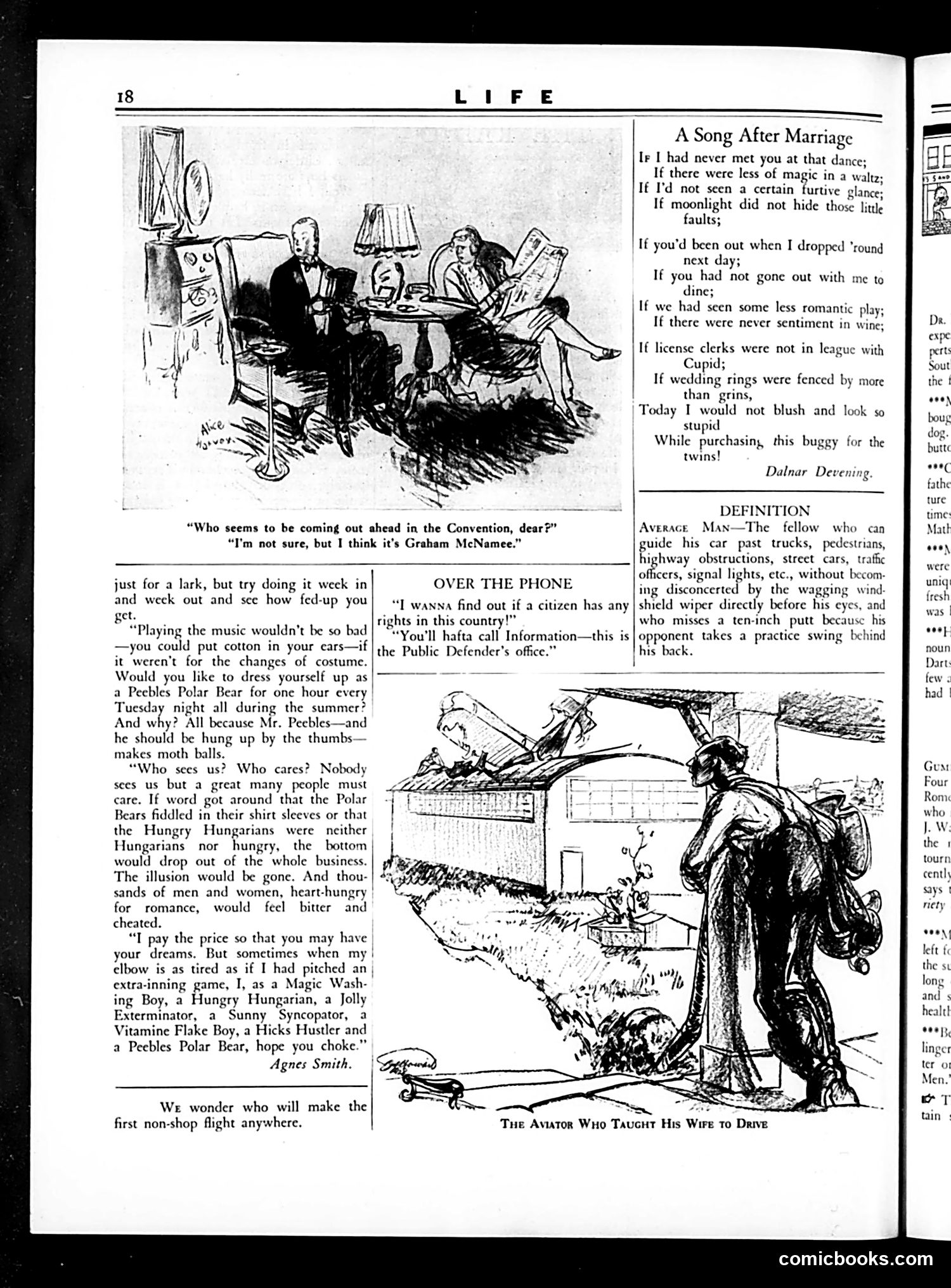
**Top Cartoon**: References a political convention (likely 1920s-era). The joke is that Graham McNamee—a famous radio broadcaster of the era—is "coming out ahead" because he's the only one the public hears about through radio coverage. Radio was still novel; the satire suggests media personality dominates actual political substance. **"Over the Phone" Joke**: A citizen calls the Public Defender's office demanding to know their rights, but gets transferred to "Information" (directory assistance). The satire mocks bureaucratic runaround and the Public Defender's office as unhelpful. **"A Song After Marriage"**: Sentimental parody listing romantic factors that led to marriage, ending with the deflating reality: now they're buying a buggy (baby carriage) for twins. It satirizes how marriage transforms from romance to domestic mundanity. **"Average Man" Definition**: Humorous definition of an ordinary man as someone navigating urban hazards (traffic, pedestrians) successfully, yet failing at golf when distracted—poking fun at masculine pride and minor defeats. All reflect 1920s urban American life and media culture.
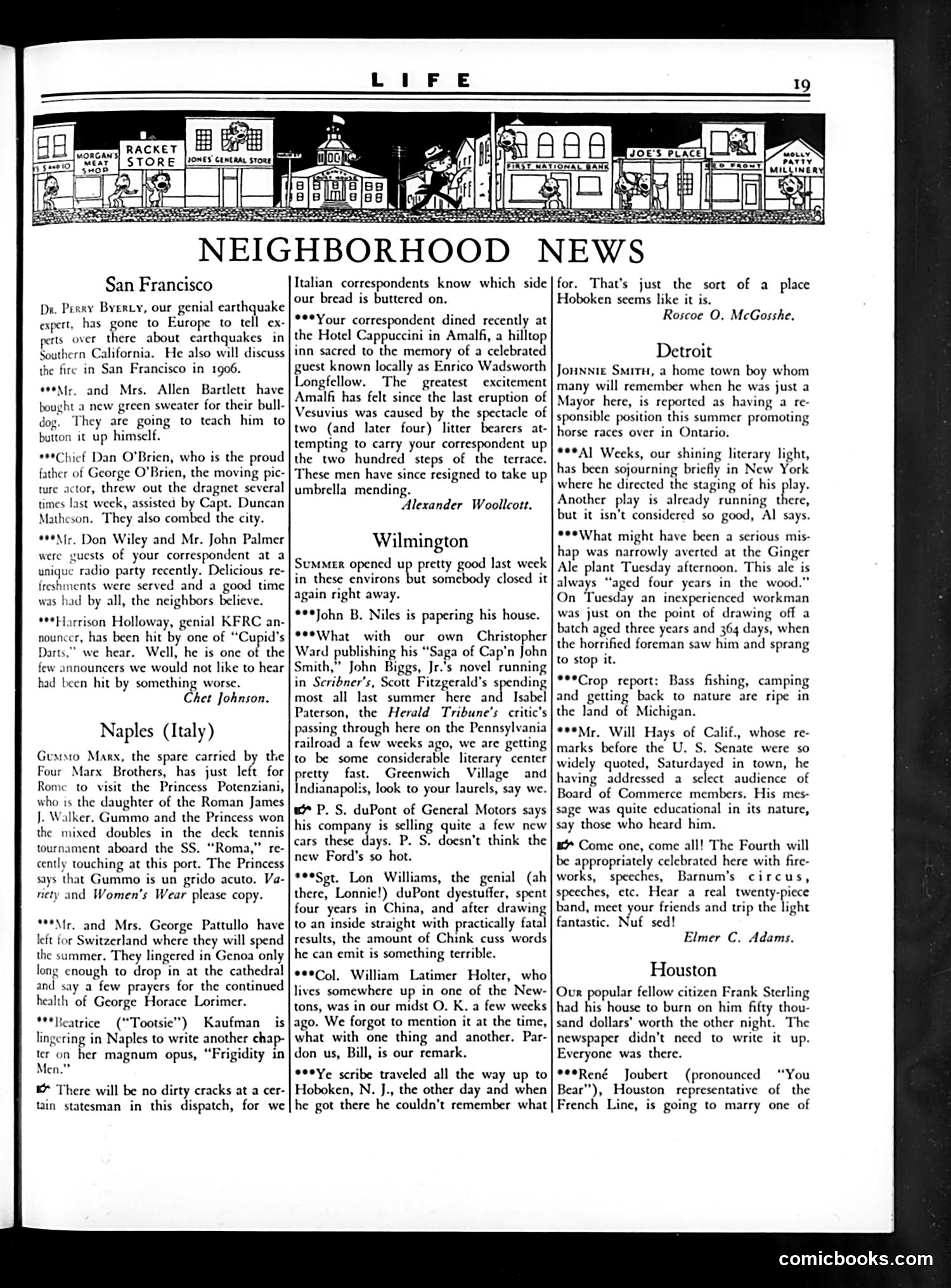
This is a **gossip and humor column** from *Life* magazine, not a political cartoon page. It consists of brief, witty dispatches from various cities reporting on local personalities and happenings. The humor relies on **gentle social satire and inside jokes**: - **San Francisco**: A bulldog learning to button its own sweater; Cupid's arrow striking a radio announcer deemed fortunate to be spared worse fates. - **Naples**: Gummo Marx (of the Marx Brothers comedy team) visiting Italy; a female writer finishing her book titled "Frigidity in Men"; a humorous anecdote about Italian porters struggling to carry a correspondent up 200 steps, then quitting to "take up umbrella mending." - **Wilmington**: Local literary figures (Scott Fitzgerald, John Biggs Jr.) making the town a cultural center; a soldier who learned creative cursing in China; automobile industry gossip. The tone is affectionate mockery of small-town life and celebrities. No deep political satire—just light entertainment for readers interested in celebrity gossip and local color.
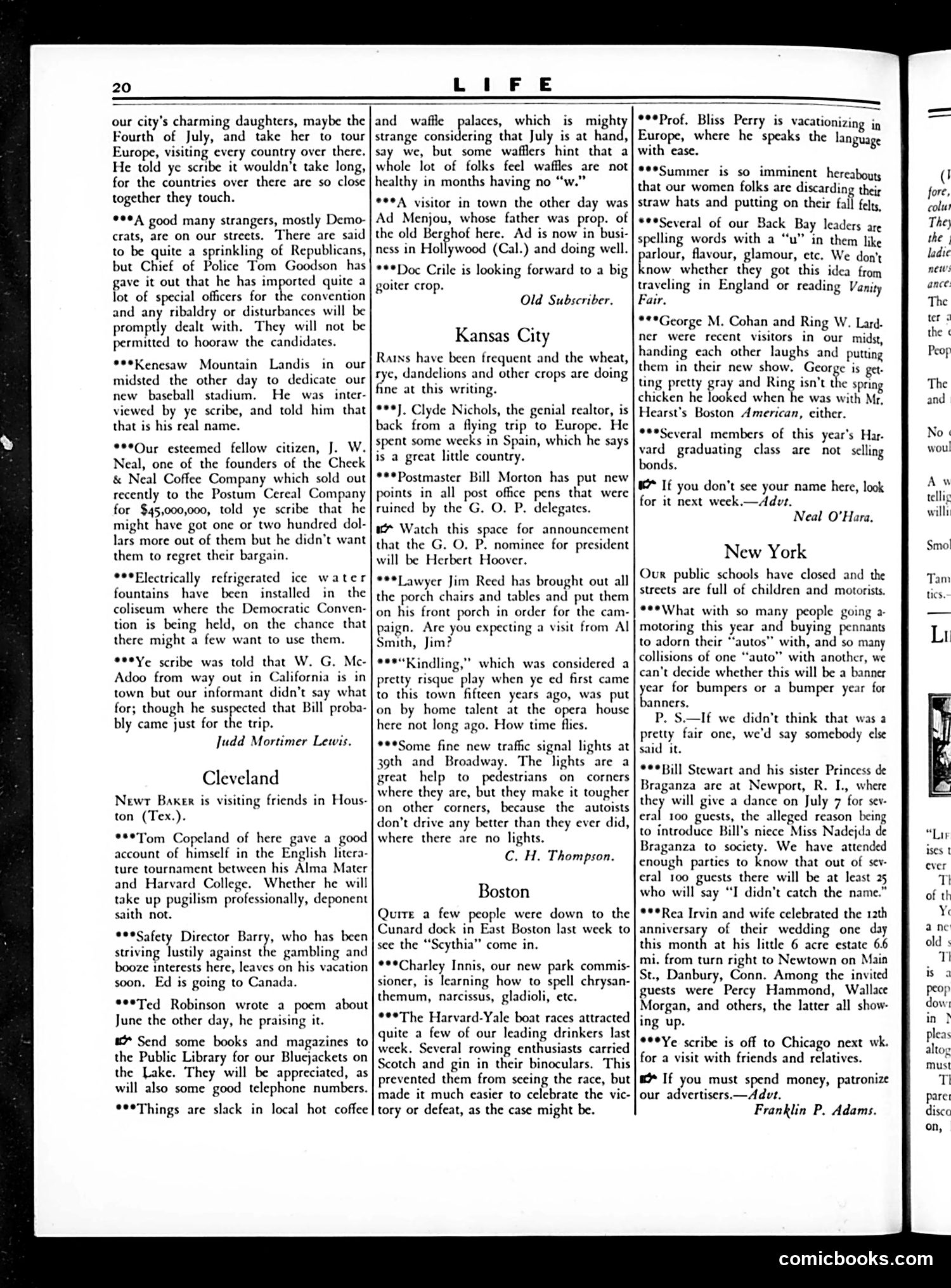
This page from Life magazine consists primarily of **gossip columns** organized by city (Kansas City, Cleveland, New York, Boston), not political cartoons. The content is satirical social commentary typical of Life's format. **Key satirical points:** - **Democratic Convention references**: Jabs at political disorder, with police importing "special officers" to prevent disruption by Democrats and Republicans alike - **Prohibition-era jokes**: Quips about "waffles" (code for alcohol, since "waffle" contains "w") being unhealthy in months without "w" - **Political figures mocked**: W.G. McAdoo's mysterious visit from California; Herbert Hoover's expected presidential nomination - **Local celebrity gossip**: Actor Adolphe Menjou's father's old restaurant; baseball commissioner Kenesaw Mountain Landis - **Commercial satire**: A $45 million coffee company sale, refrigerated fountains at the convention The tone is playful small-town mockery mixed with national political observation, characteristic of Life's satirical approach in the 1920s.
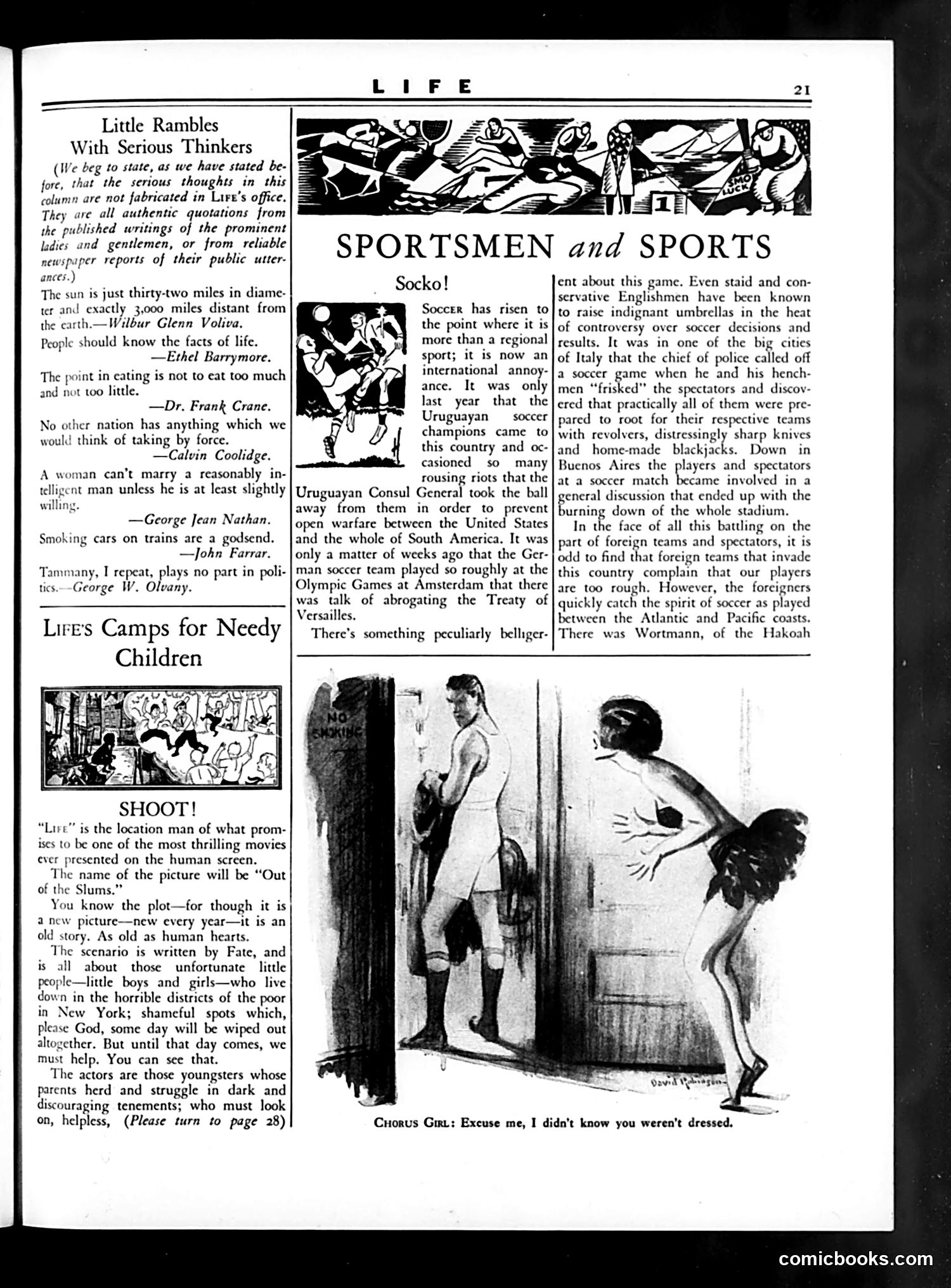
This page contains three distinct sections: **"Little Rambles with Serious Thinkers"** is Life's satire of public figures' often-absurd statements. The quotes—ranging from Wilbur Glenn Voliva's bizarre claim that the sun is 3,000 miles away to Calvin Coolidge's platitude about eating—mock the nonsensical pronouncements celebrities and politicians make that get treated as wisdom. **"Life's Camps for Needy Children"** promotes a charitable film called "Out of the Slums," depicting poor New York children in tenements. This reflects 1920s Progressive Era concern for urban poverty. **"Socko!"** satirizes soccer's violent international reputation. The article humorously describes how the Uruguayan team caused riots, the German team played dangerously at the Olympics, and Italian spectators brought guns and knives to matches. The joke: foreign teams complain American players are "too rough"—ironic given soccer's actual brutality abroad. The bottom cartoon shows a woman surprised to encounter an undressed chorus girl, a mild joke about backstage theater propriety.
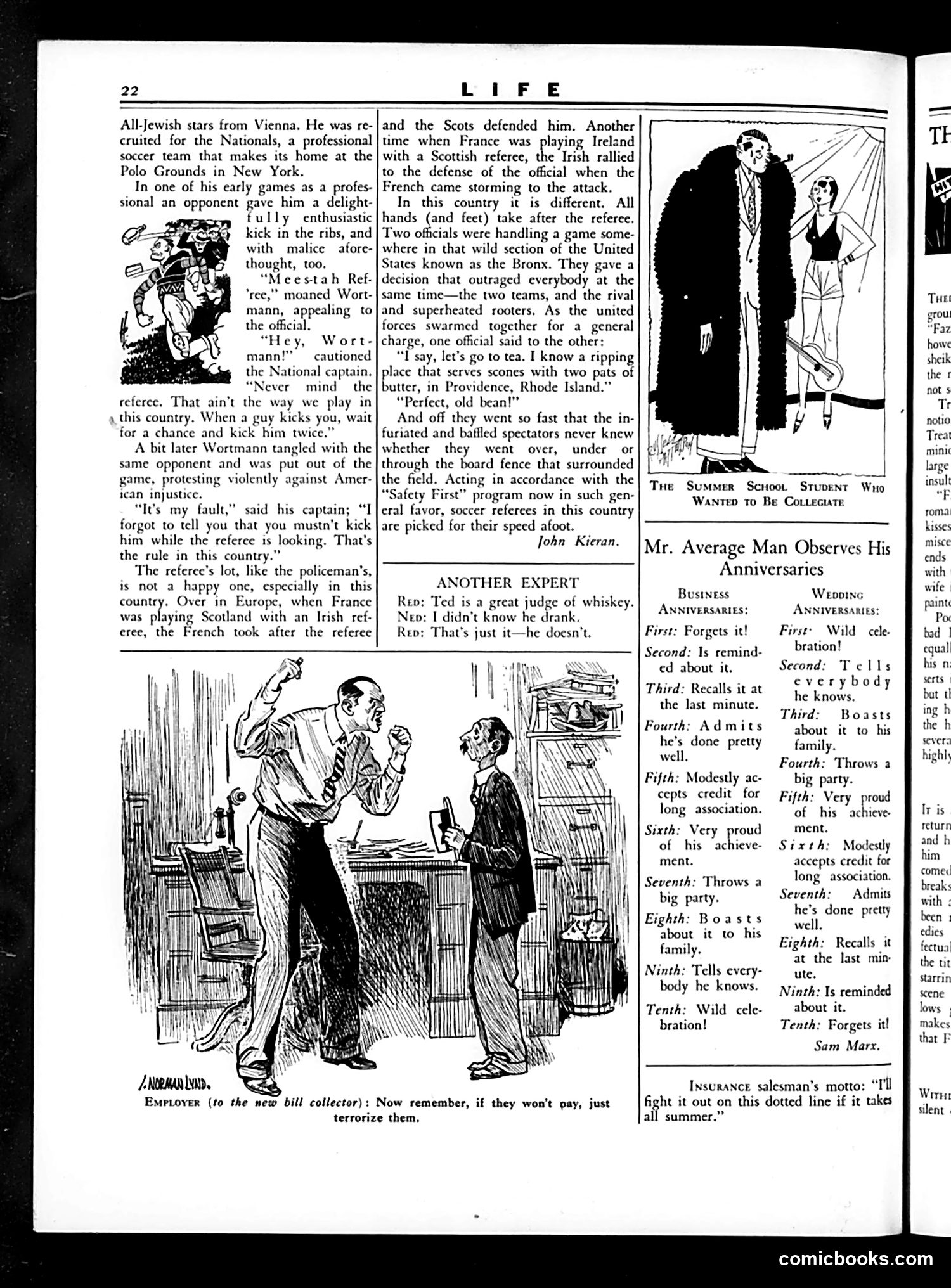
This page contains satirical commentary on soccer/football referees and sports conduct in America versus Europe. **The Main Article (by John Kieran):** Discusses Wortmann, an Austrian Jewish soccer player recruited for the Nationals team in New York. The satire contrasts European and American sports behavior: European fans will defend referees from opposing teams' attacks, showing some civility. American fans and players, however, indiscriminately attack referees regardless of which team they favor. The joke concludes that American soccer referees must be hired for their speed, as they literally flee the field after unpopular decisions. **The Cartoon (bottom left):** Shows an employer instructing a new bill collector to "terrorize" delinquent customers if they won't pay—satirizing harsh debt collection practices. **"Mr. Average Man Observes His Anniversaries":** A humorous comparison of how business and wedding anniversaries are handled oppositely—business anniversaries start forgotten and build to celebration, while wedding anniversaries reverse: enthusiastic at first, then progressively forgotten. The overall tone mocks American rowdiness and poor sportsmanship compared to European standards.
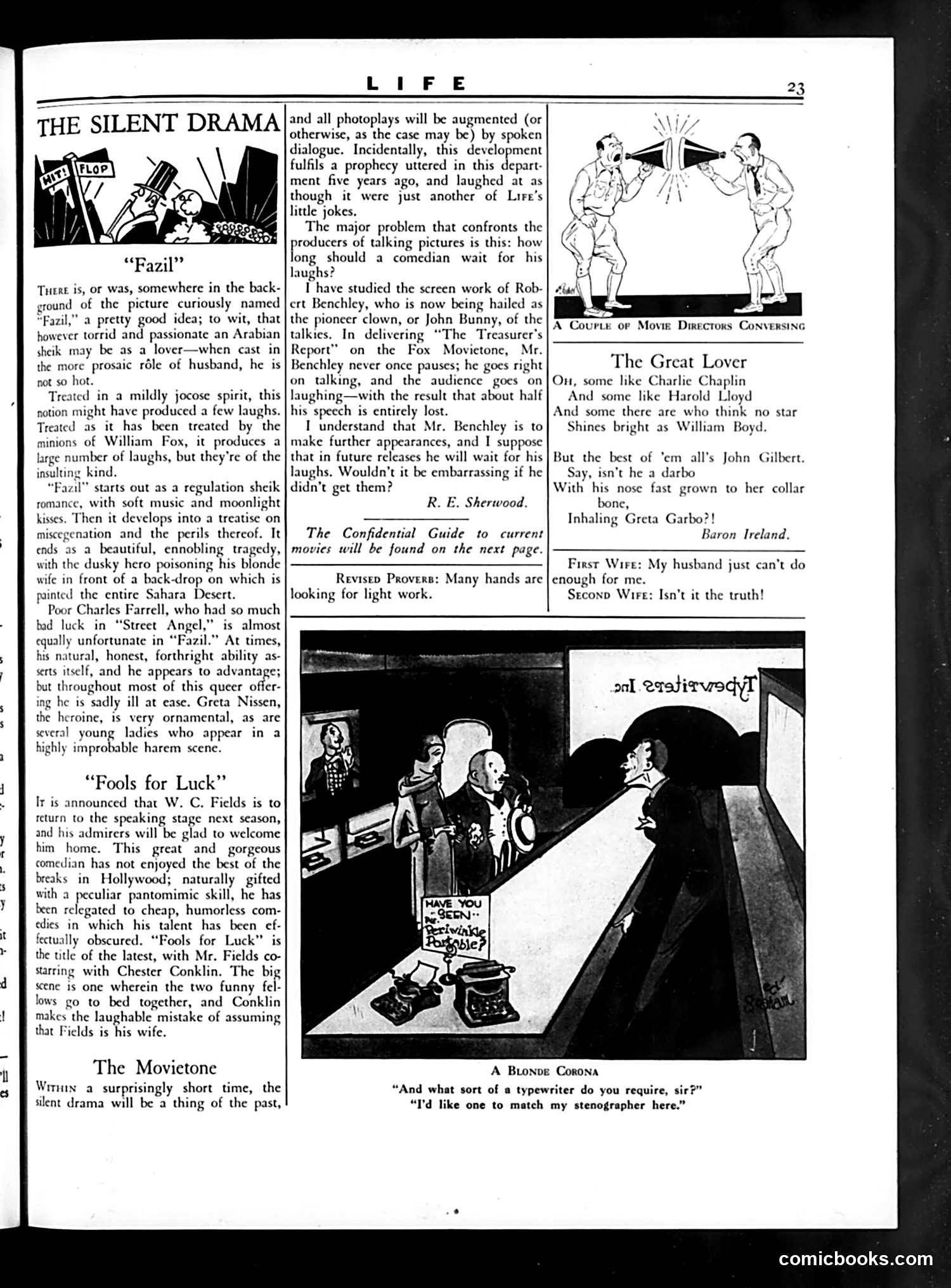
This page reviews three silent films from the late 1920s. **"Fazil"** stars Charles Farrell and Greta Nissen. The critic mocks the film's treatment of a romance between an Arabian sheik and a blonde woman, condemning its exploration of miscegenation as offensive rather than humorous. The plot culminates in the sheik poisoning his wife—presented as tragic but apparently absurd to the reviewer. **"Fools for Luck"** features W.C. Fields and Chester Conklin in a bedroom scene where Conklin mistakes Fields for his wife—a crude joke. The critic notes Fields' talent has been wasted in poor Hollywood comedies. **"The Movietone"** discusses the coming transition to talking pictures, citing Robert Benchley's pioneering comedy shorts. The writer questions whether comedians in talkies should pause for audience laughter—a practical concern as sound film technology was revolutionizing cinema. The cartoons and jokes throughout reflect 1920s attitudes toward gender, ethnicity, and emerging media technology.
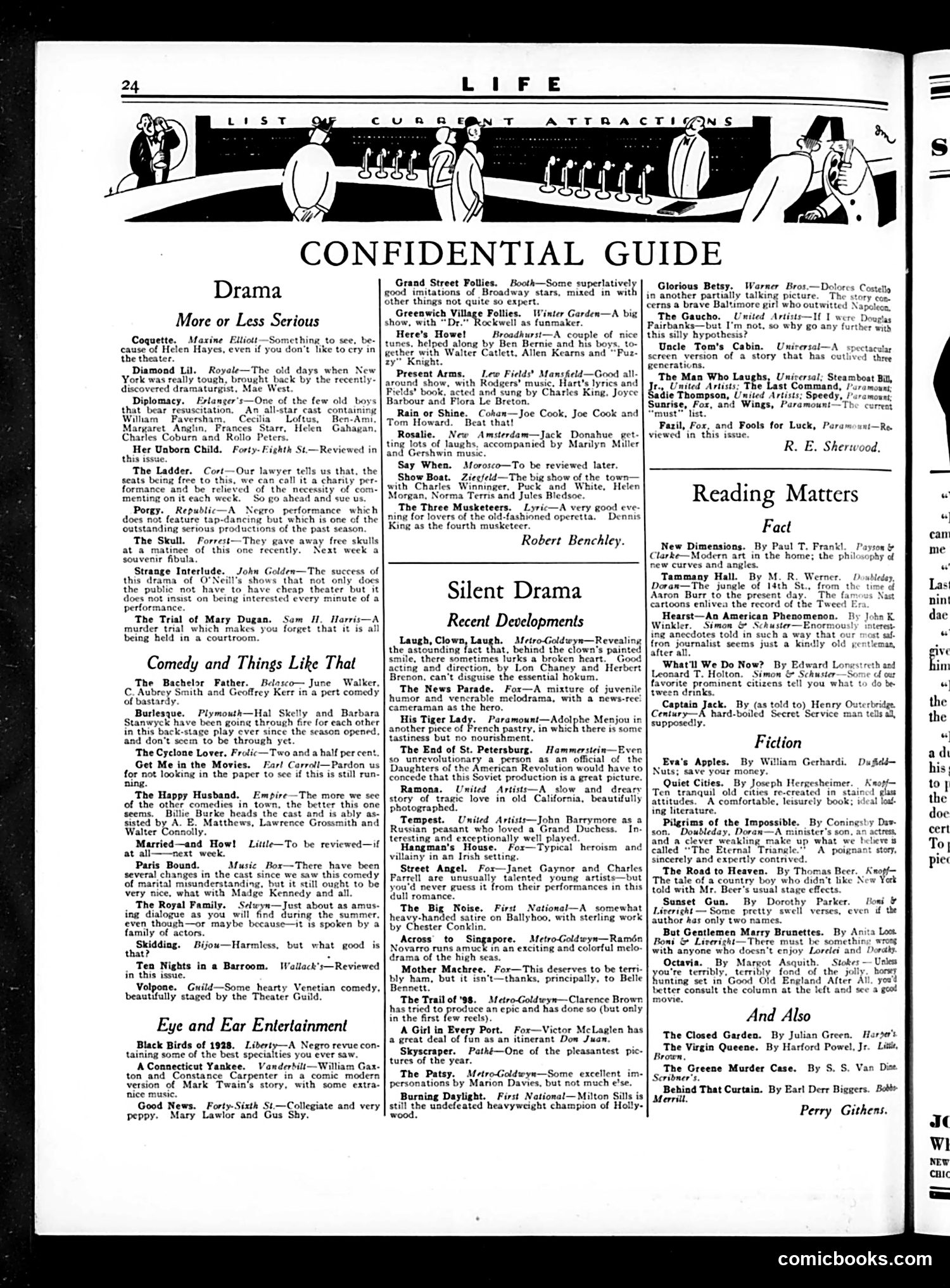
This page is a **theater review guide** from Life magazine's "Confidential Guide" section, not a political cartoon. It catalogs current Broadway productions circa late 1920s, organized by genre (serious drama, comedy, musical entertainment). The reviews are brief, witty assessments targeting sophisticated urban readers. Notable entries include Mae West's "Diamond Lil" (referencing her recent notoriety), O'Neill's "Strange Interlude" (praised for its intellectual ambition), and the all-Black production "Porgy" (distinguished as serious theater rather than tap-dancing entertainment—a notable distinction for that era). The tone is sardonic throughout: "The Ladder" gets a joke about free seating as charity; "The Trial of Mary Dugan" is praised for making courtroom drama engaging; various comedies are assessed by comparison. This reflects 1920s New York theater culture and Life's role as arbiter of sophisticated taste for educated audiences.
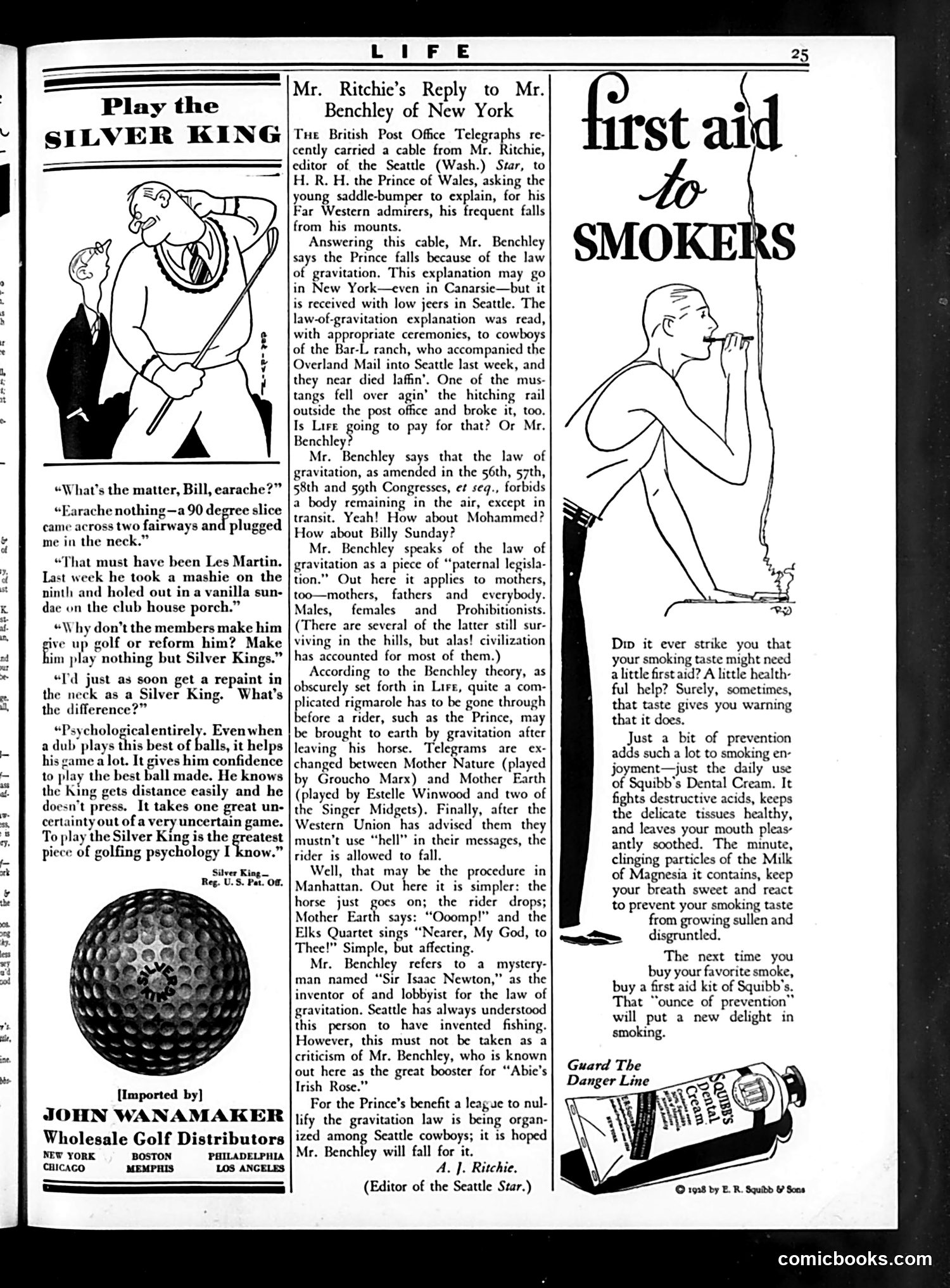
This page contains two separate pieces of satirical content: **"Play the Silver King"** (left): A golf equipment advertisement disguised as humorous dialogue. Two golfers discuss why players should use "Silver King" golf balls, arguing that using premium balls provides psychological confidence that improves performance—even if the balls themselves aren't objectively better. This is satirizing marketing psychology and consumer gullibility. **"Mr. Ritchie's Reply to Mr. Benchley"** (center/right): A humorous feud between two magazine editors about the Prince of Wales's frequent horseback riding falls. One editor (Benchley) seriously explained the falls using the law of gravitation; the other (Ritchie, from Seattle) sarcastically mocks this "Eastern" explanation as overcomplicated, contrasting it with how straightforward and matter-of-fact Westerners view such accidents. The satire targets East Coast pretension versus Western practicality, with references to contemporary figures like Groucho Marx and Billy Sunday adding topical humor.
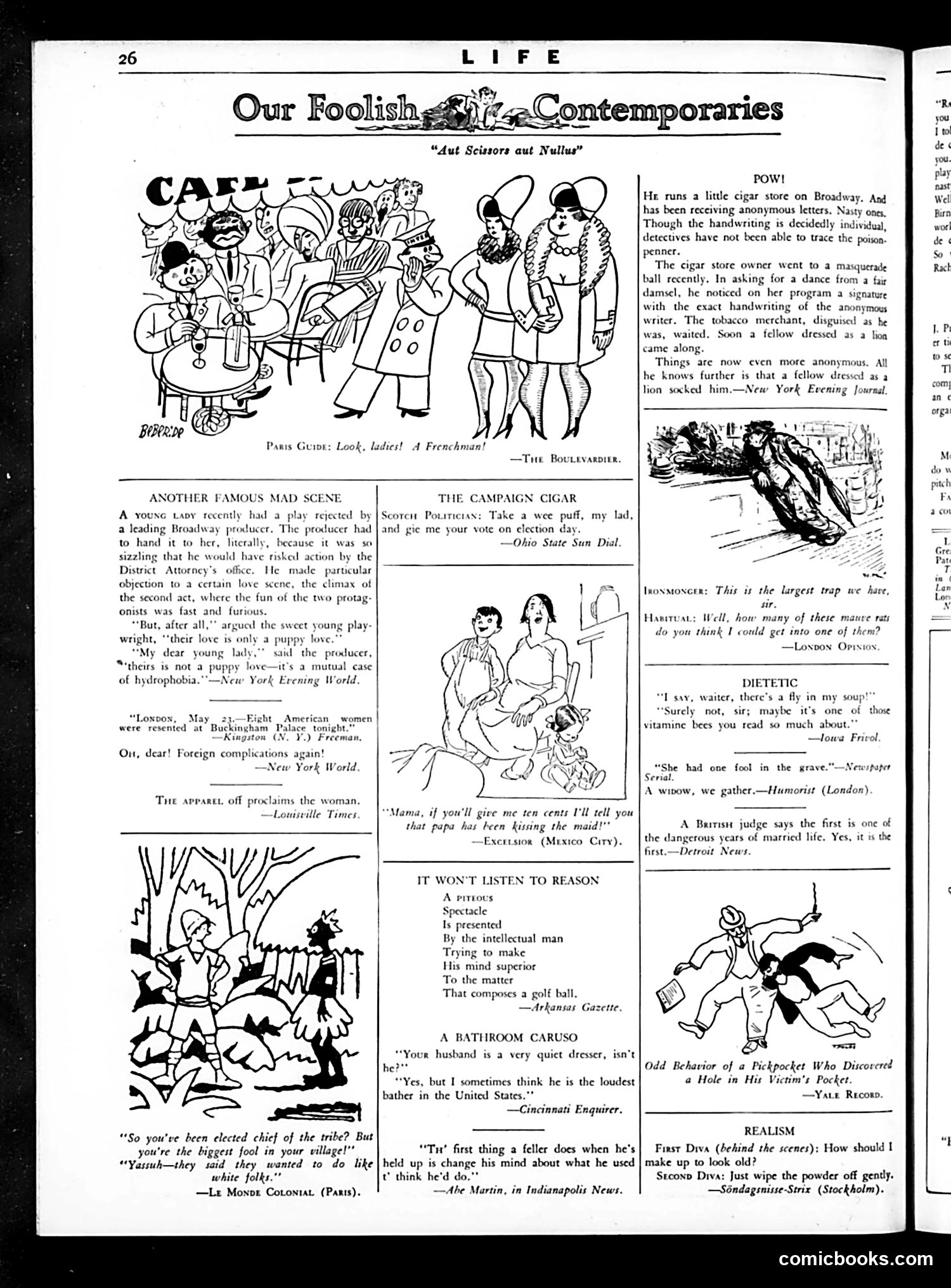
This is a humor page from *Life* magazine featuring brief jokes and satirical cartoons on various social topics. Key items: **"Paris Guide"** (top): A French observer mocks American tourists, suggesting xenophobic humor about foreigners visiting Paris. **"The Campaign Cigar"**: Political satire about vote-buying—a Scottish politician offers cigars in exchange for votes, mocking election corruption. **"Another Famous Mad Scene"**: Broadway theater satire about a female playwright whose love scene is deemed too sexually explicit for authorities to allow. **"It Won't Listen to Reason"**: Absurdist commentary on intellectuals trying to prove superiority over a golf ball. **Other items**: Domestic humor about bathing noise, bathroom traps for mice, and racial dialect jokes (the "Yassuh" item uses period-appropriate but now-offensive racial stereotyping). The page reflects 1920s-era concerns: political corruption, theatrical censorship, gender dynamics, and casual ethnic/racial mockery typical of the era's mainstream humor publications.
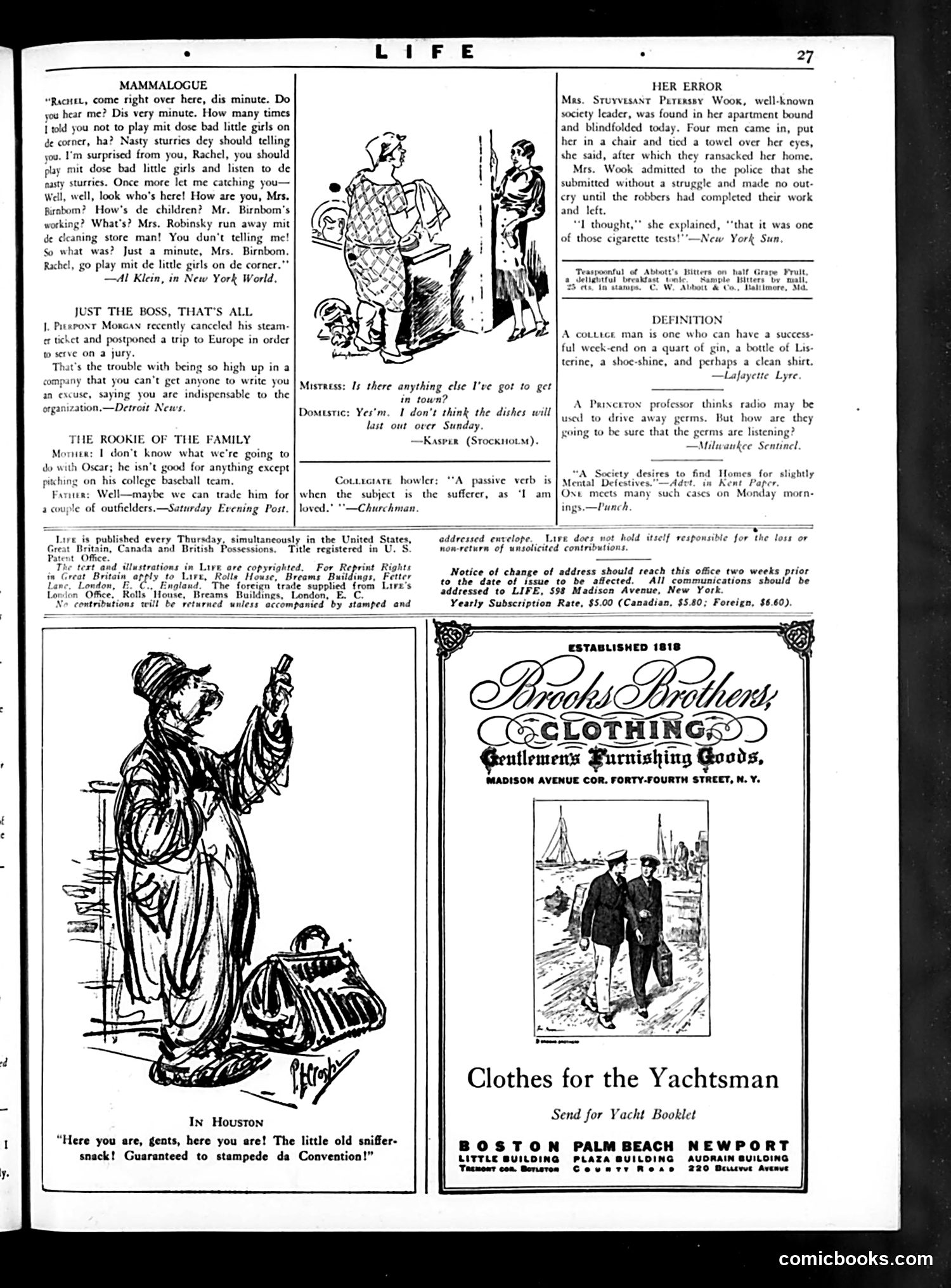
This page contains several brief satirical pieces typical of Life's humor format: **"Mammalogue"** depicts a Jewish immigrant mother (identifiable by dialect and name) scolding her daughter Rachel for playing with "bad little girls" and hearing "nasty stories," then immediately contradicting herself by sending Rachel back to play with them. The satire mocks parental hypocrisy and anxiety. **"Just the Boss, That's All"** jokes about an executive so indispensable he cannot escape jury duty—satirizing corporate self-importance. **"The Rookie of the Family"** mocks parents who see their son's only value as a baseball player, worth trading like a commodity. **"Her Error"** reports a society lady (Mrs. Stuyvesant Pearsay Wood) robbed in her home, who thought the intruders were conducting a "cigarette test"—likely a reference to contemporary advertising claims about cigarette quality. The humor lies in her comical misidentification. The page also contains advertisements and miscellaneous jokes about college life and definitions. The content reflects early 20th-century American humor, class attitudes, and period concerns.
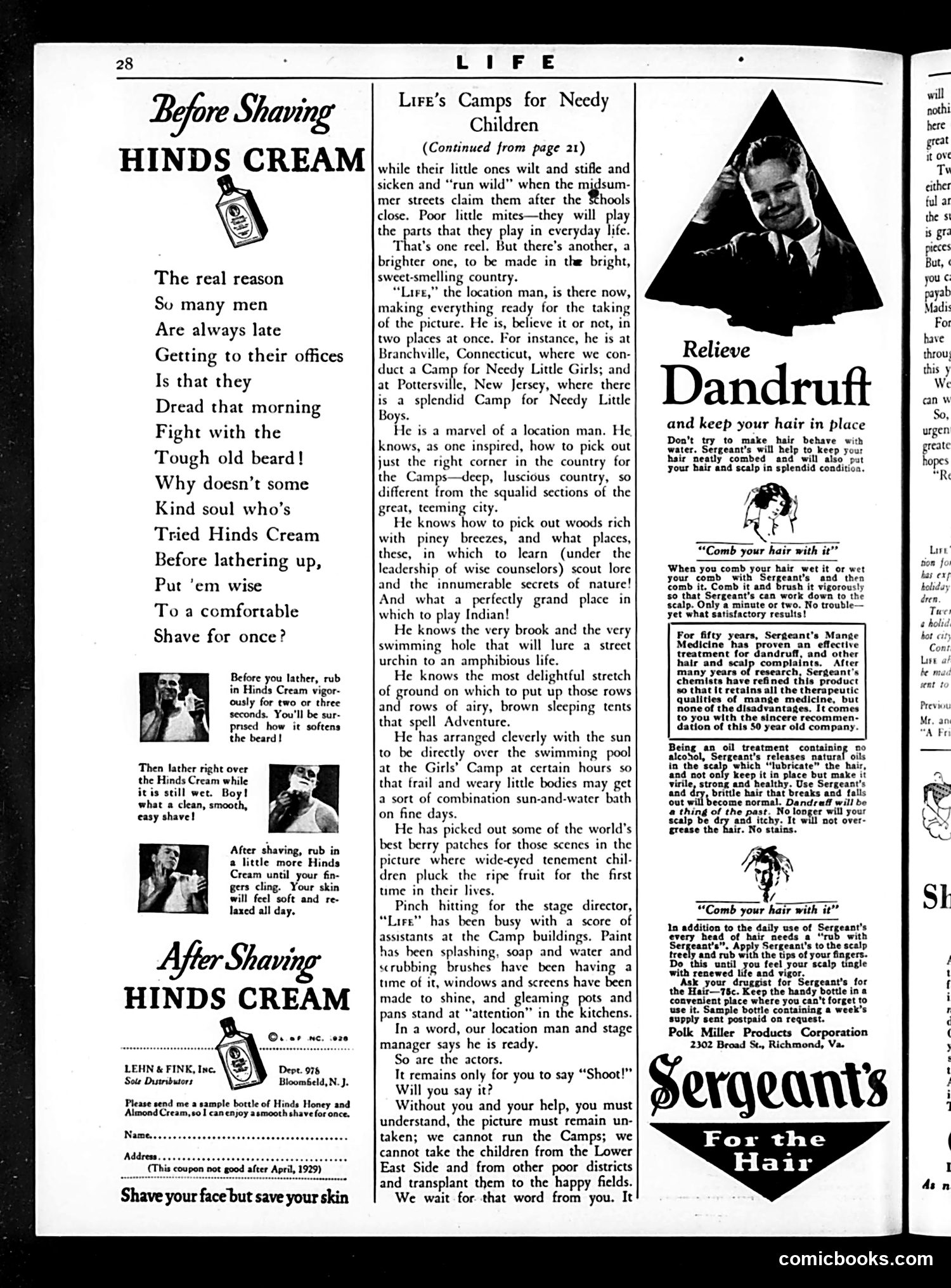
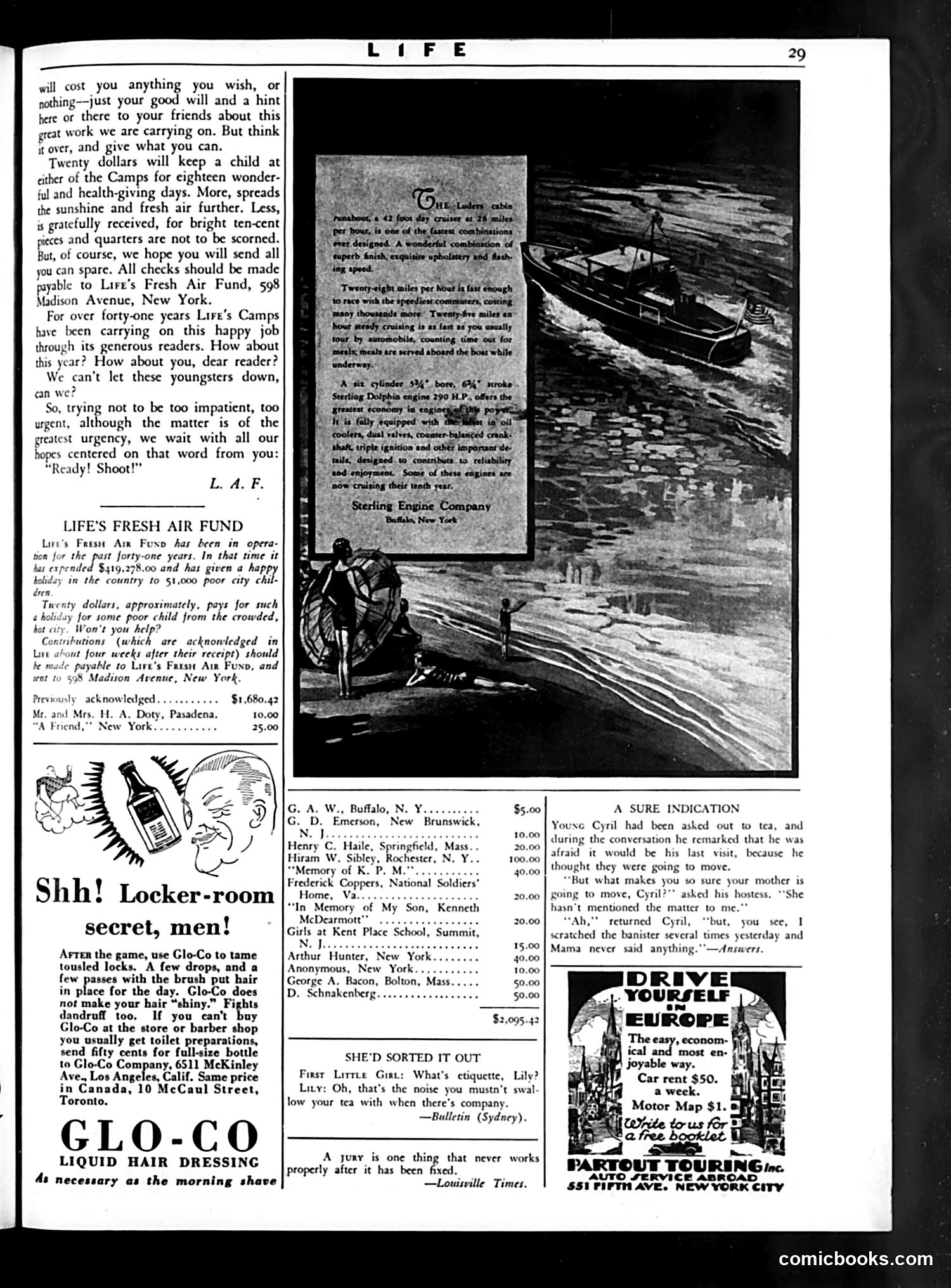
This page is primarily **advertising and charitable fundraising**, not political satire. The dominant content is **Life's Fresh Air Fund**, a 41-year-old charity that had distributed $419,278 to send 51,000 poor city children to camps. The appeal urges readers to donate (twenty dollars funds an 18-day camp stay). This reflects early 20th-century Progressive Era philanthropy addressing urban poverty. Secondary content includes: - **Three humor snippets** with no political content: jokes about etiquette, jury duty, and a child's logic about moving - **Glo-Co hair dressing advertisement** with a "locker-room secret" angle - **Partout Touring car rental ad** for European travel The single **cartoon image** (upper right) shows what appears to be a speedboat or racing vessel with advertising copy about Sterling Dolphin engines—commercial promotional material. The page reflects 1920s-30s American magazine culture: charity appeals, genteel humor, and lifestyle advertising targeting middle-class readers.
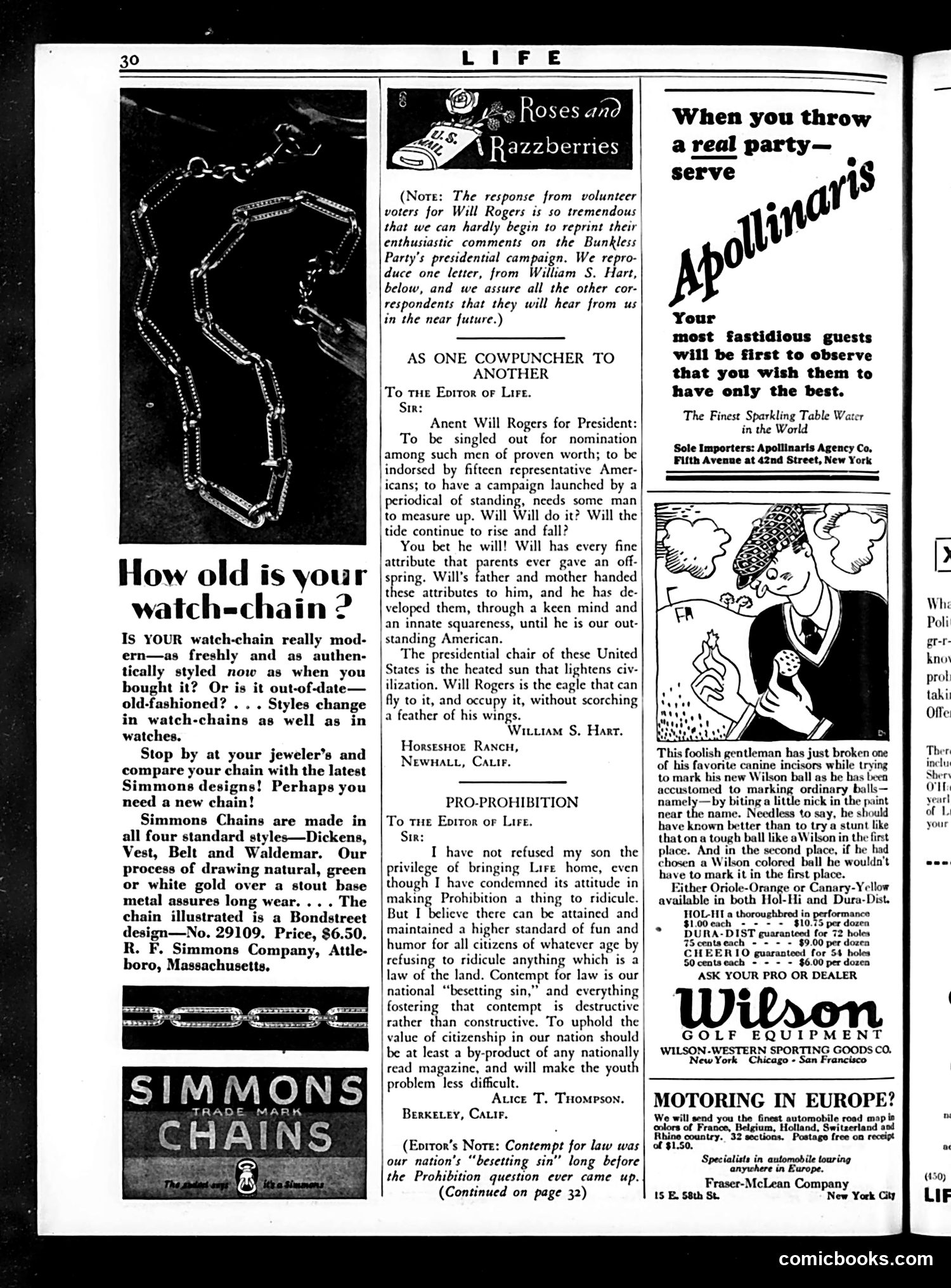
This page mixes advertisements with reader correspondence about a "Bunkless Party" presidential campaign endorsing humorist **Will Rogers for President**—an apparent satirical promotion by Life magazine. **The Political Content:** Actor-cowboy **William S. Hart** endorses Rogers in folksy terms, calling him an "eagle" fit for the presidency. This reflects 1920s sentiment that celebrities and entertainers represented authentic American values against corrupt politics. **The Social Satire:** Two letters follow. The pro-Rogers letter celebrates Rogers's character; a contrasting pro-Prohibition letter criticizes Life for ridiculing Prohibition laws, arguing magazines should uphold civic respect for law. The editor's footnote dismissively counters that contempt for law predates Prohibition—revealing Life's libertarian stance against the recently-enacted 18th Amendment. **The Ads:** Simmons watch chains, Apollinaris sparkling water, and Wilson sporting goods fill remaining space—typical period advertising unrelated to the editorial content. The page exemplifies Life's satirical approach: using celebrity endorsements and reader debate to mock both political earnestness and moral reformism.
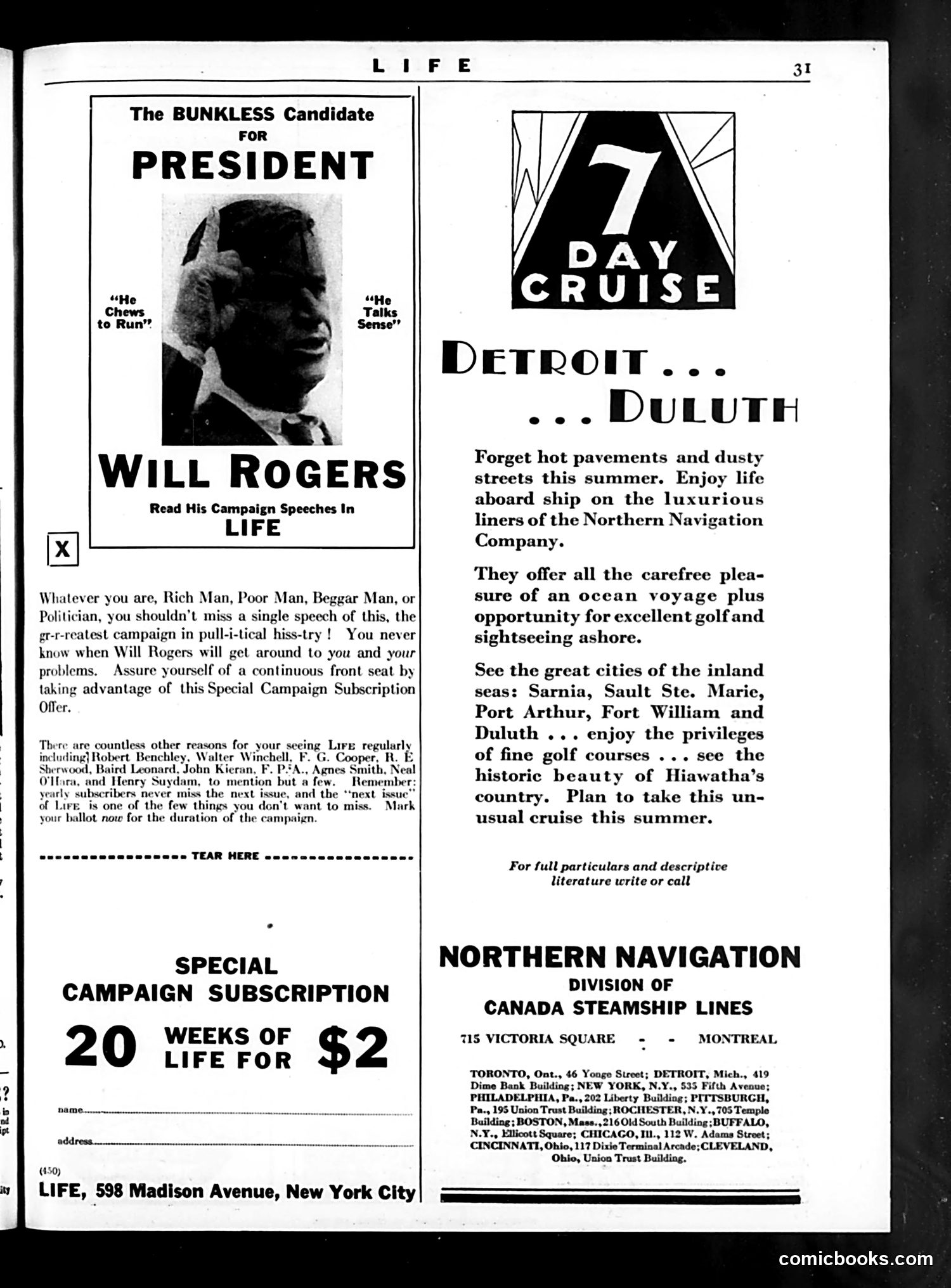
This satirical advertisement promotes a subscription to *Life* magazine by positioning humorist **Will Rogers** as a mock presidential candidate. The humor plays on Rogers' reputation as a political commentator who made sharp observations about American politics and politicians through his comedy routines and newspaper columns. The "bunkless" title is a pun—suggesting Rogers speaks plainly without political "bunk" (nonsense). The advertisement promises readers won't miss his "campaign speeches," which actually refers to his satirical commentary published in *Life*. The joke implies Rogers would make a more honest candidate than actual politicians, appealing to readers' cynicism about conventional politics. The page also contains an unrelated cruise advertisement, suggesting this is a magazine spread mixing editorial content with paid ads.
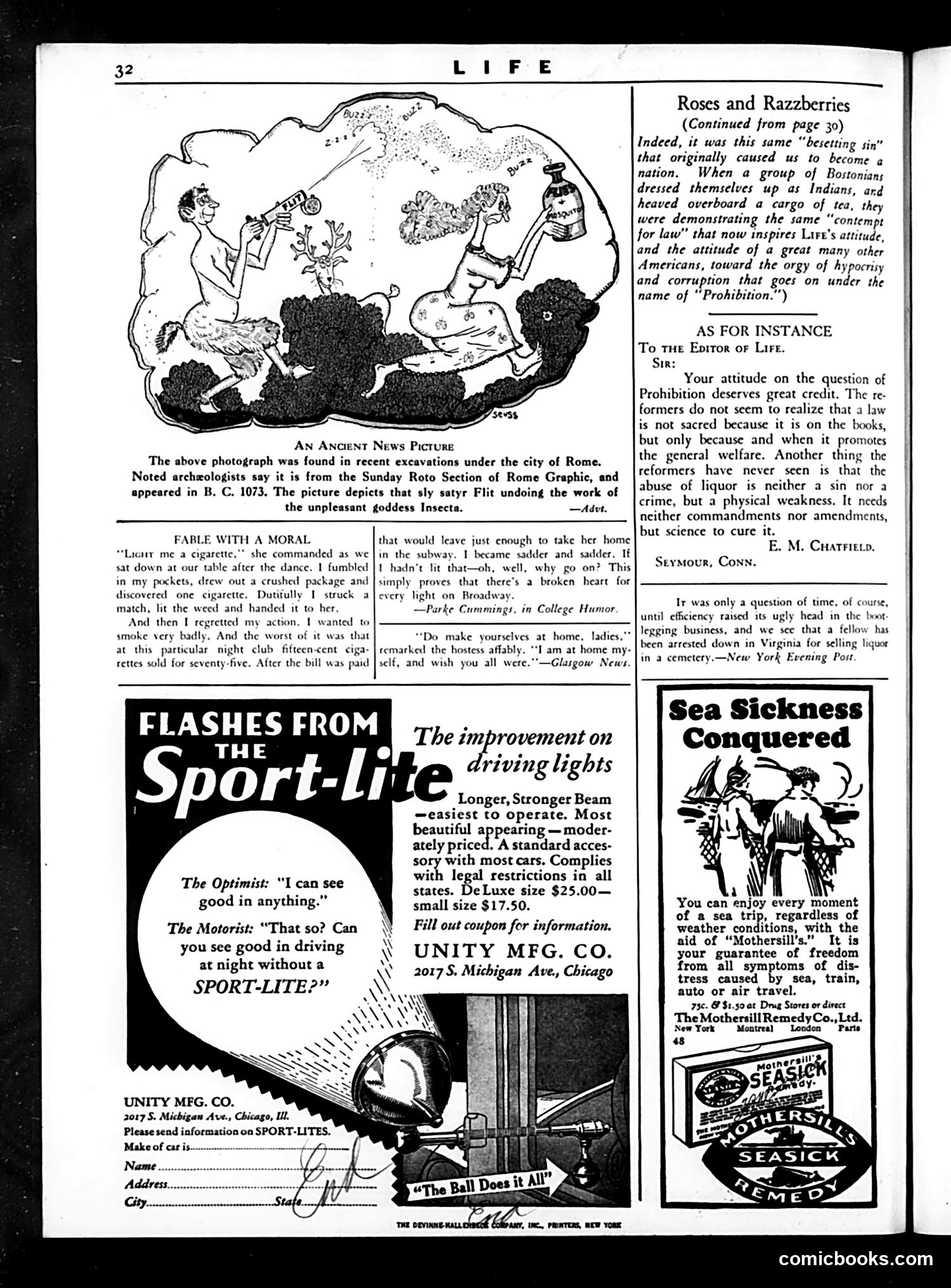
This Life magazine page (circa 1920s) contains satirical commentary on Prohibition and related social issues. **The "Ancient News Picture"** is a joke faux-advertisement claiming an archaeological find from Rome depicting "Flit" (a pest-control product) defeating insects. It's absurdist humor. **"Fable with a Moral"** satirizes dating economics during Prohibition: a man gives his date his last cigarette at an expensive nightclub, leaving him unable to afford her subway ride home. The joke critiques both nightclub prices and romantic obligation. **The letters section** defends Prohibition's critics, arguing laws lack moral authority unless they promote "general welfare"—referencing the Boston Tea Party as precedent for disobeying unjust laws. This reflects 1920s debate over Prohibition's legitimacy. **The motorist joke** advertises Sport-Lite driving lights through contrasting an optimist and motorist's perspectives. The page overall reflects Jazz Age skepticism toward Prohibition while mixing consumer advertising with social commentary typical of Life's satirical approach.

I can see this is a blank or nearly blank page from what appears to be a Life magazine issue, based on the "comicbooks.com" watermark at the bottom. The page contains no visible cartoon, illustration, text content, or advertising that I can discern from the image provided. Without actual content to analyze, I cannot identify any figures, caricatures, political references, or satirical points. This appears to be either a blank page, a title page, or an advertisement page with content that has not reproduced clearly in this scan. To provide the historical analysis you've requested, I would need a page with visible cartoon or textual content.