
Life, 1928-06-28 · page 7 of 35
Life — June 28, 1928 — page 7: what you’re looking at
What you’re looking at
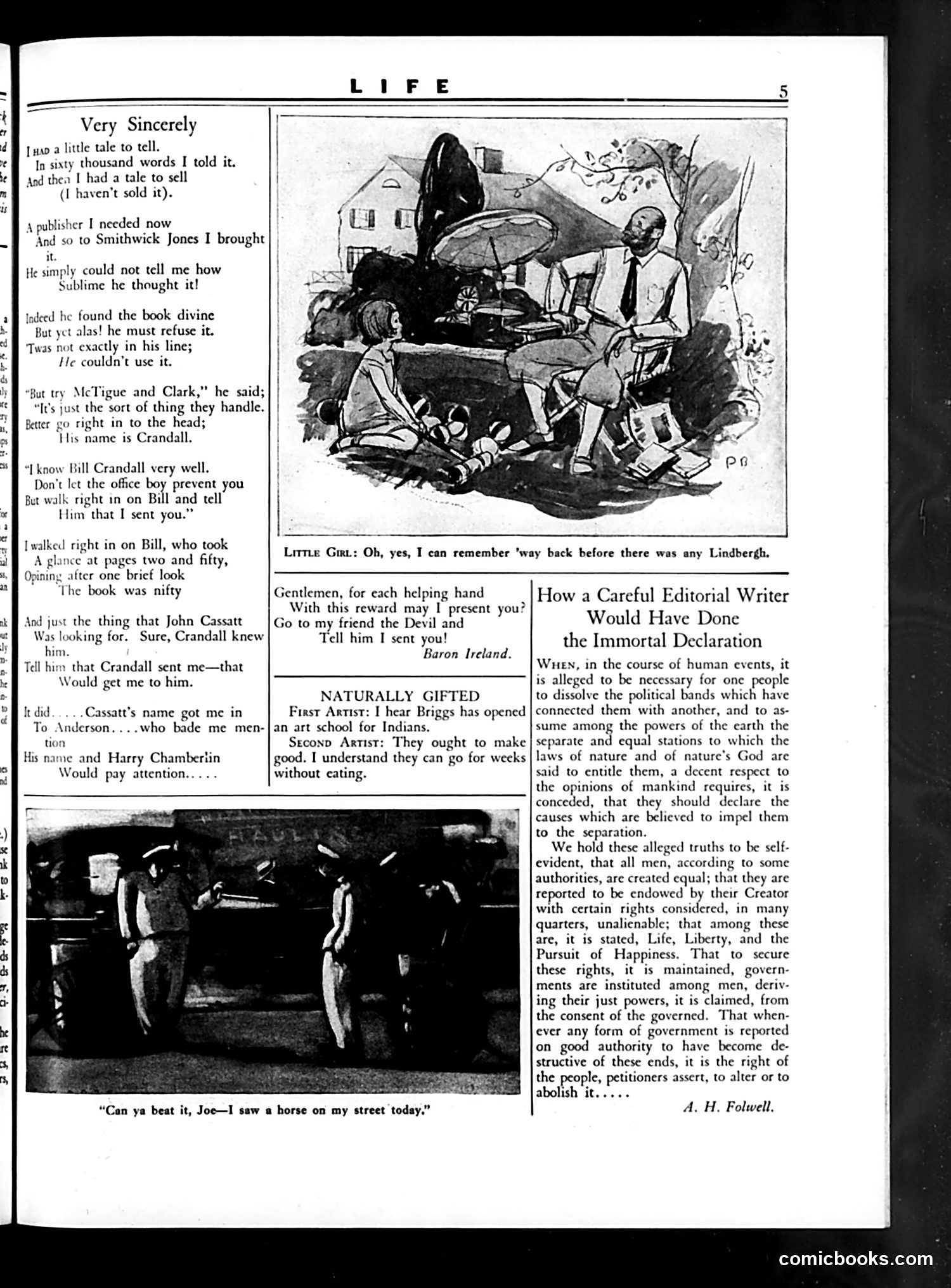
This page contains three distinct sections: **"Very Sincerely"** (left column): A humorous anecdote about pitching a manuscript to publisher Smithwick Jones, who refers the author to editors "McTigue and Clark" at the magazine *Life*. The joke appears to be about the difficulty of getting published and editorial gatekeeping. **Cartoon** (top right): Shows a young girl speaking with adults near a typewriter and papers, captioned about remembering "way back before there was any Lindbergh"—likely referencing Charles Lindbergh's famous 1927 transatlantic flight, treating it as a watershed historical moment even a child would reference. **"How a Careful Editorial Writer Would Have Done the Immortal Declaration"** (right): A mock rewrite of the Declaration of Independence in dry, legalistic language, satirizing bureaucratic and editorial over-writing of historical documents. The overall theme appears to be satire about writing, publishing, and historical perspective.
📄 Transcribed text from this page (OCR, searchable)
Machine-transcribed from the original scan — historical spelling and the odd misread are preserved.
ana ast 16 Very Sincerely [uw a little tale to tell. In sixty thousand words I told it. And thea I had a tale to sell (I haven't sold it). A publisher I needed now And so to Smithwick Jones I brought it. He simply could not tell me how Sublime he thought it! Indeed he found the book divine But yet alas! he must refuse it. Twas not exactly in his line; He couldn't use it. “But try McTigue and Clark,” he said; “It’s just the sort of thing they handle. Better go right in to the head; His name is Crandall, “[ know Bill Crandall very well. Don’t let the office boy prevent you But walk right in on Bill and tell Him that I sent you.” Iwalked right in on Bill, who took A glance at pages two and fifty, Opining after one brief look The book was nifty Gentlemen, for each helping hand With this reward may I present you? Go to my friend the Devil and Tell him I sent you! Baron Ireland. And just the thing that John Cassatt Was looking for. Sure, Crandall knew him. Tell him that Crandall sent me—that Would get me to him. NATURALLY GIFTED First Artist: I hear Briggs has opened an art school for Indians. Seconp Artist: They ought to make good. I understand they can go for weeks without eating. It did .Cassatt’s name got me in To Anderson, ...who bade me men- tion His name and Harry Chamberlin Would pay attention... . . “Can ya beat it, Joe—I saw a horse on my street today.” Lime Girt: Oh, yes, I can remember ’way back before there was any Lindbergh. How a Careful Editorial Writer Would Have Done the Immortal Declaration Wuen, in the course of human events, it is alleged to be necessary for one people to dissolve the political bands which have connected them with another, and to as- sume among the powers of the earth the separate and equal stations to which the laws of nature and of nature's God are said to entitle them, a decent respect to the opinions of mankind requires, it is conceded, that they should declare the causes which are believed to impel them to the separation. We hold these alleged truths to be self- evident, that all men, according to some authorities, are created equal; that they are reported to be endowed by their Creator with certain rights considered, in many quarters, unalienable; that among these are, it is stated, Life, Liberty, and the Pursuit of Happiness. That to secure these rights, it is maintained, govern- ments are instituted among men, deriv- ing their just powers, it is claimed, from the consent of the governed. That when- ever any form of government is reported on good authority to have become de- structive of these ends, it is the right of the people, petitioners assert, to alter or to abolish it..... A. H. Folwell. comicbooks.com