
Life, 1928-06-28 · page 20 of 35
Life — June 28, 1928 — page 20: what you’re looking at
What you’re looking at
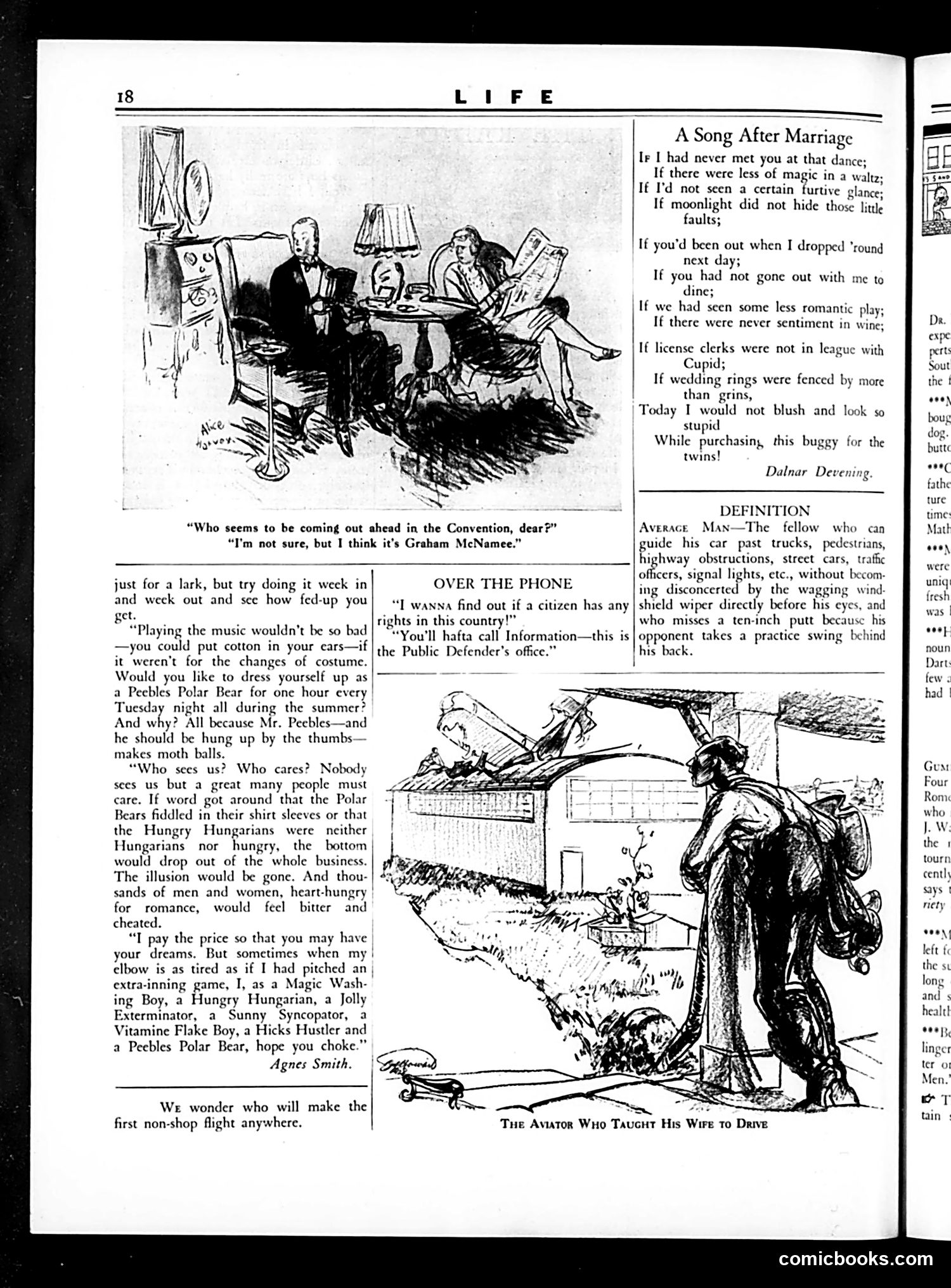
**Top Cartoon**: References a political convention (likely 1920s-era). The joke is that Graham McNamee—a famous radio broadcaster of the era—is "coming out ahead" because he's the only one the public hears about through radio coverage. Radio was still novel; the satire suggests media personality dominates actual political substance. **"Over the Phone" Joke**: A citizen calls the Public Defender's office demanding to know their rights, but gets transferred to "Information" (directory assistance). The satire mocks bureaucratic runaround and the Public Defender's office as unhelpful. **"A Song After Marriage"**: Sentimental parody listing romantic factors that led to marriage, ending with the deflating reality: now they're buying a buggy (baby carriage) for twins. It satirizes how marriage transforms from romance to domestic mundanity. **"Average Man" Definition**: Humorous definition of an ordinary man as someone navigating urban hazards (traffic, pedestrians) successfully, yet failing at golf when distracted—poking fun at masculine pride and minor defeats. All reflect 1920s urban American life and media culture.
📄 Transcribed text from this page (OCR, searchable)
Machine-transcribed from the original scan — historical spelling and the odd misread are preserved.
“Who seems to be coming out ahead in the Convention, dear?” “I'm not sure, but I think it's Graham McNamee.” just for a lark, but try doing it week in and week out and see how fed-up you pet. “Playing the music wouldn't be so bad —you could put cotton in your cars—if it weren't for the changes of costume. Would you like to dress yourself up as a Peebles Polar Bear for one hour every Tuesday night all during the summer? And why? All because Mr. Peebles—and he should be hung up by the thumbs— makes moth balls. “Who sees us? Who cares? Nobody sees us but a great many people must care. If word got around that the Polar Bears fiddled in their shirt sleeves or that the Hungry Hungarians were neither Hungarians nor hungry, the bottom would drop out of the whole business. The illusion would be gone. And thou- sands of men and women, heart-hungry for romance, would feel bitter and cheated. “T pay the price so that you may have your dreams. But sometimes when my | elbow is as tired as if I had pitched an | extra-inning game, I, as a Magic Wash- ing Boy, a Hungry Hungarian, a Jolly Exterminator, a Sunny Syncopator, a Vitamine Flake Boy, a Hicks Hustler and a Peebles Polar Bear, hope you choke.” Agnes Smith. We wonder who will make the first non-shop flight anywhere. OVER THE PHONE “T wanna find out if a citizen has any rights in this country!” “You'll hafta call Information—this is the Public Defender’s office.” A Song After Marriage Tr I had never met you at that dance; If there were less of magic in a waltz; If I'd not seen a certain furtive glance; If moonlight did not hide those little faults; If you'd been out when I dropped ‘round next day; If you had not gone out with me to dine; | If we had seen some less romantic play; If there were never sentiment in wine; If license clerks were not in league with Cupid; If wedding rings were fenced by more than grins, Today I would not blush and look so stupid While purchasiny, this buggy for the twins! Dalnar Devening. DEFINITION Averace Man—The fellow who can guide his car past trucks, pedestrians, highway obstructions, street cars, traffic officers, signal lights, etc., without becom- ing disconcerted by the wagging wind- shield wiper directly before his eyes, and who misses a ten-inch putt because his opponent takes a practice swing behind jhis back. were uniq: fresh was | soe} noun Dart: few < had | Guu Four Rom who J. W. the 1 tourn cently says | niety comicbooks.com