
Life, 1928-06-28 · page 26 of 35
Life — June 28, 1928 — page 26: what you’re looking at
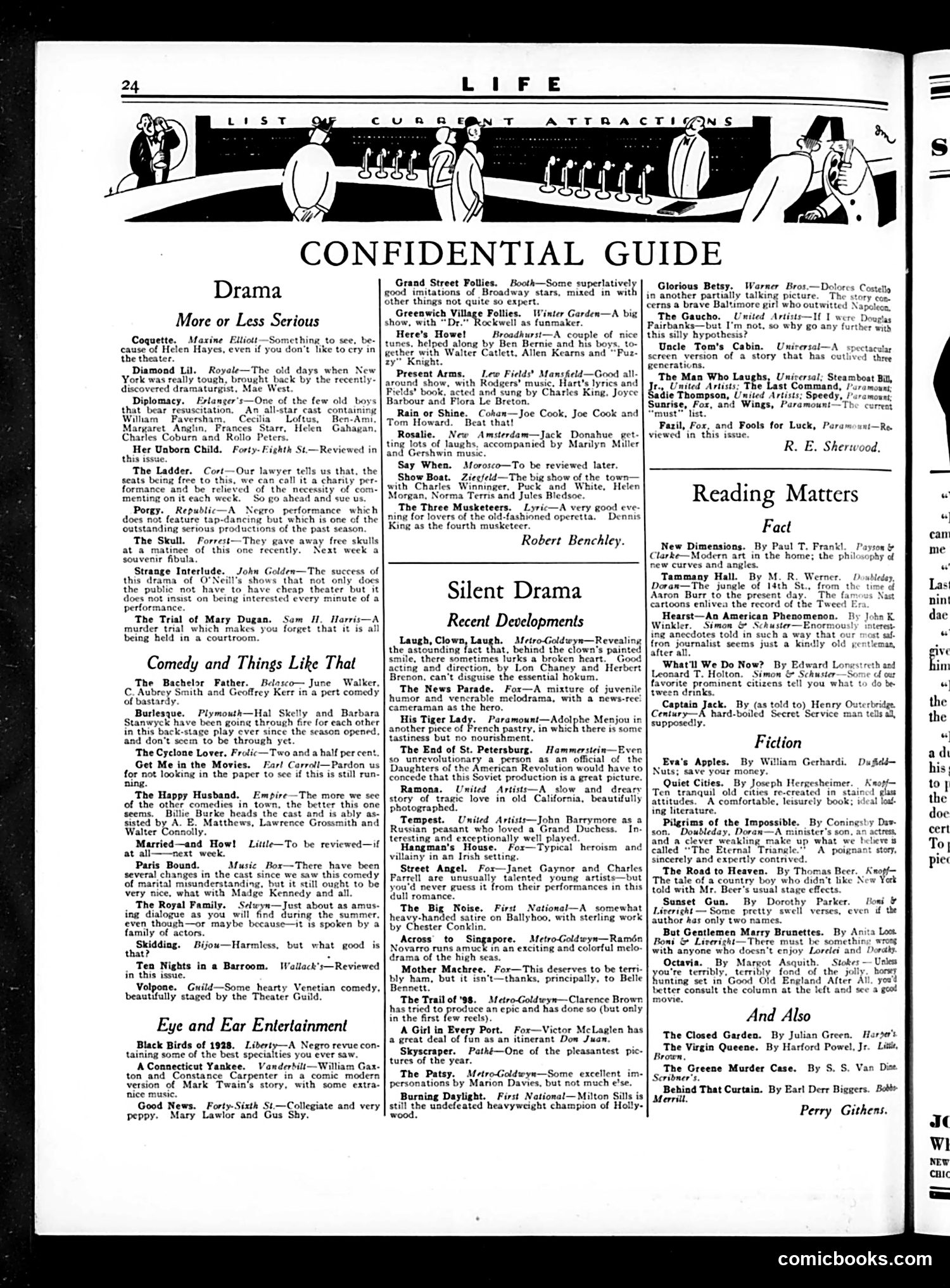
What you’re looking at
This page is a **theater review guide** from Life magazine's "Confidential Guide" section, not a political cartoon. It catalogs current Broadway productions circa late 1920s, organized by genre (serious drama, comedy, musical entertainment). The reviews are brief, witty assessments targeting sophisticated urban readers. Notable entries include Mae West's "Diamond Lil" (referencing her recent notoriety), O'Neill's "Strange Interlude" (praised for its intellectual ambition), and the all-Black production "Porgy" (distinguished as serious theater rather than tap-dancing entertainment—a notable distinction for that era). The tone is sardonic throughout: "The Ladder" gets a joke about free seating as charity; "The Trial of Mary Dugan" is praised for making courtroom drama engaging; various comedies are assessed by comparison. This reflects 1920s New York theater culture and Life's role as arbiter of sophisticated taste for educated audiences.
📄 Transcribed text from this page (OCR, searchable)
Machine-transcribed from the original scan — historical spelling and the odd misread are preserved.
CONFIDENTIAL GUIDE Drama More or Less Serious Coquette. Maxine cause of Helen Hayes, ev the theater. Diamond Lil. Royele—The old days when York was really tough, brought back by the rece discovered dramaturgist, Mae West. Diplomacy. Exlanger’s—One of the few old boys that bear resuscitation. An all-star cast containing Witham Faversham, Cecilia Loftus, Ben-Ami, Margaret Anglin, Prances Starr, Helen Gahagan. Charles Coburn Rollo Peters. Her Unborn Child. Forty-Fighth St—Reviewed in this issue. The Ladder. Cort—Our lawyer tells us that, the seats being free to this, we can call it a charity per formance and be relieved of the necessity of com- menting on it each week. So go ahead and sue us. Porgy. Republic—A Negro performance which does not feature tap-dancing but which is one of the outstanding serious productions of the past season The Skull. Forrest—They gave away free skulls at a matinee of this one recently, Next week a souvenir fibula. Strange Interlude. John Golden—The success of this drama of O'Neill's shows that not only d the public not have to have cheap theater but it does not insist on being interested every minute of a performance. The Trial of Mary Dugan. Sam H. Harris—A murder trial which makes you forget that it is all being held in a courtroom. Comedy and Things Like That The Bachelor Father. Belasco— June Walker, C. Aubrey Smith and Geoffrey Kerr ina pert comedy of bastardy. Burlesque. Plymouth—Hal Skelly and Barbara Stanwyck have been going through fire for each other in this back-stage play ever since the season opened, and don't scem to be through yet. The Cyclone Lover. Frotic—Two and a half per cent, Get Me in the Movies. Far! Carroll—Pardon us for not looking in the paper to sce if this is still run- ning. The Happy Husband. Empire—The more we sce of the other comedies in town, the better this one seems. Billie Burke heads the cast and is ably as- sisted by A. E. Matthews, Lawrence Grossmith and Walter Connoliy. Married—and How! at all——next week. Paris Bound. | Music Bor—There have been several changes in the cast since we saw this comedy of marital misunderstanding, but it still ought to be very nice, what with Madge Kennedy and all. __ The Royal Fami elwyn—Just about as amus- ing dialogue as you will find during the summer, even though—or maybe because—it is spoken by a family of actors. Skidding. Bijou—Harmless, that? . Ten Nights in a Barroom. Wallack"s—Reviewed in this issue. Volpone. Guild—Some hearty Venetian comedy, beautifully staged by the Theater Guild. thing to see, be- jon’t like to ery in Littl—To be reviewed—if but what good is Eye and Ear Entertainment Black Birds of 1928. Liberty—A Negro revue con- taining some of the best specialties you ever saw. AConnecticut Yankee. Vanderdili—William Gax- ton and Constance Carpenter in a comic modern version of Mark Twain's story, with some extra- nice music. Good News. Forty. Sixth St—Collegiate and very peppy. Mary Lawlor and Gus Shy. Grand Street Follies. | Booth—Some superlatively good imitations of Broadway stars, mixed in with other things not quite so expert. Greenwich Village Follies. Winter Garden—A big show, with “Dr.” Rockwell as funmaker. Here’s Howe! Broadhurst—A couple of nice tunes, helped along by Ben Bernie and his boys. to- gether with Walter Catlett, Allen Kearns and “Puz- zy” Knight. Present Arms. Lew Fields’ Mansfield—Good all round show, with Rodgers’ music, Hart's lyrics elds’ book, acted and sung by Charles King, Joyce Barbour and Flora Le Breton. Rain or Shine. Cohan—Joe Cook, Joe Cook and Tom Howard. Beat that! Rosalie. New Amsterdam—Jack Donahue get- ting lots of laughs, accompanied by Marilyn M and Gershwin music, Say When. Morosco—To be reviewed later. Show Boat. Ziec/eld—The big show of the town— with Charles Winninger. Puck and White, Helen Morgan, Norma Terns and Jules Bledsoe. The Three Musketeers. Lyric—A very good eve- ning for lovers of the old-fashioned operetta. King as the fourth musketeer. Robert Benchley. Silent Drama Recent Developments Laugh, Clown, Laugh. Metro-Goldwyn—Revealing the astounding fact that, behind the clown’s painted le, there sometimes lurks a broken heart. Good acting and direction, by Lon Chaney and Herbert Brenon, can’t disguise the essential hokum. The News Parade. Fox—A mixture of juvenile humor and vencrable melodrama, with a news-ree cameraman as the hero. His Tiger Lady. | Paramount—Adolphe Menjou in another piece of Prench pastry, in which there is some tastiness but no nourishment. The End of St. Petersburg. Hammerstein—Even so unrevolutionary a person as an official of the Daughters of the American Revolution would have to concede that this Soviet production is a great picture. Ramona. United Artists—A slow and dreary story of tragic love in old California, beautifully photographed. Tempest. United Artists—John Barrymore as a Russian peasant who loved a Grand Duchess. In- teresting and exceptionally well played. Hangman's House. Fox—Typical heroism and villainy in an Irish setting. Street Angel. For—Janet Gaynor and Charles Parrell are unusually talented young artists—but you'd never guess it from their performances in this dull romance. The Big Noise. First National—A somewhat heavy-handed satire on Ballyhoo, with sterling work by Chester Conklin. Across’ to Singapore. Metro-Goldwyn—Ramén Novarro runs amuck in an exciting and colorful melo. drama of the high seas, Mother Machree. For—This deserves to be terri- bly ham, but it isn't—thanks, principally, to Belle Bennett. The Trail of '98. Metro-Goldwyn—Clarence Brown, has tried to produce an epic and has done so (but only in the first few reels). A Girl in Every Port. Fox—Victor McLaglen has a great deal of fun as an itinerant Don Juan. Skyscraper. Pathté—One of the pleasantest pic- tures of the year. The Patsy. MetroGoldwyn—Some excellent personations by Marion Davies, but not much e'se. Burning Daylight. First Notional—Milton Sill still the undefeated heavyweight champion of Hi wood, Glorious Betsy. Warner Bros.—Dolores Costellg in another partially talking picture. The story com cerns a brave Baltimore girl who outwitted The Gaucho. United Artists—If I were Pairbanks—but I’m not, so why go any furth this silly hypothesis? Uncle Tom's Cabin. Unirersal—A " screen version of a story that has outlived three generations, The Man Who Laughs, Universal; Steamboat Bil, Jeg United Artists; The Last Command, 1'sromosat die Thompson, United Artists; Speedy, aramo Sunris i: current, Fox, and Wings, Paramount—Tb list. Pazil, For, and Fools for Luck, Param uui—Ro. viewed ‘in this issue. R. E. Sherwood, Reading Matters Fact New Dimensions. By Paul T. Frankl Clarke—Modern art in the home; the phil mew curves and angles. Tammany Hall. By M. R. Werner. Doran—The jungle of 14th St., from Aaron Burr to the present day. cartoons enlivea the record of the Tweer Hearst—An American Phenomenon. Winkler. Simon & Schuster—Enormou anecdotes told in such a way that fron journalist seems just a kin after all, What'll We Do Now? By Edward Lon Leonard T. Holton. Simon & Schuster favorite prominent citizens tell you wh: tween drinks, Captain Jack. By (as told to) Henry Ox Century—A hard-boiled Secret Service man supposedly. Payson & ophy of Fiction Eva's Apples. By Wi save your money. Quiet Cities. By Joseph Hergesheimer. Ten tranquil old cities re-created in stai attitudes. A comfortable, leisur: ing literature. Pilgrims of the Impossible. By Coni son, Doubleday, Doran—A minister's son and a clever weakling make up what we called “The Eternal Triangle.” A poig sincerely and expertly contrive The Road to Heaven. By Thomas Beer. Knopf— The tale of a country boy who didn't like New Yor told with Mr. Beer's usual stage effects. Sunset Gun. By Dorothy Parker. Loni & Literight — Some pretty swell verses, even if the iam Gerhardi. author has only two names. But Gentlemen Marry Brunettes. By Anita Loot Boni & Liveright—There must be something: wrosg with anyone who doesn't enjoy Lorelei and Dorey. ith. Stokes — Unless of the jolly. horsey unting set in Good Old England After All. you'd better consult the column at the left and sec a geo! a And Also The Closed Garden. By Julian Green. Harper's The Virgin Queene. By Harford Powel, Jr. Little, Brown. The Greene Murder Case. By S. S. Scribner's. Behind That Curtain. By Earl Derr Biggers. Bobtr Merrill. Van Dise Perry Githens. comicbooks.com