
Life, 1928-06-28 · page 18 of 35
Life — June 28, 1928 — page 18: what you’re looking at
What you’re looking at
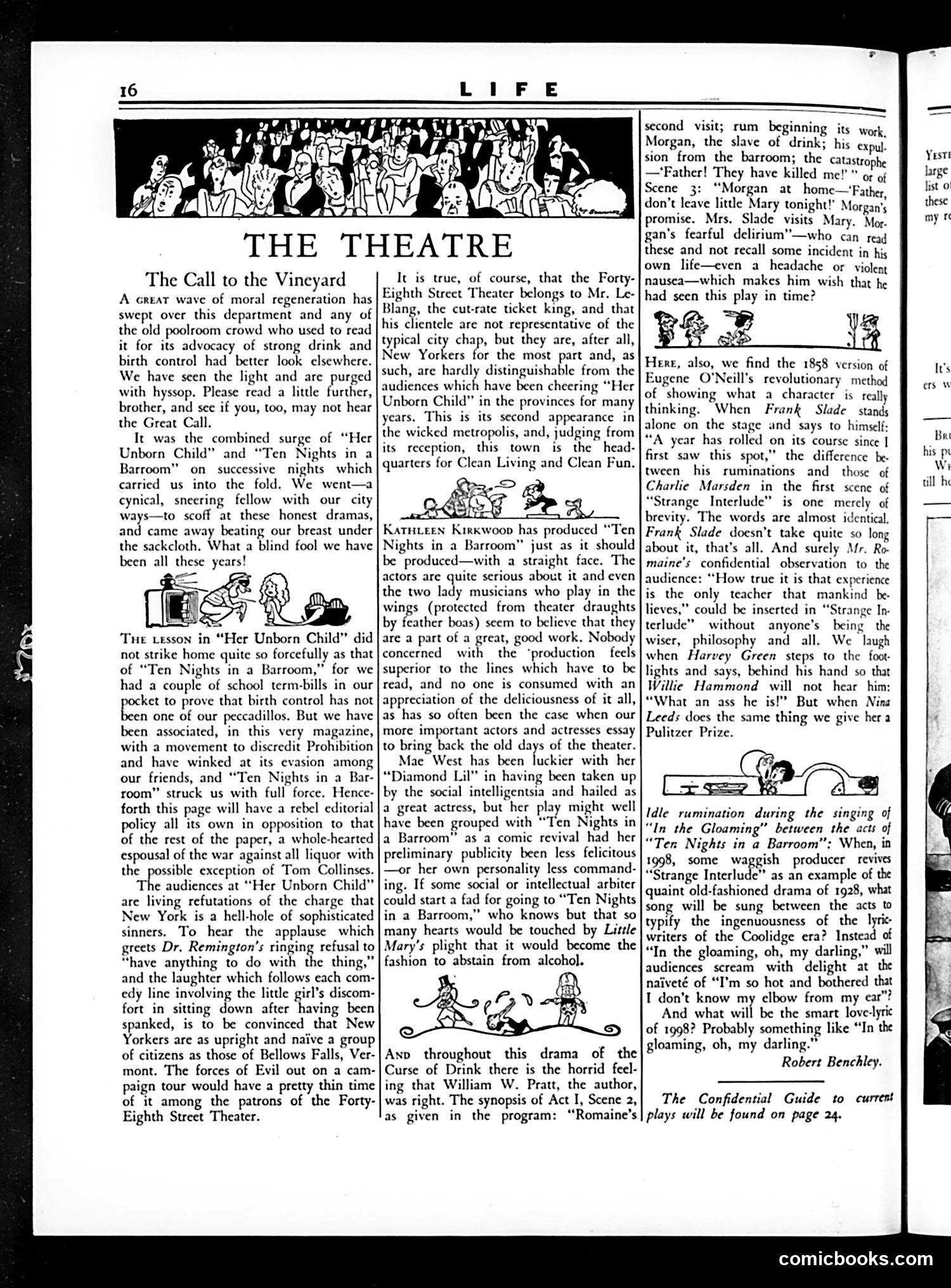
This is a theatre review page discussing Broadway productions. The main content critiques "The Call to the Vineyard" and praises "Her Unborn Child" and "Ten Nights in a Barroom," which the reviewer considers superior dramatic works. The cartoons appear to illustrate scenes from these plays—one shows a crowded theatre audience, another depicts what seems to be domestic drama with multiple figures. The text emphasizes these plays' advocacy for "birth control" and "strong drink" temperance, noting they represent honest drama with social messages. The reviewer contrasts them favorably against lighter theatrical fare typical of the Forty-Eighth Street Theatre crowd. The satire targets New York's sophisticated theatre-goers as "upright and naive," suggesting they underestimate serious drama's impact while overlooking its actual merit.
📄 Transcribed text from this page (OCR, searchable)
Machine-transcribed from the original scan — historical spelling and the odd misread are preserved.
The Call to the Vineyard A creat wave of moral regeneration has swept over this department and any of the old poolroom crowd who used to read it for its advocacy of strong drink and birth control had better look elsewhere. We have seen the light and are purged with hyssop. Please read a little further, brother, and see if you, too, may not hear the Great Call. It was the combined surge of “Her Unborn Child” and “Ten Nights in a Barroom” on successive nights which carried us into the fold. We went—a cynical, sneering fellow with our city ways—to scoff at these honest dramas, and came away beating our breast under the sackcloth, What a blind fool we have been all these years! — not strike home quite so forcefully as that of “Ten Nights in a Barroom,” for we had a couple of school term-bills in our pocket to prove that birth control has not en one of our peccadillos. But we have been associated, in this very magazine, with a movement to discredit Prohibition and have winked at its evasion among our friends, and “Ten Nights in a Bar- room” struck us with full force. Hence- forth this page will have a rebel editorial policy all its own in opposition to that of the rest of the paper, a whole-hearted espousal of the war against all liquor with the possible exception of Tom Collinses. The audiences at “Her Unborn Child” are living refutations of the charge that New York is a hell-hole of sophisticated sinners. To hear the applause which greets Dr. Remington’s ringing refusal to “have anything to do with the thing,” and the laughter which follows each com- edy line involving the little girl's discom- fort in sitting down after having been spanked, is to be convinced that New Yorkers are as upright and naive a group of citizens as those of Bellows Falls, Ver- mont. The forces of Evil out on a cam- paign tour would have a pretty thin time of it among the patrons of the Forty- Eighth Street Theater. It is true, of course, that the Forty- Eighth Street Theater belongs to Mr. Le- Blang, the cut-rate ticket king, and that his clientele are not representative of the typical city chap, but they are, after all, New Yorkers for the most part and, as such, are hardly distinguishable from the audiences which have been cheering “Her Unborn Child” in the provinces for many years. This is its second appearance in the wicked metropolis, and, judging from its reception, this town is the head- quarters for Clean Living and Clean Fun. Kirkwoop Ten Nights in a Barroom” just as it should be produced—with a straight face. The actors are quite serious about it and even the two lady musicians who play in the wings (protected from theater draughts by feather boas) seem to believe that they are a part of a great, good work. Nobody concerned with the ‘production feels superior to the lines which have to be read, and no one is consumed with an appreciation of the deliciousness of it all, as has so often been the case when our more important actors and actresses essay to bring back the old days of the theater. Mae West has been luckier with her “Diamond Lil” in having been taken up by the social intelligentsia and hailed as a great actress, but her play might well have been grouped with “Ten Nights in a Barroom” as a comic revival had her preliminary publicity been less felicitous —or her own personality less command- ing. If some social or intellectual arbiter could start a fad for going to “Ten Nights in a Barroom,” who knows but that so many hearts would be touched by Little Mary’s plight that it would become the fashion to abstain from alcoho]. wa Anp throughout this drama of the Curse of Drink there is the horrid feel- ing that William W. Pratt, the author, was right. The synopsis of Act I, Scene 2, as given in the program: ‘“Romaine’s second visit; rum beginning its work. Morgan, the slave of drink; his expul. sion from the barroom; the catastrophe —Father! They have killed me!’ ” of of Scene 3: “Morgan at home—Father don't leave little Mary tonight!” Morgan’ promise. Mrs. Slade visits Mary. Mor. gan’s fearful delirium"—who can read these and not recall some incident in his own life—even a headache or violent nausea—which makes him wish that he had seen this play in time? BB, YZ Here, also, find the 1858 version of Eugene O'Neill's revolutionary method of showing what a character is really thinking. When Frank Slade stands alone on the stage and says to himself: “A year has rolled on its course since | first saw this spot,” the difference be- tween his ruminations and those of Charlie Marsden in the first scene of “Strange Interlude” is one merely of brevity. The words are almost identical, Frank Slade doesn’t take quite so long about it, that’s all. And surely Mr. Ro- maine's confidential observation to the audience: ‘How true it is that experience is the only teacher that mankind be lieves,”” could be inserted in “Strange In- terlude” without anyone's being the wiser, philosophy and all. We laugh when Harvey Green steps to the foot- lights and says, behind his hand so that Willie Hammond will not hear him: “What an ass he is!” But when Nina Leeds does the same thing we give her a Pulitzer Prize. Idle rumination during the singing of “In the Gloaming” between the acts of “Ten Nights in a Barroom”: When, in 1998, some waggish producer revives “Strange Interlude” as an example of the quaint old-fashioned drama of 1928, what song will be sung between the acts to typify the ingenuousness of the lyric- writers of the Coolidge era? Instead of “In the gloaming, oh, my darling,” will audiences scream with delight at the naiveté of “I’m so hot and bothered that T don’t know my elbow from my car”? And what will be the smart love-lyric of 1998? Probably something like “In the gloaming, oh, my darling.” Robert Benchley. The Confidential Guide to current plays will be found on page 24. = Yest! large list 0 these my re Bri his pr Wi till he comicbooks.com