
Life, 1928-06-28 · page 14 of 35
Life — June 28, 1928 — page 14: what you’re looking at
What you’re looking at
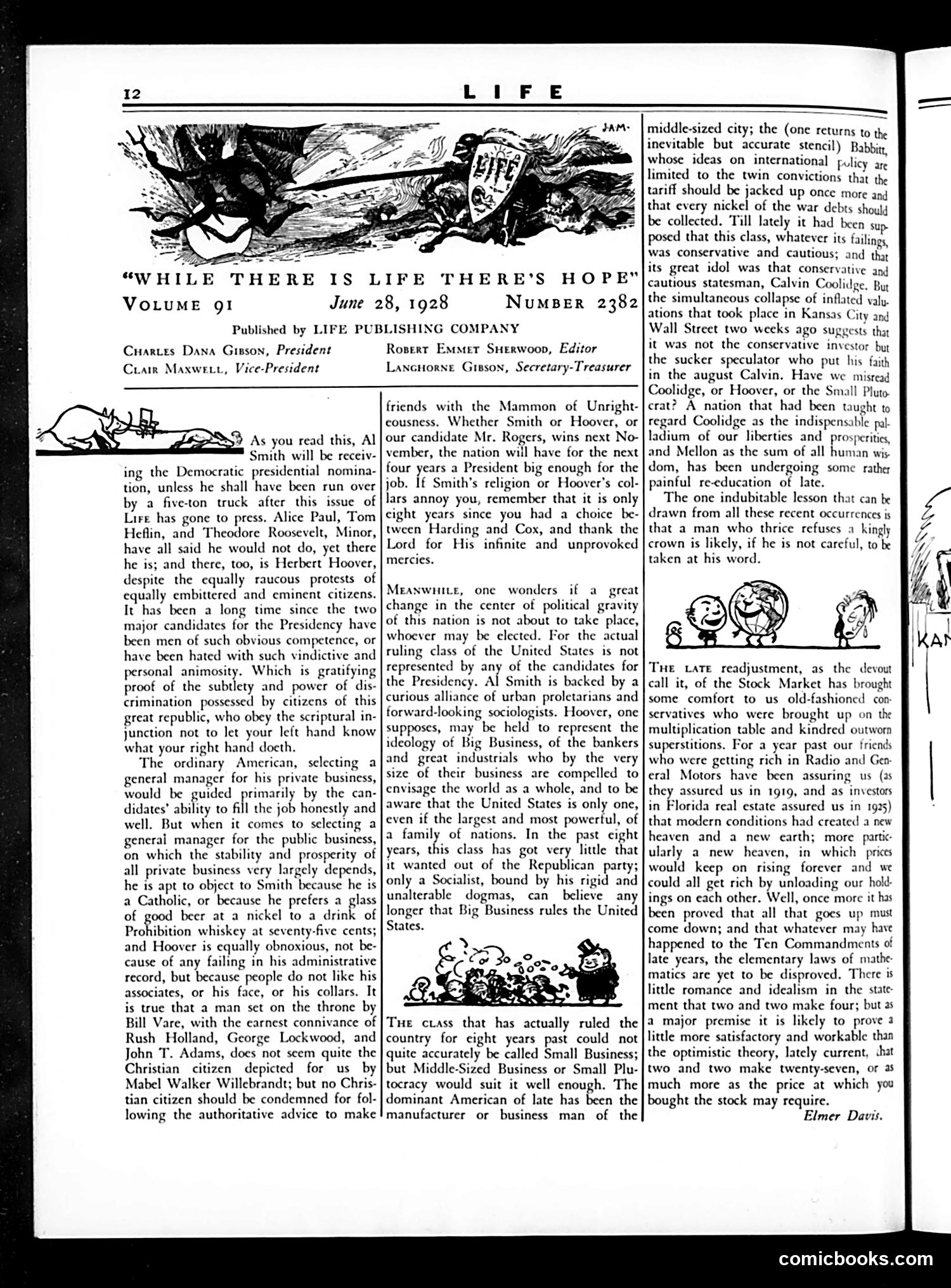
This Life magazine page (June 28, 1928) discusses the upcoming U.S. presidential election. The article examines potential Democratic nominees, mentioning Al Smith specifically. It references the "Mammom of Unrighteousness"—a biblical allusion suggesting corruption. The text argues that major presidential candidates have recently been businessmen or conservative figures (Harding, Coolidge, Hoover), and questions whether actual power lies with "Big Business" rather than elected officials. The author suggests the ruling class is represented by bankers and industrialists who control policy regardless of who wins elections. The satirical point: American democracy may be theater masking the real power of wealthy business interests. The cartoons (small figures visible) likely reinforce this cynical view of political choice under capitalist control.
📄 Transcribed text from this page (OCR, searchable)
Machine-transcribed from the original scan — historical spelling and the odd misread are preserved.
“WHILE VOLUME 9gI THERE IS LIFE THERE'S HOPE” June 28, 1928 NuMBER 2382 Published by LIFE PUBLISHING COMPANY Cuarces Dana Gisson, President Crain Maxwetr, Vice-President Rosert Emmet SHerwoon, Editor LancHorne Grason, Secretary-Treasurer As you read this, Al Smith will be receiv- ing the Democratic presidential nomina- tion, unless he shall have been run over by a five-ton truck after this issue of Lire has gone to press. Alice Paul, Tom Heflin, and Theodore Roosevelt, Minor, have all said he would not do, yet there he is; and there, too, is Herbert Hoover, despite the equally raucous protests of equally embittered and eminent citizens. It has been a long time since the two major candidates for the Presidency have been men of such obvious competence, or have been hated with such vindictive and personal animosity. Which is gratifying proof of the subtlety and power of dis- crimination possessed by citizens of this great republic, who obey the scriptural in- junction not to let your left hand know what your right hand docth. The ordinary American, selecting a general manager for his private business, would be guided primarily by the can- didates’ ability to fill the job honestly and well. But when it comes to selecting a general manager for the public business, on which the stability and prosperity of all private business very largely depends, he is apt to object to Smith because he is a Catholic, or because he prefers a glass of good beer at a nickel to a drink of Prohibition whiskey at seventy-five cents; and Hoover is equally obnoxious, not be- cause of any failing in his administrative record, but because people do not like his associates, or his face, or his collars. It is true that a man set on the throne by Bill Vare, with the earnest connivance of Rush Holland, George Lockwood, and John T. Adams, does not seem quite the Christian citizen depicted for us by Mabel Walker Willebrandt; but no Chris- tian citizen should be condemned for fol- lowing the authoritative advice to make friends with the Mammon of Unright- cousness. Whether Smith or Hoover, or our candidate Mr. Rogers, wins next No- vember, the nation will have for the next four years a President big enough for the job. If Smith's religion or Hoover's col- lars annoy you, remember that it is only eight years since you had a choice be- tween Harding and Cox, and thank the Lord for His infinite and unprovoked mercies. Meanwuite, one wonders if a great change in the center of political gravity of this nation is not about to take place, whoever may be elected. For the actual ruling class of the United States is not represented by any of the candidates for the Presidency. Al Smith is backed by a curious alliance of urban proletarians and forward-looking sociologists. Hoover, one supposes, may be held to represent the ideology of Big Business, of the bankers and great industrials who by the very size of their business are compelled to envisage the world as a whole, and to be aware that the United States is only one, even if the largest and most powerful, of a family of nations. In the past eight years, this class has got very little that it wanted out of the Republican party; only a Socialist, bound by his rigid and unalterable dogmas, can believe any longer that Big Business rules the United Tue crass that has actually ruled the country for eight years past could not quite accurately be called Small Business; but Middle-Sized Business or Small Plu- tocracy would suit it well enough. The dominant American of late has been the manufacturer or business man of the middle-sized city; the (one returns to the inevitable but accurate stencil) Babbitr, whose ideas on international policy are limited to the twin convictions that the tariff should be jacked up once more and that every nickel of the war debts should be collected. Till lately it had been sup. posed that this class, whatever its failings, was conservative and cautious; and that its great idol was that conservative and cautious statesman, Calvin Coolidge. But the simultancous collapse of inflated valy. ations that took place in Kansas City and Wall Street two weeks ago suggests that it was not the conservative investor but the sucker speculator who put his faith in the august Calvin. Have we misread Coolidge, or Hoover, or the Small Pluto. crat? A nation that had been taught to regard Coolidge as the indispensable pal. ladium of our liberties and_ prosperitics, and Mellon as the sum of all human wis dom, has been undergoing some rather painful re-education of late. The one indubitable lesson that can be drawn from all these recent occurrences is that a man who thrice refuses a kingly crown is likely, if he is not careful, to be taken at his word. Tue Late readjustment, as the devout call it, of the Stock Market has brought some comfort to us old-fashioned con servatives who were brought up on the multiplication table and kindred outworn superstitions. For a year past our friends who were getting rich in Radio and Gen- eral Motors have been assuring us (as they assured us in 1919, and as investors in Florida real estate assured us in 1925) that modern conditions had created a new heaven and a new earth; more partic. ularly a new heaven, in which prices would keep on rising forever and we could all get rich by unloading our hold- ings on each other. Well, once more it has been proved that all that goes up must come down; and that whatever may have happened to the Ten Commandments of late years, the elementary laws of mathe- matics are yet to be disproved. There is litle romance and idealism in the state ment that two and two make four; but as a major premise it is likely to prove a little more satisfactory and workable than the optimistic theory, lately current, chat two and two make twenty-seven, or 3s much more as the price at which you bought the stock may require. Elmer Davis. comicbooks.com