
A complete issue · 38 pages · 1928
Life — February 2, 1928
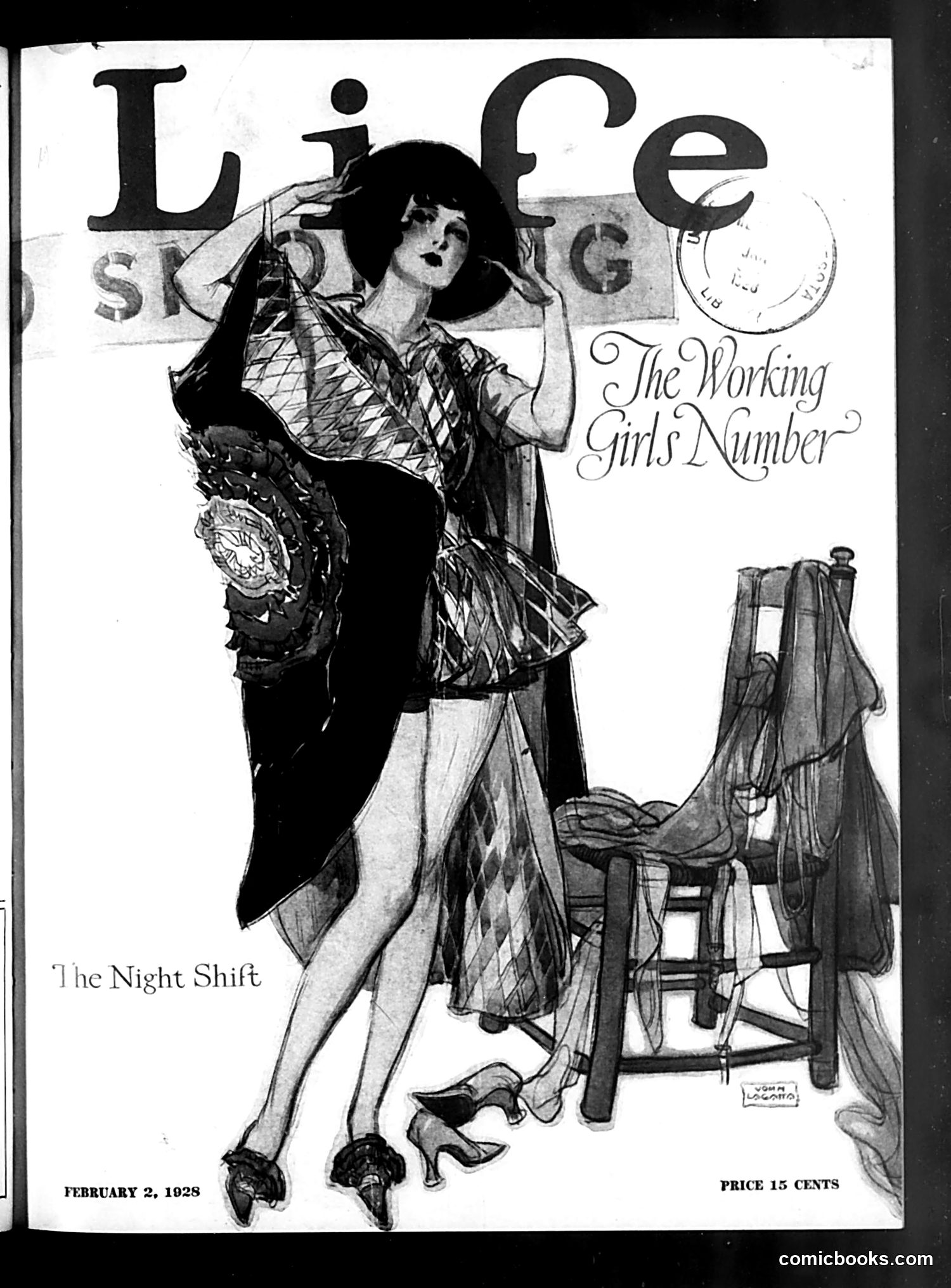
This is the cover of *Life* magazine's "Working Girls' Number," featuring an illustration titled "The Night Shift." The artwork depicts a young woman in 1920s attire—short skirt, heeled shoes, and revealing clothing—juggling multiple objects while appearing playful and energetic. Clothes hang on a chair beside her. The satire comments on working women's dual roles in the Jazz Age: balancing employment with social life and domestic duties. The "night shift" likely refers both to nighttime factory or service work and the era's active nightlife/entertainment scene. The image satirizes the modern "working girl" as simultaneously professional, fashionable, and perpetually busy—reflecting societal fascination and some anxiety about women's expanding roles in 1920s society.
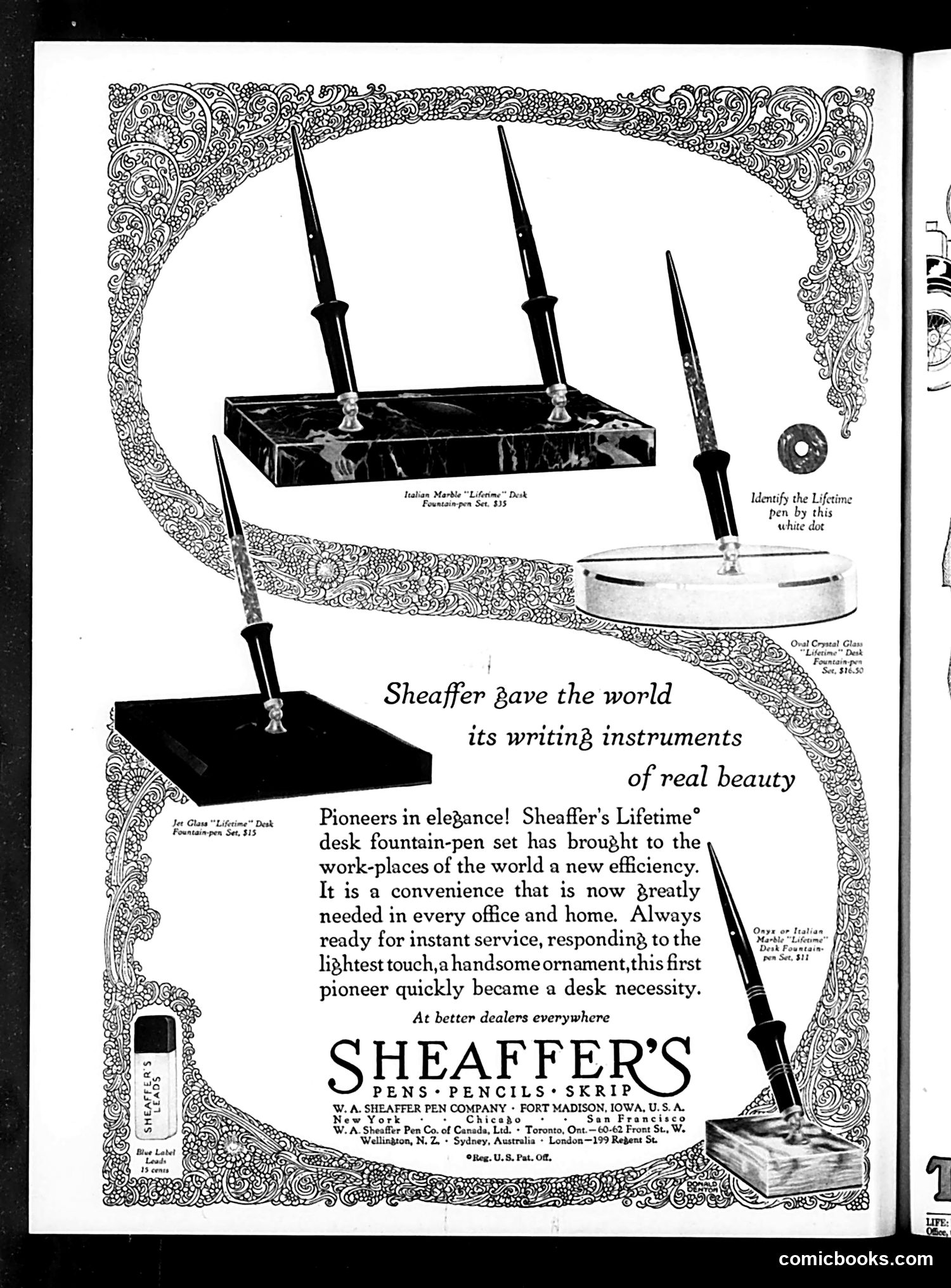
This is **not a political cartoon or satire**, but rather a **vintage advertisement** for Sheaffer fountain pens and desk sets, likely from the 1920s-1930s based on the Art Deco styling and typography. The page showcases various "Lifetime" desk fountain pen sets in ornate marble and glass designs, displayed against an elaborate decorative border. The ad emphasizes that Sheaffer pens represent beauty and efficiency in office work, positioning them as essential desk accessories for modern workplaces and homes. The tagline "Sheaffer gave the world its writing instruments of real beauty" is straightforward product marketing, not satire. This is purely commercial advertising promoting writing instruments as both functional tools and decorative status symbols for professionals.
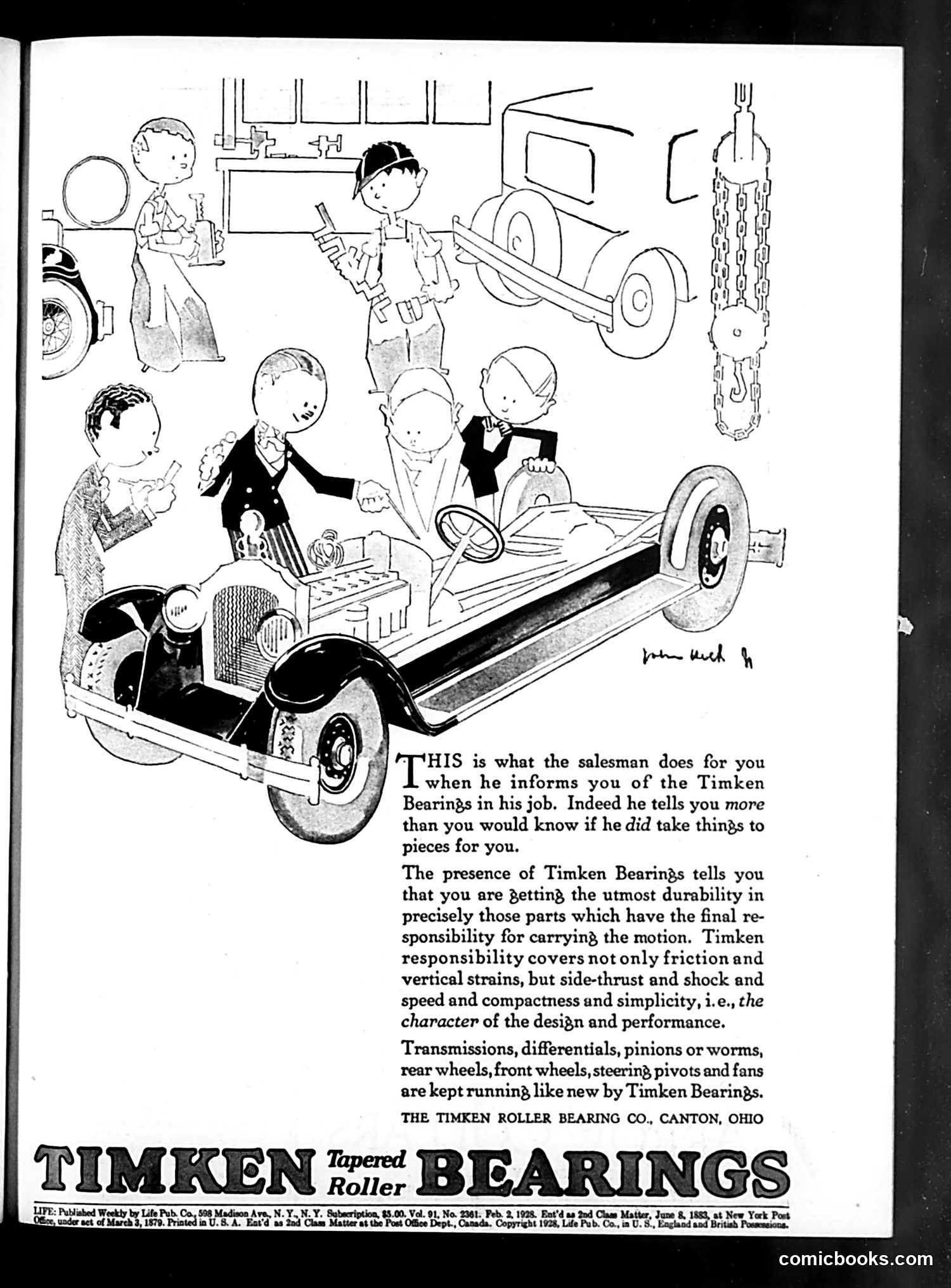
This is **not satire or political commentary**—it's a straightforward **advertisement for Timken Tapered Roller Bearings**, a mechanical component manufacturer based in Canton, Ohio. The cartoon depicts a salesman demonstrating how bearings function within automotive parts (transmissions, differentials, wheels, steering mechanisms). The illustration shows multiple figures examining a cutaway car chassis to understand bearing placement and importance. The ad's messaging targets business/industrial readers: it argues that specifying Timken bearings ensures vehicle durability and performance across critical stress points. The phrase "character of the design" emphasizes engineering reliability. This represents typical 1920s trade advertising in *Life* magazine, which published both humor and industrial marketing alongside satirical content. The cartoon style simply made technical information more visually engaging for contemporary readers.
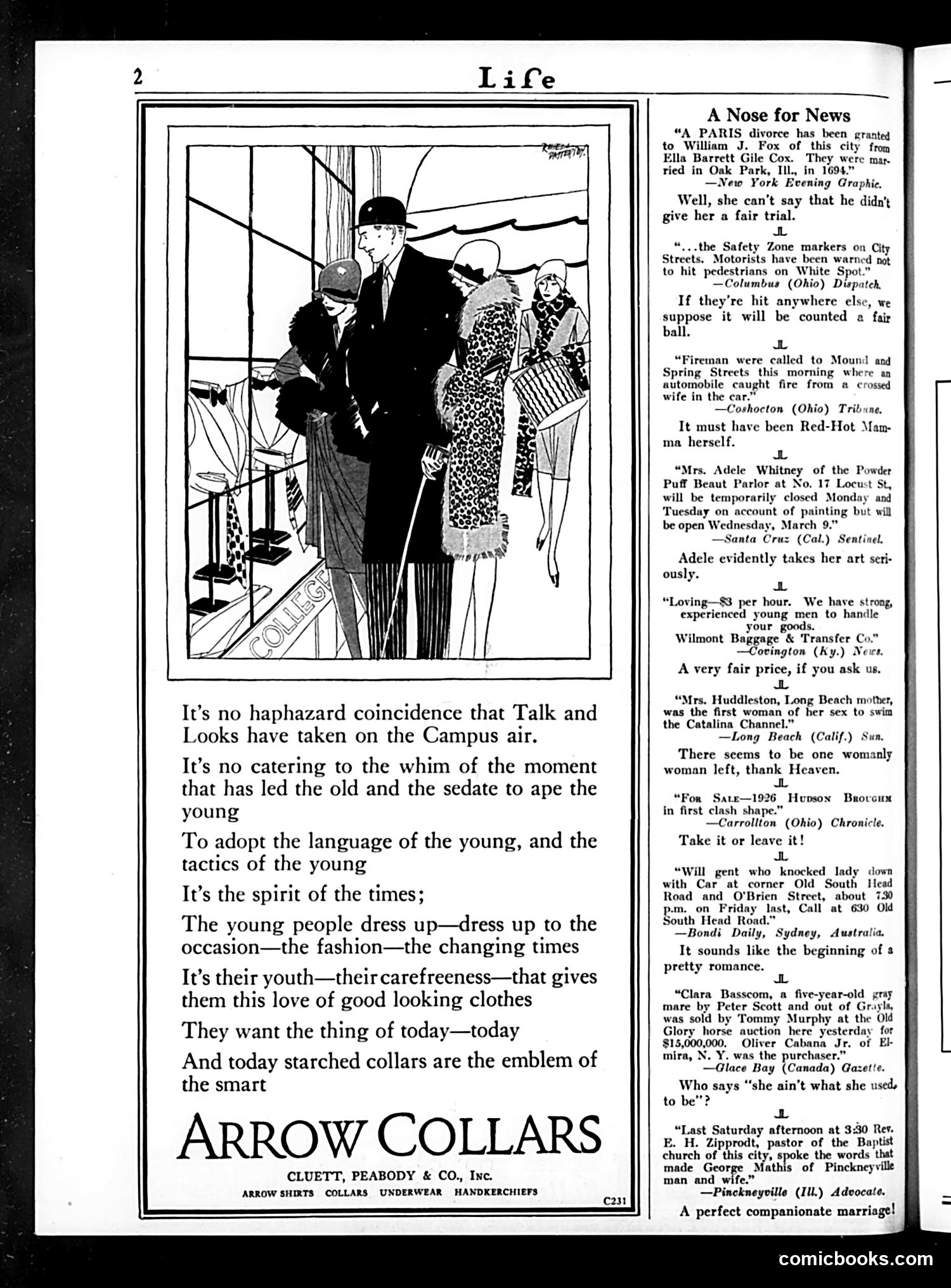
This page is primarily an **Arrow Collars advertisement** (bottom half), not political satire. The ad uses social commentary as marketing, arguing that young people's fashion choices—particularly starched collars—reflect modern times and youthful spirit. The accompanying text (left side) makes a broader cultural point: that fashion and style among youth represent genuine social change, not mere fad-chasing. It suggests adopting "the language of the young" and their "carefree" attitude through clothing reflects the era's spirit. The illustration shows well-dressed figures in what appears to be a public setting, supporting the ad's thesis that proper dress signals sophistication and modernity. The right column contains unrelated brief news items and classified advertisements—typical Life magazine filler. This reflects 1920s consumer culture using generational commentary to sell products.
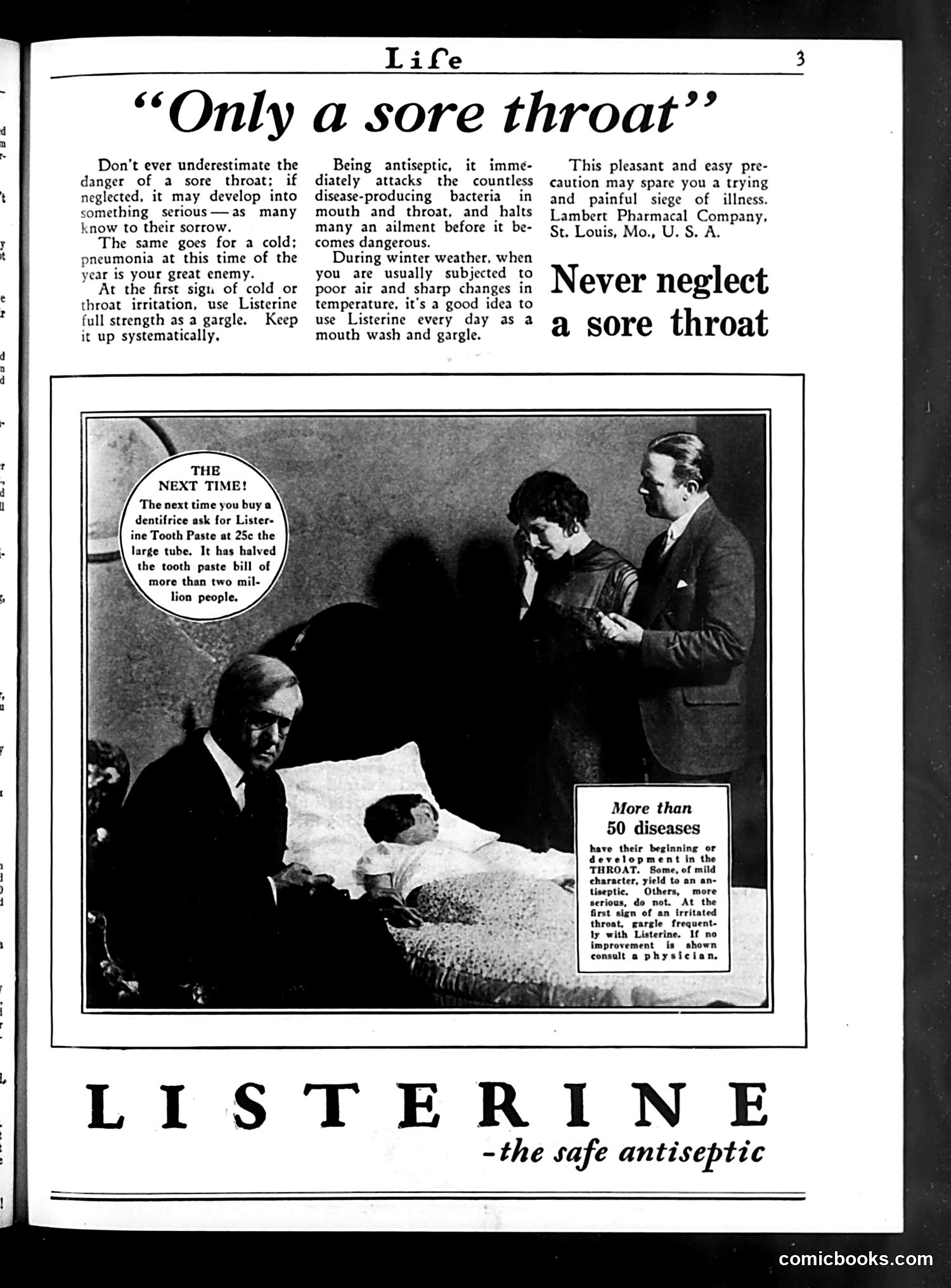
This is primarily a **Listerine advertisement**, not political satire. The page depicts a medical scene where a doctor examines a sick infant while concerned adults (likely parents) look on. The advertisement warns that sore throats should never be neglected, as they can develop into serious illnesses like pneumonia. It promotes Listerine as an antiseptic solution—a gargle to use "at the first sign of cold or throat irritation." A callout bubble claims Listerine Tooth Paste at 25 cents "has halved the tooth paste bill of more than two million people." The boxed text notes that over 50 diseases originate in the throat, recommending Listerine treatment or consulting a physician if no improvement occurs. This reflects early 20th-century medical marketing, when antiseptics were heavily promoted for home health management.
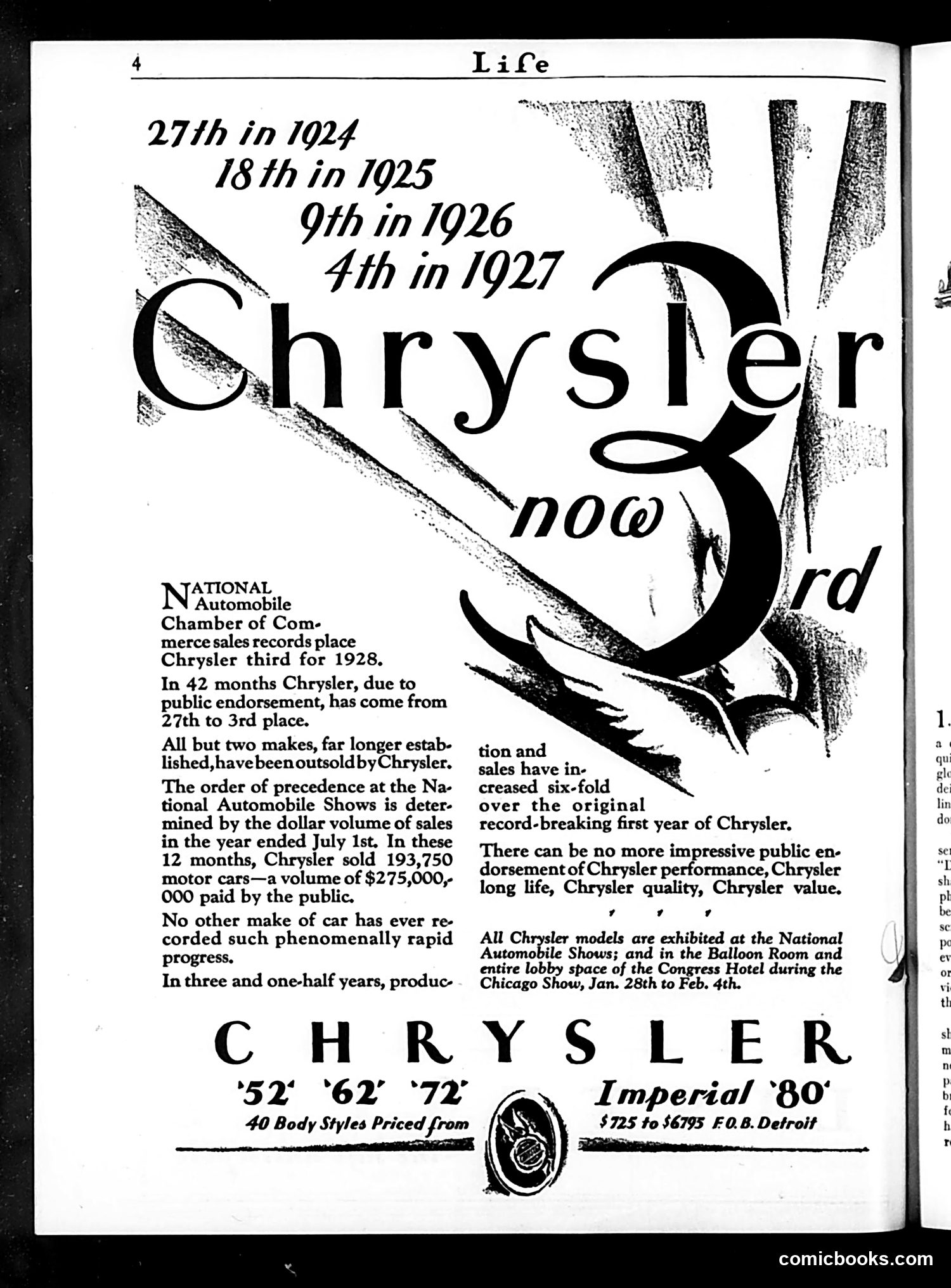
This is primarily a **Chrysler automobile advertisement**, not political satire. The page celebrates Chrysler's rapid rise in the auto industry rankings: - **The rankings listed** (27th in 1924, 18th in 1925, 9th in 1926, 4th in 1927) document the company's extraordinary market growth in just three years. - **The large stylized "3rd" figure** emphasizes that Chrysler achieved 3rd place in 1928 sales rankings—a remarkable achievement for a relatively new manufacturer. - The text boasts that Chrysler sold 193,750 cars (worth $275 million) in 12 months and that only two older car manufacturers outsold them. - **The bottom advertises specific models**: the '52, '62, '72, and Imperial '80, with prices ranging from $725 to $625 F.O.B. Detroit. This reflects the booming 1920s auto industry and Chrysler's genuine success during this period.
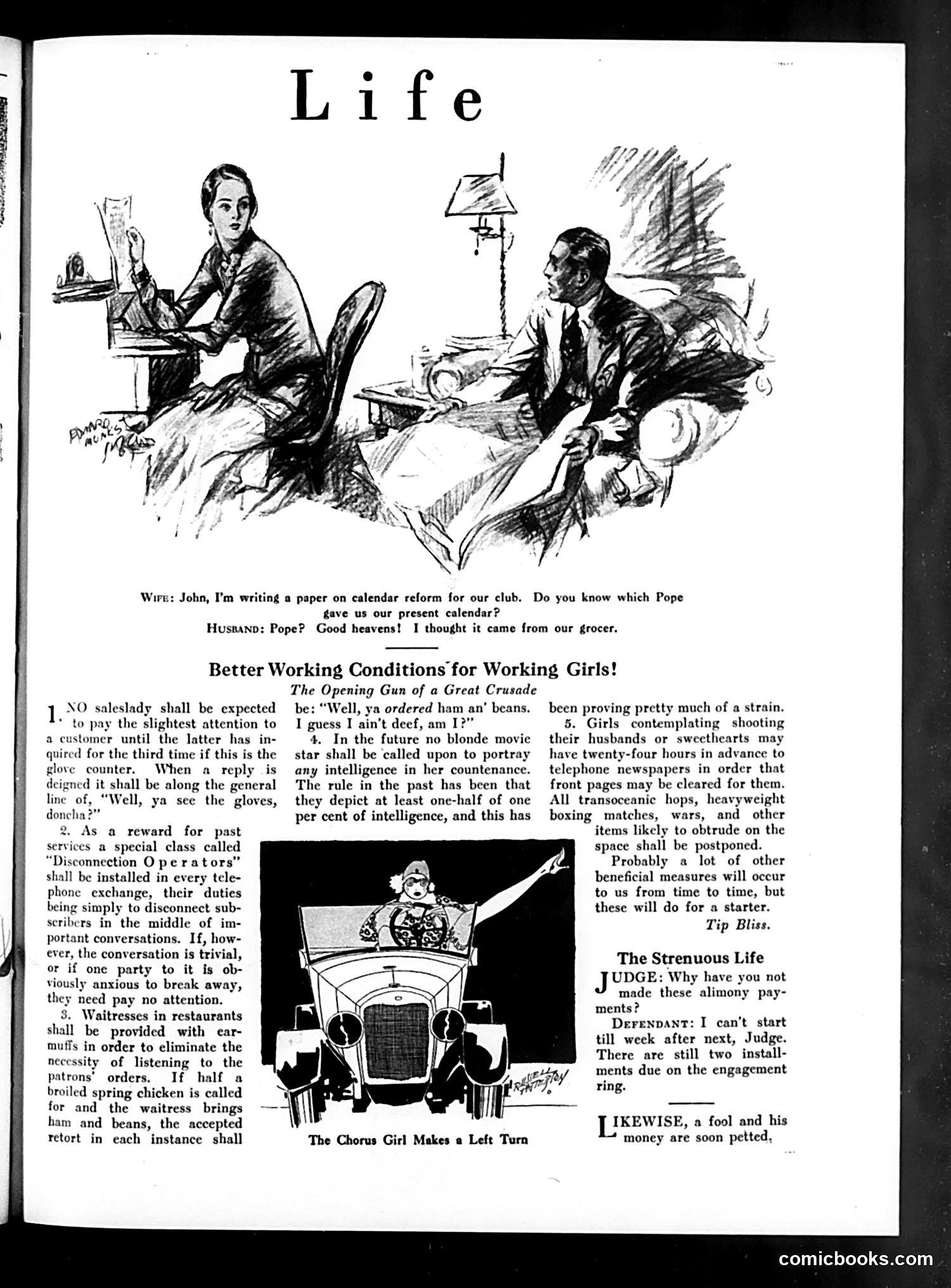
This page satirizes women's workplace issues and social customs of the early 20th century. The top cartoon shows a wife asking her husband about "calendar reform" — a historical movement to standardize the calendar. His comical misunderstanding (thinking the Pope came from their grocer) jokes about men's indifference to women's intellectual pursuits. The main article, "Better Working Conditions for Working Girls!," presents absurd "reforms" as satire: rules about saleslady attentiveness, telephone operators interrupting conversations, and waitresses wearing ear muffs. These ridiculous suggestions mock the actual poor conditions working women faced while highlighting how employers and society dismissed their legitimate grievances. The cartoons below ("The Chorus Girl Makes a Left Turn," "The Strenuous Life") continue satirizing social expectations and economic precarity affecting working women and the working class generally.
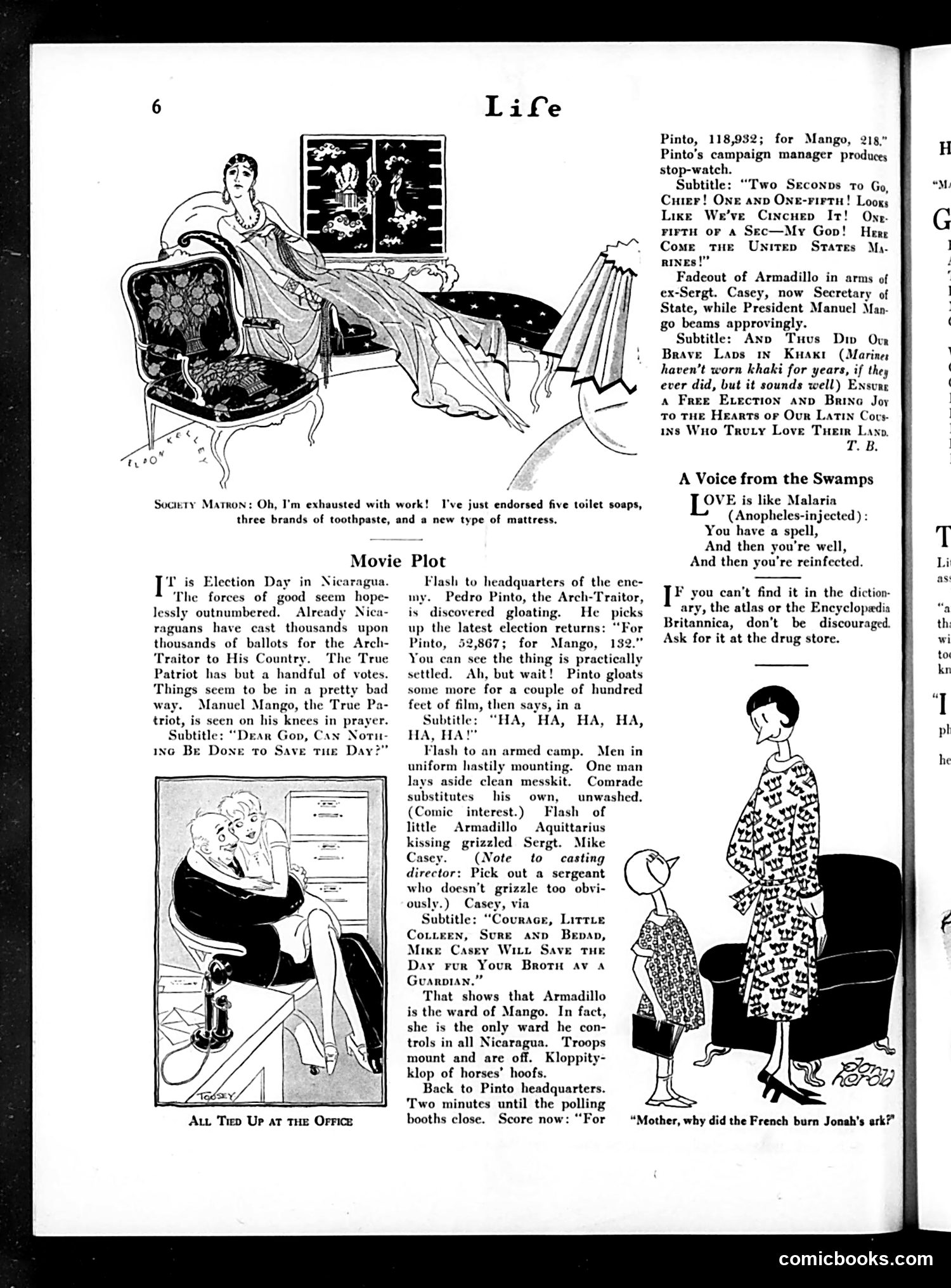
This Life magazine page satirizes a **Nicaraguan election** during the era of American interventionism in Central America. The "Movie Plot" section mocks the predictable nature of the conflict: Pedro Pinto (the "Arch-Traitor") is losing to Manuel Mango (the "True Patriot"), with American forces backing the preferred candidate. The humor targets how such elections played out like scripted films—the outcome predetermined, the dialogue stilted ("HA, HA, HA!"). References to an "armed camp," soldiers, and Armadillo as Mango's ward suggest American military involvement ensuring the "correct" winner. The top cartoon shows a society matron exhausted from endorsing consumer products—satirizing celebrity endorsement culture and commercialism. The bottom right depicts a child asking why the French burned Jonah's ark—a non-sequitur joke on historical absurdity.
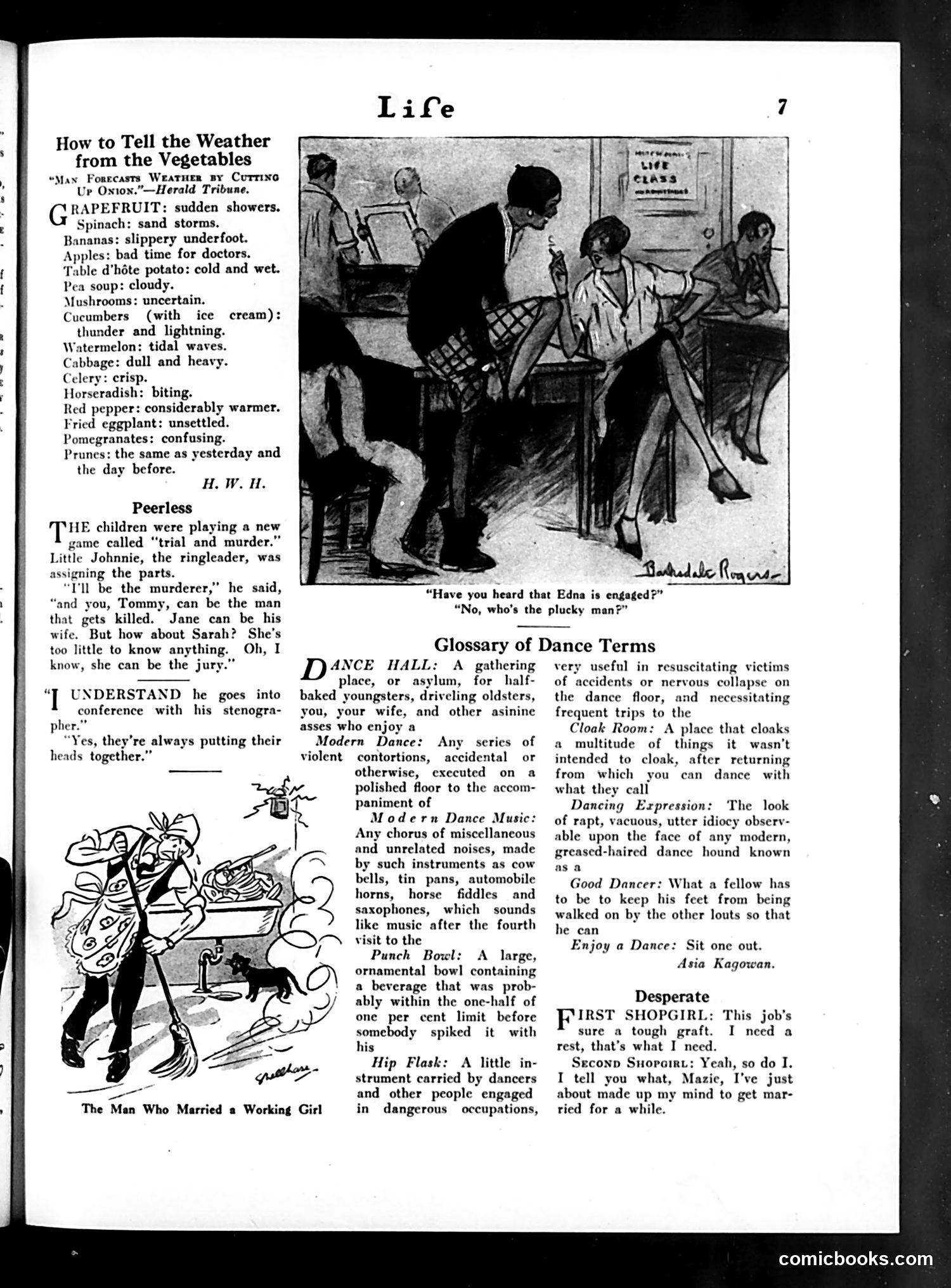
This page contains several humorous sections typical of Life's satirical format: **"How to Tell the Weather from Vegetables"** is a whimsical piece satirizing pseudo-scientific fortune-telling by linking produce characteristics to weather predictions (grapefruit = showers, spinach = sand storms, etc.). It mocks superstitious or absurd reasoning. **"Peerless"** is a children's game narrative poking fun at childhood logic and role-playing, where young players casually discuss murder and death as entertainment—likely satirizing both children's morbid curiosity and period melodrama tropes. The main cartoon "Have you heard that Edna is engaged?" depicts a social gathering, likely mocking gossip culture and shallow engagement discussions among the upper classes. **"Glossary of Dance Terms"** humorously defines modern dance jargon with exaggerated, critical descriptions, satirizing the pretentiousness of contemporary dance culture.
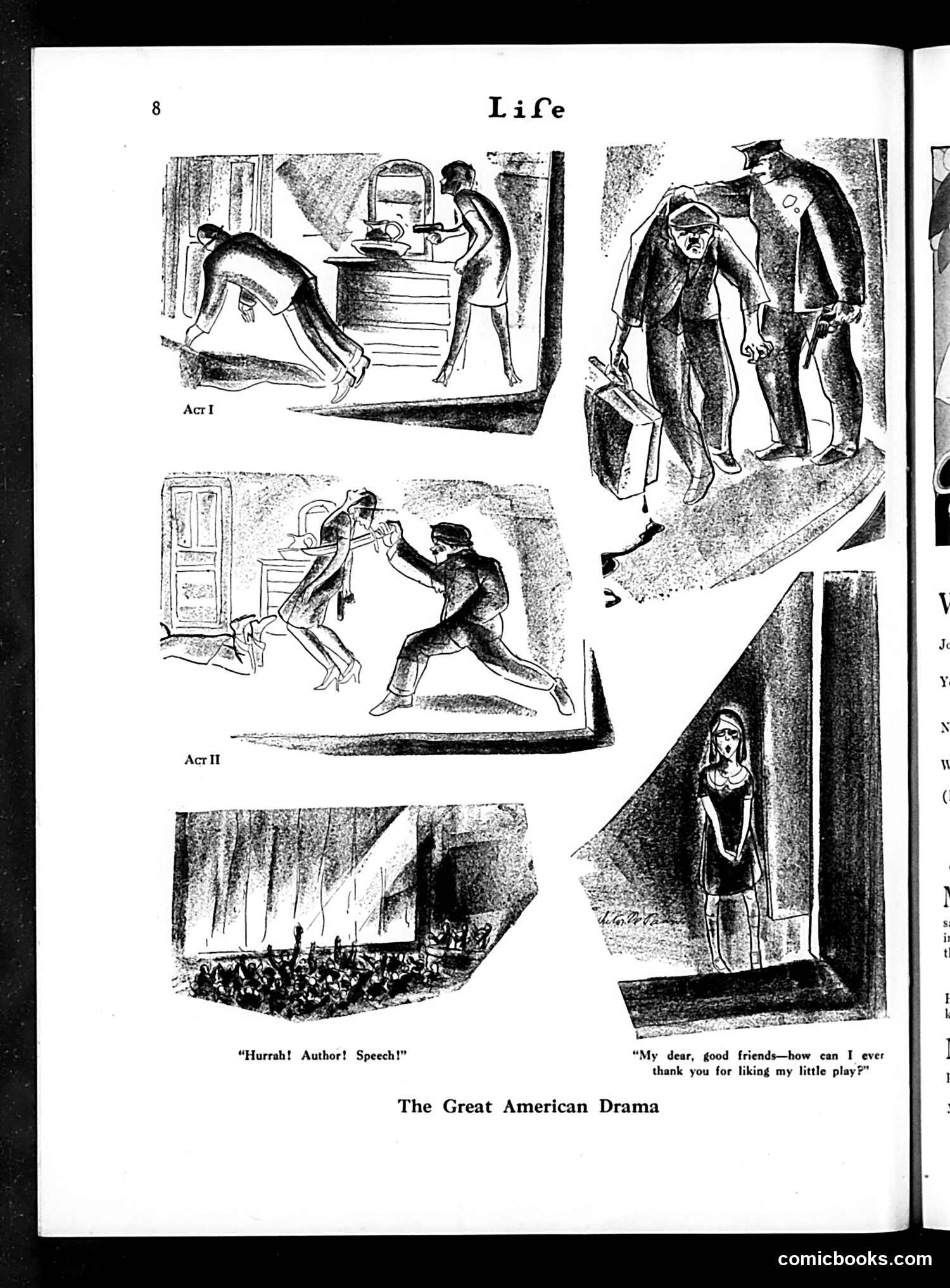
This satirical piece critiques theatrical pretension in America. The four-panel sequence shows the progression of a play production: **Act I** depicts domestic servants preparing for a performance. **Act II** shows what appears to be a theatrical rehearsal or confrontation between actors. The lower left panel shows an audience watching a theatrical performance ("Hurrah! Author! Speech!"), while the final panel shows a woman (likely the playwright) humbly thanking the audience for liking her "little play." The satire targets the gap between the grandiose reception of American theater and its often humble or trivial origins—suggesting that what audiences celebrate as great drama may simply be domestic farce dressed up as art. The title's ironic tone emphasizes this deflation of theatrical pretense.
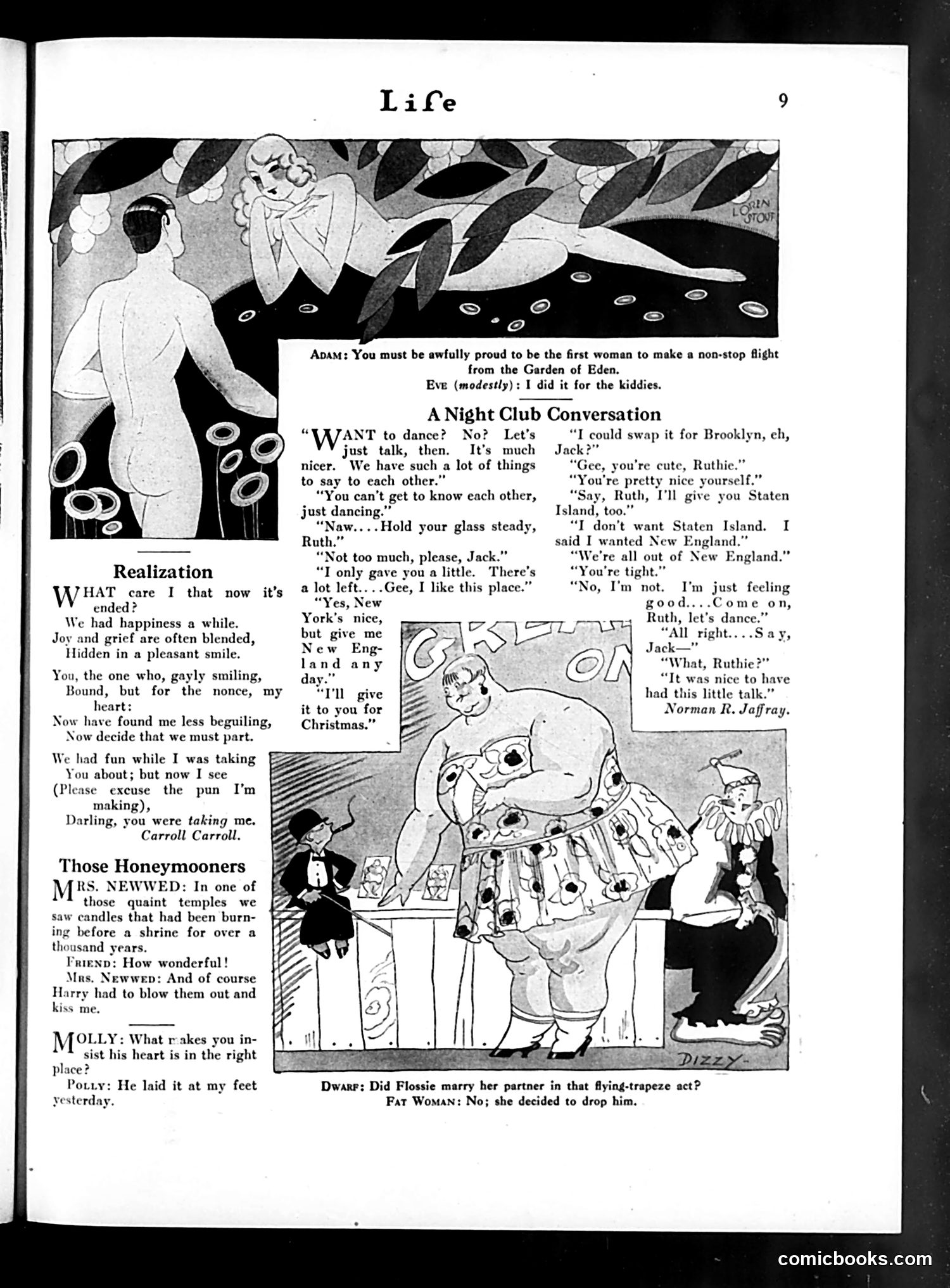
This page contains three humor pieces mocking 1920s social trends: 1. **"A Night Club Conversation"**: Satirizes young women's increasing independence and sexual frankness in the Jazz Age. The dialogue between "Jack" and "Ruth" captures the modern flapper's casual attitude toward romance and travel—shocking to conservative readers. 2. **"Realization"**: A poem about romantic disappointment, contrasting initial happiness with present separation. The tone is sentimental, typical of period verse. 3. **"Those Honeymooners"** and **"Molly"**: Brief comic exchanges mocking marriage and women's changing roles—including a jab at women's presumed materialism (the final "Dwarf/Fat Woman" caption). The accompanying illustration depicts a large woman in revealing attire, reflecting period caricature conventions and attitudes toward female sexuality and body types.
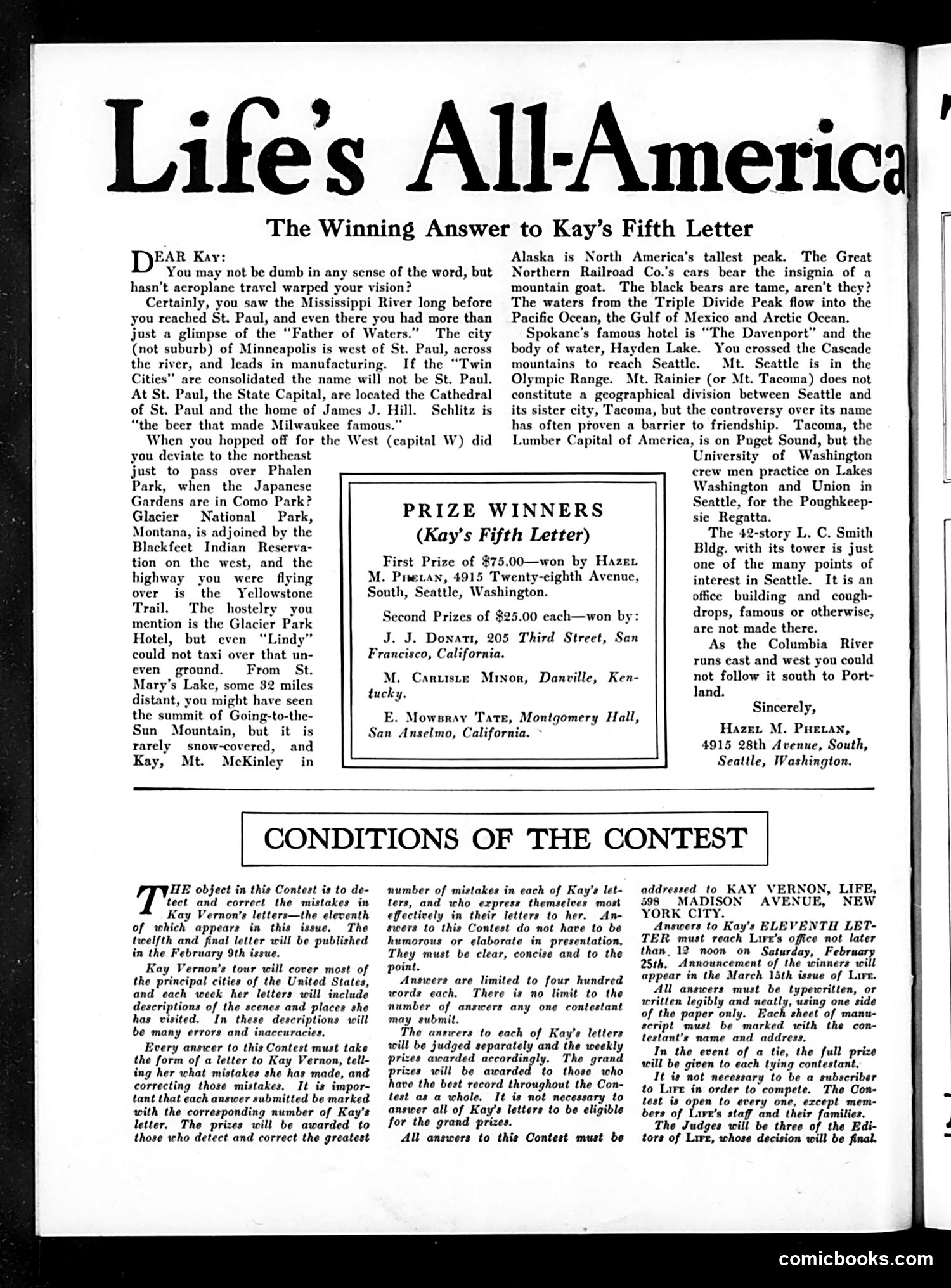
This page is primarily **not a cartoon but a contest results announcement**. It presents "Life's All-America" feature responding to a reader named Kay's geography question about American landmarks and locations. The content includes: - A letter from **Hazel M. Phelan** (Seattle) answering Kay's fifth letter with corrections about U.S. geography - **Prize winners** listed for detecting mistakes in Kay's letters - **Contest conditions** explaining the mechanics of an ongoing reader participation game The feature appears to be an **interactive educational element** where Life magazine engaged readers by publishing letters containing deliberate geographical errors, then rewarding readers who caught and corrected them. This was a popular early 20th-century magazine format combining entertainment with reader engagement and geography education.
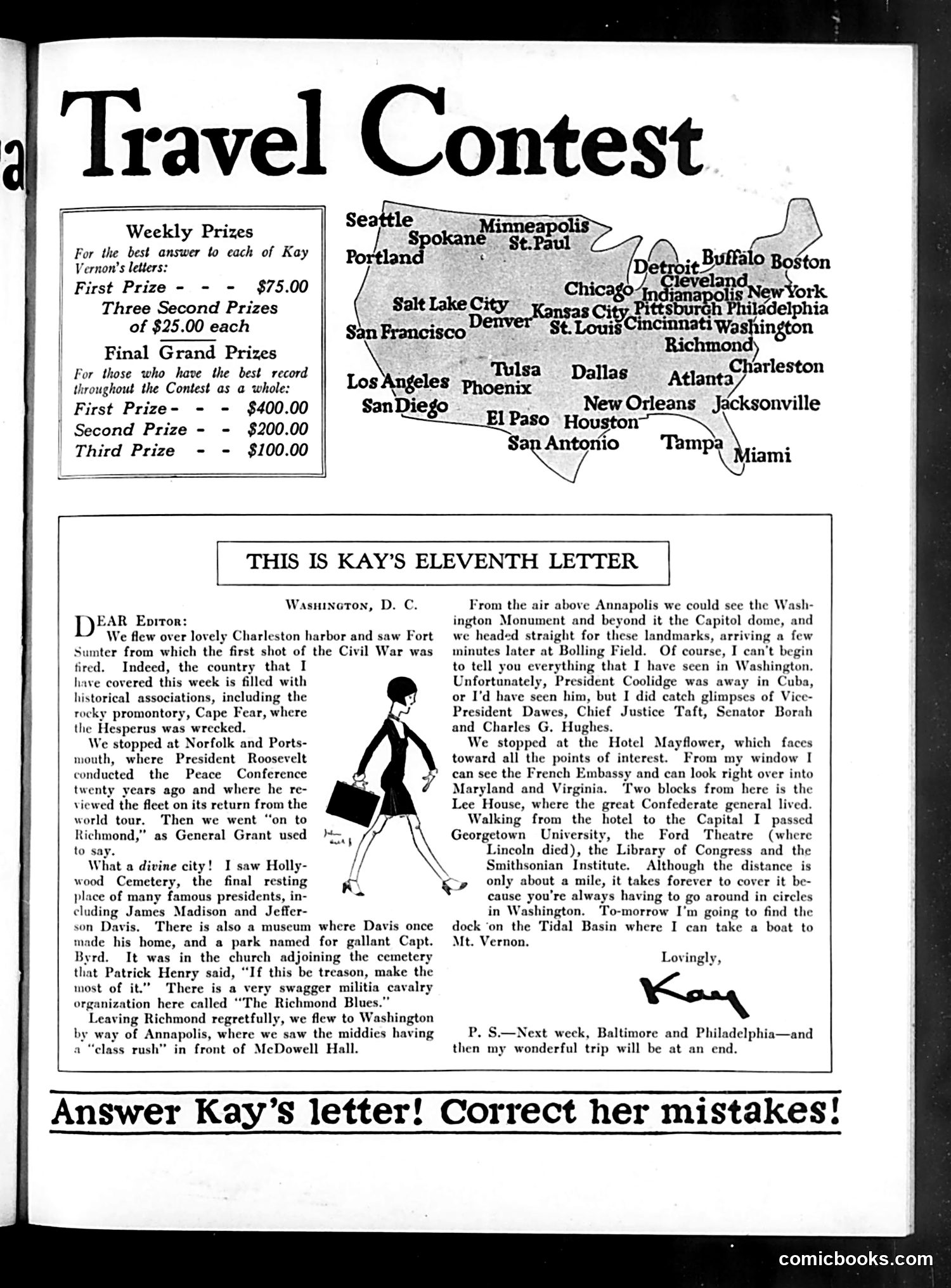
This is a **contest/game page**, not political satire. The page features: **The Contest**: Readers submit answers to errors ("mistakes") in Kay's weekly travel letter. Weekly prizes ($75 first prize) and grand finals prizes ($400) incentivize participation. **Kay's Letter**: The eleventh in a series, this week covers Washington, D.C. Kay describes visiting historical sites (Fort Sumter, Richmond, the Capitol, Georgetown University, etc.) and mentions seeing President Coolidge was away in Cuba. **The Game Mechanic**: Readers must identify factual errors in Kay's account to win prizes—a common early 20th-century magazine engagement strategy. **Modern Context**: This reflects pre-television era entertainment: readers actively participated in magazines through contests and puzzles, making them interactive rather than passive media.
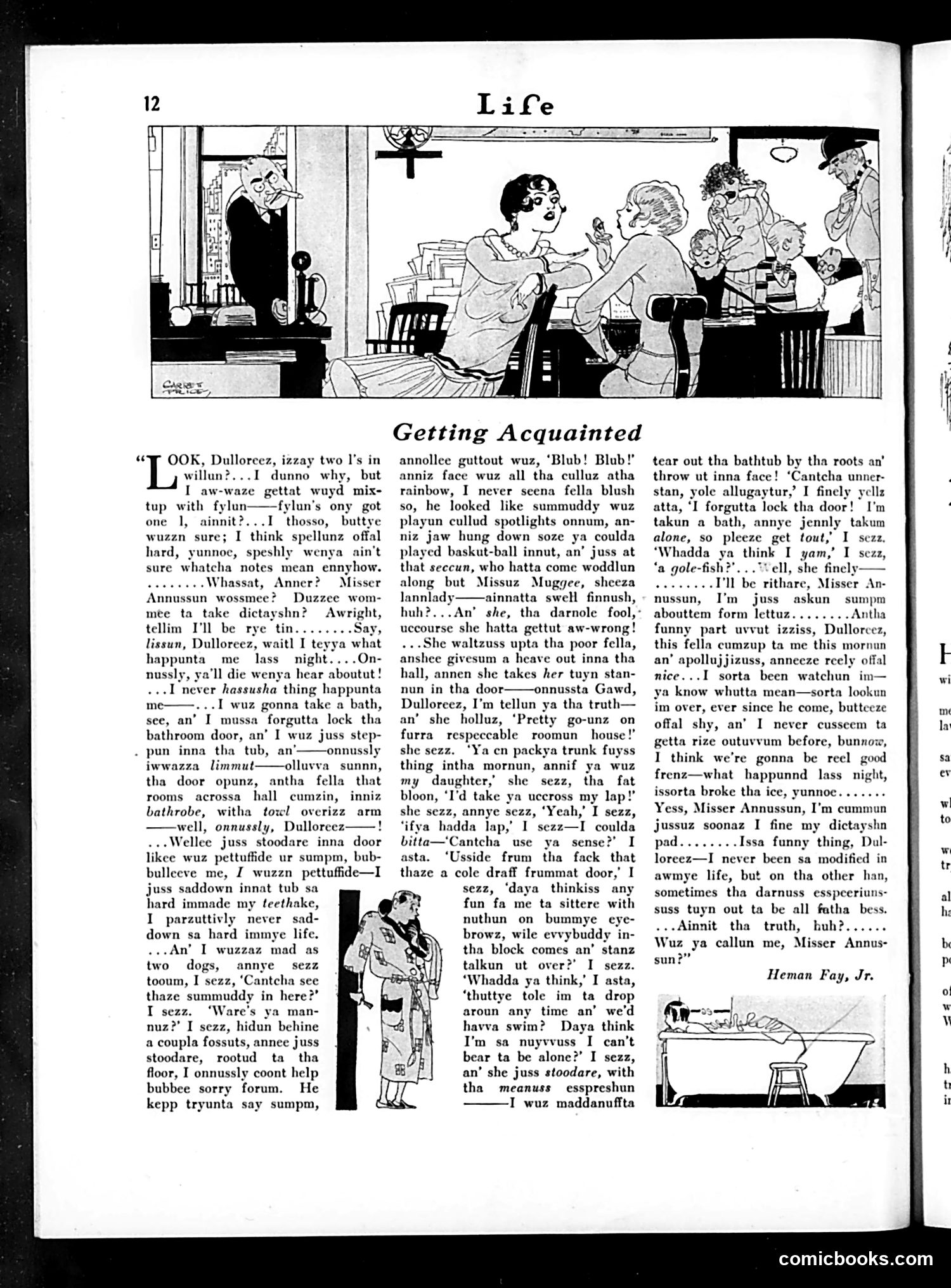
This page satirizes African American dialect and stereotypes through a fictional monologue titled "Getting Acquainted." The text uses exaggerated, offensive phonetic spelling to represent Black speech patterns—a common (though deeply racist) comedic device in early 20th-century American humor magazines. The cartoon illustrations show an interior domestic scene with multiple figures engaged in social interaction. The satire appears to mock both the characters depicted and, implicitly, contemporary social anxieties about integration or unfamiliar social situations. This represents the casual, institutional racism embedded in mainstream American publications of the era, where caricature and dialect humor targeting Black Americans were treated as standard comedic fare. Modern readers should recognize this as a historical artifact of period prejudice rather than acceptable humor.
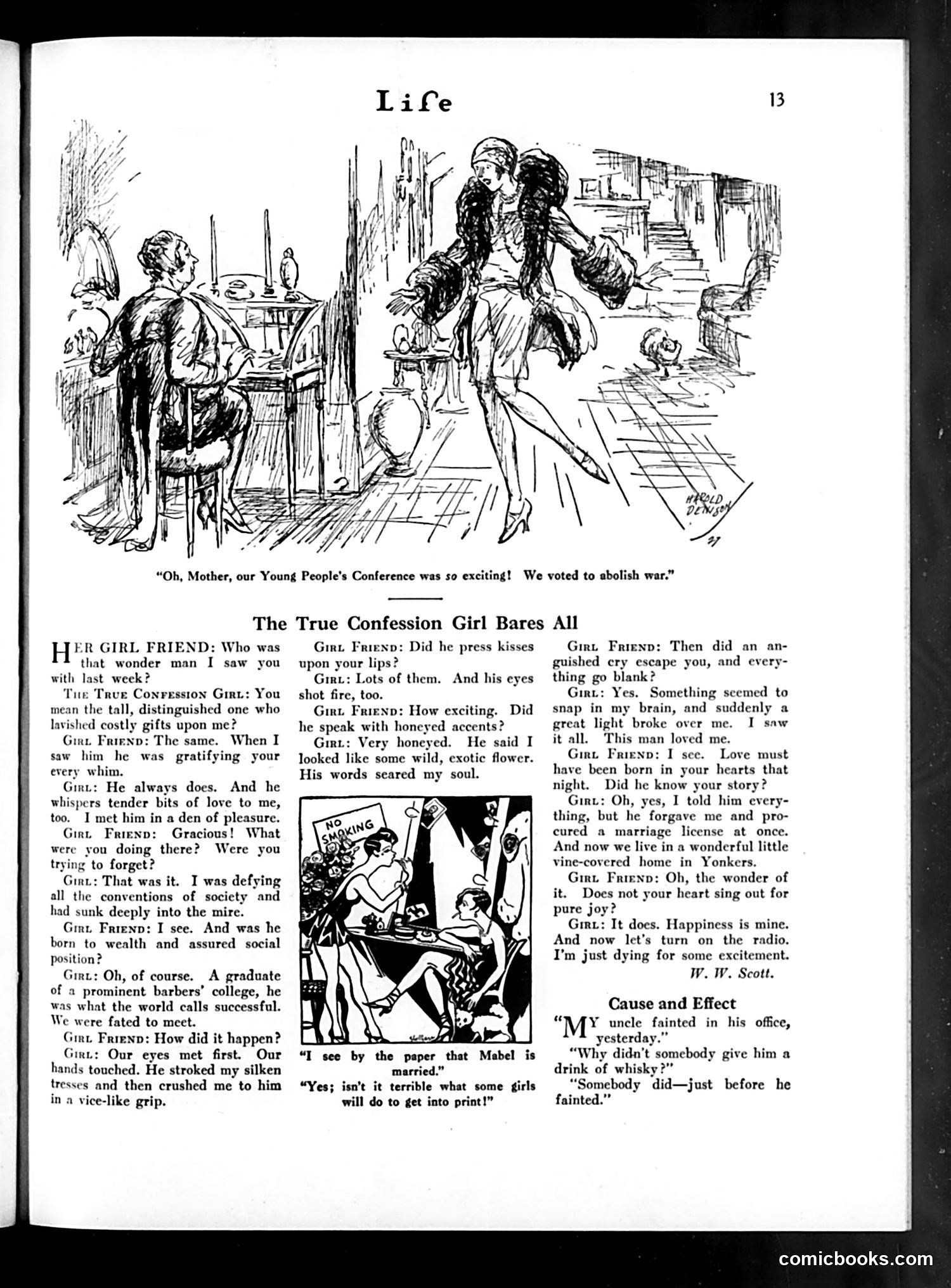
This page satirizes young women's social and romantic behavior in the early 20th century. The main cartoon depicts a woman breathlessly telling her mother about attending a "Young People's Conference" where attendees voted to "abolish war"—suggesting naive idealism. The dialogue column "The True Confession Girl Bares All" mocks female gossip and romantic drama. A young woman confesses details about meeting a wealthy, distinguished man at a social gathering, describing their encounter in breathless, melodramatic terms. The humor targets women's preoccupation with romance and social climbing. The embedded comic strip joke references marriage and journalism, satirizing women's desperation to get published or married. Overall, the page ridicules young women as simultaneously idealistic about social causes yet entirely focused on romance and social status.
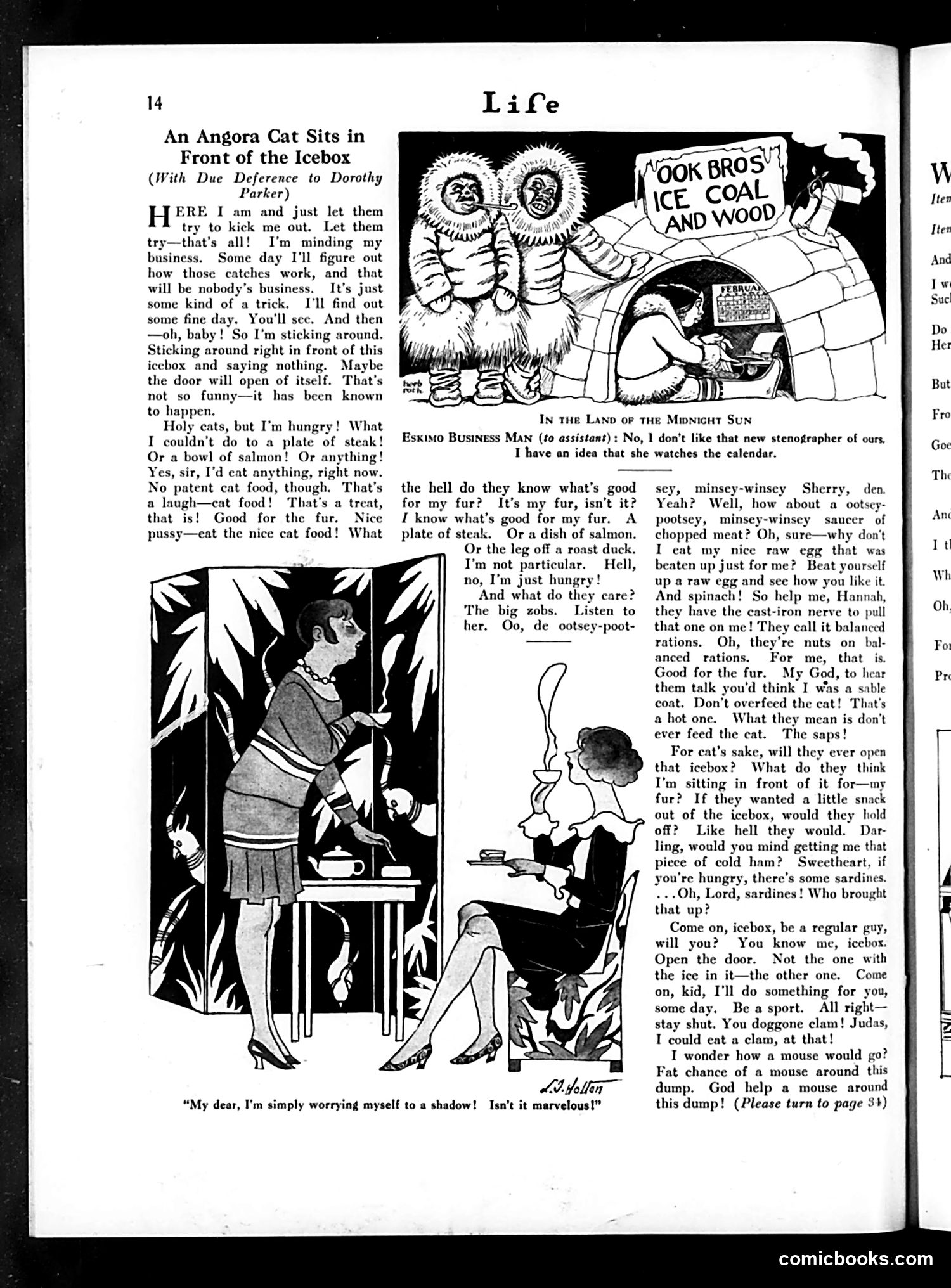
This page from *Life* magazine contains two pieces of satirical humor typical of early-to-mid 20th century American comics: 1. **"An Angora Cat Sits in Front of the Icebox"** features a monologue by a hungry cat complaining about "balanced rations" and low-quality food while sitting guard outside the icebox. The satire mocks nutritional fad diets and the pretense of "balanced" feeding—the cat would rather eat steak or salmon. 2. **"In the Land of the Midnight Sun"** shows an Eskimo stenographer, satirizing the absurdity of modern office work existing even in remote Arctic locations. The joke suggests that bureaucratic "balanced rations" follow humanity everywhere. The cartoons share a unified theme: mocking contemporary obsessions with dietary science and the intrusion of modern corporate rationality into unlikely places, including pets' lives.
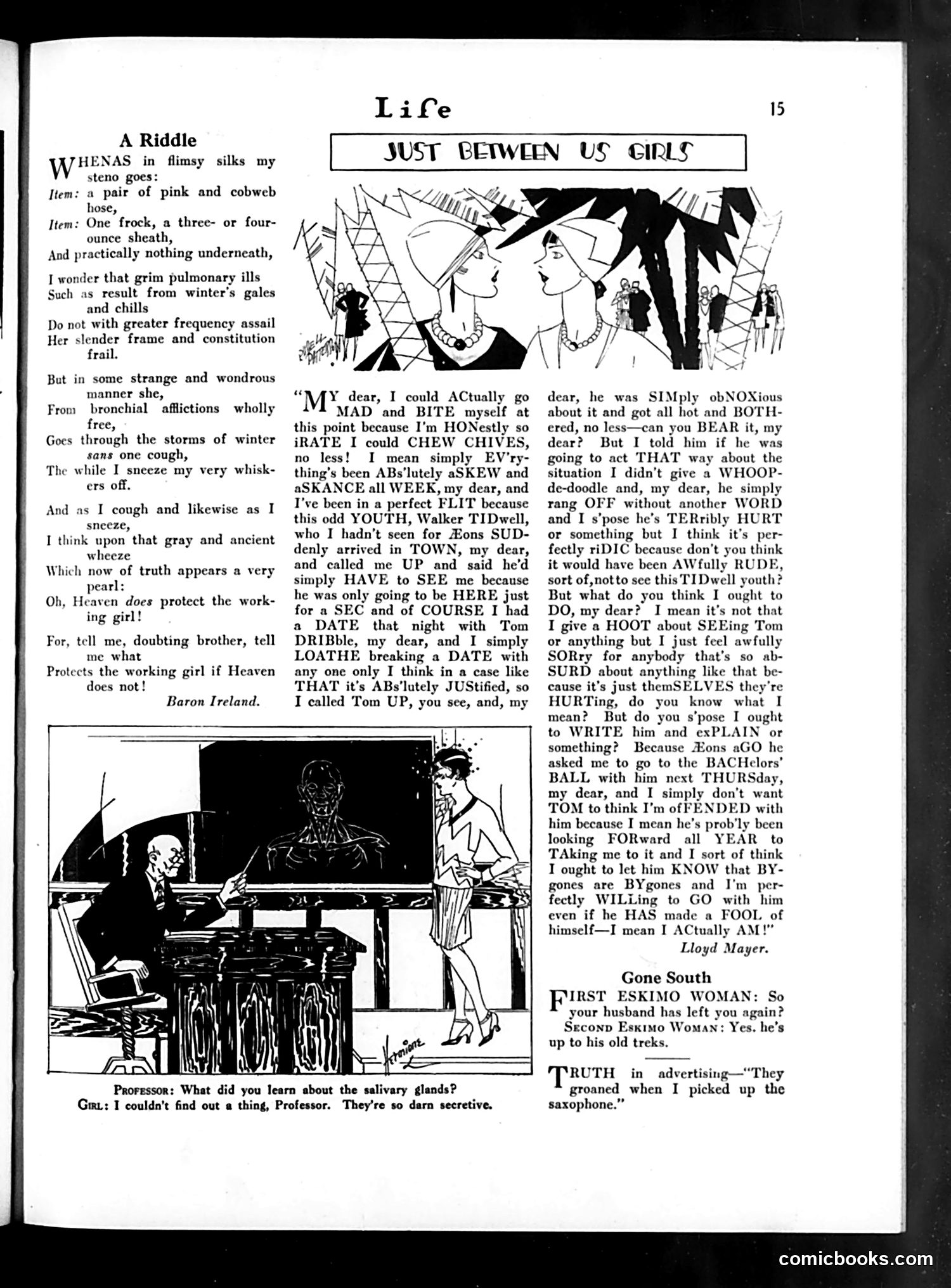
This Life magazine page (page 15) contains three distinct humor pieces: 1. **"A Riddle"** (left): A poem about a woman who endures winter ailments while remaining mysteriously healthy—likely satirizing women's resilience or the Victorian ideal of fragile femininity masking actual strength. 2. **"Just Between Us Girls"** (top right): A comic about young women discussing dating and social etiquette, with one girl complaining about a boy named Tom's behavior. It satirizes the elaborate social codes and romantic anxieties of early 20th-century courting. 3. **"Gone South"** and other brief jokes (bottom): Quick one-liners about marriage and everyday life. 4. **The cartoon** (bottom left): Shows a professor and student discussing "salivary glands"—the joke being the girl's coy inability to find information, playing on period prudishness about anatomy. The page reflects 1920s-30s social humor centered on gender relations and courtship rituals.
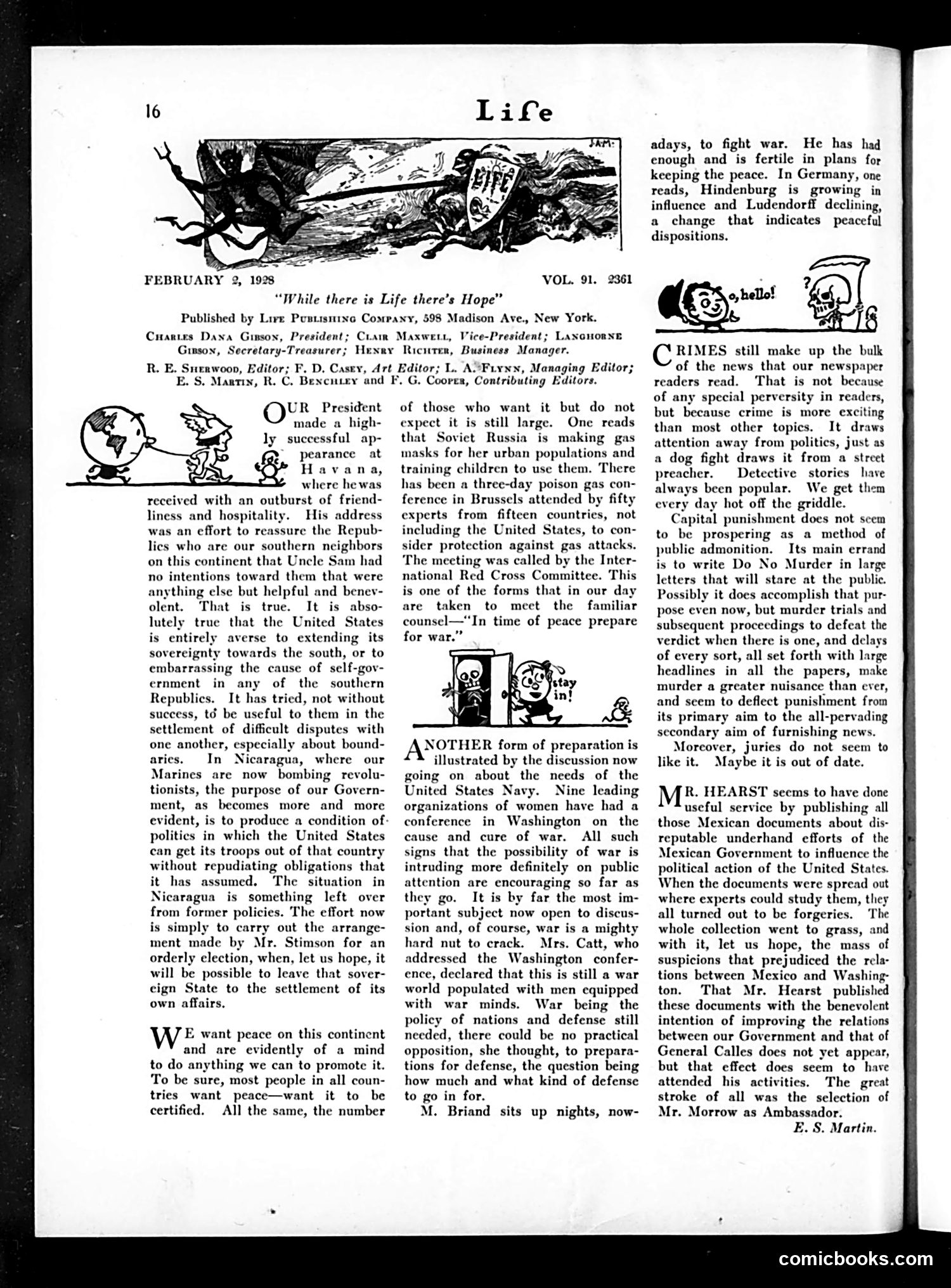
This page contains editorial commentary on peace and defense preparedness rather than a political cartoon. The main illustration shows a globe character greeting another figure—likely representing the U.S. President and America's diplomatic stance. The editorial discusses the President's "successful appearance" at a Pan-American reception, where he reportedly received "an outburst of friendliness and hospitality." The text notes this was meant to reassure Southern neighbors of American sovereignty, especially regarding Nicaragua and Marines operations. The broader argument critiques American preparations for war while claiming to want peace. It references ongoing Navy discussions about defense needs and mentions documents published by Mr. Hearst regarding Mexican-American relations. The tone suggests skepticism about whether America's peace rhetoric matches its military actions.
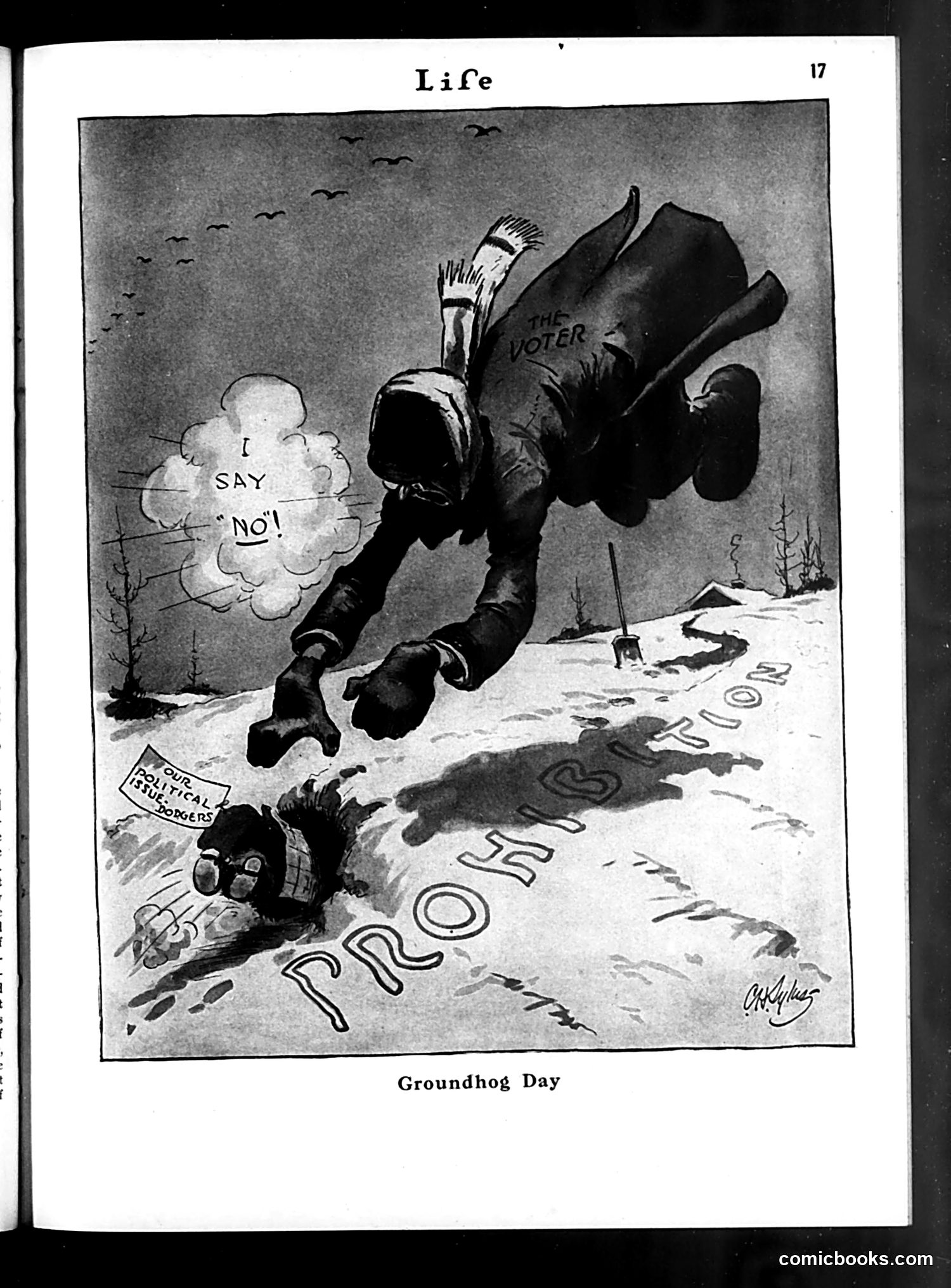
This Life magazine cartoon satirizes "The Voter" during what appears to be a contentious election period. A large figure labeled "The Voter" is depicted being blown backward by his own declared statement "I SAY NO!"—suggesting his political opposition lacks force or conviction. The ground shows "PROHIBITION" written across it, indicating this cartoon concerns voting on alcohol policy. The phrase "POLITICAL PRISONERS" appears on a sign, likely referencing detainees related to prohibition enforcement. The cartoon's title "Groundhog Day" plays on the tradition of predicting seasons—here implying voters predictably emerge from obscurity only to retreat again, or that their political engagement is cyclical and unreliable. The satire critiques voter inconsistency or apathy regarding prohibition policy.
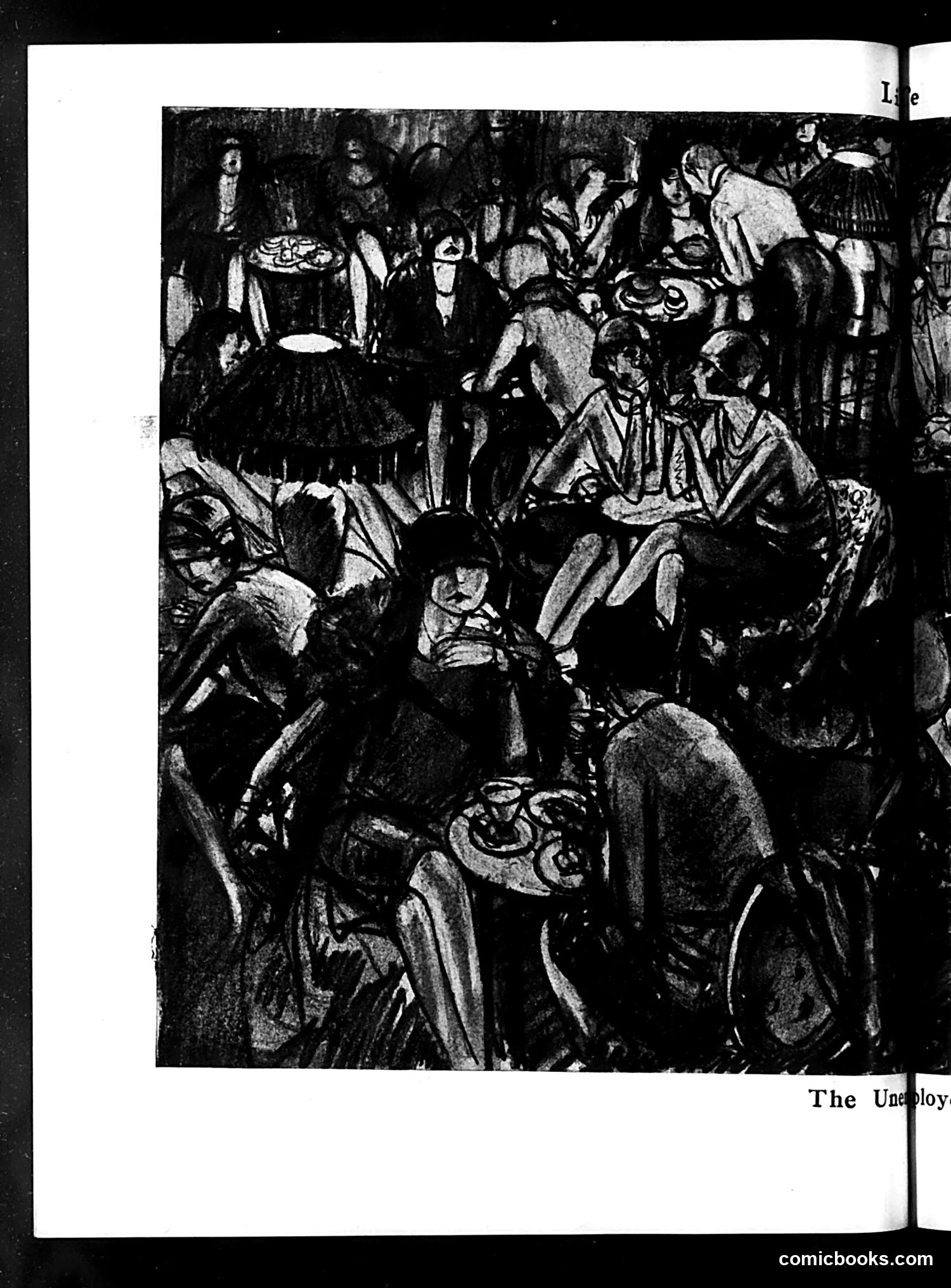
This appears to be a page from *Life* magazine showing a crowded indoor social scene rendered in stark black and white. The caption reads "The Unemploy[ed]" (text cut off), suggesting this depicts unemployed people gathered together. The densely packed composition emphasizes the large number of figures—men, women, and children—crowded into a confined space. The artistic style uses heavy contrast and expressionistic treatment typical of Depression-era social commentary. Given the title and visual treatment, this is likely satirizing or documenting unemployment during the Great Depression, showing the human cost through the sheer density of displaced workers. The crowded, claustrophobic composition reinforces themes of economic hardship and social dislocation that characterized 1930s American life.
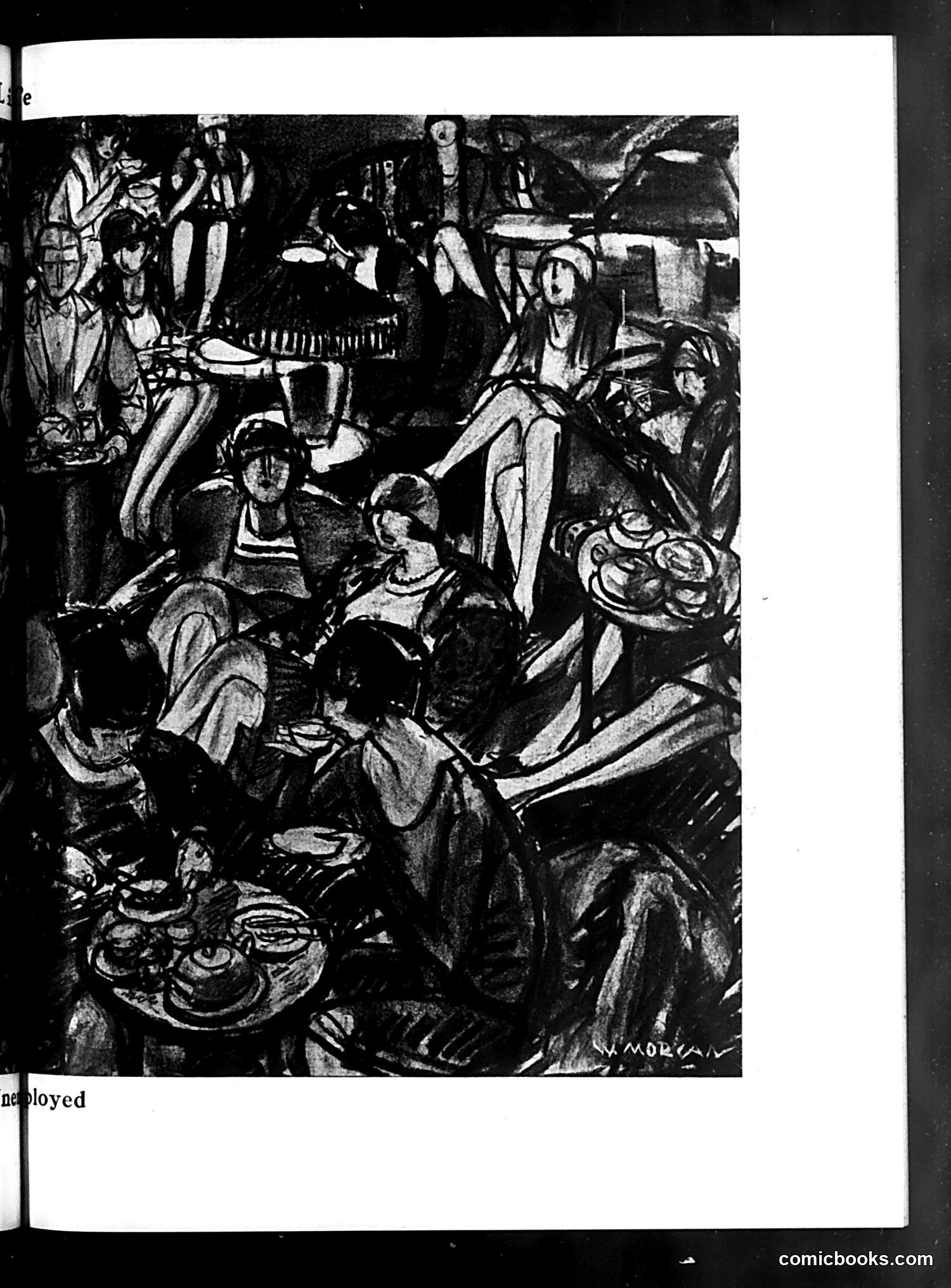
This appears to be a satirical illustration depicting a nightclub or cabaret scene, likely from the 1920s-1930s based on the style and fashion. The scene shows women in revealing clothing entertaining men in what seems to be a speakeasy or similar venue—a reference to Prohibition-era entertainment culture. The artist's signature reads "SIMONIAN" (or similar). The satire likely critiques either the hypocrisy of Prohibition enforcement, the degradation of women in entertainment venues, or the excess and moral decay associated with underground nightlife during this period. The visible text fragment "employed" suggests commentary on employment conditions, possibly criticizing how women were exploited in these establishments. The crude, expressionistic style emphasizes the chaotic, morally questionable nature of the scene being mocked.
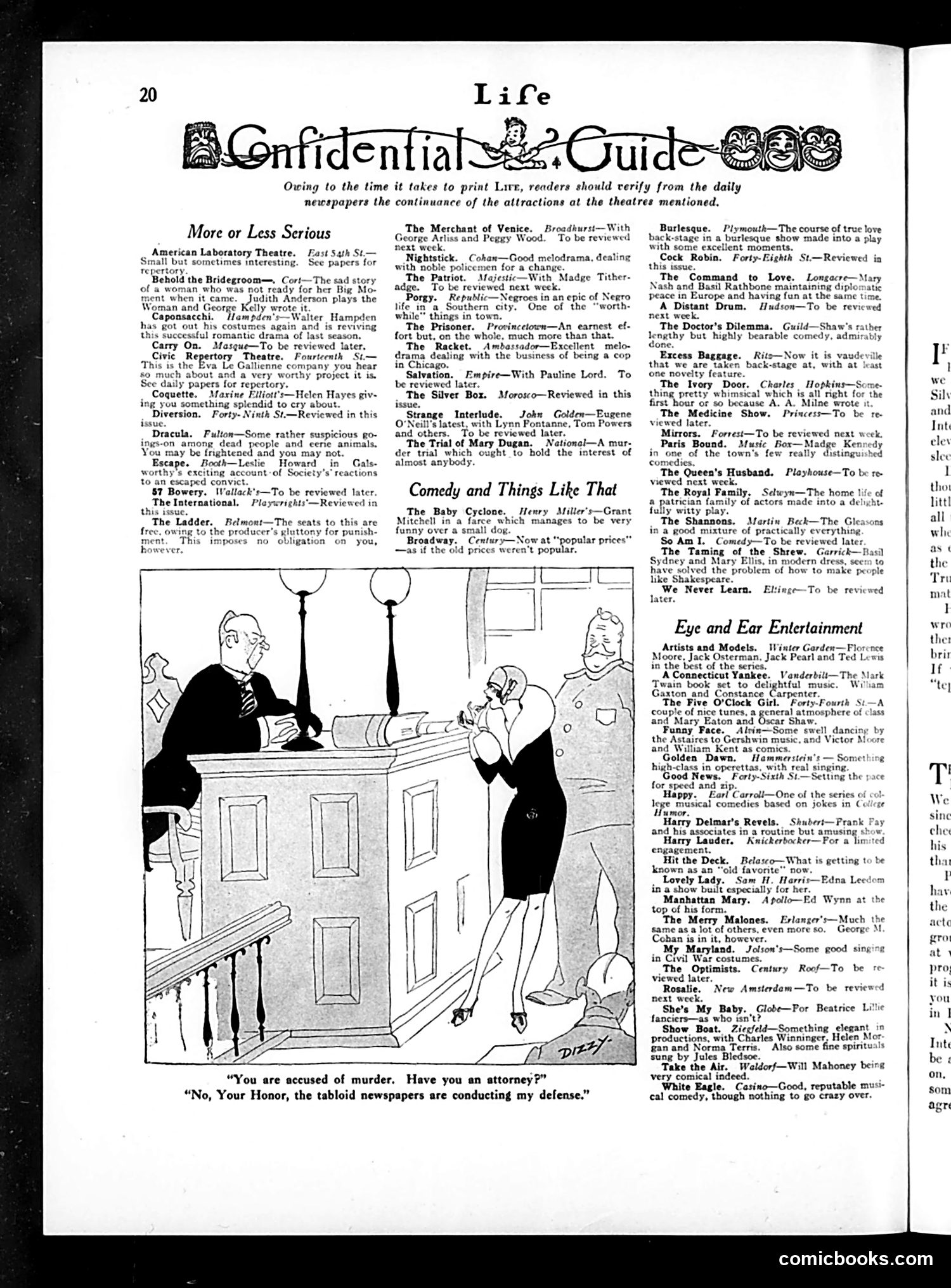
This page from *Life* magazine presents a courtroom satire. The cartoon depicts a defendant accused of murder standing before a judge, with the caption exchange: **"You are accused of murder. Have you an attorney?"** **"No, Your Honor, the tabloid newspapers are conducting my defense."** The satire criticizes **sensationalist tabloid journalism** of the 1920s era. The joke suggests that tabloid newspapers—known for lurid crime coverage and inflammatory reporting—were effectively serving as the defendant's legal counsel through their extensive, often prejudicial coverage. Rather than hiring an actual lawyer, the defendant ironically claims the tabloids themselves are defending him through their relentless news coverage. This reflects contemporary anxiety about tabloid influence on public opinion and justice, satirizing how tabloid sensationalism could shape trial outcomes more effectively than traditional legal representation. The cartoon mocks both the defendant's naive reliance on tabloid coverage and the tabloids' outsized power in shaping criminal proceedings.
This theater review column critiques three Broadway productions. The author playfully dismisses John Howard Lawson's "The International" as tedious propaganda—full of worthy socialist messages about trusts and class struggle, but dramatically inert. The satirical point is that Lawson's play preaches rather than entertains; you might as well read the script at home. By contrast, Philip Barry's "Cock Robin" (a murder mystery co-written with Elmer Rice) succeeds because it prioritizes entertainment and clever staging tricks over political messaging. The reviewer praises Barry as a "favorite personal friend-playwright." The reference to Galsworthy's "The Silver Box" and "Free Silver Bulletin" anchors the piece in a broader critique: outdated theatrical and political material. The humor lies in the tension between avant-garde political theater and commercial entertainment—a recurring 1920s debate about drama's purpose.
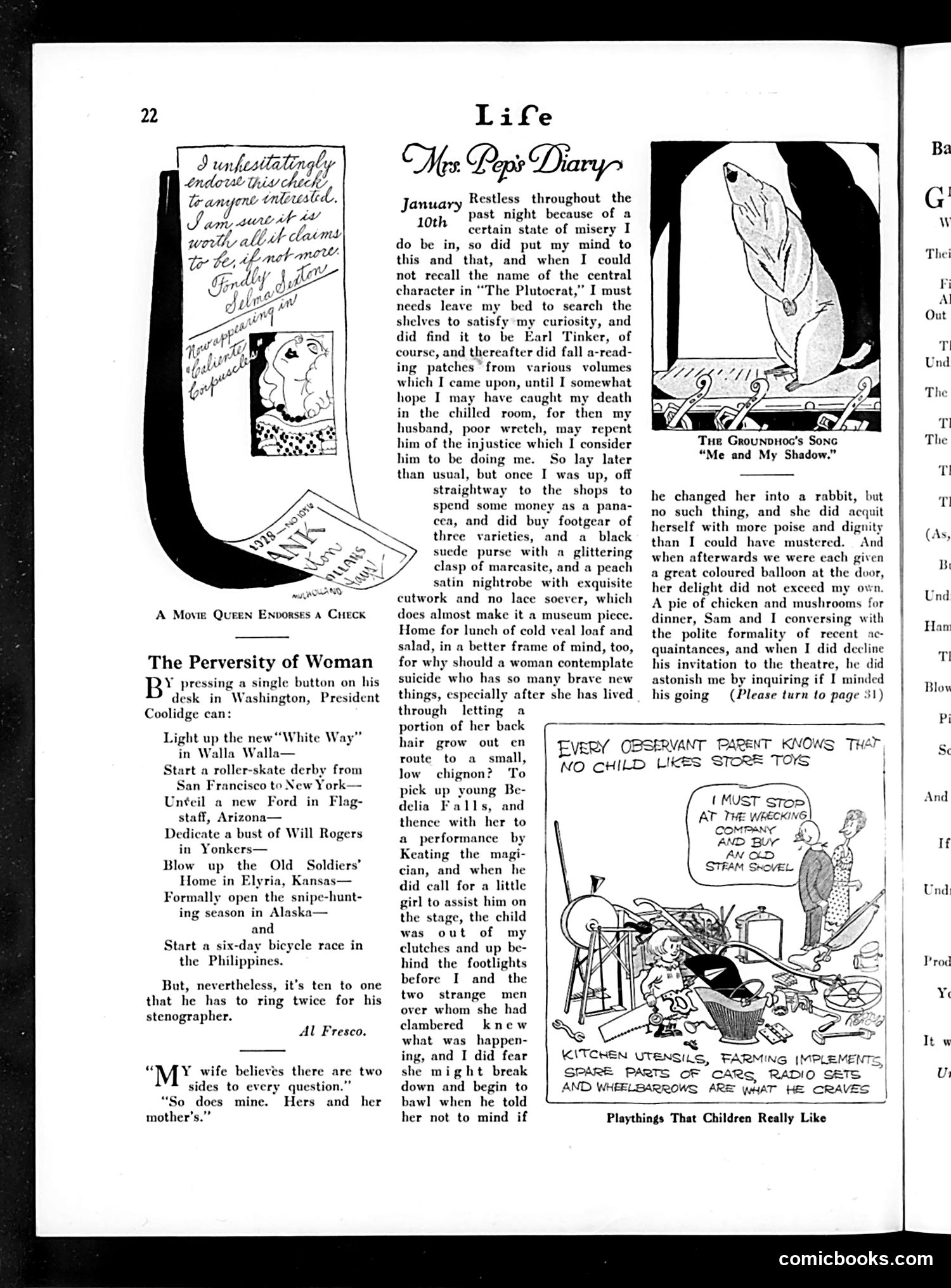
This *Life* magazine page (circa 1920s) contains three distinct satirical pieces: **"The Perversity of Woman"** mocks President Coolidge's vast executive power. The joke: despite controlling national infrastructure via a desk button, he cannot command his own stenographer to answer on the first ring—humorously suggesting women are inherently uncontrollable. **"Mrs. Pope's Diary"** (top right) parodies self-absorbed, melodramatic women who contemplate suicide over trivial matters, then recover through shopping and entertainment. The satire targets upper-class female frivolousness. **"Playthings That Children Really Like"** (bottom) presents a domestic cartoon showing a child preferring to play with actual junkyard items—old tools, car parts, wheelbarrows—over manufactured toys. The caption expresses what "every observant parent knows," satirizing the disconnect between what consumers buy children and what children actually enjoy. All three pieces reflect 1920s attitudes: skepticism toward female rationality, class-based humor about consumption, and commentary on modern consumer culture.
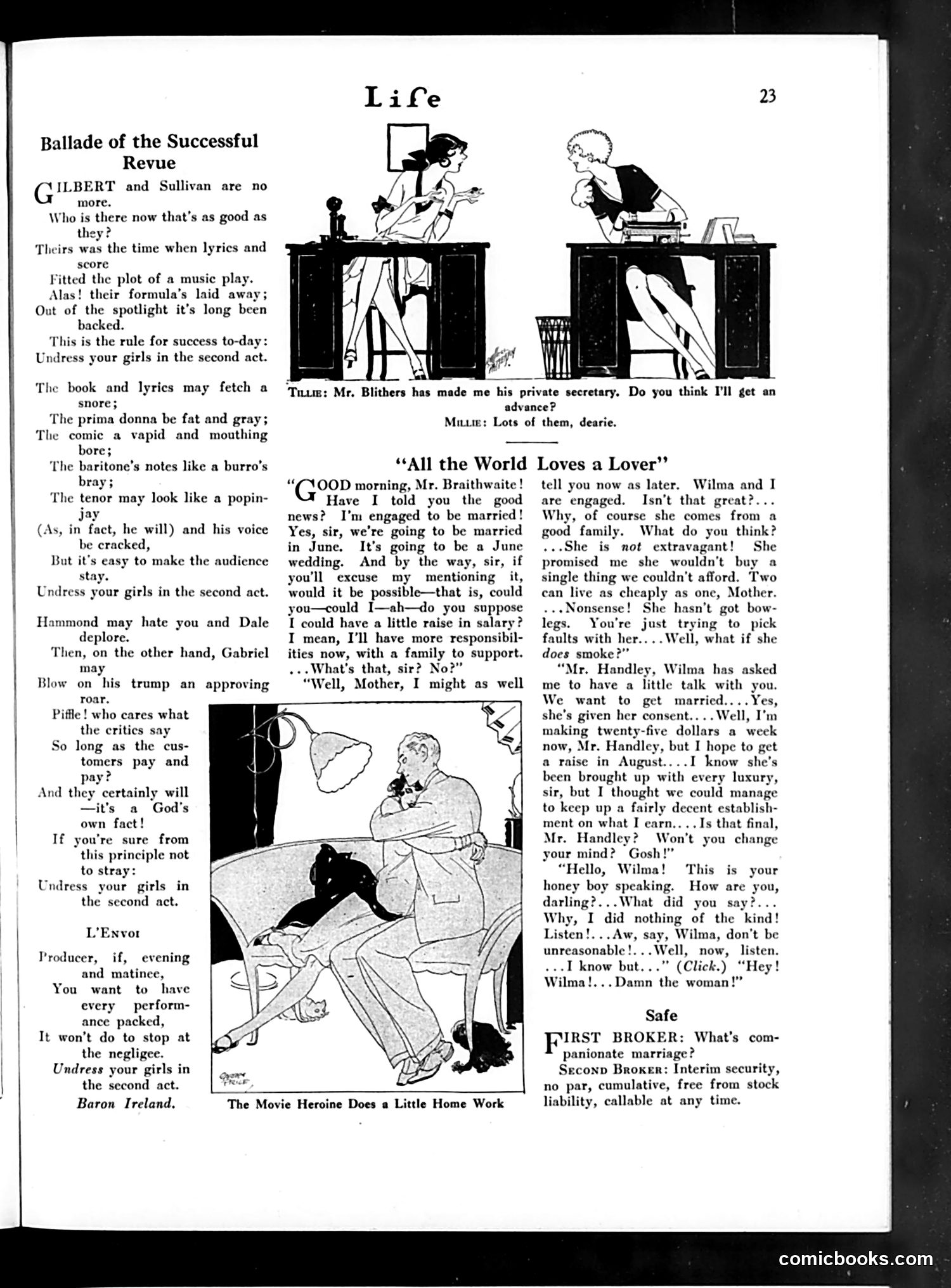
This Life magazine page contains two distinct satirical pieces: **"Ballade of the Successful Revue"** (left) mocks the decline of quality musical theater. It contrasts Gilbert and Sullivan's sophisticated operettas with contemporary revues that prioritize spectacle over artistry. The poem's repeated refrain—"Undress your girls in the second act"—satirizes producers who rely on female nudity rather than plot, lyrics, or talented performers to fill seats. The joke: audiences will pay regardless of quality if skin is exposed. **"All the World Loves a Lover"** (right) satirizes young men's desperation in courtship and marriage. The cartoon shows a fiancé nervously asking his employer (Mr. Handley) for a raise to support his engagement, only to be rejected. The dialogue captures the anxious, submissive tone men adopted when seeking approval and financial security for marriage—reflecting early 20th-century class dynamics and marriage customs where a woman's family's approval (and financial standing) heavily influenced outcomes. Both pieces critique contemporary social values: shallow entertainment and transactional courtship.
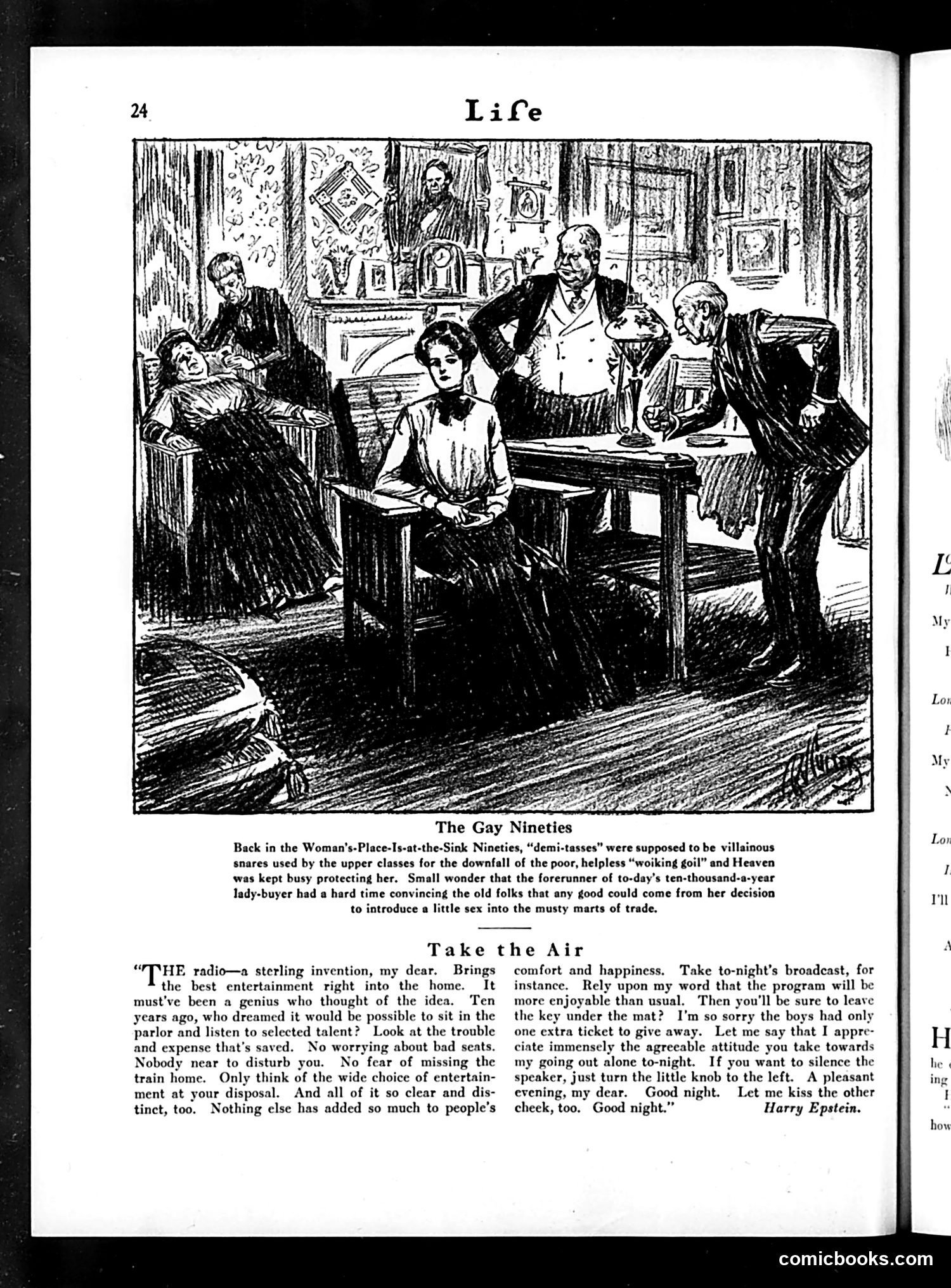
This page contains two satirical pieces from Life magazine mocking social hypocrisy. **"The Gay Nineties"** cartoon depicts upper-class men introducing young working-class women ("demi-tasses," French coffee cups, a period slur) into department stores as saleswomen. The caption mocks how 1890s moralists—who believed such women needed protection from "villainy"—struggled to accept this as legitimate work. The satire targets prudish attitudes that saw any mixing of classes as morally dangerous, yet allowed economic exploitation. **"Take the Air"** is a darkly comedic monologue by a man using radio as an excuse to go out alone while leaving his wife at home. He patronizingly praises radio's convenience, then casually mentions giving his ticket to someone else and asking her to stay put. The final "let me kiss the other cheek" suggests infidelity. Epstein's satire exposes how men weaponized new technology to justify neglecting their wives while maintaining a facade of modern sophistication.
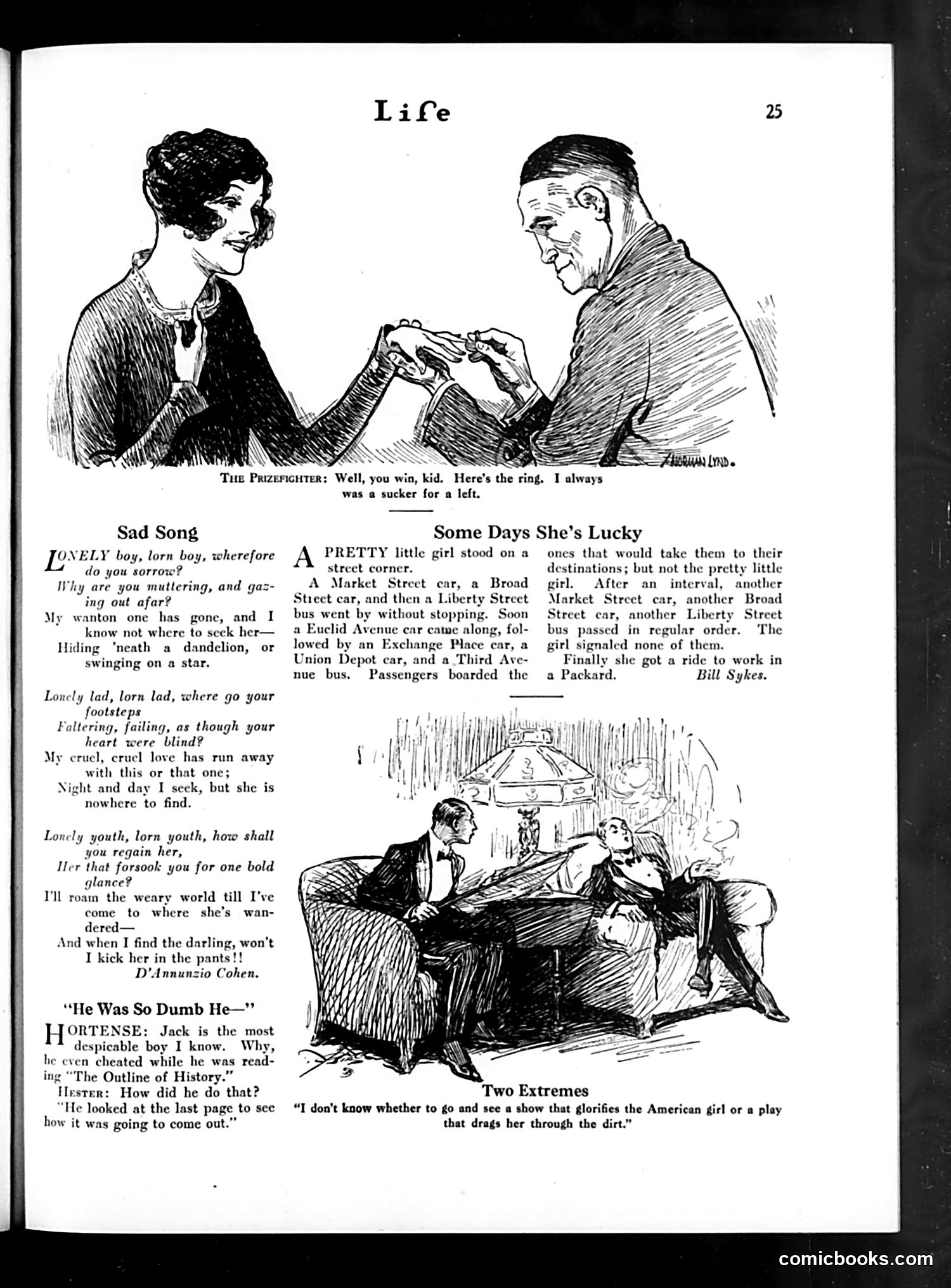
This page contains several satirical pieces reflecting early 20th-century American humor: **"The Prizefighter" cartoon** shows a boxer giving a woman a ring, joking he was "a sucker for a left"—playing on boxing terminology for romantic vulnerability. **"Sad Song"** parodies sentimental poetry about lost love, ending with crude humor: the lovelorn narrator threatens to kick his departed lover "in the pants"—the anticlimax mocks overwrought romantic verses popular at the time. **"Some Days She's Lucky"** satirizes a pretty girl waiting for public transportation. Multiple streetcars pass while she signals none, until finally a wealthy person in a Packard automobile picks her up—commenting on class distinctions and women's economic dependence. **"Two Extremes"** lampoons conflicting cultural representations of American women: theatrical productions either idealize or degrade her, offering no middle ground. The page reflects period anxieties about gender roles, class, and cultural representation through humor.
This is a film review column defending Charlie Chaplin's *The Circus* against critical dismissal. The author argues that other critics wrongly condemned the film for being "too funny" and reverting to slapstick rather than Chaplin's celebrated "tragic appeal." The writer defends low humor by citing Chaplin's best moments—eating a shoe in *The Gold Rush*, sitting on a candle in *The Pilgrim*—arguing that when Chaplin performs old gag formulas, his genius elevates them above similar comedians like Buster Keaton. The piece also critiques how dancer-turned-actress Gilda Gray has received progressively worse film roles despite earnest effort (*The Devil Dancer* being the poorest), suggesting her movie career may be ending despite earning $2 million. The satire targets critical snobbery—the notion that Chaplin's worth depends on pathos rather than comedy craft.
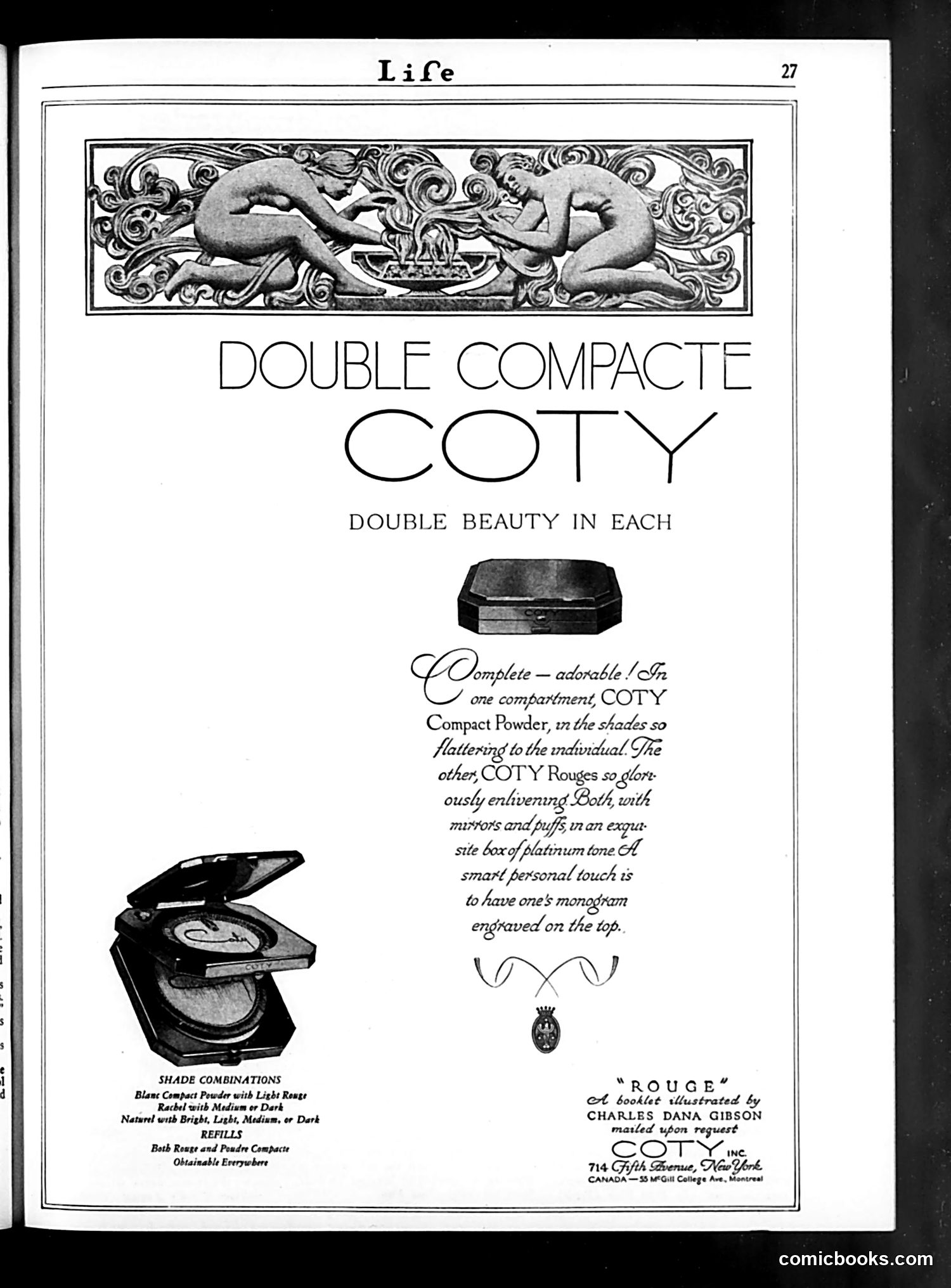
This is a cosmetics advertisement, not a political cartoon. The page promotes COTY's "Double Compacte Coty" makeup product—a compact containing both powder and rouge in a single case. The ornamental header features classical cherub figures, typical Art Deco design of the era. The ad emphasizes luxury and personalization: the compact comes in a platinum-toned box with optional monogram engraving. It lists various shade combinations (Blanc, Rachel, Naturel) paired with different rouge options. The copy uses flowery language ("double beauty in each") typical of 1920s-30s advertising. The illustration by Charles Dana Gibson (famous American illustrator) shows the opened compact. This is straightforward product advertising aimed at affluent female consumers, promoting cosmetics as a desirable status symbol and personal luxury item.
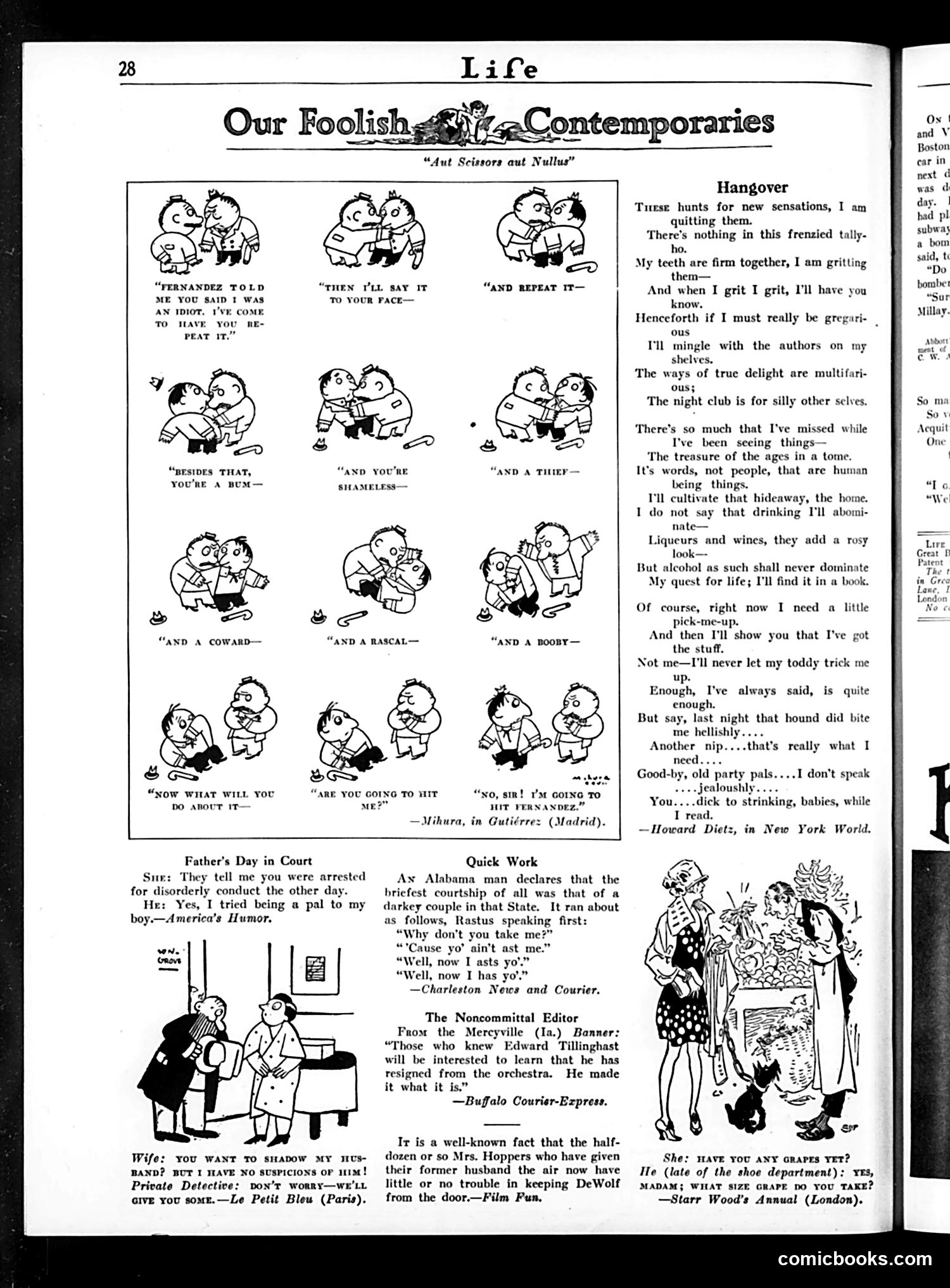
This page collects short humorous pieces mocking contemporary social follies. The main cartoon by Mihura (a Spanish cartoonist) depicts two men in an escalating cycle of insults—one tells the other he's an idiot, leading to recursive accusations of being a "bum," "rascal," and "thief," culminating in threats to repeat the cycle. It satirizes how petty disputes spiral absurdly through third-party gossip and wounded pride. The accompanying jokes target various modern behaviors: a man arrested for "being a pal" to his son (satirizing excessive drinking/indulgence), a private detective who manufactures suspicions to justify his employment, and quick courtship among working-class couples. The poem "Hangover" mocks someone swearing off nightlife and sensations, promising to embrace books and solitude—then immediately undermining that resolve by requesting a drink. The page ridicules 1920s urban excess, gossip culture, and hollow resolutions.
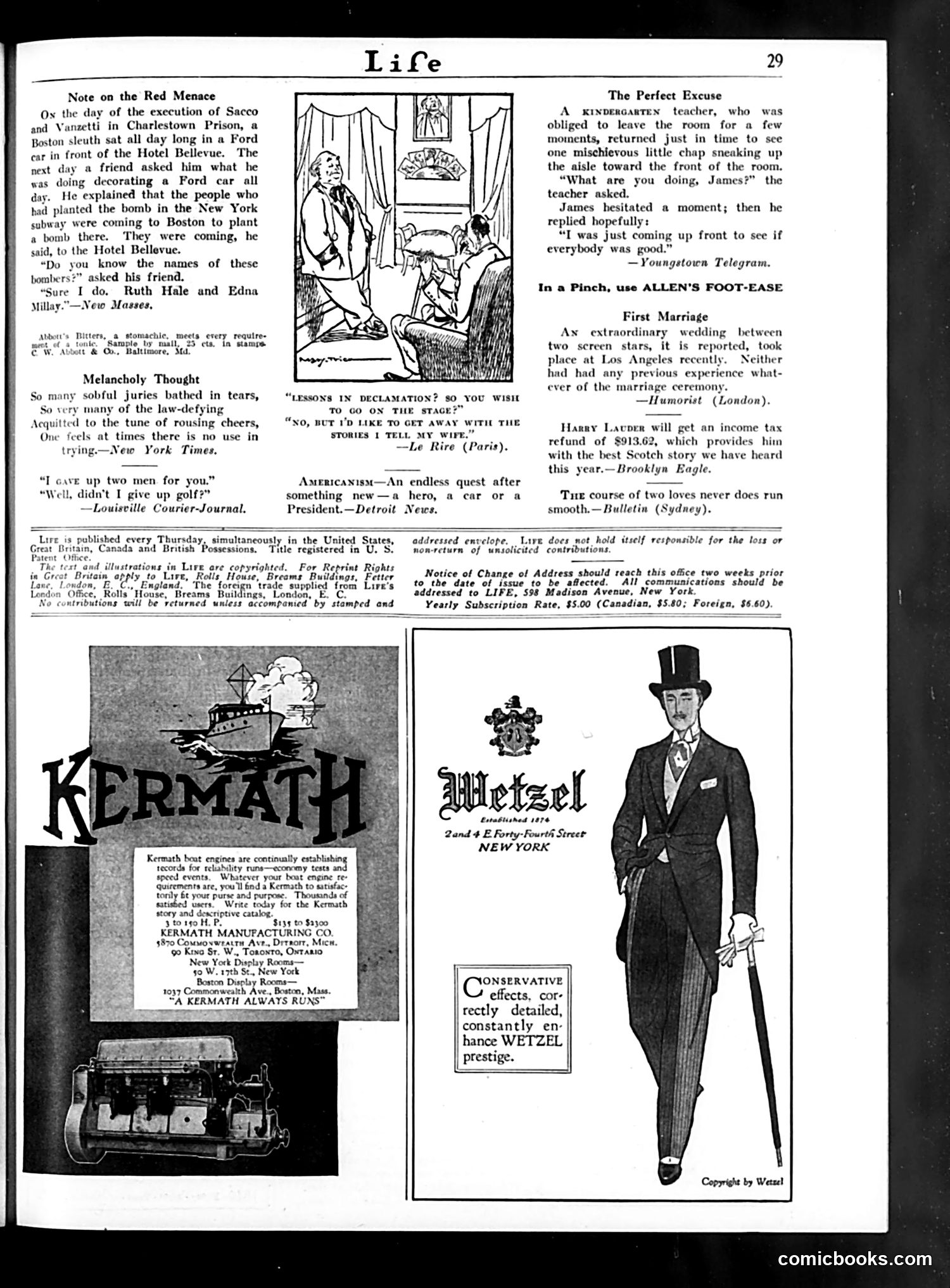
This page from *Life* magazine (a satirical publication) contains several brief humor items and advertisements typical of the era. **"Note on the Red Menace"** references the 1927 execution of anarchists Sacco and Vanzetti. The joke satirizes anti-communist hysteria by claiming a Boston detective suspected Ruth Hale and Edna St. Vincent Millay—prominent literary figures—of being subway bombers, simply because they were known radicals. The satire mocks the paranoia and indiscriminate targeting of leftist intellectuals during the "Red Scare." **"Melancholy Thought"** ironically laments that too many criminals escape justice through acquittals. The remaining items are brief, generic jokes about golf, marriage inexperience among film stars, and classroom mishaps—standard filler humor. **Advertisements** for Kermath boat engines and Wetzel (formal wear) occupy the lower half, with no particular satirical content. The page demonstrates *Life's* focus: topical political satire mixed with light domestic humor and ads.
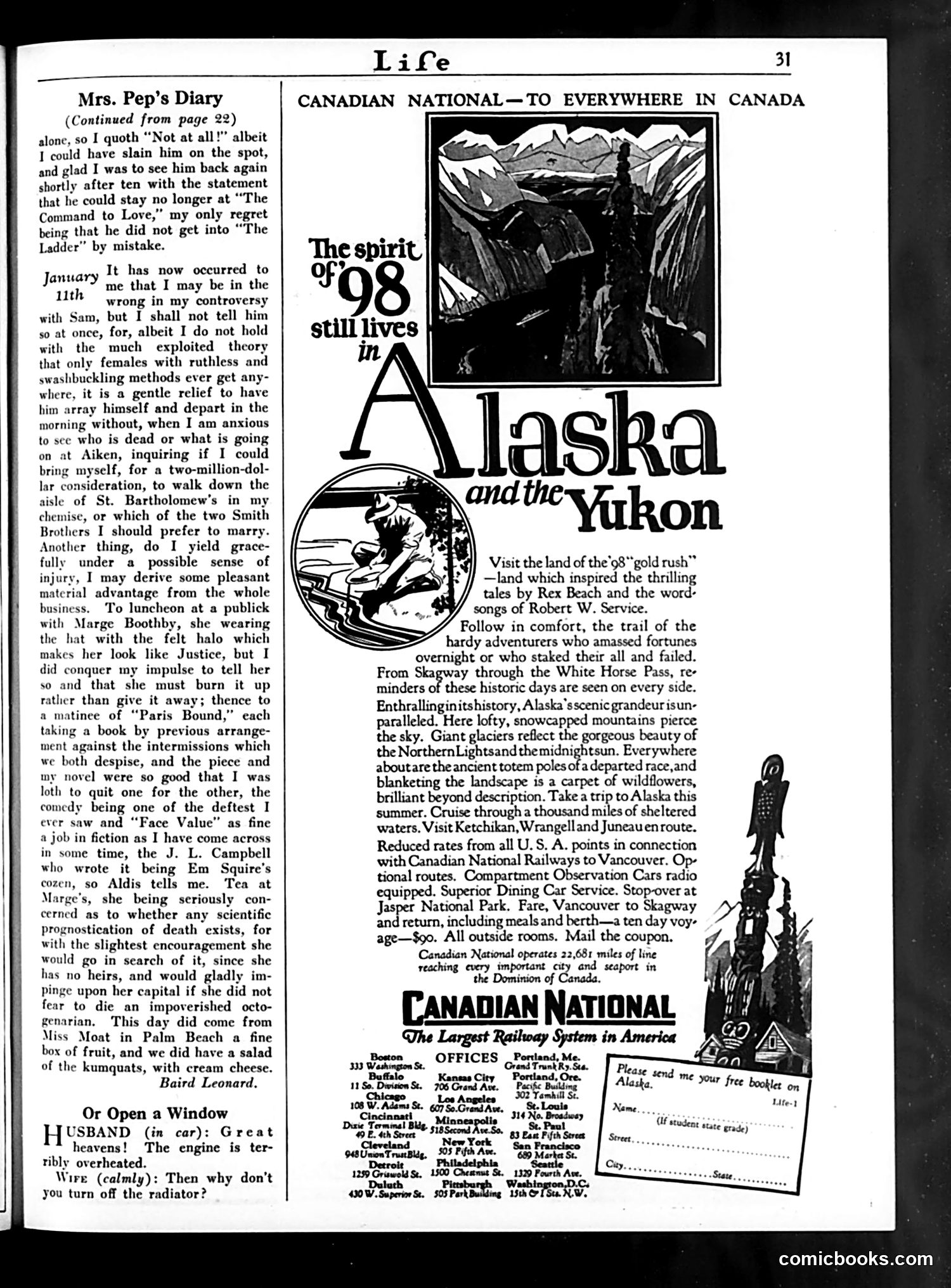
This page contains two distinct elements: **Mrs. Pep's Diary** (left column): A satirical society column following a wealthy woman's trivial daily concerns—attending theater matinees, lunching with friends, discussing hats and fruit salads. The humor lies in treating these mundane activities with mock-serious literary gravity, parodying the breathless society reporting common in 1920s magazines. **"Or Open a Window" (bottom)**: A brief comedic domestic exchange where a husband panics about engine overheating while his wife offers obvious (and emasculating) practical advice, poking fun at masculine bluster and female common sense. **Right side**: A Canadian National Railways advertisement promoting Alaska tourism, emphasizing the Klondike Gold Rush history and scenic beauty—a straightforward travel pitch unrelated to satire. The page exemplifies *Life* magazine's blend of social satire and commercial content targeting affluent readers.
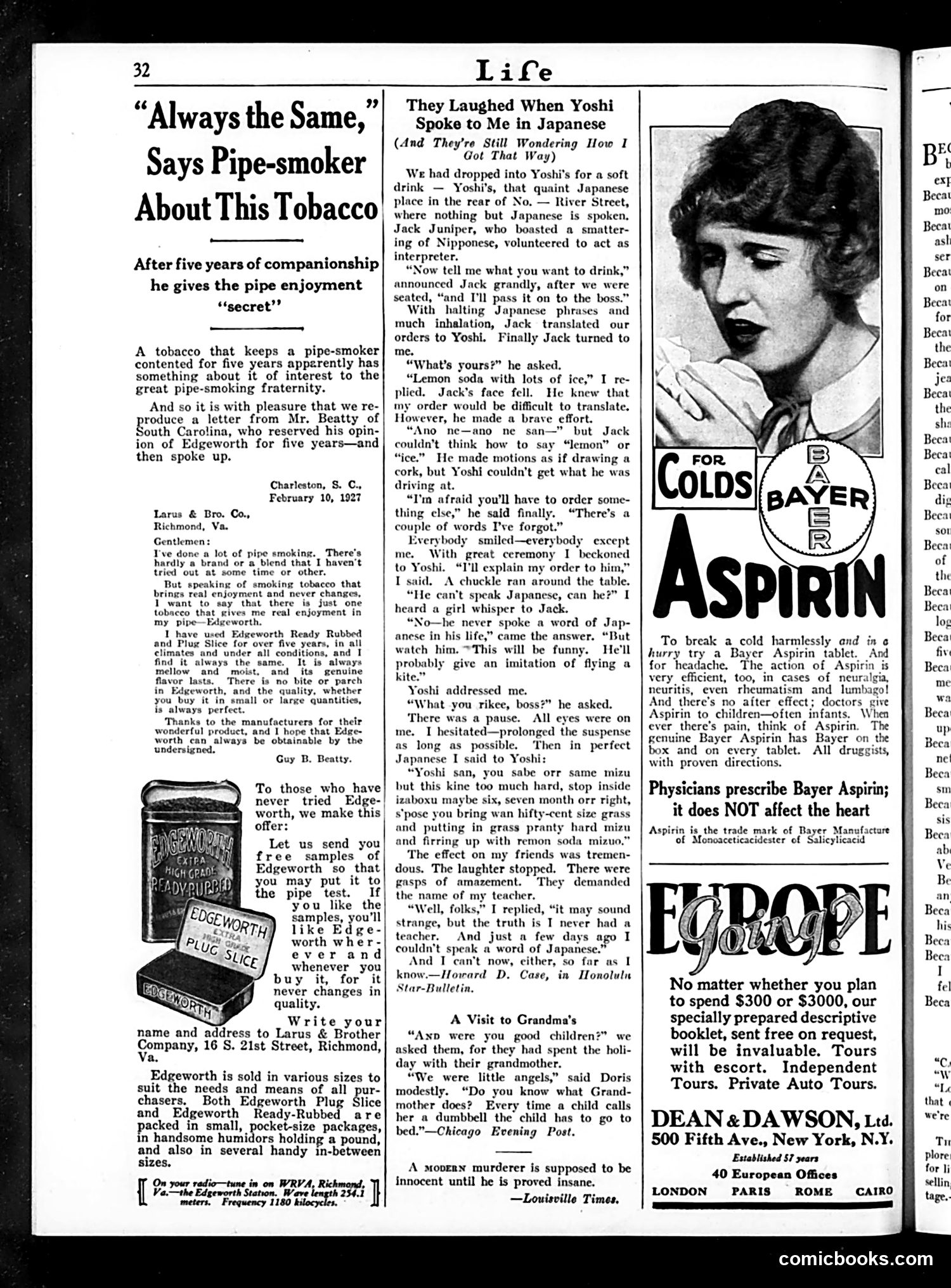
This page contains primarily **advertising** rather than satirical content. The dominant feature is a **testimonial advertisement for Edgeworth tobacco**, featuring a letter from a South Carolina pipe-smoker praising the product's consistency over five years. The "satire" is gentle corporate humor—playing on the pipe-smoking fraternity's exacting standards. Below is a humorous **anecdote titled "They Laughed When Yoshi Spoke to Me in Japanese."** The joke setup involves Jack Juniper attempting to order drinks at a Japanese restaurant using broken Japanese, failing comically. The narrator then steps in, presumably to demonstrate superior language ability—though the text cuts off before the punchline. This reflects 1920s casual stereotyping of Asian characters and broken English for comedic effect. The remaining advertisements include **Bayer Aspirin** and **Dean & Dawson** travel services. No political cartoons are present on this page.
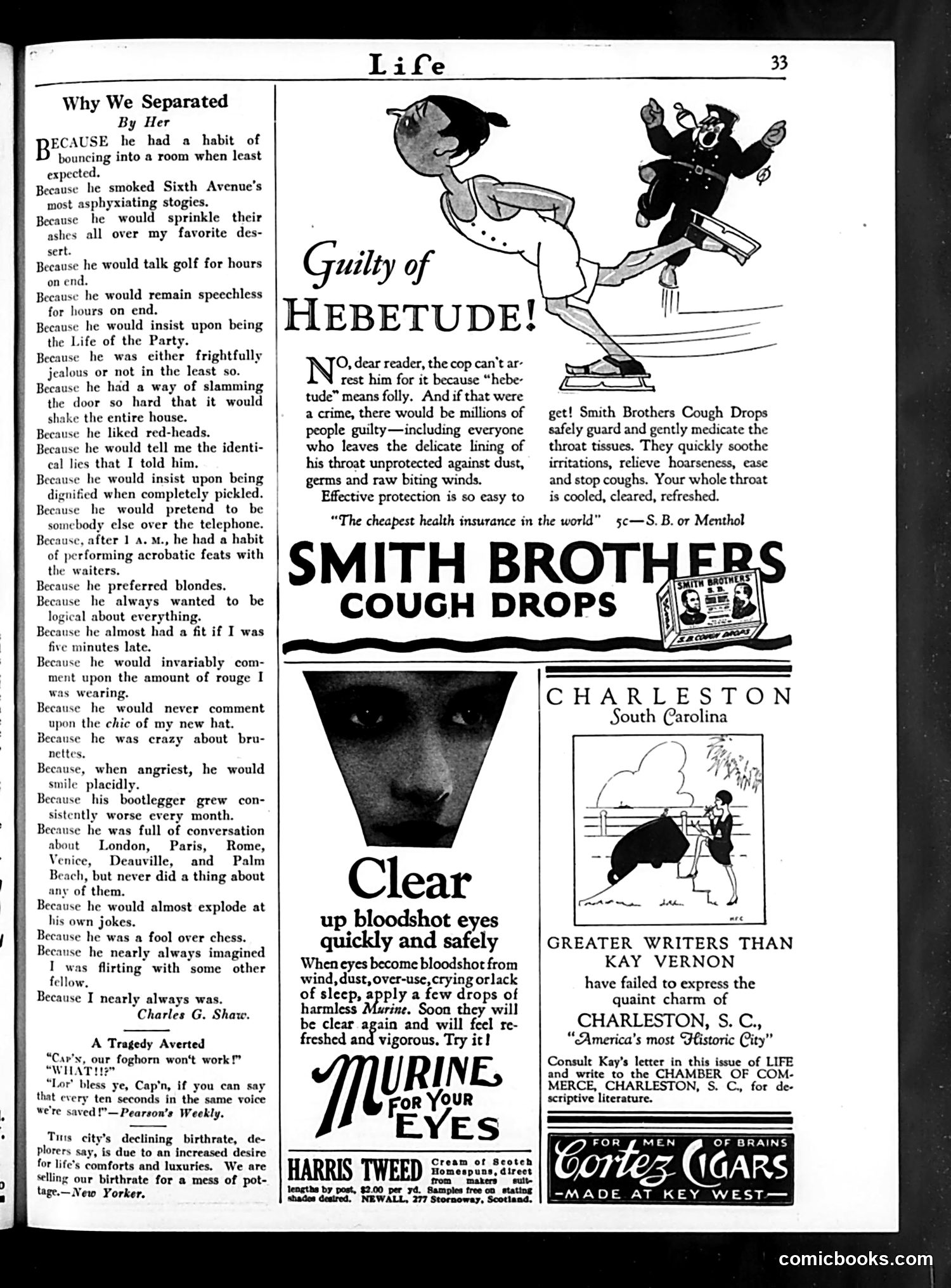
This page mixes humor and advertising typical of 1920s Life magazine. **"Why We Separated"** is a satirical essay by Charles G. Shaw presenting a wife's divorce grievances through contradictory complaints: her husband both talked golf for hours *and* remained speechless for hours; he was jealous and not jealous; he preferred blondes, brunettes, *and* redheads. The humor lies in the contradictions—suggesting marital incompatibility is often about personality clashes rather than genuine wrongs. The final line ("Because I nearly always was" flirting) reveals the narrator's own infidelity, adding ironic self-awareness. The other content is **period advertising** for Smith Brothers Cough Drops, Murine eye drops, Harris Tweed fabric, and Cortez cigars. A small item titled "A Tragedy Averted" jokes about a ship's foghorn—a self-contained humor bit unrelated to larger commentary. The Charleston, South Carolina tourism advertisement references "Kay Vernon," apparently a writer whose letter appeared elsewhere in that issue. The page reflects 1920s sensibilities: Jazz Age social satire, product-driven advertising culture, and light domestic humor.
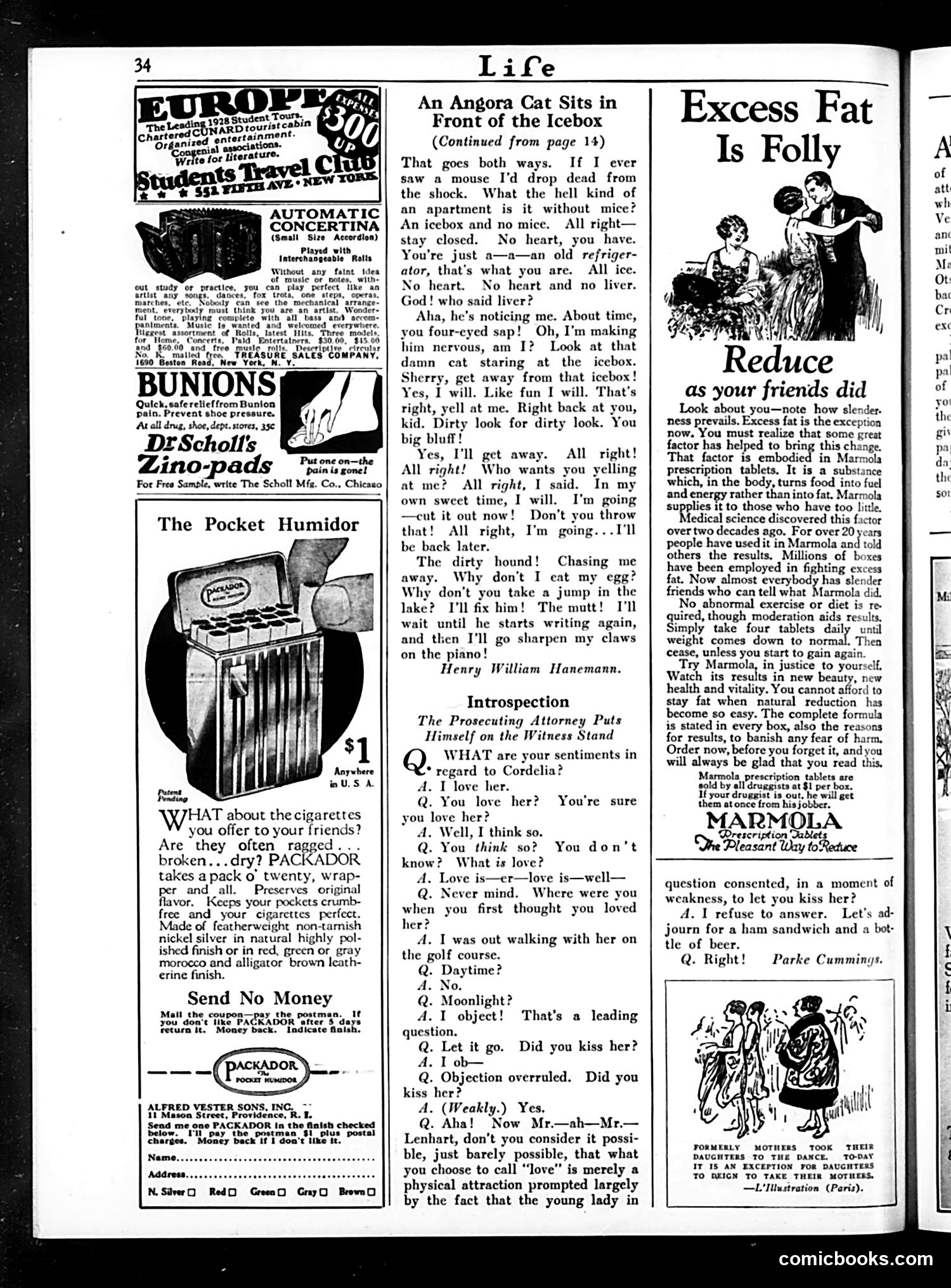
This page from Life magazine (circa 1928) contains two main pieces of satirical content: **"An Angora Cat Sits in Front of the Icebox"** is a humorous monologue depicting the internal thoughts of a cat and its owner during a domestic dispute over the refrigerator. The cat resents being told to leave and mentally threatens revenge (scratching the piano). The satire mocks the silent, petty grievances that arise in everyday household life—a relatable domestic conflict elevated to comedic absurdity through the cat's vindictive perspective. **"Introspection: The Prosecuting Attorney Puts Himself on the Witness Stand"** satirizes legal cross-examination techniques. A lawyer questions himself about his "love" for someone named Cordelia, and the prosecutor becomes increasingly skeptical, using leading questions to suggest the defendant's feelings are merely physical attraction rather than genuine love. The satire ridicules how legal maneuvering can deconstruct human emotion into doubt through clever questioning. The remainder consists of period advertisements (cigarette cases, bunion remedies, etc.) and a Marmola weight-loss product ad promising slenderness.
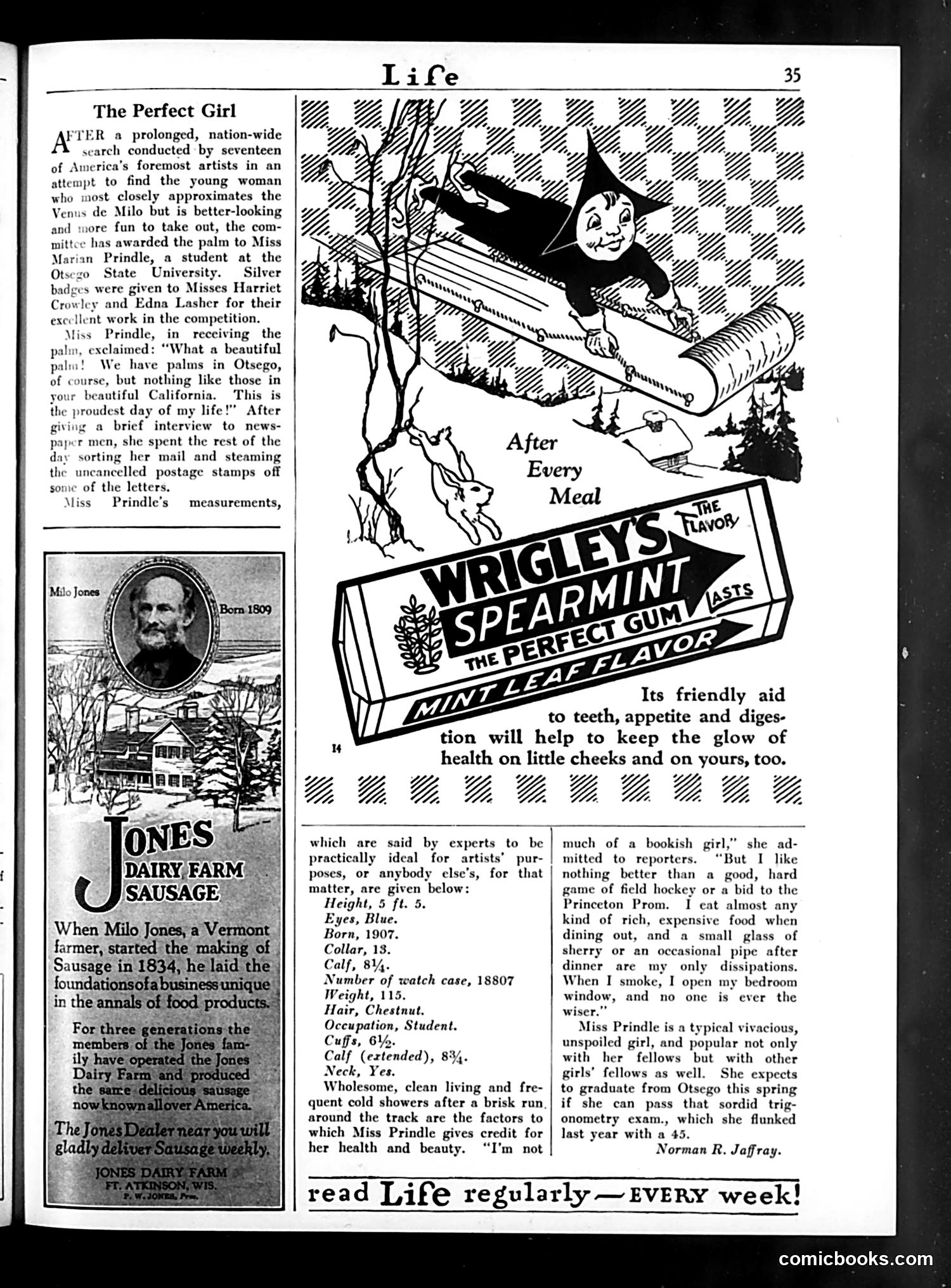
This page satirizes the 1920s cultural obsession with finding an idealized "perfect woman." Life magazine humorously reports that seventeen prominent artists conducted a nationwide search for a young woman resembling the Venus de Milo—but "better-looking and more fun to take out." The satire targets several things: the absurdity of reducing women to physical measurements (listed precisely: collar size 13, calf 8⅛%), the winner's vapid response about California palms, and her contradictory claims to be "not much of a bookish girl" while casually mentioning field hockey, Princeton proms, and sophisticated dining—revealing shallow materialism masked as wholesomeness. The joke emphasizes how she spends her day steaming stamps off fan mail, underscoring that her "perfection" is purely decorative. Her admission that she smokes and drinks, while pretending concern about propriety, mocks the era's hypocritical standards for women's respectability. The accompanying ads (sausage, chewing gum) reinforce the commercialization of femininity being criticized.
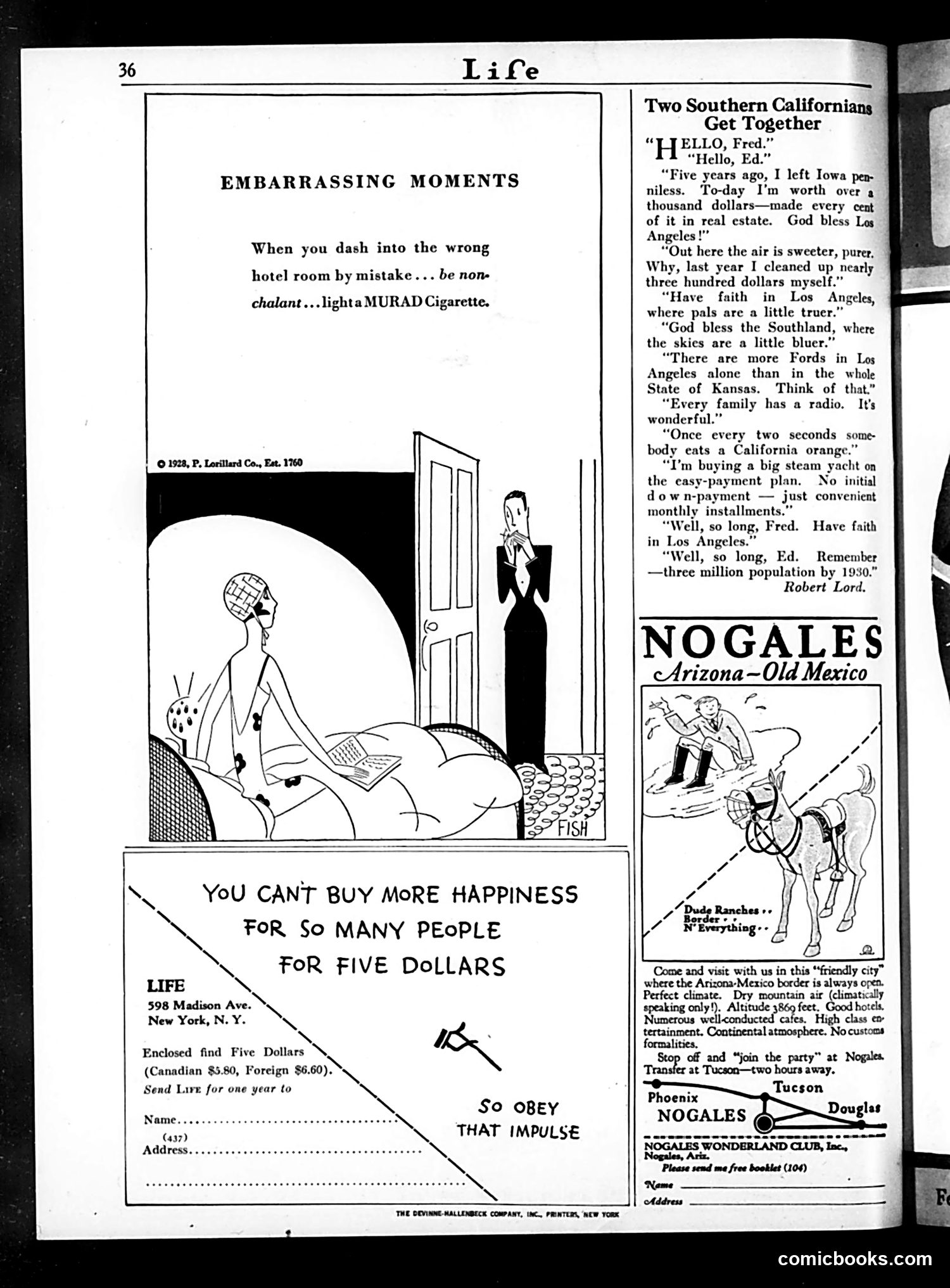
**The Main Cartoon ("Embarrassing Moments"):** depicts someone awkwardly entering the wrong hotel room while holding a lit Murad cigarette. The joke's premise—that lighting a cigarette makes one appear calm and sophisticated enough to brazen through embarrassment—relies on 1920s attitudes about cigarettes as markers of poise and nonchalance. **"Two Southern Californians Get Together":** satirizes the booster mentality of 1920s Los Angeles real-estate speculation. Two men compare their newfound wealth, each citing wildly optimistic claims: Fords everywhere, radios in every home, oranges consumed constantly, easy-payment yachts. The satire mocks both the exaggerated faith in LA's growth (predicting "three million by 1930") and the get-rich-quick schemes that defined the era's land boom. **The Nogales Advertisement:** promotes Arizona-Mexico border tourism, selling it as an exotic, consequence-free escape with Continental atmosphere and lax customs enforcement—reflecting period attitudes toward Mexico as a pleasure destination for Americans seeking relaxation outside legal/social constraints.